
XLUX Plant Soil Moisture Meter
4.4Editor score
Battery-free spot checking
Color-coded ten-level dial
Slim stainless steel probe
Digital Soil Moisture Meters guide comparing ten models for display quality, probe design, measurement features, durability, and ease of use for plant care.
Digital soil moisture meters help plant owners replace guesswork with consistent readings from the root zone. A useful model should provide clear results, a practical probe, understandable measurements, and enough durability for the places where it will be used. The right choice depends on whether you need a quick indoor check or continuous outdoor monitoring.
The products in this guide were compared using their stated measurement functions, display design, probe construction, monitoring capabilities, power requirements, environmental features, and intended applications. The list covers multifunction testers, leave-in sensors, wireless systems, professional handheld meters, and a battery-free option for simple spot checks.
Each review explains the feature that distinguishes the meter and identifies trade-offs that may affect particular plant collections. Ratings and specifications reflect the supplied product information, while availability and prices change over time. Readers should compare current listings, included accessories, and setup requirements before purchasing.
4.4Editor score

4.2Editor score

4.4Editor score
This side-by-side overview compares each meter's primary measurement style, display, probe design, monitoring capabilities, and outdoor suitability. It also distinguishes simple spot-check tools from leave-in sensors, multifunction garden testers, wireless monitors, and professional field instruments.




The YAMRON 4-in-1 combines moisture, pH, soil temperature, and light-level readings in a digital tester intended for indoor and outdoor plants. Its supplied rating is 4.2, and the most immediately useful feature is the backlit LCD, which presents numerical information more clearly than a traditional color dial. The display is designed to make the results understandable even to a new plant owner.
We may earn a commission when you buy through this link, at no additional cost to you.
Its multifunction design is particularly helpful when a plant looks unwell and moisture alone does not explain the problem. Checking temperature and light can provide useful context, while the pH reading helps users consider whether soil chemistry may be affecting plant performance. The rotating head can tilt through 45 degrees, allowing the screen to be viewed without repeatedly bending over or awkwardly positioning the device.
There are important operational limitations. Four AAA batteries are required but not included, and the probe should not be used directly to test liquids. The instructions also warn against forcing it into extremely dry, hard soil because the instrument may be damaged. For the best results, users should moisten a hard test area and take readings from at least five locations before averaging the moisture and pH values.
This is a strong choice for a houseplant collection or garden where one compact device can cover several common diagnostic questions. It is less appropriate for someone who wants automatic monitoring or a probe designed to remain buried permanently. Buyers should treat its readings as one part of plant care, combining them with visual signs, plant type, season, and watering habits rather than watering solely from one number.
Moisture, pH, temperature, and light measurements make this more informative than a single-purpose moisture tool. The combination can reveal several common reasons a plant may be struggling.
The large backlit screen and adjustable head improve everyday use. Readings remain visible in daylight and darkness while reducing the need to hunch directly over the soil.
We may earn a commission when you buy through this link, at no additional cost to you.
This digital soil tester provides seven measurement functions in one package, earning a supplied rating of 4.4. Its feature set extends beyond the usual moisture, pH, temperature, and light combination to include fertility, EC, and TDS measurements. That breadth gives it the strongest all-around measurement coverage in this group, although every reading still needs to be interpreted in the context of the plant and soil.
We may earn a commission when you buy through this link, at no additional cost to you.
The extra-large LCD uses a white backlight and clear numerical symbols, making the unit practical for both bright rooms and darker indoor plant areas. Its probe is intended to be inserted around 10 centimeters into soil, with a ten-second wait before reading. A low-battery warning helps prevent confusing incomplete readings with actual soil conditions, and the single-button presentation keeps navigation approachable.
This is not a leave-in sensor, so users should avoid treating it as a permanently installed monitor. It must not be placed directly into liquids, and hard or dry soil should be lightly moistened before insertion. The instructions recommend waiting after watering because excessive moisture near the probe may not accurately represent conditions elsewhere in the pot.
The kit is best suited to indoor growers, balcony gardens, and mixed plant collections that want more than a basic moisture reading. It offers particularly strong value for users interested in soil fertility or water-quality indicators, but the extra readings require thoughtful interpretation. Buyers who only need a quick moisture check may prefer a simpler model, while serious indoor gardeners may appreciate the broader diagnostics.
EC, TDS, fertility, pH, moisture, temperature, and light readings create a more complete view of growing conditions. This helps users ask better questions when a plant's growth changes unexpectedly.
Numerical results and recognizable icons reduce interpretation time. The backlit display is especially useful during evening watering routines or in dim indoor gardens.
We may earn a commission when you buy through this link, at no additional cost to you.
The RAINPOINT Large Display Meter takes a different approach from handheld testers by staying in the soil with its screen visible. Its supplied rating is 4.1, and the standout advantage is immediate access to moisture information while walking past a plant. A color-coded gauge offers a quick qualitative indication, while the digital display provides a more precise percentage for users who want specific readings.
We may earn a commission when you buy through this link, at no additional cost to you.
Automatic monitoring occurs every two hours, and a button allows manual checks at any time. Because the device remains installed, it avoids the repeated insertion and removal associated with portable probes. That approach may reduce disturbance around delicate roots and makes the meter convenient for busy plant-care routines in which regularly retrieving a separate tool would be inconvenient.
The body is exceptionally slim at 0.63 inches and weighs 1.1 ounces, making it easy to store in shallow drawers, compact tool totes, or a pocket. Its plant-friendly tag slot can hold care reminders or a propagation date, and the ribbed grip supports steady handling. The design is optimized for indoor houseplants rather than large-scale agricultural sampling.
This is a good match for owners who want a visible reminder to check moisture without repeatedly handling a probe. Its leave-in design may be less convenient for users who need to move among many outdoor beds or use one tool across multiple locations. It is best for a small indoor collection where a permanent display adds more value than portability.
Leaving the sensor in place supports regular checks and reduces soil disturbance. The always-visible screen also helps users notice changing moisture before it becomes a stressful routine omission.
Its slim, lightweight form fits neatly into compact plant-care areas. The low-tip design also improves stability in loose potting soil compared with a top-heavy instrument.
We may earn a commission when you buy through this link, at no additional cost to you.
The General Tools DSMM500 is a precision digital meter designed for professional, agricultural, and commercial soil-moisture work. It has a supplied rating of 4.2 and focuses on one measurement rather than combining several functions. Its zero-to-50 percent range, detailed accuracy specification, and eight-inch heavy-duty probe make it more specialized than a typical houseplant tester.
We may earn a commission when you buy through this link, at no additional cost to you.
Minimum and maximum memory are useful when a user wants to move the probe through an area and retain the extremes encountered. The data-hold function supports more controlled documentation, while the 0.8-second sampling time helps reduce waiting at multiple locations. Its IP65 water resistance offers protection in damp environments, and the stated CE and RoHS approvals add formal compliance information for professional buyers.
The instrument uses four AAA batteries, which are not included, and its focused measurement set does not cover pH, temperature, light, or fertility. It is therefore not the most convenient choice for diagnosing every aspect of plant health. However, those omissions are reasonable for a dedicated soil-moisture instrument intended to provide repeatable professional measurements rather than general-purpose garden data.
This is our editor's choice for users who need a rugged handheld meter and want professional features without an elaborate monitoring platform. It is well suited to agricultural work, landscaping, greenhouse spot checks, and research where a portable probe is more useful than a permanently installed sensor. Home users with many pots can also benefit from its reach and memory functions.
Minimum, maximum, and data-hold features make the DSMM500 useful for comparative field sampling. These functions help preserve useful readings while moving among zones or checking different depths.
The long probe, water resistance, and portable format suit outdoor and commercial use. Its dedicated focus also keeps operation straightforward for users who need dependable moisture data rather than a broad diagnostic dashboard.
We may earn a commission when you buy through this link, at no additional cost to you.
Although included in this digital-focused category because it offers an unusually practical alternative to electronic meters, the XLUX Plant Soil Moisture Meter is an analog, battery-free spot checker. Its supplied rating is 4.4. The defining feature is immediate operation: there are no batteries to install, no charging, and no digital menus to navigate before checking whether a plant needs water.
We may earn a commission when you buy through this link, at no additional cost to you.
The large color-coded dial presents ten distinct levels spanning dry, moist, and wet. This makes the result understandable at a glance and particularly accessible for beginners. A high-sensitivity needle reaches into the root zone, while the slim 304 stainless steel design displaces less soil than a bulky dual-probe meter and may reduce disturbance to sensitive roots.
Trade-offs are important. It is not a true digital meter, does not provide pH, temperature, or light readings, and cannot remain in the soil for continuous monitoring. The instructions specify that the probe should be inserted, read, and removed within five minutes, then wiped clean and stored in its protective sleeve. It also cannot be used directly to test liquids.
This is the best budget option for anyone who wants a dependable, low-friction way to check moisture across houseplants and garden beds. It is especially useful as a secondary tool beside a richer digital meter: the XLUX provides a quick, reliable visual check without consuming batteries, while a multifunction model can supply deeper diagnostic information when needed.
The battery-free design removes an entire category of friction. A user can pick up the meter, insert the probe, and interpret the color-coded dial immediately.
The single slender needle minimizes soil displacement compared with thicker dual-probe designs. Its portability also makes it easy to check different pots and beds without carrying batteries or accessories.
We may earn a commission when you buy through this link, at no additional cost to you.
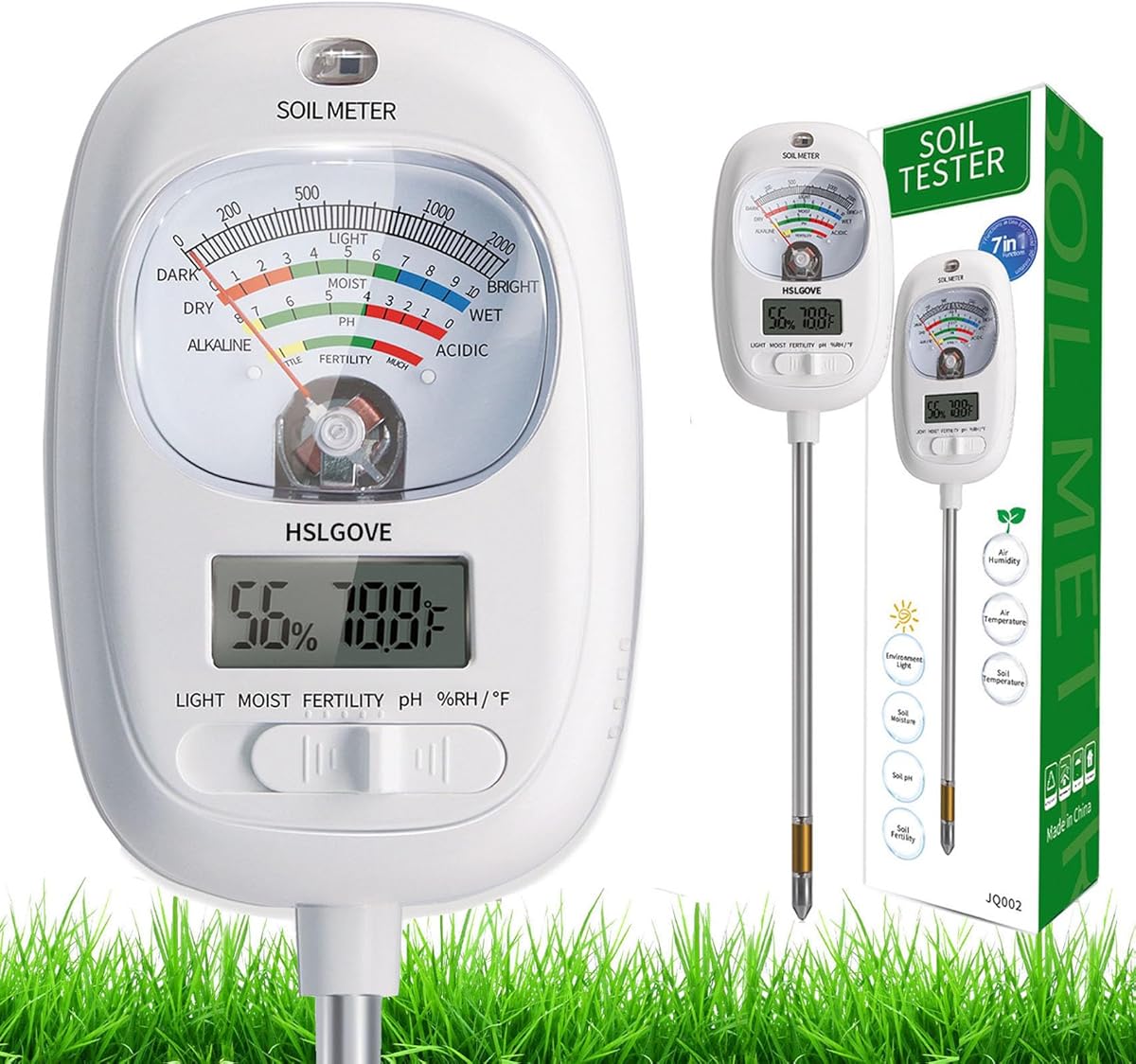
The HSLGOVE 7-in-One is a hybrid soil and environmental tester with a supplied rating of 4.4. Its origin dual-dial design combines a traditional color gauge with an LCD screen, offering quick visual moisture guidance alongside numerical information for soil temperature, air temperature, and humidity. The overall layout is aimed at users who want more plant-care data than a simple moisture reading.
We may earn a commission when you buy through this link, at no additional cost to you.
A single button switches among seven functions, including soil moisture, pH, fertility, temperature, light, air temperature, and humidity. The long probe is built from three metals and measures approximately 6.8 inches, making it suitable for medium to large pots. Its single-probe construction is also intended to reduce the amount of soil brought to the surface during a test.
Operation is less streamlined than the digital meters that report results after a short wait. The supplied guidance calls for replacing or installing three batteries each time and allows three to five minutes for readings. It is a soil tester rather than a water-moisture instrument and should not be placed directly into liquids. Users should insert the probe more than three inches for soil readings.
This kit is well suited to home gardens, lawns, farms, flowers, and vegetable beds where both root-zone and ambient conditions matter. It is especially useful for growers who appreciate a broad range of measurements in one body. People seeking automatic notifications or remote access should choose a connected system, while routine indoor users may find the multifunction display excessive.
Tracking air temperature and humidity alongside soil readings gives indoor growers a broader view of their growing environment. That context can help distinguish a watering issue from temperature-related stress.
The analog dial allows quick color interpretation, while the LCD supplies more precise values. One-button operation keeps the many functions accessible without a complicated menu system.
We may earn a commission when you buy through this link, at no additional cost to you.
The RAINPOINT Smart Digital Wireless Meter combines a leave-in sensor with app-based remote monitoring. Its supplied rating is 4.2, and the main distinction is connectivity: compatible RAINPOINT hub models let users review moisture readings through the RAINPOINT Home app instead of relying entirely on the meter beside the plant. The hub is sold separately and supports only the listed 2.4 GHz models.
We may earn a commission when you buy through this link, at no additional cost to you.
The sensor automatically checks soil moisture every three minutes and displays the current reading on its LCD at all times. A manual button check returns a result within seconds. Its capacitive probe is an important technical choice because capacitive sensing is described as less prone to rust-related accuracy loss than traditional resistive probes.
IPX5 protection helps the sensor tolerate rain, watering splashes, and humid growing areas, making it usable both indoors and outdoors. It should not be submerged or used as a liquid tester. Remote monitoring requires extra equipment and setup, while the local display remains useful if the phone or hub is unavailable. Users must also consider whether the sensor's placement allows reliable wireless communication.
This model is ideal for travelers, busy plant owners, or anyone who wants alerts and history through an app. It is a better fit for a small number of monitored plants than a multi-zone receiver system. Buyers should confirm hub compatibility, WiFi band support, and the desired monitoring workflow before considering the additional ecosystem cost.
Three-minute automatic detection keeps readings current while the display remains available at the plant. The app extends that visibility to locations where users cannot inspect the soil directly.
The capacitive probe is designed to resist corrosion-related degradation. That makes it a practical choice for long-term use in moist indoor pots and weather-exposed outdoor containers.
We may earn a commission when you buy through this link, at no additional cost to you.
The EVO10 is built for long-term installation rather than occasional spot checks. Its supplied rating is 4.2, and its most significant feature is trend recording: the meter can retain soil-moisture history for up to six months, allowing users to study drying speed, post-watering recovery, and periods of excessive wetness instead of viewing only isolated readings.
We may earn a commission when you buy through this link, at no additional cost to you.
Two separated stainless steel probes sample a wider root-zone area than a single-point meter. That arrangement should produce more stable results when soil moisture varies across a pot or bed. The device also tracks root-zone temperature and Daily Light Integral, classifying the growing location as Full Sun, Partial Sun, Partial Shade, or Shade. This is more informative than a momentary light level.
Bluetooth setup is required initially, but the meter can then record independently without a constant phone, WiFi, or internet connection. Temperature compensation is used to reduce temperature-related moisture drift. One AA battery is stated to provide more than six months of typical use. The corrosion-resistant construction and rain-resistant housing support indoor or outdoor placement, although the unit must not be submerged.
This is an excellent choice for plant keepers who want to understand watering cycles and seasonal changes. It suits containers, raised beds, and garden locations where long-term pattern data is more valuable than a quick percentage. It is less convenient for moving between locations, and users who do not review stored trends may not benefit fully from its advanced recording features.
Six months of stored information shows how quickly a root zone dries and how long it stays wet. That history can make watering schedules more responsive to actual conditions.
Daily Light Integral considers the light received across an entire day rather than one instant. Its four exposure categories make the result easier to relate to plant placement decisions.
We may earn a commission when you buy through this link, at no additional cost to you.
The Extech MO750 is a rugged digital soil-moisture meter with a supplied rating of 4.4. Its core appeal is straightforward field capability: a durable eight-inch stainless steel probe reaches beneath the surface, while a large LCD provides quick, legible results. The device is positioned for home gardeners, landscapers, farmers, greenhouse managers, and environmental researchers.
We may earn a commission when you buy through this link, at no additional cost to you.
The long probe allows readings deeper in the soil than a compact indoor meter, and the stainless steel construction is well suited to repeated field handling. A lightweight handheld body makes the instrument easier to carry between locations. Standard AAA batteries support familiar power replacement, and the large display avoids the inconvenience of interpreting a tiny analog scale.
The MO750 is a dedicated moisture meter rather than a multifunction diagnostic instrument. It does not offer the automatic history, wireless alerts, sunlight categories, or soil-temperature tracking found in specialized monitoring systems. That simplicity is an advantage for users who want a dependable instrument without setup requirements, but it limits the kind of analysis available after a reading.
This is the premium pick for users who value a robust, professional-style field instrument. It is especially compelling for agriculture, forestry, environmental studies, soil research, and greenhouse work where a deep, durable probe is valuable. Indoor houseplant owners who only need a quick root-zone check can find more specialized features in a connected or leave-in meter.
The eight-inch stainless steel probe reaches into the root zone and tolerates regular field use. Its length is particularly useful when surface conditions do not represent moisture deeper in the profile.
The large digital display makes values easy to inspect in a garden, greenhouse, or field setting. Its portable form and familiar battery power support use across multiple locations.
We may earn a commission when you buy through this link, at no additional cost to you.
The Nexuslab Wireless Soil Moisture Meter is designed to monitor several garden areas from one central receiver. Its supplied rating is 4.2, and the system includes two sensors that can be expanded to as many as 12 zones. Each sensor measures moisture, soil temperature, and light, while the receiver provides a combined indoor view of the growing area.
We may earn a commission when you buy through this link, at no additional cost to you.
The sensors use Time Domain Reflectometry, or TDR, with stainless steel triple probes. The stated technology is designed to deliver stable readings with less interference from soil salinity and composition than simpler sensing methods. A radio range of up to 230 feet in an open area allows the receiver to remain indoors while sensors sit in raised beds, rows, lawns, or larger pots.
The LCD receiver highlights each zone as High, Normal, or Low and can flash an alert when moisture falls below a custom threshold, with 10 percent listed as the default. The sensors have IPX5 waterproof protection for rain, sprinklers, and dew. They are designed for soil only and are not suitable for liquids or loose media such as pure perlite, coco coir, or gravel.
This is the strongest option for a user who wants centralized monitoring across a substantial garden. Wall, foliage, and structural obstacles may reduce the stated wireless range, so placement matters. All included batteries are provided, and the listed runtime is eight to twelve months with a low-battery alert. For a few indoor pots, a single leave-in meter is simpler and less elaborate.
The expandable system lets users watch separate beds, rows, or pots from a single receiver. Status labels and flashing dry-zone alerts make attention-grabbing conditions easier to identify.
TDR sensing and stainless steel triple probes are designed for consistency in varied soil compositions. Users should still test placement in each zone and avoid substrates explicitly excluded by the manufacturer.
We may earn a commission when you buy through this link, at no additional cost to you.
The right digital soil moisture meter depends on how often you check plants, how many locations you monitor, and whether you need only moisture readings or a broader set of environmental measurements.
Match the scope to your routine rather than to the longest feature list.
Choose a handheld model for flexibility or a leave-in model for continuity.
Select a probe that fits the pot, bed depth, and root system without damaging roots.
Choose a display you can read quickly without leaning close to the soil.
Confirm hub compatibility, app requirements, and real-world signal range before purchase.
Check the environmental rating and never treat a soil sensor as a liquid instrument.
Balance convenience against the effort of maintaining power and cleaning probes.
Compare documented specifications, but verify consistency through repeated local readings.
Before taking a reading, identify the main root zone and check the meter at a consistent depth and position. For compact indoor meters, follow the stated insertion guidance, which is commonly around 10 centimeters or roughly four inches. For longer field probes, insert to a depth appropriate for the crop and target zone. Avoid areas occupied by drainage holes, loose surface mulch, fertilizer granules, or unusually dry pockets that do not represent the rest of the root zone.
Insert the probe carefully without forcing it. Several products warn that hard, dry soil can damage a probe, so lightly moisten the testing area first and allow time for water to distribute when necessary. Wait for the stated stabilization period, record the result, and repeat at several locations for a more representative average. Do not use a soil meter directly in liquids, standing water, or loose media that cannot support the probe.
After use, clean and dry the probe as directed, remove replaceable batteries from long-unused electronic meters, and store the instrument in a protected location. Do not submerge sensors, even when their housing carries a water-resistance rating. For leave-in devices, periodically confirm that readings still track the plant's condition and that the display, app, hub, or receiver remains responsive.
The best type depends on your routine. A handheld multifunction meter is useful for occasional checks and broader diagnostics, while a slim leave-in model is convenient when you want a visible reading without repeatedly inserting a probe. For many indoor plants, consistency and easy interpretation matter more than a long list of advanced features.
No. The products in this guide are designed to measure conditions in soil, not the moisture content of liquid samples. Their instructions specifically warn against direct liquid testing because the probes and sensing systems are not intended for that use. Always follow the manufacturer's operating and maintenance instructions.
Yes, especially when soil moisture is uneven. Water may pool on one side, dry quickly near a wall, or remain wet near the bottom. Taking readings from multiple root-zone locations and comparing the results gives a more representative picture. Some meters also recommend averaging several pH and moisture readings.
Choose a leave-in meter if consistent monitoring, minimal root disturbance, and historical trends are your priorities. Choose a portable probe if you need to move between many pots or outdoor beds, conduct spot checks, or want one inexpensive tool without a permanent display. Connected systems are useful when remote alerts are worth the added setup.
No. A broad meter can reveal useful context, but every additional reading requires correct interpretation. If your primary goal is deciding when to water, a reliable moisture measurement may be sufficient. Multimeter and connected models are most valuable for growers who also need pH, light, temperature, fertility, or trend data.
Only models specifically designed for leave-in outdoor monitoring should be considered for that use. Look for corrosion-resistant probes, a water-resistant housing, suitable temperature performance, and stable placement. Even water-resistant devices should not be submerged, and wireless range can be affected by walls, structures, and vegetation.
Water distribution takes time, and the probe may initially sit in a wet pocket or a comparatively dry area. Allow the soil to settle and take additional readings at different locations. Repeated observations under similar conditions are more useful than comparing one immediate post-watering number with a much later reading.
Check as often as your plants and environment require, which may mean daily for small indoor pots or less frequently for deep-rooted outdoor plants. Factors such as temperature, humidity, pot size, soil composition, and root development all affect drying rates. Leave-in or connected meters can make frequent checks more convenient.
The YAMRON 4-in-1 is a versatile choice for users who want moisture, pH, temperature, and light information in a backlit display. The 7-in-1 Digital Soil Tester goes further with fertility, EC, and TDS, while the RAINPOINT Large Display and Smart Wireless models prioritize continuous or connected monitoring. The General Tools DSMM500 and Extech MO750 serve users who prefer dedicated, professional-style spot-checking instruments.
Prioritize the operating pattern that matches your plants. Choose a slim leave-in sensor for a visible indoor reading, a multiprobe connected receiver for multiple outdoor zones, or a long handheld probe for deeper field sampling. Display clarity, probe construction, environmental ratings, and included accessories are just as important as the number of measurements printed on the box.
Before buying, verify the current listing details, included components, battery requirements, and compatibility requirements. Prices, ratings, availability, and manufacturer information can change, so comparing the latest product pages is essential. Use any meter as informed support alongside careful observation rather than treating a single reading as an automatic watering command.