
JALL Full-Screen Wake Up Light
4.3Editor score
Ten-to-60-minute sunrise simulation
Dual alarms and snooze controls
Twenty-five sounds and FM radio
Explore the best sunrise alarm clock options, comparing wake-up lights, sound machines, displays, connectivity, and features for better mornings.
A sunrise alarm clock is designed to make waking up feel less abrupt by gradually brightening a bedside light before the alarm sounds. The best models combine convincing light progression with readable controls, useful alarm options, soothing audio, and night-friendly displays, making them especially appealing to heavy sleepers and light-sensitive users.
We compared all ten products using their supplied specifications, focusing on sunrise duration, brightness control, alarm flexibility, sound libraries, radio or Bluetooth functions, display darkness, setup requirements, and bedside usefulness. The guide covers everything from straightforward full-screen wake-up lights to feature-rich units that combine a clock, sound machine, night light, speaker, and charging hub.
Each pick highlights a different reason to consider a sunrise alarm, including strong all-around performance, budget-friendly value, premium sleep-and-wind-down features, compact bedside design, or easy physical controls. Product features and availability can change, so readers should confirm current specifications, accessories, and prices before purchasing.
4.3Editor score
4.5Editor score

4.3Editor score
The comparison below organizes each sunrise alarm clock by its most important practical attributes: wake-up simulation, sound options, alarm control, display treatment, and connected features. It makes it easier to identify a model suited to a particular bedside, sleep schedule, or preference for physical controls.


The Odokee Sunrise Alarm Clock White Noise Machine combines a wake-up light, sound machine, night light, digital clock, and Bluetooth speaker in one bedside unit. Its 4.5 rating reflects a strong balance of features, and the most impressive element is the sunrise period, which can be adjusted from five to 60 minutes. That flexibility allows a fast sunrise for restless mornings or a gradual, gentler transition for heavy sleepers.
We may earn a commission when you buy through this link, at no additional cost to you.
The sound library is unusually useful for a bedside device, with 25 choices spanning white, pink, brown, and blue noise plus waves, rain, and other natural recordings. A sleep timer supports winding down, while the 5W stereo speaker can stream music, podcasts, or audiobooks over Bluetooth. The display dims across its entire range, and the night light offers 12 colors, including a sunset-style setting. Most importantly, users can choose sunrise light plus sound, sound alone, or sunrise light without sound.
Physical labeled buttons and dials make the Odokee approachable. There is no need to create an account, connect to a Wi-Fi network, or depend on an app, which can be a significant advantage for people who prefer reliable bedside hardware over app-based controls. The lack of a listed FM radio and the single-alarm setup mean it is less accommodating for two people on different schedules than some competing models. Nevertheless, its core morning functions are broad and clearly presented.
This is the strongest all-around choice for a reader who wants a versatile sunrise alarm, a capable sound machine, and flexible morning lighting without navigating complicated software. It is particularly well suited to one person who uses audio as part of a bedtime routine and wants Bluetooth playback. For households requiring separate weekday and weekend alarms, one of the dual-alarm JALL models may be a better fit.
The adjustable five-to-60-minute ramp is the Odokee's defining advantage. A longer simulation gives the wake-up light more time to brighten gradually, while a shorter ramp is useful when there is little time between waking and leaving for work or school.
With 25 sounds, three alarm modes, a full-range dimmer, a multicolor night light, and Bluetooth audio, the unit can function as a complete bedside sound and light hub. That versatility gives it value beyond the few minutes immediately around the alarm.
We may earn a commission when you buy through this link, at no additional cost to you.
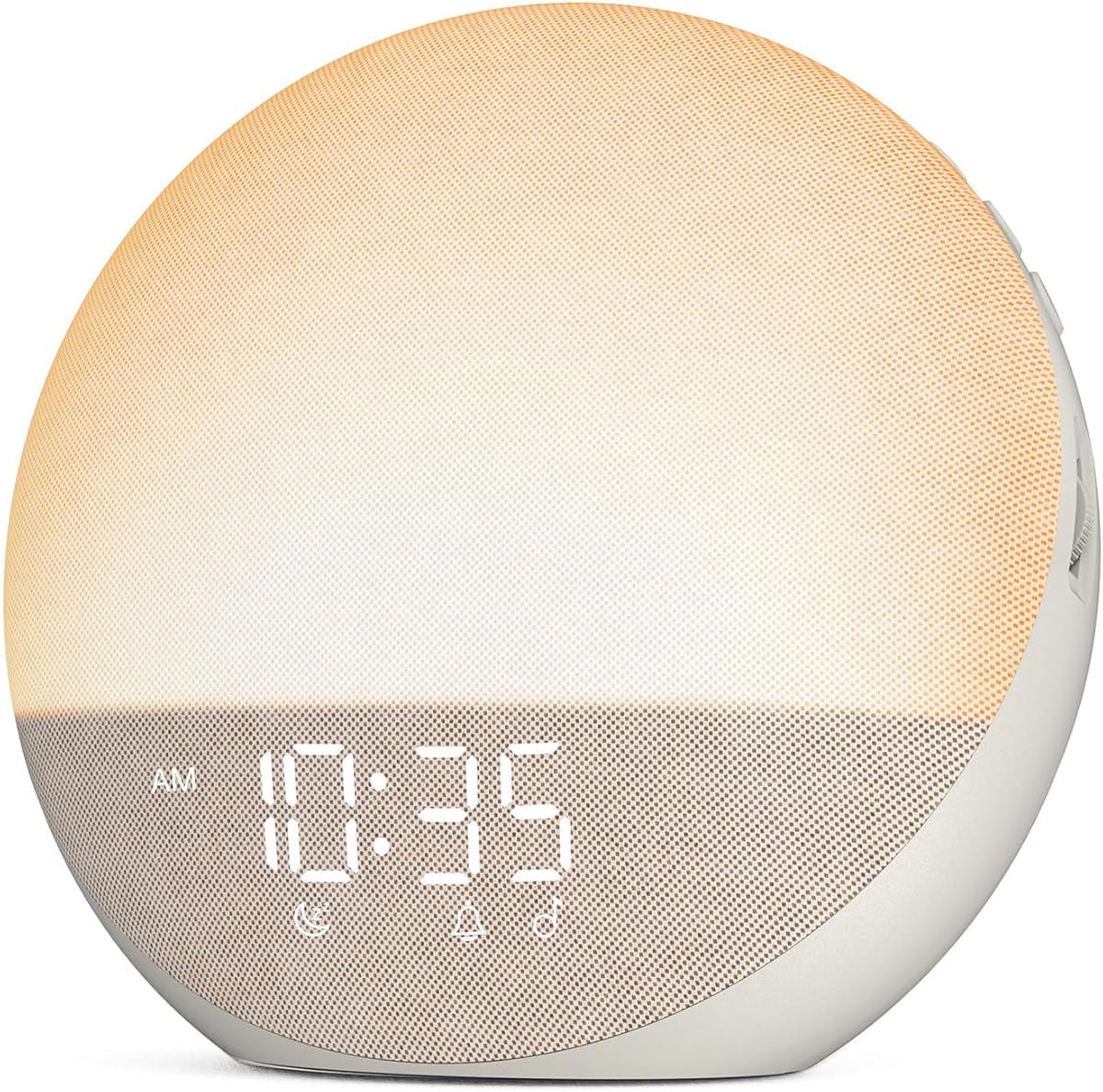
The JALL Full-Screen Wake Up Light delivers a broad range of bedside functions without moving into the premium category. Its 4.3 rating reflects a capable package centered on a full-screen sunrise simulation, 25 natural sounds and white noises, dual alarms, a 5W Bluetooth speaker, and an FM radio. The light can progress from darkness to full brightness over a user-selected 10-to-60-minute period.
We may earn a commission when you buy through this link, at no additional cost to you.
The front-facing light panel is the main reason to consider this model for heavy sleepers. Rather than relying on one small lamp, it aims to fill more of the bedside viewing area with gradually increasing light. Its wake-up system supports separate everyday, weekday, or weekend routines, along with a configurable five-to-20-minute snooze. Bluetooth time synchronization is a useful convenience, reducing the need to adjust the clock repeatedly.
The sound and sleep features are also thorough. Users can select from 25 natural sounds and white noises, set a timer from 10 to 480 minutes, and choose an FM station as an alarm tone using the built-in auto-scan. Seventeen lighting effects add color, while L0 blackout mode removes the visible clock face. The main compromises are the absence of a listed sunset feature and a control panel that may take a little time to master, although the buttons are described as straightforward.
For a buyer seeking many core features at a budget-friendly level, this JALL is difficult to overlook. It is a particularly strong choice for couples or light sleepers who need different alarm schedules and for anyone who appreciates radio listening at bedtime. Its full-screen construction and dark-display mode also make it more adaptable than a basic sunrise lamp.
The large front panel is designed to spread light more effectively than a conventional bedside lamp. A gradual 10-to-60-minute ramp gives heavy sleepers a wider window in which to begin waking before the alarm reaches maximum intensity.
Dual alarms can be assigned to separate everyday, weekday, and weekend routines. A configurable snooze, phone time synchronization, and a long sleep timer make the unit practical for shared bedrooms and changing household schedules.
We may earn a commission when you buy through this link, at no additional cost to you.
The Philips SmartSleep Wake-up Light HF3520/60 focuses on a polished sleep-and-wake routine rather than maximizing the number of connected features. It carries a 4.3 rating and adds colored sunrise and sunset simulations, five natural wake-up sounds, an FM radio, tap snooze, an automatically dimming display, and a reading lamp. The result is a focused bedside device built around light-based routines.
We may earn a commission when you buy through this link, at no additional cost to you.
The sunset feature is particularly valuable because it allows the clock to support a wind-down period as well as the morning. Colored sunrise and sunset effects make the routine more engaging than a simple brightness ramp, while the display automatically dims to remain unobtrusive overnight. Tap snooze offers a convenient way to silence the alarm without hunting for a small button in a dim room.
Its sound library is smaller than those offered by many modern JALL, Odokee, Vivilumens, and KEPLUG units, and the supplied information does not list Bluetooth connectivity or a built-in rechargeable phone dock. However, the FM radio adds an audio option without requiring a phone, and the 20-setting reading lamp makes the clock more useful during both morning and nighttime reading. Philips also describes its wake-up lights as clinically proven and recommended by physicians and pharmacists for establishing healthy sleep and wake routines.
This model is best for someone who values a coherent bedtime-to-morning routine, straightforward physical interaction, and a dedicated reading lamp. It is also a logical premium option for buyers who recognize the Philips sleep-light name. Those wanting a large sound library, Bluetooth audio, or a phone charging dock should examine the other premium models in this comparison.
The simulated sunset gives the clock a role before bedtime rather than limiting it to morning use. Pairing that wind-down with a sunrise, natural sounds, and the auto-dimming display creates a more consistent lighting schedule throughout the night.
Twenty brightness settings turn the unit into a practical reading lamp. Tap snooze and the FM radio further extend its usefulness, making it a more traditional bedside fixture than an app-dependent smart device.
We may earn a commission when you buy through this link, at no additional cost to you.
The JALL Sunrise Alarm Clock White Noise Machine with Bluetooth in Beige Linen has a 4.4 rating and stands out for combining a relatively compact 7-by-7-by-3.6-inch design with an extensive bedside feature set. Its central attraction is a large, approximately 400-lux full-front sunrise panel that can brighten over anywhere from zero to 60 minutes.
We may earn a commission when you buy through this link, at no additional cost to you.
The display treatment is excellent for light-sensitive sleepers. Five display levels include L0, which turns the clock face completely off rather than leaving a faint glow. The sound machine, timer, and night light can continue while the screen remains dark. Separately, the wake-up light offers 20 brightness levels, allowing the user to tune the sunrise independently from the clock numerals.
The 25 calming sounds include white, pink, and brown noise, rain, ocean waves, wind, birds, campfire, and soft melodies. Adjustable timers run from 10 minutes to eight hours. A Bluetooth speaker, rear USB charging port, one daily alarm, seven wake sounds, and 16 volume levels complete the package. Built-in memory preserves alarm, sound, and brightness choices, while a one-time Bluetooth connection permits automatic phone time synchronization.
This is a strong recommendation for a small nightstand or for anyone who wants a genuinely dark screen without giving up background sound. The single daily alarm is the principal limitation for couples or variable work schedules. Even so, the combination of compact dimensions, high output, automatic synchronization, and power-outage memory makes it one of the most thoughtfully specified models here.
L0 is more useful than ordinary dimming because it removes the visible clock face altogether. This allows the sound machine, timer, and night light to remain active in a room that appears completely dark to a light-sensitive sleeper.
The small footprint does not require sacrificing the main wake-up function. An approximately 400-lux full-screen panel, 20 light levels, a 0-to-60-minute sunrise, Bluetooth audio, and a charging port create a capable hub in a relatively small enclosure.
We may earn a commission when you buy through this link, at no additional cost to you.
The JALL Sunrise Alarm Clock with 25 Nature Sleep Sounds has a 4.5 rating, making it one of the highest-rated products in the guide. It combines a full-screen sunrise simulation, a broad sound library, a fully dimmable digital clock, 17 ambient light modes, and Bluetooth audio. The result is a capable general-purpose bedside device for readers who want many functions without a complicated setup.
We may earn a commission when you buy through this link, at no additional cost to you.
The sunrise panel brightens from 10% to 100% over a 10-to-60-minute period. That schedule gives heavy sleepers and shift workers a meaningful transition before the alarm sounds. The 25 audio options divide into 10 noise-masking choices and 15 nature tracks, and 16 volume levels make it possible to create a relatively low background bed of sound. The matte finish is intended to reduce glare around the light panel.
Beyond the wake-up function, eight solid colors and nine RGB gradients allow the unit to serve as a nursery light, sensory lamp, or decorative bedroom feature. Music-responsive lighting pulses can accompany streamed audio through the Bluetooth speaker. A 5V 1A USB charging port and included power adapter add convenience, while the memory function preserves sound and time settings following an outage. The absence of documented dual alarms keeps it simpler than some full-featured competitors.
This JALL is a good match for someone who wants a dark-display clock, a strong sound library, colorful ambient lighting, and a reliable alarm in one unit. It is also suitable for a nursery or child's room, provided the household is comfortable with the range of light effects. For shared sleeping spaces with different schedules, however, a dual-alarm model would offer a more suitable alarm structure.
The split between 10 masking sounds and 15 nature tracks gives users a useful choice between steady acoustic coverage and more environmental audio. Sixteen volume levels help the sound remain present without overwhelming the room.
Seventeen ambient modes turn the clock into a visual centerpiece for nurseries, meditation spaces, or evening rooms. Music-pulse behavior adds a synchronized element when music is streamed from a phone.
We may earn a commission when you buy through this link, at no additional cost to you.
The Vivilumens Sunrise Alarm Clock with Sound Machine has a 4.3 rating and emphasizes straightforward morning and bedtime routines in a compact bedside format. Its sunrise simulation begins ten minutes before the alarm, gradually replacing a harsh sound-only wake-up with increasing light. The overall feature set is practical rather than expansive, with dual alarms, ten soothing sounds, adjustable display brightness, and several timer choices.
We may earn a commission when you buy through this link, at no additional cost to you.
Two separate alarms can accommodate different routines, and the display supports both 12-hour and 24-hour formats. The sound machine includes 30-, 60-, and 90-minute sleep timers, while a breathing-light function adds a calming visual pattern for relaxation. Alarm volume can be adjusted through 12 levels, and a nine-minute power nap function offers added flexibility during the day.
A built-in USB charging port adds everyday convenience, though the product information does not mention Bluetooth audio, an FM radio, or a long hourly timer. The sound library is also smaller than the 25- and 30-sound options offered by several JALL and KEPLUG models. The fixed ten-minute sunrise is less customizable, so a buyer who wants a longer or shorter light ramp should look elsewhere.
The Vivilumens is most appropriate for someone who values dual alarms, a dark bedside, and a simple physical interface. It also works well for couples with different wake times or for people who want a short but noticeable sunrise without configuring multiple sound profiles. Its restrained feature set makes it easier to understand, though less flexible than the most extensively equipped models.
The dual-alarm setup is the model’s most valuable feature for couples or split schedules. Twelve- and 24-hour formats, snooze, adjustable volume, and a nap timer cover the most common bedside time-management needs.
The ten-minute light ramp is brief compared with the longer options from other models. That makes it a practical choice for buyers who want a straightforward visual wake-up without a lengthy pre-alarm sequence.
We may earn a commission when you buy through this link, at no additional cost to you.
The JALL Full-Screen Wake Up Light Sunrise Alarm Clocks for Bedrooms shares a broad feature profile with another JALL model in the guide. It has a 4.3 rating, a 10-to-60-minute full-screen sunrise, two alarm schedules, 25 natural sounds and white noises, an FM radio, 17 lighting effects, and a 5W Bluetooth speaker. It is a well-equipped option for readers who want visual, audio, and radio functions in one device.
We may earn a commission when you buy through this link, at no additional cost to you.
The front panel is designed to provide wider light coverage than a conventional compact lamp. The user can choose a 10-to-60-minute ramp, while L0 screen blackout mode removes the clock display. Separate everyday, weekday, and weekend schedules support households with changing routines, and the snooze can be set from five to 20 minutes. Bluetooth synchronization handles the time automatically after connection.
Audio is especially versatile because the FM radio can be used for background listening and as an alarm tone. The 76-to-108 MHz tuner includes auto-scan, while the Bluetooth speaker supports phone music. Eight solid colors and nine dynamic RGB effects add a substantial ambient-lighting component, including a rhythm mode that flashes to music. The 10-to-480-minute sleep timer offers broad control over nighttime audio.
The product is best for buyers who want the full-screen wake-up effect and regularly use radio or streamed audio. It is less compelling for someone wanting a simple device, since the number of options can create a steeper learning curve. The lack of a listed sunset simulation also separates it from the Philips models. Even so, it delivers a strong combination of alarm scheduling, dark sleeping, and flexible entertainment.
A built-in FM tuner adds value beyond a conventional alarm. It can provide background sound in the evening and serve as a personalized alarm source, with automatic station scanning simplifying setup.
Seventeen effects go beyond the sunrise itself, including solid colors, RGB gradients, and a music-responsive mode. These options are useful for ambient lighting while also making the unit more engaging as a bedside feature.
We may earn a commission when you buy through this link, at no additional cost to you.
The KEPLUG Sunrise Alarm Clock Sound Machine with Dual Alarm has a 4.4 rating and distinguishes itself through a broad 30-sound library and a sunrise ramp adjustable from zero to 60 minutes. It is designed for heavy sleepers and households that need flexible timing, with dual alarms, 20 dimmable light levels, eight RGB night-light colors, and several preset sleep timers.
We may earn a commission when you buy through this link, at no additional cost to you.
The sunrise range gives users considerable control over the transition into the day. A zero-minute setting allows the light to begin at the alarm itself, while a full hour creates a long, gradual brightening period. Thirty sound choices range from soft melodies to white noise, and the timer can be set to 15, 30, 60, 90, 120, or 180 minutes, allowing both short naps and longer bedtime use.
The light can be completely dimmed, and its RGB night-light mode adds color for reading, relaxation, or nursery use. Intuitive controls are designed to make the unit approachable for a wide age range. It is powered by USB through an included wall plug or a laptop, while two AAA batteries preserve time settings during a power interruption. Those backup batteries are not included, and the clock itself does not run normally without power.
This KEPLUG is an excellent choice for someone who prioritizes sound variety and a highly adjustable sunrise. It also serves shared bedrooms well because of its dual alarms. The main practical consideration is the need for a reliable outlet, since battery operation is limited to preserving settings. Buyers who need a phone-charging port or Bluetooth audio should look at the JALL and Philips alternatives.
Thirty sounds provide more variety than most competing models. The mixture of melodies, natural recordings, and white noise supports different preferences, while six preset timer lengths make the sound machine useful for both naps and full-night routines.
A sunrise that can start anywhere from zero to 60 minutes provides useful flexibility. Twenty brightness levels and eight RGB colors further customize both the morning wake-up and nighttime ambient light.
We may earn a commission when you buy through this link, at no additional cost to you.
The JALL Full Screen Dimmer Sunrise Alarm Clocks for Bedrooms earns a 4.4 rating and offers a broad combination of light-first waking, sound support, radio entertainment, and bedside ambiance. Its sunrise panel moves from 10% to 100% brightness during a 10-to-60-minute period, creating the visual progression that distinguishes a wake-up light from a conventional alarm.
We may earn a commission when you buy through this link, at no additional cost to you.
Dual alarms can follow daily, weekday, or weekend routines, and the unlimited nine-minute snooze offers a more forgiving way to handle a difficult morning. The clock can also function as a 25-sound white noise machine, with a 10-to-480-minute timer. A 5W speaker supports Bluetooth playback, while the FM radio covers the 76-to-108 MHz band for local listening and radio alarm tones.
The ambient lighting system includes 17 colors and 20 brightness levels. These settings make the device useful for reading, yoga, nursery care, or general bedroom decoration in addition to waking. A full-screen panel offers broader illumination than a small bedside lamp, while the dimmer helps manage brightness through the night. The product does not list phone time synchronization, so the clock must be set manually.
This JALL is well suited to a buyer who wants many bedside functions without a required app or Wi-Fi connection. It is especially practical for shared rooms because of dual alarms and the flexible snooze system. Its large number of options demands a little more setup than a basic clock, but the physical controls and no-app design preserve straightforward day-to-day use.
The unlimited nine-minute snooze differs from models with a fixed number of repeats. It can be particularly helpful for heavy sleepers, although establishing a consistent first response to the alarm remains important for a smoother morning routine.
Bluetooth audio and an FM radio add familiar sources of sound without requiring Wi-Fi or a dedicated application. The result is accessible entertainment and alarm flexibility for people who prefer physical controls.
We may earn a commission when you buy through this link, at no additional cost to you.
The Philips SmartSleep Sleep and Wake-Up Light HF3650/60 has a 4.2 rating and represents the most extensive dedicated sleep-light system in the guide. Unlike many multifunction bedside clocks, it organizes the features around a complete routine: a customizable sunset for winding down, a sunrise for waking, multiple lights and sounds, and a RelaxBreathe guided breathing mode.
We may earn a commission when you buy through this link, at no additional cost to you.
The midnight light, bedside lamp, automatically dimming display, and speaker create a centralized nighttime environment. A phone charging dock is particularly useful for the bedside role because the phone can remain nearby without occupying a separate charging cable. Power-backup functionality helps preserve the clock's operation during a temporary power interruption, an important benefit for a device responsible for waking someone on time.
The RelaxBreathe function uses light guidance to support slower breathing, while the sunset simulation is designed to help the user settle toward sleep. In the morning, customizable sunrise profiles and sound profiles create a more personalized transition. Philips describes its wake-up lights as clinically proven and states that they are recommended by physicians and pharmacists for establishing healthy sleep and wake routines.
This is the most complete premium choice for a buyer who wants a dedicated sleep-and-wake system rather than a general entertainment clock. The lower rating than several competitors does not negate its broader premium feature set, particularly the charging dock, guided breathing, and backup function. Those wanting a larger audio catalog or Bluetooth speaker should compare the modern JALL models, while Philips buyers prioritizing a traditional, guided sleep routine will find this model especially relevant.
RelaxBreathe uses light-guided breathing as a structured transition toward sleep. Combined with a customizable sunset and midnight light, it makes the device more than a conventional sunrise alarm.
The phone charging dock, bedside lamp, speaker, dimming display, and backup functionality consolidate several nightly needs in one device. That makes it a polished choice for readers who want fewer separate bedside objects.
We may earn a commission when you buy through this link, at no additional cost to you.
The most useful sunrise alarm clock is not necessarily the one with the most functions. The right choice depends on the length and intensity of your preferred sunrise, the display brightness you need at night, how many people use the clock, and whether sound, radio, Bluetooth, charging, or guided relaxation features are genuinely useful in your routine.
A convincing sunrise needs enough time to gradually brighten before the alarm reaches maximum intensity. Available ramps range from a focused ten-minute progression to as long as 60 minutes, while some models allow the light to begin at the alarm itself. Full-screen panels generally spread illumination more broadly across the bedside, which can make a difference for heavy sleepers who do not respond to a small lamp.
Choose a duration that fits your routine. A short ramp is efficient for people who wake easily, while a longer sequence gives the brain more time to adjust gradually. Full-screen construction is worth prioritizing if the light must be visible from across the room or beneath a partially closed eye.
A sunrise clock also spends most of the night on the nightstand, so its display matters. The best options provide a true blackout setting that removes the numerals rather than merely reducing their brightness. Separate controls for display and wake-up-light brightness offer even better flexibility because the numerals can disappear while the night light remains active.
Look for a fully dimmable display and an L0 or equivalent mode. This is particularly important for light-sensitive sleepers, people who use the bedroom for relaxation, and anyone who wants a genuinely dark room without giving up background sound or an ambient night light.
A useful alarm clock should accommodate real schedules rather than one idealized morning. Dual alarms are valuable for couples, rotating shifts, and households that distinguish weekday, weekend, or everyday routines. Snooze duration and repeat behavior should also match the user's temperament, since a short fixed delay can be more useful than several long repeats.
Check the number of alarms, available schedule modes, snooze interval, and any nap timer. If you share a bed, look for separate settings. If you work rotating shifts, prioritize flexible schedules and a wide choice of alarm tones. A single daily alarm is sufficient only when the same time works every day.
Sound is a major part of the bedtime experience, not merely a backup for the visual sunrise. Libraries range from 10 to 30 tracks and commonly include white, pink, and brown noise alongside rain, waves, wind, birds, campfire, chimes, melodies, and lullabies. More choices can be useful, but sound quality and ease of selection matter more than the largest possible number.
Compare the timer range as well. Fixed presets are convenient, while a continuous control from 10 minutes to several hours offers more precision. Ensure the volume steps are granular enough for background use and that the selected sound automatically stops when the timer expires.
Connected audio expands a sunrise clock beyond a dedicated alarm. Bluetooth can add playlists, podcasts, and audiobooks, while an FM radio provides local stations without pairing a phone. A built-in speaker of approximately 5W is a useful baseline for filling a bedroom with clear sound. Radios can also serve as alarm tones, adding welcome variety.
Decide whether wireless pairing is worth the added complexity. Models using physical buttons and no required app are often easier to operate at night. If Bluetooth is important, check the specified formats, pairing process, and whether the phone is also used for automatic clock synchronization.
A sunset simulation can help mark the end of the day by gradually reducing brightness rather than abruptly extinguishing the light. Guided breathing features go further, using a visual rhythm intended to encourage slower breathing. These functions are most useful for people who intentionally build a wind-down routine around the bedside clock.
Prioritize a sunset and relaxation function if your challenge is falling asleep rather than waking up. If the primary concern is morning grogginess, concentrate on sunrise coverage, duration, and alarm flexibility instead. Devices that support both ends of the routine offer the most complete sleep experience.
A sunrise alarm depends on reliable power, so backup behavior is more important than it first appears. Some clocks continue operating during an outage, while others merely preserve the time and settings. Built-in memory can also retain alarms, sounds, and brightness choices after unplugging, avoiding the need to reconfigure everything each morning.
Look for a battery-backed clock, a clearly explained backup system, and included or clearly specified backup batteries. A rear USB charging port is convenient for a phone, and a dedicated charging dock can reduce bedside cable clutter. Verify what the port charges and whether the dock or cable is included.
The most feature-rich clock is not necessarily the easiest to use. Physical buttons, labeled controls, and simple dials can be preferable to an app, particularly in the dark or for seniors and younger children. Touch controls may look sleek, but nearby charging cables can occasionally interfere with capacitive sensors, so keep cords clear of the operating area.
Measure the available nightstand space and consider the direction and height from which you view the clock. Compact models are easier to position, while larger panels may provide more light coverage. Choose a design and color that blend with the bedroom, particularly if the unit will remain visible throughout the night.
Begin by placing the clock where the sunrise panel is visible from the pillow without shining directly into your eyes. Plug it into a reliable outlet, install any backup batteries according to the manual, and connect Bluetooth if you want phone time synchronization or audio streaming. Set the correct time manually before trusting automatic synchronization, then choose a temporary test alarm to confirm the sound and light behavior.
Experiment during the day to find a suitable ramp. Start with a 20- or 30-minute sunrise, select an alarm tone that is noticeable but not harsh, and adjust the display and night-light brightness separately. If sharing the bed, assign each alarm to the appropriate everyday, weekday, or weekend schedule. Test the snooze and radio functions as well, since button response and sleep timers can be affected by operating mode.
For care, keep the surface dry and dust-free, and avoid placing liquids directly over the light or speaker openings. Do not use harsh cleaners; a soft, lightly dampened cloth is generally sufficient. Keep power and charging cables away from capacitive touch areas, inspect the cord for damage, and use the specified power adapter. Periodically check that the alarm, displayed time, and backup settings remain correct, especially after a power interruption.
They can be, especially for people who find a sudden alarm jarring. A gradual light increase may make waking feel calmer and help some users transition from sleep. Personal preference matters, however, and a loud or vibration-based alarm may still be necessary for a very heavy sleeper or a difficult schedule. It is sensible to test both styles before relying on one exclusively.
Most models offer a range of roughly 10 to 60 minutes, with some allowing even more precise control. A 20- to 30-minute ramp is a useful starting point for many people. Longer simulations may be better for deep sleepers, while shorter progressions are more practical when morning time is limited.
A sunrise clock can support a consistent wake schedule and may improve the subjective experience of waking, but it is not a substitute for medical evaluation or treatment. People with persistent insomnia, sleep apnea, or other health concerns should discuss their symptoms with a qualified healthcare professional.
Yes. Every model in this guide can perform its core alarm functions without a phone, and some include physical controls, FM radio, and built-in sound libraries. Bluetooth is an optional convenience for streaming audio or synchronizing time, while a few advanced units also offer a phone charging dock.
For light-sensitive sleepers, a true blackout mode is valuable because dim numerals can still interrupt sleep even when set to their lowest level. Several models offer an L0 display setting, and some allow the screen to remain off while the sound machine, timer, or night light continues operating.
A sunrise alarm uses gradually increasing light, usually paired with an audible alarm, to manage the transition into wakefulness. A white noise machine masks environmental sounds to support sleep. Many combined devices perform both functions and add ambient colors, Bluetooth audio, radio, or charging.
They are highly useful when two people wake at different times. Two independently configurable alarms prevent one schedule from disturbing the other, particularly when weekday and weekend routines differ. Models also offering separate schedule modes provide even more control.
Prioritize sunrise duration, full-screen light coverage, a genuinely dark display, and enough alarm flexibility for your household. Then assess sound selection, timer range, Bluetooth or radio usefulness, charging needs, power backup, and physical control quality. Confirm dimensions and the supplied accessory list before ordering.
The Odokee Sunrise Alarm Clock is the strongest overall option because its five-to-60-minute ramp, 25 sound choices, three wake modes, complete display dimming, and Bluetooth speaker create a balanced bedside system. The JALL Full-Screen Wake Up Light stands out for broad illumination, dual alarms, a radio, and useful dark-display controls, while the Philips SmartSleep HF3520/60 is the premium pick for buyers who prioritize a focused sleep and reading-light routine.
Your priorities should determine the rest of the shortlist. Choose a full-front panel and long sunrise for heavy sleeping, a true blackout display for light sensitivity, dual alarms for shared rooms, and a large sound library for consistent background noise. Extra features matter only when they support your actual routine, so a simpler model may be more satisfying than an overloaded device.
Before purchasing, verify the current specifications, included power accessories, backup requirements, dimensions, and connectivity details. Features and product listings can change over time, and current prices fluctuate as well. Checking the latest listing and user feedback can help confirm that the chosen model still matches your bedside setup and priorities.