
OBD1 12 Pin to OBD2 16 Pin Adapter
5.0Editor score
Twelve-to-sixteen-pin connector pairing
Copper-core cable construction
Plug-and-play installation design
Sixteen-inch overall cable length
Our OBD1 to OBD2 Adapter guide compares 10 cables for GM, Ford, BMW, and other older vehicles, covering fit, protocols, materials, setup, and compatibility
An OBD1 to OBD2 adapter bridges older vehicle diagnostic ports with modern 16-pin scanners. A useful cable must match the vehicle connector, preserve data communication, and pair correctly with the diagnostic software. The right choice is less about adding features and more about achieving a dependable physical and protocol-compatible connection.
The ten products in this guide were compared by connector configuration, intended vehicle applications, stated materials, installation method, power requirements, and protocol caveats. We include GM 12-pin, Ford 7-pin, and BMW 20-pin options, plus general-purpose listings, while distinguishing simple adapters from full diagnostic scanners included in the list.
Each review identifies the connector pairing, standout benefits, limitations, and likely user, helping prevent mismatched purchases. These cables only bridge physical connections; diagnostic functions still depend on vehicle protocol support and scanner compatibility. Product listings and market conditions can change, so readers should verify current details before ordering.
5.0Editor score

4.0Editor score

4.5Editor score
This side-by-side comparison highlights each adapter's connector pairing, vehicle focus, physical construction, and important compatibility considerations. It is designed to make vehicle fit and protocol caveats easier to identify before purchase.




The Autel Original OBD1 to OBD2 GM Adapter Cable is a 12-pin male-to-female extension designed to connect a GM vehicle equipped with an OBD1 diagnostic port to an existing 16-pin OBD2 tool. It has a 3.8 rating and stands out for a clearly stated GM focus, a straightforward installation process, and construction that combines metal connectors with molded plastic.
We may earn a commission when you buy through this link, at no additional cost to you.
Its strongest feature is the directness of the connection. The vehicle-side plug fits a 12-pin OBD1 socket, while the scanner-side receptacle accepts a standard 16-pin OBD2 connection. According to the product information, the cable supports functions such as reading and clearing codes, ECU coding, full-system diagnostics, and bidirectional control when the connected vehicle and scanner support those capabilities.
The primary limitation is that this is only a physical converter cable. It does not provide a diagnostic scanner, and the listed 12-pin port does not provide power. The vehicle must support OBD2 communication, while the scanner must support the vehicle's protocol and the particular functions the owner expects to use. These caveats are normal for an inexpensive physical interface bridge but important to verify before buying.
This adapter makes the most sense for a GM owner who already owns a compatible 16-pin scanner and needs a straightforward way to connect it to an older 12-pin vehicle. It also functions as an extension, reducing repeated handling of the original vehicle connector. Buyers seeking a complete diagnostic solution should choose this for the interface function, then confirm that their scanner handles the relevant GM protocols.
The dedicated 12-pin-to-16-pin configuration removes ambiguity for owners of compatible GM vehicles. Its male-to-female arrangement allows the cable to sit neatly between the vehicle and an existing scanner without requiring modified wiring or complicated installation.
Using the cable as an extension can reduce wear on the vehicle's original diagnostic socket. That is particularly useful for owners who connect scanners regularly or prefer not to place unnecessary handling pressure directly on the factory connector.
We may earn a commission when you buy through this link, at no additional cost to you.
This OBD1-to-OBD2 GM adapter is a 12-pin male-to-female extension intended to connect an existing OBD2 scanner to a GM vehicle with a 12-pin diagnostic socket. Its 3.7 rating reflects a straightforward accessory with broad practical appeal, particularly for users who want additional cable reach or a replaceable interface connection.
We may earn a commission when you buy through this link, at no additional cost to you.
The listing highlights a combination of metal and premium PVC materials, precision injection molding, and a flexible cable design. One particularly useful feature is the stated ability to daisy-chain multiple cables for greater distance. That makes the adapter relevant to setups where the scanner must remain away from the vehicle, although users should still ensure their complete connection supports the required diagnostic protocol.
As with the other cables in this category, this is not a scanner and should not be expected to create diagnostic functions on its own. It provides the physical route between a compatible scanner and a compatible GM vehicle. The scanner's software, protocol coverage, and power arrangement determine whether codes can be read, cleared, or monitored successfully.
The adapter is best suited to a GM owner who values a simple plug-and-play extension and may need more cable length. It also serves as a practical way to reduce direct wear on the original diagnostic connector. Before ordering, confirm that the vehicle really uses a 12-pin GM socket and that the connected scanner supports the required protocols and functions.
The stated daisy-chain capability gives this cable an advantage when a short lead is inconvenient. It can help create more working room between the diagnostic tool and the vehicle while preserving the same basic male-to-female connector arrangement.
Placing the adapter between the scanner and vehicle can reduce repeated contact with the original OBD socket. This is a modest but useful benefit for owners who perform frequent checks or regularly move their scanning equipment.
We may earn a commission when you buy through this link, at no additional cost to you.
The Autel 7 Pin OBD1 to 16 Pin OBD2 Diagnostic Adapter Cable targets Ford vehicles from 1985 through 1991 that use a 7-pin OBD1 port. With a 3.9 rating, it stands out for precise application guidance, clearly described installation steps, and an explicit warning that physical conversion alone does not guarantee successful communication with every scanner.
We may earn a commission when you buy through this link, at no additional cost to you.
This cable is designed for old Ford EFI vehicles and converts the 7-pin vehicle port to a conventional 16-pin scanner connection. The product information says the vehicle-side port is commonly located below the brake master cylinder. Once connected, compatible software can potentially perform full-system diagnosis, read and clear codes, and monitor real-time data, subject to scanner and vehicle support.
The most important trade-off is protocol compatibility. The listing specifically notes that the adapter may not work with all Autel scanners and calls out earlier protocols such as Ford EEC-IV. A correct 7-pin-to-16-pin physical fit does not mean every scanner can interpret the vehicle's communication format. Owners with an older Ford should check both the vehicle connector and scanner protocol coverage before ordering.
This is a sensible choice for a 1985-1991 Ford owner who already has a suitable 16-pin scanner and understands that the scanner must support the correct older protocol. It is less appropriate as a universal solution or as a stand-alone diagnostic package. Its strengths are focused fit, straightforward installation, and detailed guidance for owners of the intended vehicles.
Instead of presenting itself as a universal converter, the cable narrows the use case to Ford vehicles with a 7-pin OBD1 port from the stated 1985-1991 period. That focus makes connector verification easier for owners of eligible vehicles.
The warning that not every Autel scanner will communicate is valuable rather than a weakness. It reminds buyers that this product changes the physical interface, while the scanner's support for the vehicle's legacy protocol determines whether diagnostic data can be exchanged.
We may earn a commission when you buy through this link, at no additional cost to you.
This general-purpose OBD1-to-OBD2 adapter provides a 12-pin male connection to a 16-pin female scanner connection. It carries a 3.4 rating and distinguishes itself through compact dimensions, a stated 16.14-inch size, and a construction designed for regular connection and storage in a vehicle.
We may earn a commission when you buy through this link, at no additional cost to you.
The listing says the cable is made from wear-resistant PVC that is rugged, resistant to deformation, and described as environmentally friendly. It also emphasizes anti-interference characteristics and stable transmission. Installation is straightforward: connect the 12-pin vehicle socket to the adapter and attach the 16-pin end to a compatible diagnostic tool, with no additional tools called for.
Its broad compatibility language requires careful checking. Although the title refers to most models, the actual fit begins with a vehicle that has the correct 12-pin OBD1 socket and a scanner designed for the relevant protocol. The package contains only cables, so a buyer without a diagnostic scanner will still need compatible equipment and software.
This option is most useful for an owner seeking a compact general adapter for a verified 12-pin vehicle and an existing 16-pin scanner. Its small footprint makes it convenient to keep in a trunk or tool bag. The trade-off is less vehicle-specific guidance than the dedicated GM, Ford, and BMW options, so confirming the connector shape is especially important.
At a stated size of 16.14 by 1.83 inches, the cable is designed to remain small enough for convenient storage. That makes it practical for owners who want diagnostic access available in the car without carrying a large adapter assembly.
The plug-and-play format reduces installation to matching the vehicle and scanner connectors. No cutting, rewiring, or complex software installation is required for the physical connection, although the scanner must still support the vehicle's communication protocol.
We may earn a commission when you buy through this link, at no additional cost to you.
The Ford 7 Pin to 16 Pin OBD2 Diagnostic Cable is a focused solution for Ford vehicles that use a 7-pin OBD1 connector. It has a 4.0 rating and offers one of the clearest product descriptions in this group, naming its intended vehicle connector, standard 16-pin scanner end, and compatibility with ELM327 OBD2 scanners and code readers.
We may earn a commission when you buy through this link, at no additional cost to you.
The adapter converts the vehicle's 7-pin port to a standard 16-pin interface, allowing an existing scanner to be used without complicated modifications. The product information states that it can provide real-time vehicle data, fault codes, and advanced diagnostic functions. It is also described as durable, compact, and easy to transport, making it suitable for both independent owners and professional technicians.
The main limitation is that the listing does not establish broad protocol compatibility beyond the named ELM327 examples. A physically matching adapter can still fail to exchange useful data when a scanner does not understand the vehicle's protocol or lacks a required communication mode. The Ford focus also means it is not the right cable for GM 12-pin, BMW 20-pin, or other connector formats.
This is a strong recommendation for a Ford owner with a confirmed 7-pin port who uses an ELM327-based scanner and wants a portable, easy-to-store adapter. It balances focused vehicle compatibility with a widely recognized scanner type. The buyer should still confirm the exact Ford connector and scanner support before purchase, particularly for a vehicle with an unusual configuration.
Naming ELM327 scanners makes this listing more useful than a generic cable for shoppers who already own that common scanner type. It provides a clear basis for compatibility checking instead of relying only on broad claims about code readers and diagnostic tools.
The stated support for real-time information, fault codes, and other diagnostic functions makes the adapter attractive to owners who want more than basic physical port conversion. Actual results remain subject to the vehicle and scanner sharing the required protocol support.
We may earn a commission when you buy through this link, at no additional cost to you.
The 40CM OBD1 Scanner Connector is a general 12-pin-to-16-pin adapter designed to connect OBD1 diagnostic systems with OBD2 scanners. Its 3.0 rating is the lowest among the products reviewed, but the cable offers a useful combination of 40-centimeter length, flexible construction, and a simple connection process for compatible vehicles.
We may earn a commission when you buy through this link, at no additional cost to you.
The product information describes a durable and flexible cable intended for frequent diagnostic use. Owners connect the OBD1 end to the vehicle and the OBD2 end to the scanner, after which the scanner can be used to read diagnostic codes. The length provides more working room than a minimal short adapter and may be useful where the vehicle socket is positioned in a less accessible location.
The phrase compatible with most cars is broader than the product information can establish. The actual requirements are a vehicle with the appropriate 12-pin OBD1 port, an OBD2 scanner, and compatible diagnostic software and protocols. The package contains one cable, not a scanner, so users without existing diagnostic equipment will need to obtain it separately.
The cable is best suited to a general user who has already verified a 12-pin vehicle socket and wants a moderately long, flexible extension. It is less compelling than a model-specific option when the vehicle and scanner combination is known. Its lower rating and limited application detail make careful compatibility verification especially important.
The stated 40-centimeter, or 15.7-inch, length gives the scanner more freedom of movement around the vehicle. That can make it easier to position a display where it remains visible without placing strain on the original diagnostic port.
A flexible cable is useful for repeated diagnostic sessions because it can be routed around nearby components without requiring a sharply angled connection. The construction is also described as durable for regular use, although careful storage remains sensible.
We may earn a commission when you buy through this link, at no additional cost to you.
The CERRXIAN OBD1 to OBD2 GM Adapter is a 12-pin-to-16-pin diagnostic cable for connecting an existing scanner to a compatible GM vehicle. Its 3.5 rating is supported by one notably precise detail: the listing identifies the connected pin positions, giving careful buyers a clearer understanding of the cable's wiring than many general listings provide.
We may earn a commission when you buy through this link, at no additional cost to you.
The pin description lists connections at 4, 5-A, 7-M, and 16-G, with the remaining positions not connected. This level of specificity helps advanced users compare the cable with their scanner and vehicle requirements. The adapter is also usable as a port-protection extension, reducing direct wear caused by repeatedly attaching and removing a scanner.
The product does not supply power. A compatible scanner must have a built-in power supply, and the vehicle and scanner must support the required communication protocol. Although the listing refers to reading and clearing codes and full-system diagnostics, those are capabilities of the connected equipment rather than functions performed independently by the cable.
This adapter is most appropriate for a GM owner who understands the listed pin configuration and already has a powered 16-pin scanner. It is less suitable for a first-time buyer seeking a self-contained diagnostic package. The clear wiring note and tool-free installation are useful, but compatibility should be verified before connecting the cable to an unfamiliar vehicle.
Listing the connected positions gives technically minded buyers information they can compare with their scanner and vehicle requirements. It also prevents the broader 12-pin-to-16-pin description from being mistaken for a completely wired universal interface.
The no-power note is important because the adapter cannot energize the connection itself. Users should select a scanner with an appropriate internal power arrangement, and they should also confirm that the software supports the vehicle's protocol before expecting useful diagnostic results.
We may earn a commission when you buy through this link, at no additional cost to you.
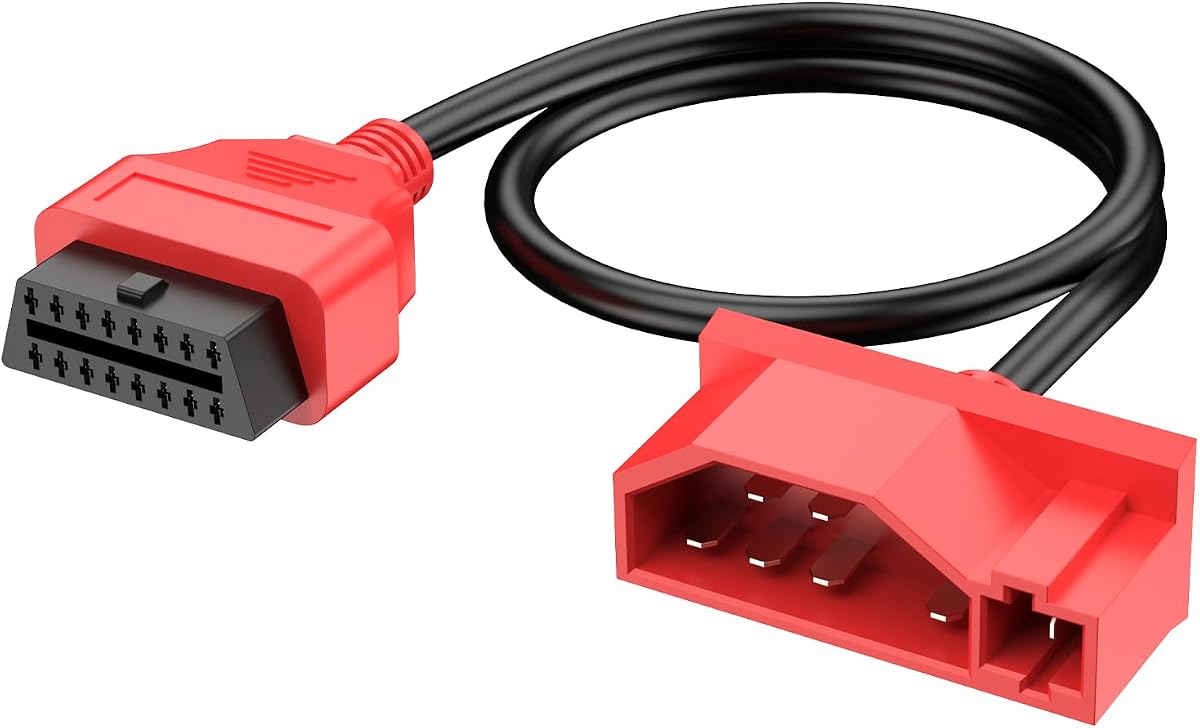
This black Ford 7 Pin to 16 Pin connector is intended for older Ford vehicles using a 7-pin OBD1 socket. It carries a 3.5 rating and stands out for explicitly covering 1985 through 1993 models, while also stating that it is incompatible with the 1992 Ford F350.
We may earn a commission when you buy through this link, at no additional cost to you.
The adapter uses a 7-pin vehicle connector and a 16-pin diagnostic-tool connector, allowing compatible code readers and scan tools to attach to the older Ford port. Its metal and PVC construction is described as durable, and precision injection molding is cited as a feature of the workmanship. The simple connection process requires no special tools.
The excluded 1992 Ford F350 is a useful warning for buyers because similar model years can have different connector arrangements. The listing also says to compare the photographed interface with the vehicle before purchasing. As with the other Ford options, the product is a cable only, and successful communication still depends on the scanner supporting the vehicle's protocol.
This is a reasonable choice for owners of eligible 1985-1993 Ford EFI vehicles with a confirmed 7-pin socket. It is especially relevant to those who already own a compatible code reader or scan tool and want a straightforward replacement connector. The model-year limitation should be checked carefully, particularly for F-series buyers.
The stated 1985-1993 range gives shoppers a useful initial filter. Since connector layouts can vary within a model line, the advice to compare the interface image with the actual socket remains essential before ordering.
Explicitly mentioning the incompatible 1992 Ford F350 demonstrates why connector-level verification matters. A buyer can quickly rule out that configuration rather than discovering the mismatch only after the cable arrives.
We may earn a commission when you buy through this link, at no additional cost to you.
The Autel Original 20 Pin to 16 Pin OBD2 Cable is a vehicle-specific adapter for BMW models that use a 20-pin OBD port. With a 4.5 rating, it is the highest-rated product in the guide and distinguishes itself through detailed model coverage, industrial-grade materials, a measured 40-centimeter length, and manufacturer-backed support.
We may earn a commission when you buy through this link, at no additional cost to you.
The listed compatible BMW model families include E28, E30, E32, E34, E36, E38, E39, E46, E52, E53, R50, R52, and R53. This breadth makes the cable appealing for owners of multiple qualifying BMW vehicles or workshops that regularly service these models. It converts the 20-pin vehicle port to the standard 16-pin interface used by many diagnostic tools.
Like the GM adapter in this roundup, the cable does not supply power. The connected scanner must be appropriately powered and compatible with the BMW's protocol and the functions needed. The listing mentions reading and clearing codes, ECU coding, full-system diagnostics, and bidirectional control, but those features depend on the attached scanner and the vehicle's support for them.
This is the premium choice for a BMW owner with one of the listed 20-pin applications. The heavy-duty construction, detailed fitment guidance, warranty, and extension design make it more specialized and supported than a generic cable. Buyers should still verify the actual port shape and their scanner compatibility, since a correct-looking adapter cannot overcome unsupported protocols.
The explicit model-family list gives BMW owners a concrete way to check fit before purchasing. It also makes this cable more useful for a workshop or enthusiast who may encounter several listed platforms over time.
Industrial-grade heavy-duty materials, precision molding, and a stated 10,000-plus plugging and unplugging test program support the product's premium positioning. The included one-year warranty and replacement or return policy add reassurance for buyers comparing it with generic alternatives.
We may earn a commission when you buy through this link, at no additional cost to you.
The general 12 Pin to 16 Pin Auto Diagnostic Extension Cable is a compact adapter for connecting OBD1 vehicles to OBD2 diagnostic devices. It has a 5.0 rating in the supplied data and stands out for its copper-core conductors, flame-retardant PVC housing, and unusually specific dimensional information for a general-purpose cable.
We may earn a commission when you buy through this link, at no additional cost to you.
The product information gives a total length of 16 inches, with a 1.8 by 2.2 by 0.7-inch 12-pin male connector and a 1.8 by 1.9 by 0.8-inch 16-pin female connector. It says the plug-and-play design requires no tools or complex wiring. The stated applications include fault-code reading, data-stream monitoring, sensor-status checks, and use with cars, trucks, and SUVs that use the applicable 12-pin OBD1 interface.
The copper-core and anti-interference construction are notable, but they cannot guarantee that every scanner will communicate with every vehicle. Protocol support in the scanner and software remains essential. The broad compatibility claim is best interpreted as a range of vehicles with the correct physical connector, not a promise that all diagnostic functions or vehicle protocols are supported.
This is the strongest budget-oriented general choice in the list for owners who have verified a 12-pin vehicle socket and already own a compatible OBD2 scanner. Its short length makes it easy to carry, while the detailed dimensions make it easier to plan storage and placement. It is not a substitute for a scanner or for protocol compatibility.
The stated copper cores and flame-retardant PVC housing provide more technical detail than many competing listings. Those features are intended to support stable signal transmission and resistance to everyday handling in a compact cable format.
At a stated 16 inches, the adapter is short enough for simple storage while still functioning as an extension. Its stated applicability to cars, trucks, and SUVs broadens its potential use among owners with compatible 12-pin diagnostic ports.
We may earn a commission when you buy through this link, at no additional cost to you.
The most important buying factors are connector shape, vehicle application, protocol support, scanner compatibility, power requirements, and cable construction. Comparing these details first can prevent a mismatched purchase more effectively than focusing on broad compatibility claims.
Begin by identifying the exact connector fitted to the vehicle. The products in this guide cover common 12-pin GM layouts, 7-pin Ford layouts, and a 20-pin BMW layout, but connector shape alone does not establish complete compatibility. Compare the vehicle socket with the product photographs, check the model and year, and note exclusions such as the 1992 Ford F350 mentioned for one adapter. A connector that looks broadly similar may have a different pin arrangement or irregular shape.
Choose the cable whose vehicle-side connector precisely matches the socket. Do not rely only on a brand name, because even vehicles from the same manufacturer and era can use different diagnostic interfaces. When a listing provides model-year guidance, treat that as a valuable filter and still confirm the physical connector before ordering.
An adapter changes the physical connection between a vehicle and a scanner. It does not automatically teach the scanner how to communicate with an older protocol. The Ford adapter for 1985-1991 vehicles specifically notes that success depends on support for older protocols such as EEC-IV, while the BMW and GM options similarly depend on the scanner understanding the vehicle's communication format.
Check the scanner manufacturer's supported vehicle families, protocol list, and required connection type. If the seller provides compatibility guidance, use it as part of the decision rather than treating it as a substitute for checking. The most reliable purchase is one where the vehicle connector, legacy protocol, and scanner software are all explicitly supported.
Several adapters in this category do not provide power, including the Autel GM and BMW cables and the CERRXIAN GM option. Their listings require an appropriately powered scanner. This distinction matters because a physically correct cable may still fail to establish a usable connection if the attached diagnostic tool lacks the necessary power arrangement.
Look for a scanner that is compatible with the vehicle, uses the matching OBD2 connector arrangement, and provides suitable power for the connection. If the scanner documentation is unclear, resolve that question before purchasing an adapter. The cable is an interface accessory, not a power source or a complete diagnostic system.
Every product reviewed is a cable rather than a diagnostic scanner, even when a listing uses terms such as scanner, code reader, or diagnostic tool in its title. Some packages explicitly contain one adapter, while others simply describe the cable as the only included item. A buyer who needs to read codes must already own a compatible scanner or plan to obtain one separately.
Treat the adapter as one component in a complete system: the vehicle, the physical converter, the OBD2 scanner, compatible software, and the correct protocol all matter. Reading the package contents and product description can prevent the disappointment of expecting a ready-to-use code-reading solution from a cable-only purchase.
Cable geometry affects usability. The general 40-centimeter product offers extra reach and flexibility, the Autel BMW cable is also listed at 40 centimeters, and the general 12-pin options are shorter at approximately 16 inches. A longer cable can make a scanner easier to position or move around the vehicle, while a shorter cable is more compact to store. Flexibility also reduces strain on the connection when the tool is not directly beside the diagnostic port.
Choose a length that suits the vehicle and working space rather than assuming one is automatically better. For occasional use, a compact cable may be more convenient. For a vehicle with a recessed socket or a scanner that needs to remain visible from the driver's seat, additional reach can be more useful. Avoid sharply bending either connector.
Most options use molded plastic housings, while several also identify metal connector components. The general diagnostic cable specifies copper cores and flame-retardant PVC, while the Autel BMW cable highlights industrial-grade heavy-duty materials. These construction details can help distinguish products designed for repeated insertion from basic replacements, although no material description can guarantee a particular lifespan.
Look for a balanced construction that includes a strain relief at the cable exit, clean molded connector housings, and secure pin retention. If the cable will be used regularly, avoid sharp bends, excessive pulling, and storage in a location where it can be crushed. Proper handling matters regardless of the stated material quality.
The dedicated Autel products provide a clearer ownership package than many generic listings. The GM and BMW cable descriptions mention a one-year warranty, a stated return or replacement policy, and technical support. The early Ford Autel adapter also states a one-year warranty and a 30-day return or exchange service. These policies can be meaningful when a connector arrives damaged or does not match the vehicle.
For a simple cable, warranty terms should complement rather than replace compatibility research. Review the current listing for exact policy details and support contact information, and retain the purchase record. If a product has no stated support, base the decision more heavily on connector accuracy, construction, and the seller's application guidance.
Listings may mention reading and clearing codes, real-time data monitoring, full-system diagnosis, ECU coding, sensor checks, or bidirectional control. These are potential benefits when the connected scanner and vehicle support them, not guaranteed functions supplied by the cable. The Autel BMW listing, for example, associates the adapter with advanced functions while also requiring a compatible car and scanner.
Write down the functions you actually need and verify each one in the scanner documentation. A basic code reader user may need less than a professional technician working on coding or bidirectional controls. Matching expectations to the complete system's capabilities prevents an adapter from being judged by features it never promised to provide independently.
Before connecting the adapter, identify the vehicle's diagnostic socket and confirm that the cable's vehicle-side plug matches its shape and pin layout. Compare the model-year guidance, inspect both ends of the cable, and verify that the scanner accepts a 16-pin OBD2 connection and supports the vehicle's protocol. If the listing names a power requirement, make sure the scanner meets it before proceeding.
With the vehicle turned off, connect the OBD1 end firmly to the vehicle port and the OBD2 end to the scanner. Do not force either connector or rotate it while it is partially inserted. Once both ends are seated, start the vehicle and the diagnostic software, allow the scanner to establish communication, and then select the functions required for the vehicle. Disconnect the scanner and the adapter after the session before servicing the area around the diagnostic port.
Store the cable in a dry location where it will not be crushed or sharply bent. Keep the connectors free of oil, dirt, and moisture, and wipe the housing with a soft dry cloth when needed. Do not pull the cable by its conductor or force a connector into an uncertain port. If communication fails, reseat both ends and recheck protocol support before assuming the cable itself is defective.
It is a cable that physically converts an older OBD1 vehicle diagnostic connector to a 16-pin OBD2 interface for a compatible scanner. The cable does not contain a scanner or create diagnostic functions by itself. Successful data exchange also requires a scanner that supports the vehicle's protocol and the functions the owner wants to use.
No. Common examples in this guide include 12-pin GM connections, 7-pin Ford connections, and a 20-pin BMW connection. Even vehicles within the same brand or era can differ, so buyers should check the physical socket, model, year, and any stated exclusions before ordering.
It may, provided the adapter matches the vehicle connector and the ELM327-based scanner supports the vehicle's protocol. The Ford 7-pin adapter in this guide explicitly names ELM327 compatibility, while other products have more general scanner language. A correct physical connection alone does not guarantee that the software can interpret every vehicle's data.
The Autel GM, Autel BMW, and CERRXIAN GM cables are specifically described as not providing power. They require an appropriately powered scanner. Buyers should also check whether the scanner can power the connection through the relevant pins and whether its software supports the older vehicle protocol.
No. Every product reviewed is a connector cable rather than a standalone code reader. The adapter gives a compatible OBD2 scanner physical access to an OBD1 vehicle, after which the scanner and its software perform any supported diagnostic functions. A separate scanner is required.
The most likely causes are a connector mismatch, unsupported vehicle protocol, insufficient scanner power, or an incomplete connection. Start by comparing the vehicle socket with the adapter's vehicle-side plug, then confirm protocol support in the scanner documentation. Reseat both connector ends and verify the vehicle year and model against the product's stated compatibility.
It can reduce direct wear by placing the adapter between the scanner and the vehicle. The original port is then connected to the adapter rather than having the scanner attached and removed as often. This is a modest protective benefit, although the adapter and connector should still be handled gently.
Keep both connectors clean and dry, avoid sharp bends near the housings, and never pull the cable by the wire. Store it loosely in a dry tool bag or compartment, and inspect it periodically for damage. A seated, undamaged connection is more important than applying excessive force during installation.
The best general-value option is the 12 Pin to 16 Pin Auto Diagnostic Extension Cable because it combines the highest listed rating with copper-core construction, clear measurements, and broad stated use. The Ford 7 Pin to 16 Pin adapter is the most practical dedicated choice for owners of compatible Ford vehicles using ELM327 scanners, while the Autel BMW 20-pin cable is the premium selection for the listed BMW models.
Prioritize the vehicle connector first, scanner protocol support second, and power requirements third. A durable cable and attractive construction matter, but they cannot compensate for an incorrect physical fit or unsupported diagnostic protocol. Model-specific GM, Ford, and BMW cables are easier for a first-time buyer to assess because their intended applications are stated directly.
Before ordering, verify the vehicle's exact connector, model-year limits, scanner support, and package contents on the current listing. Product details and availability can change, so the latest seller information should guide the final decision. With those checks complete, the selected adapter can provide a cleaner and more practical bridge between an older diagnostic port and a compatible modern scanner.