CX4121A Dual 25GbE Card
4.9Editor score
Dual 25GbE SFP28 ports
RoCE RDMA support
PCIe 3.0 x8 interface
SR-IOV and overlay support
This Fiber Optic Network Interface Card guide compares ten PCIe adapters for speed, ports, controllers, OS support, virtualization, and flexible SFP networking.
A fiber optic network interface card adds high-speed Ethernet connectivity to a desktop, workstation, or server through PCIe expansion slots. A good card balances port count, controller capabilities, operating-system support, physical fit, and compatibility with the SFP modules or cables already used in your network.
The cards in this guide were compared using their supplied specifications, including controller type, PCIe lane requirements, supported media, port configuration, virtualization features, bracketing, and documented system compatibility. The list includes one-gigabit and multi-gigabit models, single- and dual-port designs, and a dual 25GbE RDMA adapter.
Each review explains the most important strengths, limitations, and ideal use case so the final choice is easier to make. Ratings and product details reflect the information available in the source data, while pricing and availability can change, making it wise to verify current listings and requirements before purchasing.
4.9Editor score

5.0Editor score

4.5Editor score
The comparison below highlights the physical interfaces, port layouts, networking capabilities, and intended deployment roles of all ten cards, from dual-port 25GbE RDMA hardware to compact single-port 10GbE adapters.


The StarTech 2-Port GbE SFP Network Card is a flexible dual-port option for systems that need reliable fiber or copper connectivity without moving to 10GbE. It has a 5.0 rating, and its two open SFP slots make it especially useful when a network must support different media types, redundant links, or equipment upgrades.
We may earn a commission when you buy through this link, at no additional cost to you.
Its Intel I350-AM2 chipset provides 1Gbps full-duplex bandwidth on each port and includes TCP/UDP offloading, IPv4 and IPv6 support, and link aggregation. The SFP slots accept compatible single-mode or multimode MSA-compliant modules, as well as branded SFP and direct-attach copper modules. Status and activity LEDs simplify basic network monitoring.
The main limitation is speed: each port is limited to 1Gb, so this card is less appropriate for large storage arrays, intensive virtual machine migration, or high-bandwidth NAS traffic. It also requires a PCIe x1 or larger slot and the appropriate modules or cables. Those constraints are reasonable for a flexible one-gigabit network but important when comparing it with 10GbE and 25GbE models.
This is the strongest general-purpose recommendation for a small server, workstation, or virtualization host that values two ports, broad compatibility, and mature manageability. The card supports Windows Server 2012 and later, Windows 10 and later, Linux, VMware ESXi 7.x, and Microsoft Hyper-V. PXE boot, VLAN tagging, jumbo frames, and Intel virtualization features add further value for administrators.
Using separate SFP modules allows one port to serve a fiber backbone while the other uses direct-attach copper, which can simplify transitions between wiring types. The two-port layout also gives administrators an immediate path to link aggregation or redundant connectivity when the switches and configuration support it.
PXE boot, VLAN tagging, jumbo frames, and Intel VT-c, VMDq, and SR-IOV support make the adapter practical for managed infrastructure. A built-in heatsink and included low-profile bracket also improve suitability in compact servers and long-duration deployments.
We may earn a commission when you buy through this link, at no additional cost to you.
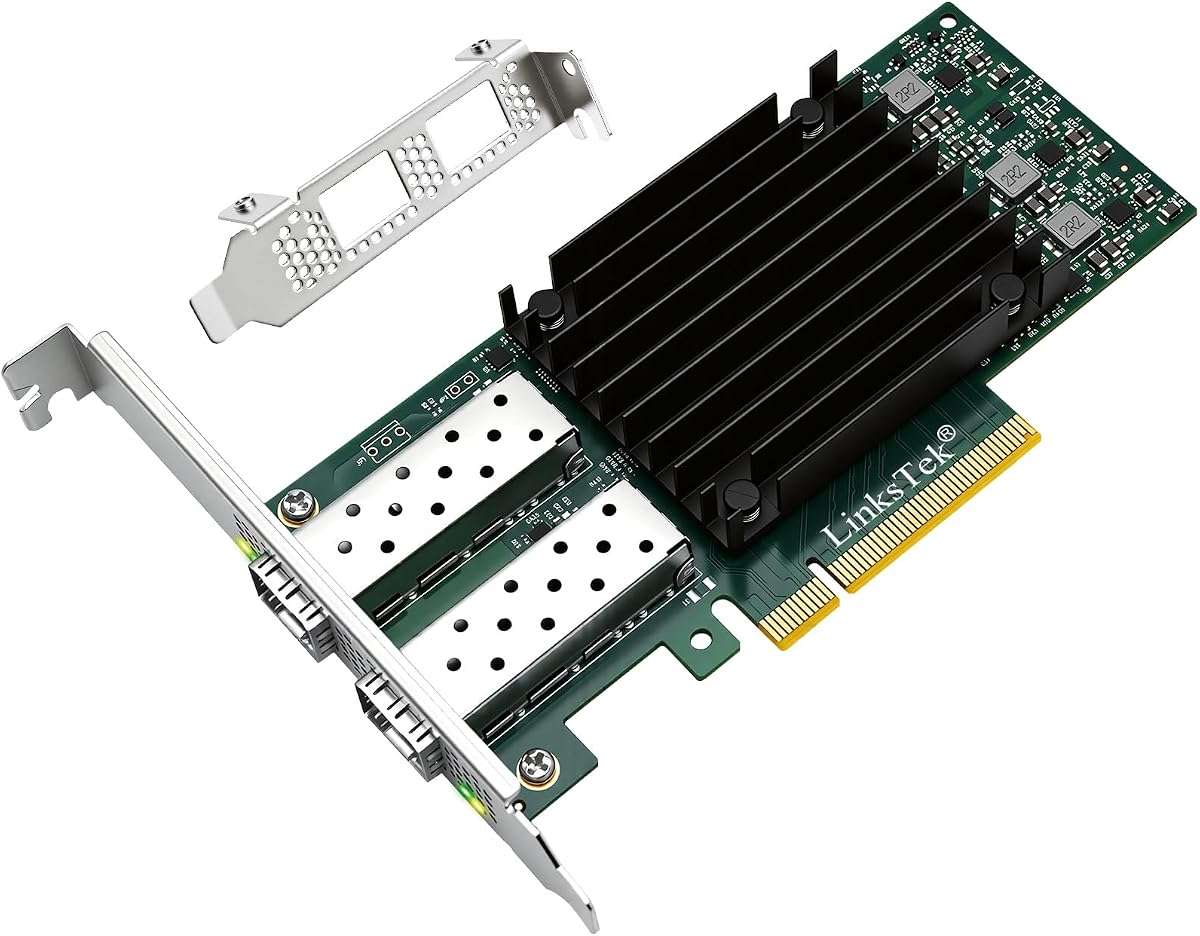
The LinksTek X520-DA1 is a single-port 10GbS SFP+ adapter aimed at NAS systems, desktop PCs, gaming machines, and servers that need a substantial speed increase over ordinary Gigabit Ethernet. It carries a 4.3 rating and uses an Intel 82599 controller with a PCIe x4 host interface.
We may earn a commission when you buy through this link, at no additional cost to you.
The adapter supports 10GbE and 1GbE optical modules, 10GbE DAC cables, and 10GbE AOC cables. It can be used for LAN or SAN traffic and supports iSCSI, FCoE, and NFS. Features such as Flexible Port Partitioning, VMDq, SR-IOV, Receive Side Coalescing, and Ethernet Flow Director make it more relevant to virtualized and storage-oriented systems than a basic desktop card.
Its compatibility record is broad, with support for several generations of Windows Server and a lengthy list of Linux distributions. However, Windows 11, 10, 8.x, and 7 systems require driver installation, and Linux users may need the IXGBE driver. The x4 interface also limits installation flexibility compared with compact cards designed around a single lane.
Choose this adapter when a NAS, workstation, or server needs 10GbE through SFP+ and the host has a suitable PCIe x4, x8, or x16 slot. It is less ideal for a system with only x1 space or for users who want a simple cable-only installation. A full-height bracket is preinstalled and a low-profile bracket is included for smaller cases.
The SFP+ interface separates the network adapter from the physical medium, allowing a deployment to use fiber, DAC, or AOC connectivity. That flexibility is useful in offices, studios, and data centers where equipment changes but installed wiring standards do not.
Support for iSCSI, NFS, FCoE, VMDq, SR-IOV, traffic management, and flow control gives the card a strong foundation for NAS and server environments. The PCIe 2.0 x4 interface provides enough host bandwidth for a single 10GbE port.
We may earn a commission when you buy through this link, at no additional cost to you.
The Asus XG-C100F is a 10GbE SFP+ network card for users who want fiber-optic or direct-attach copper connectivity in a PCIe desktop or workstation. Its 4.3 rating reflects a capable design centered on a single SFP+ port, a PCIe 2.0/3.0 x4 interface, and straightforward 10Gbps performance.
We may earn a commission when you buy through this link, at no additional cost to you.
The SFP+ cage supports both fiber-optic and direct-attach copper connections, allowing administrators to choose the physical medium that best fits the installation. A built-in aluminum heatsink helps dissipate heat during high-performance tasks, while automatic QoS prioritizes bandwidth for important streams or games.
As a one-port card, it does not offer native redundancy or link aggregation without additional hardware. The stated operating range is 0°C to 40°C, with a storage range of -40°C to 60°C, which should be considered for industrial or unusually warm environments. Buyers must also provide an appropriate SFP+ module or compatible cable.
This is a good option for a high-speed workstation, compact system, or individual server that needs one 10GbE link and values a clean single-port arrangement. It is less suitable for storage systems requiring multiple independent connections. As with any PCIe network card, confirming chassis clearance and slot dimensions before ordering is essential.
The shared SFP+ cage accepts either optical modules or direct-attach copper, so the card can be deployed over fiber in a building backbone or over short copper runs inside a rack. This makes it a flexible middle ground for a single high-speed workstation link.
The integrated aluminum heatsink is intended to keep the controller cool during demanding transfers. Automatic QoS adds a practical layer by directing priority to latency-sensitive or otherwise important network traffic.
We may earn a commission when you buy through this link, at no additional cost to you.
The 10Gtek X520-10G-1S is a 10GbE PCI Express adapter built around an original Intel 82599EN controller. It is intended for data-center and server environments where a dedicated 10G SFP+ connection, storage networking, and I/O virtualization are more important than backward-compatible low-speed operation.
We may earn a commission when you buy through this link, at no additional cost to you.
Its single SFP+ port accepts a 10GbE module, DAC, or AOC connection, and the card supports storage over Ethernet through iSCSI, FCoE, and NFS. The Intel controller provides I/O virtualization, and the package includes both a full-height and low-profile bracket. Compatibility extends across multiple generations of Windows Server, Windows client systems, Linux, and ESX or ESXi.
A key trade-off is that the card supports 10G but not 1G, 2.5G, or 5G. The PCIe x8 interface also uses more lanes than some competing designs. Hot swapping is not supported, which matters in environments where operators expect removable or field-serviceable network hardware.
Buyers using QNAP or Synology equipment should contact the seller before ordering because compatibility can depend on the particular platform and card behavior. For standard servers, virtualization hosts, and storage systems with a clear 10GbE requirement, this is a practical, well-documented option with a 4.4 rating.
The card focuses on a full-rate 10GbE path rather than trying to negotiate across many lower speeds. That specialization suits a server tied to a 10GbE switch, storage array, or aggregation platform where a consistently high link rate is required.
Both standard and low-profile brackets are included, allowing installation in full-size servers and compact low-profile systems. The bracket choice should still be confirmed against the chassis layout before purchase.
We may earn a commission when you buy through this link, at no additional cost to you.
The Realtek RTL8127 SFP+ card is a cost-conscious way to add a 10GbE SFP+ connection to a modern desktop or server. It earns a 4.5 rating and uses a compact PCIe Gen4 x1 interface that can operate in x1, x4, x8, or x16 slots, offering more installation flexibility than cards requiring several lanes.
We may earn a commission when you buy through this link, at no additional cost to you.
The single SFP+ port supports 10G SFP+ modules, DAC cables, and AOC cables. RealWoW technology adds wake-up and diagnostic functions, while PXE, Wake-on-LAN, jumbo frames, IEEE 802.1Q VLAN tagging, 802.3x flow control, and double VLAN support cover common administration needs.
This card is not a universal server accelerator. The supplied information specifically says it does not support ESX or ESXi, FreeBSD, or other incompatible systems. Linux compatibility is limited to kernels up to 6.15, which could become relevant as operating systems evolve. Users with hypervisor requirements should choose a more specialized Intel-based adapter instead.
For a Windows 10 or 11 workstation, a compatible Windows Server, or a supported Linux kernel, it is a strong choice when conserving PCIe lanes matters. The included full-height and low-profile brackets simplify installation, and the QR-code driver download provides a straightforward setup route.
The PCIe Gen4 x1 design can fit in a small number of lanes while remaining usable in progressively larger slots. This is especially useful in systems where a multi-lane card would obstruct neighboring connectors or reduce future expansion options.
VLAN tagging, double VLAN, flow control, jumbo frames, PXE, and Wake-on-LAN cover a broad set of everyday networking needs. These features make the card more versatile than a minimal driver-only expansion card.
We may earn a commission when you buy through this link, at no additional cost to you.
The Intel 82599EN X520-DA1-compatible card is a single-port 10GbE SFP+ adapter designed for NAS transfers, virtual machine migration, and iSCSI storage. Its 4.5 rating and emphasis on platform detection make it appealing to administrators who want a broadly recognized Intel-based option.
We may earn a commission when you buy through this link, at no additional cost to you.
The SFP+ cage is not restricted to Intel-branded modules. It supports third-party DAC twinax cables, AOC connections, 10GBASE-SR multimode optics, and 10GBASE-LR single-mode optics. It can also step down to 2.5G, 1G, and 100M, which provides more flexibility when connected to a slower switch port.
The adapter is described as plug-and-play on Proxmox, TrueNAS, Unraid, and ESXi, with detection also noted on QNAP, Synology, Ubuntu, Debian, and CentOS. Windows systems require the Intel Ethernet Adapter Complete Driver Pack. The included passive heatsink may run warm, so case airflow or an additional small fan is advisable in a silent or tightly packed enclosure.
With only four PCIe lanes, the card fits x4, x8, and x16 slots while leaving the rest of the board unobstructed. Full-height and low-profile brackets are included for towers, 1U and 2U racks, and mini-ITX systems. It is a strong choice for mixed software environments, although the single port does not provide built-in link redundancy.
Accepting common third-party DAC, AOC, multimode, and single-mode media gives administrators more sourcing flexibility. It can be particularly helpful when standardizing a deployment across multiple chassis.
The combination of automatic detection on major virtualization and NAS platforms and driver support for Windows reflects the broad software reach of the Intel 82599 family. Confirm the exact operating-system version before installation.
We may earn a commission when you buy through this link, at no additional cost to you.
The CX4121A is the most advanced adapter in this guide, with two 25GbE SFP28 ports and a 4.9 rating. Based on the Mellanox ConnectX-4 Lx EN MT27711A0 controller, it targets web infrastructure, cloud platforms, databases, analytics systems, and storage servers that benefit from high throughput and low latency.
We may earn a commission when you buy through this link, at no additional cost to you.
Its PCIe Gen3 x8 interface provides substantial host bandwidth and can auto-negotiate down to x4 or a lower PCIe generation. Both ports can operate at 25GbE, and the adapter supports SFP28 transceivers, DAC cables, and AOC cables using PAM4 Ethernet links. Remote boot options include RoCE, PXE, and iSCSI.
RDMA over RoCE is the defining feature. It allows supported workloads to reduce CPU involvement and network processing overhead, which can be valuable in high-concurrency virtualization and storage clusters. The card also supports I/O virtualization, SR-IOV, NVGRE, VXLAN, GENEVE, jumbo frames up to 9.6KB, and numerous traffic-control and synchronization standards.
This is the premium choice for a properly engineered data-center deployment, not a casual desktop upgrade. It requires SFP28 infrastructure, a PCIe x8 slot, suitable cooling, and software support for the advanced features. Even so, its dual-port design, comprehensive virtualization capabilities, and RDMA support place it well ahead of the standard 10GbE cards in this list.
Two independent 25GbE SFP28 connections create a strong foundation for high-throughput storage, clustered virtualization, and low-latency services. The x8 host interface supplies ample bandwidth for simultaneous full-rate links.
RoCE support can lower processing overhead by allowing supported applications and operating systems to transfer data more directly. It is most valuable in coordinated environments where the operating system, applications, switches, and cabling are all configured to support the intended data path.
We may earn a commission when you buy through this link, at no additional cost to you.
The 82599EN Single SFP+ card is a one-port 10GbE fiber adapter that includes a multimode optical module. It is a practical starter option for users who want a complete optical connection rather than a bare adapter that still requires separate media.
We may earn a commission when you buy through this link, at no additional cost to you.
Despite its compact PCIe x1 interface, the card is compatible with x1, x4, x8, and x16 physical slots. The SFP+ port supports single-mode and multimode optical modules, AOC cables, and DAC cables. It also offers automatic speed adaptation, half- and full-duplex modes, and TCP/UDP/IP checksum offload with TCP segmentation offload to reduce processor workload.
No numerical customer rating is supplied for this product, so its evaluation must rely on the stated features rather than a rating comparison. It also has just one optical port, which limits native redundancy and aggregation. The included multimode module is useful, but users should confirm the distance and connector requirements of their actual fiber link.
The card supports Windows, Windows Server, Linux, VMware, CentOS, Ubuntu, and FreeBSD, making it broadly applicable to industrial PCs, workstations, servers, and digital multimedia systems. It is a good match for a compact system that can benefit from one 10GbE fiber connection and prefers an included module over sourcing optics separately.
The bundled multimode optical module shortens the initial setup path for compatible short-reach multimode fiber. Users should still verify connector type, fiber type, and link distance before connecting the card to existing infrastructure.
The x1 interface can be installed in a wide range of PCIe slots, which is helpful in compact systems with limited expansion room. Both full-height and low-profile brackets are included to assist with different chassis designs.
We may earn a commission when you buy through this link, at no additional cost to you.
The TP-Link TX401 is a 10GBase-T PCIe adapter for users who want 10GbE performance over ordinary structured copper cabling instead of installing SFP+ media. It has a 4.2 rating and is particularly approachable for desktop upgrades, gaming systems, and local high-speed storage connections.
We may earn a commission when you buy through this link, at no additional cost to you.
The adapter automatically negotiates among 10Gbps, 5Gbps, 2.5Gbps, 1Gbps, and 100Mbps, allowing it to work with a wider range of switch and router ports. A 1.5-meter CAT6A cable is included, and the package provides both full-height and low-profile brackets for different case styles.
Its defining limitation is that it is not a fiber-optic SFP+ card. The 10GBase-T port is convenient for short runs, but copper has stricter distance and installation requirements than an optical link. For a workstation beside a switch, this simplicity can be a major advantage; for long runs between buildings or floors, an SFP+ adapter and appropriate fiber media would be more appropriate.
System support includes Windows 10, 8.1, 8, and 7, several Windows Server releases, and Linux. The card is best for users who need a straightforward 10GbE connection with flexible speed negotiation and strong brand support. It rounds out the guide as a practical copper alternative rather than a direct optical upgrade.
Using a familiar RJ-style copper connection avoids separate optical transceivers and fiber patch leads for a nearby switch. The included CAT6A cable helps users establish a suitable high-speed link immediately.
Automatic negotiation down to 100Mbps means the card can still connect when the other end offers a slower port. That makes it easier to introduce a 10GbE adapter gradually instead of replacing every switch simultaneously.
We may earn a commission when you buy through this link, at no additional cost to you.
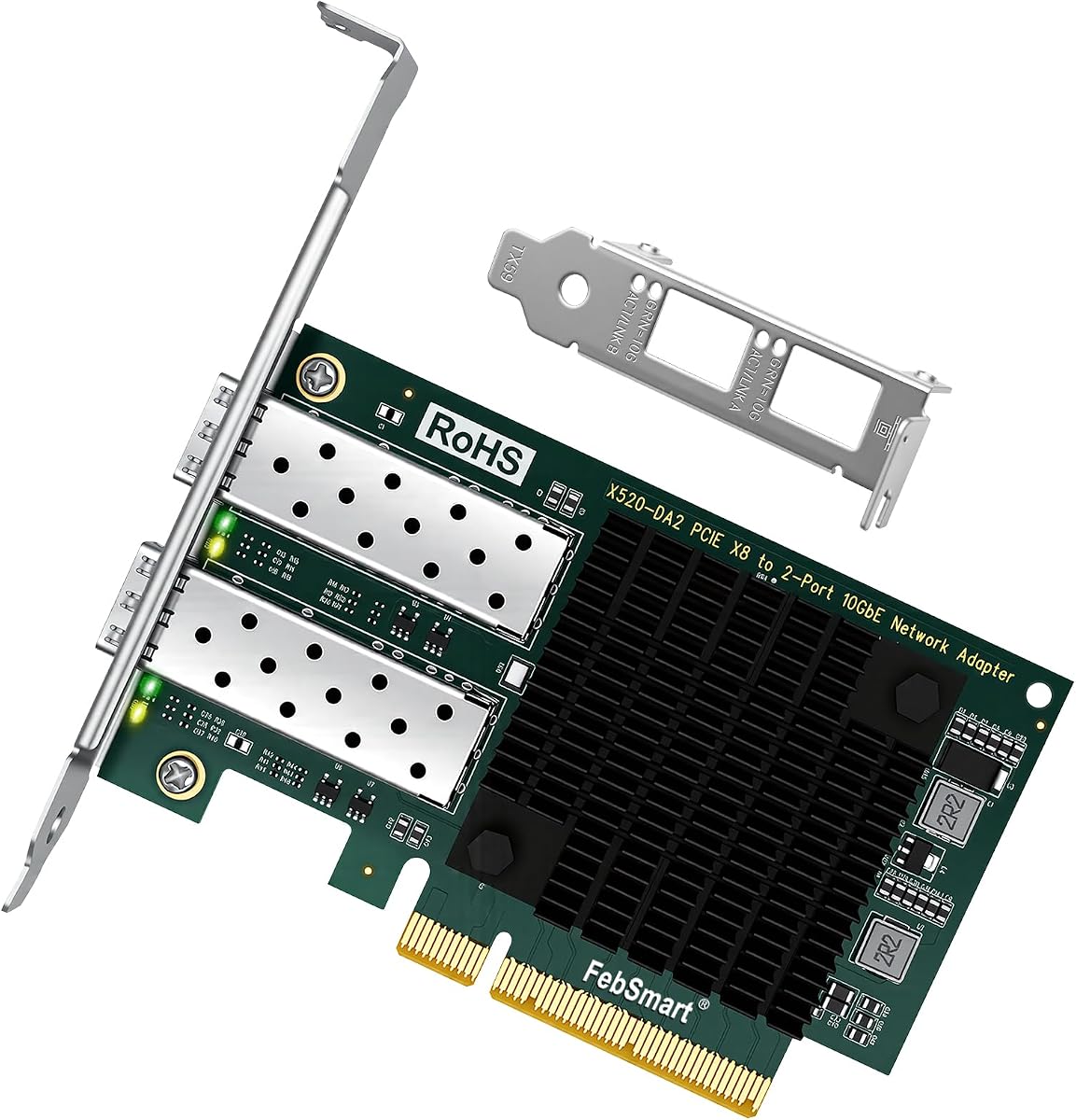
The FebSmart X520-DA2 is a dual-port 10GbE SFP+ adapter with a 4.8 rating. It is built for Windows desktops, Windows servers, NAS systems, Linux PCs, and data centers that want two optical links without moving to the 25GbE class of the CX4121A.
We may earn a commission when you buy through this link, at no additional cost to you.
Its Intel 82599ES controller supports 10GbE and 1GbE SFP+ media, DAC cables, and AOC cables. The PCIe 2.0 x8 interface supplies 40Gbps of total bandwidth, allowing both transmit and receive paths to work at full 10GbE. Features include IEEE 1588, Data Direct I/O, intelligent offloads, FCoE, PXE, VLAN-oriented traffic management, and Flexible Port Partitioning.
Windows Server 2012 through 2022 is listed as driver-free for the relevant operating systems, while Windows client systems require a driver. Linux installations need the IXGBE driver, and the listing gives extensive support for RHEL, SLES, Ubuntu, Debian, FreeBSD, and VMware ESXi. The card requires a physical x8 or x16 slot, so older compact PCs may not be candidates.
Two ports can support a more resilient topology, separate storage and application traffic, or a future expansion path. The full-height bracket is mounted, and a low-profile bracket is included. Overall, it is an attractive high-speed dual-port option for administrators comfortable with the Intel X520 platform and its driver requirements.
Two SFP+ ports provide more flexibility than a single-port card and can support segmented traffic, redundant links, or separate storage connections. The x8 host interface is appropriately matched to the combined port capability.
FCoE, PXE, intelligent offloads, Flexible Port Partitioning, and IEEE 1588 support address common data-center management and transport needs. These features are most useful when the host operating system, switch, and associated services are configured together.
We may earn a commission when you buy through this link, at no additional cost to you.
The right fiber optic network interface card depends on link speed, media type, host interface, physical space, operating system, and administrative features. Matching those requirements prevents an expensive mismatch and makes installation more predictable.
A 1Gb SFP card is appropriate for standard Gigabit Ethernet links, access aggregation, and cost-sensitive installations where longer reach is more important than throughput. The StarTech dual-port model is a clear example of a flexible 1Gb solution. A 10GbE SFP+ adapter is better suited to high-speed NAS access, large file transfers, virtual machines, and storage fabrics, while 25GbE becomes relevant for dense virtualization, clustered databases, and low-latency RDMA workloads.
Match the card to the slowest device in the intended path. A faster adapter cannot create a faster link if the switch, transceiver, storage system, or remote device only supports a lower rate, although some models can negotiate downward. Choose the highest speed that every required component can support.
SFP and SFP+ describe the cage and physical module format, but not every combination of adapter, module, cable, distance, and connector is guaranteed to work. Fiber installations may require single-mode or multimode transceivers, while short connections may use DAC or AOC cables. Some cards support both 10GbE and 1GbE, while others accept only 10G modules.
Confirm the supported media type, nominal speed, connector, fiber mode, and link distance before ordering. Third-party module acceptance can vary by controller, so it is also useful to check the card listing and ask the seller about a specific transceiver or cable if compatibility is critical.
The physical x1, x4, x8, or x16 shape of a PCIe slot does not always reveal its usable lane configuration, and the host may reserve lanes for graphics or other devices. A compact x1 design can be ideal in a constrained workstation, while dual 10GbE or 25GbE cards often require x8 to provide sufficient host bandwidth. The operating system should also support the intended PCIe generation and card capabilities.
Inspect the motherboard manual and system inventory rather than relying only on the slot's physical size. For servers, verify the platform's supported network adapters and approved driver stack. This avoids discovering that the chosen card is physically insertable but cannot run at its intended lane width.
A single-port card is enough for one client or server connection and keeps the design simple. Dual-port cards can connect separate networks, support link aggregation, provide a path to redundancy, or separate storage and general-purpose traffic. The port count alone does not guarantee redundancy; the switches, cables, operating system, and configuration must also support the intended topology.
Choose one port for a simple endpoint and two ports when failover, aggregation, or traffic separation is important. For substantially greater throughput, move beyond two 10GbE links and consider the dual 25GbE CX4121A when the rest of the infrastructure supports SFP28 and RDMA.
Driver support is as important as the physical connection. Some Intel-based cards work without a manual Windows Server driver step, while Windows client installations may require a specific driver package. Linux support can depend on the kernel version and the IXGBE or other relevant driver, and the Realtek card has a stated Linux kernel limit. VMware ESXi and other hypervisors must be checked independently.
Use a compatibility table that includes the precise operating-system release, kernel, hypervisor version, and device model. If the intended platform is not listed, verify with the manufacturer or seller before purchasing. This is especially important for production servers where a driver mismatch can interrupt deployment workflows.
Network cards come in full-height and low-profile formats, but a low-profile bracket alone does not guarantee that the card will fit. The adapter's length, thickness, port position, and clearance around neighboring slots all matter. Servers and compact systems may also have limited airflow, and passive 10GbE or 25GbE controllers can produce noticeable heat under sustained load.
Measure the available expansion area and compare it with the card dimensions. Both brackets are convenient when the model supports both, but one must be selected before installation. Ensure the chassis has sufficient airflow around the card, and consider a small fan if the manufacturer recommends additional cooling in a particularly quiet enclosure.
Features such as PXE boot, VLAN tagging, jumbo frames, flow control, SR-IOV, VMDq, and traffic management can materially improve administration in server environments. RDMA over RoCE goes further by offering a low-latency data path for supported workloads, but requires compatible switches, software, and application support. More features are not automatically better if the operating system or deployment model cannot use them.
Prioritize the capabilities needed by the actual workload. A management-focused Windows or Linux server may benefit most from PXE, VLAN support, and jumbo frames. A virtualization cluster may need SR-IOV and partition controls, while an RDMA deployment requires an end-to-end compatible stack.
SFP and SFP+ adapters provide media flexibility and are the most direct choice for fiber installations, but they require modules or compatible cables. The TX401 offers a simpler alternative over 10GBase-T copper, which is attractive for a nearby switch and can negotiate at several lower speeds. Neither approach is universally better; distance, building layout, switch hardware, and cabling determine the most practical option.
Use fiber when long runs, electromagnetic immunity, future flexibility, or data-center topology matter. Use high-quality copper when the devices are close together and a simple Ethernet connection is preferred. Confirm that the switch has the matching port type before selecting either approach.
Before installation, power off the computer, disconnect the power cable, and open the chassis according to its service documentation. Identify a compatible PCIe slot, check lane support and physical clearance, and install the appropriate full-height or low-profile bracket. Connect the grounding precautions and avoid touching the card's contacts or components.
Install the card firmly, secure the bracket, and reconnect the system power. Attach the correct SFP module, DAC, AOC, or other supported media, then connect the fiber or network cable. Power on the system and install the operating-system or hypervisor driver if the platform does not detect it automatically. Use the documented software utilities to confirm that the link is active and negotiated at the intended speed.
For ongoing care, keep the adapter and its media free of dust, avoid sharply bending fiber cables, and protect unused optical ports with appropriate dust caps. Monitor port activity, temperature, errors, and negotiated link rates through operating-system or management tools. If a link fails, check the transceiver, cable, switch port, driver, and PCIe lane configuration before assuming the adapter itself is defective.
A fiber optic network interface card is a PCIe adapter that adds an Ethernet port or ports capable of connecting with compatible optical modules, fiber cables, DAC cables, or AOC cables. It is used when a desktop or server needs a network connection unavailable from its built-in Ethernet ports. The card combines a network controller, PCIe interface, port hardware, and driver support.
Compatibility depends on the specific card. The LinksTek X520-DA1 and FebSmart X520-DA2 are described as supporting both 10GbE and 1GbE, while the 10Gtek X520-10G-1S is explicitly limited to 10G. The Intel 82599EN X520-DA1 can step down to 2.5G, 1G, and 100M. Check the model specifications and switch configuration before connecting it.
It depends on the connection. A bare SFP+ adapter normally needs a compatible transceiver or supported direct-attach or active optical cable. The 82599EN Single SFP+ card includes a multimode optical module, while most other cards in the guide do not. The module, connector, fiber type, speed, and link distance must all match the network.
Yes, provided the desktop has an available compatible PCIe slot, adequate physical clearance, a supported operating system, and the necessary driver. Some cards work in x1 slots, while others require x4 or x8 lanes. Check the card dimensions and bracket format as well, because some compact cases only accept low-profile cards.
The main distinction is the supported link generation. SFP is commonly associated with 1GbE, SFP+ with 10GbE, and SFP28 with 25GbE. A physical cage may look similar, but module electronics, signal rates, and software support differ. The selected media must match both the adapter and the equipment on the other end of the link.
Usually not. RDMA is most valuable in data centers, high-performance storage clusters, and dense virtualization environments where reduced CPU involvement and consistent low latency matter. A conventional 1GbE or 10GbE adapter is usually more appropriate for a home or small office. The CX4121A makes the most sense when the entire infrastructure is prepared for 25GbE and RDMA.
Link speed is negotiated across the adapter, cable or transceiver, switch port, and remote device. A mismatch in supported rates, a lower-capability cable, or a switch configuration can cause the connection to operate at a lower rate. Confirm compatibility, check the port's auto-negotiation setting, and update the appropriate driver before changing hardware.
They can, particularly high-speed 10GbE and 25GbE cards operating under sustained loads. The supplied guidance for the Intel 82599EN X520-DA1 notes that its passive heatsink runs warm and may benefit from case airflow or a small fan. Proper chassis ventilation is important for all PCIe adapters, especially in compact and acoustically sensitive systems.
The StarTech 2-Port GbE SFP card is the most versatile general-purpose recommendation, offering two flexible media ports, broad platform support, and mature virtualization features. The CX4121A stands apart as the premium choice for dual 25GbE, RDMA, and advanced data-center workloads, while the Realtek RTL8127 provides a focused and lane-efficient 10GbE SFP+ option for compatible Windows and Linux systems.
For most 10GbE installations, prioritize the switch and media first, then choose between a single-port card, the dual-port FebSmart X520-DA2, or the Intel-based adapters based on lane width, driver support, and physical fit. Compact systems may favor the Realtek or 82599EN x1 options, while storage and virtualization servers benefit from the richer offload and management features of Intel-based designs.
Product pricing, availability, driver packages, and operating-system compatibility can change, so verify the current listing and the complete hardware configuration before purchasing. Checking the PCIe slot, optical media, switch port, bracket, thermal clearance, and software stack will help ensure that the selected Fiber Optic Network Interface Card integrates cleanly into the intended network.