
BENFEI USB C Hub 5-in-1
4.6Editor score
4K HDMI at 30Hz
Up to 90W pass-through charging
Three USB-A ports
A monitor adapter for MacBook can turn a single USB-C connection into a practical workstation, adding display output, charging, card readers, Ethernet, and USB-A ports. The right choice depends on your Mac model, monitor configuration, peripherals, and whether portability or expanded connectivity matters most.
This guide compares ten USB-C and Mini DisplayPort adapters using their stated ports, supported resolutions, charging capabilities, data speeds, compatibility details, and customer ratings. It covers basic HDMI converters, compact multiport hubs, card-reader models, and a larger dual-monitor docking station.
Each review explains the strongest use case, important limitations, and the types of user most likely to benefit. Ratings and specifications reflect the supplied product information, while availability and pricing can change, so check the current listing before purchasing.
4.6Editor score

4.6Editor score
4.3Editor score
As an Amazon Associate we earn from qualifying purchases.
The comparison below highlights the display, charging, data, and expansion capabilities of all ten adapters, helping MacBook users identify the most suitable connection style for their workspace.


This compact USB-C multiport adapter combines an HDMI output, a USB-C charging connection, one USB 3.0 port, and one USB 2.0 port. Its 4.2 rating places it below the stronger-rated options in this list, but the feature mix is practical for MacBook users who want a monitor connection and a few essential peripherals without carrying a large dock.
We may earn a commission when you buy through this link, at no additional cost to you.
The HDMI 2.1 output supports 4K and is backward compatible with HDMI 2.0, while the listed resolutions also include 2K, 1080p, and 720p. The USB-C charging port can supply up to 27W, allowing a connected charger to keep the computer powered while the adapter handles display and peripheral connections.
Its high-speed USB port supports data transfer up to 10Gbps, making it more useful for flash drives and external storage than a basic converter that only carries video. The second USB-A port is better suited to slower accessories such as a keyboard, mouse, or controller. One important limitation is that the relatively low 27W charging maximum may not satisfy demanding power requirements.
The adapter works with USB-C laptops, tablets, and smartphones, including Thunderbolt 3 and Thunderbolt 4 systems, and the listed compatibility includes MacBook Pro and Air models from 2018 through 2021. It is a good choice for students, travelers, and office users who need a compact all-purpose dongle, but a higher-power model may be preferable for a permanent desk setup.
The gray aluminum shell measures 60 by 55 by 10 millimeters and includes a short 130-millimeter cable, making the adapter easier to carry than a full docking station. It can serve as a small everyday hub for connecting a display, input devices, and removable storage in a café, meeting room, or shared office.
Keeping the charging path separate from display and data use is useful for a desk setup. The 27W maximum is the principal caveat, while the 10Gbps USB connection adds meaningful flexibility for users who regularly move files between a MacBook and an external drive.
We may earn a commission when you buy through this link, at no additional cost to you.
The UGREEN 5-in-1 adapter is one of the strongest all-around choices in this guide, earning a 4.6 rating from customers. It expands one USB-C connection into a 4K HDMI port, a 100W USB-C power-delivery port, one 5Gbps USB-A data port, and two additional 480Mbps USB-A ports.
We may earn a commission when you buy through this link, at no additional cost to you.
The balance between display, charging, and data is particularly useful for MacBook Air and MacBook Pro users who regularly connect a laptop to a larger monitor. The high-speed USB-A port is intended for file transfer and compatible storage, while the two lower-speed ports can accommodate peripherals such as a keyboard, mouse, webcam, or other low-bandwidth accessories.
Unlike several more elaborate docks in the list, this adapter does not include an SD card reader, Ethernet, or multiple display connectors. Those omissions keep the focus on a common desk configuration, but they may limit its usefulness for photographers, editors, or users who need wired networking. Its 100W charging specification also makes it more appropriate for power-hungry MacBook configurations than the 27W model above it.
This is a strong recommendation for a clean, general-purpose workstation that needs one external display, charging, and several USB devices. It covers the most frequent reasons to buy a monitor adapter without requiring a large permanently deployed dock. Users needing more specialized ports should look to the card-reader or dual-monitor models, while anyone wanting a similarly balanced but more expansive design should consider the ACASIS option.
One HDMI, one charging connection, and three USB-A ports cover the most common needs of a laptop-based desk. The 5Gbps data port provides a sensible division of labor: faster storage can use the dedicated high-speed port, while mice and keyboards can remain on the other two.
The listed 100W power delivery makes the hub suitable for a wider range of MacBook setups than lower-powered adapters. It can simplify a desk by allowing the display, peripherals, and charger to remain connected through one compact hub rather than competing for available ports.
We may earn a commission when you buy through this link, at no additional cost to you.
This BENFEI hub combines a 4K HDMI port, a USB-C charging port, and three USB-A ports in a portable aluminum case. Its 4.6 rating matches the UGREEN model in customer feedback, while its soft 20-centimeter silicone-woven cable and lightweight construction make it particularly suitable for travel and mobile offices.
We may earn a commission when you buy through this link, at no additional cost to you.
The HDMI output supports media display at up to 4K 30Hz, provided the host device's USB-C port supports video output. The three USB-A connections include a USB 3.2 port capable of data transfer at up to 10Gbps and two USB 2.0 ports suited to keyboards, mice, and similar accessories.
The USB-C charging path supports up to 90W pass-through, with 10W reserved for hub operations according to the supplied information. That charging port does not support data or video, so the hub's video and data functions depend on the dedicated HDMI and USB-A connectors. The 4K 30Hz ceiling may be limiting for high-refresh desktop arrangements, even though it suits many 4K productivity monitors.
This is a compelling pick for mobile professionals who need more than a basic HDMI converter but do not need card readers, Ethernet, or multiple displays. The combination of a 4.6 rating, 10Gbps USB-A transfer, soft cable, and broad device compatibility makes it particularly easy to recommend. For high-refresh gaming or color-sensitive work, verify the monitor's acceptable refresh rate before purchasing.
The soft silicone-woven cable is described as resistant to knotting and is rated for more than 25,000 bend cycles. Its 20-centimeter length offers enough reach for many placements while remaining compact enough to fold into a laptop sleeve, making it a good match for frequent travelers.
A 10Gbps USB-A port gives the hub a clear role for external SSDs, flash drives, and other high-bandwidth storage. The two USB 2.0 ports handle everyday input devices without requiring additional equipment, although they are not intended for demanding data-transfer workflows.
We may earn a commission when you buy through this link, at no additional cost to you.
The MOKiN 7-in-1 dongle is designed for users who need more than display output and basic USB expansion. It provides a 4K at 60Hz HDMI port, two USB 3.0 ports, a dedicated USB-C data port, a 100W power-delivery input, and both SD and TF card-reader slots.
We may earn a commission when you buy through this link, at no additional cost to you.
Its 4.6 rating and broad device list make it an attractive option for MacBook Pro, MacBook Air, M1 and M2 models, iMac, iPad Pro, and other USB-C devices. The 60Hz 4K output is more demanding than many similarly sized adapters, making it a sensible choice for detailed creative work, presentations, and productivity monitors that benefit from smoother motion.
The integrated card readers are especially useful for photographers and designers who can move images from SD or TF media without a separate reader. The two USB 3.0 ports support up to 5Gbps, while the dedicated USB-C data port can accept compatible USB-C storage and accessories. Only one hard drive or SSD should be connected, and the product is not compatible with the Apple USB SuperDrive.
Power delivery accepts up to 100W and is described as safely limiting power output to 87W. The overall feature set is particularly appealing to creative professionals, but users who do not use memory cards may find simpler models easier to justify. It is also important to check whether the MacBook's host port supports the desired display configuration.
The combination of 4K at 60Hz video and two card-reader formats reduces the need for separate accessories. A photographer can connect a display, transfer media, and retain access to peripherals through a single hub, although high-power storage should be limited to one device.
Unlike charging-only USB-C sockets, the dedicated data connection can support compatible storage and accessories. This makes the hub more versatile for users who want to connect modern USB-C devices while also retaining full-size USB-A ports for existing equipment.
We may earn a commission when you buy through this link, at no additional cost to you.
The ACASIS 6-in-1 hub combines a 4K at 60Hz HDMI output, three USB-A 3.1 ports, one USB-C 3.1 data port, and a 100W USB-C charging port. Its 4.4 rating reflects a solid general-purpose design focused on fast data, smooth 4K output, and a single-monitor workflow.
We may earn a commission when you buy through this link, at no additional cost to you.
Data transfer can reach 10Gbps through the USB-C data port and the listed USB-A connections, making the hub appropriate for external storage and large file workflows. The USB-C port marked 10Gbps handles data only; it cannot carry display output or charge the host device. Display and charging therefore rely on the dedicated HDMI and PD ports.
The adapter supports one external monitor only, and the host USB-C port must support video output, with USB4 and Thunderbolt 3 or 4 identified as compatible technologies. This limitation prevents it from replacing a full dual-screen dock, but it remains a strong option for users who have one high-resolution display and several USB peripherals.
For a MacBook desk where speed matters more than multiple screens, this model offers a balanced mix of 60Hz 4K, 10Gbps data, and 100W charging. The inclusion of troubleshooting guidance in the supplied product information is also helpful because signal problems often come from port capabilities, cable placement, or display settings rather than the adapter itself.
The 60Hz output rate makes the hub more appropriate for fluid high-resolution work than many basic 4K converters. It still supports only one HDMI display, so buyers should treat it as a premium single-screen hub rather than a multi-monitor docking solution.
The 10Gbps USB-C connection and 10Gbps-capable USB-A ports support demanding storage tasks. Keeping the data-only port, charging port, and display port separate reduces ambiguity and makes it easier to build a predictable workstation.
We may earn a commission when you buy through this link, at no additional cost to you.
This BENFEI adapter is a purpose-built Mini DisplayPort-to-HDMI converter for MacBooks and other devices with a Mini DisplayPort output. It has a 4.6 rating and a slim aluminum body, but its specialized connector means it is not interchangeable with a USB-C or Thunderbolt 3 monitor adapter.
We may earn a commission when you buy through this link, at no additional cost to you.
The adapter supports resolutions up to 3840 by 2160 at 30Hz, along with 1920 by 1200 and 1080p output. It also supports uncompressed digital audio in 7.1, 5.1, or 2-channel configurations. The HDMI specification is listed as 2.1, while the stated maximum 4K refresh rate is 30Hz rather than 60Hz.
Gold-plated pure-copper connectors and multiple shielding are intended to promote stable signal transmission, and the housing is rated for more than 15,000 bends. The broad compatibility list includes MacBook Air and Pro, iMac, Mac mini, Mac Pro, Microsoft Surface models, assorted ThinkPads, Dell XPS systems, Chromebooks, and many monitors and projectors.
This adapter is most valuable for an older MacBook equipped with Mini DisplayPort or a compatible Thunderbolt 2 connection. Newer MacBook models generally use USB-C, so choosing this option simply because it appears under a monitor-adapter search could lead to incompatibility. Check the connector shape and video capability before ordering.
Older MacBook Air, MacBook Pro, and Mac mini models often used Mini DisplayPort, and this converter preserves that route into a modern HDMI display. It offers a direct solution when buying a replacement USB-C adapter would not physically fit the computer.
The compact aluminum enclosure, gold-plated connectors, and supported audio formats suit a straightforward desktop-to-monitor or projector connection. It is best for standard 4K at 30Hz and Full HD workflows rather than demanding high-refresh displays.
We may earn a commission when you buy through this link, at no additional cost to you.
This MacBook-specific 8-in-2 adapter is designed for 13-, 15-, and 16-inch MacBook Pro and Air models listed from 2016 through 2026. It expands a computer with HDMI, Thunderbolt 3, USB-A and USB-C data connections, USB 2.0, and SD and Micro SD card readers.
We may earn a commission when you buy through this link, at no additional cost to you.
The HDMI port supports 4K at 60Hz, while the Thunderbolt 3 port is listed as supporting 5K at 60Hz, 40Gbps data transfer, and up to 100W charging input with an 85W output. This makes the adapter more ambitious than a basic hub, particularly for users who want a high-bandwidth path to storage or an additional high-resolution display.
Dual-display support is possible through the HDMI and Thunderbolt connections, either mirrored or extended. However, the supplied details note that M1-chip MacBooks do not support two external monitors, and one display may remain black. The design also may not fit if a case covers the bottom of the MacBook, making case clearance an important consideration.
The card-reader section can read SD and Micro SD media simultaneously at speeds up to 104Mbps, which is useful for photo workflows. For stable operation, the instructions recommend avoiding high-power devices, supporting only one hard drive, and not using the Apple USB SuperDrive. The adapter is a strong option for a modern, port-rich MacBook desk, provided the case and display configuration are compatible.
The 40Gbps Thunderbolt 3 connection is the hub's defining feature. It provides substantially more bandwidth than standard USB-A and can support a 5K at 60Hz display, making the adapter attractive for users who move large media files or operate multiple high-resolution screens.
The listed support for multiple MacBook generations and sizes is useful, but the fit is not automatic. A case that blocks the lower connection area can prevent proper seating, so buyers should compare the adapter's shape with their existing case before ordering.
We may earn a commission when you buy through this link, at no additional cost to you.
The UANTIN 7-in-1 hub expands a USB-C or Thunderbolt 3 or 4 connection into an HDMI port, three USB-A ports, an SD and TF card-reader slot, and a USB-C power-delivery input. It offers plug-and-play operation without drivers and receives a 4.4 rating.
We may earn a commission when you buy through this link, at no additional cost to you.
Its display support includes 4K at 30Hz and 1080p at 120Hz. That makes it a flexible option for a 4K productivity display or a high-refresh Full HD gaming monitor. The 30Hz ceiling at 4K is lower than several competing products, so users seeking smooth 4K motion should choose based on their monitor's supported refresh rates.
Power delivery accepts up to 100W, allowing a MacBook to remain powered while the attached hub handles display and peripheral duties. The USB 3.0 connection supports up to 5Gbps, and the USB 2.0 port operates at 480Mbps. The card-reader slot provides quick access to media from photographers, designers, and editors without requiring a separate reader.
This is a good general-purpose travel and desk hub for one display, several USB devices, and memory cards. It lacks Ethernet and a second display output, so it is less appropriate for a permanent dual-screen workstation. Its broad port selection and driver-free setup make it easy to recommend for users who want more flexibility than a simple HDMI converter.
Supporting 1080p at 120Hz is a meaningful advantage for compatible gaming monitors and fluid desktop use. The adapter also handles 4K at 30Hz, which remains suitable for many office monitors, creative applications, and video playback.
The combination of three USB-A connections, display output, charging, and card access covers many temporary desk requirements. Because it requires no driver installation, it is also convenient for shared offices, meeting rooms, and travel kits where software compatibility may be uncertain.
We may earn a commission when you buy through this link, at no additional cost to you.
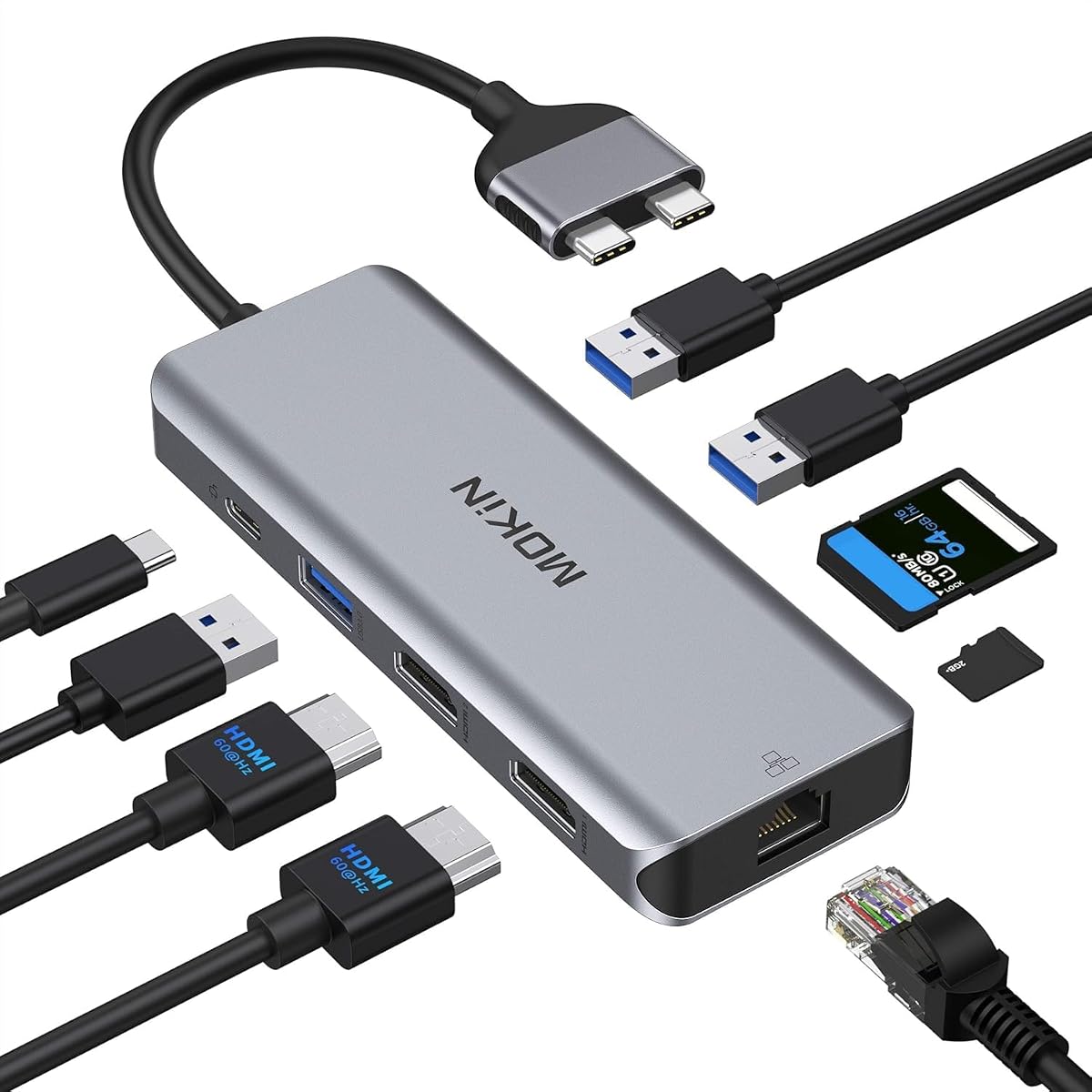
The MOKiN docking station is the most expansive option in this roundup, designed for MacBook Pro and Air 13-, 15-, and 16-inch models listed from 2017 through 2021. It expands the computer into two HDMI ports, two USB 3.0 ports, one USB 2.0 port, SD and Micro SD readers, Gigabit Ethernet, a Thunderbolt 3 port, and 100W power delivery.
We may earn a commission when you buy through this link, at no additional cost to you.
Its primary advantage is dual-display support. One HDMI output can deliver up to 4K at 60Hz, while using both HDMI outputs simultaneously reduces the maximum resolution to 4K at 30Hz on two different monitors. The dock supports both mirrored and extended layouts, making it appropriate for editing, programming, presentations, finance work, and other multi-screen tasks.
Gigabit Ethernet provides a stable wired network option, and the Thunderbolt 3 connection adds high-speed data and display potential. The card readers transfer at up to 104Mbps, while three USB-A connections support peripherals and storage at up to 5Gbps. As with several other docks, the Apple USB SuperDrive is not supported.
This premium dock is best for a fixed dual-screen desk rather than a lightweight travel accessory. It must connect on the side of a compatible MacBook with two Thunderbolt 3 ports, and the instructions explicitly warn that a model with only one Thunderbolt 3 port on that side is unsupported. Its aluminum body and broad port selection reward users who want one permanent connection point for an entire workstation.
The dual HDMI arrangement is the standout feature, allowing a MacBook to serve as the central computer for a multi-display workspace. A single display can run at 4K 60Hz, while a two-screen setup operates at up to 4K 30Hz per output according to the supplied information.
Ethernet, card readers, high-speed USB, Thunderbolt 3, charging, and dual displays reduce the number of cables required at a desk. The anodized aluminum housing is designed for a stationary setup, while side-port placement requirements make compatibility with the exact MacBook model essential.
We may earn a commission when you buy through this link, at no additional cost to you.
This USB-C-to-HDMI adapter is the simplest option in the guide, providing a direct video and audio connection from a compatible MacBook or other USB-C device to a monitor, television, or projector. It has a 4.4 rating and avoids the complexity of a multiport dock.
We may earn a commission when you buy through this link, at no additional cost to you.
The adapter supports up to 4K at 30Hz, 2K at 60Hz and 75Hz, 1080p at 60Hz and 120Hz, and 720p at multiple refresh rates. Synchronous audio and video transmission means sound can follow the image without requiring a separate audio cable. Both mirroring and extended desktop modes are supported when the host device and operating system allow it.
Its main limitation is also its main strength: there are no USB-A ports, card readers, Ethernet connections, or power-delivery input. Users who need to charge the MacBook or attach a keyboard and mouse will still need separate cables or a more complete hub. The product supports hot-plugging and requires no driver or software installation.
This converter is a sensible choice for presentations, a second display, travel, or a simple desk where video is the only requirement. It also works with compatible tablets, smartphones, Chromebooks, and XPS systems as listed. Confirm that the source USB-C port supports video output before use, since not every USB-C connection includes DisplayPort Alternate Mode.
By limiting the feature set to video conversion, the adapter avoids unnecessary connections and remains straightforward to operate. It is a practical first monitor accessory for someone who needs a larger display but has no immediate requirement for charging, storage, networking, or card access.
The broad resolution list gives users options across 4K, 2K, Full HD, and HD displays. Support for 1080p at 120Hz is particularly useful for compatible high-refresh monitors, while 4K at 30Hz remains appropriate for many productivity and media displays.
We may earn a commission when you buy through this link, at no additional cost to you.
The best monitor adapter for MacBook depends on connector compatibility, display resolution, charging needs, peripheral count, portability, and the specific ports your daily workflow requires.
Most modern MacBook Air and MacBook Pro models use USB-C, but an older MacBook may use Mini DisplayPort or a related video output. A USB-C hub cannot physically connect to Mini DisplayPort, while a Mini DisplayPort converter cannot be assumed to work with a USB-C port. Check the exact connector on the computer rather than relying only on the model family.
A 4K specification alone does not reveal the complete display capability. Some adapters support 4K at 30Hz, while others support 4K at 60Hz. High-refresh Full HD output, such as 1080p at 120Hz, may be more relevant to a gaming monitor than a higher-resolution but slower 4K mode.
A single HDMI port does not guarantee that a MacBook can drive two external displays. Some adapters include only one display output, while others provide HDMI plus Thunderbolt. Apple Silicon models can have different external-display limitations, so confirm the exact MacBook chip and the adapter's stated support before planning a mirrored or extended multi-screen layout.
A hub with a USB-C charging port can keep a MacBook powered while the display and peripherals remain connected. The listed maximum input may reach 100W, but some hubs reserve part of that capacity for connected devices or deliver less to the computer. Compare the charger, MacBook model, and hub specifications rather than treating every USB-C charging port as equivalent.
USB-A data speeds range from 480Mbps on USB 2.0 connections to 10Gbps on high-speed ports. A 5Gbps port is generally practical for external storage and everyday file transfers, while Thunderbolt 3 provides a much higher bandwidth path. Count keyboard, mouse, storage, webcam, and reader connections before selecting the number and type of ports.
Integrated SD and TF readers can save photographers and designers from carrying separate adapters, and they are convenient for quickly reviewing media. Gigabit Ethernet provides a dependable wired network connection. Neither feature is essential for every user, but both can eliminate clutter when the MacBook has few built-in ports.
Compact dongles suit travel, shared desks, and occasional presentations, while larger docking stations suit permanent workstations. Cable length, housing material, and the number of ports all affect portability. A highly compact adapter may also provide less charging power, fewer data ports, or only one display output, so the smallest device is not automatically the most versatile.
Important limitations can include unsupported storage, restrictions on connecting multiple hard drives, case-fit problems, and host-port requirements. Some products explicitly exclude the Apple USB SuperDrive, and some high-speed ports cannot carry display or charging signals. Reading the complete specifications helps prevent a mismatch that may not be obvious from the port count.
Begin by confirming that the MacBook's connector supports video output and that the adapter is intended for that connector type. Connect the hub to the MacBook first, attach the display cable to the HDMI or other video port, and then connect a compatible charger to the power-delivery port if the hub provides one. The final step is to select the correct display arrangement in macOS system settings.
When there is no picture, check that the monitor input matches the output being used, confirm the display is powered on, and try reconnecting the adapter. The system may also need the display recognized through macOS settings. For no-signal problems, the ACASIS guidance recommends checking the host's video support, switching cables or ports where possible, and reviewing display configuration settings.
For long-term care, avoid sharply bending the cable near the connector and do not force it into a case or port. Connect high-power hard drives one at a time when the product instructions require it, and do not use incompatible devices such as the Apple USB SuperDrive. Periodic cleaning with a dry, soft cloth helps keep the connectors free of dust without introducing moisture into the electronics.
No, not every MacBook has a compatible connector or supports the same functions through that port. Modern USB-C MacBooks generally work with DisplayPort Alternate Mode, but the host port must support video output. Older MacBooks may require a Mini DisplayPort adapter instead, so checking the connector on the computer is essential.
Only if it includes a separate USB-C power-delivery input. A basic display converter carries video and sometimes audio but has no charging capability. Multiport hubs with charging ports can power a MacBook while the adapter remains connected, subject to the adapter's stated wattage and any power reserved for hub operations.
Choose a resolution and refresh rate supported by both the adapter and the monitor. A 4K at 60Hz adapter is preferable for smooth high-resolution operation, while 4K at 30Hz is adequate for many productivity and media tasks. For high-refresh gaming, verify whether the adapter supports the desired Full HD or higher refresh mode.
It depends on the number of video outputs and the MacBook's capabilities. A dock with two HDMI ports may support two displays, potentially at a reduced maximum resolution when both are active. Some MacBook configurations, including certain M1 models, do not support two external displays and may show a black screen on one output.
A hub generally offers a compact collection of ports such as HDMI, USB-A, charging, and card readers. A docking station is usually a larger, more permanent desktop accessory that may add multiple display outputs, Ethernet, more USB ports, and Thunderbolt connectivity. The best choice depends on whether the device is used mainly for travel or a fixed workstation.
The cause may be an unsupported MacBook port, an inactive display setting, a mismatched monitor input, or a loose connection. Verify that the USB-C port supports video output, select the correct display configuration in macOS, and confirm that the monitor is set to the input connected to the adapter. Reconnecting the cable or testing a known-compatible display can narrow down the problem.
Many of the listed adapters support external hard drives or SSDs, but the model instructions may limit you to one drive at a time. High-power storage can also require more energy than a hub provides, making a powered or more capable connection preferable. The Apple USB SuperDrive is explicitly unsupported by several products in this guide.
Usually not. Mini DisplayPort adapters are intended for older MacBook models and compatible devices that have the appropriate Mini DisplayPort or Thunderbolt 2 output. Most recent MacBook Air and MacBook Pro models use USB-C, so a USB-C hub or adapter is normally required. Always compare the physical connector and supported video path before ordering.
The UGREEN 5-in-1 hub stands out as the most balanced general recommendation, combining a 4K HDMI port, 100W power delivery, and a useful mix of USB-A connections. The BENFEI 5-in-1 is also highly rated and particularly portable, while the MOKiN docking station leads the group for buyers who need two displays, Ethernet, and a broad permanent workstation connection.
Before buying, prioritize the features you will actually use: verify the MacBook connector, confirm display resolution and refresh rate, check charging capacity, and count the peripherals that need ports. Creative users may prioritize card readers and fast storage, frequent travelers may prefer a compact hub, and multi-screen workers should ensure both the MacBook model and operating system support the proposed arrangement.
Specifications, ratings, availability, and pricing can change over time. Review the current product listing and updated compatibility notes before ordering, especially for older MacBooks, recently released models, or setups involving multiple external monitors.