
Newentor Weather Station Wireless Indoor Outdoor Thermometer, Black, 1Sensor
4.3Editor score
Large color LCD display
Three-channel sensor support
Atomic clock and forecasts
Our Large Screen Weather Station guide compares ten readable, feature-rich models for home monitoring, forecasts, smart-home use, and backyard data in 2026.
A large screen weather station turns a complex collection of environmental readings into information you can check at a glance. The strongest models combine readable displays with useful forecasts, indoor comfort data, wireless outdoor sensors, and thoughtful functions such as barometric graphs, alerts, atomic time, and smart-home connectivity.
We compared all ten products by display size and readability, sensor capabilities, forecast features, wireless range, power options, mounting requirements, and usefulness for different households. The list includes basic indoor and outdoor stations, professional-style all-in-one sensors, Wi-Fi models, and a no-moving-parts station designed for low-maintenance monitoring.
Each review explains what the product does well, where its feature set stops, and the type of buyer it suits best. The three highlighted selections cover affordable, well-rounded, and premium priorities, while every other model brings a distinct advantage. Product availability and pricing can change, so confirm current details before purchasing.
4.3Editor score

4.4Editor score

4.2Editor score
The comparison below highlights each model's display, core sensor coverage, connectivity, and most distinctive capability, making it easier to identify the station that matches your monitoring needs.


The Newentor Weather Station delivers an unusually broad set of features for an entry-level model, earning a 4.3 rating among buyers. Its large color LCD presents indoor and outdoor temperature, humidity, daily records, forecasts, time, alarms, moon phase, and barometric pressure in a format designed for quick everyday checks rather than specialist meteorological analysis.
We may earn a commission when you buy through this link, at no additional cost to you.
Its strongest advantage is flexibility. Although the package includes one remote sensor, the console supports up to three channels, allowing a household to monitor several rooms or locations. The forecast uses barometric pressure over a calibration period, while customizable alerts, dual alarms, snooze, and atomic time make the unit useful as a bedside or living-room clock. Wall power keeps the display continuously illuminated, whereas battery operation activates an energy-saving backlight.
The trade-offs are straightforward: only one remote sensor is supplied, and batteries are not included. Barometric forecasting also needs several days of calibration before its projections become established, so the station should not be judged from a single day's output. These limitations make it less suitable for users who need wind or rainfall measurements, but they do not diminish its value for core temperature, humidity, comfort, and forecast monitoring.
This is a strong budget recommendation for a household wanting a colorful, multifunction display without investing in a complete outdoor sensor array. It offers more visible information and expandability than a simple indoor-outdoor thermometer, while remaining approachable to set up. Choose it when readable presentation, atomic time, and multiple temperature channels matter more than professional-grade wind and rain sensors.
The screen brings together the data most households check most often: indoor and outdoor temperature, humidity, high and low records, pressure, forecast icons, and the clock. Adjustable illumination improves visibility at night, while the dual-alarm setup broadens its value beyond weather monitoring.
Supporting as many as three remote sensors makes this console more versatile than basic two-part thermometers. You can add sensors for additional rooms or outdoor positions as needed, although the included one-sensor package determines what you can monitor immediately.
We may earn a commission when you buy through this link, at no additional cost to you.
The AcuRite Iris combines an attractive large color display with one of the most complete environmental feature sets in this guide, earning a 4.4 rating. It reports more than 55 data points, including temperature, humidity, wind, rainfall, pressure, heat index, dew point, and feels-like temperature, giving users both immediate conditions and deeper context.
We may earn a commission when you buy through this link, at no additional cost to you.
The console's real strength is its balance of information and usability. Wireless readings arrive from an outdoor sensor, while the pressure trend and elevation data help generate a personalized forecast for the following 12 hours. A large, adjustable-dimming LCD keeps the clock, date, conditions, and measurements legible, and the supplied mounting bracket makes it straightforward to position the remote sensor on a pole or post.
Its limitations are practical rather than fundamental. This is a single-console system, so it does not offer the multiple display units seen in the dual-display option, and outdoor installation requires suitable placement. A wireless station also depends on a clear radio path and sound mounting practices. Nevertheless, the Iris provides an unusually complete picture without requiring a separate professional-grade all-in-one sensor array.
For most households seeking the strongest balance of screen size, local forecasting, and meaningful backyard measurements, the AcuRite Iris is the most convincing all-around choice. It suits a homeowner who wants wind, rain, humidity, and comfort information in one readable place without moving into network-connected or solar-powered territory. Its feature breadth and ease of setup justify our Editor's Choice designation.
Rather than presenting forecast icons without context, the Iris combines pressure, trend, and elevation information to create a personalized 12-hour outlook. Giving that system time to collect consistent pressure data produces a more useful local forecast than a generic icon alone.
Wind speed and direction, rainfall, heat index, dew point, and historical data make the station useful for planning yard work, checking comfort, and understanding changing conditions. The more than 55 available data points reward users who want to explore beyond a basic forecast.
We may earn a commission when you buy through this link, at no additional cost to you.
The La Crosse Technology C85845-INT is a polished indoor and outdoor station with a 4.4 rating, particularly strong for households that want alerts tailored to their routines. Its large display combines dynamic forecast icons, trend arrows, indoor and outdoor temperature, humidity, dew point, heat index, comfort charts, and a full calendar in one highly readable console.
We may earn a commission when you buy through this link, at no additional cost to you.
Customization is the defining feature. Users can establish high and low alerts for both temperature and humidity, while colorful comfort bars visually translate relative humidity from 10% to 99% for indoor and outdoor sensors. The atomic self-setting clock supports 12- or 24-hour formats, seven time zones, automatic daylight-saving adjustment, a crescendo alarm, and a 10-minute snooze.
The station operates on its included 5V cord for a constant backlight, with three AA batteries serving as optional backup; those backup batteries are not included. Forecast arrows and icons also require approximately seven to 10 days of barometric calibration. The included outdoor temperature and humidity sensor requires two AA batteries, adding another maintenance item to consider.
This model is an excellent fit for families who want prominent, configurable warnings and clear comfort information without a complex installation. It lacks the wind and rain hardware of higher-end stations, but it turns basic atmospheric data into a polished and highly practical display. For alert-focused monitoring, it is one of the most attractive choices in the group.
Separate high and low thresholds for temperature and humidity make the display useful for children, pets, plants, and home comfort. A warning can be tailored to the range that matters instead of relying on one generic alarm.
Colorful comfort bars make relative humidity easier to interpret than a percentage alone. Seeing indoor and outdoor comfort side by side can help identify muggy, dry, or excessively humid conditions without navigating through multiple menus.
We may earn a commission when you buy through this link, at no additional cost to you.
The Ambient Weather WS-5000 is a sophisticated smart station with a 4.1 rating, designed for users who want detailed backyard observations and remote automation. Its full-color TFT console is paired with an ultrasonic sensor array, rain cup, and indoor-outdoor thermo-hygrometer-barometer, creating a complete monitoring package with a professional appearance.
We may earn a commission when you buy through this link, at no additional cost to you.
The all-in-one array eliminates moving components while updating conditions every five seconds. Through enhanced Wi-Fi, measurements can be transmitted to the Ambient Weather Network, accessed remotely, and integrated with IFTTT, Google Home, Alexa, and other smart-home systems. That makes the station more than a display: it can serve as a trigger for lighting, heating, cooling, or other automated decisions.
The trade-off is complexity. A station with this many sensors, network features, and calibration options demands more attention than a basic thermometer forecast, and a 4.1 rating suggests that some buyers may find the experience less immediately straightforward. The extensive capabilities also place it closer to the premium end of this guide than the simpler indoor-outdoor models.
Choose the WS-5000 if you want frequent updates, dependable sensing without exposed moving parts, and real smart-home integration. It is especially appealing to a technically comfortable homeowner who plans to monitor conditions remotely or automate decisions around them. The model is less appropriate for someone seeking a simple bedside display with minimal configuration.
The WS-5000 can feed current backyard conditions into connected services, turning the station into a useful input for automations. This is more valuable than merely viewing readings when the goal is to react to heat, rain, or changing conditions automatically.
Updates every five seconds give the display a live quality, while the ultrasonic array removes the mechanical parts associated with some traditional wind sensors. That combination supports dependable operation with less routine attention to moving components.
We may earn a commission when you buy through this link, at no additional cost to you.
The Ambient Weather WS-2000 is a capable backyard station with a 4.4 rating and a compact all-in-one design. A TFT color display provides a clear central readout, while the integrated outdoor sensor array measures wind speed, wind direction, temperature, humidity, rainfall, ultraviolet index, and solar radiation.
We may earn a commission when you buy through this link, at no additional cost to you.
Its integrated array simplifies the physical setup compared with stations that require several separate remote components. The console supports imperial and metric units, and sensor calibration is available for users who want to refine readings. Enhanced Wi-Fi is also an option, allowing transmission to the Ambient Weather Network for remote viewing and sharing of hyperlocal conditions.
The outdoor array uses three AAA batteries, which are not included, while the console receives power through an included 5V adapter. A user who expects a permanent solar setup may therefore need to address battery replacement separately. Wi-Fi connectivity is optional as well, so buyers who prioritize remote access should verify the exact configuration included with the current package.
This station suits users who want a broad collection of outdoor measurements in a relatively straightforward package. It offers a particularly strong balance of data and presentation, especially for garden, pool, or general backyard monitoring. If remote access and automation are secondary, its core local display remains highly capable and can serve as the central monitoring point in a home.
Combining wind, rain, temperature, humidity, UV, and solar sensing in a single array reduces the number of separate installations. It is an efficient approach for users who want broad coverage without managing multiple outdoor sensor units.
Support for both imperial and metric measurements makes the station adaptable to different preferences. Available calibration also gives careful users a way to adjust readings when placement or local conditions warrant more precise comparisons.
We may earn a commission when you buy through this link, at no additional cost to you.
The La Crosse Advanced Weather Station is a familiar-style indoor and outdoor display with a 4.4 rating. It focuses on the essentials: temperature, humidity, weather tendencies, records, alerts, and accurate time. A large full-color LCD makes the console approachable for everyday household use.
We may earn a commission when you buy through this link, at no additional cost to you.
Its weather-resistant remote sensor transmits readings from up to 330 feet when unobstructed, offering a useful balance between reach and installation flexibility. The display provides minimum and maximum records, customizable temperature and humidity alerts, dynamic forecast icons, and tendency indicators. An atomic self-setting clock, daylight-saving reset, and selectable 12- or 24-hour display add convenient clock functionality.
This model does not measure wind or rainfall, so it cannot replace a complete backyard weather station. It also needs a 5V adapter for the full display, with three AAA batteries providing optional backup; those backup batteries are not included. When running on batteries only, the backlight is temporary rather than constant, which is sensible but less convenient at night.
Its audience is the household that wants accurate indoor comfort and outdoor conditions in a traditional, uncluttered format. It is a particularly good fit for bedrooms, kitchens, and living rooms where atomic time and straightforward alerts matter more than remote access. For those priorities, the station delivers a polished and dependable experience.
Temperature, humidity, records, and adjustable alerts cover the most common reasons to buy a home weather station. The display keeps these functions prominent, reducing the learning curve for users who do not need specialist meteorological tools.
High, low, and off backlight settings let users tailor visibility to different rooms and times. The temporary battery-only illumination conserves power while keeping a quick nighttime glance possible.
We may earn a commission when you buy through this link, at no additional cost to you.
The Tempest Weather Station is a premium, connected system with a 4.2 rating. It combines a broad measurement set with a solar-powered outdoor sensor, wireless transmission of more than 1,000 feet, and real-time updates every three seconds. The result is designed for owners who want detailed hyperlocal data without maintaining exposed moving parts.
We may earn a commission when you buy through this link, at no additional cost to you.
A single outdoor device measures temperature, humidity, barometric pressure, wind speed and direction, dew point, solar radiation, UV index, lightning strikes, and rainfall. The absence of moving parts supports long-term, near-zero-maintenance operation. Tempest also integrates with Amazon Alexa, Rachio, IFTTT, and popular smart-home platforms, allowing weather readings to influence lighting, thermostats, and irrigation.
Its primary compromise is the emphasis on connected app-based use. Buyers who want a self-contained bedside display with no ecosystem dependency may find that approach less direct. It also occupies the premium end of the selection, making its value proposition more dependent on how fully the user intends to use remote monitoring and automation. The outdoor installation and solar positioning still require thoughtful placement.
The Tempest is our premium selection because it offers a convincing combination of maintenance reduction, rapid updates, extensive sensor coverage, and smart-home depth. It is an especially strong option for a homeowner building an automated irrigation or climate-control system. Those seeking simpler local readings can find more straightforward models, but nobody else in this list matches this level of connected all-in-one capability.
The absence of mechanical components reduces the routine wear associated with spinning anemometers and other moving sensors. Combined with solar power, it supports an outdoor installation designed for dependable, low-attention operation.
Real-time conditions can flow into services such as Alexa, Rachio, and IFTTT, allowing irrigation, lighting, and temperature controls to react to actual backyard weather. This turns observation into practical automation rather than leaving the data on a passive screen.
We may earn a commission when you buy through this link, at no additional cost to you.
The S84107 Wireless Color Forecast Station provides a colorful, information-rich display and carries a 4.4 rating. It is particularly distinctive for showing barometric pressure alongside a 24-hour historical graph, allowing users to see whether conditions are rising, falling, or holding steady instead of relying only on a forecast icon.
We may earn a commission when you buy through this link, at no additional cost to you.
Indoor and outdoor temperature, humidity, minimum and maximum records, and customizable alerts complete the practical weather functions. The seasonal foliage background changes every three months, adding visual variety without getting in the way of the readings. A forecast tendency indicator gives a quick indication of the expected direction of change.
The unit does not supply wind or rainfall measurements and does not include remote app connectivity, so it is better suited to comfort and forecast monitoring than comprehensive backyard analysis. The listed indoor temperature range is +32°F to +99°F, or 0°C to 37°C, and the manual is recommended for setup and troubleshooting. Prospective owners should ensure that the specified indoor range suits their location.
This station is a good choice for someone who appreciates a traditional forecast display but wants more pressure context than a basic thermometer. Its graph, themes, and color interface make it visually engaging while remaining useful. It is less compelling for smart-home users, yet it offers an effective way to understand short-term weather trends from a comfortable indoor console.
The 24-hour pressure graph adds context that a single barometer number cannot provide. Trends can help explain why the forecast is changing and make short-term conditions easier to interpret.
Foliage backgrounds that rotate every three months give the console a fresh appearance without complicating operation. The change is decorative rather than functional, but it makes a frequently visible household display more pleasant to keep in view.
We may earn a commission when you buy through this link, at no additional cost to you.
The La Crosse V42-PRO-INT is a smart Wi-Fi station built for detailed home and backyard monitoring, earning a 4.2 rating. Its large color console supports six standalone views, and the included outdoor equipment measures wind, rainfall, temperature, and humidity. The main appeal is the ability to check conditions remotely through the La Crosse View mobile app.
We may earn a commission when you buy through this link, at no additional cost to you.
With Wi-Fi connected, the station expands beyond its standalone forecast, showing today and the next seven days, the following 12 hours, UV index, sunrise and sunset, thunderstorm information, air quality, and additional data. Wind readings include current and top speed, direction, and a compass rose, while rain graphs and historical records provide context for recent weather.
This breadth comes with a more involved installation. The temperature and humidity sensor requires two AA batteries, the wind and rain sensor requires three AA batteries, and none of those batteries are included. The console includes a 5V adapter and a CR2032 backup cell for retaining data, though that cell does not keep the system running. The transmission range reaches up to 400 feet.
Choose this model when remote access and a detailed outdoor record are central goals. It is especially useful for monitoring rain before a trip, reviewing wind conditions, or tracking forecasts from inside the home. Users wanting a simple display will find more setup, but those who use the extended data and app alerts may find the investment thoroughly worthwhile.
Current and peak wind data, a compass rose, rainfall graphs, and timestamped records go beyond a simple present reading. These features make the station useful for reviewing recent conditions instead of losing the context as soon as a number changes.
Remote app access and expandable Wi-Fi views make it possible to check the coming hours and week from a phone. Custom alerts and notifications reduce the need to keep returning to the console for every update.
We may earn a commission when you buy through this link, at no additional cost to you.
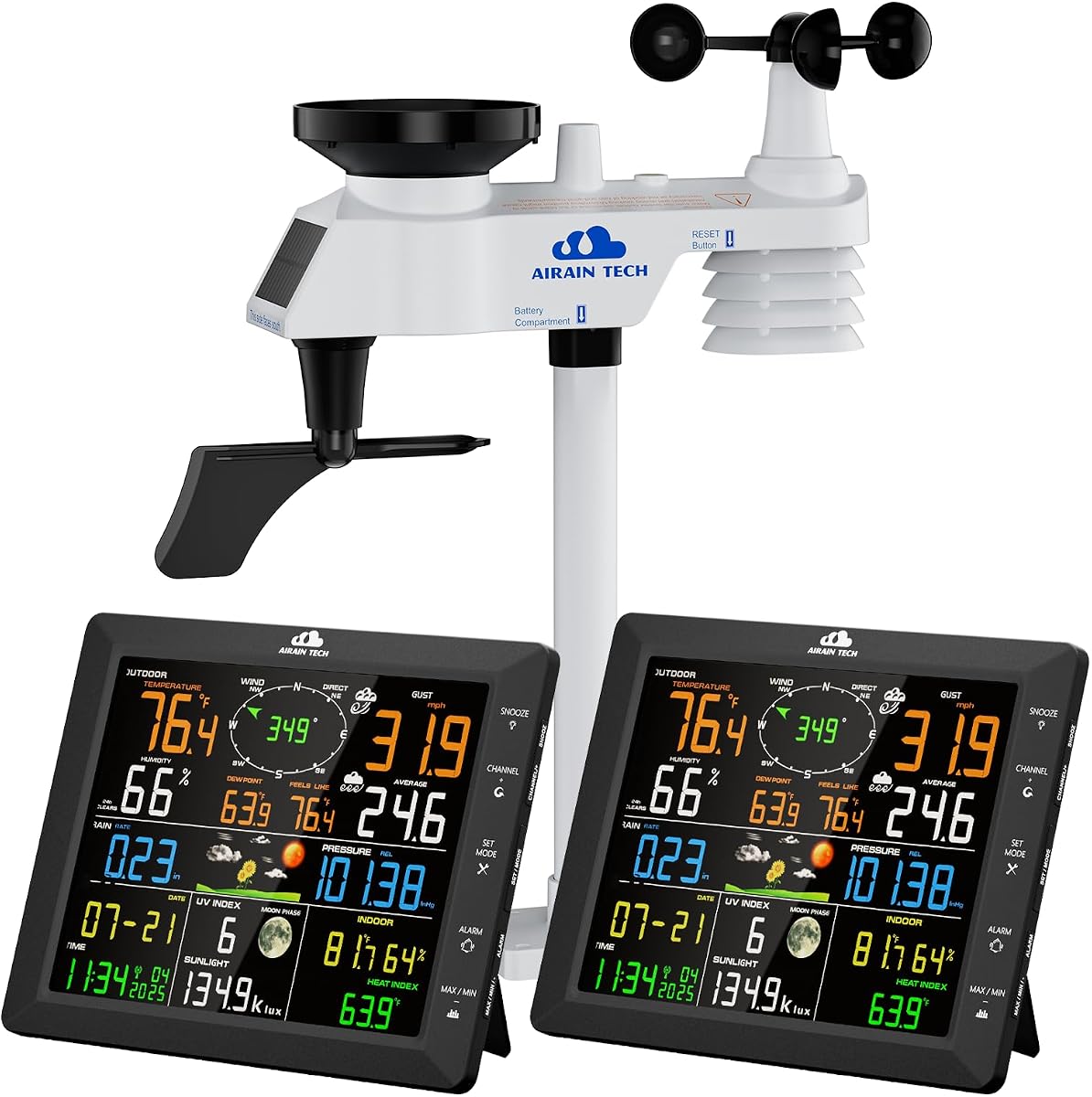
The Dual-Display Weather Station stands out with two 8.5-inch color LCD consoles, each capable of presenting the same broad range of environmental information. Its 4.4 rating reflects a feature-rich approach aimed at households that want to see weather conditions in two separate rooms without relying on an app.
We may earn a commission when you buy through this link, at no additional cost to you.
Each display shows wind speed and direction, future weather trends, indoor and outdoor temperature and humidity, barometric pressure changes, moon phase, UV index, wind chill, and dew point. The outdoor equipment includes a rain gauge, anemometer, and temperature and humidity sensors, with a stated wireless coverage radius of up to 328 feet. An atomic clock adds another familiar household function.
The absence of Wi-Fi is the clearest limitation. There is no remote app or connected automation, so the two physical screens carry most of the value. The package is also extensive, including mounting hardware, a pole, adapters, fasteners, and an adjustable bracket. Setup is designed to be straightforward, with automatic pairing and synchronization after power-up.
This is a good option for a main living area and a bedroom, office, or kitchen where a second large readout is useful. It offers the broadest two-console solution in this guide and performs well for people who prefer local displays over phones. The best buyer is someone who values visibility and complete readings more than remote access.
Two large consoles let different parts of the home share the same outdoor sensor data. It is a practical alternative to checking a phone and removes the need to walk to a single display every time conditions change.
Rainfall, wind, UV, moon phase, wind chill, dew point, pressure, and temperature and humidity create one of the broadest local information sets. The combined display makes the most of that data in a single glance.
We may earn a commission when you buy through this link, at no additional cost to you.
The best large screen weather station depends on what you want to monitor, where the console will live, and whether you need remote access. Display quality, sensor coverage, installation demands, and ongoing maintenance deserve equal attention.
A large screen is useful only when its information can be read from a normal viewing distance. Look for a color LCD or TFT display, clear icons, adjustable backlight, and labels large enough to distinguish temperature, humidity, wind, and pressure without sitting directly in front of the console. A dimmer is especially important for bedrooms, while constant backlight suits a display that remains visible throughout the day.
In practice, prioritize the most important readings for your routine rather than simply choosing the largest panel available. Dual-display models can be more useful than one enormous screen when the goal is visibility in two rooms. Select a display that presents daily conditions clearly and relegates advanced data to secondary views.
Temperature and humidity are the baseline measurements for most home stations. Models with barometric pressure can add a forecast tendency, while wind and rain sensors are important for gardening, pools, outdoor work, and storm awareness. Premium systems may also add UV, solar radiation, dew point, heat index, wind chill, lightning detection, and comfort calculations. Choose sensors that will improve decisions you regularly make.
More measurements are not automatically better. Each additional outdoor component adds mounting, alignment, power, and maintenance requirements. A station with dependable temperature, humidity, and pressure may serve a small household better than a complex setup whose advanced data will rarely be consulted.
Many local forecasts are generated from barometric pressure trends, which means the station needs consistent readings over several days. Products in this guide may require approximately seven to 10 days for calibration. Check whether the forecast is an icon, a directional tendency, an hourly outlook, or a multi-day projection, and consider how a Wi-Fi connection changes the available forecast data.
A forecast based on local pressure is useful for short-term planning, but it is not a replacement for official severe-weather alerts. Treat the display as an added layer of household awareness and continue following local emergency guidance when conditions warrant it.
Stated wireless ranges generally assume an unobstructed path between the sensor and console. Walls, floors, metal objects, and the location of the outdoor unit can reduce practical performance. Compare the manufacturer's range with the actual distance and building layout of your property. Systems supporting multiple sensors or long ranges offer flexibility, but a clear line of communication remains more important than a headline number.
For a console in the center of a home and a sensor outside, test reception before mounting permanently. Outdoor sensors should also be positioned where they can measure representative conditions without direct shelter that weakens wind or rainfall readings.
Wi-Fi adds remote viewing, historical data, expanded forecast data, and integrations with services such as Alexa, IFTTT, Google Home, and Rachio. These features can support irrigation control, lighting, heating, and cooling, but they also require network configuration and compatible accounts. A local-only station is simpler and remains fully useful for anyone who prefers not to connect personal devices to a weather network.
Consider whether remote access is occasional convenience or an essential part of the purchase. If automation will drive real decisions, smart connectivity may justify the added complexity. If the display mainly provides a glanceable indoor reading, local operation can be the more dependable choice.
Wall power generally enables the clearest display, continuous backlight, and full wireless transmission. Battery operation offers installation flexibility but requires regular replacement, and many packages do not include the specified batteries. Backup power can preserve the clock and some data during an outage, although it may not keep every display function active. Note which components need mains power and which run on batteries.
Low-maintenance designs deserve attention if the station is difficult to reach. Solar-powered or no-moving-parts systems reduce ongoing work, while traditional anemometers, rain collectors, and distributed sensors may need cleaning and adjustment. The best station is one you can realistically maintain for years, not merely the one with the most advanced hardware.
Atomic time, automatic daylight-saving adjustment, dual alarms, snooze, customizable thresholds, and historical high-low records can make a weather station more useful every day. These functions are especially valuable when the console doubles as a bedroom or kitchen clock. Comfort charts, dew point, heat index, and feels-like readings are also helpful for judging indoor conditions and planning daily activities.
Set the benefits around your routine. A plant owner may prioritize humidity alerts, while a family may value freeze and heat warnings. Choose a model that presents those thresholds clearly rather than hiding useful information within a complicated menu.
The console should be mounted or placed where it can be seen easily without being exposed to glare, accidental knocks, or moisture. Consider night-time visibility, viewing distance, power-cord access, and whether the device is also serving as an alarm clock. Models with two displays solve the placement problem more effectively for some homes, while one console keeps the arrangement simpler.
Outdoor sensor placement also affects the usefulness of indoor readings. Avoid positioning a temperature probe in direct sun, near a heat vent, or under a roof where it cannot accurately represent conditions. Follow the manual's mounting guidance to preserve sensor exposure and wireless performance.
Begin by unpacking every component and comparing it with the included manual before installing batteries or mounting hardware. Identify the console, remote sensors, rain and wind components, power adapters, mounting brackets, and any required fasteners. Install batteries in the specified sections only, observe polarity, and keep the display console indoors unless its manual explicitly permits outdoor operation.
Position the remote equipment in an open, representative location away from direct sunlight, strong artificial heat, sheltered rain collection, and obstructions that could distort wind readings. Use the supplied pole or bracket where appropriate, and keep the radio path between the sensor and console as clear as practical. Power on the display, allow the system to pair or synchronize, and set the time, date, units, alerts, and backlight preferences.
For accurate forecasts, let the station operate continuously long enough to calibrate its barometric sensor, which may require several days. Clean accessible rain collectors and sensor openings on the schedule recommended in the manual, especially after severe weather. Check battery levels, wireless reception, and time synchronization periodically, and update connected apps or firmware when the manufacturer provides a new release.
The most important feature depends on how you plan to use the station. Most households prioritize an easy-to-read display, accurate indoor and outdoor temperature, humidity, and a reliable forecast, while gardeners and weather enthusiasts may prioritize wind, rainfall, UV, and pressure history. Choose the sensor data that will influence your daily decisions rather than paying for features you will never consult.
No. Local stations display readings on the console and do not require a network connection. Wi-Fi is useful when you want remote monitoring, historical data, expanded multi-day forecasts, app alerts, or smart-home automation. If you only need a glanceable display in one or two rooms, local operation can be simpler and equally effective.
Local barometric forecasts depend on identifying changes in atmospheric pressure rather than a single instantaneous reading. The console needs consistent measurements over approximately seven to 10 days to establish a meaningful trend. Give the station time to operate before judging the accuracy of its forecast icons or tendency arrows.
That depends on the model. Some stations support several channels and can monitor different rooms or outdoor locations, while others are designed for one indoor display and one remote sensor. Check the channel count and included components before purchasing, especially if you want to compare a bedroom, kitchen, garage, and outdoor area simultaneously.
Choose an open location that represents the local environment without direct sunlight, heat exhaust, or heavy shelter. Keep the sensor visible to wind where appropriate, allow rainfall to reach the collector, and maintain a clear wireless path to the console. Secure the mounting pole or bracket firmly because wind and weather can place substantial force on outdoor equipment.
Atomic time is not necessary for weather sensing, but it makes the console more accurate as a household clock. It automatically synchronizes and can correct clock drift, especially for users who rely on alarms or keep the display in a bedroom. Models without it can still be set manually and function perfectly well as weather monitors.
A home weather station can help you notice rapid changes in pressure, wind, rainfall, and other local conditions, but it should not replace official alerts. Continue following local emergency services and National Weather Service warnings. A home sensor is best treated as supplemental awareness and planning information.
Maintenance usually includes replacing batteries, keeping the rain collector and sensor openings clean, checking mounting stability, and confirming that readings are arriving normally. Models with moving parts may require additional care, while no-moving-parts and solar-powered designs generally need less routine attention. Always follow the model's cleaning and service instructions.
The Newentor Wireless Weather Station is the best budget option because it combines a large color screen, atomic time, forecasts, and expandable sensor channels. The AcuRite Iris is the strongest all-around choice, adding wind, rainfall, detailed environmental data, and a personalized forecast, while the Tempest Weather Station represents the premium connected experience with rapid updates, solar power, and extensive automation.
Prioritize the information you will use every day, along with the distance between your console and outdoor equipment. Basic indoor-outdoor models are easiest to maintain, comprehensive stations are more useful for yard and storm awareness, and Wi-Fi systems are worth the added complexity when remote access or automated irrigation and climate control are genuine priorities. Local displays remain the most straightforward choice for limited-screen households.
Before buying, verify the current package contents, sensor requirements, forecast details, wireless range, and power options on the product listing. Availability and prices can change over time, so check current retailer information and compare the final package with the features that matter most to your home.