
Skar Audio EVL-65 D4
4.6Editor score
Dual 4-ohm voice coils
200-watt RMS handling
Compact 6.5-inch design
A subwoofer dedicated to reproducing 69 Hz can add focused low-end impact to music, films, and games, but the best choice depends heavily on the vehicle, enclosure, amplifier, and connection method. The category includes compact car drivers, larger 6×9-inch units, powered home speakers, and complete preloaded bass packages.
We compared the ten featured models using their supplied specifications, including driver size, voice-coil impedance, power handling, frequency response, enclosure type, crossover controls, and input options. The list also distinguishes bare subwoofers that need external equipment from powered and loaded systems designed for a more direct installation.
Each pick highlights a different practical advantage, from space-conscious construction to ready-made amplifier packages. The three featured selections represent especially useful configurations, while the remaining reviews explain where other drivers or complete systems may be a better fit. Prices and availability can change, so confirm current details before buying.
4.6Editor score

4.7Editor score

4.6Editor score
As an Amazon Associate we earn from qualifying purchases.
This side-by-side comparison covers compact component drivers, 6×9-inch car speakers, powered home subwoofers, under-seat systems, and fully loaded bass packages, with attention to the specifications that most affect installation and performance.




The KICKER 48CWRT672 CompRT 6.75-inch subwoofer combines a 4.7 rating with a design centered on installation flexibility. Its dual-voice-coil configuration allows several wiring arrangements, while the thin profile makes it more practical for constrained vehicle cavities than many conventional square-cone subwoofers.
We may earn a commission when you buy through this link, at no additional cost to you.
Its standout feature is the heat-management design, which combines a high-mass solid pole piece, a unique thin-driver cooling arrangement, and forced-air cooling that the manufacturer states operates 20 percent cooler. The dual voice coils also give installers flexibility when matching the driver to an amplifier, although the published 2-ohm configuration still requires care to stay within the amplifier's supported load.
As a bare component subwoofer, this model does not include an enclosure, amplifier, or wiring. Those omissions are reasonable for builders who already have a custom box, but they make the KICKER less convenient than a loaded or powered package. The need to construct a correctly sized, sealed, or ported enclosure is the main tradeoff for a buyer comparing complete systems.
This is a strong choice for installers who want a powerful 6.75-inch driver without surrendering cabin space. It also suits enthusiasts who understand impedance and enclosure design and want flexibility in how the voice coils are wired. For anyone seeking a ready-to-install system, one of the loaded Skar packages may be easier, but the CompRT is the top pick for tailored, space-conscious installations.
The 6.75-inch format and dual voice coils give the KICKER more installation options than a standard single-coil driver. The compact format can also help builders fit a subwoofer where a square 10-inch or 12-inch cone would consume valuable trunk or seat space.
Forced-air cooling and a substantial pole piece are especially relevant during high-volume listening, when voice-coil heat can reduce efficiency. The stated cooling improvements make the CompRT a sensible choice for builds where sustained bass is more important than maximum short-term peak figures.
We may earn a commission when you buy through this link, at no additional cost to you.
The Skar EVL-65 D4 earns a 4.6 rating and stands out as a compact, value-oriented 6.5-inch car subwoofer. Its dual 4-ohm voice coils offer installation flexibility, while the listed 200-watt RMS rating gives builders a more useful guide to amplifier sizing than the headline 400-watt maximum.
We may earn a commission when you buy through this link, at no additional cost to you.
The 2-inch copper voice coil, 82.8 dB sensitivity, and 64 Hz resonant frequency support the product's compact but hard-hitting design. Dual coils let an installer present different equivalent loads to the amplifier, helping create a setup that is easier to match to available amplification while preserving the small mounting footprint.
This is not an all-in-one system. The EVL-65 D4 requires a suitable enclosure, amplifier, and appropriate wiring, so its lower purchase entry point can be misleading for someone comparing it directly with a powered home subwoofer or a loaded automotive package. Building the enclosure also introduces additional labor and design decisions.
The Skar is best for budget-conscious car audio builders who want a small subwoofer with real low-end output and flexible wiring. It is less suitable for a plug-and-play buyer or anyone who prioritizes home-theater convenience. Within the component-driver category, its combination of compact size, dual coils, and 4.6 rating makes it an especially balanced recommendation.
A 6.5-inch driver is easier to accommodate than a larger square-cone subwoofer, making the EVL-65 D4 useful in small enclosures and constrained vehicle spaces. Its 200-watt RMS rating and 64 Hz resonant frequency provide meaningful low-end capability without requiring a large, high-power installation.
The dual 4-ohm coils can be wired in series or parallel to suit the amplifier and enclosure plan. That flexibility helps installers balance electrical load, amplifier compatibility, and the desired level of output instead of committing to a single fixed configuration.
We may earn a commission when you buy through this link, at no additional cost to you.
The Klipsch R-100SW is a powered 10-inch home subwoofer with a 4.7 rating and one of the strongest combinations of deep extension and installation convenience in this list. Its all-digital amplifier, frequency response from 32 to 120 Hz, and line-level LFE connection make it a natural choice for a home theater or music system.
We may earn a commission when you buy through this link, at no additional cost to you.
Built-in volume, low-pass crossover, and phase controls let users match the subwoofer to different rooms and source equipment. A 10-inch spun-copper IMG woofer supplies the low-frequency output, while the stated dimensions of 14.5 by 12.5 by 16.4 inches allow buyers to assess whether the cabinet fits the intended location before installation.
The main compromise is footprint. This is a full-size home subwoofer rather than a compact automotive component or under-seat unit. It also cannot be installed like a bare car driver: the enclosure and amplifier are already integrated, so the relevant setup is electronic rather than constructing a box and wiring a separate monoblock.
The R-100SW is the recommendation for someone who wants meaningful low frequency and straightforward home-audio integration without assembling a separate amplifier and enclosure. It is especially suitable for receivers with LFE or RCA output, while the adjustable crossover and phase controls make it flexible across movies, music, and games.
The stated 32 Hz lower limit offers a meaningful extension for a compact home subwoofer, while the separate volume, low-pass, and phase adjustments help integrate it with the main speakers. Those controls are especially useful because room placement and main-speaker crossover settings can otherwise cause uneven bass.
Line-level LFE RCA inputs provide a direct route from an AV receiver, and the included control set supports common setup routines. Automatic power-on and the integrated digital amplifier reduce the amount of separate equipment needed for a functional home system.
We may earn a commission when you buy through this link, at no additional cost to you.
The Rockville RVL69W is a 4.4-rated 6×9-inch car mid-bass subwoofer designed around a standard rectangular mounting location. It offers 300 watts of peak handling and 150 watts RMS per speaker, making it more immediately compatible with common vehicle openings than a square-cone subwoofer requiring a purpose-built enclosure.
We may earn a commission when you buy through this link, at no additional cost to you.
A double-stacked 60oz magnet and 2-inch high-temperature voice coil form the foundation of its power-handling design. The non-pressed paper cone, butyl rubber surround, expanded aluminum basket, and phase-plug bullet dustcap emphasize durability, clarity, and high-output operation, while the supplied TS parameters help builders calculate enclosure options.
The word subwoofer can be misleading for this product because a 6×9-inch driver is often used as a mid-bass specialist rather than the primary source of very deep low frequency. It may complement a larger subwoofer or serve as a rear-fill or enclosure-mounted driver. The 4.57-inch mounting depth should be checked before ordering.
This model is a good fit for installers who want substantial mid-bass from a 6×9 format and value a rigid, well-specified driver for either competition or daily use. It is less appropriate as the only low-frequency source in a system that must reproduce the deepest bass. A smaller sealed enclosure or a carefully designed ported box can help determine its strongest role.
A 6×9 driver can fit openings designed for that format, potentially simplifying installation in trunks, rear panels, or custom boxes. The specified 4.57-inch depth remains important, because exterior clearance and mounting hardware can be just as restrictive as the nominal opening size.
The high-temperature voice coil, substantial magnet, and aluminum basket indicate a design focused on power handling and structural stability. The butyl surround and non-pressed paper cone are also intended to withstand repeated high-volume use while limiting distortion.
We may earn a commission when you buy through this link, at no additional cost to you.
The Memphis MS69MV is an oversized 6×9 convertible mid woofer with a feature set oriented toward flexible installation. Its defining elements are a carbon-fiber cone, external passive crossovers, an MClip crossover mounting solution, a rubber surround, and a 12dB crossover arrangement.
We may earn a commission when you buy through this link, at no additional cost to you.
The convertible approach gives installers more options when the driver is used in a customized system rather than in a simple replacement role. External crossover components can be positioned according to the installation, while the MClip solution is designed to keep the crossover hardware organized and mounted. The carbon-fiber cone provides a rigid, low-mass surface for controlled movement.
Unlike several other products in this guide, the supplied information does not include a numeric customer rating, RMS power, peak power, sensitivity, or impedance. That makes it harder to recommend for a specific amplifier without checking the full manufacturer specifications. Its appeal is presently clearer in terms of specialized design and installation flexibility than quantified output.
The MS69MV is best for experienced car audio builders who appreciate a purpose-designed 6×9 system and understand the importance of crossover placement and proper loading. It may work particularly well for a dedicated mid-bass or multi-way installation, but prospective buyers should confirm electrical requirements and enclosure recommendations before committing to it.
A carbon-fiber cone can help control resonance and maintain consistent movement, particularly in a properly designed enclosure. The material is paired with a rubber surround to provide a compliant connection between the cone and frame.
External passive crossovers and the MClip mounting solution allow the filtering hardware to be integrated more deliberately than a fixed, minimal design. This is useful for advanced builds where system architecture and component placement are carefully planned.
We may earn a commission when you buy through this link, at no additional cost to you.
The Skar Audio dual 12-inch SDR package is the most complete high-output car option here, combining a loaded vented enclosure, a Class D monoblock amplifier, and a 4-gauge OFC wiring kit. Its 4.6 rating reflects a package designed to deliver substantial output without requiring the buyer to select each major component separately.
We may earn a commission when you buy through this link, at no additional cost to you.
The included SDR-2X12D4 loaded enclosure is paired with the RP-1200.1D Class D amplifier, which is listed at 1,200 watts. The package also includes the SKAR4ANL-OFC wiring kit. Together, these components address the enclosure, amplification, and power-wire stages of an installation, although the wiring still has to be routed and connected correctly.
The obvious trade-off is physical size. A dual 12-inch vented enclosure is unlikely to fit under a seat or in a small vehicle trunk, and its power demands make correct electrical installation essential. A 1,200-watt amplifier and dual drivers should not be treated as a casual upgrade for a system with very limited electrical capacity.
This package is the most attractive choice for a car-audio builder who wants a coordinated, high-output system and prefers not to design a box or independently match an amplifier and wiring kit. It is less appropriate for a compact vehicle, a home theater, or a buyer who already owns compatible high-quality equipment. For those situations, the component drivers or Klipsch powered subwoofer offer a better fit.
The package removes much of the decision-making involved in matching a subwoofer, amplifier, enclosure, and wiring kit. Buyers still need to verify electrical suitability, enclosure dimensions, and vehicle space, but they receive a substantially more unified starting point than a bare driver.
Two 12-inch drivers in a vented enclosure are designed to move substantial quantities of air and produce strong low frequency. The stated 1,200-watt RMS and 2,400-watt peak figures make this package more appropriate for high-output car builds than for modest, space-conscious upgrades.
We may earn a commission when you buy through this link, at no additional cost to you.
The Skar EVL-65 D2 is the low-impedance counterpart to the D4 model, with dual 2-ohm voice coils, a 4.4 rating, and a compact 6.5-inch format. It shares a listed 400-watt peak and 200-watt RMS output with the D4 version but offers a slightly different sensitivity and resonant-frequency specification.
We may earn a commission when you buy through this link, at no additional cost to you.
Its 2-inch copper voice coil, 83.1 dB sensitivity, and 61 Hz resonant frequency support a design that can produce hard-hitting low end despite its small cone area. Dual 2-ohm coils provide wiring flexibility, but a correctly configured load is important because many amplifiers are optimized for 4-ohm loads.
Like the D4, this is a component driver rather than a complete system. The buyer must provide an enclosure, amplifier, and wiring, and the final performance will depend heavily on those choices. Its compact dimensions are a major advantage, but a small driver cannot replicate the air-moving capacity of a loaded dual 12-inch package.
The D2 is a strong pick for a small or power-limited vehicle build where space is scarce and a lower-impedance amplifier is available. It is less suitable for a plug-and-play installation or for someone seeking the deepest possible home-theater extension. Buyers should compare the load requirements with their amplifier before selecting it over the D4.
The 6.5-inch format is well suited to a small custom enclosure, while the 61 Hz resonant frequency provides a useful indication of its low-frequency behavior. The 83.1 dB sensitivity also gives installers a baseline for estimating amplifier requirements and available output.
Dual 2-ohm coils offer several possible wiring arrangements, but the selected arrangement must remain within the amplifier's specifications. Checking both the steady-state power capability and minimum load before installation helps prevent a mismatch and protects the system.
We may earn a commission when you buy through this link, at no additional cost to you.
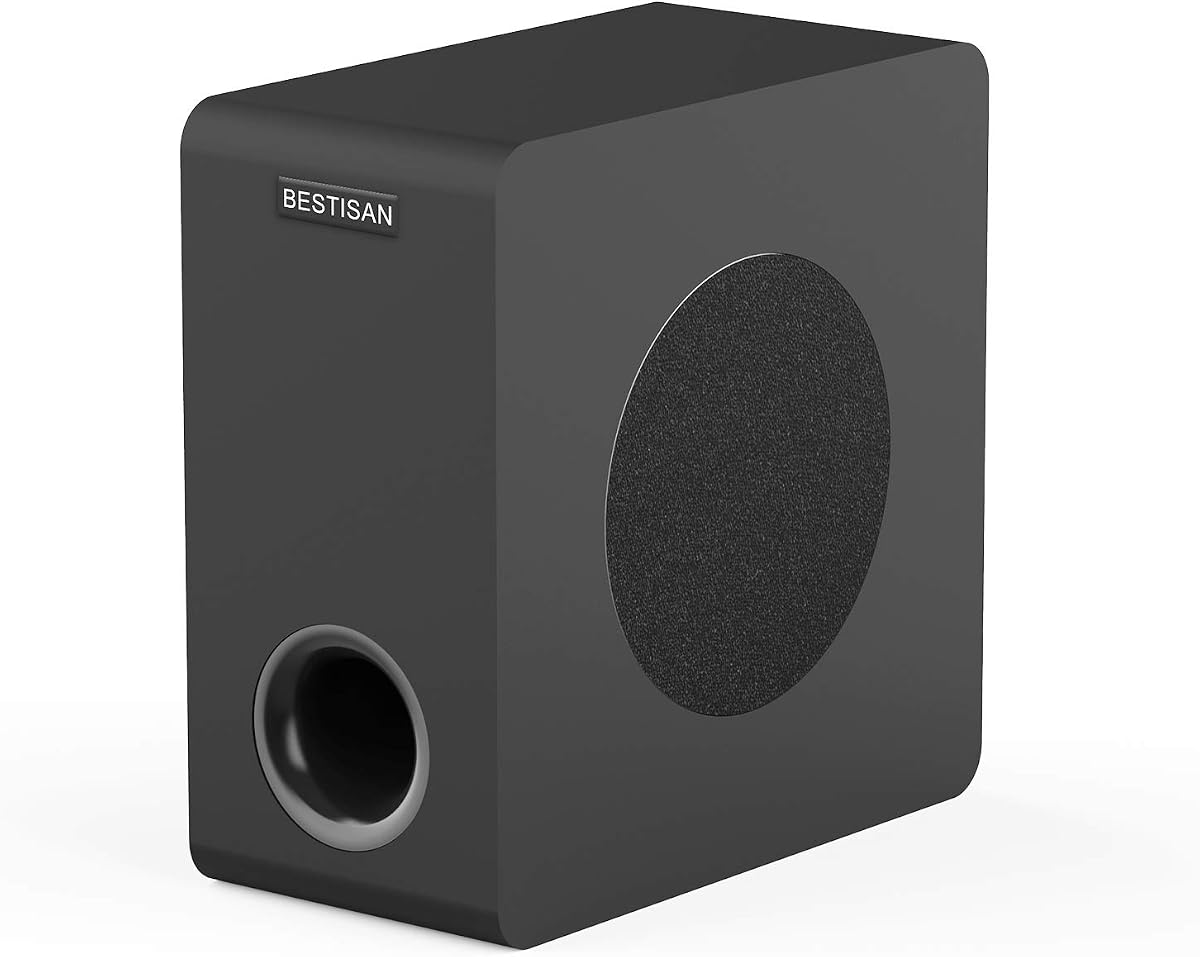
The BESTISAN powered 6.5-inch subwoofer is designed for flexible home-audio use, combining a 4.0 rating with side-firing construction and a wide range of inputs. Its frequency response spans 35 to 200 Hz, and the bottom-ported bass-reflex cabinet with internal bracing is intended to deliver low-frequency impact without requiring separate amplification.
We may earn a commission when you buy through this link, at no additional cost to you.
RCA, 3.5 mm AUX, LFE, and high-level speaker inputs and outputs allow it to connect with AV receivers, televisions, soundbars, and conventional speakers. The compact side-firing format and black oak finish are practical for living-room placement, while the product's recommended pairing with BESTISAN speakers and soundbars supports a coordinated system setup.
One important operating guideline is the recommendation to use source devices with output no higher than 850 mV. Users with unusually strong preamp outputs should check compatibility before connecting the subwoofer. The 4.0 rating is also the lowest among the rated home choices, so buyers should not treat the broad feature list as a substitute for evaluating output quality and room fit.
The BESTISAN is a good option for users who need a relatively small powered subwoofer and want compatibility with many source types. It is particularly helpful in a secondary room, desktop-adjacent system, or setup without a full-size home-theater subwoofer. It is less compelling than the Klipsch R-100SW for maximum extension and rated power in a dedicated home cinema.
The mix of RCA, LFE, AUX, and high-level connections makes the unit adaptable to both dedicated AV equipment and simpler source setups. Speaker-level input and output can also be useful when integrating the subwoofer into a chain of powered or compatible passive speakers.
The side-firing 6.5-inch woofer, bottom port, and internal bracing create a compact design intended to reduce unwanted cabinet resonance. The black oak finish is intended to blend into living-room furniture rather than look exclusively like a technical speaker component.
We may earn a commission when you buy through this link, at no additional cost to you.
The Seventour 10-inch under-seat package combines a powered subwoofer, integrated amplifier, and compact cast-aluminum enclosure, earning a 4.3 rating. Its 3.1-inch thickness and listed dimensions make it a candidate for vehicles where a conventional trunk enclosure would be inconvenient.
We may earn a commission when you buy through this link, at no additional cost to you.
The built-in amplifier is rated at 800 watts peak and 220 watts RMS, with a frequency response from 20 to 500 Hz. Controls include gain, bass boost, a 50–150 Hz low-pass filter, and a 0–12 dB boost at 45 Hz. Low-level RCA and high-level inputs broaden compatibility with different source signals.
The enclosure still needs to be checked carefully against the vehicle's under-seat area, including clearance, mounting access, and seat travel. The 800-watt peak number should not be confused with continuous output; the 220-watt RMS specification is the more useful figure when estimating amplifier loading. Protection circuitry and a 25A rated fuse add useful safeguards, but proper power installation remains essential.
This package is a compelling pick for a driver who wants substantial low end without sacrificing all trunk space. It is less suitable when the under-seat area cannot accommodate the stated width and depth or when a completely hidden installation is required. The wired remote makes control adjustments convenient once the unit is mounted.
Combining the driver, amplifier, and thin cast-aluminum enclosure removes the need to find space for a separate box and amplifier. The stated 3.1-inch thickness is the key measurement to compare with under-seat clearance in the intended vehicle.
A wired remote provides access to gain, bass boost, and crossover controls after installation. Thermal, short-circuit, and overload protection, together with a 25A fuse, help support reliable operation when the system is configured correctly.
We may earn a commission when you buy through this link, at no additional cost to you.
The Skar Audio single 12-inch SDR package offers a middle ground between compact component systems and the larger dual-12 configuration. It combines the SDR-1X12D2 vented loaded enclosure with an RP-800.1D Class D monoblock amplifier and a four-gauge amplifier wiring kit.
We may earn a commission when you buy through this link, at no additional cost to you.
The package is rated for 1,200 watts peak and 600 watts RMS. Including a matched enclosure, amplifier, and wiring removes several separate purchasing decisions, which can make the system easier to plan than buying an unamplified driver. A 4.2 rating indicates a positive overall customer reception, though it is lower than the dual-12 package's 4.6.
Its trade-offs are space and power relative to the dual 12-inch option. One 12-inch driver cannot move as much air as a matched pair, and the vented enclosure still needs a suitable cargo-area location. The included amplifier and wiring kit also need to be installed correctly rather than simply connected and assumed to deliver their advertised output.
The single-12 package is a strong selection for someone who wants a complete, high-output car system but does not need the size or output of the dual-driver package. It is also a good middle point between a bare subwoofer and a maximum-output build. Buyers should verify enclosure dimensions against their vehicle and ensure adequate electrical support.
A single 12-inch subwoofer, one monoblock, and one enclosure are generally easier to place than a dual-driver package. The complete format is attractive to builders who want a defined system without sourcing and matching every major component separately.
The stated 600-watt RMS rating provides considerable continuous output while remaining less physically demanding than the 1,200-watt RMS dual-12 package. This makes the single-12 setup useful for vehicles that lack space for two large drivers but can still host one vented enclosure.
We may earn a commission when you buy through this link, at no additional cost to you.
The right subwoofer depends on where it will be used, how much room is available, and whether the buyer wants a component driver or a system that already includes amplification. The following factors help narrow the decision before installation begins.
Driver size affects how much air a subwoofer can move, how much enclosure space it requires, and how the system blends with the rest of the vehicle or room. A 6.5-inch component model is easier to place in a tight build but generally cannot match the low-frequency reach and output potential of one or two 12-inch drivers. A 6×9-inch driver often serves as a mid-bass specialist or a supplementary source, while a 10-inch home subwoofer is a practical middle ground for powered use.
Choose the size that matches the job. For very deep low end and high output, a 12-inch system is more appropriate; for a compact car installation, a 6.5-inch driver or under-seat powered unit may be the better compromise.
Impedance describes the electrical load presented to an amplifier, and it must be compatible with the amplifier's specifications. Dual-voice-coil drivers offer several possible wiring arrangements, but choosing the wrong one can reduce output or exceed the amplifier's supported load. The 2-ohm KICKER and dual 2-ohm Skar EVL-65 D2 require particular attention, while the dual 4-ohm EVL-65 D4 can be more forgiving of some amplifier configurations.
Before buying a component driver, calculate the intended wiring arrangement and compare its load and power requirements with the amplifier. Do not rely on a peak-power number as the sole guide for amplifier sizing.
Peak power describes a maximum short-term figure, while RMS power is more useful for judging sustained output. A system rated at 800 watts peak and 220 watts RMS, for example, should be assessed primarily around its continuous capability. The speaker's sensitivity, voice-coil design, enclosure type, and amplifier behavior all influence how much clean bass it can produce in practice.
Compare RMS ratings when products are otherwise similar, and pay attention to whether the rating applies to each driver, the enclosure, or the complete package. More raw power is not automatically better if the amplifier or vehicle electrical system cannot support it.
Bare drivers need a purpose-built enclosure, and the chosen box type has a major effect on output and response. Sealed enclosures generally offer controlled, accurate bass with a compact profile, while ported enclosures move more air and can produce greater low-frequency extension. A loaded package saves enclosure-building work, but its dimensions still need to be measured against the intended location.
Check mounting depth, width, length, port clearance, and seat or cargo movement before ordering. For under-seat systems, compare both the width and the stated thickness with the available space rather than relying on the driver size alone.
A powered subwoofer includes an amplifier, making it more approachable for home use and easier to integrate with a television, soundbar, or receiver. A component car subwoofer offers more customization but requires an enclosure, amplifier, power wiring, and proper grounding. Complete loaded packages sit between those approaches by bundling a car subwoofer, enclosure, amplifier, and wiring kit.
Choose a powered model for convenience and home connectivity. Choose a component driver when you want control over the enclosure and amplifier, and choose a loaded package when you want coordinated car-audio components without building the box yourself.
Frequency response indicates the frequency range the subwoofer is designed to reproduce, while crossover controls determine how much of that range passes through. A home unit specified from 35 to 200 Hz offers a broad range for movies and music, whereas the Seventour's 50–150 Hz low-pass filter gives the installer a defined automotive adjustment range. Phase control and bass boost can help with placement-related problems, although excessive boost can cause distortion.
Match the available controls to the rest of the system. For home use, look for volume, low-pass, phase, and compatible line-level inputs; for cars, low-pass range, bass boost, remote level control, and high-level input support can be especially valuable.
Connection requirements determine whether a subwoofer can integrate cleanly with the rest of the system. RCA and LFE inputs suit conventional AV receivers, while 3.5 mm AUX and high-level speaker inputs offer alternative routes for TVs, soundbars, and stereo systems. Automotive packages benefit from low-level RCA and high-level inputs, and many installation-ready systems also include a wired remote for control.
List the source devices the subwoofer must support and confirm that every required input or output is present. The BESTISAN's recommendation to use sources at or below 850mV is a good example of why connection compatibility should include signal-level considerations.
Materials such as aluminum baskets, carbon-fiber cones, rubber surrounds, and high-temperature voice coils can contribute to a driver's durability and performance characteristics. Cooling also matters, particularly in automotive use where compact enclosures and high power can increase heat. The KICKER's forced-air cooling and substantial pole piece are notable examples of a design that explicitly addresses thermal management.
Look for construction details that support the intended workload rather than assuming a premium-looking driver will handle every installation. For daily high-output use, thermal design, voice-coil construction, and enclosure bracing deserve as much attention as the listed wattage.
Begin by confirming that the subwoofer, amplifier, enclosure, wiring, and source equipment are compatible. For a home system, connect the appropriate RCA, LFE, AUX, or high-level input, set the subwoofer volume low, and adjust the low-pass crossover and phase controls after establishing normal listening levels through the main speakers. Follow the manufacturer's signal-level guidance, particularly when connecting a powered subwoofer directly to a source.
In a car, mount the enclosure securely without blocking vents, seat movement, trunk access, or emergency equipment. Use appropriately rated power and ground wiring, install the required fuse near the battery or power source, and keep speaker and power cables away from locations where they could be pinched or exposed to damaging heat. Set gain conservatively, then use the low-pass crossover and remote control to refine the output.
Care for the system by listening for rattling, loose connections, distortion, or changes in output. Clean removable grilles according to the manufacturer's instructions, keep the enclosure and port openings clear, and avoid pushing a home subwoofer below the recommended source signal level. In vehicles, inspect connections and mounting points periodically, especially after rough roads or changes in cargo placement.
Not necessarily. A 6×9-inch driver is often optimized for mid-bass and can fit standard rectangular openings, but one or two larger square-cone subwoofers may produce deeper low-frequency extension and greater output. The best choice depends on whether your priority is deep bass, available mounting space, enclosure design, and system cost.
The numbers describe the resistance of each voice coil, and the two coils can often be wired in series or parallel. A dual 2-ohm model can provide lower-impedance configurations than a dual 4-ohm unit, but the correct arrangement depends on the amplifier. Always verify the final load against the amplifier's specifications before powering the system.
For judging sustained output, RMS power is generally the more useful specification. Peak power represents a maximum figure that may only be reached briefly, while RMS power better describes continuous handling. A meaningful comparison also considers sensitivity, voice-coil design, enclosure, and amplifier, since wattage alone does not determine perceived bass quality.
It depends on the available outputs. Many televisions can feed a subwoofer through a headphone jack, RCA output, or another line-level connection, but some provide only optical or digital audio output. Check the television's manual and use the appropriate adapter when necessary, and keep the source output below the subwoofer manufacturer's recommended signal level.
A loaded enclosure includes the subwoofer and box, but it may still require an amplifier and wiring unless the package explicitly includes them. The Skar SDR bundles shown here include a monoblock amplifier and a wiring kit. Check the package contents carefully before ordering so you know which additional equipment, if any, is still required.
Leave enough room for ventilation, controls, connectors, and the driver's movement, as specified by the manufacturer. Ported enclosures need their ports unobstructed, and an under-seat unit must not interfere with seat travel or mounting hardware. Measure the complete enclosure, including connection clearance, before deciding that it will fit.
Low-level RCA inputs generally provide a cleaner signal when the head unit offers suitable outputs. High-level inputs are useful for adding bass to a system without those outputs, although they can pick up more electrical noise. Use the appropriate connection method and configure the gain and crossover carefully for stable operation.
A low-pass crossover removes higher frequencies and passes the lower range intended for the subwoofer. It helps prevent the bass driver from reproducing midrange content that the main speakers already handle, reducing overlap and localization issues. The correct setting depends on the main speakers, source material, room or vehicle acoustics, and the subwoofer's own frequency response.
The featured choices cover three practical approaches. The Skar EVL-65 D4 is a compact value pick for car builders, the Klipsch R-100SW delivers the most accessible home-theater bass, and the Skar dual 12 SDR package offers coordinated high-output equipment for a major car-audio installation. Each serves a different space, power, and convenience requirement.
Prioritize the type of system that matches your environment rather than selecting on wattage alone. A home buyer should consider the enclosure footprint, source connections, crossover controls, and frequency extension. A car installer should evaluate impedance, RMS output, enclosure dimensions, electrical demands, and the amount of cabin or cargo space available.
Before making a final purchase, verify the current specifications, package contents, dimensions, compatibility requirements, and current price. Ratings and product details can change over time, and vehicle layouts, home rooms, and source equipment differ. Checking those final details will help ensure that the selected subwoofer fits both the installation and the listening priorities.