
Antrader 3-Pack 6015
4.3Editor score
Three 60mm fans
Compact 15mm profile
3600 RPM brushless design
Discover the best 60mm cooling fans for computers, network gear, 3D printers, and DIY projects, compared by noise, speed, airflow, voltage, and size.
A 60mm cooling fan may be compact, but choosing the right one can have a major effect on equipment temperature, operating noise, and service life. Useful options range from quiet PWM models for sensitive electronics to high-speed AC and industrial fans built for demanding ventilation projects.
We compared all ten options by examining fan dimensions, electrical requirements, bearing construction, speed, airflow, pressure, noise specifications, connector type, mounting hardware, and intended applications. The guide also distinguishes 12V and 5V models, 15mm and 25mm depths, low-profile DC units, AC axial fans, and high-pressure server designs.
Each review identifies the most useful reasons to consider a particular fan, along with the compromises that informed its place on the list. The selections highlight different priorities, including quiet operation, budget-conscious replacement, broad voltage support, compact installation, and serious cooling performance; prices and availability can change.
4.3Editor score

4.8Editor score
4.9Editor score
This side-by-side comparison highlights the major differences among the ten fans, including power input, physical depth, maximum speed, airflow, acoustic output, bearing type, and control options, helping readers match a fan to a specific enclosure or device.


The Noctua NF-A6x25 PWM is the strongest all-around choice in this guide because it combines a standard 60x60x25mm format with quiet operation, automatic four-pin PWM control, and a generous accessory package. Its 4.8 rating reflects broad buyer satisfaction, while the stated maximum speed of 3000 RPM and maximum noise of 19.3 dB(A) make it especially appealing for sensitive equipment.
We may earn a commission when you buy through this link, at no additional cost to you.
Flow Acceleration Channels and an Advanced Acoustic Optimisation frame are central to the fan's design, with both intended to improve airflow consistency and acoustic performance. Its 4-pin PWM interface supports automatic speed adjustment across a broad 550-3000 RPM range, giving users finer control than a simple two-wire fan. Anti-vibration mounts, screws, a Low-Noise Adaptor, an extension cable, and a y-cable make it particularly well suited to replacement projects involving multiple PWM fans.
The main compromise is that the fan needs compatible four-pin PWM control for its full automatic-control feature. It is also deeper than the 15mm options in this list, so installers should confirm that the enclosure has enough clearance behind the fan. Even so, these limitations are modest because the 25mm depth is standard for many 60mm applications and offers greater room for airflow-related performance.
This is the recommendation for users who want a dependable 12V replacement for a NAS, DVR, network device, storage appliance, or 3D printer without sacrificing low operating noise. It also works well when automatic thermal control is important. For a standard 12V PWM header, this model combines the most useful balance of features in the roundup.
The four-pin PWM connection allows the fan to respond to compatible control signals, making it easier to maintain airflow only when needed. The supplied Low-Noise Adaptor can also reduce the maximum speed to 2300 RPM for setups where lower sound is the priority.
Rather than supplying only the fan, the package includes mounting hardware, anti-vibration pieces, an extension cable, and a y-cable. These extras can simplify upgrades, help manage vibration, and support two compatible fans from one header.
We may earn a commission when you buy through this link, at no additional cost to you.
The Noctua NF-A6x25 FLX serves the same noise-focused role as the PWM edition but uses a three-pin Molex connection, making it relevant to older or non-PWM equipment. It holds a 4.8 rating and combines the standard 60x60x25mm size, a 3000 RPM maximum, and a maximum noise specification of 19.3 dB(A).
We may earn a commission when you buy through this link, at no additional cost to you.
Its defining convenience is the choice of 3000, 2400, or 1600 RPM settings using the supplied Low-Noise and Ultra-Low-Noise Adaptors. That gives the installer manual control over the balance between cooling output and sound. The fan also includes anti-vibration mounts, screws, an extension cable, and a three-to-four-pin adaptor for direct connection to a suitable power supply.
Compared with the NF-A6x25 PWM, this model cannot provide the same automatic, signal-based speed control. That distinction matters in a system where the motherboard or controller would manage fan speed dynamically. Users with older three-pin headers may still appreciate the familiar connection, while those with modern four-pin headers should consider the PWM version for simpler automatic operation.
Choose the FLX model for a three-pin setup where quiet operation is essential and manual speed selection is acceptable. It is well suited to replacing noisy 12V 6cm fans in network, storage, DVR, and 3D-printer equipment. For a new installation with a four-pin PWM header, the related PWM option is generally more versatile.
The supplied adaptors allow operation at 3000, 2400, or 1600 RPM, depending on the cooling and noise balance required. This is useful in older systems that lack programmable fan control.
Flow Acceleration Channels and the Advanced Acoustic Optimisation frame support the fan's low-noise positioning. Its stated maximum of 19.3 dB(A) is particularly attractive for compact electronics operating near its owner.
We may earn a commission when you buy through this link, at no additional cost to you.
The Wathai EC Axial Brushless stands out for accepting a broad 90V to 270V AC input, which separates it from the 12V and 5V models intended for computer and electronic equipment. It has a 4.4 rating, a standard 60x60x25mm frame, 24.8 CFM airflow, and a maximum speed of 4800 RPM.
We may earn a commission when you buy through this link, at no additional cost to you.
Its dual-ball bearing is rated for 67,000 hours and can accommodate fans mounted flat or upright, offering useful installation flexibility. The package includes one fan, mounting screws and nuts, a power plug measuring about 59 inches, and a wiring head. The fan is brushless and consumes 1.5W, providing a relatively efficient AC cooling option for suitable projects.
An important installation detail is that the plug is not prewired to the fan. Buyers should be comfortable making the indicated wiring connection, and the product should only be used with a compatible AC source. Its higher speed and 24.8 CFM airflow make it more forceful than many low-noise DC alternatives, but it lacks the PWM convenience of the leading 12V selections.
This fan is best for an AC-powered DIY ventilation, cabinet, or equipment-cooling project that needs flexible voltage compatibility and strong airflow. It is less appropriate for a conventional PC fan header or a low-voltage project without an appropriate power source. With the wiring understood, it is a capable choice for installers comfortable with mains-powered accessories.
A rated range of 90V to 270V AC allows the fan to operate from many common mains supplies. This flexibility is more useful for standalone projects than for a standard desktop-computer replacement.
The 4800 RPM speed and 24.8 CFM airflow target projects needing more movement than a quiet office fan. Dual-ball bearings are stated to last 67,000 hours and permit both flat and upright installation.
We may earn a commission when you buy through this link, at no additional cost to you.
The Thermalright TL-B6B is a practical 12V PWM option for budget-conscious builders who still want automatic fan control and a low stated noise ceiling. Its 4.6 rating reflects a generally favorable response, while the specification sheet lists a 3200 RPM speed, 16.17 CFM airflow, and noise of no more than 20.17 dB(A).
We may earn a commission when you buy through this link, at no additional cost to you.
The fan uses seven blades to move air through a computer case, and its S-FDB V2 bearing is intended to reduce vibration and support long-term cooling performance. Double-sided silicone pads around the frame add shock absorption, while an airflow-direction indicator on the inner frame helps the installer orient it correctly. A four-pin PWM connector supports variable-speed operation on compatible systems.
The included screws fit a 50mm hole spacing, but the chassis holes are not threaded. That means the installer may need to apply extra force while securing the fan, making the tool fit and mounting technique worth considering beforehand. Its 16.17 CFM airflow is also lower than that of the high-speed AC models, though that is not a drawback for ordinary case ventilation.
The TL-B6B is a strong choice for a small computer case, 12V electronics enclosure, or replacement fan where PWM control matters more than extreme airflow. It offers a compelling mix of four-pin control, a seven-blade design, and quiet-focused features. Buyers who want the simplest installation should verify their case's mounting holes before ordering.
Silicone pads on both sides of the frame help isolate vibration, while the fan's specified noise ceiling remains low for its speed class. These details can make a meaningful difference in a quiet desktop or office environment.
The airflow arrow on the inner frame removes guesswork when deciding which way the fan should push air. The mounting pattern uses 50mm spacing, and the included screws complete the basic installation.
We may earn a commission when you buy through this link, at no additional cost to you.
The ANVISION 2-Pack is built for installations where two compact 60mm fans are useful and enclosure depth is limited. Each fan measures 60x60x15mm, operates on 12V DC, and has a 2-pin 2.5mm connector with a 200mm lead wire. The product carries a 4.5 rating and includes a two-year warranty.
We may earn a commission when you buy through this link, at no additional cost to you.
Both fans are brushless and use dual-ball bearings. Their maximum speed is 4000 RPM, airflow is listed at 17.6 CFM, and noise reaches 30.7 dBA. That noise figure is noticeably higher than the quiet-focused alternatives in this guide, so the set is better suited to a functional enclosure, equipment cabinet, or project where compactness and multiple replacement units matter more than near-silence.
The two-wire design provides power but not PWM control, meaning the fan runs continuously when energized. There is also no stated low-noise adaptor or automatic speed adjustment. Buyers should therefore treat these as straightforward fixed-speed fans and ensure that 30.7 dBA is acceptable for the intended location.
This two-fan set is a good match for paired intake and exhaust positions in a shallow 12V enclosure. It is particularly useful for multi-fan builds, maintenance projects, and applications where carrying a spare 60x15mm unit is convenient. Those seeking the lowest possible noise or automatic control should instead consider a 12V PWM option.
The package includes two matching fans, making it convenient to establish an intake-and-exhaust arrangement. The common 60mm footprint simplifies sourcing matching replacements later.
The 15mm thickness makes the fans useful where a 25mm model would not fit. A listed 4000 RPM speed provides useful movement within that shallow frame, although the corresponding 30.7 dBA noise level should be considered.
We may earn a commission when you buy through this link, at no additional cost to you.
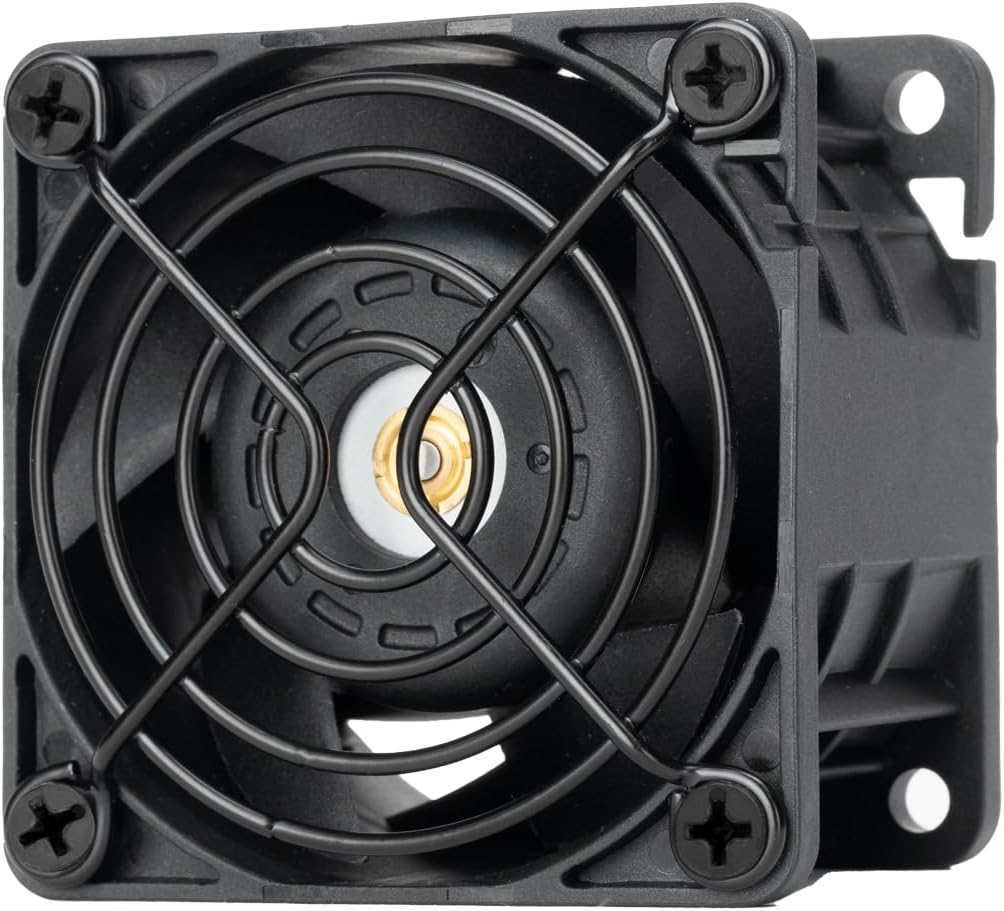
The Antrader 3-Pack is the most budget-oriented multi-fan selection here, providing three 60x60x15mm brushless DC fans for 12V installations. Its 4.3 rating is the lowest among the ten products, but the three-unit package and 22.7 CFM airflow specification make it useful for several cooling positions at once.
We may earn a commission when you buy through this link, at no additional cost to you.
Each fan has a nine-blade plastic design and a speed of 3600 RPM. The product information describes a dual-ball bearing and a sleeve-bearing design, so buyers may wish to note that inconsistency when comparing it with fans that make a single bearing claim. A two-terminal 2-pin connector provides basic power, and the stated current draw is 0.1A.
The primary limitation is the absence of PWM control. These fans are intended to run whenever their two-wire power supply is active, making them suitable for fixed-speed project use. Their 15mm profile is advantageous in tight spaces, but the chassis still needs adequate clearance for the complete frame and airflow path.
The three-pack is a sensible choice for 3D printers, humidifiers, aromatherapy appliances, communication equipment, small appliances, industrial controls, and other compact electronics. It is especially useful when a project needs more than one fan or benefits from having a spare. For quiet variable-speed operation, however, a PWM model offers better control.
The multi-pack can populate more than one position in a compact project or leave a spare on hand. That flexibility is particularly useful for multi-zone 3D-printer cooling and small equipment cabinets.
The 15mm frame fits shallow spaces that cannot accept a 25mm fan. A stated current draw of 0.1A per fan and a two-terminal connector keep the electrical arrangement straightforward.
We may earn a commission when you buy through this link, at no additional cost to you.
The UMLIFE 2-Pack is a versatile AC-powered option for small-space ventilation and electronic equipment cooling. It includes two 60x60x25mm EC brushless axial fans rated for 90V to 270V AC, with each producing 24.8 CFM airflow at up to 4800 RPM. Its 4.6 rating indicates generally positive buyer feedback.
We may earn a commission when you buy through this link, at no additional cost to you.
The product is aimed at applications such as cabinets, small campers, modems, motor cases, keezers, projectors, biltong boxes, amplifiers, receivers, mushroom-growing spaces, wood engravers, breaker boxes, and stereo equipment. Dual-ball bearings are stated to offer a 67,000-hour lifespan, and the fans can be mounted flat or upright.
As an AC fan, it is entirely different from the low-voltage models intended for computer headers. It cannot be connected directly to a 12V DC fan header, and its high speed will be more audible in close quarters. The listing also shows slight variation between 4700 and 4800 RPM in its performance description, so buyers should treat approximately 4800 RPM as the stated maximum figure.
This two-pack is attractive for a project that benefits from matched intake and exhaust fans, especially when an AC supply is already available. It provides more airflow than many DC alternatives without increasing the nominal 60x25mm dimensions. For a standard PC case or low-voltage enclosure, choose a compatible DC PWM or fixed-speed fan instead.
Two matching units support straightforward intake-and-exhaust arrangements in cabinets and equipment boxes. The shared dimensions and broad AC input make the set convenient for standalone ventilation projects.
The stated application range covers everything from projectors and amplifiers to small camper spaces and wood engravers. That versatility comes with the requirement for a compatible AC power source.
We may earn a commission when you buy through this link, at no additional cost to you.
The Noctua NF-A6x15 PWM is the quiet-oriented choice for users who need a slim 60x15mm fan with automatic control. Its 4.9 rating is the highest among the listed products, and the stated maximum noise of 19.8 dB(A) is among the lowest. It reaches 3500 RPM while maintaining a 60x60x15mm frame.
We may earn a commission when you buy through this link, at no additional cost to you.
Its four-pin PWM connection supports automatic speed control from compatible headers. The supplied Low-Noise Adaptor reduces the maximum to 3050 RPM, giving users a straightforward way to favor lower sound. Flow Acceleration Channels and the Advanced Acoustic Optimisation frame support the fan's airflow and acoustic design, while its stated MTTF exceeds 150,000 hours.
The package includes anti-vibration mounts, fan screws, the Low-Noise Adaptor, an extension cable, and a y-cable for running two PWM fans from one header. The trade-off is the 15mm depth, which provides less internal volume than a 25mm fan. Although the 3500 RPM maximum is higher than some 25mm alternatives, this model's distinguishing benefit is its combination of thinness, quiet operation, and PWM control.
This is the leading option for a compact 3D printer, NAS, DVR, switch, router, or other network and storage device with a four-pin PWM header. It is particularly useful when enclosure clearance is tight but low noise remains important. Buyers should confirm the 15mm depth and the location of the fan's mounting pattern before ordering.
The fan combines a 3500 RPM maximum with a 19.8 dB(A) noise ceiling, an impressive balance for a compact unit. PWM control allows the connected system to reduce speed when extra cooling is unnecessary.
At only 15mm thick, this model fits shallow spaces that may reject a standard 25mm fan. Its intended uses include 3D printers, network equipment, and compact storage devices where both dimensions and noise matter.
We may earn a commission when you buy through this link, at no additional cost to you.
The Silverstone FHS 60X is the clear high-performance selection, offering a 60x60x38mm industrial and server-oriented frame with a maximum speed of 15,000 RPM. It carries a 4.9 rating and delivers a listed maximum airflow of 65.74 CFM, far above the moving-air figures of the compact DC models in this roundup.
We may earn a commission when you buy through this link, at no additional cost to you.
A specially designed impeller and the thicker 38mm frame are intended to enhance cooling efficiency and ease of use. Maximum static pressure is listed at 62.95 mmH2O, making the fan suitable for restrictive or high-resistance cooling situations rather than only open airflow. PWM control provides an unusually wide speed range from 0 to 15,000 RPM.
The trade-offs are substantial. Its maximum noise level is listed at 61.5 dBA, so this is emphatically not a near-silent option. It is also much deeper than the standard 60x25mm format and may not fit ordinary computer cases or small equipment panels. Users need compatible PWM control and adequate enclosure volume.
The included protective metal fan grille adds a safety-oriented finishing touch for demanding installations. Choose the FHS 60X for server, industrial, rack, or high-heat applications where airflow and pressure are the priorities and the available space accommodates its 38mm depth. For a quiet office or compact electronics project, one of the 12V Noctua models is a more appropriate fit.
With 65.74 CFM airflow and 62.95 mmH2O maximum pressure, the fan is built for restrictive cooling paths and high-performance equipment. Its 15,000 RPM maximum establishes it as the most aggressive option in the guide.
The 0-15,000 RPM PWM range allows substantial adjustment to match cooling demand. That control is valuable in a server or industrial setting where operating conditions can change quickly.
We may earn a commission when you buy through this link, at no additional cost to you.
The Noctua NF-A6x25 5V PWM is a specialized replacement for equipment that explicitly requires a 5V supply. It combines the familiar 60x60x25mm dimensions with a four-pin PWM connection, a 3000 RPM maximum speed, and a maximum noise rating of 19.3 dB(A). Its overall rating is 4.8.
We may earn a commission when you buy through this link, at no additional cost to you.
The fan is intended for 5V applications with PWM speed control and includes polarity protection. Anti-vibration mounts, fan screws, an extension cable, a y-cable, and an OmniJoin adaptor set are included, giving it a well-equipped package for replacement installations. The accessory selection is particularly helpful when a device uses a proprietary fan connection.
The crucial consideration is voltage. A 5V fan is not interchangeable with the 12V NF-A6x25 PWM, even though their dimensions and connectors may look similar. It should be connected only to a suitable 5V source. Users must verify the original device's requirements rather than assuming that all four-pin 60mm fans use the same supply.
This model is a strong choice for compatible 5V 3D printers, DVRs, NAS units, switches, routers, and other network or storage devices. It provides the quietness and automatic control associated with Noctua's premium 60mm range while supplying the less common 5V version. If the target device uses 12V, choose the corresponding 12V model instead.
This version is designed specifically for 5V equipment and includes polarity protection for those applications. It should never be treated as a substitute for a 12V fan unless the power source has been properly verified.
The included extension cable, y-cable, and OmniJoin adaptor set help accommodate different header arrangements. Anti-vibration mounts and screws round out a practical replacement package.
We may earn a commission when you buy through this link, at no additional cost to you.
The right 60mm cooling fan depends on electrical compatibility, available depth, airflow requirements, noise expectations, and the connector used by the host device. Comparing these factors before buying prevents an otherwise capable fan from being unsuitable for the installation.
Start with the power requirements of the device rather than the physical appearance of the fan. Most computer and electronics projects use 12V DC, while the Noctua NF-A6x25 5V PWM is intended specifically for 5V applications. The Wathai and UMLIFE models operate from broad AC supplies and should not be attached to a low-voltage DC header. Connector type is equally important: two-wire fans generally provide fixed-speed power, three-pin Molex fans can support manual voltage-based speed settings, and four-pin PWM fans add dedicated control signaling.
The 60mm face size is only one part of a fan's dimensions. Standard 25mm-thick models offer more internal depth, while 15mm alternatives are intended for shallow spaces. The Silverstone FHS 60X is 38mm thick and needs substantially more clearance than either common format. Measure the complete enclosure, including mounting hardware, wire bend radius, vents, and nearby components before choosing. A fan that looks identical from the front may still be difficult or impossible to install if its frame is too deep.
Published airflow figures provide a useful starting point, but the amount of air a fan can move through a restricted grille or dense heatsink is equally important. Models such as the Silverstone FHS 60X include a high maximum static-pressure specification, which is relevant when cooling air must pass through restrictive paths. The Wathai and UMLIFE AC fans also offer 24.8 CFM airflow, while several compact DC models list lower figures. Compare airflow with the actual cooling need rather than assuming the highest headline number is always necessary.
Noise specifications are most meaningful when they are compared directly. The Noctua models lead this group with maximum figures around 19.3-19.8 dB(A), and the Thermalright TL-B6B is specified at no more than 20.17 dB(A). The ANVISION set reaches 30.7 dBA, while the high-speed Silverstone reaches 61.5 dBA. Actual perceived sound also depends on enclosure resonance, vibration, mounting, and airflow restrictions, but the published figures provide a clear indication of each model's acoustic character.
Bearing design influences long-term reliability, vibration, and the conditions under which a fan can be mounted. Dual-ball bearing fans are presented as durable options suited to demanding use, while the Antrader listing contains both sleeve-bearing and dual-ball-bearing wording that should be noted. Noctua specifies an MTTF greater than 150,000 hours across its listed models, while the Wathai and UMLIFE products state 67,000 hours for their dual-ball bearings. The published figure is not a guarantee of service life, but it provides a useful point of comparison.
A four-pin PWM fan can vary speed through a compatible controller, allowing a system to balance cooling demand and noise. The Noctua NF-A6x25 PWM, NF-A6x15 PWM, Thermalright TL-B6B, and Silverstone FHS 60X fall into this controllable category. The Noctua NF-A6x25 FLX instead uses three-pin Molex and provides 3000, 2400, or 1600 RPM settings through adaptors. Two-pin models, such as the ANVISION and Antrader sets, are simplest electrically but normally run continuously whenever powered.
A complete package can make installation much easier, but compatibility still needs checking. Most 60mm fans use a 50x50mm hole pattern, yet the Thermalright model specifically notes that the chassis holes are not threaded and may require extra force. Noctua's packages include screws, anti-vibration mounts, extension leads, and y-cables. The Wathai package includes screws, nuts, a long power plug, and a wiring head, but its plug is not connected to the fan. The Silverstone product adds a protective metal grille, which is useful in exposed high-speed installations.
The intended use should guide the final decision. Quiet Noctua models suit 3D printers, network equipment, NAS devices, and DVRs. Three-wire Noctua hardware addresses older systems, while the 5V version fits compatible low-voltage devices. The Wathai and UMLIFE AC fans target standalone cabinet and ventilation projects. The Silverstone model is designed for high-performance industrial or server cooling, where its depth and noise are acceptable. A multi-pack is convenient for projects that need several compact positions.
Before installation, disconnect power from the host device and confirm the replacement fan's voltage, connector, dimensions, and airflow direction. Compare the new fan with the original mounting pattern, inspect the grille for dust or restrictions, and make sure the fan can pull air through rather than sit against a solid panel. Mount the fan with the correct screws and avoid forcing it into incompatible holes.
Connect the fan only to the specified supply and control source. For PWM models, use a compatible four-pin header or controller; for a three-pin Molex fan, use the supplied adaptors and select the intended speed range; and for a two-wire fan, confirm that constant operation is acceptable. AC models require a suitable mains supply and correct wiring, with the Wathai's plug connection completed according to the product instructions. Route cables away from fan blades and hot components.
After installation, test the system while watching for unusual vibration, scraping, rattling, or airflow restriction. Use PWM control or an appropriate adaptor to tune the balance between cooling and noise. Keep the grille and frame free of dust, inspect mounting screws periodically, and replace the fan if the bearings become noisy, the blades stop moving freely, or cooling performance declines.
No. Fans with the same 60mm face size can differ in thickness, voltage, connector type, speed-control method, and mounting requirements. Check the device's required voltage and connector before purchase, and also confirm that the 15mm, 25mm, or 38mm depth fits the available space.
A two-pin fan normally has power and ground and runs continuously when powered. A three-pin fan adds a speed-control connection that can be used with compatible hardware or a supplied adaptor. A four-pin PWM fan includes a dedicated PWM signal for automatic variable-speed operation.
No. The electrical requirements must match even when the frame and connector appear identical. The Noctua NF-A6x25 5V PWM is designed for compatible 5V applications, while the standard NF-A6x25 PWM is a 12V model. Verify the original equipment specifications first.
A 60x15mm fan is better when enclosure depth is the priority. A 60x25mm model has more internal depth and may be a better choice when space is unrestricted and maximum airflow or acoustic characteristics matter more. The best option depends on the available clearance and cooling demand.
They can be, provided the case has the required depth, mounting pattern, and compatible PWM control. The Silverstone FHS 60X is particularly intense, with a 15,000 RPM maximum and 61.5 dBA maximum noise. It is better suited to demanding industrial or server cooling than a quiet office build.
CFM measures the volume of air a fan can move, while mmH2O describes static pressure against airflow restrictions. A high CFM rating alone does not guarantee strong performance through a dense grille or heatsink. Both figures help reveal whether a fan is designed for open ventilation or more resistant cooling paths.
Use vibration-isolating mounts where available, ensure the fan is securely fastened, and avoid loose screws or cables that can contact the frame. Mounting the fan with the airflow direction aligned with the enclosure's intended path can also reduce turbulence and resonance.
Replacement timing depends on operating conditions, bearing quality, dust exposure, and fan design. Monitor for increasing noise, vibration, reduced airflow, or visible dust buildup. Cleaning a removable grille and keeping the fan unobstructed can support cooling performance, while a noisy or obstructed fan should be replaced promptly.
The Noctua NF-A6x25 PWM is the most versatile overall choice for a standard 12V four-pin setup, balancing quiet operation, useful airflow characteristics, automatic control, and a well-equipped package. The Antrader 3-Pack is the best budget selection when several compact 12V fans are needed, while the Silverstone FHS 60X is the premium option for users who require exceptional airflow, static pressure, and high-speed PWM control.
Start with compatibility rather than the largest specification. Match voltage and connector, measure the enclosure, decide how much sound is acceptable, and consider whether the installation needs PWM control. The remaining choices are more specialized: the NF-A6x25 FLX for three-pin systems, the NF-A6x15 PWM for shallow spaces, the 5V Noctua for compatible low-voltage equipment, and the Wathai or UMLIFE models for AC-powered projects.
Product specifications, ratings, availability, and prices can change, so check the current listing and the requirements of the device before making a final purchase. The right fan is not necessarily the fastest or quietest model in the guide; it is the one that fits the electrical system, physical enclosure, cooling load, and operating environment with the least compromise.