
Titan ONE
4.8Editor score
App-based drill programming
Internal oscillation and motor design
Large 85–240 ball capacity
Multiple control options
Explore the best ball machine for pickleball practice, comparing launch control, oscillation, capacity, portability, power options, accessories, and overall
A ball machine for pickleball practice can turn scattered court time into focused repetition, helping players work on consistency, positioning, reaction speed, and shot selection. The best system is not simply the one with the most features; it is the machine that reliably creates useful feeds while fitting your skill level, court space, power access, and preferred training routine.
We compared the ten products in this guide across the features that directly affect practice: automatic feeding, oscillation, launch adjustment, hopper capacity, power source, portability, included accessories, app support, and compatibility with solo drills. The list includes full launchers, starter systems, rebounders, recycling nets, and a ball collector designed to support more efficient training setups.
Each review explains the strongest reasons to consider the product, along with its practical limitations. The three leading selections are highlighted separately, while the comparison table makes the major differences easier to scan. Product specifications and availability can change, so confirm the current listing and included accessories before making a final purchasing decision.
4.8Editor score

4.8Editor score

4.4Editor score
The table below compares all ten training products by control method, movement, capacity, and power. Use it to separate full automatic launchers from rebounder and net systems, then review the detailed recommendations for important compatibility and setup details.


The Furlihong 3816PBH combines remote operation, two-axis movement, adjustable speed, and flexible power options in a well-rounded practice machine. Its 4.8 rating reflects a strong overall package for players who want repeatable feeds without committing to an app-dependent system. The most noticeable advantage is its flexibility: the launcher can change height and direction while the base moves laterally.
We may earn a commission when you buy through this link, at no additional cost to you.
The included remote handles the most important adjustments without requiring the player to walk back to the machine. The oscillating base produces random left-right placement, which is more useful for reaction work than a fixed launch. Meanwhile, the automatic up-and-down swing allows practice at different heights, and the speed adjustment from L to H supports everything from controlled volleys to faster rally-style repetitions.
Dual power operation also broadens where the machine can be used. Batteries remove the need for a nearby outlet, while the AC adapter suits fixed indoor locations or extended sessions where charging interruptions would be unwelcome. The tripod-compatible design is another practical touch because launch height can be adapted to different players and drill positions. Buyers should note that pickleballs and the tripod are not included.
This is our leading recommendation for most players because it balances movement, control, and convenience without requiring a phone to run every session. It suits a solo player building consistency, a family practicing at home, or a coach establishing repeatable ball feeds. Those wanting sophisticated app-based programming or a much larger hopper may prefer the Titan ONE, but the 3816PBH offers the more approachable overall package.
The oscillating base changes the lateral landing point, while the auto swing changes the launch height. Together, these features help a player react to feeds that do not arrive from exactly the same spot every time.
Remote controls make it easier to move from a slow dinking rhythm to a faster feed without walking over to the machine. The local side button also provides a way to hold the launch port at a selected angle.
We may earn a commission when you buy through this link, at no additional cost to you.
This all-in-one pickleball and tennis system pairs an automatic launcher with a return net, making it more than a simple ball feeder. Its 4.0 rating places it below the category leaders, but the supplied net and broad drill options create a convenient practice loop. The launcher can be used independently or together with the net depending on the space and drill.
We may earn a commission when you buy through this link, at no additional cost to you.
Remote operation gives users control over distance, height, and left-right oscillation. The seven-track hopper accepts up to 28 pickleballs or 30 tennis balls, reducing the need for frequent refills. A built-in 5200mAh battery is listed for six to eight hours of non-stop use, while the stated 15-minute assembly and lightweight construction make the system easier to move between a home, yard, or court.
The largest limitation is its listed maximum shot distance of nine feet, or three meters. That makes the system more suitable for close-range dinks, controlled volleys, touch work, and target drills than for simulating deep baseline shots. Buyers should also distinguish the included free scoring app from a full programmable drill platform, since the product information primarily describes a companion app rather than a complete coach-programming system.
Choose this product when a beginner wants a complete setup, when multiple family members will use the equipment, or when tennis and pickleball practice are both priorities. It is less convincing for experienced players seeking longer feeds or advanced randomization. For a lower-cost entry into automated practice, the Furlihong 3816PBH offers more explicit speed control and broader movement, while this package wins on included accessories and multi-sport use.
The return net is designed to route balls back toward the practice area, allowing the included launcher and net to function as a system. That can reduce pauses and make solo repetition more efficient.
Because the hopper and launcher can also handle tennis balls, this setup may offer better value for households or clubs that want to train more than one racket sport. Its multi-track hopper supports the differing ball sizes.
We may earn a commission when you buy through this link, at no additional cost to you.
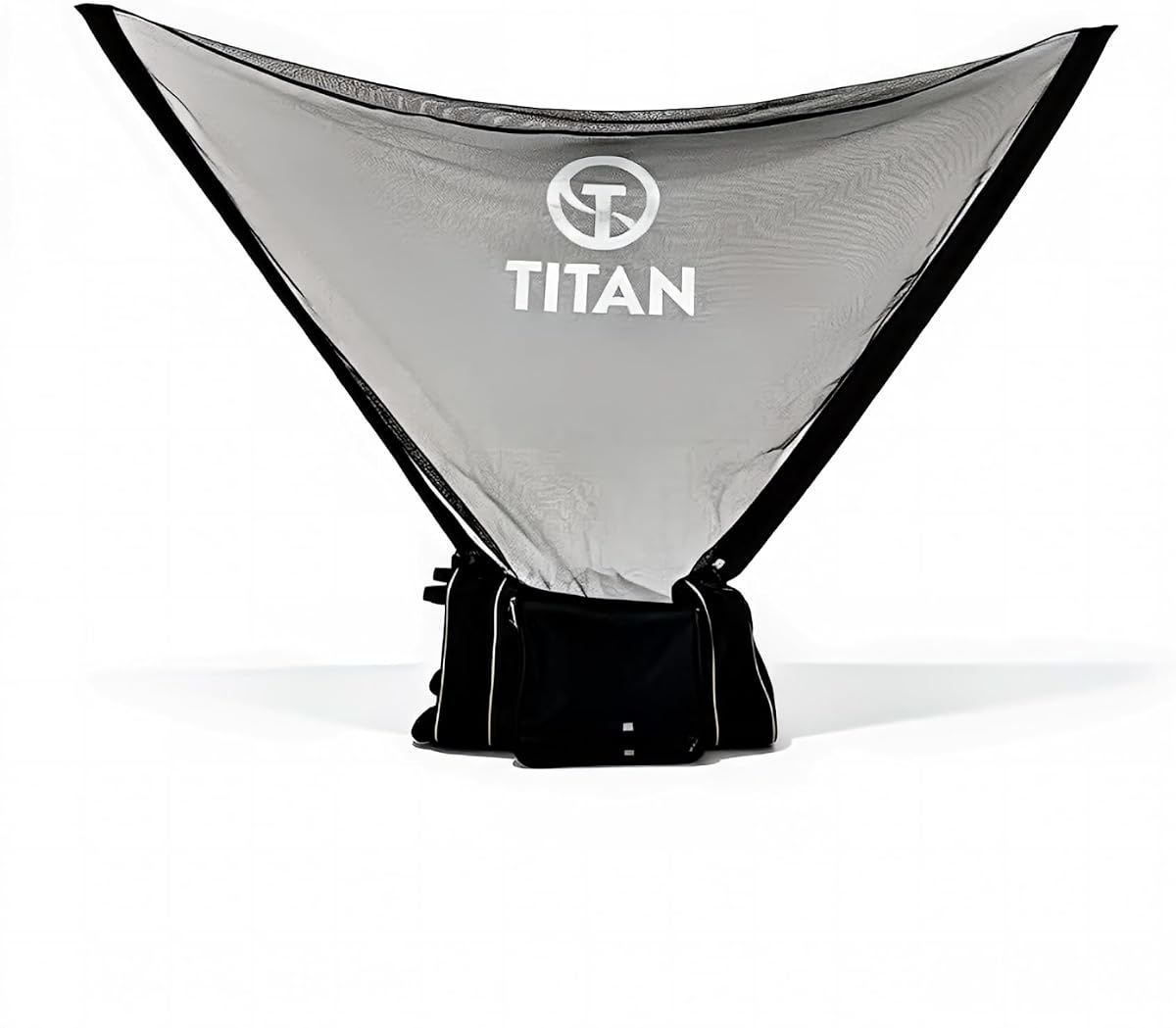
Titan ONE is the most advanced machine in this roundup, offering programmable drills, internal oscillation, a shared drill library, and a free app. Its 4.8 rating places it alongside the Furlihong 3816PBH for the strongest customer feedback in the group. It is built for players and instructors who want the machine to generate varied, match-like repetition rather than simply repeating one feed.
We may earn a commission when you buy through this link, at no additional cost to you.
The Titan Drill App lets users program dinks, volleys, strokes, and other patterns from a phone. A QR-based drill library provides additional material from YouTube, coaches, and other users, while internal oscillation and the patented motor design are intended to create less predictable sequences. The hopper supports between 85 and 240 balls, depending on the configuration, making long sessions and group use easier to manage.
Control can come from the app, an Apple Watch, the onboard panel, or a separately sold remote. The app also supports designing, editing, and sharing drills. Over-the-air updates add new functions over time, including the listed Rapid Fire option. These capabilities create a strong argument for coaches, clubs, and technically oriented players, although users who only want a simple timed feed may find the advanced ecosystem unnecessary.
Titan ONE is the premium recommendation for anyone investing in a long-term training system with shared drills and app-based control. It is particularly attractive for coaches preparing sessions for multiple players. The Furlihong 3816PBH is a more straightforward alternative for individual practice, while the Ball Thrower with Net is better suited to buyers wanting a simpler multi-sport package and included return net.
The app allows drills to be created, edited, and shared, reducing the need to make repeated physical adjustments at the machine. That is especially useful when a coach is running structured sessions for several players.
A hopper range of up to 240 balls and a trolley handle make the machine easier to use where sustained feeding is required. The large capacity reduces interruptions, while shared drill access can help groups standardize their practice.
We may earn a commission when you buy through this link, at no additional cost to you.
The Furlihong 680PBH Starter Kit is aimed at new pickleball players who want the essential pieces of a home practice setup in one package. Its 3.7 rating suggests mixed experiences, but the list of included equipment is unusually complete. Buyers receive a launch machine, recycling net, paddle, carrying bag, and three pickleballs.
We may earn a commission when you buy through this link, at no additional cost to you.
The machine offers adjustable angles and launch intervals, tossing balls from three to 6.6 feet high while oscillating. That makes it useful for dinking repetitions, close-range control work, and basic shot practice. The included net is designed to create a ball loop, which can reduce the time spent collecting balls. Additional ball chutes can also be added to extend feeding time between refills.
Compatibility is the most important caveat. The product information states that the included net is only designed for the Furlihong 681PBH, 680BH, and 6801BH machines. Because the kit is sold under the 680PBH name, buyers should verify the current contents and compatibility details carefully rather than assuming every similarly named machine will work with the net. The included paddle and balls also offer less choice for experienced players.
This kit makes most sense for a beginner building a first practice station or for someone who values a ready-to-use bundle. It is less suitable for advanced players who already own equipment and want a sophisticated programmable launcher. If purchasing separately would be straightforward, the Furlihong 3816PBH offers stronger movement, speed controls, and customer feedback while leaving you free to choose your own net and accessories.
The combination of launcher, paddle, balls, carrying bag, and net removes much of the setup guesswork for a new player. It also gives beginners a practical way to experience automated feeding before purchasing a more specialized machine.
The launch height, interval, angle, and oscillation controls are particularly relevant to short dinking exchanges. These adjustments let beginners narrow the feed pattern before attempting faster or more demanding drills.
We may earn a commission when you buy through this link, at no additional cost to you.
The PP SMART PRO brings smartphone control, remote operation, and a large hopper to a comparatively accessible automatic launcher. Its 4.4 rating is the second-highest among the budget-oriented choices, and the adjustment range gives it value for both beginners and more experienced players seeking predictable speed, spin, and frequency control.
We may earn a commission when you buy through this link, at no additional cost to you.
Through the app, users can set ball speed from 20 to 120 km/h, serving frequency from 1.8 to 8 seconds, and elevation from 5 to 45 degrees. The stated serving distance reaches up to 20 meters. A hopper that holds more than 80 balls extends uninterrupted practice, while a built-in DC25.6V/6AH battery is listed for four to six hours of continuous use.
The ABS and metal construction provides a more substantial appearance than a small entry-level toss machine, and the included wheels make it possible to move the unit between courts. However, the stated 18KG weight means it is not the lightest option for carrying. It is better suited to a wheeled route from storage to court than to regular lifting by one person. It also lacks the extensive shared drill library offered by Titan ONE.
This is our best budget selection for players who want app control, a large capacity, and broad launch adjustments without moving into the premium category. It is well suited to backyard, club, or school sessions where wheels can be used. Beginners can begin with slower settings and shorter feeds, while experienced players have enough speed and frequency control to work on timing and reaction. Choose the Titan ONE instead if shared drill programming is a priority.
Separate speed, spin, and frequency settings make it possible to build a progression instead of using one fixed feed. A player can begin with a slower pace, add spin, and then shorten the interval as consistency improves.
Holding more than 80 balls can keep a solo practice moving with fewer refills. Combined with the battery and wheels, this makes the machine practical for a dedicated training area or an instructor moving between sessions.
We may earn a commission when you buy through this link, at no additional cost to you.
The YUEWO Pickleball Machine offers a straightforward automatic launcher with four power levels, three angle options, and an automatic swinging base. Its 3.6 rating is lower than those of the leading machines, so buyers should consider the product's simplicity as much as its feature set. It is most appropriate for basic, repeatable solo drills.
We may earn a commission when you buy through this link, at no additional cost to you.
The hopper accommodates up to 26 pickleballs, 26 red tennis balls, or 30 standard tennis balls. Throw force can be changed across four levels, and the elevated design is intended to support high-volley practice. Its rotating base introduces some variation in placement, but the available adjustment is simpler than the multi-axis or programmable systems found elsewhere in this guide.
Power can come from four Type D batteries or a 110V/220V plug, giving the machine flexibility for indoor and outdoor use. The product information also emphasizes compatibility with several ball types and states that free parts are exchanged within one year when the buyer contacts support first. That support policy may offer added confidence for a mechanical purchase, although it should be confirmed in the current listing.
Choose this launcher when you want uncomplicated feeds, multiple power levels, and a moderate hopper without relying on an app. It may work well for a player practicing volleys at one end of a court. Those who need remote control, a large hopper, sophisticated randomization, or app programming should consider the Furlihong 3816PBH, Titan ONE, or PP SMART PRO instead.
The four power levels provide an uncomplicated way to increase feed pace. A beginner can establish control before moving to faster settings, while the elevated launch can introduce higher volleys.
The multi-track hopper is designed for pickleballs, red tennis balls, and standard tennis balls. That flexibility is useful for mixed training, although the product does not offer the same app-driven drill tools as the leading options.
We may earn a commission when you buy through this link, at no additional cost to you.
The Franklin Sports ProShot is a compact automatic launcher designed to deliver one pickleball every eight to nine seconds. Its 3.5 rating indicates that it may not satisfy users seeking sophisticated placement control or extensive adjustment, but its direct purpose is clear: provide regular repetition for forehands, backhands, dinks, and touch shots.
We may earn a commission when you buy through this link, at no additional cost to you.
The hopper holds up to 15 pickleballs, which is sufficient for short drills without requiring the user to remain next to the machine. It can operate with four D batteries, which are not included, or through the attached AC power adapter. The sturdy, lightweight construction is useful for moving between a home practice area, park, or local court.
Compared with full-size machines, the ProShot makes few promises about oscillation, launch-height range, speed control, or app programming. That simplicity may be a benefit for a beginner who wants a feed without learning a complex interface. It is less suitable for coaches who need repeatable positions, varied drill patterns, or the ability to change feeds quickly while standing at the opposite end of the court.
The ProShot is best for short, focused sessions centered on repetition and touch. It can also serve as a secondary feeder in a practice area alongside a more capable machine. If you need left-right movement, remote operation, or a large battery-powered system, the Furlihong 3816PBH or PP SMART PRO offers a more advanced foundation.
The automatic feed interval removes the need to pick up and toss every ball. That makes it convenient for practicing a specific stroke or completing a short touch-focused routine.
Its stated lightweight design and dual power options support use at home or on a court. The AC adapter is preferable for long sessions, while batteries offer more placement flexibility when no outlet is available.
We may earn a commission when you buy through this link, at no additional cost to you.
The Westant Match Buddy is a rebounder rather than a powered launcher, using an adjustable string and high-bounce pickleball to return shots. Its 3.3 rating is the lowest numerical score in this list, so it should be considered a specialized training aid rather than a substitute for a full automatic ball machine. Its strength is the possibility of continuous, hands-free repetition.
We may earn a commission when you buy through this link, at no additional cost to you.
Product information states that players can achieve more than 100 consecutive hits with practice. The string length can be adjusted and locked in place, changing the rebound power and making the system useful for serves, dinks, resets, sweet-spot work, footwork, overheads, and hand-eye coordination. The design is specifically proportioned for pickleballs rather than adapting a general tennis rebounder.
This is not the same experience as receiving a machine-controlled feed. A launcher offers repeatable launch placement, timing, and speed settings, while a rebounder responds to the player's strike. As a result, the Match Buddy rewards contact quality and position but offers less direct control over the pattern. The included high-bounce balls are important to the return behavior, and users should understand that they are practicing a rebounder-specific feed.
Choose the Match Buddy for short, inexpensive solo workouts focused on contact, footwork, and repeated swings. It is especially useful where a full launcher would be unnecessary or where space is limited. Players who need programmed feeds, remote changes, or direct control over ball placement should select a launcher such as the Furlihong 3816PBH instead.
A shorter string generally requires more power and a longer string changes the pace of the return. Adjusting that setting allows a player to progress gradually as contact quality and strength improve.
The rebounder creates a self-sustaining exchange when the player can keep the ball in the hitting zone. It removes electrical and hopper requirements, making it a simple option for backyard touch work.
We may earn a commission when you buy through this link, at no additional cost to you.
The Portable Pickleball Net and Ball Collector is an accessory that strengthens a practice area by catching and recycling balls. Its 3.6 rating reflects its position as a supporting system rather than a complete automatic launcher. It is most valuable when paired with a compatible machine and used to reduce manual collection during sustained drills.
We may earn a commission when you buy through this link, at no additional cost to you.
The angled base and weighted 360-degree collar are designed to integrate with pickleball, baseball, and tennis training equipment. According to the product information, the weighted collar delivers 98 percent accuracy for tournament balls. A dual-layer buffer combines 420D anti-UV polyester with memory-foam padding, reducing rebound by 70 percent compared with standard nets.
Setup is described as tool-free and takes about 90 seconds. The resulting zone measures 5.25 feet high by 3.38 feet wide by 6.6 feet long, and the frame collapses for transport. The product information states that it can handle more than 200 shots in a row, though actual performance will depend on alignment, shot placement, and the feeding machine being used.
Choose this net when your priority is ball recovery and compact storage rather than programmable launching. It can improve a home, yard, school, or club practice station by creating a more continuous loop. Because it does not generate shots on its own, you will still need a launcher or training partner. The Furlihong 680PBH Starter Kit may be more convenient for a complete package, while the TITTAN Reload Collector offers a higher-capacity rolling solution.
Catching shots in the net removes much of the stop-and-collect work that can break concentration. That makes it easier to maintain the rhythm of a solo drill.
The collapsible frame and stated 90-second assembly make the net suitable for temporary practice stations. Its footprint is smaller than a full court, allowing a drill to be established where space is limited.
We may earn a commission when you buy through this link, at no additional cost to you.
The TITTAN Reload is a dedicated ball-collection system designed to make automatic machine practice more continuous. It is not a launcher, and no numerical customer rating is supplied in the available product information. What distinguishes it is the combination of a waist-height net, 180-ball rolling storage bag, wheels, and a refill handle intended for Titan machines.
We may earn a commission when you buy through this link, at no additional cost to you.
Capturing shots at waist height can reduce the need to bend toward the court, which is helpful during extended sessions on hard surfaces. Balls move into the storage bag beneath the net, maintaining a smoother practice loop. Once the bag is full, the retractable handle and smooth wheels allow the collector to be rolled to the machine and tipped for an easy refill.
The product information states that the system can reclaim 40 percent of court time previously spent chasing loose balls. That is a product-specific claim, so actual time savings will depend on the user's shot accuracy, the machine's placement, and how efficiently the system is positioned. It is also designed specifically for Titan machines, meaning compatibility should be confirmed before purchase.
Choose the TITTAN Reload if you already own a compatible Titan machine and want to reduce cleanup interruptions. It is less appropriate as a stand-alone solution because it does not launch balls. For a compact and more immediately portable net, the Portable Recycling Net may be easier to store, while the Furlihong 680PBH Starter Kit includes a net with the launcher in one package.
A net and rolling bag remove much of the manual collection between feeds. This can help solo players stay in a drill and maintain a consistent pace.
The retractable handle and wheels make it possible to move the loaded bag to the machine. Its stated 180-ball capacity should reduce the number of refills required during high-volume practice.
We may earn a commission when you buy through this link, at no additional cost to you.
The most useful machine is the one that matches your training priorities, physical space, and skill level. Consider how feeds are controlled, how much variation you need, where the equipment will be used, and whether you want a launcher, a rebound system, or a collection accessory.
Automatic launchers, rebounders, and recycling nets solve different training problems. A launcher feeds balls from a set position and is ideal for solo repetition, reaction timing, and stroke consistency. A rebounder returns the player's own shot, which is useful for contact, footwork, and hand-eye coordination. A recycling net does not create a feed but catches balls and helps a practice loop run with fewer interruptions. Choose a launcher for independent drills, a rebounder for inexpensive contact work, and a net when you already have reliable feeding equipment.
A fixed launcher is useful for putting a repeatable ball in the same area, but side-to-side and vertical movement make the drill more representative of live play. Look for an oscillating base, internal oscillation, or automatic vertical swing. App-programmable patterns are the next step up because they can combine movement with changes in shot type. Randomization is valuable for reaction training, while fixed feeds are often better for beginners learning one movement or trying to establish a repeatable swing.
Local buttons, handheld remotes, onboard panels, smartphone apps, and smartwatches offer different levels of control. A remote is convenient for changing speed or oscillation without leaving the baseline. An app is most useful when drills can be designed, edited, and shared. Consider whether the listed control functions are genuinely needed or if a simpler timer would be sufficient. A product requiring a phone should also have a practical way to start or stop the feed if the device is unavailable.
A machine that cannot produce a comfortable beginner feed may frustrate new players, while an advanced player may need greater speed and distance than a basic model provides. Review the minimum and maximum launch speed, elevation, distance, and interval carefully. Some machines excel at close-range dinks but cannot reproduce deep baseline feeds. Spin control is another useful variable when working on heavy or shaped shots. Match these ranges to the drills you realistically plan to perform.
Capacity affects how often practice pauses. A 15-ball hopper may be sufficient for short touch sessions, while a larger hopper supports drills, coaching groups, and longer rallies. Capacity should be considered alongside the ball sizes the machine accepts and the size of the track system. Large hoppers can add weight and may require a trolley. If a machine uses multiple tracks, verify that the stated ball count is the full configured capacity rather than a figure for a different setup.
AC-powered machines suit fixed indoor locations, while rechargeable batteries make outdoor and mobile practice easier. Check the stated battery operating time, included adapters, and whether the machine supports both power methods. Weight matters when moving a unit to a public court or storing it between sessions. Wheels and a trolley handle improve mobility but do not make a heavy machine suitable for regular lifting. Plan a clear transport route and confirm that your chosen power source is available at the practice site.
A starter kit may include a net, paddle, balls, carrying bag, or additional chutes, while advanced systems may rely on separately sold remotes or compatible collectors. Inventory the components before ordering and confirm that each accessory works with the selected machine. Net compatibility can depend on specific model numbers, and a machine designed for one brand may not support every launcher on the market. This check is especially important when adding a recycling net or Titan-compatible refill system.
A full-size launcher, return net, and storage system can occupy a meaningful portion of a court. Measure the available space and note where the machine must sit relative to the intended drill. Powered launchers are generally better suited to scheduled court use or a dedicated home area because they create more sound and require more attention than a rebounder. A compact trainer may be more appropriate for a driveway, yard, or shared space where noise and obstruction need to be minimized.
Begin with a clear drill goal rather than immediately turning the machine to its most demanding setting. For a new player, choose a slow or moderate speed, a predictable location, and a short feed interval. Establish a comfortable distance, then add oscillation once the basic stroke is reliable. If the machine supports app programming, save a few simple drill patterns before adding speed, spin, or frequent changes.
Place the machine on a stable, level surface and secure the net or collection system according to its instructions. Keep the launch path clear and stand to the side of the feed when changing settings. Use the intended balls, inspect them for damage, and avoid overfilling the hopper. For powered units, use the specified battery type or approved power adapter, and do not operate the machine in wet conditions unless its documentation explicitly permits it.
After each session, switch the machine off, disconnect mains power, and wipe the hopper and exterior with a dry or lightly damp cloth. Remove trapped debris from moving parts, allow wet or dusty components to dry, and store the unit in a dry location. For a launcher, periodically check that the launch path remains unobstructed. For nets and rebounders, inspect strings, frames, mesh, fasteners, and wheels for looseness or wear before the next drill.
Yes, provided the speed and feed placement start at an appropriate level. A slower fixed or gently oscillating feed can help a beginner contact the ball consistently and complete repetitions without chasing every shot. Beginners should also check whether the machine is intended for pickleballs specifically, since some launchers accommodate several ball types while others do not.
A ball machine automatically launches balls toward the player, while a rebounder returns shots that the player strikes into it. A launcher is generally better for repeatability, reaction timing, and testing a specific feed, whereas a rebounder is better for hand-eye coordination, footwork, and continuous contact. Some training setups combine a launcher with a net to provide both feeding and collection.
Not necessarily. Several machines provide local buttons or a handheld remote, which can be sufficient for speed, interval, and oscillation changes. Apps become most valuable when they support detailed programming, drill sharing, or remote editing. If you want the freedom to practice without a phone, verify that essential functions are available through the onboard controls or a separate remote.
Some can. The Ball Thrower with Net and the YUEWO machine explicitly accommodate tennis balls, and their hoppers are designed for multiple ball sizes. A machine that only accepts pickleballs should not be assumed to work with tennis balls. Ball size, weight, track configuration, and launch performance can all affect compatibility.
The launcher itself needs enough room for its base, hopper, power connections, and intended feed range. A return or collection net adds substantially more footprint because it must sit in the path of incoming shots. When planning a setup, consider where the machine or net will be placed, how wide the ball can travel, and whether either component blocks normal court movement.
Battery operation gives you flexibility to use a machine away from an outlet, making it useful for outdoor courts, yards, and schools. Battery life varies by model, and the published operating window is affected by feed speed, frequency, and movement. For a full day of club use, AC operation may be more convenient, while a battery model is easier to relocate.
A recycling net is useful when you want longer sessions with fewer collection breaks. It is especially helpful for solo practice or group instruction, where repeated ball chasing can reduce the number of useful repetitions. Confirm that the net is compatible with the exact machine model and that the setup has enough space for the net and collection system.
Turn the unit off and disconnect power before inspecting or cleaning it. Remove dust and debris from the hopper and moving areas, check the launch path for obstructions, and wipe the exterior with a soft, lightly damp cloth. Avoid immersing electronic components or using harsh cleaning products. Periodically inspect the frame, wheels, net, strings, and fasteners for looseness or wear.
The Furlihong 3816PBH is the strongest overall choice for most players because it combines remote operation, lateral oscillation, vertical movement, adjustable speed, and flexible power options. Titan ONE stands apart as the premium option for coaches and dedicated users who value programmable drills, shared content, and extensive control, while the PP SMART PRO delivers the most approachable combination of app-based adjustment and large capacity.
Prioritize the training variable you most need to improve. Choose movement and randomization for reaction work, a large hopper for sustained sessions, a recycling net for fewer collection breaks, and simple controls for beginners. Also verify ball compatibility, included accessories, and the space required by the full setup. A simpler machine that supports your favorite drill consistently is more useful than a complex model whose features you will rarely use.
Before buying, review the current product listing, included components, remote availability, net compatibility, and power requirements. Specifications, customer feedback, and pricing can change over time, so the information in this October 2026 guide should be treated as a structured comparison rather than a guarantee of current listing contents.