
NVX VADM4 v2
4.2Editor score
Exceptionally compact Class D design
Marine-grade conformal circuit coating
Flexible crossover and input options
Discover the best compact marine amplifier options, comparing waterproofing, channel count, power, controls, connectivity, and installation needs for boats.
A compact marine amplifier should provide reliable power without taking over valuable space aboard a boat. The right model depends on your speaker layout, source system, exposure to moisture, and whether you need multi-channel control, subwoofer support, or wireless streaming.
This guide compares ten marine-rated amplifiers across channel configuration, output capability, environmental protection, crossover controls, input options, and installation flexibility. The selections include conventional marine amplifiers, waterproof digital models, a subwoofer amplifier, and units designed for use without a separate head unit.
Each profile explains the product's strongest qualities, practical limitations, and ideal installation. Rankings reflect the information available in October 2026, while product details and prices can change, so readers should confirm the current specifications and listing before purchasing.
4.2Editor score
4.5Editor score

3.9Editor score
The comparison highlights the main differences among these ten marine amplifiers, including channel count, power configuration, environmental protection, filtering, and source connectivity.




The Pyle PLMRA402 is a four-channel marine amplifier with a 4.0 rating and a useful balance of channel flexibility, input compatibility, and environmental protection. Its advertised maximum output is 100 watts per channel, making it a practical option for a standard multichannel boat speaker system where separate control of bow, stern, port, and starboard speakers matters.
We may earn a commission when you buy through this link, at no additional cost to you.
One of the amplifier's strongest features is its willingness to work with different source units. Premium RCA stereo inputs support conventional marine head units, while high-level terminals allow connection through speaker-output leads when a receiver lacks RCA jacks. Dual adjustable input gain controls give the installer another way to reduce distortion and match the amplifier to the source.
Protection features include a heavy-duty aluminum-alloy heatsink, thermal overload protection, speaker short protection, and an LED status indicator. The dual MOSFET power supply, 4- and 8-ohm speaker-impedance support, and gold-plated output terminals also make it easier to create a durable installation. Its IP-01 marine rating means it is built with marine use in mind, although that designation should not be treated as equivalent to the deepest submersion ratings offered by some competitors.
This is a sensible choice for a boat owner who needs four independently amplified channels without moving to a larger digital amplifier. It is less compelling for a dedicated subwoofer installation, and buyers who require a specific quantified waterproof-and-dustproof certification should compare it carefully with sealed enclosures. Even so, the PLMRA402 remains a flexible, approachable amplifier for conventional marine audio upgrades.
RCA inputs and high-level speaker inputs broaden the amplifier's compatibility with marine receivers. That flexibility can simplify upgrades when the existing source unit has limited connections.
Separate channel control is useful for boats with speakers in several positions. The installer can balance output levels across different seating or listening areas without sharing a single gain setting.
We may earn a commission when you buy through this link, at no additional cost to you.
The Kenwood KAC-M5001 is a sealed monoblock Class D amplifier created specifically for subwoofer applications in cars, boats, and outdoor audio systems. It carries a 4.0 rating and is built around 300 watts RMS at 2 ohms and 200 watts RMS at 4 ohms, giving it a clearer purpose than many of the four-channel alternatives in this guide.
We may earn a commission when you buy through this link, at no additional cost to you.
Environmental protection is the standout feature. The sealed chassis carries IP67 and IP66 waterproof and dustproof protection, can withstand submersion up to 3.3 feet for 30 minutes, and is reported as ASTM B117 salt-spray tested for corrosion resistance. The rugged die-cast aluminum chassis also helps reduce vibration, an important consideration in a boat with an active engine and constant movement.
Installation flexibility improves through speaker-level input, signal-sensing automatic turn-on, RCA connectivity, an adjustable low-pass filter, and a bass-boost frequency switch. A waterproof wired level control is included so subwoofer output can be adjusted after installation. Polymer multilayer capacitors in the filter circuit are designed to reduce distortion, while magnetic shielding on the output coils helps limit radiated noise.
This amplifier is best for a boat owner adding or upgrading a subwoofer and prioritizing sealed protection over full-range multichannel capability. It should not be selected to power a set of ordinary full-range speakers. For its intended role, however, it offers one of the strongest environmental-protection stories in the list and a thoughtfully equipped control package.
The sealed enclosure is a major advantage in exposed or splash-prone installations. Its quantified protection and salt-spray testing make it especially appealing where a coated chassis may not provide sufficient confidence.
The included waterproof wired level control, selectable bass boost, and adjustable low-pass filter make it easier to tune the subwoofer to the boat's acoustics without repeatedly reaching into the installation.
We may earn a commission when you buy through this link, at no additional cost to you.
The NVX VADM4 v2 is the most compact-looking conventional marine amplifier in this group, measuring 6.49 inches long, 3.3 inches wide, and 1.48 inches high. It has a 4.2 rating and combines four-channel flexibility with Micro Class D efficiency, making it especially attractive for space-conscious boat installations.
We may earn a commission when you buy through this link, at no additional cost to you.
Its published power specifications include 800 watts peak, 80 watts RMS per channel at 4 ohms, and 125 watts RMS per channel at 2 ohms. The product title also identifies 1000 watts peak and 500 watts RMS, so careful shoppers should compare the detailed channel ratings rather than relying on one headline figure. For system planning, the per-channel RMS values are generally the more useful baseline.
The conformal-coated marine-grade circuit board is designed to withstand demanding marine environments. A rugged enclosure is complemented by LED power and protection indicators, thermal protection, overload protection, speaker short protection, DC-offset protection, balanced differential inputs, and low-level RCA inputs. Crossover configuration is unusually flexible, with FULL, HPF, and LPF modes plus variable filters from 40 to 400 Hz and a stated frequency response of 20 to 20,000 Hz.
The VADM4 v2 earns the Editor's Choice position because it combines a very small footprint with useful marine construction and extensive tuning controls. Its coating is not the same as a fully sealed, IP-rated enclosure, so it deserves careful placement away from standing water. For an installer seeking a discreet four-channel unit with detailed crossover control, it remains one of the most compelling choices here.
The small chassis is the defining practical benefit. It can be mounted under a console, inside a storage compartment, or in another restricted cavity without requiring as much space as a larger conventional marine amplifier.
Selectable full-range, high-pass, and low-pass modes allow channels to be adapted to different speaker roles. That makes the amplifier useful for both full-range boat speakers and more specialized system arrangements.
We may earn a commission when you buy through this link, at no additional cost to you.
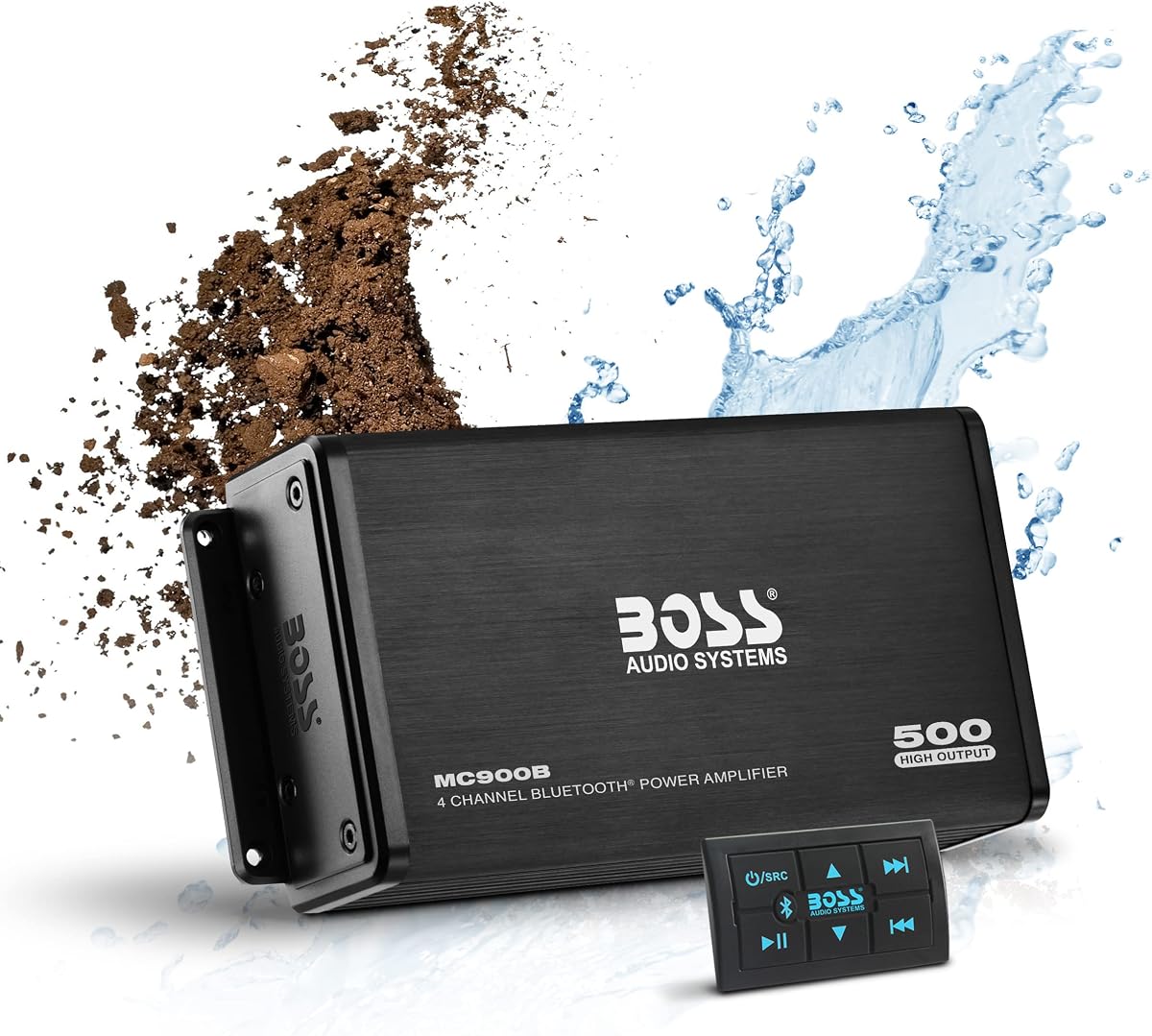
The Boss Audio Systems MC900B is a four-channel, weatherproof marine amplifier with a 4.2 rating. Its distinguishing feature is integrated Bluetooth streaming, allowing a boat owner to use a phone as the audio source without installing a conventional marine head unit. A separate 500-watt class designation in the listing should be interpreted alongside the more specific 94-watt RMS and 125-watt maximum ratings.
We may earn a commission when you buy through this link, at no additional cost to you.
The included Bluetooth remote supports streaming from compatible devices and can work with applications such as Spotify and Pandora. Its auxiliary input also accepts audio output from smartphones and MP3 players, while the USB charging port provides a practical way to replenish a connected device. These conveniences make the MC900B appealing for smaller boats, pontoons, or a secondary audio zone where a permanent source unit is unnecessary.
The enclosure measures 6.6 inches long and 1.75 inches wide and high, making it manageable in a console or storage area. As a Class AB amplifier, it differs fundamentally from the compact digital models in the list. Class AB operation can offer a familiar sound character, but it generally draws more current and requires more heat-management capacity than a comparable Class D design.
The primary limitation is environmental positioning. The listing describes the unit as designed to handle some light weather conditions, which is not the same as a sealed or deeply waterproof enclosure. It is best suited to a protected helm, console, or compartment. Buyers needing guaranteed exposure tolerance should choose a model with a stronger quantified rating.
Bluetooth and auxiliary connectivity remove the need for a permanent marine source unit. The included control makes basic phone operation convenient from the helm or seating area.
Full-range capability lets the amplifier serve conventional speakers rather than being limited to subwoofer duty. Its four channels can support a distributed speaker layout when the boat's power and wiring allow it.
We may earn a commission when you buy through this link, at no additional cost to you.
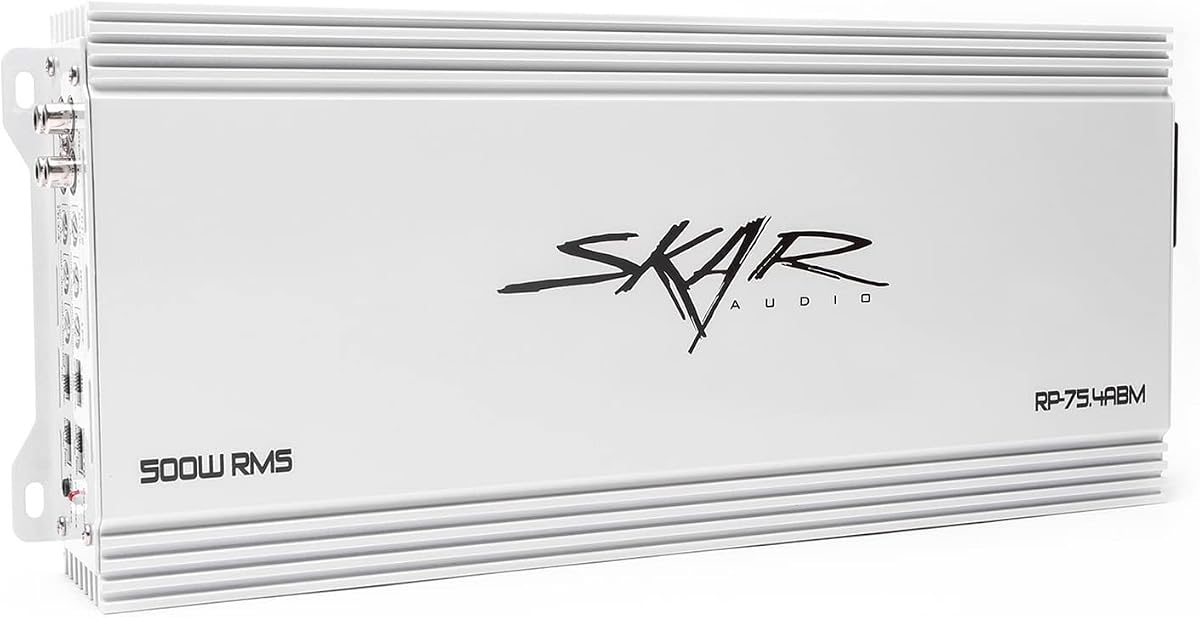
The Skar Audio RP-75.4ABM stands out with a 4.5 rating, the highest among the ten products considered. It is a full-range, four-channel Class A/B marine amplifier rated at 75 watts RMS per channel at 4 ohms and 125 watts RMS per channel at 2 ohms. That sustained-output information is more useful for system planning than the broad 500-watt category label.
We may earn a commission when you buy through this link, at no additional cost to you.
Its marine treatment includes a waterproof coating on the circuit board and rust-resistant painting on the mechanical case. Those measures address the moisture and corrosion risks common in boat installations. A four-way protection circuit provides additional safeguards, while the large power and ground terminals are designed to support strong current flow with appropriately sized wiring.
Sound tuning is a major strength. The amplifier offers adjustable gain, variable low-pass and high-pass filters, and a bass EQ switch with 0, +6, and +12 dB positions. The stated 105 dB signal-to-noise ratio indicates a design intended to maintain a clean signal floor. Full-range operation also provides more freedom than a subwoofer-only model when the speakers serve different musical roles.
The trade-offs are physical size and the absence of integrated Bluetooth. A Class AB design generally needs more enclosure space and may produce more heat than a micro Class D amplifier, while a separate source unit remains necessary. Even with those limitations, the RP-75.4ABM offers the strongest combination of rating, output information, marine coating, protection, and user-adjustable controls in this roundup.
The clearly stated RMS ratings make channel planning straightforward. Owners can estimate output for each speaker location and select an appropriate impedance configuration for their wiring.
A waterproof board coating and corrosion-resistant case finish address two separate threats encountered on the water. The additional protection circuit helps the amplifier operate more predictably.
We may earn a commission when you buy through this link, at no additional cost to you.
The Pyle PLMRMB4CB is a compact four-channel marine amplifier built around independent channel control. Its 3.9 rating is the second-lowest in the group, but the product's practical feature set makes it a strong value-oriented option for owners who need separate control of multiple boat speaker zones.
We may earn a commission when you buy through this link, at no additional cost to you.
The listing emphasizes a 200-watt multi-channel output, with four speakers able to operate on independent channels rather than being bridged or shared. That distinction is particularly relevant to a rigged boat with speakers assigned to the bow, stern, port, and starboard positions. Each zone can be balanced without sharing a common gain control, producing a more consistent listening experience.
The brushed aluminum housing is designed to resist heat, moisture, and vibration. Its low-profile enclosure can fit under a console, within a storage compartment, or near a transom where larger equipment would be inconvenient. A blue remote turn-on wire at 12VDC allows the amplifier to follow the head unit's operating state, reducing the need for a separate switch and helping avoid unnecessary battery drain.
The product description also highlights standard RCA integration and color-coded red, black, and blue wiring. A black version is included as PLMRMB4CB, with a white version also offered under a separate model number. The main drawback is that the listing does not provide the same level of quantified environmental certification as the sealed Kenwood or IPX-rated DS18, so protected placement remains important.
Separate channel control is the amplifier's most useful distinction. It allows different speaker areas to receive their own level adjustment, which can be helpful when passengers sit in different parts of the vessel.
The compact housing, conventional color-coded connections, and remote turn-on lead make integration comparatively straightforward. Automatic switching follows the head unit and avoids leaving the amplifier powered unnecessarily.
We may earn a commission when you buy through this link, at no additional cost to you.
The Pyle PLMRA200 is a two-channel Hydra Marine amplifier with a 4.0 rating. It is designed for straightforward stereo reproduction and offers 400 watts of maximum output through a dual MOSFET power supply. It is a logical fit for a smaller boat or a two-zone installation that does not require four separate output channels.
We may earn a commission when you buy through this link, at no additional cost to you.
Like the PLMRA402, the PLMRA200 supports both RCA stereo inputs and high-level terminal connections. The latter is valuable when the marine receiver lacks RCA outputs and the installer must use speaker-level leads. Dual adjustable gain controls allow the amplifier to be matched to the source while helping prevent clipping, distortion, or excessive noise.
Thermal overload and speaker short protection are supported by a heavy-duty aluminum-alloy heatsink and an LED indicator. The amplifier has an IP-01 marine rating, while gold-plated speaker output terminals are intended to resist corrosion over extended service. These features reflect a design focused on durability and straightforward use rather than elaborate signal processing.
The PLMRA200 is best for owners who need a durable two-channel unit and do not require per-zone control for four speakers. It lacks the crossover flexibility of the NVX and Skar models and does not offer a quantified deep-water protection standard comparable to the Kenwood. Its simplicity, dual inputs, and marine-focused construction nevertheless make it a credible compact marine amplifier choice.
Two channels keep the signal path and installation straightforward. This model is well matched to a standard stereo speaker pair where independent four-zone control is unnecessary.
The aluminum heatsink, short-circuit protection, and corrosion-resistant speaker terminals support long-term marine use. Placement in a protected area remains advisable within the limits of its listed rating.
We may earn a commission when you buy through this link, at no additional cost to you.
The DS18 NXL-N2 is an ultra-compact, two-channel Class D marine amplifier with a 4.1 rating. It combines a stated maximum output of 900 watts with RMS ratings of 150 watts per channel at 2 ohms and 100 watts per channel at 4 ohms. It is designed for boats and powersports vehicles, including bikes, ATVs, and UTVs.
We may earn a commission when you buy through this link, at no additional cost to you.
Its IPX67 waterproof rating is one of the strongest environmental credentials among the conventional two-channel choices. Stable four-layer PCB layouts support reliable operation, while the compact enclosure simplifies installation where space is limited. The Class D design also makes high output more practical in a small chassis than a similarly powerful conventional Class AB unit.
Sound configuration includes selectable high-pass, low-pass, and full-range modes. That versatility allows a pair of full-range speakers, a woofer with a tweeter, or a specialized crossover arrangement to be handled more effectively. The listing notes that the amplifier can work with different speakers, including subwoofers, mids, and tweeters, although careful gain and filter adjustment remains important.
The NXL-N2 is a strong choice for a compact two-speaker marine system or a mixed powersports installation where space and weather resistance are priorities. Its main limitation is that only two channels are provided, so it cannot independently serve four speaker zones. The competing maximum-power figures also require care, making the per-channel RMS values the safer basis for amplifier and speaker matching.
Digital Class D efficiency allows substantial output in a small housing. The result is useful when a conventional marine amplifier would occupy space needed for storage or equipment.
The IPX67 rating gives this model an advantage in wet installations. It is a more compelling choice for exposed marine or powersports applications than units offering only general weather-resistant construction.
We may earn a commission when you buy through this link, at no additional cost to you.
The Marine Bluetooth Amplifier is a compact, waterproof Class D unit designed to support four channels at 60 watts each. It has a 4.2 rating and focuses on simple wireless audio, making it most relevant to boat, golf-cart, motorcycle, and UTV installations where a permanent head unit is inconvenient.
We may earn a commission when you buy through this link, at no additional cost to you.
Its primary advantage is the included three-meter wired remote with a three-color LED indicator. The remote displays the active source—USB, auxiliary, or Bluetooth—and lets the user control a concealed amplifier. A clean, hidden installation is particularly useful in performance boats, center consoles, golf carts, and recreational vehicles where a large visible source unit would disrupt the design.
The amplifier supports Bluetooth streaming alongside USB and auxiliary input, giving the installer several ways to connect a phone, media player, or other source. The hidden-amplifier concept also keeps the main enclosure away from passengers, which can improve space planning while keeping essential controls within reach.
Output is the primary limitation. At 60 watts per channel, the amplifier is best for efficient, moderately powered speakers rather than a demanding large-speaker installation. The description calls it waterproof, but it does not provide a specific IP rating equivalent to the DS18 or Kenwood. Buyers should therefore prioritize a protected mounting location and verify the included wiring and accessories before installation.
The wired remote separates basic control from the concealed amplifier. Its status illumination helps the driver identify USB, auxiliary, or Bluetooth mode without accessing the main unit.
Bluetooth removes the requirement for a permanent marine head unit while four channels support a distributed speaker layout. This makes the model convenient for compact recreational and performance-boat installations.
We may earn a commission when you buy through this link, at no additional cost to you.
The Pyle PLMRMP3B is a compact four-channel Hydra Marine micro amplifier with a 3.7 rating, the lowest among the products reviewed. Its defining purpose is uncomplicated integration with a marine receiver, smartphone, or MP3 player rather than advanced signal processing.
We may earn a commission when you buy through this link, at no additional cost to you.
The amplifier includes RCA stereo inputs and a 3.5mm-to-RCA adapter, allowing a phone or other portable source to be connected when the boat lacks a conventional head unit. Adjustable input gain controls are included, while a remote provides volume control in the product description. This makes the PLMRMP3B a practical option for adding compact amplification to a basic source system.
Protection features include built-in power-protection circuitry and soft turn-on and turn-off behavior. These measures are intended to protect the amplifier and the vehicle's electrical system from short-circuit conditions and abrupt startup events. Its four-channel layout can power a distributed speaker arrangement, although the 800-watt maximum figure is a broad peak-style description rather than a clear per-channel RMS specification.
The PLMRMP3B is best considered a simple, space-conscious marine amplifier for a modest system. It trails the field in customer rating and offers less environmental detail, crossover control, and output transparency than the strongest alternatives. A buyer who values phone connectivity, straightforward RCA hookup, and compact four-channel capability may still find it useful, especially when a larger or more complex marine amplifier would be excessive.
The included 3.5mm-to-RCA adapter makes portable sources easy to add. This is useful for boats that do not have a full marine head unit but still want a four-speaker system.
The compact four-channel format is valuable where enclosure space is tight. Adjustment controls remain available without adding the larger signal-processing sections found on some competing models.
We may earn a commission when you buy through this link, at no additional cost to you.
The best compact marine amplifier is the one that matches your speaker configuration, source connections, available space, and exposure to water while providing enough clean output for the intended system.
Begin with the number of speakers and the amount of independent control the installation requires. A two-channel amplifier is sufficient for one stereo pair, while a four-channel model can serve bow, stern, port, and starboard speakers with separate level adjustments. Independent channels are particularly useful when different seating areas hear the same music at different distances. A subwoofer-only system calls for a monoblock, whereas a mixed system may benefit from an amplifier with selectable high-pass and low-pass filters.
Choose a channel count that matches the actual layout rather than paying for unused outputs. Extra channels can also complicate grounding, wiring, and control placement.
Compare RMS power at the impedance of the intended speaker load rather than relying on a broad maximum-wattage headline. The ideal amplifier should deliver adequate continuous power without forcing the speakers beyond their own limits. Check whether the amplifier supports the speakers' configured impedance, especially when multiple speakers share a channel or a bridgeable output is involved. Per-channel figures are essential when comparing four-channel models with different channel configurations.
A lower-power amplifier matched correctly can sound better than an oversized unit set at an unnecessarily high gain. Always use appropriate amplifier configuration charts when wiring multiple speakers.
Marine amplifiers face moisture, salt, dust, vibration, and changing temperatures. A quantified IP rating provides a more useful comparison than the broad term waterproof, particularly for exposed compartments, wash-down areas, and boats that see frequent spray. Fully sealed enclosures offer the strongest physical barrier, while conformal coating and corrosion-resistant finishes help protect conventional designs. Even a protected model should be mounted where standing water and direct hose exposure are unlikely unless its rating explicitly permits those conditions.
Prioritize the level of protection appropriate to the mounting location. A dry helm cabinet does not need the same enclosure rating as a transom or storage area exposed to heavy spray.
RCA inputs are standard on conventional marine systems, while speaker-level inputs make an amplifier easier to add when the existing head unit lacks preamp outputs. A 3.5mm adapter or Bluetooth capability can simplify phone and portable-source integration, but wireless streaming does not replace a correctly wired marine receiver when multiple zones, low latency, or reliable signal control are priorities. Wired remote controls and automatic turn-on functions improve daily usability.
List every source the boat will use before choosing. Ensure the amplifier supports that source and can start and stop cleanly with the rest of the system.
Gain, high-pass, low-pass, and bass controls determine how the amplifier works with the rest of the system. A high-pass filter is useful for preventing subwoofers from receiving full-range content, while a low-pass filter can focus an amplifier on lower frequencies. Full-range mode offers flexibility but requires correct speaker selection and careful setup. Bass boost should be treated as a minor adjustment, since excessive low-frequency boost can increase distortion and strain the power supply.
More controls are useful only when the installer understands their purpose. Select the model that matches the system design, then set filters and gain deliberately rather than maximizing every available setting.
Class D amplifiers are often the best fit for compact installations because they can deliver strong output in a smaller, cooler-running enclosure. Class A/B designs may satisfy certain sound and power preferences, but they generally require more space and power. Micro Class D models are especially attractive under consoles and inside storage compartments. Measure the available cavity before purchasing, and include room for ventilation, cable bend radius, terminals, and service access.
A smaller amplifier is not automatically better if it cannot deliver the required output. Confirm dimensions against the installation space and avoid planning around a tight fit with no service clearance.
Thermal protection, overload protection, speaker short protection, DC-offset protection, and soft turn-on behavior add resilience to a marine installation. Large or gold-plated power and speaker terminals can improve current transfer and resist corrosion, but they still require correct wire gauge, clean connections, and sound grounding. A remote turn-on lead helps the amplifier follow the head unit and avoid unnecessary battery drain. LED status indicators are useful for diagnosing power and protection conditions.
Choose the amplifier that makes safe installation easier. Features that reduce wiring errors, automate shutdown, or clearly reveal fault conditions can be as valuable as extra output in a long-term marine build.
A head unit-free amplifier can be ideal for a smaller boat or a secondary system where a full marine stereo would consume too much space. Bluetooth supports convenient phone streaming, while USB and auxiliary inputs provide alternatives. These features do not automatically make every installation better: a permanent head unit may offer cleaner integration, easier source switching, and more control over multi-zone audio. For concealed installations, a wired remote with visible source indicators is particularly useful.
Choose wireless convenience when it matches the boat's usage. Keep a wired source available if reliable control, quick device charging, or integration with existing marine electronics matters more.
Before installation, confirm amplifier compatibility with the speaker impedance, wiring configuration, source output, and available electrical supply. Read the included wiring diagram and identify the power, ground, remote turn-on, RCA, and speaker-level connections. Disconnect the boat battery during wiring, and use the appropriate wire gauge and fused power feed for the amplifier's current requirements.
Mount the unit in a dry, ventilated location unless its protection rating specifically supports harsher exposure. Secure it away from moving parts and allow service access to terminals and controls. Connect ground to a clean, bare-metal boat ground point, minimize input cable routing near power wires, and check every polarity connection before powering the system.
Begin with gain and crossover settings at their minimum, then increase gain slowly while listening for distortion. Set filters to match the speaker roles, use the wired remote or source controls for daily volume, and avoid maximum gain when the amplifier is not receiving a strong signal. Periodically inspect terminals for corrosion, check that airflow remains unobstructed, and keep the enclosure dry whenever practical.
A marine-rated amplifier is strongly recommended because boat environments expose electronics to humidity, salt, dust, and vibration. The amount of protection needed depends on the installation area, with sealed or IP-rated models offering greater security in exposed compartments. Even a well-built marine amplifier benefits from a dry location and periodic terminal inspection.
A four-channel amplifier is better when the boat has multiple independently controlled speaker zones, such as bow, stern, port, and starboard positions. A two-channel model is usually sufficient for one stereo pair. Choose based on the actual speaker layout rather than the number of channels alone, and consider a monoblock for a dedicated subwoofer.
RMS power indicates the amplifier's continuous output under a specified test condition and speaker impedance. It is generally more useful than a maximum or peak number when matching an amplifier to speakers. Compare the per-channel RMS rating at the same impedance for every model considered.
Many marine amplifiers can operate without a conventional head unit through Bluetooth, USB, auxiliary input, or a phone connection. Some also accept high-level speaker inputs from an existing receiver. Check the amplifier's input options and ensure the source device has the appropriate output connection.
The amplifier should be installed in a protected, ventilated location with access for wiring and maintenance. A dry console or storage compartment is usually preferable to a location exposed to standing water or direct wash-down spray. If exposure is unavoidable, select a model with a suitably high IP or sealed-enclosure rating.
High-pass and low-pass filters prevent speakers from receiving frequencies they cannot reproduce efficiently. A high-pass filter can keep a subwoofer focused on bass, while a low-pass filter can direct an amplifier channel toward low-frequency speakers. Correct filter settings reduce distortion and improve how multiple speaker types work together.
Professional installation is not always essential for a simple two-channel system, but it is advisable for complex boat audio, high-current wiring, multiple speaker zones, or integrated Bluetooth and remote controls. A qualified installer can reduce electrical risk, prevent signal problems, and ensure that fuses, grounds, wire gauges, and protection are correctly configured.
Inspect the enclosure and terminals periodically, especially after extended use in a salt-heavy environment. Look for corrosion, loose wiring, obstructed ventilation, or moisture inside the mounting area. Keep the unit dry when possible, confirm that connections remain firm, and address unusual noise, power loss, or protection indicators promptly.
The Skar Audio RP-75.4ABM is the strongest all-around choice for buyers who want four channels, clear RMS ratings, extensive crossover controls, and marine-focused coating. The NVX VADM4 v2 stands out for its exceptionally small Class D enclosure, while the Pyle PLMRMB4CB provides independent channels and compact value for a distributed boat speaker system.
The right choice ultimately depends on the installation. Select a monoblock such as the Kenwood KAC-M5001 for a subwoofer, a highly weather-resistant model such as the DS18 NXL-N2 for wet placement, and a Bluetooth-equipped unit when avoiding a permanent head unit is important. Match channels to the speaker layout, prioritize the appropriate protection level, and use continuous RMS ratings rather than broad peak claims.
Specifications, availability, and prices can change, so check the current listing and manufacturer guidance before buying. Confirm speaker impedance, connection requirements, mounting space, and remote-control compatibility, and use a correctly sized fused power line for a safe and dependable installation.