
Panasonic KX-TGA710B
4.2Editor score
16,000 total blocking capacity
Bilingual talking caller ID
100 trusted-number entries
Large red block button
Backlit information display
Compare the 10 best call blockers for landline phones, including capacity, filtering modes, compatibility, setup, and ease of use, to find your ideal option.
Call blockers for landline phones create a quieter, more controlled home or office phone line by filtering unwanted callers. The best models combine a useful starting database with simple controls, dependable line-powered operation, and compatibility with the telephone service and equipment you already use.
This guide compares ten options based on blocking capacity, allow-and-block modes, caller ID requirements, installation method, display features, and suitability for seniors or busy households. It also highlights important differences between simple one-touch blockers and more advanced systems designed to manage multiple extensions.
Each review explains the product's strongest benefits, practical limitations, and ideal buyer, while the comparison table provides a quick overview. Product ratings, features, and availability can change over time, and current prices should be checked on the linked retailer pages before purchasing.
4.2Editor score

4.2Editor score
4.0Editor score
The comparison below highlights each blocker's practical distinctions, including database size, manual capacity, filtering controls, power requirements, and line compatibility. Because features vary substantially, buyers should confirm their telephone type and Caller ID service before ordering.


The CPR V5000 is a straightforward, purpose-built call blocker for traditional analog landline phones. Its 4.2 rating reflects a balance of useful preloaded protection, simple controls, and a large one-touch block button. Unlike app-based solutions, it puts the essential action directly beside the phone and does not require a smartphone, account, subscription, or mains power.
We may earn a commission when you buy through this link, at no additional cost to you.
Its most valuable feature is the combination of 5,000 preloaded nuisance numbers with room for 1,500 additional manual entries. Users can stop and immediately add a repeated offender without navigating through a complicated menu. The clear screen, loud button click, and large red control also make the device approachable for older adults, while the included manufacturer support and three-year warranty add reassurance.
The important limitation is service compatibility. The V5000 requires Caller ID and an analog telephone line, making it unsuitable for internet-based or digital services such as Vonage, Ooma, Xfinity Voice, and Quantum Fiber. It also cannot guarantee that every fraudulent call will be stopped because scammers regularly change numbers. Even with a robust database, a new or spoofed number may ring through initially.
This is the strongest general recommendation for a household using a traditional analog line that wants immediate protection and uncomplicated operation. Pair it with a provider's spam-filtering service when possible, keep the manual block list current, and confirm your line type before ordering. Those constraints are clear, making the V5000 especially appealing to buyers who value simplicity over smart-home integration.
Best overall for analog homes seeking a genuinely hands-on filter
Clear preloaded protection with a physical block button
The preloaded database gives the V5000 a useful advantage before the owner enters a single number. Its large block button and loud click make recording unwanted callers quick, particularly for someone who wants a physical control rather than navigating through a phone menu.
Keeping a nuisance list effective means adding new numbers and occasionally reviewing allowed contacts. The V5000 supports a substantial manual list and presents status information on a clear screen, making ongoing housekeeping more convenient than an unassisted database alone.
We may earn a commission when you buy through this link, at no additional cost to you.
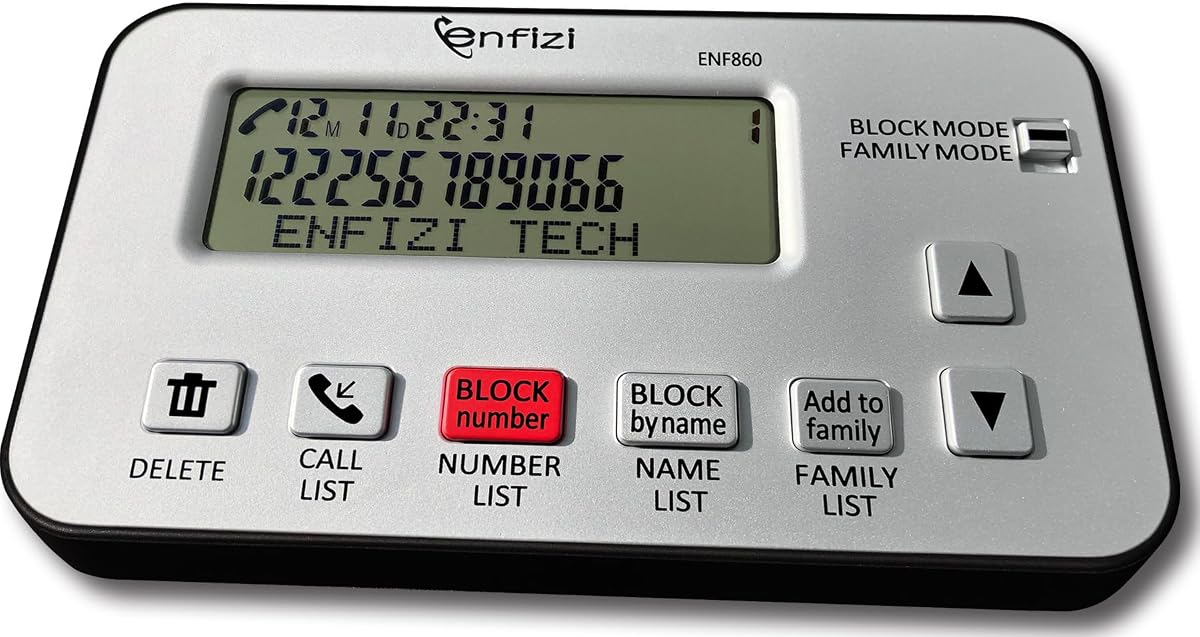
The Enf860 is the most flexible traditional call blocker in this guide, with separate Block and Family modes that give users two different ways to control incoming calls. Its 4.1 rating reflects a capable filtering system for analog lines. The device can block callers by both number and name, add more than 4,000 numbers manually, and store as many as 256 blocked names.
We may earn a commission when you buy through this link, at no additional cost to you.
In Block mode, unwanted callers can be added to a growing number blacklist, while the preloaded database provides an initial layer of protection. Family mode takes a stricter approach by allowing only numbers placed on the approved list to ring through. Callers outside that list are blocked, making the mode useful for households that want tight control and are willing to maintain their contacts carefully.
The Enf860 is not a telephone or answering machine, and it requires analog service with Caller ID. Its manufacturer also warns that newly created scam numbers can bypass the database. In those cases, users must manually add the number or activate Family mode. Broad filtering options for international, private or withheld, and out-of-area calls add value, although the available controls may feel more technical than a basic blocker.
The Enf860 best suits a technical or privacy-focused household that wants both a blacklist and a strict allowlist. It is less appropriate for someone who wants a completely hands-off system, because Family mode depends on keeping the approved list current. For users who understand that tradeoff, it offers unusually broad control for a line-powered analog device.
Best premium choice for two-mode call control
Flexible filtering for blocklists and trusted contacts
The ability to switch between Block and Family modes without losing saved data is the Enf860's defining advantage. Block mode supports active blacklisting, while Family mode is a stricter allowlist approach for homes that prefer to admit only known contacts.
Blocking by caller name can help users suppress repeated nuisance categories or suspicious labels beyond a single number. The 256-name allowance and thousands of number entries make this more versatile than simple one-touch blockers, provided the owner maintains the lists accurately.
We may earn a commission when you buy through this link, at no additional cost to you.
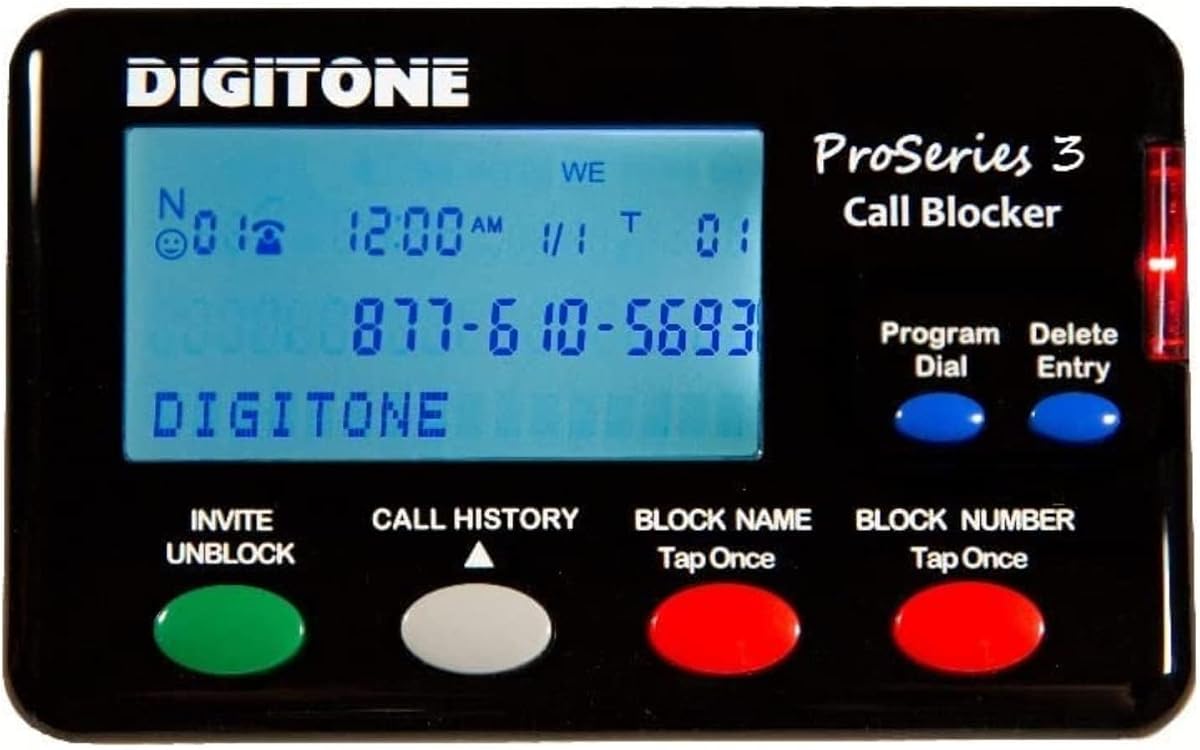
The Digitone ProSeries 3 focuses on automatically identifying and stopping known spam before a phone rings. Its 3.8 rating places it behind the leaders in overall user satisfaction, but its feature set is attractive for buyers who want less manual intervention. The device works with analog corded and cordless phones, answering machines, and fax systems across numerous services.
We may earn a commission when you buy through this link, at no additional cost to you.
A major advantage is the separation between block and invite buttons. Recognized spam calls are filtered automatically, preferred calls pass through with Caller ID visible, and phones connected through the TEL port do not ring for blocked calls. Users can also block the name or number shown in call history, add allowed family members, and remotely block a call by dialing the specified handset code.
The primary trade-off is that automation cannot keep pace with every changing or spoofed caller. The product description also makes broad compatibility claims while noting that Caller ID name and number service is required for automatic operation. Buyers should therefore verify the precise behavior of their carrier and telephone system rather than assuming every digital or VoIP arrangement will provide identical results.
The ProSeries 3 is a good fit for someone who wants automatic filtering but also wants physical controls for exceptions. It is especially useful for people who cannot always reach the unit in time to answer, since remote blocking and invited contacts can simplify ongoing management. Its lower rating should encourage buyers to verify compatibility before purchase.
Best automatic filtering for mixed call types
Stops recognized spam while preserving invited contacts
The ProSeries 3 automatically handles recognized spam but also provides block and invite controls when a judgment call is needed. That combination can reduce the frustration of repeatedly reaching for a device while a phone continues to ring.
Its large backlit display is useful for reviewing caller information and confirming that a number has been added. The support number displayed on the screen also provides a convenient starting point when setup questions or unusual call patterns need assistance.
We may earn a commission when you buy through this link, at no additional cost to you.
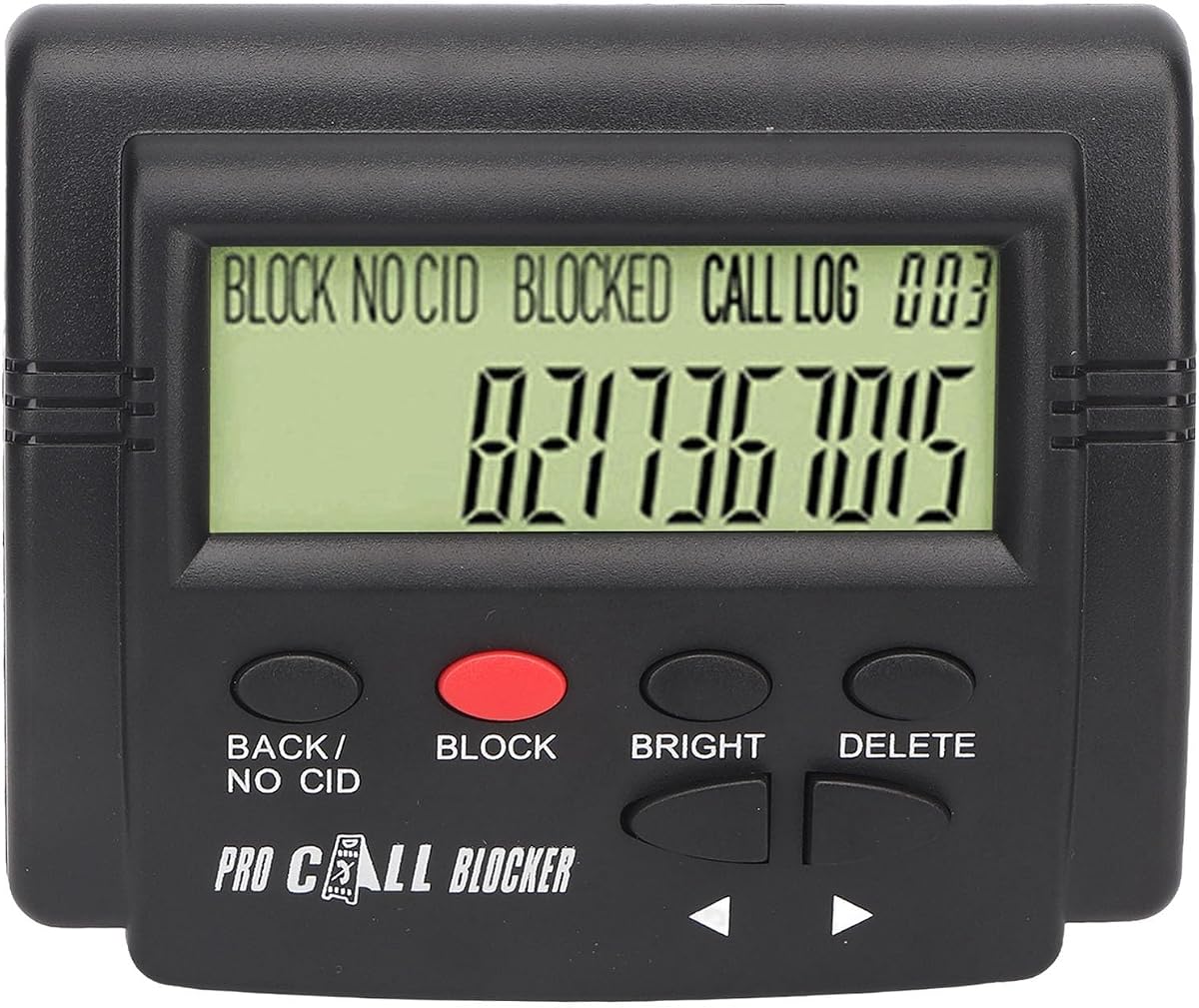
The HEITIGN 4000-Number Blocker is a compact, budget-conscious option for traditional fixed-line telephones. Its 4.0 rating indicates broadly positive reception, and the core feature set is appropriately direct: a large blacklist, an LCD screen, dual plugs, and a dedicated button for adding nuisance numbers without changing the existing telephone.
We may earn a commission when you buy through this link, at no additional cost to you.
Storage for as many as 4,000 blocked numbers gives it ample room for a household that accumulates unwanted callers gradually. The display can be set across five brightness levels, which is a helpful detail for easy viewing in different rooms and lighting conditions. A one-touch Block button also reduces friction, allowing a user to reject a call quickly and preserve the number for future filtering.
The supplied information does not describe a substantial preloaded nuisance database, so this product should be viewed as a user-managed blacklist rather than a fully automatic filtering system. It is also expressly limited to fixed-line and landline telephones with Caller ID enabled. Its precise support for prefixes, area-code rules, multiple lines, and advanced filtering modes is not clearly specified, which may matter to technically demanding buyers.
This is a compelling pick for someone who wants a straightforward box with a generous capacity, readable display, and uncomplicated installation. It offers good utility for a standard analog home phone, especially when the goal is to build a personal blacklist over time. Prospective buyers should confirm their service provides Caller ID and that the device's line connection suits their setup.
Best budget option for manual blacklist building
A readable, no-frills filter with generous capacity
A 4,000-entry blacklist is more than most households need for routine nuisance-call management. The dual-plug format and dedicated block button let users begin filtering quickly, without replacing their handset or learning an elaborate menu system.
Five brightness levels make the LCD more useful across different indoor conditions. While the screen does not make the device automatic, it helps the owner review incoming information and manage the blacklist with less guesswork.
We may earn a commission when you buy through this link, at no additional cost to you.
The Enf510 is a line-powered blocker for analog telephones, answering machines, and home cordless systems. Its 3.8 rating reflects a functional device with useful filtering rules, although it is less advanced than the top dual-mode alternatives. The supplied information lists 4,000-plus preloaded frequently complained numbers and capacity for 3,000 more added by the user.
We may earn a commission when you buy through this link, at no additional cost to you.
Users can block a caller with the physical button or by pressing the specified sequence on the telephone, making the device quicker to operate from another room. It supports broader rules for entire area codes, number prefixes, international calls, private or withheld numbers, and VoIP or out-of-area calls. A Family List creates exceptions so important contacts can continue reaching the household even if a database rule catches them.
The Enf510 displays only the caller's number rather than the caller's name, and it works only with analog phones. The Family List is an exception list rather than a strict whitelist, so a caller outside that list may still ring through unless another rule blocks it. New scam-number variants can also bypass the database and must be added manually.
The Enf510 makes sense for an established analog phone setup that wants both preloaded protection and detailed prefix rules. It is a good option for users comfortable with telephone sequences and willing to maintain exceptions. Those who require caller names, a true allow-only mode, or support for modern internet-based services should choose a more specialized model.
Best established choice for analog homes
Substantial preset coverage with flexible prefix rules
The handset shortcut is particularly useful when the blocker sits beside a shared phone. Users can add an unwanted number without walking to the box, while the physical button remains available for straightforward one-touch operation.
Blocking by area code or fixed prefix can be more efficient than adding every new variation individually. The Family List helps preserve access for important contacts when those broader rules are active.
We may earn a commission when you buy through this link, at no additional cost to you.
The Generic 2000-Group Blocker is a basic line-filtering box intended for fixed-line and landline telephones with Caller ID. Its 3.4 rating is the lowest among the products reviewed, so buyers should treat it as a simple utility rather than a feature-rich solution. It focuses on adding nuisance numbers, blocking regional groups, and presenting status information on an LCD.
We may earn a commission when you buy through this link, at no additional cost to you.
The product uses a dual-plug design and is described as plug-and-play for most landline phones. Once connected, a dedicated control adds a number permanently to the blacklist, while area-code settings can suppress entire groups of regional numbers. The screen and simple buttons make the basic process accessible, and the adjustable display brightness adds a small degree of flexibility.
Its 2,000-group capacity is lower than the 4,000-number and larger lists offered by several alternatives. The supplied information is also limited regarding preloaded databases, allowlists, name-based filtering, multiple-line support, and exact power requirements. Because no Caller ID means no visible number to block, compatibility is a more important consideration than usual.
This device is most appropriate for a basic household that wants a simple box to reduce obvious harassment and telemarketing calls. It may also suit buyers who do not want to pay for a more advanced model or need only a moderate personal list. Those requiring known incoming callers, robust preset coverage, or sophisticated family controls should look elsewhere.
Best basic box for moderate blacklisting
A simple display-led approach to nuisance calls
The core interaction is direct: connect the box, read the incoming information, and press the blocking control. This makes the device practical for a household that wants immediate disruption reduction without learning complicated software.
Blocking an entire area code can be useful against a recurring regional nuisance pattern. The same broad rule can also create inconvenience, so it should be applied selectively and reviewed when trusted contacts use matching numbers.
We may earn a commission when you buy through this link, at no additional cost to you.
The 4000-Capacity Call Blocker is a practical filter for users who want detailed control over individual numbers, prefixes, and area codes. Its 3.9 rating places it near the middle of the group. The device can store as many as 4,000 individual numbers and is also described as supporting incoming and outgoing calls, prefixes, and ten-digit area codes.
We may earn a commission when you buy through this link, at no additional cost to you.
A prominent one-touch control makes it easy to add a number after locating it in the caller's information. More importantly, the blacklist remains stored even if the device loses power or is unplugged from the telephone line. It draws power from the line and does not require batteries, which reduces routine maintenance and makes it convenient for long-term installation.
Installation method matters. The manufacturer recommends connecting the blocker in series between the telephone and the PSTN line, although parallel installation is possible in some arrangements. That alternative is not compatible with every phone system. Buyers should also review the blacklist after creating broad area-code or prefix rules, because an overly wide rule can unintentionally stop a legitimate contact.
This model is a good fit for a standard single-line analog setup where the owner wants robust manual control and does not need a smartphone interface. Its persistent storage and large capacity support a gradual, long-term approach to nuisance-call management. It is less attractive for multi-line offices or consumers who want automatic robocall classification and a polished allowlist system.
Best persistent list for manual filtering
Reliable storage with flexible prefix controls
Persistent storage is a meaningful convenience in a device expected to remain connected continuously. A temporary power interruption does not erase the numbers the owner has worked to collect.
Series installation provides the intended signal path for most setups, while parallel use is available for some systems. Checking the manual and telephone configuration before connecting it can prevent unexpected compatibility issues.
We may earn a commission when you buy through this link, at no additional cost to you.
The Panasonic KX-TGA710B is the most premium-oriented call blocker in this roundup, combining an expansive 16,000-number capacity with one of the most thoughtful caller-identification features. Its 4.2 rating matches the leading product in the guide. The unit combines 14,000 preloaded robocaller and telemarketer numbers with room for 2,000 manually registered numbers.
We may earn a commission when you buy through this link, at no additional cost to you.
Its talking Caller ID is a standout benefit. The device can announce a caller's name or number in English or Spanish, allowing the user to identify a caller from across the room. A green light signals a trusted contact, a red light signals an unknown call, and the large red block button makes registering an unwanted number immediate. The bright backlit LCD provides the same information visually.
The product is designed for cordless home phones that lack their own call-blocking function or have limited registration capacity. Because a premium feature set and large advertised database do not guarantee perfect screening, buyers should still expect some fraudulent calls to require manual blocking. The model is also more elaborate than many users need, particularly households seeking only a basic personal blacklist.
The Panasonic is best for a user who wants a large selection of preloaded numbers, audible caller identification, and an easy way to distinguish trusted contacts. It also makes sense for multilingual households because announcements can be heard in English or Spanish. Check the connection requirements and existing cordless phone arrangement before buying, but for a compatible home setup it offers the richest interface here.
Best premium option for larger databases
Audible caller ID and trusted-contact signals
Spoken caller information reduces the need to walk to the phone and read a small screen. English and Spanish announcements make the feature useful to a wider range of users and add a level of convenience absent from most basic blockers.
A green indicator for accepted contacts and a red indicator for unknown calls provide an immediate visual distinction. This is particularly helpful when screening calls during meetings, meals, or other moments when repeated interruptions are costly.
We may earn a commission when you buy through this link, at no additional cost to you.
The Senior Landline Blocker is designed around accessibility, with large buttons, a bright LCD, and a one-touch blacklist control. It does not yet have a customer rating in the supplied data, so its long-term user reception cannot be compared with the rated products. Its principal appeal is the emphasis on making call screening and blocking easy for older adults.
We may earn a commission when you buy through this link, at no additional cost to you.
The screen lets a user inspect an incoming number before deciding whether to answer. When a call is unwanted, the physical control adds the number to the blacklist, while the advertised 2,000-call capacity supplies enough room for gradual list building. Direct connection to a home telephone line keeps setup comparatively uncomplicated, with no mention of an app or ongoing subscription.
The bundle includes an in-line coupler, a 25-foot curly handset cord, and a cord detangler intended to help with static-free connections. Those accessories are useful for placement flexibility, although buyers should still confirm that their existing telephone arrangement can accommodate the unit. Detailed information about a preloaded database, allowlist, area-code filtering, and VoIP behavior is not provided.
This is a sensible choice for an older adult or caregiver seeking a physically intuitive blocker. Its controls and bright display reduce barriers to use, while the included hardware simplifies installation. Because it has no rating yet, buyers should inspect recent customer feedback and confirm service compatibility, and they should not expect the enormous preloaded coverage offered by the premium models.
Best accessible choice for older adults
Large controls and a bright screening display
Large buttons and one-touch blacklist control reduce the need for precise sequences or a small menu. These are meaningful usability advantages for users with limited dexterity or anyone who wants to reject a call without learning a complex interface.
The in-line coupler, lengthy handset cord, and detangler give the owner more freedom when positioning the unit near a landline phone. These included components are especially helpful if the standard cord would otherwise be too short or awkward.
We may earn a commission when you buy through this link, at no additional cost to you.
The TB208 is designed for a two-line home or small office with multiple extension telephones. It has no customer rating in the supplied data, but it stands apart from the other products by focusing on call routing rather than local one-touch blocking. The system supports two central-office line jacks and eight extension jacks within a wall-mountable or desktop metal case.
We may earn a commission when you buy through this link, at no additional cost to you.
Its defining feature is whitelist-only operation. Up to 500 allowed contact groups can ring designated extension phones, while unapproved calls are automatically answered and directed to a verification request. Calls that fail to provide the correct response are disconnected, a method intended to frustrate automated callers. Users can manually place as many as 1,000 number, area-code, or prefix groups on the blocklist.
There are important operational compromises. The unit has no display, so it does not show Caller ID or confirm which calls it has blocked. It also lacks a physical BLOCK or ALLOW button; all management occurs on the associated extension telephone. Because the system only passes the caller's number rather than the name, contacts must already be stored in the extension phone. Users also cannot dial star or pound codes through the associated extension, which prevents normal voicemail access.
The TB208 is best for a multi-extension household or small office that needs to route approved callers to specific staff or family members. It is less suitable for a single landline or a buyer who wants an on-box screen and physical block button. Because installation and call-routing behavior differ substantially from simple blockers, confirm every telephone, voicemail, and extension requirement before purchasing.
Best for multi-extension small offices
Whitelist routing for busy shared phone lines
Allowed contacts can ring the corresponding extension directly without hearing the verification prompt. After a call is answered, the system can transfer it to another extension, making it useful for employees or family members sharing multiple lines.
Non-whitelisted calls are auto-answered and challenged with a voice prompt. Automated callers are less likely to enter the correct code, while legitimate visitors or clients can respond and reach the associated telephone.
The lack of a display, physical controls, and star or pound code support can interfere with an established telephone workflow. Confirm voicemail use, contact storage, and extension routing before integrating the system into a working office.
We may earn a commission when you buy through this link, at no additional cost to you.
The best call blocker is the one that works with your telephone service, fits your household's screening habits, and remains easy to maintain. Compatibility, Caller ID support, filtering strategy, capacity, and physical accessibility should be evaluated before purchase.
Traditional analog landlines and modern internet-based telephone services use different signaling systems, so a blocker designed for one may not work correctly with the other. Several products in this guide expressly require an analog line and Caller ID, while the Digitone ProSeries 3 and TB208 claim broader support. Contact your provider or check the equipment markings on your existing phone before ordering, and pay particular attention to whether your service identifies VoIP-generated numbers.
A physical call blocker generally needs an incoming number to place on a blacklist. If Caller ID is not active, hidden or withheld callers may not be identifiable, and automatic name-based screening will not function as intended. Products such as the CPR V5000, Enf860, Enf510, and HEITIGN explicitly require Caller ID service. Treat Caller ID as a necessary companion feature rather than an optional convenience.
An active blocklist gives you control, but you must add new nuisance numbers as they appear. A preloaded or automatic database filters many calls immediately, yet a changing scam number can still require manual intervention. The CPR V5000 and Panasonic offer large starting databases, and the Digitone ProSeries 3 emphasizes automatic recognition. Your preferred balance depends on whether you want immediate passive protection or a completely user-managed list.
Capacity affects how often you must clean up or reorganize your lists. The Panasonic KX-TGA710B advertises 16,000 total entries, while the Enf860, Enf510, HEITIGN, and 4000-Capacity Blocker support around 4,000 individual entries. The TB208 instead emphasizes 500 allowed contacts and 1,000 blocked groups. Capacity alone is not a quality measure; the system should also make it easy to review, add, and remove entries.
A large physical block button, readable display, and clear feedback are especially valuable for seniors, people with limited dexterity, or anyone who wants to answer a call without navigating a complicated menu. The CPR V5000 and Panasonic emphasize large controls, while the Senior Landline Blocker focuses on accessibility. Screen brightness, spoken announcements, and handset shortcuts can further improve daily usability.
A single-line home can be well served by a simple one-touch box, but households with multiple extensions may need routing capabilities. The TB208 includes two line jacks and eight extension jacks for that purpose. It also requires mains power and has no built-in display, making it a different category from line-powered desktop units. Map the number of lines, extensions, answering machines, and fax machines before choosing.
Many analog blockers draw power from the telephone line, eliminating batteries and an external power adapter. This is convenient for a permanent installation, although the device cannot provide the verification voice prompt offered by a powered small-office system. The TB208 includes an AC supply and is designed for a metal-case installation. Consider outlet access, mounting location, cable reach, and whether you want the unit near the phone.
Individual number blocking is only the beginning. Area-code and prefix rules can stop clusters of related callers, while family or allowlist modes protect known contacts. International, private or withheld, and out-of-area categories offer additional layers. Broad rules are powerful but can accidentally block legitimate people, so use them carefully and establish an easy procedure for reviewing and correcting the list.
Begin by confirming that your telephone line supports Caller ID and that the call blocker is compatible with your analog, digital, or VoIP service. Read the included manual, identify the line and phone ports, and disconnect power where applicable. Most units use a dual-plug arrangement or a short series cable, but the intended connection can differ by model, so verify the diagram before inserting anything.
Connect the device according to the manual and perform a test call from a telephone known to be allowed. Confirm that the caller's name or number appears correctly and that the connected phone rings normally. Next, add several trusted contacts, if the model supports an allowlist, and test one of them. Then call from a blocked or withheld number if possible to confirm that the phone remains quiet and the unit records the event as expected.
For routine care, review recent call history and add repeated nuisance numbers immediately. Periodically check the blacklist for entries added by mistake, especially after creating an area-code or prefix rule. Clean the unit with a dry or lightly damp cloth, avoid liquids near the line plugs and electrical controls, and inspect cords for damage. Do not unplug the line-powered models unnecessarily, and preserve the manual because it contains the codes and settings needed for maintenance.
Many do, provided the phones connect through a compatible analog landline and the call blocker is installed correctly. The CPR V5000, Enf860, Enf510, HEITIGN, and Panasonic models are intended for traditional telephone systems and may connect beside a cordless base. Digital and VoIP services have different requirements, so verify the manufacturer's compatibility list and confirm Caller ID support before purchasing.
No. Scammers frequently change numbers, spoof caller information, or exploit gaps in a provider's screening system. A call blocker is most effective when it combines a useful preloaded database with rapid manual blocking. Carrier spam filtering, cautious screening, and avoiding unnecessary personal information can provide additional protection.
A blacklist blocks specified numbers while allowing other callers through by default. A whitelist works in the opposite direction, allowing only approved contacts and stopping unknown callers. The Enf860 and TB208 emphasize whitelist-style control, while most other products center on a blacklist. Whitelisting can reduce interruptions but requires the owner to keep approved contacts current.
Caller ID is required or explicitly expected by most models in this guide because the blocker needs an incoming number to match against its lists. Without Caller ID, hidden or withheld callers may not be identifiable. Confirm that your telephone provider includes Caller ID and that your service transmits the number information needed for the selected device.
It depends on the model and the provider's signaling behavior. The CPR V5000 and Enf860 expressly exclude VoIP services, while the Digitone ProSeries 3 and TB208 list broader compatibility. Even when a product states VoIP support, it is prudent to confirm whether the service sends Caller ID, supports the required line signals, and presents the caller's number in a compatible format.
A capacity of 2,000 to 4,000 individual entries is usually ample for a household, especially if the device can also use area-code or prefix rules. The Panasonic offers the largest advertised total, while the TB208 is designed around 500 allowed groups for a shared office. Choose based on your list-building habits and whether you prefer a large manual database or a maintained allowlist.
It can, depending on the connection method and telephone system. The Enf510 and Digitone ProSeries 3 expressly mention compatibility with answering machines, while other products provide less detail. Check the manual for series or parallel installation guidance, and test both normal and blocked calls before relying on the setup for voicemail or call recording.
Add new nuisance numbers as soon as they appear, and review the list regularly for accidental entries. Broad area-code and prefix rules deserve special attention because they can catch a trusted contact. If someone important is blocked, remove that entry or add the person to the allowlist, then retest the phone connection to confirm that both allowed and unwanted calls behave correctly.
The CPR V5000 is the best overall choice for most traditional analog homes because it combines a substantial preloaded database, 1,500 manual additions, a large physical block button, and line-powered operation without requiring an app. The Panasonic KX-TGA710B is the premium selection for buyers who prioritize a very large database, trusted-contact indicators, and bilingual spoken Caller ID, while the HEITIGN model is the practical budget selection for a straightforward 4,000-entry blacklist.
Before choosing, confirm the telephone type, Caller ID availability, line power, and the number of extensions you need. Simple homes may be best served by a one-touch box, while demanding users should consider dual modes, caller-name filtering, remote controls, or automatic verification. A multi-extension office should evaluate the TB208 only after checking voicemail access, contact routing, and the limitations of its display-free design.
Ratings, features, and prices can change, so review the latest product information and current retailer listing before ordering. If your carrier already offers spam filtering, use it alongside a physical call blocker rather than assuming either solution will stop every fraudulent caller. The right device is the one that integrates cleanly with your phone, fits your routine, and makes screening calls genuinely easier.