
WASSERMANN RV Pump
4.4Editor score
4.0 GPM maximum flow
45 PSI shut-off pressure
Automatic pressure switch
Self-priming RV design
Looking for a 12V Water Pump? This expert guide compares flow, pressure, priming, power draw, durability, and ideal RV, marine, and off-grid uses for buyers.
A 12V water pump can make an RV, camper, boat, food truck, cabin, or mobile freshwater system far more useful by delivering pressure on demand. The right model should match your required flow, plumbing pressure, available current, mounting position, and expected duty cycle while remaining suitably quiet and protected against dry-run damage.
The pumps in this guide were compared using the specifications and product information supplied by their manufacturers and sellers. We examined flow rate, pressure, self-priming capability, electrical requirements, automatic controls, noise-related features, included accessories, warranty coverage, and intended environments rather than relying on a single headline specification.
Each pick highlights a different practical route: higher output for demanding RV systems, compact flow for a single fixture, quiet operation for sleeping spaces, or strong self-priming for installation above a tank. Product ratings and availability can change over time, and current prices should always be checked before purchasing.
4.4Editor score

4.4Editor score

4.9Editor score
The table below compares the key operating characteristics of all ten pumps, making it easier to match flow, pressure, priming capability, and mounting needs with a particular RV, marine, irrigation, or off-grid installation.




The WASSERMANN RV Pump combines a 4.0 GPM flow rate, 45 PSI pressure setting, and automatic pressure switch in a package explicitly designed for RVs, campers, marine vehicles, camping equipment, and garden use. Its 4.4 rating reflects a broadly positive reception, while the supplied specifications suggest it is a practical middle ground for users who need more capacity than a single-fixture pump without moving to the highest-output model in this guide.
We may earn a commission when you buy through this link, at no additional cost to you.
Its self-priming design makes it practical when the pump must draw from a freshwater tank rather than sit below the water line. The automatic switch starts the unit when a tap opens and stops it after the tap closes, which simplifies everyday operation and avoids leaving the motor running continuously. Corrosion-resistant construction and limited dry-run capability add confidence for RV travel, where a temporary loss of water supply should not immediately damage the pump.
The main limitation is that 45 PSI is less than the pressure offered by the 70 PSI models in this comparison. That may matter for showers, multiple outlets, or long hose runs, although actual output depends on the complete installation. The package includes a 12V pump, barbed 1/2-inch adapters, a 1/2-inch male-thread hose adapter, an inlet filter, and a manual, reducing the need to source basic fittings separately.
This is a compelling selection for RV owners and campers seeking a straightforward on-demand pump with moderate flow and broad application potential. It is particularly suitable as a replacement in systems that already operate around 45 PSI and use compatible 1/2-inch connections. Buyers wanting substantially greater pressure or quieter operation should investigate the higher-specification alternatives, but for a versatile budget-oriented replacement, this model covers the essential features well.
The included adapters, filter, and manual make the pump more approachable for first-time installers. Matching the fittings to the existing plumbing before purchase can simplify the replacement process and reduce incompatible connections.
Self-priming operation allows the pump to draw from a mounted tank without needing to remain beneath the water level. That installation freedom is valuable in RVs and boats where space and tank placement are often limited.
We may earn a commission when you buy through this link, at no additional cost to you.
The 2026 Upgraded RV Water Pump is the most performance-oriented model in this guide, pairing 6.0 GPM flow with a 70 PSI factory pressure setting. Its 4.9 rating is also the highest listed, and the feature set targets demanding RV, marine, camper, and boat systems where smooth shower flow, multiple-fixture use, and reduced pulsation are priorities.
We may earn a commission when you buy through this link, at no additional cost to you.
The four-chamber diaphragm and genuine NSK double ball bearings are designed to lower vibration and operating noise. A smart bypass system is intended to reduce rapid cycling and pulsing, while the adjustable pressure switch lets installers tune the system more closely to the plumbing. Automatic start and stop provide hands-free operation, and the listed self-priming capability reaches 10 feet vertically and 155 feet horizontally, offering considerable placement flexibility.
This pump requires more electrical capacity than most entries. The specification lists a maximum current of 15 amps, so a properly sized circuit, wiring, fuse, and battery system are essential. The 85–90 PSI bypass figure also deserves attention when choosing regulators or fixtures that should not be exposed to higher pressure. These demands make the premium model more involved than a compact pump intended for one sink.
Despite those considerations, it is the strongest choice for a full RV freshwater system, a tankless water-heater arrangement, or a boat that needs meaningful flow at more than one outlet. The three-year warranty and responsive U.S.-based support add ownership reassurance, while standard 1/2-inch NPT ports and included adapters aid installation. It earns the premium recommendation because its output, noise-control design, bypass logic, and support package form the most complete high-capacity package here.
A four-chamber diaphragm is intended to produce steadier flow than a simpler single- or dual-chamber arrangement. Combined with the bypass system, it is well suited to showers and installations where pressure consistency matters.
The use of double ball bearings and a one-piece diaphragm targets both sound and vibration. These details are particularly helpful in an occupied camper or boat where pump noise can be disruptive.
We may earn a commission when you buy through this link, at no additional cost to you.
This 4.0 GPM, 50 PSI diaphragm pump offers a balanced combination of capacity and installation guidance for RV, kitchen, bathroom, marine, caravan, courtyard, irrigation, and cleaning tasks. Its 4.4 rating indicates generally favorable user reception, and the explicit list of included components makes it easier to judge what arrives with the unit.
We may earn a commission when you buy through this link, at no additional cost to you.
Automatic pressure-switch operation allows the pump to respond directly to faucet demand. The 50 PSI setting is a useful middle ground between the compact 35 PSI SEAFLO model and the higher-pressure options in the guide. Thermal overload protection and the ability to tolerate a short dry run offer added protection, while the 50-mesh inlet strainer helps reduce debris entering the pump.
The electrical requirement deserves attention: the pump is rated at 8 amps maximum and the supplied instructions call for an adapter capable of supplying at least 12V and 8 amps. Users should also observe the stated 30 PSI maximum inlet pressure, avoid applying inlet pressure when possible, and ensure joints are securely tightened. The manufacturer advises against adjusting the pre-set pressure screw independently.
This pump is a strong choice for a DIY freshwater or transfer installation that needs more flow than a single-fixture unit but does not require the premium model's 6.0 GPM output. It works particularly well for RV, boat, camper, and courtyard tasks where automatic operation and thermal protection are important. Buyers should follow the installation precautions carefully, but within those limits, it is a flexible and well-rounded option.
The 50 PSI setting gives this model more useful pressure for cleaning and general RV use than the lowest-flow entry without reaching the draw and plumbing demands of the premium model.
An included 50-mesh strainer helps protect the pump from larger particles in a tank or transfer source. Keeping the inlet clean also supports the stated dry-run and thermal-protection features.
We may earn a commission when you buy through this link, at no additional cost to you.
The SEAFLO 21 Series is built for compact freshwater applications where low electrical demand matters more than high flow. It supplies 1.2 GPM at a 35 PSI shut-off pressure while drawing 4.0 amps, making it well suited to a single sink, marine galley, small camper, boat, kiosk, or auxiliary off-grid system.
We may earn a commission when you buy through this link, at no additional cost to you.
Its compact enclosure can fit where larger diaphragm pumps cannot, and the rubber isolation feet help reduce vibration transfer into nearby cabinetry or sleeping areas. The built-in pressure switch starts the pump when a faucet opens and stops it when flow ceases, eliminating the need for an accumulator tank in the described installation. The shut-off pressure is adjustable, giving owners some control over how the unit interacts with their plumbing.
The four-foot self-priming limit is the chief constraint. It will not suit installations where the pump must sit substantially above the water source, and its 1.2 GPM output may be insufficient for showers or simultaneous fixture use. Nevertheless, the product information cites NSF/ANSI/CAN 61 and 372, NSF 24, and UL 778 standards, along with ignition protection, Santoprene construction, and RoHS, SGS, and ISO certification.
This is the most compelling option for a small, power-conscious system rather than a whole-RV upgrade. The four-year limited warranty is the longest explicitly stated warranty in this guide, adding confidence for long-term use. For one fixture or a secondary freshwater point, it offers quiet operation, efficient consumption, reputable safety certifications, and a compact installation with fewer demands on the electrical system.
A four-amp draw is easier to support from a modest battery or solar setup than the requirements of higher-flow pumps. This makes the model attractive for mobile or off-grid installations with limited electrical capacity.
The listed potable-water, RV plumbing, and motor-operated pump standards are valuable differentiators for users who want documented safety and material compliance for a drinking-water system.
We may earn a commission when you buy through this link, at no additional cost to you.
The ECO-WORTHY RV Pump delivers 3.5 GPM with a factory pressure setting of 45 PSI and a listed self-priming lift of 9.8 feet vertically. Its 4.2 rating is solid rather than exceptional, but the specification combination gives RV, yacht, camper, and food-truck owners a useful middle ground between compact single-fixture pumps and higher-output models.
We may earn a commission when you buy through this link, at no additional cost to you.
One of its most attractive features is the adjustable pressure range of 35–80 PSI. This allows an installer to move beyond the default 45 PSI when a system needs more pressure, while retaining a lower setting for delicate or compact installations. The automatic pressure switch starts the pump when a faucet opens, and the product information specifically notes its ability to reject rapid cycling.
Protection features include thermal overload and dry-run capability. The motor circuit is designed to stop automatically when the temperature exceeds 70°C, helping prevent damage in demanding conditions. Its maximum current draw of 6 amps is lower than the requirements of several 4.0-to-6.0 GPM competitors, which may simplify power planning.
This pump is well suited to a moderate RV system, food truck, yacht, or camper that benefits from a generous vertical lift without requiring the highest possible flow. Buyers should take advantage of the pressure adjustment only where their plumbing and fixtures can safely accommodate it. Overall, it is a flexible and easy-to-integrate pump with particularly strong self-priming capability for its class.
The wide 35–80 PSI adjustment range helps a single pump serve different plumbing needs. It can be tuned up for hose or cleaning tasks and down for more sensitive fixtures.
Thermal overload and dry-run protection reduce the risk of motor damage when water flow stops unexpectedly. These safeguards are particularly useful where the pump may operate without continuous supervision.
We may earn a commission when you buy through this link, at no additional cost to you.
The VEVOR Water Diaphragm Pump provides 5.5 GPM open flow and a rated pressure of 70 PSI, placing it among the more powerful models in the guide. Its 4.1 rating reflects a generally positive but less emphatic reception than the leading pumps, while the specification supports use in RVs generally while also clearly noting that it is not for RVs.
We may earn a commission when you buy through this link, at no additional cost to you.
That qualification matters because this pump is better aligned with the supplied description of car washing, agricultural irrigation, boats, yachts, and yard pumping. The automatic pressure switch starts and stops the unit with faucet demand, and the pressure can be adjusted from 40 to 100 PSI. The pump can self-prime up to six feet and supports short periods of dry running.
The 17-amp motor is the most significant practical constraint. It requires a robust 12V supply, appropriately rated wiring, and correct circuit protection. Its adjustable pressure range is broad, but a range of that size also requires attention to hose ratings, regulators, and fixtures. The inclusion of sealing tape is helpful for leak prevention at threaded connections.
For users seeking a powerful transfer or spraying unit outside a typical RV freshwater role, this model offers substantial flow and flexible pressure. It should not be selected on the assumption that it is a drop-in RV solution, because the supplied product information states otherwise. With adequate electrical support, it is a capable choice for washing, irrigation, and general water-transfer work.
A 5.5 GPM open-flow rate is especially useful for washing vehicles, moving water quickly, or supporting sprayers. The result is more suited to high-volume tasks than compact residential sink use.
Adjustment from 40 to 100 PSI allows the operator to match output to different hoses, nozzles, and cleaning equipment. Correctly selected regulators can also help protect sensitive components downstream.
We may earn a commission when you buy through this link, at no additional cost to you.
The Quiet RV Water Pump focuses on sound and vibration control while retaining a useful 4.0 GPM flow and 45 PSI default pressure. Its stated 40 dB operating level, vortex noise-reduction technology, and rubber damping base distinguish it for buyers who place a pump near a sleeping area or sensitive cabin interior.
We may earn a commission when you buy through this link, at no additional cost to you.
The pump offers a 10-foot self-priming capability and 100 feet of head pressure, giving RV, camper, boat, marine, and food-truck users flexible placement. Pressure is preset at 45 PSI but can be adjusted from 30 to 80 PSI. Automatic start and stop maintain the selected pressure according to demand, reducing the need for manual control.
Overheating protection activates at 158°F, or 75°C, and the product information describes the unit as suitable for demanding off-grid use. A three-year warranty and 24/7 support add useful ownership coverage. The complete kit includes fittings intended to make replacement more straightforward, although exact included items should be confirmed during purchase.
This model is a good fit for users who prioritize a quieter cabin experience but do not require the premium model's higher flow and bypass sophistication. The available information does not state the electrical current draw, so buyers should verify the pump's wiring requirements before installation. Subject to that verification, it is a well-rounded RV pump with an unusually clear emphasis on noise reduction.
The vortex-based noise reduction and rubber base work together to limit airborne sound and structure-borne vibration. These features matter when a pump is mounted close to a bed, cabinet, or passenger compartment.
A 10-foot self-priming lift supports installation above many onboard freshwater tanks. This reduces the need to redesign the layout solely to keep the pump below the water source.
We may earn a commission when you buy through this link, at no additional cost to you.
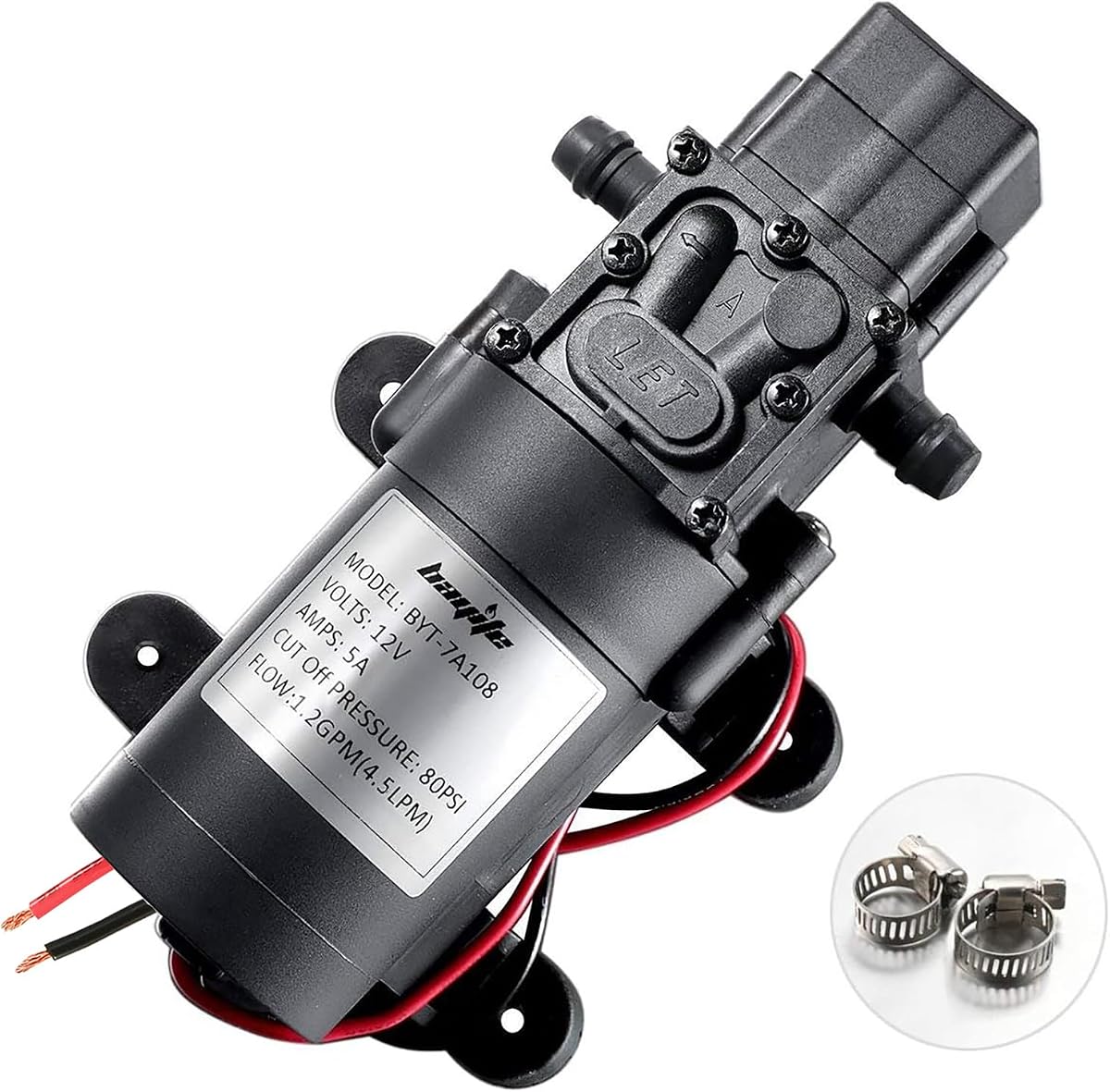
The 12V DC Water Transfer Pump is a compact 1.2 GPM unit with a much higher default cutoff pressure than most of the RV-focused models. Its 4.3 rating suggests dependable performance for specialized transfer duties, while the sealed body and corrosion-resistant coating suit damp environments.
We may earn a commission when you buy through this link, at no additional cost to you.
The listed 6.6-foot vertical suction lift allows the pump to be mounted above a source tank. Low current draw is another advantage for battery-powered systems, and the soft rubber mounting tabs help limit vibration transmitted to the installation surface. The body is sealed against incidental moisture and dust, and the product information states that it can operate in a wet environment.
There are several important limitations. The pump should not run continuously for more than six hours, and voltage above 14V may damage the motor. Its 80–85 PSI default cutoff does not mean it delivers 4.5 liters per minute at 100 PSI; flow naturally changes across the operating range. The 3/8-inch hose barb ports are also smaller than the 1/2-inch connections common on many RV pumps.
This is best treated as a specialized transfer pump rather than a general whole-house freshwater solution. It may suit a low-backpressure water system, compact boat, or auxiliary transfer application where high pressure and low consumption matter more than shower-like flow. It is less suitable for multiple fixtures, RV showers, or systems requiring sustained high-volume operation.
The 80–85 PSI cutoff gives this pump a clear distinction from compact 35 PSI models. It is useful in specialized transfer setups where additional pressure is valuable, provided the connected hose and fittings are appropriately rated.
The sealed pump body, electro coating, and rubber mounting tabs support use in damp spaces and help limit both corrosion and vibration. These features are useful in boats, utility compartments, and mobile systems.
We may earn a commission when you buy through this link, at no additional cost to you.
The DC HOUSE 33 Series uses a three-chamber diaphragm to deliver up to 3.5 GPM at a 45 PSI shut-off pressure. Its 4.5 rating is among the strongest in the guide, and the design emphasizes smoother delivery, lower pulsation, and the ability to meet demand from multiple fixtures.
We may earn a commission when you buy through this link, at no additional cost to you.
A copper-wound motor provides the mechanical foundation, while overload and dry-run protection guard against motor damage. The built-in adjustable pressure switch offers a 40–80 PSI range and automatically activates when flow is detected. A rubber mounting base combines with optimized construction and flexible support to reduce vibration and motor sound.
The 9.8-foot self-priming lift provides practical mounting flexibility for campers, boats, cabins, and off-grid systems. Three chambers are intended to produce steadier output than a simpler design, but 3.5 GPM remains a moderate total flow. If several fixtures open simultaneously, users should consider whether the downstream plumbing and consumption rate will feel adequately responsive.
This pump is a strong option for a small but complete freshwater system where smooth operation and multi-fixture capability matter. It combines useful flow, quiet mounting features, broad pressure adjustment, and meaningful motor safeguards without moving into the highest electrical demand of the premium models. It is particularly attractive as an upgrade or dependable backup in a camper, boat, or cabin.
Dividing the pumping work among three chambers is intended to reduce pulsation and maintain steadier pressure. That makes the pump more suitable to shared outlets than a basic single-chamber unit.
The adjustable automatic switch lets the installer tune pressure between 40 and 80 PSI. This range supports different freshwater uses while preserving automatic start and shutdown behavior.
We may earn a commission when you buy through this link, at no additional cost to you.
The SEAFLO 22-Series combines a modest 1.3 GPM open flow with a 100 PSI shut-off pressure, making it the highest-pressure option in this guide. Its 4.3 rating is consistent with the strong SEAFLO 21 Series, and the specification targets marine, RV, agricultural, and off-grid systems where pressure and compactness matter more than shower-sized flow.
We may earn a commission when you buy through this link, at no additional cost to you.
The pump self-primes to six feet, includes a pressure switch, and is supplied with 3/8-inch hose barb fittings, installation instructions, quick-connect wiring, warranty documentation, and a user manual. EPDM valves and a Santoprene diaphragm provide the stated material construction, while RoHS, SGS, and ISO standards are cited in the product information.
Automatic start and stop conserve water and energy when no outlet is in use. The internal bypass is designed to reduce cycling and maintain consistent pressure, while dry-run capability adds protection during supply interruptions. Nevertheless, 100 PSI exceeds the pressure of most household-style RV systems, so regulators may be needed to protect fixtures, hoses, and fittings.
This model is well suited to water transfer, filtration, spraying, circulation, and other compact applications requiring higher pressure than a standard freshwater pump. It is not the best selection for a shower or multiple high-flow fixtures because its 1.3 GPM maximum is modest. For marine, agricultural, and off-grid users who value pressure over volume, however, it is a distinctive and capable option.
The 100 PSI shut-off rating distinguishes this pump from compact RV models that typically shut off around 35 PSI. That extra pressure can benefit transfer, spray, and filtration tasks, subject to compatible plumbing.
The internal bypass helps smooth operation and limit unnecessary cycling. Combined with the ability to run dry without damage, it provides practical protection when flow is interrupted.
We may earn a commission when you buy through this link, at no additional cost to you.
Choosing a 12V water pump involves balancing flow, pressure, electrical demand, mounting limits, and intended use. The most important step is to examine the complete freshwater system rather than selecting a model solely by its headline GPM figure.
Flow rate indicates how quickly a pump can move water under open-flow conditions. The models here range from 1.2 GPM to 6.0 GPM. Compact pumps are generally appropriate for one sink, galley, or auxiliary point, while 3.5 to 4.0 GPM models offer more margin for RV use. A 5.5 to 6.0 GPM pump is better suited to showers, multiple fixtures, or tankless water-heater arrangements where several outlets may operate at once.
Shut-off pressure is the maximum pressure the pump reaches when the system closes. The guide includes options from 35 PSI to 100 PSI. Lower pressure can be sufficient for a compact sink, while 45 to 70 PSI offers more authority for RV showers and cleaning. Very high pressure requires compatible hoses, regulators, and fixtures so that a sudden pressure change does not cause leaks or damage.
A 12V pump still places meaningful demands on a battery, fuse, switch, and wiring system. Current draw varies dramatically, from 4 amps for the SEAFLO 21 Series to 15 or 17 amps for the highest-output models. Underrated wiring can create voltage drop, heat, or unreliable starting. Installation should follow the pump's electrical requirements, and high-current models may require a dedicated circuit or substantially larger conductor.
Self-priming capability determines how far above the water source the pump can be installed. Listed vertical lifts range from four feet to 10 feet, with one product also claiming 155 feet of horizontal priming. Greater lift offers installation freedom but should not be confused with a guarantee of strong flow at the maximum distance. The pump's location should also account for vibration, moisture, accessibility, and available space.
Existing plumbing may determine whether a pump can be installed directly or needs adapters. Several RV-focused models use 1/2-inch barbed or NPT connections, while both SEAFLO models use 3/8-inch hose barbs. Voltage must also match exactly: these products require 12V DC and should not be connected to AC power. Check fittings, hose diameter, thread type, and electrical requirements before ordering.
A pump that sounds loud in a workshop may be distracting inside a camper or boat. Rubber mounting bases, isolation feet, balanced bearings, and multi-chamber diaphragms can reduce both airborne noise and vibration through the vehicle structure. The SEAFLO 21 Series and the Quiet RV Water Pump make explicit noise-reduction claims, while the premium six-GPM model uses NSK double ball bearings. Installation quality also affects perceived noise.
Dry-run capability, thermal overload protection, and sealed construction help prevent damage when water is unavailable or operating temperatures rise. These safeguards are especially valuable in unattended mobile systems. Duty-cycle limits still matter: the 1.2 GPM transfer pump should not run continuously for more than six hours, and several diaphragm pumps are designed for intermittent freshwater service rather than continuous industrial operation.
RV use, potable freshwater, marine exposure, irrigation, car washing, and drinking-water systems have different requirements. The SEAFLO 21 Series cites potable-water and RV plumbing standards, while the VEVOR model is expressly described as unsuitable for RVs. Warranty periods also vary, with some products listing multi-year coverage while others provide no duration in the supplied information. Installation support and included documentation can be equally valuable.
Before installation, disconnect the battery or turn off the appropriate circuit, identify the water source and discharge side, and confirm that all hose barbs, threads, and electrical connections match. Secure the pump to a rigid surface using vibration-isolating supports if available. Fit the supplied strainer on the inlet, connect the discharge hose, and tighten every threaded joint carefully without applying excessive force.
Connect the pump to a correctly rated 12V DC supply through suitable wiring, a fuse, and an accessible power switch. Use a regulator when the selected pump's cutoff pressure exceeds the safe working pressure of downstream hoses, regulators, or fixtures. Follow the stated cut-in, cut-off, bypass, and current specifications. Do not exceed the permitted voltage, inlet pressure, temperature, or continuous run time.
Open a faucet and allow the pump to prime, then check every connection for leaks while watching for stable pressure, unusual noise, vibration, or excessive current. If the pump fails to prime, verify that the source contains water, the inlet is not blocked by air, and the pump is positioned within its stated lifting capability. Clean or replace the strainer when flow declines, and address leaks or abnormal cycling before continuing normal operation.
It depends on flow rate and pressure, but a shower generally benefits from a pump delivering around 4.0 GPM or more at a suitable pressure. The 4.0 GPM models are reasonable starting points, while the 5.5 and 6.0 GPM options provide more flow for demanding RV or marine installations. Compact 1.2 to 1.3 GPM pumps are better suited to a sink, galley, or transfer task than a comfortable shower.
Not necessarily, because many of the listed pumps include an automatic pressure switch that starts and stops them according to demand. The SEAFLO 21 Series is specifically described as eliminating the need for an accumulator tank in its installation. An accumulator may still be useful in a larger or more complex plumbing system if it is designed to smooth cycling and maintain pressure.
A self-priming pump can draw water from a tank even when it is mounted above the water level. The distance it can lift water is limited by the model's specification, which ranges from four feet to 10 feet among the RV-focused choices. If the planned mounting position exceeds that lift, relocation or a different pump is necessary.
A 12V pump can use a battery, but the battery, wiring, switch, and fuse must be sized for its maximum current. Draw ranges from about four amps for the compact SEAFLO model to 15 or 17 amps for higher-output pumps. Undersized cables or connections can cause voltage drop, overheating, poor starting, or an unreliable pressure switch.
No. Higher flow can improve performance when several fixtures, a shower, or a tankless water heater are involved. For a single sink in a small boat or camper, however, a compact pump may be quieter, easier to mount, and less demanding on the electrical system. The correct choice balances flow with pressure, duty cycle, noise, and available power.
Several products in this guide are described as capable of short dry runs without immediate damage, while others include thermal overload protection. Dry-run capability is not permission for extended operation, because the diaphragm, seals, and motor can still overheat or wear. A healthy water supply, pressure switch, and strainer remain important safeguards.
Choose a model with a rubber isolation base, multi-chamber diaphragm, or quality bearings, and mount it securely on a rigid surface. Flexible hoses should be supported so they do not bang against the vehicle frame. Avoid using a loose platform that creates additional vibration, and keep the pump away from sleeping areas when the layout allows.
No. The supplied information explicitly says the VEVOR model is suitable for washing and irrigation but not for RVs. Others are marketed for RV, marine, camper, or off-grid freshwater systems. Before purchasing, verify the intended application, port size, pressure requirements, and any applicable plumbing or potable-water certifications.
The WASSERMANN RV Pump stands out as a balanced budget-oriented option with 4.0 GPM flow, 45 PSI pressure, automatic controls, and a useful fitting kit. The 2026 Upgraded RV Water Pump is the strongest high-capacity choice, combining 6.0 GPM flow, 70 PSI pressure, quiet construction, bypass control, and a three-year warranty. For a versatile 4.0 GPM installation, the RV Fresh Water Diaphragm Pump offers useful thermal and dry-run protection.
The right choice ultimately depends on the system rather than one universal specification. Choose enough flow for simultaneous demand, match pressure to the plumbing, confirm the self-priming distance, and provide properly rated electrical connections. Compact users should also consider the SEAFLO models, while the ECO-WORTHY, DC HOUSE, VEVOR, and quiet-pump options serve different combinations of mounting flexibility, noise control, and task-specific performance.
Ratings, seller details, warranty terms, and prices can change, so confirm the current listing and product information before making a final decision. Review the supplied dimensions, port sizes, maximum current, pressure settings, and included components one final time so the replacement integrates cleanly with the intended 12V system.