
ECO-WORTHY Powermega 48V 314Ah
4.8Editor score
Large 16.07kWh capacity
Active balancing 200A BMS
Touchscreen and remote monitoring
48V LiFePO4 Battery guide comparing capacity, power, cycle life, safety, monitoring, expansion options, and ideal applications.
A 48V LiFePO4 battery is a high-capacity, low-maintenance energy-storage solution used in golf carts, RVs, marine systems, solar installations, and off-grid projects. The best model depends on usable power, physical fit, charging equipment, communication needs, and the demands of your equipment.
This guide compares ten 48V lithium iron phosphate batteries by examining capacity, rated and peak discharge, BMS protection, cycle life, weight, monitoring features, physical design, and expansion options. It includes both complete golf-cart kits and batteries aimed at stationary storage, mobile power, or specialized applications.
Each pick reveals what makes it best suited to a particular use, from ready-to-install cart upgrades to rack-mounted home energy systems. Specifications and availability can change, and current prices fluctuate, so compare the latest listing details and compatibility requirements before purchasing.
4.8Editor score
4.8Editor score

4.8Editor score
The table below compares the ten featured batteries across their core capacity, power, monitoring, and expansion characteristics. It is intended to make differences in intended use immediately clear, from golf-cart conversions to high-capacity energy storage.


The TEMGO 48V 100Ah is a complete lithium battery package designed primarily for golf-cart and low-speed utility-cart upgrades. With a 4.6 rating, its strongest qualities are the coordinated 51.2V 100Ah configuration, 200A continuous discharge rating, and generous accessory bundle. A touch display, Bluetooth app, charger, and retention strap give the package a polished, integrated feel.
We may earn a commission when you buy through this link, at no additional cost to you.
The battery is rated for 10.24kW of maximum power, with a stated 600A output for three seconds, making it suited to carts that encounter hills, heavy passenger loads, or demanding terrain. Its supplier claims more than 5,000 deep cycles at an 80% depth of discharge. The ABS enclosure also helps with impact resistance, vibration protection, and overall portability compared with a bank of lead-acid batteries.
The principal compromise is compatibility rather than performance. The listing states that it works with most 48V carts using standard controllers, but explicitly excludes carts originally configured for lithium with CAN-based communication. Its parallel support is also limited to four units. Buyers should therefore confirm controller voltage, communication requirements, compartment dimensions, and terminal arrangement before ordering.
This is a strong choice for someone replacing a conventional 48V lead-acid cart bank who values a ready-to-install package, strong power delivery, and detailed remote monitoring. It is less suitable for communication-dependent modern carts or installers needing large-scale parallel expansion. For a conventional golf-cart upgrade with the correct controller, it offers one of the most complete feature sets in this roundup.
A 200A continuous discharge rating and 10.24kW maximum output provide useful headroom for acceleration, climbing, and loaded carts. The stated 5,000-plus cycle figure at 80% depth of discharge makes the unit especially interesting for owners who expect frequent use.
The 2.8-inch touch display and Bluetooth app provide convenient visibility into operating status. Up to four units can operate in parallel, although that limit is more restrictive than the expansion supported by several energy-storage models in the list.
We may earn a commission when you buy through this link, at no additional cost to you.
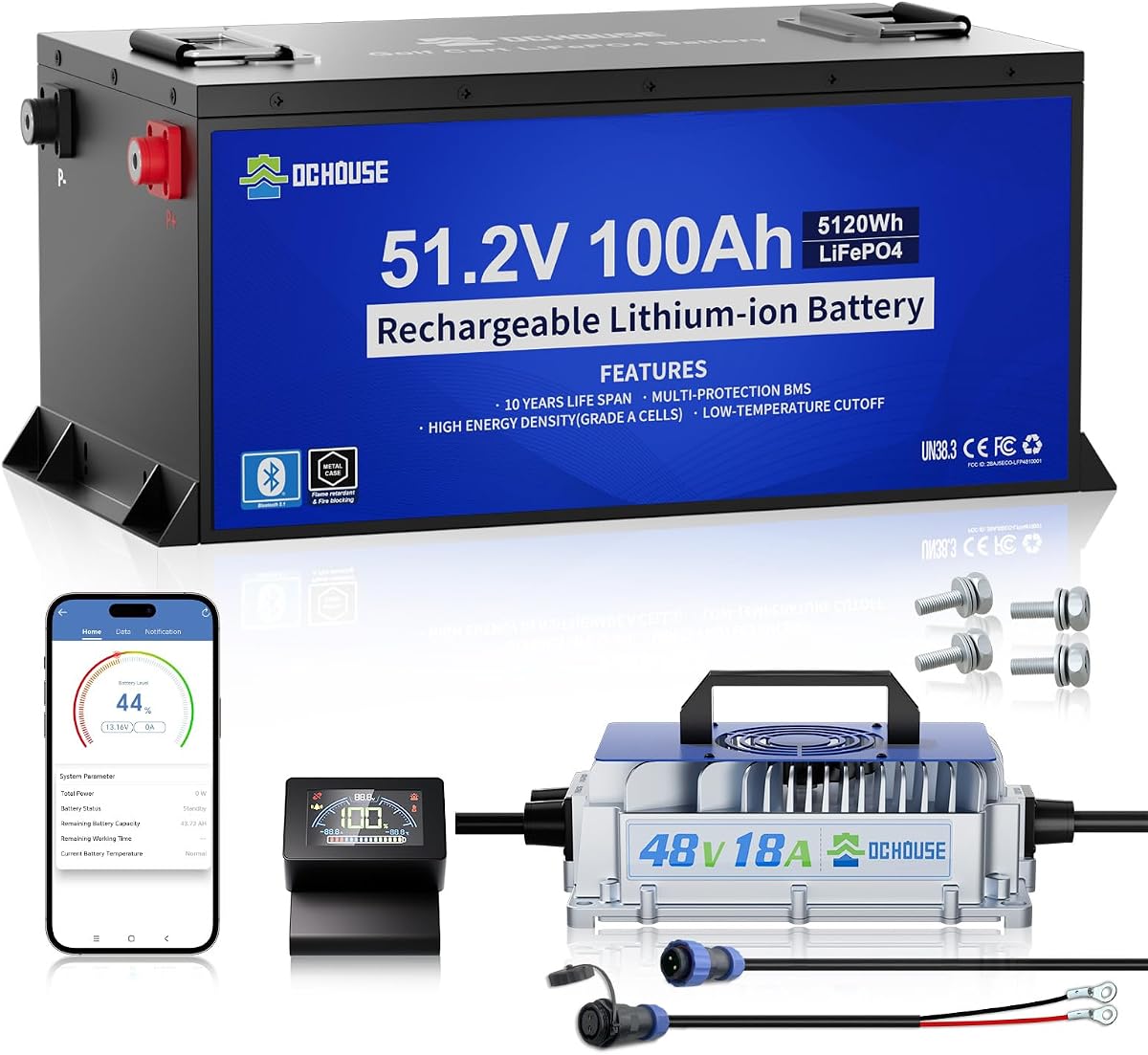
The DC HOUSE Metal Case 48V 100Ah combines high output, a metal enclosure, an 18A charger, and wireless monitoring in a package built for golf-cart conversions. Its 4.8 rating places it among the strongest performers here, and the metal case helps it stand apart from typical ABS-enclosed alternatives by adding structural rigidity and resistance to collision damage.
We may earn a commission when you buy through this link, at no additional cost to you.
The internal 200A BMS is specified for 2C continuous discharge, or 250A for 30 seconds, with a peak current of 670A for half a second. That output should support quick acceleration and climbing while giving the motor controller the short bursts required by many carts. Grade A cells, a safety switch, and six BMS protections add further layers of control, including enhanced low-temperature charging and discharging cutoffs.
Monitoring is handled through a Bluetooth LCD monitor, and the battery's reserved communication port can accommodate a separately purchased wired monitor. The included 18A charger is described as capable of a full charge in 5.5 hours and uses an automatic stop when charging is complete. The main practical concern is fit: compartment layouts differ between golf-cart brands, so measuring the available space is essential.
This kit is a compelling choice for a 48V cart owner who wants substantial power, a more rugged enclosure, and the necessary charging and monitoring equipment in one purchase. It is particularly attractive when a metal case and one-key safety switch are priorities. For carts with unusual battery compartments, verify dimensions first; otherwise, the feature set and output ratings make it an excellent all-around upgrade.
The sheet-metal enclosure and metal fixtures provide a sturdier protective structure than a conventional plastic case. A key safety switch also allows the battery system to be disconnected, which is useful during storage or maintenance.
An 18A charger, plug-and-play connections, and a wireless LCD monitor reduce the need for separate purchases. Buyers should still confirm that the charger is appropriate for their electrical setup and that the battery compartment accommodates the stated design.
We may earn a commission when you buy through this link, at no additional cost to you.
The ECO-WORTHY Cubix100 48V 200Ah is a server-rack energy-storage battery rather than a conventional cart replacement. Its 4.7 rating reflects a strong combination of safety certification, closed-loop communication, and large-scale expansion. The vertical rack format makes it especially relevant to home backup, solar storage, off-grid cabins, and professionally organized stationary installations.
We may earn a commission when you buy through this link, at no additional cost to you.
The battery carries UL9540, UL1973, and California Energy Commission listing, according to the supplied product information. Those certifications focus on electrical safety, design, and thermal-runaway management. It uses Grade A LiFePO4 cells, while CAN and RS485 interfaces allow communication with compatible integrated solar inverters. Bluetooth and WiFi add local and remote monitoring through the ECO-WORTHY app.
Expansion is a major strength: as many as 32 units may be paralleled, allowing systems to reach up to 163.8kWh. The vertical mounting format helps conserve space, but this is still a substantial installation rather than a portable battery. Shipping can be split across multiple packages, and the listing notes a 10-year limited warranty with specified support for verified technical issues.
Choose this model when a certified, communicative, and highly expandable stationary battery is more important than golf-cart convenience. It is well suited to owners planning a substantial home energy system, integrating solar, or using compatible inverter equipment. Buyers should confirm inverter protocols, rack requirements, installation environment, and local electrical-code considerations before purchase.
UL9540, UL1973, and CEC listing make this a strong candidate for projects where documented safety testing matters. These certifications should be checked against current listings and local authority requirements during system design.
CAN, RS485, Bluetooth, and WiFi create a flexible monitoring and control setup. The ability to parallel as many as 32 units also makes it easier to scale capacity as backup or solar-storage requirements grow.
We may earn a commission when you buy through this link, at no additional cost to you.
The ECO-WORTHY Powermega 48V 314Ah is the most substantial premium energy-storage model in the guide. It combines 16.07kWh of capacity with a 4.8 rating, active balancing, a seven-inch touchscreen, fire-suppression modules, and compatibility-oriented communication ports. It is designed for demanding whole-home backup, off-grid systems, and users who want considerable stored energy in one package.
We may earn a commission when you buy through this link, at no additional cost to you.
Its 200A smart BMS uses active cell balancing to keep the cells working more evenly, which can improve charging efficiency and reduce long-term capacity loss. Safety is reinforced with an internal BMS, an external two-pole circuit breaker, genuine Grade A cells, and integrated aerosol fire-suppression modules. Those features make the product especially relevant to residential stationary storage, although installation still requires appropriate planning.
Monitoring is unusually comprehensive for a battery in this category. The HD touchscreen provides immediate system visibility, while WiFi and Bluetooth enable remote tracking and cell-level data access. RS485 and CAN ports assist with inverter compatibility, and integrated wheels with M8 high-current terminals aid handling. Up to 15 units can be paralleled, potentially expanding the installation to 241kWh.
The tradeoff is scale and logistics. This is a large, heavy battery shipped by pallet and truck, so the delivery address must be suitable for freight service. It is best suited to installers with a dedicated battery location and a long-term plan for whole-home storage. For those needs, its capacity, layered protection, and controls justify a premium position.
The 16.07kWh energy capacity makes the Powermega practical for extended outage coverage and substantial off-grid consumption. Fifteen-unit parallel support allows the system to grow into a much larger installation without relying on several unrelated battery families.
Active balancing, dual circuit protection, and aerosol fire suppression address different aspects of battery-system risk. The touchscreen and remote access allow users to inspect cell-level information and system conditions without opening the enclosure.
We may earn a commission when you buy through this link, at no additional cost to you.
The LOSSIGY 48V Lithium Battery Golf Cart Conversion Kit is a 51.2V 100Ah unit aimed at drivers seeking substantial short-duration output. It carries a 4.6 rating and stands out for a claimed 1,000A peak current lasting three to five seconds, a specification intended to satisfy demanding controller and motor requirements.
We may earn a commission when you buy through this link, at no additional cost to you.
Automotive Grade A cells are used to provide consistent power and energy density, while the built-in 200A smart BMS protects against high temperature, low temperature, short circuits, overcurrent, and overload. The battery is presented as a self-contained installation that is easier to position than a series of lead-acid batteries. The supplier also states that it can provide at least 4,000 cycles.
As the title references a kit, buyers should carefully examine the package contents to ensure the necessary charger, monitor, and connection hardware are included in the specific listing. High peak output is most useful when it can be safely delivered to the cart's controller, so battery, controller, wiring, and connector compatibility should be treated as one system rather than separate considerations.
LOSSIGY is a practical option for a 48V golf cart that needs aggressive acceleration or hill-climbing performance and does not want to install multiple traditional batteries. The stated support commitment and 90-day after-sales period add reassurance. Buyers should still verify dimensions, terminals, charger inclusion, and controller limits before ordering.
The 1,000A peak claim gives this model an advantage when a cart must accelerate quickly or climb under load. A three-to-five-second window is designed for brief motor demands rather than sustained output, so the battery and controller should be matched appropriately.
One self-contained lithium battery can simplify the layout of a cart that previously carried six or more lead-acid units. The reduced number of separate components can make weight distribution and routine inspection more manageable.
We may earn a commission when you buy through this link, at no additional cost to you.
The OGRPHY 48V 105Ah is a cart-focused battery package with an 18A charger, touch LCD monitor, 200A BMS, and high peak-current capability. Its 4.5 rating reflects a capable overall package, while the slightly larger 105Ah capacity provides 5.37kWh of nominal energy compared with the more common 100Ah configuration.
We may earn a commission when you buy through this link, at no additional cost to you.
The BMS supports 10.24kW of sustained output, and the manufacturer claims 1,000A peak output for three to five seconds. Grade A LiFePO4 cells with UL certification form the core of the battery. Together, these specifications make the unit relevant to golf carts, trolling applications, and other 48V mobile systems that need responsive acceleration or sustained power.
The listing also states that a 3kW motor cart can travel up to 50 miles under the brand's tests. That number should be treated as a controlled result rather than a guarantee, because terrain, speed, payload, controller behavior, and stopping conditions can materially change real-world range. The included touch display offers immediate status information, while the five-year battery warranty adds long-term support.
OGRPHY is well suited to buyers who want a slightly higher-capacity cart battery with accessories already included. It also appeals to anyone who values a high short-term peak rating. The main caution is to compare actual charger, monitor, and warranty terms carefully with other kits, and to confirm that the physical design and terminals suit the intended equipment.
The 18A charger and touch LCD monitor make the package convenient for a new installation. A 200A BMS and substantial peak output support the demands of a 48V golf cart or trolling system, subject to proper equipment matching.
The stated 50-mile result was obtained under the manufacturer's test conditions. Users should plan based on their own course, payload, speed, and stopping pattern rather than treating that figure as a guaranteed operating distance.
We may earn a commission when you buy through this link, at no additional cost to you.
The 48V 100Ah Lithium LiFePO4 Battery for RV, Camper, and Boat is the lightest-looking general-purpose option in the guide, with a listed weight of 79 pounds. It has a perfect 5.0 rating and is aimed at mobile and off-grid applications rather than high-current golf-cart conversions. Its most attractive qualities are broad use-case support, straightforward parallel expansion, and low maintenance.
We may earn a commission when you buy through this link, at no additional cost to you.
A 100A BMS supplies overcharge, over-discharge, overcurrent, and short-circuit protection. The battery uses automotive-grade A LiFePO4 cells and is rated for more than 4,000 deep cycles, with a claimed service life of ten years. Its applications include RVs, campers, boats, trolling motors, solar systems, and home backup, making it a versatile choice for users who move between different projects.
Capacity can be increased by connecting compatible units in parallel, but series connection is expressly unsupported. The 100A BMS is lower than the 200A controllers offered by several cart-focused products, so it is less appropriate for a motor that demands very high sustained current. The product description also provides less detail about remote communications and user interfaces than the display-equipped alternatives.
This battery is a good match for RV owners, anglers, and portable solar users who value low weight and flexible placement more than touchscreen monitoring. It can also serve as a straightforward stationary bank. Those planning a high-power cart or other traction-heavy system should select a model whose continuous and peak ratings are explicitly designed for that load.
At a listed 79 pounds, the battery reduces the weight burden associated with a traditional 48V lead-acid bank. That makes handling and installation more practical in RVs, boats, camper compartments, and portable energy setups.
Parallel connections allow owners to scale total amp-hour capacity as their energy requirements grow. Because series connection is not supported, the unit should be treated as part of a 48V parallel architecture rather than a general building block for arbitrary voltage stacking.
We may earn a commission when you buy through this link, at no additional cost to you.
VATRER POWER's 48V 100Ah battery combines a familiar 5.12kWh energy capacity with a polished control interface and strong safety positioning. Its 4.7 rating makes it one of the most well-rounded batteries in the guide, particularly for owners who want remote information and convenient power isolation without moving to a much larger stationary system.
We may earn a commission when you buy through this link, at no additional cost to you.
The battery uses 16S automotive Grade A prismatic cells and is stated to comply with UL1973 and carry Intertek ETL certification. Its touch display can be used to monitor and control the battery, while the companion app provides phone-based status information. A one-touch ON/OFF control also acts as a circuit breaker, automatically shutting down if load current becomes excessive.
The most distinctive physical feature is the presence of two positive and two negative terminals. According to the product information, this arrangement helps distribute current, reduce heat, and avoid concentrating the load on one connection. The integrated 100A BMS provides the usual overcharge, over-discharge, overcurrent, and short-circuit protections, plus high-temperature charging cutoff and low-temperature protection.
VATRER POWER is well suited to RVs, solar storage, backup systems, and mobile equipment that can operate within a 100A continuous class. It also claims more than 5,000 cycles. Its latest enclosure design remains parallel-compatible with an earlier version, but users should still follow current wiring guidance and verify connector and communication requirements before combining batteries.
A built-in touch display and app make it easier to check operating information without relying on a separate meter. The one-touch switch adds a straightforward way to disconnect the battery and functions as a protective circuit breaker.
Two terminals on each polarity can help manage current more evenly and reduce connection heat. Proper torque and equal cable lengths remain important when distributing current across multiple high-current posts.
We may earn a commission when you buy through this link, at no additional cost to you.
The GrenerPower 48V 25Ah is a compact Group 24 battery best suited to stationary backup, portable solar, camping auxiliary power, and other low-to-moderate current applications. Its 4.8 rating and long stated cycle life make it an appealing entry into 48V lithium storage, but the explicit prohibition on motive-power use must be respected.
We may earn a commission when you buy through this link, at no additional cost to you.
The battery provides 1.28kWh of nominal energy, a 50A BMS, and maximum power output of 2,560W. Its listed dimensions are 8.27 by 6.62 by 10.23 inches, and the weight is 23.67 pounds. These physical characteristics make it easier to place than a full 100Ah bank and useful where battery-compartment space is limited.
The supplier claims up to 15,000 cycles at a 60% depth of discharge, although actual life depends on temperature, charge habits, load, and operating conditions. A dedicated 58.4V 5A or 10A lithium charger is recommended, and the battery does not include one. Four units can be paralleled to produce a 100Ah, 48V pack for expanded capacity.
This is the best pick for buyers who want a manageable 48V battery for an RV, boat, small solar system, or home backup and do not need to power a golf cart. Its compact format, low weight, and expansion path offer flexibility. Do not use it in carts, starter batteries, manned vehicles, or traction equipment, as the supplier states those applications void the warranty.
The Group 24-style enclosure and 23.67-pound listed weight make the battery easier to carry and install. It can serve as a single 48V module or be combined with up to three matching units to form a 100Ah bank.
Despite being marketed for trolling motors in its title, the supplied instructions explicitly say it must not be used in golf carts or other traction applications. Buyers should treat stationary and auxiliary power applications as the intended use and follow the recommended dedicated charger.
We may earn a commission when you buy through this link, at no additional cost to you.
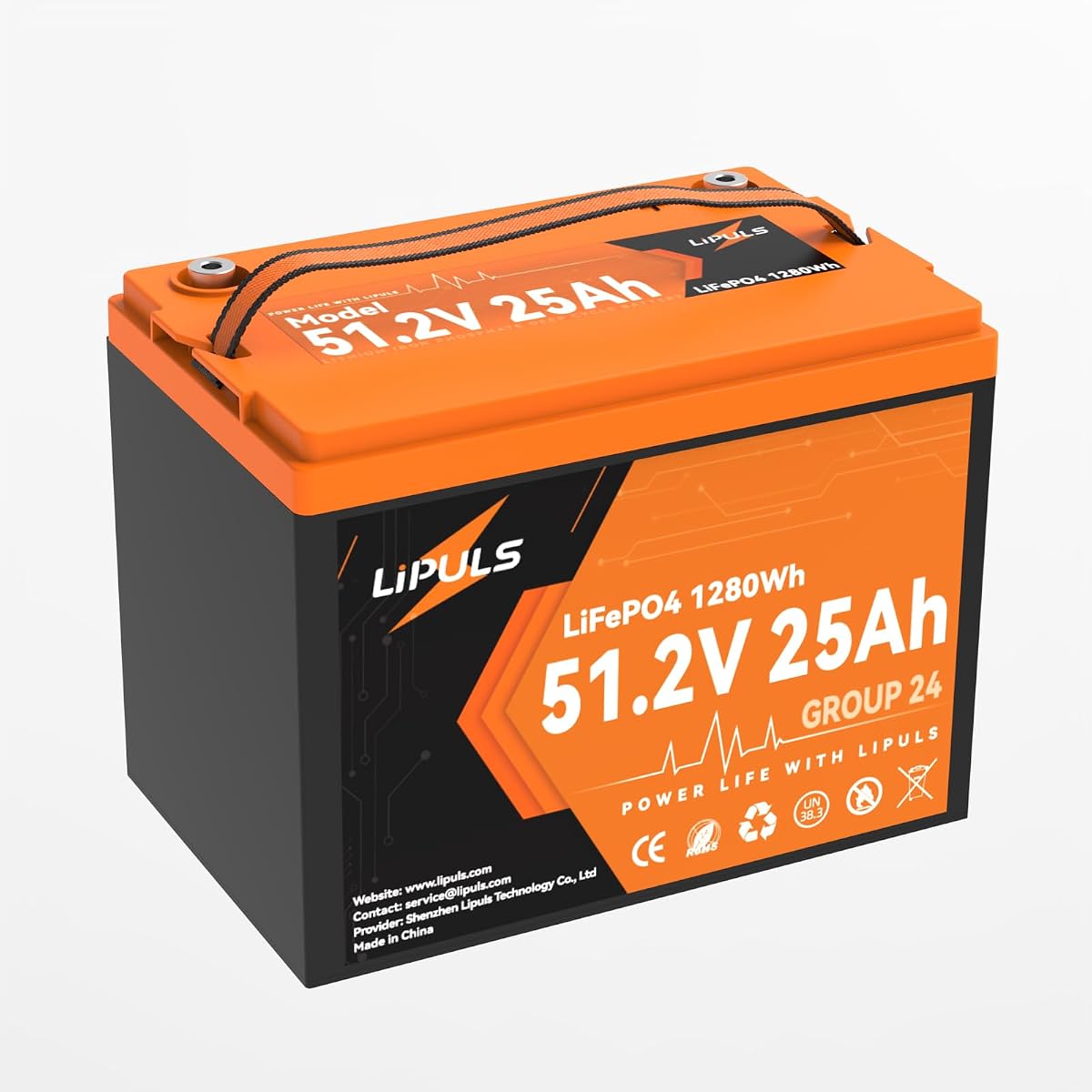
The LIPULS 48V 25Ah provides a compact 51.2V power source in a standard Group 24 form. Its 4.4 rating is the lowest among the featured products, but the battery's recognizable dimensions, listed 24.47-pound weight, and broad range of RV, marine, solar, and backup uses make it relevant to buyers prioritizing a conventional footprint.
We may earn a commission when you buy through this link, at no additional cost to you.
A 50A BMS provides protection against overcharging, over-discharging, overcurrent, short circuits, and high temperatures. The battery contains A-grade cells and provides 1,280Wh of energy. It can replace a traditional lead-acid arrangement more directly, which is useful for upgrading existing Group 24 compartments without dealing with a much larger monolithic battery.
The stated cycle life ranges from 4,000 to 15,000 cycles, with service life stated at up to ten years. This broad range indicates that operating conditions materially affect the result. The operating-temperature guidance is also important: charging is specified from 32 to 113 degrees Fahrenheit, while discharge is listed from negative 4 to 140 degrees Fahrenheit, subject to cell-surface limits.
LIPULS is best suited to RV, van, fishing, camping, solar, and stationary backup projects where a 25Ah 48V module is sufficient. It is not a golf-cart starter battery despite some broader market use of the term. Before installation, compare the physical orientation, terminal positions, charge profile, temperature range, and required capacity with the existing system.
Using the BCI Group 24 minimum size makes this model easier to compare with common lead-acid compartments. Checking physical orientation and terminal clearance is still necessary, since similar dimensions do not guarantee identical layouts.
The clearly stated charging and discharging ranges help users determine whether the battery suits their environment. Cold-weather charging below 32 degrees Fahrenheit should be avoided, and a charger with the appropriate lithium profile is essential.
We may earn a commission when you buy through this link, at no additional cost to you.
Choosing a 48V LiFePO4 battery requires balancing energy capacity, output current, physical fit, charging needs, and safety features. The most important distinction is whether the battery will power a mobile traction load, supply backup power, or support a scalable solar installation.
Capacity is commonly expressed in amp-hours, while energy is better represented in watt-hours or kilowatt-hours. A 51.2V 100Ah battery provides approximately 5.12kWh of nominal energy, whereas a 25Ah unit provides approximately 1.28kWh. Estimate the energy your loads require, apply an appropriate reserve, and avoid selecting capacity solely from a travel-range claim because motor efficiency, speed, terrain, payload, and stop-start use all affect real consumption.
Choose enough usable capacity for expected daily demand while leaving room for deeper discharge and future expansion. Larger stationary systems should also consider inverter surge requirements, parallel architecture, and whether cooling or ventilation is needed.
Continuous discharge describes the current a battery can supply over an extended period, while peak discharge covers brief motor or inverter surges. Golf carts generally need meaningful short-duration output for acceleration and climbing, while backup systems may need inverter surge support. Compare both figures with the connected controller, motor, inverter, and wiring rather than focusing on the largest advertised peak number.
A higher peak rating does not compensate for an underpowered controller, inadequate cables, or a poorly sized charger. The entire energy path should be reviewed as one electrical system.
A quality Battery Management System protects against overcharge, over-discharge, overcurrent, short circuits, and temperature extremes. Some models add low-temperature charging cutoff, high-temperature cutoff, active cell balancing, an external breaker, or a physical disconnect. These functions are particularly important when batteries sit in a hot vehicle, a cold garage, or an unattended storage area.
Look for multiple protection layers and clear operating-temperature guidance. A one-touch safety switch or breaker can also make maintenance safer, but it should supplement rather than replace correct wiring practices.
A 48V nominal LiFePO4 battery normally uses a 58.4V charging profile. Some kits include a dedicated charger, while others recommend purchasing one separately. Confirm plug type, connector polarity, charge current, and whether the charger communicates with the battery. An undersized charger extends charging time, while excessive charge current can stress the battery or require additional cooling.
Do not use a conventional lead-acid charger unless the charger and battery manufacturer explicitly permit the selected profile. For systems with communication protocols, use equipment approved for that protocol.
Measure the battery compartment, including length, width, height, terminal clearance, lid space, and access to securing points. Golf-cart battery bays vary considerably, and a battery that is slightly too large may require modification. Also consider weight, especially for carts, portable systems, and installations where lifting and service access are important. The listed weights range from compact 25Ah modules to palletized high-capacity systems.
Check the orientation of terminals and communication ports as well as the enclosure itself. A standard Group 24 form is easier to accommodate, while a rack-mounted design is intended for a prepared stationary enclosure.
Basic BMS protection is essential, but monitoring can add considerable convenience. Touch displays, Bluetooth apps, WiFi, RS485, and CAN communication provide information about voltage, state of charge, faults, cell balance, and operating history. These features are especially valuable in stationary systems where remote visibility can reveal abnormal behavior before a shutdown occurs.
For inverter-connected installations, confirm supported protocols before buying. A battery with attractive monitoring features will not integrate automatically with every inverter, generator controller, or energy-management system.
Many 48V lithium systems are expanded by connecting identical batteries in parallel, increasing amp-hour capacity without raising voltage. Maximum unit counts vary widely: compact 25Ah models support four-unit configurations, while the premium ECO-WORTHY models support much larger arrays. Always follow the manufacturer's wiring diagram, use matched models, and observe cable and balancing requirements.
Series connection is a separate matter. Several products in this guide expressly support only parallel expansion, and stacking voltages beyond the specified 48V architecture can invalidate protections and create unsafe operating conditions.
Cycle-life figures are often quoted under specific depth-of-discharge, temperature, and charge conditions. A 15,000-cycle claim at a limited depth of discharge does not imply the same result at 80% depth, and actual longevity also depends on heat, age, current, and charging habits. Mobile applications, solar storage, and backup systems create different demand patterns, so the advertised range should be interpreted carefully.
Some compact batteries are explicitly prohibited from golf-cart or other motive use. Match the manufacturer's intended application to your own use, and prioritize suitable discharge ratings, environmental limits, and warranty coverage over the highest cycle number.
Before installation, verify the battery's nominal voltage, capacity, terminal polarity, connector type, physical dimensions, and communication requirements. Use cables and protection devices rated for the battery's continuous and peak current. Proper torque is important: loose high-current connections create heat, while overtightening can damage terminals. Secure the battery against movement and keep ventilation openings clear.
Charge with a compatible 58.4V lithium charger, and observe the battery's specified temperature limits. Allow the charging process to complete rather than repeatedly interrupting it, and avoid leaving the battery deeply discharged for long periods. Do not charge below the listed cold-temperature cutoff, and use the BMS or system display to investigate unusual voltage, temperature, or fault readings.
For a multi-battery system, use matched models, equal-length appropriately sized cables, and the manufacturer's parallel wiring sequence. Do not mix communication protocols or assume parallel operation is automatic. Periodically inspect terminals, cables, restraints, and ventilation, keep the enclosure clean and dry, and contact the seller or a qualified technician if a cell-balance warning, persistent fault, physical damage, or unusual heating appears.
A battery marketed as 48V is commonly configured around a nominal 51.2V, with a standard charge voltage near 58.4V. This rating is not identical to the battery's peak charging voltage. Equipment should be designed for the manufacturer's recommended 48V lithium charging profile rather than a generic lead-acid charger.
No. The battery's current rating, peak output, controller, wiring, communication protocol, and physical dimensions must all be compatible. Some products are explicitly restricted from motive use, while some cart batteries cannot communicate with carts originally designed for CAN-controlled lithium systems. Check the listing's compatibility notes and cart specifications before purchasing.
The supported number depends on the model. Four units are enough to build a 100Ah pack from 25Ah batteries, while some rack-mounted and high-capacity products support much larger parallel arrays. Parallel expansion normally increases amp-hour capacity while preserving the nominal voltage. Series connection is not supported by every model and should only be attempted when explicitly documented.
Yes, they generally require a charger with the correct 58.4V lithium LiFePO4 charging profile and an appropriate charge current. Some kits include a compatible charger, while compact batteries often require a separate purchase. Never assume a lead-acid charger is safe, particularly in cold weather where low-temperature charging protection is important.
Yes, provided the battery's power, communication, and environmental specifications match the inverter and installation. High-capacity models with CAN, RS485, WiFi, and Bluetooth are particularly suitable for integrated systems. A qualified installer should also assess wiring, circuit protection, ventilation, temperature, and applicable electrical-code requirements.
The main differences are energy capacity, physical size, weight, and current handling. A 51.2V 25Ah battery stores approximately 1.28kWh, while a 51.2V 100Ah battery stores approximately 5.12kWh. A 100Ah model can run supported loads for longer and often handles higher current, but it is heavier and requires more space.
LiFePO4 batteries require less maintenance than lead-acid batteries, but they still need sensible charging, temperature management, and physical inspection. Use the correct charger, keep terminals secure, avoid deep discharge for prolonged periods, and review fault information in the BMS or app. Do not ignore swelling, damaged cables, persistent warnings, or unusual heat.
Often, yes, because one 51.2V 100Ah lithium battery can replace a common bank of six 12V 100Ah lead-acid batteries. Compatibility still depends on the cart's controller, terminal layout, compartment size, communication requirements, and expected current. Measure and verify specifications before disconnecting the existing battery bank.
The DC HOUSE Metal Case 48V 100Ah stands out as the strongest complete golf-cart package, combining a 200A BMS, high peak output, a metal enclosure, a charger, and wireless monitoring. The ECO-WORTHY Powermega 48V 314Ah is the premium choice for substantial home or off-grid storage, while the GrenerPower 48V 25Ah offers a compact, economical option for stationary and portable auxiliary power.
Prioritize the application before comparing specifications. Golf-cart buyers should examine controller compatibility, continuous current, peak output, and battery-bay dimensions. Home-energy buyers should focus on safety certification, inverter communication, expansion, and installation environment. RV, marine, and trolling users should account for weight, temperature limits, available space, and the correct charging profile.
Specifications, certification details, package contents, and prices can change over time. Review the current listing and seller documentation before ordering, especially for included chargers, communication protocols, warranty terms, and physical dimensions. A careful compatibility check is more valuable than selecting on cycle count or peak-current headline alone.