
Yamaha R-S202BL
4.4Editor score
Two-speaker system switching
Bluetooth wireless streaming
Compact brushed-aluminum styling
Our expert guide compares the best Stereo Receivers from the 70s Style, highlighting classic design, modern connectivity, audio quality, and home theater.
Stereo receivers inspired by the 1970s combine the warm, substantial character associated with classic hi-fi equipment with the convenience expected from modern home entertainment. The strongest choices balance useful features such as phono inputs, Bluetooth, streaming, HDMI, room correction, and surround-sound support without losing sight of straightforward two-channel performance.
The products in this guide were compared by examining amplifier configuration, power claims, speaker flexibility, analog and digital connections, video capabilities, wireless platforms, calibration tools, and physical design. The list includes traditional stereo-only receivers, slim classic-style models, surround-sound AV receivers, and an integrated amplifier that can anchor a two-channel system.
Each selection reveals a different path for modern listeners. Some emphasize vinyl playback and compact styling, while others prioritize 8K HDMI, immersive audio, multi-room streaming, gaming features, or a traditional analog signal path. Specifications and availability can change, so readers should verify current details and prices before making a final purchase.
4.4Editor score

4.4Editor score
4.2Editor score
This side-by-side overview compares traditional stereo purity, compact classic styling, surround-channel flexibility, HDMI performance, streaming functions, and turntable support across all ten featured models.


The Marantz STEREO 70s is the most convincing expression of the classic stereo receiver concept in this collection. It combines a slim 4.1-inch enclosure, a fully discrete Class A/B amplifier rated at 75 watts, and a carefully styled front panel with an unusually broad range of modern connections. Its 4.4 rating reflects a product that successfully bridges nostalgia, music-focused functionality, and contemporary entertainment needs.
We may earn a commission when you buy through this link, at no additional cost to you.
Its standout strengths begin with flexibility. The amplifier can drive a conventional stereo setup through Speaker A and Speaker B connections, support up to two subwoofers, and include a phono input for turntables. Wired and Bluetooth headphone outputs, Zone 2 audio, six HDMI inputs, and one ARC output make it more versatile than a purely minimalist vintage-inspired receiver. HEOS adds Spotify Connect, AirPlay 2, Bluetooth, Tidal, TuneIn, and other streaming choices, including high-resolution playback up to 192 kHz/24-bit and DSD support where the source and service allow it.
The main limitation is intentional: this is not a conventional multichannel AV receiver. It is designed to create an enveloping two-speaker presentation and can add bass through subwoofers, but it does not provide the native surround and height-speaker channels found on the Yamaha and Denon models in this guide. It also remains a network product rather than a completely self-contained analog component, so the most streamlined setup depends on whether wireless streaming and HDMI integration are important to the listener.
This is the strongest all-around choice for someone who wants a 1970s-inspired silhouette without surrendering modern streaming, vinyl, subwoofer, headphone, or television functionality. It should appeal particularly to listeners who value musical presentation and a compact visual footprint but do not need a full 5.1 or 7.2 channel theater system.
The slim chassis is the STEREO 70s' immediate visual signature, allowing it to fit where full-size AV receivers cannot. Six HDMI inputs and HEOS streaming turn that compact retro form into a practical hub for current sources rather than a purely nostalgic object.
Speaker A and B switching, a phono stage, two subwoofer connections, headphone outputs, and Zone 2 audio provide multiple paths for building a system. That makes the receiver a credible central component for vinyl, streaming, television, and multi-room music.
We may earn a commission when you buy through this link, at no additional cost to you.
The Sony STRDH190 is a straightforward home stereo receiver built around two-channel listening, a phono input, and a cabinet-friendly enclosure. Its stated output is 100 watts per channel into 8 ohms at 1 kHz, and its 5.25-inch height allows it to fit into conventional AV furniture more easily than a large home theater receiver. The 4.5 rating is the highest numeric score among the featured stereo-focused products with a stated customer rating.
We may earn a commission when you buy through this link, at no additional cost to you.
Connection options cover the essentials without attempting to become an AV hub. There is a phono input, four stereo RCA audio inputs, a 3.5 mm input, and a stereo RCA output. Bluetooth expands the source options, while an FM radio with 30 presets provides a traditional broadcast option. A full-size quarter-inch headphone jack is useful for private listening, and A/B switching allows up to four speakers to be connected for either simultaneous playback or separate zones. High-Resolution Audio support and a large-capacity power transformer underline Sony's focus on sound quality and practical home use.
Its limitations are equally clear. There are no HDMI inputs, surround channels, height effects, gaming features, or built-in HEOS-style music services. Listeners who want to stream internet radio or lossless services through a network platform must add a separate streamer. The receiver is therefore most attractive for someone assembling a traditional two-speaker system around vinyl, local sources, Bluetooth, and television audio rather than seeking an all-in-one entertainment center.
Choose the STRDH190 when simplicity, speaker flexibility, and a compact profile matter most. It is a particularly sensible match for listeners who want a conventional receiver with a modern convenience feature and a phono stage but do not need the complexity of a surround receiver.
The A/B arrangement can operate two speaker pairs together or independently, making the Sony useful in a main room with a secondary stereo area. It reduces the need for additional amplification in a modest two-zone installation.
A dedicated phono input and FM presets preserve familiar hi-fi sources. With a 3.5 mm input, stereo RCA output, Bluetooth, and a headphone jack, the receiver covers many common listening routines without network setup.
We may earn a commission when you buy through this link, at no additional cost to you.
The Yamaha RX300A is a modern 5.2-channel AV receiver that offers a strong feature set for buyers building a home theater around Dolby Atmos and current-generation televisions. Its 4.0 rating is lower than those of several products in the guide, but the supplied specifications position it as a flexible option with 4K120 and 8K60 HDMI support, Bluetooth Multipoint, room correction, immersive audio formats, and gaming-oriented functions.
We may earn a commission when you buy through this link, at no additional cost to you.
The receiver delivers 70 watts of power and supports flexible layouts, including 3.1.2-channel configurations with up-firing or in-ceiling height speakers. Dolby Atmos and DTS Virtual:X provide dimensional sound, while the included setup microphone measures room acoustics and speaker characteristics to help optimize performance. HDMI features include Dolby Vision, HDR10+, HDMI eARC and ARC, ALLM, and VRR, creating a suitably modern foundation for movies and games.
This is not a 1970s replica in appearance or behavior. It is a contemporary Yamaha AV receiver whose appeal to the keyword comes from the resurgence of interest in serious, receiver-based hi-fi systems rather than from a deliberately retro enclosure. Its greater complexity, additional speakers, and calibration routine can be unnecessary for someone who only wants music in two channels. The lower 4.0 rating also suggests more mixed customer sentiment than the class leaders.
The RX300A makes sense for a family room where music and movies share the same system, especially when Atmos height effects and newer television features are priorities. For a dedicated stereo setup, the Marantz STEREO 70s or Yamaha R-S202BL is likely to be simpler and more focused.
The included measurement microphone and automatic optimization reduce the difficulty of balancing a 5.2 or 3.1.2 setup. This is valuable for listeners who want cinematic effects without manually adjusting a large collection of surround parameters.
4K120, 8K60, eARC, ALLM, and VRR support help the RX300A work with current displays and game consoles. The receiver therefore offers more longevity for mixed entertainment than a traditional two-channel receiver with analog connections alone.
We may earn a commission when you buy through this link, at no additional cost to you.
The Denon AVR-X1700H is a capable 7.2-channel receiver for listeners who want a traditional receiver-based home theater with extensive video and streaming support. Its 4.4 rating places it among the better-reviewed products in this guide, while the 80-watt-per-channel specification provides a straightforward foundation for a medium-sized room with seven powered speakers and two subwoofers.
We may earn a commission when you buy through this link, at no additional cost to you.
Its most notable strength is the combination of three dedicated 8K HDMI inputs, 4K120 and 8K60 pass-through, 8K upscaling across all six inputs, and support for 4:4:4 color, HDR10, HDR10+, Dolby Vision, and HLG. Audio includes Dolby Atmos, DTS:X, DTS Virtual:X, and Dolby Atmos Height Virtualization. Two pre-outs allow the addition of external amplification, while the connection panel supports digital, coaxial, analog, and phono sources.
The trade-off is complexity. A seven-channel receiver requires more speaker placement, more calibration, and a larger cabinet than a two-channel model. Its feature set can also feel excessive for someone whose goal is simply to connect a turntable, streaming box, and pair of stereo speakers. The multi-room HEOS platform, voice-control support, and home-automation controls add convenience for some buyers but are not essential to basic two-channel listening.
Buyers with a growing home theater should choose the AVR-X1700H for its channel flexibility, extensive HDMI capabilities, and pre-out expansion options. If the room will remain strictly stereo, the smaller footprint and simpler purpose of a dedicated stereo receiver will usually be more appropriate.
Seven powered channels and two subwoofer outputs support a complete surround layout. The two pre-outs add flexibility for external amplifiers, helping the system grow when room size or speaker demands increase.
Built-in HEOS allows music services to be distributed beyond the main theater. Wi-Fi, AirPlay 2, Bluetooth, and voice-control options make the receiver useful as a broader household audio hub.
We may earn a commission when you buy through this link, at no additional cost to you.
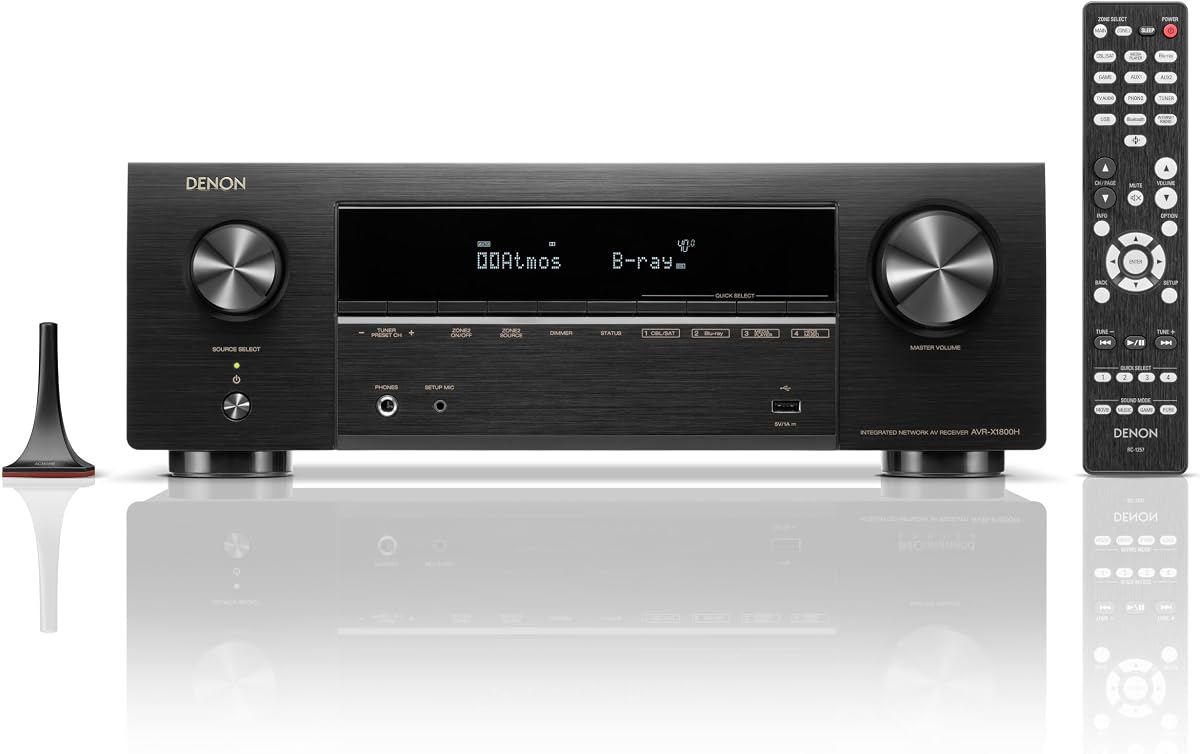
The Denon AVR-X1800H is a premium-oriented 7.2-channel receiver designed to serve as the hub of a medium home theater and a whole-home music system. Its 4.2 rating is solid, and its most appealing combination is seven channels of amplification, 80 watts per channel, a dedicated 8K HDMI section, and built-in HEOS streaming.
We may earn a commission when you buy through this link, at no additional cost to you.
The HDMI section provides three dedicated 8K inputs and one output, with 8K60 and 4K120 pass-through. Dolby Vision, HLG, HDR10+, and Dynamic HDR pass-through are supported through bandwidth up to 40 Gbps, making the receiver relevant to current high-end televisions and lag-conscious gaming setups. Dolby Atmos, DTS:X, DTS Virtual:X, and height virtualization allow cinematic effects to be explored with or than without dedicated height channels.
As the top pick in the comparison's premium category, it should not be mistaken for a traditional compact stereo receiver. Its dimensions and control scheme reflect a full AV component, and it can demand a carefully placed speaker array. Three dedicated 8K inputs are also fewer than the four advertised by the less expensive AVR-S570BT, although dedicated inputs can be more valuable than simply having extra sockets that share bandwidth.
The AVR-X1800H is a strong recommendation for a serious living-room theater where music, films, streaming, and gaming must coexist. Buyers should choose it for comprehensive integration, not simply because it is more advanced than a stereo-only alternative.
Seven-channel amplification, immersive decoding, and high-bandwidth HDMI switching create a robust theater foundation. The specification also supports 8K60 and 4K120 video, preserving headroom for compatible source components and displays.
HEOS multi-room streaming, Wi-Fi, AirPlay 2, and Bluetooth let the receiver serve as a network music hub. That makes the investment easier to justify when it is used for daily listening as well as occasional movie nights.
We may earn a commission when you buy through this link, at no additional cost to you.
The Denon AVR-S570BT delivers the essentials of a modern home theater in a 5.2-channel configuration. Its 4.2 rating, 70-watt power rating, and emphasis on 8K HDMI make it a practical middle ground for rooms that do not require seven powered channels. It supports Dolby TrueHD, DTS HD Master, Dolby Atmos, and standard 5.1 surround sound.
We may earn a commission when you buy through this link, at no additional cost to you.
Four dedicated HDMI 2.1 8K inputs and one HDMI output distinguish it from many competitors at this feature level. eARC support extends to 40 Gbps, while HDR, HLG, Dolby Vision, HDR10+, Dynamic HDR, VRR, and Quick Frame Transport target modern displays and gaming. The stated Power 310 W and Standby 0.1 W figures give buyers a general view of electrical use, although these aggregate numbers should not be confused with per-channel power ratings.
The receiver's limitations are mostly about expansion and ecosystem depth. Five powered channels cannot match a 7.2 model, and the feature summary places greater emphasis on Bluetooth and service applications than on the more elaborate multi-room and voice-control functions found on Denon's X-series receivers. It also does not solve the problem of someone wanting a slim, traditional two-channel unit.
The AVR-S570BT is best for buyers building a dedicated 5.2 theater with several 8K source devices. Its four dedicated gaming-ready inputs are particularly useful for consoles, while the on-screen assistant helps simplify initial setup and EQ configuration.
The receiver provides more individually specified 8K inputs than several higher-tier models. That is useful for households with multiple game consoles, a streaming device, and a disc player that need direct, high-bandwidth connections.
VRR, Quick Frame Transport, HDR10+, Dolby Vision, HLG, and Dynamic HDR provide relevant tools for compatible televisions. The HDMI platform is therefore designed for more than conventional film viewing.
We may earn a commission when you buy through this link, at no additional cost to you.
The Denon AVR-S670H offers a balanced mix of 5.2-channel power, current HDMI standards, immersive audio, and network streaming. Its 4.3 rating is among the stronger results in the guide. With 75 watts per channel, it sits between lower-powered five-channel designs and the 80-watt X-series receivers, making it a plausible choice for a compact-to-medium home theater.
We may earn a commission when you buy through this link, at no additional cost to you.
Dolby TrueHD, Dolby ProLogic II, and DTS Neo:6 Upmixer support the core surround experience, while HDMI ARC and eARC simplify television integration. The receiver handles 8K60 and 4K120 pass-through, 8K upscaling of 4K content, HDR10+, HLG, HDR, Dolby Vision, Dynamic HDR, VRR, ALLM, and QFT. HEOS, Wi-Fi, and Bluetooth expand the system beyond local sources and allow music to be shared across rooms.
As with the AVR-S570BT, five powered channels mean a larger theater configuration is unavailable without external amplification. The supplied details do not identify the number of dedicated 8K inputs, so buyers needing many simultaneous high-bandwidth sources should verify the rear-panel details. The benefit of this model is its balance rather than an unusually large channel count.
The AVR-S670H is a strong choice for a household wanting one receiver to handle 5.1 or 5.2 cinema, television audio, gaming, streaming, and music throughout the home. It is less appropriate for listeners committed to seven powered channels or a strictly traditional stereo-only aesthetic.
8K60 and 4K120 support, 8K upscaling, HDCP 2.3, and the latest dynamic HDR formats cover the principal video needs of a current mixed-use system. ARC and eARC also reduce cable clutter when television audio is routed through the receiver.
HEOS multi-room streaming works with services such as Spotify and Tidal, while Bluetooth and Wi-Fi cover wireless sources. Voice-agent compatibility adds another way to adjust the system without reaching for the remote.
We may earn a commission when you buy through this link, at no additional cost to you.
The Yamaha R-S202BL is a compact, focused stereo receiver whose brushed aluminum finish, simple controls, and two-speaker layout embody the approachable side of classic receiver design. Its 4.4 rating is strong, and the feature set remains focused on music rather than attempting to serve as a full home theater hub.
We may earn a commission when you buy through this link, at no additional cost to you.
The receiver includes a speaker selector for two systems, a CD input sensitivity of 500 mV/47 kOhms, a headphone terminal, an auto power standby function, and speaker terminals for two pairs. Bluetooth provides access to streaming services and other wireless sources, while FM and AM radio offers 40 preset stations. The stated frequency response ranges from 10 Hz to 100 kHz, with different tolerances indicated for different sections.
Its simplicity is a limitation in one sense and a virtue in another. There is no HDMI, no surround processing, no height channels, no HEOS, and no AirPlay support. A listener who wants to route a television through the receiver or build a multichannel theater will need another product. Network music services also require a separate streamer or a source with Bluetooth.
The R-S202BL is best for a small or medium stereo system where appearance, ease of use, and speaker switching are more important than cinematic formats. It also fits the nostalgic theme of the guide particularly well, combining a classic receiver silhouette with one modern convenience feature in Bluetooth.
The receiver avoids the menus, video processing, and calibration complexity associated with AV models. That simplicity makes it a practical choice for listeners who want to connect speakers and sources, select an input, and begin listening.
Speaker A/B selection allows two stereo systems to share the same amplifier. The feature is useful in a main listening area, a second room, or a setup where different pairs of speakers suit different music or periods of the day.
We may earn a commission when you buy through this link, at no additional cost to you.
The Marantz Model 50 is technically an integrated amplifier rather than a receiver, but it offers one of the most authentic interpretations of classic high-fidelity equipment in this guide. Its 4.9 rating is the highest listed score, and its design focuses on a warm, rich, spacious musical presentation delivered through a pure analog signal path.
We may earn a commission when you buy through this link, at no additional cost to you.
A high-current Class A/B architecture is said to drive demanding loudspeakers with authority, while Marantz HDAM SA-3 discrete modules replace conventional integrated operational amplifiers. The result is a component designed around signal integrity rather than a broad collection of wireless and video features. A built-in MM phono stage uses HDAM technology and JFET input circuitry, making vinyl integration more convenient.
There are six analog inputs, including dedicated CD and phono connections, as well as stereo pre-amp outputs, a subwoofer output, power-amp input, and speaker A/B switching. Those expansion points allow the Model 50 to become the foundation of a more ambitious system. However, the absence of HDMI, HEOS, Bluetooth, AirPlay, radio, and surround processing means it cannot replace an AV receiver in a contemporary entertainment center.
The Model 50 is ideal for an enthusiast who already has digital sources, a streamer, or a television elsewhere and wants the listening chain centered on a high-quality analog amplifier. It is also the strongest choice here for someone who associates the 1970s hi-fi aesthetic with minimalism, robust construction, and dedicated music playback rather than streaming convenience.
The absence of digital circuitry in the signal path removes potential digital interference from the amplifier's core operation. This makes the Model 50 a focused choice for listeners who value analog sources and a straightforward chain between preamplification and the speakers.
Pre-amp outputs, a subwoofer connection, a power-amplifier input, and speaker A/B switching provide more growth options than a basic integrated model. The receiver can become the center of a system that evolves as sources and listening ambitions change.
We may earn a commission when you buy through this link, at no additional cost to you.
The Sony STRDH190 Bundle packages the company's two-channel STRDH190 receiver with a 12-month enhanced protection plan from Deco Essentials. The package is designed for listeners who want the receiver's familiar combination of phono input, Bluetooth, and A/B speaker switching with additional accidental-damage and burn-in coverage.
We may earn a commission when you buy through this link, at no additional cost to you.
The receiver itself is described as engineered for sound quality and matched for optimal performance with Sony PS-HX500 and PS-LX300USB speakers. A phono input supports turntable connection, Bluetooth handles mobile devices, and the A/B speaker function allows flexible installation. The package includes the Sony 2.0-channel stereo receiver with Bluetooth.
The main difference from the standalone Sony STRDH190 is the protection bundle rather than a different core receiver. Buyers should carefully review the plan's terms, covered events, exclusions, and claim process, because a bundle can otherwise conceal the price of protection within the complete package. The product data provides no numeric customer rating, which makes independent customer feedback especially relevant when comparing long-term satisfaction.
This bundle is a sensible starting point for someone building a two-speaker Sony system around vinyl or Bluetooth. It is less compelling when the receiver will live in a modern television-centered setup, since the product does not list HDMI, surround channels, network streaming, or a room-correction system.
The enhanced plan includes accidental-damage and burn-in coverage, offering additional support during the period when a new receiver is being installed and adjusted. Buyers should confirm the plan's specific terms before assuming every type of damage or issue is covered.
A dedicated phono input, Bluetooth, and A/B speaker switching cover the core needs of a compact hi-fi system. The advertised matching with Sony PS-HX500 and PS-LX300USB speakers gives buyers a clear starting point for a coordinated setup.
We may earn a commission when you buy through this link, at no additional cost to you.
The right receiver depends on whether the priority is focused music, compact styling, vinyl playback, wireless streaming, or a complete surround theater. These factors help narrow the field without treating one feature checklist as universal.
A two-channel receiver is designed around a left and right speaker pair and can be the best choice for music-focused rooms. A 5.2 receiver adds powered center, surround, and rear channels plus two subwoofer outputs, while a 7.2 model supplies additional rear-height amplification. The Marantz STEREO 70s, Sony STRDH190, Yamaha R-S202BL, and Marantz Model 50 emphasize stereo; the Yamaha RX300A, Denon AVR-S570BT, and Denon AVR-S670H use 5.2; and the two Denon X-series receivers provide 7.2 channels. Match the layout to the room rather than paying for channels that will remain unused.
Published wattage is useful for initial comparison, but it is not a complete measure of sound quality. The stated conditions, such as 8-ohm loads and 1 kHz measurement frequency, can differ between products. Speaker impedance also matters: the Sony STRDH190 supports speaker impedances from 6 to 16 ohms, and every receiver should be paired with speakers whose requirements are compatible. For difficult loads, a high-current design such as the Marantz Model 50 may offer a different approach from a video-focused AV receiver. Buyers should consider room size, speaker sensitivity, amplifier quality, and placement rather than treating a headline wattage figure as the only criterion.
HDMI support matters when a receiver serves as the central home-theater hub. The Denon models support high-resolution video, dynamic HDR formats, and gaming features such as VRR, ALLM, and Quick Frame Transport. Dedicated 8K inputs can matter for households with multiple game consoles, while eARC simplifies returning television audio to the receiver. A traditional two-channel model may instead rely on a television's own speaker output or a separate streaming device. A 1970s-style listening room focused on records will gain little from video processing, so those features should not outweigh sound quality, connectivity, and fit.
A built-in phono stage simplifies a vinyl system because it removes the need for a separate external phono preamplifier. The Marantz STEREO 70s, both Sony STRDH190 listings, the Denon AVR-X1700H, and the Marantz Model 50 all list phono connectivity. The Model 50 goes further with a dedicated high-performance MM stage, while the Marantz STEREO 70s also provides a Zone 2 output. Confirm the type of cartridge and turntable output level, because a built-in MM stage generally suits moving-magnet cartridges rather than low-output moving-coil models. Analog users should also check whether the receiver includes a line-level output for recording or additional components.
Bluetooth is the most widely compatible wireless option and appears on the Sony STRDH190, the Marantz STEREO 70s, the Yamaha R-S202BL, and the Denon models. Bluetooth Multipoint on the Yamaha RX300A allows two source devices to be paired and switched more conveniently. HEOS adds network-based service integration and multi-room use on the Marantz STEREO 70s and Denon X-series receivers. AirPlay 2 offers another useful ecosystem for Apple users. Decide whether a simple local connection is enough or whether internet services, whole-home control, and app-based management are central to the intended system.
A slimline receiver can recreate the visual proportions associated with classic stereo equipment while fitting into modern furniture. The Marantz STEREO 70s is only 4.1 inches tall, and the Yamaha R-S202BL has a compact brushed-aluminum design. The Sony STRDH190 is 5.25 inches tall, while the Yamaha and Denon AV receivers are likely to demand more shelf or cabinet space. Listeners should measure the furniture, allow room for cables and ventilation, and consider front-panel display visibility. Retro styling is appealing, but practical fit and control accessibility should take priority.
A stereo receiver generally needs fewer decisions than a surround system. The Yamaha RX300A includes a setup microphone that measures room acoustics and speaker characteristics, while Denon's Quick Setup and on-screen assistant help configure home theater models. More channels, height speakers, subwoofers, and room correction can produce a more convincing result, but they also require correct placement and additional setup time. Buyers without a full theater should be honest about the speakers and processing they will actually use rather than selecting an advanced receiver only for its specification list.
A useful receiver should accommodate not only today's components but the sources likely to appear later. The Marantz STEREO 70s offers six HDMI inputs, headphone outputs, Zone 2 audio, and two subwoofers. The Denon AVR-X1700H includes two pre-outs for external amplification, while the Marantz Model 50 provides pre-amp outputs, a subwoofer output, a power-amp input, and speaker A/B switching. Expansion may also mean a separate streamer, network player, or powered speakers. Select the chassis that leaves useful paths forward without paying for a complex system that will remain underused.
Position the receiver on a stable, level surface with adequate ventilation. Do not place it inside a fully enclosed cabinet unless the manufacturer permits it. Connect speakers while the unit is powered off, observe correct channel and polarity connections, and avoid exceeding the compatible speaker impedance. For subwoofers, use the appropriate line output and consult the subwoofer's gain and crossover guidance before making fine adjustments.
Begin with the receiver's setup guide, connect one source at a time, and complete any room measurement or EQ process before judging the final sound. Run a calibration routine with the listening position occupied and the room in its normal condition. Set a moderate volume before connecting additional components, and use source-specific modes for movies, games, and music. If using a turntable, confirm that the phono input is selected and that the cartridge type matches the built-in stage.
Keep vents free of dust and leave clearance around heat-producing components. Use the unit's standby or auto-standby functions as intended, but avoid repeatedly changing settings while powered. Firmware updates for network-enabled models should be completed through the manufacturer's official process. For long periods of non-use, disconnect unnecessary cables, store the receiver in a dry environment, and follow the manufacturer's storage and cleaning instructions rather than using harsh chemical cleaners.
A stereo receiver is built primarily for a left and right speaker pair, with emphasis on music and traditional sources. An AV receiver adds surround and height channels, HDMI video switching, gaming features, decoding, and room calibration for home theater. The Marantz STEREO 70s and Sony STRDH190 are stereo-focused, while the Yamaha RX300A and Denon models are intended for multichannel arrangements.
No. Their visual styling and focus on two-channel audio may evoke a classic era, but many models include modern conveniences such as Bluetooth, HEOS, AirPlay 2, HDMI, high-resolution streaming, and phono inputs. The Marantz STEREO 70s is a particularly clear example, combining slim proportions with six HDMI inputs and extensive network streaming.
Only if the room and speakers support an immersive layout. A two-speaker system can sound excellent through a focused stereo receiver, while Atmos requires a compatible 5.1 or 5.2 channel arrangement and ideally height speakers. If movies and games are secondary to music, paying for additional surround channels may add cost and setup complexity without improving the core listening experience.
Several models include a dedicated phono input, including the Marantz STEREO 70s, both Sony STRDH190 listings, the Denon AVR-X1700H, and the Marantz Model 50. Check whether the built-in stage supports your cartridge type, particularly if using a low-output moving-coil cartridge. Otherwise, an external phono preamplifier can provide the required signal level and loading.
The ideal number matches the number of high-bandwidth devices that will remain connected. Four dedicated 8K inputs on the Denon AVR-S570BT suit several consoles and media devices, while the Marantz STEREO 70s provides six HDMI inputs in a stereo-focused design. Account for the television connection, disc player, streaming device, and game consoles, and verify the supported HDMI features of each input.
No. Bluetooth sends audio directly from a nearby phone, tablet, or computer and does not normally require an internet service. HEOS is Denon's network platform and is also used by the Marantz STEREO 70s, enabling supported streaming services, app control, and multi-room playback. A receiver can include one, both, or neither, depending on its design.
Choose a slim stereo receiver for music, vinyl, compact cabinetry, and uncomplicated two-speaker listening. Choose a full-size AV receiver when you need surround channels, television integration, gaming features, room correction, and multiple high-bandwidth sources. A larger receiver should earn its additional size through the speaker layout and entertainment functions you genuinely intend to use.
Confirm speaker impedance compatibility, available cabinet space, required source connections, and the number of channels you need. For network products, verify service support and account requirements; for phono-equipped models, check cartridge compatibility. Specifications can change between revisions, so the current product listing and manual should guide the final decision.
The Marantz STEREO 70s stands out as the most complete interpretation of a classic-inspired stereo receiver, combining a slim silhouette with six HDMI inputs, HEOS, phono support, subwoofer flexibility, and headphone outputs. The Yamaha R-S202BL offers the most focused budget approach, while the Denon AVR-X1800H represents the premium theater option with seven channels and high-bandwidth HDMI.
The right priority depends on the system rather than on the word retro. Music listeners should examine amplifier quality, analog connectivity, speaker compatibility, and stereo switching. Home-theater buyers should assess channel count, HDMI standards, gaming features, calibration, and streaming. Vinyl owners should confirm a suitable phono stage, and compact-room users should measure their furniture before committing to a chassis.
Ratings, configurations, features, and prices can change as manufacturers update products or retailers revise listings. Buyers should compare the current specification sheet, check the included accessories, review the latest customer feedback, and confirm the final cost at the point of purchase. With those checks in place, the right receiver can serve as both a capable audio hub and a convincing expression of classic receiver culture.