
TADA 200g/0.2g Mechanical Balance Scale
3.8Editor score
Compact 200g capacity
0.2g measurement precision
Portable classroom-oriented design
Seven-piece graduated weight set
Battery-free mechanical operation
This Mechanical Balance guide compares ten laboratory and classroom models by capacity, readability, construction, damping, portability, and included weights.
A mechanical balance uses calibrated sliding weights, beams, and a physical pointer to determine mass without relying on batteries or electronic components. The most useful model depends on required capacity, readability, portability, construction, and the kind of items being weighed, from classroom specimens to food ingredients.
This guide compares ten mechanical balances across laboratory, educational, medical, and general weighing uses. We evaluated the supplied specifications, including maximum capacity, graduation or readability, included weights, zero adjustment, magnetic damping, platform design, dimensions, and stated construction materials.
Each pick highlights a different balance of practical strengths, including higher laboratory capacity, compact classroom portability, stainless steel platforms, and medical-scale versatility. Ratings and specifications reflect the available product information, while prices can change, so readers should confirm the current listing and requirements before purchasing.
3.8Editor score
5.0Editor score

4.4Editor score
The comparison below organizes all ten balances by capacity, readability, platform or construction, and included accessories, making it easier to identify the right instrument for a laboratory, classroom, medical facility, kitchen, or teaching demonstration.


The QWORK Triple Beam Mechanical Balance is a 2610g-capacity instrument with 0.1g accuracy, a zero adjustment knob, magnetic damping, and a six-inch platform. Its 3.7 rating reflects mixed customer experiences, but the stated specifications make it a practical option for classrooms, teaching laboratories, universities, and kitchen weighing.
We may earn a commission when you buy through this link, at no additional cost to you.
The balance is designed around familiar triple-beam principles. Two 1000g weights and one 500g weight expand the usable range from 610g to 2610g, while the clear graduation and damping system help the pointer settle more quickly. Its mechanical design removes batteries and other power sources from the operating equation, which can simplify routine demonstrations and reduce dependence on electronics.
The most important caveat is transportation. Although the product is described as professionally calibrated, movement during shipping may disturb the zero setting, so some users may need to recalibrate it. The supplied instructions are important, and the 3.7 rating makes it particularly worthwhile to review recent customer feedback and seller support before choosing.
This is a sensible choice for readers who need more capacity than a compact classroom scale but do not require the more specialized construction of a medical balance. It is best suited to teaching, demonstrations, and general weighing where the stated 0.1g accuracy and 2610g maximum capacity meet the task.
The 2610g maximum gives students room to work with larger samples while retaining a 0.1g stated accuracy. Included weights make the instrument more useful immediately, particularly for school and university instruction.
Clear graduations and magnetic damping support faster visual readings. The pointer settles more quickly, while the zero adjustment helps control systematic error before each session.
We may earn a commission when you buy through this link, at no additional cost to you.
The TADA 200g/0.2g Mechanical Balance Scale is built for teaching measurement principles in a compact, lightweight format. It carries a 3.8 rating and includes a set of graduated weights, making it a straightforward choice for classrooms that need a portable demonstration instrument rather than a high-capacity laboratory balance.
We may earn a commission when you buy through this link, at no additional cost to you.
Capacity and precision are the core specifications. The scale measures up to 200g with stated precision of 0.2g, and the included 5g, 10g, two 20g, 50g, and 100g weights allow several common sample sizes to be assembled. Its compact size and low weight simplify storage in laboratory cabinets and movement between teaching rooms.
The trade-off is straightforward. A 200g limit and 0.2g precision will not suit researchers or users who need to resolve differences below one-fifth of a gram, and the 3.8 rating indicates that buyers should consider the overall feedback before purchasing. It is better viewed as an educational aid than a high-resolution analytical instrument.
For elementary demonstrations, introductory science classes, or compact teaching collections, this model offers a manageable balance of portability, included accessories, and mechanical simplicity. Buyers should choose it when its stated measurement range fits the lesson and when easy transport matters more than large capacity.
The lightweight, compact body is easier to move between classrooms and store when not in use. That makes the scale more practical for shared teaching environments than a full-size laboratory instrument.
Seven graduated pieces support a variety of small-object demonstrations. This broadens lesson options without requiring users to assemble a separate weight collection.
We may earn a commission when you buy through this link, at no additional cost to you.
The MB2610 Triple Beam Balance combines 2610g capacity with a stated 0.1g resolution and holds a 4.4 rating. Its three graduated beams, magnetic damping, sturdy base, and included weights make it one of the stronger general-purpose selections for analytical teaching and laboratory-style demonstrations.
We may earn a commission when you buy through this link, at no additional cost to you.
The measurement system uses three sliding weights of 10g, 500g, and 100g, while the supplied set includes two 1000g pieces and one 500g piece. Two attachment positions can be used at the same time, extending the usable range from 610g to 2610g. This arrangement balances larger item handling with finer adjustment on the graduated beams.
Its main inconvenience is size relative to compact classroom models. A larger footprint takes more bench space, and the supplied description says adjustment is not often needed rather than claiming it is completely unnecessary. Still, the 4.4 rating suggests stronger customer satisfaction than many lower-rated alternatives in this roundup.
This model is a strong general recommendation for readers who need laboratory capacity, a readable mechanical system, and stable readings without batteries. It is particularly appropriate for schools, universities, analytical demonstrations, and facilities that value the straightforward three-beam format.
Offset graduated beams allow coarse and fine mass adjustments within one instrument. The 10g, 500g, and 100g riders provide a practical path from small corrections to heavier samples.
Magnetic damping reduces the time required for the pointer to stabilize. This supports more efficient classroom pacing and less waiting during repeated measurements.
We may earn a commission when you buy through this link, at no additional cost to you.
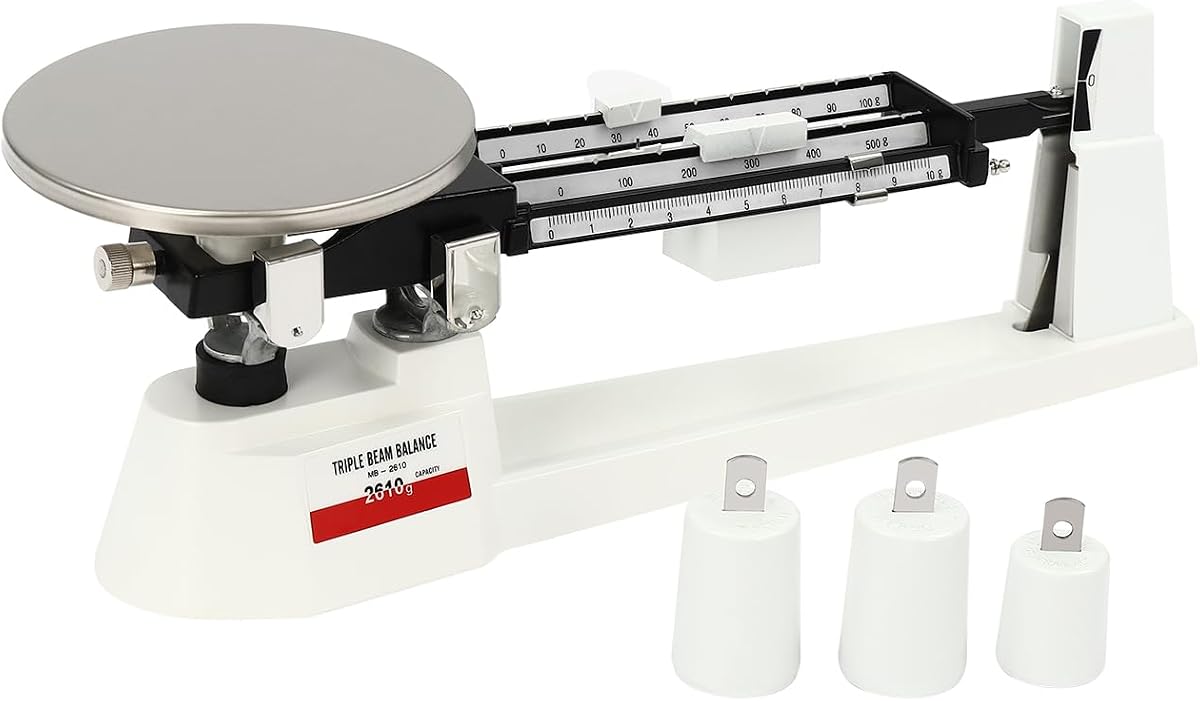
This 2610g by 0.1g Triple Beam Scale is positioned for laboratories, classrooms, universities, kitchens, agriculture, and industrial weighing. It uses stainless steel, aluminum alloy, zinc alloy, and plastic, and it pairs a six-inch tray with a zero adjustment knob and magnetic damping.
We may earn a commission when you buy through this link, at no additional cost to you.
Several practical details distinguish it from simpler models. The recessed base stores the two 1kg weights and one 500g weight after use, while clear range markings and durable reading-rod numbers improve operation. A threaded zero adjustment knob is designed to resist finger slippage during calibration.
The listing provides no customer rating, so direct user feedback is unavailable in the supplied data. Its listed dimensions of 18 by 6.7 by 7 inches also make it less suitable for small storage areas. Those factors warrant comparing the available instructions, included accessories, and seller support before purchase.
The scale is best for buyers who need a sizable, serviceable-looking instrument with a stainless platform and organized weight storage. It is a versatile workhorse for teaching and general weighing, although the lack of a stated rating makes it harder to recommend as confidently as highly rated alternatives.
A recessed base compartment keeps the supplied weights close at hand and reduces the chance of leaving them scattered across a workbench. This is especially helpful in busy teaching environments.
The threaded adjustment control is intended to maintain a secure finger position. It provides a controlled way to return the balance to zero before beginning a new measurement.
We may earn a commission when you buy through this link, at no additional cost to you.
The Health o meter Professional 400KL is a mechanical physician and patient scale designed around a 390lb, or 177kg, capacity. It carries a 4.4 rating and pairs a powder-coated alloy steel body with a non-slip platform mat for stable, comfortable use in clinics and other high-traffic medical settings.
We may earn a commission when you buy through this link, at no additional cost to you.
Its 1lb, or 100g, graduation is appropriate for general patient weighing, where readability and a broad capacity matter more than tenth-of-a-gram precision. The coating is applied inside and out to help protect against rust, and the broad platform provides a more suitable standing surface than a small laboratory pan.
This model is not a substitute for a 2610g analytical balance. Its larger scale and coarser graduations serve a different purpose, and the listed optional wheels and counterweights are not included by default. Buyers should also confirm that optional 490lb capacity accessories are appropriate for their facility.
The ten-year limited warranty and 4.4 customer rating give it a strong case as the premium medical-oriented pick. It is best for clinics, physicians, care facilities, and other users who need a stable, durable patient platform rather than fine-grained laboratory resolution.
The wide platform and non-slip black mat support steadier footing during use. These features make the scale more suitable for routine patient weighing than a compact classroom instrument.
Powder-coated alloy steel is intended to resist wear and rust in high-use areas. The included ten-year limited warranty adds long-term reassurance for professional buyers.
We may earn a commission when you buy through this link, at no additional cost to you.
The Ohaus 80000012 Specialty Mechanical Triple Beam Balance offers 610g capacity and 0.1g readability in a traditional laboratory design. Its 4.3 rating, stainless steel plate, metal beams, magnetic damping, and spring-loaded zero compensator make it appealing for classical teaching and routine lab work.
We may earn a commission when you buy through this link, at no additional cost to you.
Notched and tiered beams help guide the sliding weights and support repeatable visual results. The zero compensator enables fine corrections, while magnetic damping shortens settling time. Together, these features improve the feel and efficiency of a hands-on balance without introducing a digital display.
Its main limitation is capacity. It reaches 610g rather than the 2610g offered by several products in the list, so it will not handle the same range of larger samples. The supplied information also does not identify a complete included weight set, so buyers should check what accessories accompany the scale.
This Ohaus model is best for classroom instruction, classic analytical demonstrations, and facilities that prioritize 0.1g readability in a familiar 610g format. It is a refined middle ground between a portable teaching scale and a higher-capacity laboratory balance.
Notched and tiered beams help users position sliding weights while keeping the reading visible. The arrangement is well suited to teaching and learning conventional balance operation.
A spring-loaded zero compensator supports small, controlled adjustments. Magnetic damping then reduces pointer movement, helping repeated readings settle more quickly.
We may earn a commission when you buy through this link, at no additional cost to you.
The MB2610 Triple Beam Balance is listed for electronics, agriculture, textiles, laboratories, universities, and kitchen weighing. It combines 2610g maximum capacity with 0.1g accuracy, a six-inch tray, magnetic damping, and two 1kg plus one 500g included weights.
We may earn a commission when you buy through this link, at no additional cost to you.
The instrument uses stainless steel, aluminum alloy, zinc alloy, and plastic, creating a mixed-material frame intended for stability and durability. Clearly marked base ranges assist with operation, and the battery-free design allows use in locations where a power outlet or reliable battery supply may be inconvenient.
No customer rating is supplied, which makes it harder to assess real-world satisfaction. Buyers should verify the zeroing process, beam graduations, and included components, especially because the listing is marketed across many different sectors. The scale may also be more than a casual user needs.
This MB2610 is a practical option for users who need substantially more capacity than a 610g laboratory balance and value a sturdy platform. It is best suited to education, sample handling, and general weighing tasks whose expected mass falls within the 2610g limit.
The 2610g limit accommodates a wider assortment of items than compact classroom balances. This flexibility is useful for teaching, agricultural samples, textile materials, and general industrial work.
Mechanical operation keeps the scale usable without batteries or a mains connection. The trade-off is that users must perform the zeroing and reading steps themselves.
We may earn a commission when you buy through this link, at no additional cost to you.
The Lightweight 2610g Triple Beam Scale stands out with a perfect 5.0 rating and a balanced set of laboratory-friendly features. It offers 2610g maximum capacity, 0.1g accuracy, magnetic damping, a stainless steel platter, and a stated footprint of 18 by 6.7 by 7 inches.
We may earn a commission when you buy through this link, at no additional cost to you.
Two 1kg weights and one 500g weight are included, and two attachment points expand the range from 610g to 2610g. A zero adjustment knob helps reduce systematic error, while magnetic damping allows riders to settle more quickly. The stainless steel platter is easy to clean and suitable for food materials, powders, liquids, and other weighed items.
This is not the smallest choice, and buyers should not interpret the lightweight name as pocket-sized. The stated size is still relatively manageable for a laboratory bench, teacher’s desk, or kitchen work area. Zeroing before use remains essential because moving a mechanical balance can disturb its reference position.
The perfect rating, strong capacity, fine stated accuracy, and broad range of intended applications make this the Editor's Choice for most buyers seeking a full-size laboratory balance. It is especially appealing to schools, universities, kitchens, research institutes, and general users who need more than 610g without moving to a coarser medical scale.
The combination of 2610g capacity and 0.1g accuracy covers a useful middle ground. It supports larger samples while preserving a resolution suitable for detailed teaching and routine analytical work.
The stainless steel weighing platter is easy to clean and broad enough for common samples. Its six-inch diameter also helps users place containers without crowding the pan.
We may earn a commission when you buy through this link, at no additional cost to you.
The EISCO Triple Beam Mechanical Balance is a 610g-capacity single-pan instrument intended for teaching, laboratories, households, kitchens, and shops. Its defining features include a stainless steel pan, corrosion-resistant coated aluminum frame, magnetic damping, spring-loaded zero adjustment, and offset beams.
We may earn a commission when you buy through this link, at no additional cost to you.
The offset beam arrangement provides an unobstructed vertical view of the scale markings, which is valuable when students need to learn how each sliding weight contributes to the result. Resting notches calibrated to the scale help support stable positioning, while magnetic damping reduces waiting after an object is placed.
The absence of a customer rating leaves the feedback context unknown, so buyers should examine the current listing and included accessories carefully. Its 610g capacity also places it below the larger 2610g models, making it better for small samples than heavy objects.
The EISCO is a good choice for visual and tactile instruction where students should understand traditional weighing. It suits schools, teaching laboratories, and other settings that value clear beam visibility and durable construction more than a very high maximum capacity.
Offset beams keep the scale markings easier to see from a vertical viewpoint. This supports instruction because users can observe the balance and sliding weights more clearly.
A stainless steel pan and coated corrosion-resistant aluminum frame suit frequent use. The combined materials are intended to provide stability without a bulky, complex housing.
We may earn a commission when you buy through this link, at no additional cost to you.
The 2610g Triple Beam Lab Scale combines 2610g maximum capacity with a stated 0.1g precision and carries a 4.0 rating. It includes two 1000g weights, one 500g weight, a six-inch stainless steel platform, magnetic damping, and a zero adjustment knob.
We may earn a commission when you buy through this link, at no additional cost to you.
The included weights extend the base range from 610g to 2610g, while the stainless platform offers an easy-to-clean surface for powders, liquids, and solid materials. Magnetic damping minimizes pointer sway, and the clear scale supports direct reading without a digital display.
Although the product is described as professionally calibrated, mechanical balances can lose their zero after transport or movement. Buyers should therefore follow the manufacturer’s zeroing instructions and check the balance before each session. The 4.0 rating is positive, though not exceptional.
This model is a versatile choice for schools, universities, kitchens, and industrial environments where the 2610g range is valuable. It works particularly well for users who want fine stated precision, included accessories, and a cleanable platform without requiring a specialized medical design.
A 2610g range and 0.1g precision suit many different sample types. The platform is positioned for powders, liquids, and solids, making the scale useful beyond a single classroom exercise.
Magnetic damping reduces sway, while the clear scale presents a direct visual result. Users can read the mass without navigating menus or charging a battery.
We may earn a commission when you buy through this link, at no additional cost to you.
Choosing a mechanical balance means matching the instrument’s range, readability, construction, and operating features to the samples and environment. The most important distinction is whether you need compact teaching capability, standard laboratory resolution, or a larger medical and industrial platform.
Begin with the largest mass you expect to weigh rather than the smallest. Compact classroom balances may top out at 200g, while many laboratory models support 610g and others extend to 2610g with the supplied large weights. A 610g balance is suitable for many small samples, while 2610g gives more room for containers, food portions, and larger teaching specimens.
Choose a capacity comfortably above your normal workload rather than exactly at its limit. Also verify whether the stated maximum depends on the included attachment weights and confirm that the required calibrated masses are present.
Readability indicates the smallest graduation visible on the instrument, while accuracy describes the stated measurement performance. A 0.1g specification suits more analytical teaching and routine lab work than a 0.2g classroom model, while a 100g graduation on a medical scale is appropriate for general patient weight rather than small specimens.
Consider both figures and the type of work involved. A highly refined graduation is not especially valuable when samples differ by hundreds of grams, but it becomes important when users need to identify small mass differences.
Mechanical balances often rely on both sliding riders and removable external weights. The strongest candidates in this category include two 1000g and one 500g pieces, while the compact TADA model includes smaller graduated masses. A complete set makes a scale more useful immediately and helps users form different target weights during lessons.
Check the individual masses, quantity, and storage arrangement before ordering. Some bases include a recessed compartment, while others leave weight organization to the user.
A mechanical balance can oscillate after a sample is added, making readings slower and less consistent. Magnetic damping is the most common feature in this roundup and helps the pointer or riders settle after a measurement. This is valuable during repeated classroom demonstrations where users may place and remove many samples.
Look for a clear graduation or reading rod in addition to damping. Damping controls motion, but the final result still depends on the user being able to see and interpret the scale accurately.
Every mechanical balance should return to zero before measuring, and many models provide a knob or spring-loaded compensator for this purpose. Threaded controls can offer a secure grip, while a fine spring adjustment is useful in a fixed laboratory installation. The ability to correct zero is especially important after moving, transporting, or bumping a balance.
Look for clear zeroing instructions and a stable adjustment mechanism. Even a professionally calibrated product may lose its reference setting during transit, so zero adjustment should be treated as routine preparation rather than a sign of failure.
The platform must fit the samples and containers without interfering with the beams. A six-inch stainless steel platter offers a cleanable surface for food, powders, and general laboratory materials. Medical scales use a broader platform with a non-slip mat, while some classroom balances prioritize a compact pan and lower overall weight.
Construction varies across stainless steel, aluminum alloy, zinc alloy, plastic, and coated steel. Look for a rigid base, durable beam components, corrosion protection, and materials appropriate for the location where the instrument will be stored.
A compact balance is easier to move between classrooms, store in cabinets, and use in temporary teaching spaces. Larger 2610g models are often around 18 inches long, which may be more appropriate for a permanent bench. The Health o meter patient scale has a different footprint again because it is designed to support people standing on a broad platform.
Measure the available work surface before buying. Consider not only the balance but also the room needed to slide weights, read the pointer, and access the zero adjustment without moving the instrument.
Laboratory analysis, classroom instruction, medical weighing, and kitchen portions create different expectations. A medical scale should offer a stable patient platform and appropriate graduations, while an analytical balance needs fine resolution and a small sample pan. Educational users may prioritize durability, easy storage, and enough weights for demonstrations.
Review the warranty, included instructions, replacement weight availability, and current customer feedback. A longer warranty can add value in a clinic or shared school, while a good rating helps indicate that the product works as described.
Place the balance on a level, stable surface away from vibration, drafts, direct heat, and strong magnetic interference. Before adding a sample, inspect the beams, riders, platform, and removable weights. Move each rider to zero, allow the pointer to settle, and use the zero adjustment knob or compensator until the indicator reads zero without a sample present.
Choose weights that will keep the mass within the instrument’s capacity and near the usable range of the graduated beams. Place larger removable weights on the attachment points, then slide each rider to the nearest suitable graduation. Add the object to the center of the pan, wait for the pointer to stabilize, and record the combined reading shown by the pointer and riders.
After each session, remove the sample and return all riders and weights to their zero positions. Clean the platform and frame with a soft, appropriate cloth, avoid immersing the instrument, and keep the base dry. Store it under cover in its original orientation, and zero it again before the next use because moving the balance can disturb the setting.
A mechanical balance uses physical beams, calibrated masses, and a pointer to display a result, while a digital scale converts a load into an electronic reading. Mechanical balances require zeroing and careful reading but do not need batteries. Digital scales are often faster and easier to read, while mechanical instruments remain useful for teaching traditional weighing principles.
Capacity varies considerably across the models reviewed. The TADA model supports 200g, the Ohaus and EISCO models list 610g, and several QWORK and MB2610-style scales reach 2610g with the included large weights. Always verify both the base and maximum stated capacity before choosing.
A mechanical balance should be checked for zero before use. Even if it was calibrated before shipping, movement during transport or ordinary handling can disturb the setting. Use the zero adjustment knob or compensator and follow the supplied instructions whenever the pointer does not settle at zero.
Readability describes the smallest mass division shown on the scale, while accuracy describes how closely a measurement approaches the true mass. A 0.1g readability is more detailed than a 100g graduation, but readability alone does not guarantee that every object can be weighed equally accurately. Sample size, balance condition, and proper zeroing all affect results.
Yes, and their visible mechanical operation is often a major advantage in lessons about mass, calibration, and measurement. A compact 200g model works for small-object demonstrations, while 610g and 2610g versions support larger samples. Schools should choose a capacity and precision that match the planned experiments.
Several products in this roundup list kitchen weighing as an intended use, particularly those with stainless steel platforms and included weights. Choose a model with sufficient capacity for the containers and ingredients you plan to weigh, and clean the platform after use. A medical patient scale is not the better choice for small food portions.
The pointer establishes a mechanical reference from the balance’s position and internal alignment. Moving the instrument, carrying it, or placing weight on the platform can change that reference. Resetting the zero before each measurement helps reduce systematic error and keeps readings comparable.
Magnetic damping reduces pointer oscillation after a sample is placed or a rider is moved. The pointer settles more quickly, which makes readings easier and can improve efficiency during repeated measurements. It does not replace zeroing or proper leveling, but it helps make the mechanical readout more practical.
The Lightweight 2610g Triple Beam Scale is the strongest overall choice for most laboratory and teaching buyers because it combines 2610g capacity, 0.1g accuracy, magnetic damping, a stainless steel platter, and a perfect 5.0 rating. The TADA model is the practical budget and portability option, while the Health o meter 400KL stands apart as the premium medical-scale choice.
Prioritize capacity that matches the samples, resolution appropriate to the task, and a platform suited to the environment. Consider the included weights, zero adjustment, damping, footprint, construction, warranty, and available customer feedback together rather than focusing on one specification alone.
Ratings, product details, availability, and prices can change over time. Before making a final purchase, compare the current listing, confirm the included accessories, read the zeroing instructions, and verify that the specified capacity and readability suit the intended use.