
Mission Darkness TitanRF Faraday Tape
4.4Editor score
Lab-tested shielding performance
Durable peelable backing
Connects TitanRF fabric sheets
Includes usage instruction card
Our Faraday Tape guide compares 10 options for EMI/RF shielding, grounding, cable repair, enclosure sealing, width, length, conductivity, and ease of applicatio
Faraday tape is conductive, adhesive-backed material used to block electromagnetic and radio-frequency interference, establish grounding paths, repair shielding layers, and improve the continuity of Faraday enclosures. A strong roll should bond reliably, remain electrically conductive, fit awkwardly shaped surfaces, and create overlapping seams that do not interrupt the shielding.
We compared the ten available rolls by examining their stated construction, dimensions, adhesive behavior, shielding applications, temperature claims, and intended uses. The list covers narrow detail tape, broad enclosure-sealing rolls, high-temperature fabric, and options intended for cable harnesses, electronics repair, guitar noise reduction, RFID blocking, ESD grounding, and DIY shielding projects.
Each review explains the most useful qualities and trade-offs of its product, followed by the best buyer for that particular tape. Ratings and specifications reflect the supplied product information, while availability and prices can change, so readers should confirm current listing details before making a final purchase.
4.4Editor score
5.0Editor score

4.6Editor score
The comparison below highlights the dimensions, conductive construction, primary strengths, and intended uses of all ten Faraday tape options, making it easier to match a roll to a specific shielding or repair project.


This 2-inch-wide, 59-foot conductive cloth tape combines conductive cloth with conductive adhesive, making it a versatile option for EMI shielding, grounding, and cable-interference projects. Its 4.5 rating reflects a broadly useful product with a strong set of applications, although the supplied information does not include a formal shielding-effectiveness test report.
We may earn a commission when you buy through this link, at no additional cost to you.
A major advantage is the electrically continuous construction. Because both the cloth and adhesive are conductive, overlapping pieces can remain connected, helping installers bridge seams between tape sections. The broad width also makes this roll efficient for wrapping wire harnesses, covering enclosure joints, shielding internal device layers, and addressing interference around cables and electronic assemblies.
The listed metallized surface provides stable conductivity, while the fabric base contributes flexibility and abrasion resistance. The tape can be cut into strips, squares, or custom shapes, and the manufacturer describes it as easy to apply without complex tools. The trade-off is that a 2-inch width can be excessive for compact electronics or intricate cable work, where a narrow roll would be easier to control.
This is a strong choice for general repair kits, electronics benches, automotive wiring tasks, and builders assembling a Faraday cage. Its broad coverage, conductive adhesive, and large assortment of suggested uses make it particularly versatile. Buyers with small shielding gaps may want a narrower option, while those covering larger seams will find the 2-inch format more efficient.
The conductive adhesive and cloth are intended to keep overlapping seams electrically continuous, a useful feature when joining separate strips or patching shielding layers. Full surface contact and firm pressure remain important during application.
From circuit stickers and paper circuits to guitar noise reduction, wire-harness wrapping, and display repair, the tape can serve as a general-purpose shielding and bonding material across electronics and DIY projects.
We may earn a commission when you buy through this link, at no additional cost to you.
This 2-inch by 50-foot double-conductive fabric tape is built around high-strength polyester fiber and an acrylic adhesive. A copper-nickel layer created by a plating process gives it the electrical character needed for EMI and RFI shielding, grounding, and non-solderable connections. Its supplied rating is 4.6, indicating strong buyer satisfaction.
We may earn a commission when you buy through this link, at no additional cost to you.
The product differentiates itself through claimed high-temperature resistance, tensile strength, and anti-static performance. It is presented as suitable for precision components, internal shielding repairs, wire harnesses, cable shielding, guitar interference reduction, and Faraday-cage sealing. The two-sided conductivity is particularly useful when a repair must bridge conductive surfaces without soldering.
Its stated adhesion to metal, plastic, foam, and glass makes it adaptable, and the manufacturer says it can be removed without leaving residue. However, the 50-foot length is shorter than the 59-, 65-, 66-, and 149.2-foot options in this comparison, so extensive enclosure coverage may require more than one roll. The absence of a stated formal shielding test may matter to highly regulated buyers.
This tape is well suited to repair technicians, automotive installers, and serious electronics hobbyists who value temperature resistance and strong fabric construction. For smaller components, its broad width may require careful trimming. For large shielding projects, buyers should calculate coverage first, but the material itself is a compelling premium option.
The polyester base, plated conductive layer, and acrylic adhesive are designed for durability under demanding conditions. High-temperature resistance and tensile strength make the roll more relevant to equipment repair than an ordinary adhesive tape.
Double-sided conductivity allows the tape to provide electrical contact to non-solderable components when pressed firmly into place. This is helpful for quick repairs, although the final connection should be inspected for full contact.
We may earn a commission when you buy through this link, at no additional cost to you.
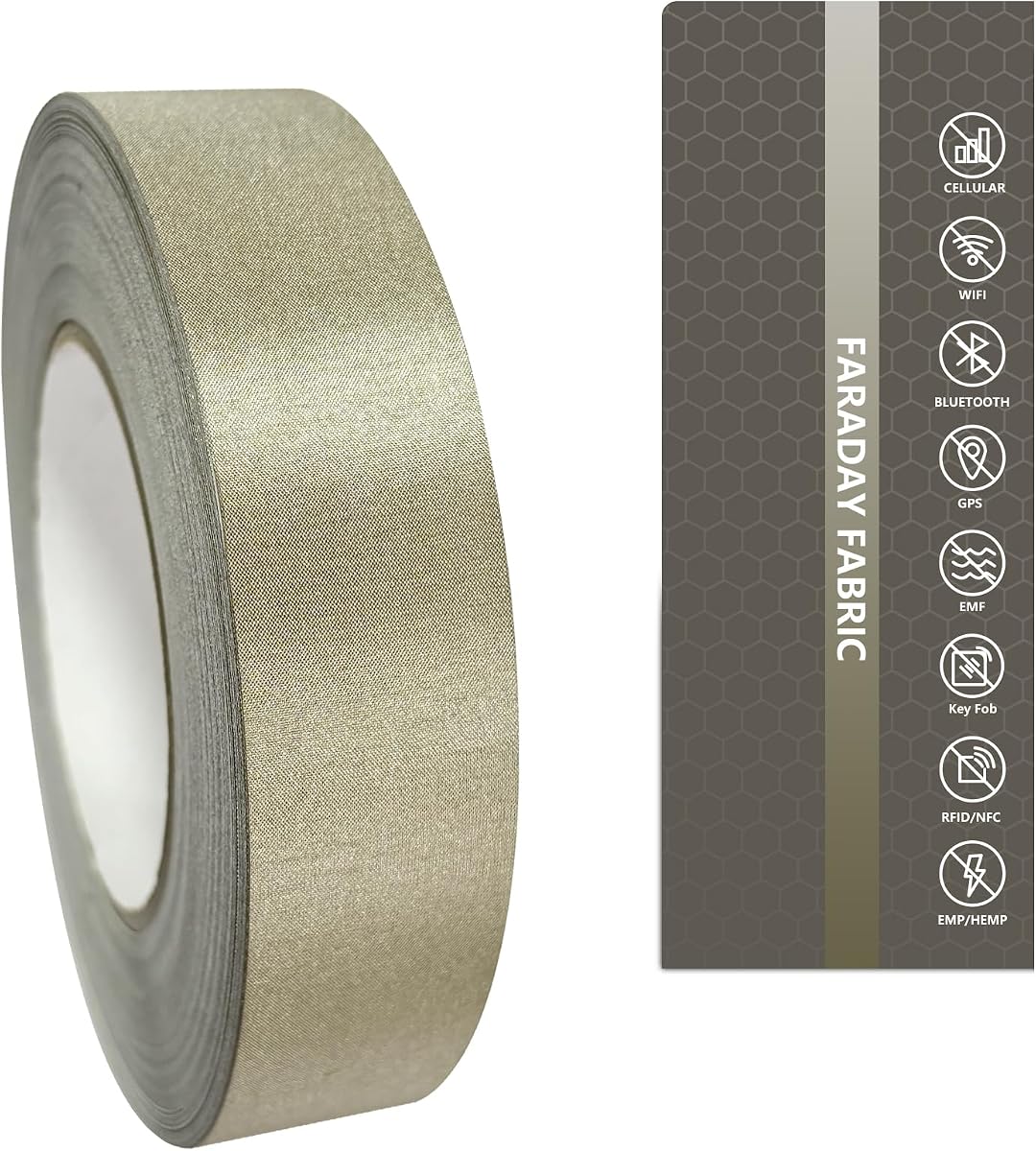
Mission Darkness TitanRF Faraday Tape is the most specialized product in this guide, designed to connect TitanRF shielding fabric or seal RF enclosures. The 2.5-inch-wide roll is relatively short at 10 feet, but its documentation-oriented features make it appealing to buyers who need evidence-based RF shielding rather than a general-purpose conductive cloth.
We may earn a commission when you buy through this link, at no additional cost to you.
The key distinguishing feature is the claim that shielding effectiveness was confirmed under IEEE 299-2006 testing, with a full report available on request. That makes this tape easier to evaluate for professional or technical projects where standards documentation is important. It also uses a peelable backing and is described as resistant to tearing without strong force or scissors.
Compared with longer cloth rolls, the 10-foot length offers limited coverage and may be insufficient for building an entire enclosure from scratch. The 4.4 rating is also slightly below the highest-rated products. Nevertheless, specialized compatibility with TitanRF fabric, included instructions, and documented testing make this a deliberate technical choice rather than a general bargain roll.
Buyers repairing TitanRF-based bags, testing enclosures, or working with RF equipment should give this option close consideration. It is less compelling for routine cable wrapping or anyone expecting a long roll, but the documented shielding performance is the central reason to choose it for specialized applications.
IEEE 299-2006 test confirmation and an available full report distinguish this option from rolls marketed only by material type. Buyers can request the documentation before committing a roll to a critical RF project.
The tape is specifically intended to join TitanRF fabric sheets and seal RF enclosures. Its 2.5-inch width supports broad seam coverage, while the included instruction card helps users handle common applications.
We may earn a commission when you buy through this link, at no additional cost to you.
This narrow 0.4-inch Faraday cloth tape is the best budget-oriented option in the list, combining a 66-foot roll with a 4.6 rating. Its double-conductive construction and narrow profile make it especially useful for routing conductive traces, wrapping small wire harnesses, or placing precise shielding strips around compact components.
We may earn a commission when you buy through this link, at no additional cost to you.
The product is described as shielding RF, RFID, RFI, EMI, EMF, and low-frequency interference, with a metallized construction that remains flexible and abrasion resistant. Because the adhesive is conductive as well as the cloth, pieces can be overlapped to maintain continuity. It is also listed for grounding, paper circuits, electrical repair, guitar interference reduction, and Faraday-cage construction.
The obvious limitation is coverage. A 0.4-inch strip is not efficient for sealing a wide enclosure seam, a large puncture, or a broad shield panel. A 1-inch or 2-inch tape would cover such areas faster, although multiple narrower passes can create a continuous path. The listing also provides no formal shielding-effectiveness test data, so the product is best judged on its construction and intended uses.
This is a compelling choice for electronics hobbyists, repair benches, and builders who need narrow, precise conductive strips. It offers a generous length and strong rating without requiring the bulk of a broad roll. For small traces and tight work areas, its narrow format is a genuine advantage rather than a compromise.
The 0.4-inch width is ideal where broad tape would overlap unwanted components or interfere with connectors. It can follow cable paths, create narrow ground traces, and fit between closely packed electronic parts.
Conductive cloth and conductive adhesive work together so overlapping sections can remain electrically continuous. Press each overlap firmly and inspect it for complete contact to support reliable shielding.
We may earn a commission when you buy through this link, at no additional cost to you.
This 1-inch by 50-foot double-conductive cloth tape is a practical middle ground for electronics repair, EMI shielding, and general conductive fabrication. Its 4.4 rating indicates a generally positive reception, and the stated 0.11-millimeter thickness gives buyers a clearer sense of the material than many competing listings provide.
We may earn a commission when you buy through this link, at no additional cost to you.
The roll combines conductive cloth with conductive adhesive, allowing overlapping seams to remain electrically continuous. It can be twisted, bent, and torn by hand without additional tools, making installation straightforward around irregular surfaces, cable bundles, internal shielding layers, and grounding points.
The manufacturer lists metal, aluminum, plastic, glass, copper, brass, ceramics, tiles, and flooring among suitable surfaces. That broad compatibility is useful for mixed-material projects. On the other hand, the 50-foot roll is shorter than most other products here, and the supplied information does not identify a specific high-temperature rating or provide quantified shielding data.
This tape is a sensible choice for repairers who want more coverage than a narrow strip without carrying a very broad roll. It also works well for small Faraday enclosures, wire-harness wrapping, paper circuits, and quick conductive repairs. Buyers should choose it for versatility and convenience rather than for documentation-heavy professional procurement.
The thin cloth construction can be bent, twisted, or torn to fit irregular parts. Scissors may produce a cleaner edge, but the listing indicates that complex tools are not required for routine installation.
Adhesion to metals, plastics, glass, ceramics, and other listed surfaces broadens the range of repair contexts. Surface cleanliness and firm pressure remain important for achieving good initial contact.
We may earn a commission when you buy through this link, at no additional cost to you.
This radio-frequency blocking tape combines a metallic foil layer with conductive adhesive and receives a 4.6 rating. It is designed to provide reliable electrical continuity across seams and joints, making it particularly relevant to equipment repairs, DIY Faraday bags, RF interference work, grounding pads, and modified electric guitars.
We may earn a commission when you buy through this link, at no additional cost to you.
The stated advantage over aluminum foil is easier handling. While foil can be rigid, awkward to shape, and prone to tearing during installation, this tape can be twisted, bent, and cut with scissors. The manufacturer recommends scissors to preserve the material's usability, giving installers more control around curved, irregular, or confined parts.
The listing references 1-inch and 2-inch width options, each with a 65-foot length. Because variants may be presented together, buyers should confirm the selected dimensions before ordering. Although the construction sounds suited to dependable RF shielding, no formal IEEE or equivalent test result is included in the supplied information.
This is a good fit for audio equipment repair, guitar builders, and makers constructing small shielding enclosures. It is especially attractive where foil is difficult to work. Buyers who require formal shielding documentation may prefer the Mission Darkness option, while general repairists may favor this easier-to-shape foil-based tape.
The flexible metallic layer is intended to simplify shaping around seams, curved housings, and repair points. It offers a more tape-like installation experience than working with loose foil.
Conductive adhesive helps maintain an electrical path across seams and joints. This is particularly important when separate pieces are used to close an enclosure or repair a damaged shielding layer.
We may earn a commission when you buy through this link, at no additional cost to you.
This 1-inch Faraday fabric tape is a general-purpose roll with a 4.5 rating, 66-foot length, and a metallized nickel or copper surface. It is positioned as a high-temperature shielding tape for circuit connections, electrical repairs, wire-harness wrapping, cable fixing, paper circuits, and heat-related electronics work.
We may earn a commission when you buy through this link, at no additional cost to you.
Two-sided conductive glue is used with the conductive cloth to support continuity across overlapping sections. The material is also described as flexible, abrasion resistant, antistatic, and resistant to aging. It can be cut into multiple shapes without complex tools, and the listing specifically notes that the roll is residue-free when removed.
Although the selected product title identifies the 1-inch width, the broader listing mentions 0.2-, 0.5-, 1-, and 2-inch options, each with a 66-foot length. Buyers should check the selected variant. The supplied information is also less technical than that of the Mission Darkness product, with no formal test report or quantified shielding figure.
This tape suits general electronics work, data-cable wrapping, device repair, and common DIY shielding tasks. Its 1-inch width offers a practical balance between maneuverability and seam coverage, while the long roll supports repeated use. It is an approachable option for buyers who do not need certification documentation.
The product family includes narrow and broad options, allowing users to select a format suited to a trace, cable, seam, or panel. The featured 1-inch version occupies the middle ground for general repair work.
A nickel or copper metallized layer is described as offering stable conductivity and effective EMI shielding. The fabric base adds flexibility, helping the tape conform around components and cable bundles.
We may earn a commission when you buy through this link, at no additional cost to you.
The NIULAFR 3/4-inch roll combines a 4.8 rating with a copper-nickel-plated polyester construction, making it one of the strongest-rated conventional fabric options. Its 65-foot length and moderate width are well suited to cable interference blocking, ESD grounding, Faraday-cage sealing, and internal shielding repairs.
We may earn a commission when you buy through this link, at no additional cost to you.
The double-sided conductive design allows the tape to establish connections with non-solderable components, while the acrylic adhesive is described as delivering strong initial tack. Heat resistance, tensile strength, and stable conductivity support use in demanding working conditions, and the material can also be used for PCB heat dissipation and guitar noise reduction.
One of its most practical features is clean removal. The manufacturer says it adheres securely to metal, plastic, glass, and foam, yet leaves no sticky residue on most surfaces. The listing also offers 3/4-inch, 1-1/4-inch, and 1-1/2-inch widths, each measuring 65 feet, although the featured product is the 3/4-inch version.
This is an excellent general-purpose choice for technicians who want a manageable width, long roll, and high rating. It handles grounding, shielding repair, RFID blocking, wire wrapping, and cage sealing without the bulk of a 2-inch roll. A formal shielding test is not included, but the stated materials and broad application support make it a versatile selection.
The 4.8 rating and 3/4-inch width suggest a favorable combination of buyer satisfaction and handling convenience. It is narrow enough for cable work but broad enough to cover many modest seams efficiently.
High-strength polyester, acrylic adhesive, heat resistance, and tensile strength support repeated service. Clean removal on most listed surfaces reduces cleanup after temporary or reversible shielding repairs.
We may earn a commission when you buy through this link, at no additional cost to you.
This 0.6-inch by 66-foot Faraday fabric tape is designed for detailed electrical connections and shielding repairs. Its 4.3 rating is the lowest among the ten products, but the supplied construction description is notably detailed, explaining the use of polyester fiber, copper, nickel, chemical or physical deposition, and an anti-oxidation electroplating process.
We may earn a commission when you buy through this link, at no additional cost to you.
The copper-nickel composite is intended to provide stable conductivity and effective EMI shielding. Strong initial adhesion and double-sided conductivity make the roll useful for non-weldable components, paper circuits, display repair, RFID blocking, grounding, wire-harness wrapping, and Faraday-cage sealing. It also carries claims for high-temperature resistance, tensile strength, and long-term performance.
Hand-tearing is convenient for quick repairs, and the roll is said to adhere to metal, plastic, foam, and glass while leaving no residue. However, 0.6-inch coverage is limited, particularly for broad panels or substantial punctures. Its military-grade positioning is also a general product description rather than a formal certification or supplied test result.
This tape is best for builders who value a specific layered construction and need narrow paths for signals, cables, or internal electronics. It can be useful alongside a wider roll for completing larger shielding jobs. Buyers prioritizing a longer, narrower strip and detailed material information may appreciate it, while those seeking the highest rating should consider another option.
A copper layer combined with an anti-oxidation nickel finish is intended to preserve conductivity over time. The construction is described as high-strength polyester with acrylic adhesive for a combination of flexibility and adhesion.
The hand-tear format allows users to size pieces directly at the workbench. It is useful for small cable paths, localized shielding patches, and compact electronic components where a broad roll would be cumbersome.
We may earn a commission when you buy through this link, at no additional cost to you.
This 1.18-inch by 149.2-foot copper-nickel double-conductive cloth tape combines a 5.0 rating with the longest roll in the guide. Its scale makes it a strong candidate for extended enclosure work, frequent repairs, and users who prefer to stock one tape for RF shielding, ESD grounding, cable repair, patching, and bonding.
We may earn a commission when you buy through this link, at no additional cost to you.
The conductive fabric bonds to listed surfaces while the copper-nickel side provides continuous shielding. Its through-plane conductivity is particularly useful for bonding shielding to a chassis, grounding components, and creating conductive traces in applications where soldering is inconvenient. The 1.18-inch width offers enough coverage for standard seams without being as bulky as a 2-inch roll.
The critical safety point is that conductive tape can create unwanted electrical paths. It must be kept away from energized circuits and power sources because accidental contact could cause a short. The product is also easy to cut with scissors, but the listing stresses complete contact and overlapping seams to establish an unbroken shield. A formal quantified shielding test is not included in the supplied data.
This is the most complete all-around roll for serious builders, electronics technicians, automotive installers, and frequent repair users. The 149.2-foot length reduces the likelihood of running out during a substantial project, while the 1.18-inch width balances coverage and control. For large jobs, it is the most compelling choice in this comparison, provided users observe the electrical-safety guidance.
At 149.2 feet, this is substantially longer than every other roll listed. That makes it suitable for enclosing a project, wrapping multiple harnesses, and completing many small repairs without frequent roll changes.
Through-plane conductivity supports both shield continuity and electrical bonding. The tape can bridge shielding to a chassis or create a ground path, provided it is kept clear of unintended live conductors.
Because the material is electrically conductive, it should never be placed casually across energized circuitry. Disconnect power, identify intended conductive paths, and verify that each joint creates the connection you actually want.
We may earn a commission when you buy through this link, at no additional cost to you.
The right Faraday tape depends on the size of the shield, the path it must create, the materials involved, and the working environment. Width, length, conductivity, adhesive behavior, and documented performance should be considered together rather than treating shielding claims as interchangeable.
Look for a product that clearly describes how electrical continuity is achieved. The strongest options in this guide use conductive cloth paired with conductive adhesive, sometimes with a metallized nickel or copper surface. Because the adhesive itself is conductive, overlapping strips can become part of the same electrical path rather than leaving a nonconductive break. This is particularly important when joining seams, closing Faraday enclosures, grounding shields, or wrapping a harness that needs uninterrupted coverage.
Width determines how efficiently a roll covers a seam and how precisely it can follow small components. A 0.4-inch roll works well for intricate cable paths and small electronic areas, while a 3/4- or 1-inch roll offers a more versatile middle ground. The 1.18- and 2-inch formats cover larger seams and wire harnesses faster. Broad tape is not automatically better, because it can be difficult to position around compact connectors and may bridge contacts that should remain isolated.
Length matters when the tape must form a complete Faraday cage, line an enclosure, wrap several cables, or seal many punctures. The rolls here range from 10 feet to 149.2 feet, creating a substantial difference in project flexibility. A longer roll is convenient for professionals and repeat users, while a short roll may be enough for a single repair or for users who prefer to buy only what is needed. Before buying, estimate the perimeter and area involved, then add extra length for overlaps and future patching.
A conductive tape is only useful when it maintains reliable contact with the intended surface. The listed products claim adhesion to combinations of metal, aluminum, plastic, glass, foam, copper, brass, ceramics, and other materials. Surface condition can affect bonding, so clean and dry areas are preferable to dusty, oily, or heavily textured surfaces. Buyers who value easy cleanup should also consider the residue-free removal claims, while keeping in mind that results may vary across different substrates.
Many listings describe materials that should shield interference without providing measured attenuation values. Mission Darkness stands apart by stating that its tape was tested under IEEE 299-2006 and that a full report is available on request. For professional RF enclosures, regulated equipment, or technical procurement, documented performance is more useful than broad claims. Hobby builders may still find general-purpose conductive cloth adequate for modest projects, but they should not assume every tape delivers the same tested shielding level.
Electronics enclosures, vehicles, and industrial equipment can place adhesive and conductive layers under thermal or mechanical stress. Several options claim high-temperature resistance, strong tensile strength, abrasion resistance, and anti-aging performance. These properties matter when the tape wraps a wire harness, sits near heat-producing components, or forms a permanent grounding connection. Flexible cloth generally conforms well to irregular surfaces, but it should still be pressed firmly and inspected for gaps, wrinkles, or areas where the conductive surface has lifted.
Faraday tape products overlap, but their emphasized uses differ. Narrow rolls suit cable wrapping, grounding traces, paper circuits, and localized electronics repair. Medium and broad rolls are better for sealing enclosure seams, covering punctures, joining shielding fabric, and wrapping automotive harnesses. Foil-based tape may be easier to shape in tight audio or guitar repairs, while a fabric-backed roll may be preferred where flexibility and abrasion resistance matter. Select the product whose construction aligns with the actual environment rather than relying on the broad label alone.
Conductive tape can bridge contacts that were intended to remain separate. It should therefore be disconnected from power and used only where an electrical path is wanted. This is especially important around exposed power sources, high-voltage areas, densely populated circuit boards, and grounding points. Plan the placement before pressing the tape down, and check for accidental contact with unrelated conductors. A shield cannot compensate for an unintended short, so safe isolation deserves the same attention as coverage.
Begin by identifying the full shielding path. Clean and dry the surfaces where the tape will bond, then map the required route around cables, panels, chassis edges, or enclosure seams. Before applying tape to a powered device, disconnect the power source and remove any conductive debris that could create an unintended bridge. If the project depends on grounding, confirm the intended chassis or ground point before making contact.
Cut the tape to a manageable length with scissors, especially when working with foil-based material. Apply one end first and press it firmly into place, then continue along the surface while keeping the conductive side in continuous contact. Avoid sharp creases, bubbles, and lifted edges. When two sections meet, overlap them generously and press the entire junction so the conductive adhesive and fabric remain continuous.
After installation, inspect the shield visually from several angles. Check corners, penetrations, cable exits, and seam edges, which are common locations for gaps. Patch any lifted or incomplete areas before energizing equipment. For maintenance, keep the tape dry and avoid exposing it to incompatible chemicals or unnecessary heat. Remove it carefully from unpowered surfaces, and do not stretch the material while peeling because that may leave adhesive behind.
Faraday tape is used to block electromagnetic and radio-frequency interference, repair damaged shielding, create grounding paths, and seal Faraday cages or RF enclosures. Because it is electrically conductive, it can also provide non-solderable electrical connections to suitable components. Its effectiveness depends on continuous contact, proper overlap, and intentional placement that does not create unwanted electrical bridges.
No. Conductive cloth tape contains a conductive layer and, in the products reviewed here, conductive adhesive designed to maintain electrical continuity. Ordinary fabric or electrical tape may block a little signal mechanically but does not provide a dependable conductive path. A Faraday tape should be identified by its stated conductivity, shielding purpose, and conductive adhesive construction.
Faraday tape can serve as a more flexible alternative in many shielding applications, particularly for seams, cable wraps, and irregular surfaces. It is often easier to cut, shape, and overlap than aluminum foil. However, shielding performance can vary by product, so buyers with critical RF requirements should review the construction or request quantified test documentation rather than assuming equivalence.
Choose a narrow roll for detailed cable paths, compact electronics, and small grounding traces. A 3/4- or 1-inch roll is convenient for mixed repair work, while 1.18- and 2-inch options cover larger seams and harnesses more quickly. Consider both the size of the shield and how precisely you need to position the material around nearby contacts.
It can, provided both the tape and its adhesive are conductive and the overlap has complete contact. Many products in this guide specifically use conductive cloth and conductive adhesive so seams remain electrically continuous. Press the overlap firmly, inspect it for gaps, and avoid wrinkles or lifted corners that could interrupt the shield path.
No. Conductive tape can create shorts by bridging live components or power sources. Disconnect equipment before applying it and plan every intended conductive path carefully. Never place the tape across energized circuitry merely for convenience, and verify that grounding contacts are intentional rather than accidental.
Yes, and most of the reviewed products are marketed for this application. A broad roll covers a harness efficiently, while a narrow roll offers more precise control near connectors and branching cables. The wrap should be smooth and firmly bonded, with no exposed conductive edges that could touch unintended conductive surfaces.
The required amount depends on the enclosure's surface area, seam count, cable penetrations, and required overlap. Measure the main panels and add extra for corners, joints, access points, and patch areas. Long rolls are more practical for full projects, while short rolls are generally sufficient for a localized repair or a single reinforced seam.
The Copper Nickel Faraday Tape at 1.18 inches stands out as the most versatile high-coverage option, with a 5.0 rating, an extra-long 149.2-foot roll, and construction suited to shielding, bonding, and grounding. The Mission Darkness TitanRF option is the premium choice for specialized RF work because it provides IEEE 299-2006 test documentation, while the narrow 0.4-inch cloth tape offers a practical budget pick for precise paths.
For most electronics and general repair users, the important priorities are reliable contact, double-sided conductivity, an appropriate width, and enough length for the planned project. Buyers handling technical RF requirements should place documented test results near the top of their criteria. Those making small cable or grounding repairs may get better control from a 0.4- to 3/4-inch roll than from a broad industrial format.
Before purchasing, confirm the selected width, roll length, adhesive compatibility, and intended grounding path. Prices, availability, and listing variants can change over time, so checking the current product page is worthwhile. Most importantly, install the tape only on unpowered equipment and ensure every overlap and contact point serves the shielding design.