
N150 Mini PC Firewall
4.3Editor score
Six 2.5GbE LAN ports
Dual NVMe storage slots
Triple 4K display support
Mini PC for Opnsense guide comparing ten compact firewall appliances by Ethernet speed, memory, storage, cooling, expansion, and network use.
A Mini PC for Opnsense can provide a dedicated, flexible foundation for routing, firewalling, VPN services, and network monitoring without taking up much desk space. The strongest choices balance useful Ethernet options, adequate memory, reliable storage, quiet cooling, and hardware that can remain connected continuously.
This guide compares ten products using the supplied specifications, customer ratings, network-controller details, storage capacity, display support, and OPNsense compatibility. It covers conventional dual-NIC mini PCs, fanless appliances, high-port-count firewalls, an SFP+ model, and a barebone platform for more advanced builders.
Each review identifies the hardware's most practical role, from a value-focused home firewall to a fanless network appliance or expandable enthusiast system. Product availability, configurations, and prices can change, so readers should verify the current listing and hardware revision before making a purchase.
4.3Editor score

5.0Editor score

4.6Editor score
The comparison covers processor class, wired networking, memory, storage, cooling, and practical firewall-oriented features. It highlights where each system offers better port density, faster Ethernet, quieter operation, easier deployment, or greater expansion potential.




The BOSGAME E5 combines a Ryzen 3 5300U processor, 16GB of DDR4 memory, and a 512GB NVMe SSD in a compact package that the manufacturer explicitly identifies as suitable for pfSense and OPNsense firewall appliances. Its 4.6 rating reflects a strong balance of everyday computing capability, networking features, and practical expandability.
We may earn a commission when you buy through this link, at no additional cost to you.
Two Realtek RTL8125 2.5GbE RJ45 ports make this system more appropriate for modern networks than a basic dual-Gigabit design. The four-core, eight-thread Ryzen processor provides additional headroom for VPN services, packet filtering, DNS services, monitoring, and lightweight virtualized workloads. Memory can reach 64GB, while a second M.2 2280 PCIe 3.0 slot permits an additional NVMe drive.
The main compromise is that this is not a fanless appliance. Its optimized cooling fan and copper heat pipes are designed for quiet operation, but a traditional router or firewall box with no moving parts will remain preferable in a bedroom, office, or network cabinet where absolute silence matters. The hardware is also a general-purpose mini PC rather than a product focused exclusively on routing.
This is a compelling recommendation for a home lab, small business, or advanced enthusiast who wants more processing capability than a basic N-series appliance and appreciates generous memory. It is especially attractive when two 2.5GbE ports and easy NVMe expansion matter more than having several physical network interfaces.
The dual 2.5GbE configuration gives an OPNsense installation flexibility when linking networks, building segmented VLANs, or connecting to faster internal infrastructure. The Ryzen platform also has more general-purpose processing capability than the smaller N2840 and N150 alternatives.
The included 16GB of RAM is comfortable for routine firewall duties, while dual SODIMM slots allow substantial upgrades. A second NVMe slot also makes it easier to separate the OPNsense installation from logs, packages, or other locally stored data.
We may earn a commission when you buy through this link, at no additional cost to you.
This dedicated firewall mini PC stands apart with six Intel i226V 2.5GbE LAN ports, making it one of the strongest choices for a segmented, multi-interface OPNsense network. Its Intel N150 processor has four cores, four threads, a 6MB cache, a maximum clock of 3.6GHz, and a 6W TDP, while the included rating is 4.3.
We may earn a commission when you buy through this link, at no additional cost to you.
Six ports reduce the need for additional interface hardware when the router connects to a modem, managed switch, wireless access point, isolated guest network, VPN endpoint, or separate WAN and LAN segments. Intel i226V controllers are a notable feature for users who value current driver support, and the enclosure is described as fanless for quiet operation.
Memory and storage are more modest than the specifications suggest for a premium network role. It includes 8GB of DDR5 RAM, one SO-DIMM slot, two M.2 2280 NVMe positions, and a SATA 3.0 connection for a 2.5-inch drive. The system also includes HDMI and USB-C display outputs, but those features are primarily useful for local administration rather than firewall performance.
Choose this model when interface count and fanless construction are the decisive requirements. It is a particularly compelling appliance for a small office, advanced home lab, or rack-adjacent setup that needs several 2.5GbE connections without immediately investing in a larger dedicated firewall.
Most firewall projects eventually require several physical connections. Six i226V ports allow more services and network segments to be attached directly, reducing cable complexity and the need for extra inline switches in a carefully planned topology.
The aluminum-alloy chassis and fanless design are well suited to offices and living spaces where fan noise would be distracting. A passive enclosure can also reduce dust exposure, although adequate airflow around the chassis remains essential.
We may earn a commission when you buy through this link, at no additional cost to you.
This lower-memory version of the BOSGAME E5 retains the Ryzen 3 5300U processor, dual 2.5GbE networking, and expandable storage design that make the platform interesting for OPNsense. The supplied configuration includes 8GB of DDR4 RAM and a 256GB M.2 drive, and it carries the same 4.6 rating as the higher-specification E5.
We may earn a commission when you buy through this link, at no additional cost to you.
The four-core, eight-thread processor supplies enough capability for conventional routing, firewall rules, VPN connections, and other network services. Two SODIMM slots support memory expansion up to 64GB, and the additional M.2 2280 PCIe 3.0 position allows a second NVMe drive to be installed without replacing the original system drive.
Compared with the 16GB E5, this model asks the buyer to accept a smaller initial storage capacity and less memory out of the box. Both storage media and the processor remain capable, so the system can be upgraded rather than being permanently limited. The main operational drawback shared with the other E5 is its cooling fan.
This configuration makes sense for a cost-conscious builder who primarily needs a standard two-interface firewall and plans to expand memory or storage later. It is also suitable for a general-purpose mini PC that will occasionally handle office tasks while OPNsense is installed on a dedicated drive.
The base 8GB memory is adequate for many firewall duties, and the dual SODIMM layout prevents the system from being confined to that initial capacity. Upgrading in stages can help owners prioritize spending on components that match their actual network load.
Unlike a firewall appliance restricted to a narrow interface layout, the E5 also provides HDMI, DisplayPort, and full-function USB-C output. That flexibility makes local troubleshooting and ordinary desktop use more convenient.
We may earn a commission when you buy through this link, at no additional cost to you.
The MeLE Quieter DL is an unusually well-balanced dedicated appliance for OPNsense, combining a fanless Intel N150 system with 16GB of DDR4 memory, a 512GB NVMe SSD, and two native Intel i226V 2.5GbE controllers. It is the only product in the group with a listed 5.0 rating, making it an obvious leading candidate for a quiet network installation.
We may earn a commission when you buy through this link, at no additional cost to you.
Intel controllers are valuable in a firewall context because they tend to be well integrated with current operating systems and network features. The product description specifically lists pfSense and OPNsense compatibility, along with VLANs, link aggregation, PXE boot, Proxmox VE, Home Assistant, and OpenWrt. Three-display support is also available through HDMI, DisplayPort, and full-function USB-C.
Its fanless 0.34-liter enclosure eliminates moving parts, which is valuable for an appliance expected to remain connected continuously. The listed power consumption is approximately 6W at idle and under 12W at full load. A VESA mount allows installation behind a display or beneath a desk, while a USB-C connection can simplify display and power arrangements.
The two-port limit means this is not a high-interface-count firewall, but it is an excellent choice for a typical two-gateway or segmented home network. Buyers prioritizing silence, current Intel networking, sufficient memory, and a tidy installation will find this model particularly compelling.
Removing the fan avoids the most obvious source of continuous mechanical noise and dust ingress. The result is better suited to bedrooms, offices, media areas, and other spaces where a small traditional PC would be noticeable.
The dual native i226V controllers are among the strongest networking details in this roundup. Their support for contemporary firewall features and operating-system drivers makes the platform especially attractive for a purpose-built OPNsense installation.
We may earn a commission when you buy through this link, at no additional cost to you.
The Origimagic C4 Plus uses a Ryzen 5 3501U with four cores and eight threads, giving it more general-purpose processing capability than the compact N-series appliances in this guide. With 8GB of DDR4 memory, a 256GB M.2 drive, and a 4.5 rating, it can serve as an OPNsense platform for networks that do not require multigigabit links.
We may earn a commission when you buy through this link, at no additional cost to you.
Its networking consists of two Realtek RTL8111H Gigabit RJ45 ports. That remains adequate for many broadband routers and conventional Gigabit Ethernet switching, but it does not match the 2.5GbE or 10GbE options available from several competing products. The system also includes Wi-Fi 5 and Bluetooth 5.0, plus USB-C, HDMI, DisplayPort, and multiple USB connections.
Expansion is a clear strength. Memory can be increased to 32GB, and a second M.2 2280 NVMe PCIe 3.0 x4 drive can be added, with stated support for capacities up to 4TB. BIOS options including auto power-on and wake-on-LAN are useful for unattended network hardware. The trade-off is that the Ryzen 5 3501U platform is not represented as a fanless firewall appliance.
This model is a good fit for users who want an affordable general-purpose mini PC with enough processing power to combine firewall duties with other services. It is less compelling when the primary goal is the lowest possible network latency over 2.5GbE, abundant physical ports, or completely silent operation.
The Ryzen 5 3501U's four cores and eight threads provide a useful margin for VPN encryption, intensive filtering, monitoring, and other concurrent tasks. This makes the system more versatile than a minimal embedded firewall.
A second NVMe position allows administrators to add storage without replacing the drive containing the firewall installation. This can be useful for local logs, package repositories, virtual machine files, or separate service data.
We may earn a commission when you buy through this link, at no additional cost to you.
The N2840 industrial mini PC brings an unusual mix of compact networking and serial connectivity to the list. It includes two Gigabit Ethernet ports, two RS232 COM interfaces that can be switched to RS485, and compatibility with OPNsense, Linux, Windows, ESXi, and OpenWrt. Its 3.7 rating is the lowest among the reviewed products and should be weighed carefully.
We may earn a commission when you buy through this link, at no additional cost to you.
The Celeron N2840 is a dual-core, dual-thread processor rated at up to 2.58GHz with 1MB of cache and a 7.5W TDP. It is intended for lightweight networking tasks rather than demanding encryption, intensive inspection, or multiple virtual machines. The system includes 8GB of DDR3L memory and 128GB of solid-state storage, with one DDR3L SODIMM socket and mixed SATA and Mini PCIe storage options.
Its most distinctive benefit is industrial flexibility. Auto power-on, wake-on-LAN, GPIO, PXE, serial interfaces, and optional Wi-Fi or 4G module support can be valuable in embedded or specialized environments. However, the processor is old by modern mini-PC standards, and the lower rating suggests it may not deliver the same perceived refinement as the newer systems.
Buyers should consider this model when serial hardware, GPIO, 4G, or an industrial form factor is more important than performance. For a typical home firewall with only two Gigabit connections and routine internet traffic, it can still fit the task, but a newer dual-NIC platform offers more processing margin.
The switchable RS232 and RS485 interfaces distinguish this system from ordinary office mini PCs. They can support connected equipment or control scenarios that would require add-on hardware on a conventional desktop.
Auto power-on, wake-on-LAN, GPIO, and PXE support help administrators deploy and recover a remotely installed firewall. These practical BIOS features can be as valuable as raw processor speed in unattended installations.
We may earn a commission when you buy through this link, at no additional cost to you.
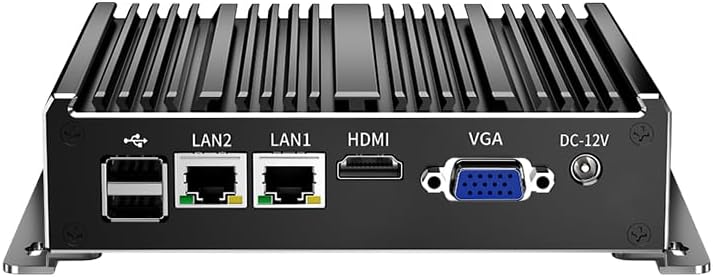
This dedicated soft-routing appliance is built around the Celeron N2840 and positions itself as a straightforward firewall or router system. It offers two Realtek RTL8111H Gigabit Ethernet ports, 4GB of DDR3L memory, and a 64GB mSATA SSD, with compatibility listed for OPNsense, Linux, Windows, ESXi, and OpenWrt. The customer rating is 4.4.
We may earn a commission when you buy through this link, at no additional cost to you.
The fanless micro-appliance format suits users who want a purpose-built network box rather than a general-purpose mini PC. USB 3.0, USB 2.0, HDMI, VGA, and audio connections support local administration and accessories, while auto power-on, wake-on-LAN, GPIO, and PXE are useful for a device deployed away from the main desk.
The most significant limitation is the very small baseline configuration. Four gigabytes of RAM and 64GB of storage can be adequate for a basic firewall, but they leave less room for packages, logs, VPN-heavy use, or multiple services than the other systems. The RAM is upgradeable through one DDR3L SO-DIMM socket, and storage can be expanded with an additional 2.5-inch SATA device alongside the mSATA drive.
This appliance is most appropriate for a simple router role in a small network where two Gigabit connections are enough. Users planning heavy VPN use, extensive logging, many firewall rules, or additional virtualized services should choose a system with more memory, faster Ethernet, and greater processing headroom.
The dedicated firewall design keeps the focus on a small, quiet network appliance. It is easier to place near networking equipment than a general-purpose mini PC with a larger assortment of desktop-oriented ports.
Although the included memory and storage are modest, the platform can accept a larger DDR3L module and a 2.5-inch SATA drive. Upgrading these components can extend its useful life as network demands increase.
We may earn a commission when you buy through this link, at no additional cost to you.
The N150 SFP+ firewall is the most specialized product in the guide, combining two 10GbE SFP+ connections with three Intel i226V 2.5GbE LAN ports. That total of five high-speed network interfaces gives it the strongest wired-networking specification here. It carries a 3.8 rating and is explicitly designed for OPNsense and other network operating systems.
We may earn a commission when you buy through this link, at no additional cost to you.
The Intel N150 processor has four cores, four threads, 6MB of cache, a maximum frequency of 3.6GHz, and a 6W TDP. AES-NI support can help accelerate compatible encryption workloads, which is relevant to VPN services. For 10GbE links, the system uses an Intel 82599ES controller with SFP+ cages, while the 2.5GbE side uses i226V chips.
This is a barebone system, with no RAM or SSD included. It accepts one DDR5 SO-DIMM and one M.2 2280 NVMe PCIe 3.0 x1 drive, so the total ownership calculation must include memory, storage, and any necessary SFP+ transceivers or cabling. The lower rating may reflect the complexity of assembling the system rather than the core platform itself.
Choose this appliance for advanced labs, high-capacity network aggregation, or environments that genuinely require fiber or other 10GbE connectivity. For ordinary home internet service, the additional interface speed may be unnecessary, but for a demanding topology the hardware is exceptionally capable.
Two SFP+ ports and three 2.5GbE interfaces provide an unusually broad set of physical options. This makes the appliance suitable for high-speed backbone connections, specialized inter-VLAN links, and laboratory network topologies.
Allowing the buyer to choose DDR5 memory and an NVMe drive can produce a better-matched system than a fixed configuration. It also means the installation is not complete until compatible components and the desired operating system are added.
We may earn a commission when you buy through this link, at no additional cost to you.
The 8GB MeLE Quieter DL offers the same core network-focused design as the 16GB model but uses 8GB of DDR4 memory and 256GB of eMMC storage. It includes dual native Intel i226V 2.5GbE controllers, a fanless 0.34-liter enclosure, and a listed 5.0 rating. Those characteristics make it an attractive compact OPNsense appliance.
We may earn a commission when you buy through this link, at no additional cost to you.
The product is explicitly compatible with pfSense, OPNsense, Proxmox VE, and OpenWrt. The Intel controllers support VLANs, link aggregation, and PXE boot, while the N150 processor provides four cores, four threads, 6MB of cache, and a maximum clock of 3.6GHz. The system also supports three simultaneous 4K displays through HDMI, DisplayPort, and full-function USB-C.
Storage expansion is handled through an empty M.2 2280 NVMe slot supporting up to 4TB and a microSD card slot. This means the included eMMC does not have to remain the primary system drive. Memory can also be upgraded to 32GB. The enclosure remains fanless, and the listed draw is approximately 6W at idle and under 12W at full load.
This is a compelling recommendation for users who want a native-Intel, quiet firewall with room to grow but do not need the larger included storage of the 16GB version. It is well suited to compact home labs, although buyers should not expect more than two physical wired interfaces.
The fanless enclosure and low listed power use make this model well suited to continuous network service. Its small footprint also simplifies placement near a router, switch, or wall-mounted network enclosure.
The empty NVMe slot allows the included 256GB eMMC to remain intact while a faster, larger drive handles the main installation. This separation can make upgrades, imaging, and recovery more convenient.
We may earn a commission when you buy through this link, at no additional cost to you.
The ASRock DeskMini X300 is the most customizable system in the guide, offering an AMD Socket AM4 platform that accepts Ryzen 5000, 4000, 3000, and 2000 series processors up to 65W. It arrives as a barebone kit and carries a 4.3 rating, making it most appropriate for experienced builders who want to assemble a tailored OPNsense system.
We may earn a commission when you buy through this link, at no additional cost to you.
Networking is handled by one Dragon RTL8125BG 2.5GbE LAN controller. A single Ethernet interface is a major limitation for the common OPNsense arrangement that separates WAN and LAN, unless a second interface is added through supported expansion hardware. The product does not specify such support, so users should confirm their complete network design before committing to this chassis.
Expansion is extensive elsewhere. Two DDR4 SO-DIMM slots support as much as 128GB of memory, two Ultra M.2 slots accept NVMe SSDs, and two 2.5-inch bays can hold hard drives or solid-state drives. RAID 0 and RAID 1 are listed as supported configurations, and the system can drive three displays through HDMI, DisplayPort, and VGA.
This platform appeals to homelab enthusiasts who want processor and storage choice, ample memory, and a compact 1.92-liter enclosure. It is less convenient for a straightforward firewall purchase because the processor, memory, drives, operating system, and possibly additional networking hardware must all be selected separately.
Supporting several generations of AM4 Ryzen processors lets the builder match performance and efficiency to a particular budget. Compatibility should be checked against ASRock's official processor list before ordering.
Two NVMe positions and two 2.5-inch bays allow a more elaborate storage layout than most competing appliances. The available RAID options can also be useful for local services where redundant local storage adds resilience.
We may earn a commission when you buy through this link, at no additional cost to you.
The right OPNsense mini PC depends on network speed, interface count, expected load, cooling preferences, expansion plans, and whether the system must also run other services. Comparing these requirements before shopping prevents an attractive specification sheet from creating an unsuitable firewall.
Gigabit Ethernet remains sufficient for many home internet connections, but 2.5GbE is valuable when moving large files, using fast NAS systems, or operating modern switching infrastructure. The BOSGAME E5 models, both MeLE Quieter DL systems, the N150 six-port firewall, and the DeskMini X300 use 2.5GbE links. The N150 SFP+ appliance goes further with 10GbE SFP+ and 2.5GbE options. Intel i226V and i226-V controllers receive particular attention in this category because current driver support can simplify firewall deployments.
A conventional OPNsense installation usually needs at least one WAN interface and one LAN interface, but practical networks often require more. Two-port systems suit basic router, VPN, and segmented-home use. Four-port designs are more flexible, while the six-port N150 appliance can connect a modem, switch, access point, VPN segment, and isolated network directly. The N150 SFP+ model offers five high-speed ports, but its SFP+ connections require compatible media.
Firewall performance depends on packet throughput, connection count, enabled inspection features, VPN encryption, logging, and additional services. The Ryzen 3 5300U and Ryzen 5 3501U models offer four cores and eight threads, while the Intel N150 and N2840 provide a lower-power baseline. The Celeron N2840 is particularly dated, with only two cores, two threads, 1MB of cache, and a 2.58GHz maximum clock. Modern N150 systems provide a more current architecture and six megabytes of cache.
OPNsense can operate with modest resources, but extra memory improves comfort when running VPN clients, intrusion tools, DNS services, dashboards, and plugins. The N2840 firewall includes only 4GB, while most other complete systems provide 8GB or 16GB. The MeLE 16GB and BOSGAME 16GB are better prepared for concurrent workloads. Storage capacity also matters because logs and packages consume space, and some users prefer to place the firewall installation on a separate drive from general storage.
Expansion can protect against future network growth. The BOSGAME E5 supports up to 64GB of memory and an additional NVMe drive. The MeLE 8GB model adds an NVMe slot and microSD support, while the N150 six-port firewall includes two M.2 positions and SATA connectivity. Barebone products such as the N150 SFP+ appliance and DeskMini X300 require memory, storage, and sometimes additional network hardware. They can be ideal for experienced builders but offer less convenience out of the box.
An always-on firewall is easier to live with when it is silent. The MeLE Quieter DL systems and several dedicated appliances use fanless designs, removing fan noise and reducing exposure to moving parts. The BOSGAME E5 and other general-purpose mini PCs use active cooling but may still be quiet under light loads. A fanless system still needs airflow around its chassis, while a powered system needs enough ventilation to prevent heat buildup. Placement near a television, bedroom, or quiet office can make the cooling design decisive.
Low power consumption matters because a firewall may remain connected continuously. The MeLE Quieter DL models list approximately 6W idle and under 12W full-load use, while the N150-based products also emphasize a 6W processor TDP. The MeLE system includes a VESA mount, making it practical to hide behind a monitor. The compact dedicated appliances are easier to place near networking equipment, while the larger DeskMini chassis offers more storage and processor flexibility.
Local display outputs are helpful during installation or troubleshooting even though a firewall is normally managed through a browser. The MeLE systems and BOSGAME E5 support three displays, while several N2840 products use HDMI and VGA for dual-screen access. Auto power-on and wake-on-LAN features are listed on several models, supporting unattended operation. PXE can assist with centralized deployment, while GPIO and serial ports on the industrial N2840 broaden its usefulness in embedded environments.
Begin by documenting the desired WAN, LAN, management, VPN, and optional guest-network connections. Install the selected OPNsense image using the method appropriate for the storage configuration, then assign interfaces carefully to avoid exposing the wrong segment directly to the internet. Connect the system through the management interface before moving the primary connection to the WAN port.
After installation, update OPNsense and its packages, change default credentials, configure time synchronization, and review firewall rules from a separate trusted device. Enable remote administration only through a secure VPN or carefully restricted access. Test upload, download, DNS, VPN, and failover behavior, and document the port mapping for future maintenance.
Keep the appliance in a ventilated, stable location with unobstructed space around its vents or passive chassis. For fanless systems, dust can still accumulate around heat spreaders and external grilles, so periodic cleaning with airflow from a dry environment is prudent. Back up the configuration, monitor storage and temperatures, and arrange a documented recovery path for both the firewall software and the hardware.
No. These are primarily mini PC and network-appliance hardware listings, and the supplied information does not establish that OPNsense is preinstalled on every unit. Buyers should treat OPNsense installation as a separate configuration step and verify the current listing, storage options, and included accessories before ordering.
A fanless design is often preferable in bedrooms, offices, and quiet workspaces because it eliminates fan noise and moving parts. It still requires adequate ventilation and careful placement. A powered system can be entirely reasonable when it runs quietly, needs more active cooling, or is installed away from people.
The amount depends on the services and connection volume. A basic installation may operate comfortably with 4GB or 8GB, while 16GB provides more flexibility for VPN, monitoring, DNS, and additional packages. Systems with upgradeable memory are easier to tailor because buyers can start modestly and expand later.
Two ports are enough for many basic setups because one can connect to the modem or upstream service and the other can connect to the main LAN switch. More ports become useful for separate guest networks, isolated IoT segments, VPN clients, a dedicated management connection, or multiple WAN services.
Not always. Gigabit Ethernet can be sufficient when the internet connection and local devices are limited to that speed. Multigigabit networking becomes valuable with fast NAS storage, local file transfers, modern switches, and high-capacity internal traffic. The 10GbE SFP+ model is primarily relevant to specialized or infrastructure-oriented networks.
Many of the more powerful and expandable models can run additional workloads, including VPN services, DNS tools, Home Assistant, lightweight virtual machines, and file-sharing functions. The Celeron N2840 systems are best kept to lighter duties because their older processors and smaller memory configurations offer less headroom.
A barebone system offers better component choice and may suit an experienced builder who wants specific memory, storage, or CPU support. The N150 SFP+ model also requires suitable networking media, while the DeskMini X300 needs a processor, memory, storage, and operating system. A complete system is generally easier to deploy.
Confirm hardware compatibility, update the firmware when practical, create the installation media, and record the intended interface assignments. Install OPNsense from a local console or temporary display, configure the management network, and only then connect the upstream service. Secure remote access and back up the configuration after setup.
The MeLE Quieter DL with 16GB stands out as the strongest all-around recommendation because it combines native Intel 2.5GbE controllers, a fanless enclosure, useful storage, and enough memory for a comfortable OPNsense installation. The six-port N150 firewall is the best choice when physical interface density is the priority, while the BOSGAME E5 16GB offers strong Ryzen performance and expandable dual-NVMe storage.
Before buying, prioritize the number of ports, Ethernet speed, memory, and thermal design in that order. Newer N150 platforms are best for quiet contemporary installations, Ryzen-based systems provide more processing headroom, and the N2840 appliances make sense for simple networks or specialized serial requirements. A barebone model only makes sense when the builder is prepared to assemble it.
Product configurations, included components, and prices can change, so check the current listing carefully before ordering. Confirm the number of Ethernet ports, memory, storage, operating-system support, and any required cables or transceivers, and ensure the final system is appropriate for the network services it will run.