
Zoom R4 Multi-Track Recorder
4.5Editor score
Four-track recording
Two combo inputs
USB audio interface
Our guide compares the best portable recorders for field recording, covering audio quality, inputs, portability, timecode, storage, and creator workflows.
Portable recorders for field recording give creators a dependable way to capture dialogue, ambience, performances, interviews, and isolated sound effects away from a studio. The best unit combines clean preamps, flexible inputs, secure file handling, intuitive controls, and enough power for long sessions. Form factor matters too, since a recorder intended for discreet documentary work should be easy to carry and operate quickly.
This guide compares ten recorders based on the features and specifications supplied for each model. It considers microphone configuration, input flexibility, recording formats, navigation, monitoring, storage support, timecode, USB workflow, and suitability for filmmakers, musicians, journalists, podcasters, and other mobile creators. The list includes both purpose-built professional field recorders and more compact devices for interviews, ambience, and content production.
Each review explains the strongest reasons to choose a particular model, along with its practical limitations. The top selections represent the most compelling options for general field work, budget-conscious recording, and advanced production, although the right choice depends heavily on the microphones, production environment, and number of isolated sources you need. Product availability and prices can change, so check current listings before making a final purchase.
4.5Editor score

4.6Editor score

4.6Editor score
The comparison below highlights the major differences among these ten portable recorders, from the two-input Zoom H1 XLR to the timecode-equipped TASCAM FR-AV2. It focuses on practical specifications that affect microphone flexibility, recording capability, portability, and production workflow.


The Zoom F3 Professional Field Recorder earns a 4.6 rating and stands out as a focused tool for capturing high-quality isolated sound in demanding locations. Its professional design centers on two locking XLR inputs, ultra-low-noise preamps, and 32-bit float recording, giving filmmakers, musicians, and location sound recordists fewer opportunities to lose a take because of an unexpected level change.
We may earn a commission when you buy through this link, at no additional cost to you.
The recorder is particularly valuable when working with separate microphones, a boom, a wired interview setup, or line-level sources. Locking connectors help maintain secure connections when the unit is mounted away from the operator, while the float recording format can preserve detail across a wide range of input levels. Flexible power options also support long days on set or on location, whether the recorder is used independently or as part of a USB workflow.
Its main limitation is specialization. The F3 is built for two-channel recording rather than the simultaneous multitrack operation offered by devices such as the Zoom H5 Studio or TASCAM DR-40XP. It also relies on attached microphones or line sources rather than offering a substantial built-in stereo capsule. Those constraints are understandable for a professional field unit but make it less convenient for someone wanting to begin recording ambience immediately.
Despite that focused design, the F3 is the strongest all-around recommendation here for serious field capture. Choose it when reliability, low noise, secure connections, and high dynamic range matter more than built-in microphones or music-oriented features. A filmmaker recording production dialogue, a sound recordist gathering isolated effects, or a musician capturing a live setup will find its feature set focused and purposeful.
The combination of 32-bit float recording and ultra-low-noise preamps reduces the need for constant gain changes. That is especially helpful outdoors, where wind, traffic, footsteps, or sudden movement can cause levels to rise and fall unexpectedly.
The dual locking XLR inputs suit mounted or unattended setups where unsecured connections would be inconvenient. Flexible standalone and USB workflows also make the recorder adaptable to different production schedules.
We may earn a commission when you buy through this link, at no additional cost to you.
The Zoom H1 Essential has a 4.1 rating and offers one of the simplest ways to begin field recording. Its integrated stereo microphones make it possible to capture voices, room tone, nature, travel ambience, rehearsals, and everyday sounds without assembling a separate microphone kit. The same compact approach suits creators who want a recorder that is ready to operate as soon as inspiration appears.
We may earn a commission when you buy through this link, at no additional cost to you.
Its USB-C connection expands the range of projects by allowing the recorder to work with a phone, tablet, or computer for recording or streaming. That makes it useful for podcasts, remote meetings, video calls, voiceovers, livestreams, and behind-the-scenes content. The supplied features also position it for songwriting, acoustic performances, lessons, and other situations where detailed stereo sound is more important than isolated XLR capture.
Compared with the Zoom H1 XLR, the Essential has fewer options for connecting professional microphones and line-level equipment. It is therefore better suited to ambient and stereo work than to a filmmaker who needs two independently controlled channels. Its 4.1 rating also trails several specialized units in this list, but ratings alone do not tell the whole story: ease of use and portability are major advantages for many buyers.
This is a compelling choice for beginners, mobile creators, podcasters who primarily need a straightforward stereo voice recorder, and anyone building a sound library. Choose it when built-in microphones, compactness, and USB connectivity matter most. It is less appropriate when a production demands several external inputs, professional connectors, or advanced time synchronization.
The built-in stereo microphones eliminate the need for an external microphone during ambience, room-tone, rehearsal, or travel sessions. That makes the recorder particularly useful for creators who want to gather sound quickly and consistently.
USB-C connectivity allows the H1 Essential to join a computer or mobile production setup. It can support a more focused workflow that combines field capture, calls, streaming, and voice recording in one compact device.
We may earn a commission when you buy through this link, at no additional cost to you.
The Zoom H1 XLR carries a 4.5 rating and combines a compact two-channel format with professional input options. Its XLR/TRS combo inputs accept microphones, instruments, and other compatible sources, giving it considerably more flexibility than a stereo-only recorder. It is a sensible middle ground for interviews, podcasts, and production audio where two isolated channels are needed without a larger multi-track device.
We may earn a commission when you buy through this link, at no additional cost to you.
The OLED waveform display gives users a direct view of signal activity, making it easier to identify clipping, check levels, and confirm that both channels are behaving as expected. The supplied specifications also highlight 32-bit / 96kHz recording for detailed capture. A 3.5mm stereo input and headphone output add further monitoring flexibility, while support for SDXC cards up to 1TB allows long, high-quality sessions.
The main constraint is channel count. It cannot record four or more tracks simultaneously like the Zoom H4 Essential, Zoom H5 Studio, Zoom R4, or TASCAM DR-40XP. It also does not include the FR-AV2's advanced timecode generation and synchronization features. For a conventional two-person interview or a compact documentary kit, however, those omissions may not affect the final result.
The H1 XLR is a strong recommendation for filmmakers, musicians, and podcasters who want professional connections in a portable body. Choose it over the H1 Essential when your work regularly depends on external microphones or instruments. It is especially attractive for two-channel work where clear level visualization and large storage support matter.
The two XLR/TRS combo connections cover common microphone and instrument requirements while retaining a compact form. This makes the recorder practical for mobile interviews, small documentaries, and acoustic music sessions.
The OLED waveform display reduces dependence on sound-level assumptions. Seeing the signal shape helps users identify unwanted peaks and verify channel balance before a take is complete.
We may earn a commission when you buy through this link, at no additional cost to you.
The TASCAM FR-AV2 earns a 4.6 rating and is the premier choice for videographers who need dependable audio and synchronization within one compact field unit. Its standout feature is built-in timecode generation, which can simplify integration with professional video equipment. Timecode input, output, generation, and synchronization functions make it a better fit for structured shoots than recorders designed mainly for isolated audio.
We may earn a commission when you buy through this link, at no additional cost to you.
Dual ADCs and 32-bit float recording support fast setup and worry-free capture, while the 2 XLR/TRS combo inputs provide the professional connections expected in location work. A 3.5mm input adds another connection option, and the high-accuracy TCXO supports precise timing. Recording formats cover 48kHz, 96kHz, and 192kHz, providing flexibility for different delivery requirements.
This is not a general-purpose multitrack recorder, and its timecode functions may be more than a solo creator needs. A beginner recording room ambience or a musician layering parts will probably find a simpler device easier to manage. The optional AK-BT2 Bluetooth adapter is also model-specific, so compatibility should be checked before planning wireless monitoring.
For filmmakers, corporate video teams, and production sound specialists who value timecode, the FR-AV2 is the most specialized and advanced recommendation in this guide. It deserves a place at the top of a professional kit because synchronization can save considerable time during post-production. Choose it when reliable multi-source recording and precise timing are central to the project.
Internal timecode generation allows the FR-AV2 to work as the timing reference in a production setup. That can reduce the number of separate devices needed when recording sound alongside video.
Dual ADCs, 32-bit float recording, and Ultra HDDA preamps support a quick setup and clean results. Multiple sample-rate options accommodate different post-production and distribution requirements.
We may earn a commission when you buy through this link, at no additional cost to you.
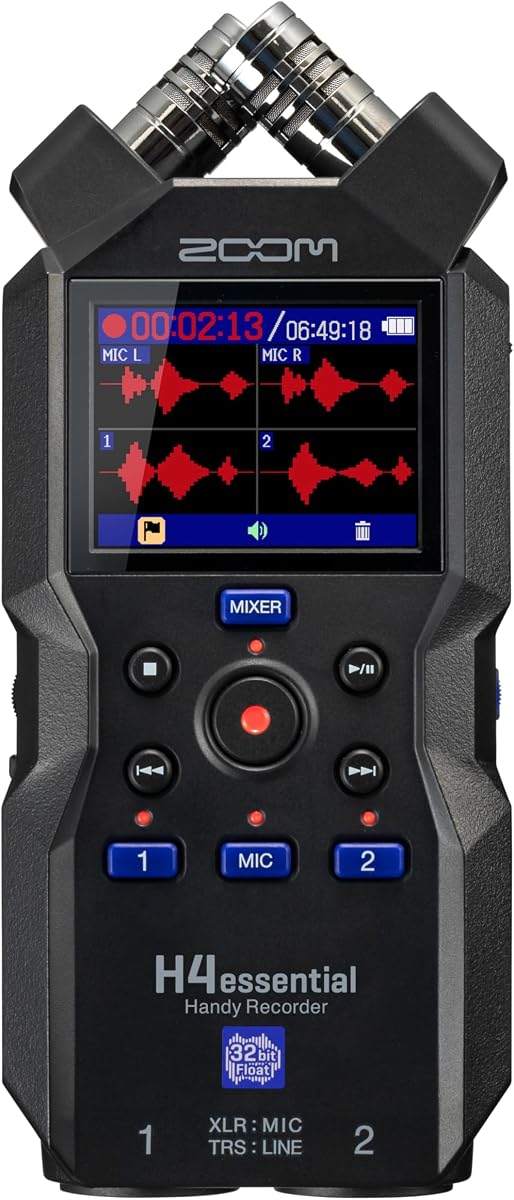
The Zoom H4 Essential has a 4.4 rating and offers a versatile combination of built-in stereo microphones, external inputs, and four-track recording. It is designed to move between music, interviews, podcasts, video audio, live performances, and field recording without requiring a different device for every task. The two XLR/TRS inputs are the foundation of that flexibility.
We may earn a commission when you buy through this link, at no additional cost to you.
A creator can begin with the built-in microphones for ambience or reference material and then connect external microphones, instruments, a mixer, or a soundboard when more controlled capture is needed. Recording to an SD card provides a direct backup, while USB-C connectivity allows recording or streaming to a phone, tablet, or computer. Spoken menu guidance also makes the interface more accessible to visually impaired users and less intimidating to newcomers.
Compared with dedicated two-channel field units, the H4 Essential is less specialized and more consumer-friendly. It does not offer the FR-AV2's professional timecode suite or the H5's larger microphone capsule and dedicated gain knobs. Some users may also find its menus less direct for pure location sound work, especially when operating without visual reference.
The H4 Essential is a versatile recommendation for creators whose projects change from one session to the next. Choose it if you want to record four tracks, retain the option to use external microphones, and keep a broad mix of music and spoken-word tools in one unit. It is less suited to advanced synchronized production but excellent for adaptable, general-purpose field recording.
Built-in stereo microphones and two external inputs let the H4 Essential cover a wide range of sources. This flexibility is valuable when a filmmaker also records musical ideas or a podcaster produces sound effects between interviews.
Spoken menu guidance helps users navigate the recorder without relying entirely on visual prompts. It is a thoughtful addition for accessibility and for people learning to operate a field recorder.
We may earn a commission when you buy through this link, at no additional cost to you.
The Zoom R4 Multi-Track Recorder has a 4.5 rating and stands out as the most budget-focused recommendation in this guide. It records up to four tracks, uses two XLR/TS combo inputs, and includes 32-bit float recording, bringing together features normally associated with more specialized units. It is especially attractive for musicians, songwriters, and creators who want to layer ideas without committing to a large production system.
We may earn a commission when you buy through this link, at no additional cost to you.
Its dedicated bounce workflow lets users mix and record finished layers to a separate bounce track, freeing channels for more material. An undo function adds a safety net when experimenting. The built-in rhythm section includes more than 80 patterns across multiple styles, while the effects and stereo built-in microphone make the device useful for writing sessions, rehearsals, and informal recordings.
The R4 also functions as a 32-bit float two-in, two-out USB audio interface for a computer or smartphone. It runs on four AA batteries or USB-C, giving creators options for mobile and stationary work. Its limitation is that it is not a location-sound specialist: it lacks professional timecode generation, locking professional connectors, and the large display and direct controls of a dedicated high-end field recorder.
Choose the R4 when you want to build a multitrack recording setup at an accessible entry point, particularly for music experimentation. It is also useful for voice layering, podcast production, and recording a musician while capturing a reference stereo mix. Field sound specialists will get more from the F3 or FR-AV2, but the R4 offers an unusually capable and approachable package.
The four-track and bounce workflow makes it possible to develop an arrangement away from a full studio. Dedicated undo support helps users experiment with parts without treating every mistake as a permanent decision.
Built-in rhythms, effects, a stereo microphone, and USB operation give the recorder value beyond basic multitrack capture. It can serve as a practice companion, interface, and standalone recorder in one package.
We may earn a commission when you buy through this link, at no additional cost to you.
The Zoom F2 Lavalier Recorder has a 4.0 rating and offers a specialized, discreet approach to field recording. It is designed for interviews, vlogs, on-camera content, and events where a visible handheld recorder could be distracting. The included LMF-2 omnidirectional lavalier microphone, windscreen, and lapel clip make the package ready for a straightforward wearable setup.
We may earn a commission when you buy through this link, at no additional cost to you.
Its 32-bit float recording captures audio at 44.1kHz or 48kHz without requiring gain adjustments, helping users concentrate on the speaker rather than continuous level control. Two AAA batteries can power the recorder for up to 15 hours, while microSD, microSDHC, and microSDXC support up to 512GB accommodates long-form recordings and extended sessions.
The absence of XLR or TRS inputs is a meaningful limitation. Users cannot add standard professional microphones or line sources, so the device is less flexible than most dedicated field recorders in this list. The REC Hold switch helps prevent accidental stops, and the internal clock has a stated accuracy of plus or minus 0.5ppm for synchronization, but it does not provide the extensive timecode capabilities of the TASCAM FR-AV2.
Choose the F2 for unattended or discreet voice capture where a lavalier is the appropriate microphone and long battery life matters. It is a strong fit for wedding speakers, documentary interviews, and mobile content creators. Users who need stereo ambience, multiple isolated sources, or interchangeable professional microphones should consider a larger recorder instead.
The wearable format is useful when the recorder must stay out of sight. Fifteen-hour battery runtime gives interviews and events a wide operational window without a frequent charging routine.
Support for microSD cards up to 512GB is useful for long sessions, while the precise internal clock improves audio and video synchronization. Neither feature replaces a full timecode workflow, but both strengthen the package.
We may earn a commission when you buy through this link, at no additional cost to you.
The EVIDA 9296 Digital Voice Recorder has a 4.3 rating and focuses on practical speech capture for lectures, meetings, interviews, speeches, and personal notes. It includes 128GB of storage and an upgraded noise-cancelling microphone, making it a convenient option for anyone who needs long-duration recording without managing removable media.
We may earn a commission when you buy through this link, at no additional cost to you.
Voice activation can be adjusted across six decibel levels so the recorder responds to speech while reducing long blank sections and whispering fragments. Recording can be set to MP3 at 128kbps or 192kbps, or WAV at 1536kbps, and files can be organized into four folders. Playback, bookmarking, A-B repeat, automatic recording, and password protection add useful controls for practical use.
This recorder is not designed to compete with professional field units for stereo ambience, external microphone flexibility, low-noise performance, or timecode. The lack of XLR and TRS connections rules out most standard production microphone workflows. The 4.3 rating should therefore be considered in the context of an accessible, dedicated voice-recording device rather than a cinematic location recorder.
Choose the EVIDA 9296 for lectures, classroom notes, meetings, long conversations, and users who value generous built-in storage and voice-triggered operation. It is a good fit for students, teachers, business users, writers, and bloggers. For environmental recordings, music, or production sound, move up to a model with external inputs and professional recording controls.
The 128GB internal capacity and adjustable voice activation make long recording sessions easier to manage. A user can capture speech over an extended period without frequently replacing storage or stopping to sort files.
Four-folder organization separates recordings into manageable groups, while password protection adds a basic layer of privacy. Playback, bookmarks, and A-B repeat make the device convenient for reviewing spoken material.
We may earn a commission when you buy through this link, at no additional cost to you.
The Zoom H5 Studio Handy Recorder has a 4.5 rating and centers on a substantial 19.4mm X/Y microphone capsule. The built-in pair is larger than those found on many handheld recorders and is intended to provide rich, detailed stereo audio with a wide dynamic range. It gives filmmakers and musicians a strong starting point without requiring external microphones for every project.
We may earn a commission when you buy through this link, at no additional cost to you.
32-bit float recording reduces the risk of clipped or unusable takes, while dedicated gain knobs allow quick, precise adjustments. The H5 can record up to four tracks simultaneously at resolutions up to 192kHz in WAV format, giving it more flexibility than a basic stereo-only model. Lightweight construction and battery operation support mobile work in the field, on location, or while traveling.
Its connection options are less extensive than those of the Zoom F3, FR-AV2, and DR-40XP. It also does not include professional timecode generation, and the built-in capsule cannot be swapped for a specialized stereo or shotgun microphone arrangement. For film professionals accustomed to timecode and multiple XLR inputs, those omissions can be significant.
Choose the H5 Studio when you want excellent built-in stereo capture, direct physical controls, and multitrack flexibility in a portable handheld body. It is particularly suitable for documentary makers, location recordists, musicians, and podcasters who need one unit to handle ambience, dialogue reference, and live recording. For synchronized professional video workflows, the FR-AV2 is the more specialized alternative.
The 19.4mm X/Y capsule is designed to capture rich stereo detail with a wide dynamic range. It makes the recorder more immediately useful for environmental recording, rehearsals, and location reference audio.
Dedicated gain knobs let users react to changing levels without navigating menus. The format supports up to four tracks, providing room for more involved creative sessions while remaining easy to carry.
We may earn a commission when you buy through this link, at no additional cost to you.
The TASCAM DR-40XP has a 4.1 rating and distinguishes itself through adjustable built-in microphones combined with four-channel recording. Its stereo condenser microphones can be configured in A-B or X-Y arrangements, letting users adjust the relationship between the capsules for different recording styles. That versatility is useful for interviews, video, music, and general location work.
We may earn a commission when you buy through this link, at no additional cost to you.
The built-in microphones handle up to 125dB SPL, while two XLR/TRS inputs allow external microphones and other sources to be added. Four-channel capture makes it possible to combine the internal stereo microphones with external inputs during the same session. Ultra-low-noise HDDA preamps support clean results, and 32-bit float recording reduces clipping concerns across changing source levels.
The DR-40XP can record 32-bit float, 24-bit, and 16-bit WAV files at 96kHz, 48kHz, or 44.1kHz. Its two-in, two-out USB-C interface permits direct computer or compatible mobile recording. A notable limitation is that microSD cards and batteries are not included, so those accessories must be added separately. It also lacks the FR-AV2's sophisticated timecode features.
Choose the DR-40XP for creators who want control over stereo capsule geometry and the option to add external sources. It is a versatile option for documentary interviews, location music, and video production where a four-channel handheld workflow is useful. Users who need synchronized professional timecode should prioritize the FR-AV2, while those focused primarily on multitrack music may prefer the Zoom R4.
A-B and X-Y configurations give the built-in microphones different recording characteristics. That flexibility helps users adapt the stereo image to interviews, ensembles, environmental sound, or other location conditions.
Four-channel recording allows the internal stereo pair and external inputs to be captured simultaneously. The USB-C interface also supports a direct digital workflow when a computer-based production setup is more convenient.
We may earn a commission when you buy through this link, at no additional cost to you.
A useful field recorder should match the source, environment, and post-production demands of the project. The most important considerations are microphone access, recording format, monitoring, storage, power, portability, and synchronization.
Begin by asking how many sources need to be captured at once. The Zoom H1 Essential, H5 Studio, F2 Lavalier, and DR-40XP include useful built-in microphones, while the H1 XLR, F3, and FR-AV2 prioritize professional external connections. A stereo-only recorder is convenient for ambience and room tone, but interviews and production dialogue often benefit from XLR inputs. Multi-channel units are useful when built-in stereo and isolated sources must coexist in one take.
Most modern options in this guide support 32-bit float recording, which can reduce the chance of a clipped take when levels change unexpectedly. The Zoom F3 and TASCAM FR-AV2 emphasize this capability for professional work, while the DR-40XP also supports 24-bit and 16-bit WAV formats at several sample rates. High-resolution options such as 96kHz and 192kHz may be useful for certain projects, but they also create larger files and require adequate storage.
Good monitoring helps a recorder operator evaluate a take before it ends. The Zoom H1 XLR uses an OLED waveform display for a direct view of levels, while the H5 Studio provides dedicated gain knobs for quick physical adjustment. Headphone outputs are important for monitoring microphones without creating acoustic feedback. For solo field work, visible meters, a headphone jack, and uncomplicated gain controls are more valuable than menus devoted to music production.
Field sessions can produce substantial data, especially in WAV format. The H1 XLR supports SDXC cards up to 1TB, while the F2 supports microSD media up to 512GB. The EVIDA 9296 takes a different approach with 128GB of built-in storage, reducing the need to manage removable cards. Whatever the capacity, confirm that the required card type is supported, use reliable media, and maintain a backup workflow before a critical shoot.
Battery support can determine whether a recorder survives a full day on location. The F2 runs for up to 15 hours on two AAA batteries, and the Zoom R4 can operate on four AA batteries or USB-C. Several professional units also offer flexible power options, including USB workflows. Battery claims should be treated as maximum-use guidance, because screen brightness, sample rate, storage type, and monitoring can affect actual runtime.
The best recorder is one that can be carried and operated without becoming a burden. The H1 Essential, F2, and FR-AV2 are particularly compact, while the F3, H5 Studio, and DR-40XP provide larger controls for demanding work. Consider whether the device will be handheld, mounted, placed in a bag, or worn on a speaker. Outdoor use also makes protection from rain, dust, impact, and cable movement important, even when the product description does not state a formal weather rating.
When field audio must align precisely with video, synchronization deserves careful attention. The TASCAM FR-AV2 is the clear specialist here, with internal timecode generation, timecode input and output, a synchronization function, and a high-accuracy TCXO. The F2 includes a precise internal clock, which is useful for basic synchronization. Recorders without advanced timing features may still work in simpler projects, but post-production alignment can become more difficult when multiple devices are involved.
USB connectivity can turn a recorder into a digital audio interface or a companion for a computer or mobile device. The H1 Essential, H4 Essential, R4, and DR-40XP all support USB-oriented workflows. The F3 offers standalone and USB options for professional use, while the FR-AV2 uses USB as part of a broader production setup. Consider whether direct computer capture, streaming, calls, or post-production transfer is central to your work, and verify compatibility with the intended device and software.
Before recording, format a compatible memory card, confirm the battery or power plan, and test the microphone arrangement in the actual acoustic environment. Listen through headphones, check the timecode or clock if synchronization matters, and begin with an appropriate gain setting. Record a short test, review the waveform and playback, and adjust the microphone placement before committing to a lengthy take.
During a session, monitor levels and storage capacity without making the recorder the center of the production. Protect the device with a case, keep it away from moisture and direct impact, and use a short cable or strain relief around connected microphones. Lock professional connectors where available, and avoid repeatedly opening files on a computer while the card is still being written to.
After recording, save files in a structured folder system and copy them to more than one storage location before formatting the card. Clean the microphone grille gently, keep openings free of debris, and inspect connectors for dirt or damage. Store batteries separately when appropriate, recharge devices before a new trip, and update or verify the recorder's settings before every project.
The best choice depends on the type of sound being recorded. The Zoom F3 is a strong all-around professional option for isolated sources, while the FR-AV2 is better when timecode is essential. The H1 Essential and H5 Studio suit creators who want to begin capturing stereo sound with built-in microphones.
It is particularly useful in unpredictable environments because it can reduce the risk of clipping when a voice or sound source suddenly becomes louder. It is not a substitute for good microphone technique, correct gain discipline, or adequate storage. Even with float recording, careful monitoring remains essential.
XLR inputs are valuable when using standard professional microphones, long cable runs, or equipment that provides a balanced connection. A small recorder with a built-in or lavalier microphone can work for simpler interviews. The right decision depends on the microphone already owned, the expected environment, and the need for isolated channels.
The TASCAM FR-AV2 is the most feature-focused choice because it includes timecode generation, timecode input and output, and synchronization functions. The Zoom F2 also offers a precise internal clock for simpler workflows. Professional multi-camera projects may need a complete timecode solution beyond what a compact recorder provides.
The required capacity depends on sample rate, bit depth, channel count, and session length. Higher-resolution multichannel WAV files can consume space quickly, so check the recorder's supported media and estimate usage before a long shoot. Keep backup copies and never format the only card containing an important session.
Several models in this list support USB audio-interface functions, including the H1 Essential, H4 Essential, Zoom R4, DR-40XP, and professional workflows offered by the F3 and FR-AV2. Compatibility with a particular computer, phone, or operating system should be verified before purchase because connector roles can differ by model.
Built-in rhythms are most useful for musicians who want to develop ideas away from a drummer or accompaniment. They add little to conventional location recording, interviews, or documentary sound capture. In those cases, input flexibility, monitoring, timecode, and a comfortable field form factor should receive more attention.
A practical kit includes suitable headphones, spare batteries or a dependable power solution, the correct memory card, a protective case, cables, and a way to back up files. A windscreen may also be useful outdoors, although the correct tool depends on the microphone and environment. Test the complete setup before leaving rather than relying on an untested combination of equipment.
The Zoom F3 is the leading general recommendation for professional field capture because its 32-bit float recording, ultra-low-noise preamps, and locking XLR inputs prioritize dependable isolated sound. The Zoom R4 is the budget-minded pick for musicians and layering workflows, while the TASCAM FR-AV2 is the premium selection for productions that require advanced timecode.
For simpler needs, compare the built-in microphone approach of the H1 Essential, H5 Studio, and DR-40XP. The F2 suits discreet wearable voice recording, the H1 XLR provides professional two-channel connectivity, and the H4 Essential bridges built-in and external sources. Prioritize the inputs, synchronization, monitoring, and power features required by the actual project rather than choosing on channel count alone.
Before purchasing, verify current specifications, accessory requirements, storage compatibility, and product availability. Prices and configurations can change over time, so the current listing should be treated as the final source for purchasing details. With the right format, microphone plan, and backup procedure, a portable recorder can become a dependable partner for professional field production.