
Airshi ABSStainless Steel RC Fish Lure Boat
4.0Editor score
500-meter remote control range
5200mAh center-mounted battery
Waterproof ABS and steel construction
LED night-fishing lighting
Our Rc Fishing Bait Boat guide compares ten models for bait capacity, range, navigation, battery life, control, and water resistance.
An RC fishing bait boat can place bait, hooks, and rigs with greater consistency than repeated casting, particularly when the target water lies beyond easy casting distance. The most useful models combine controlled steering, dependable remote range, a suitably sized bait hopper, stable navigation, and enough battery life to complete a round trip without anxiety.
This guide compares ten bait boats using the stated specifications for payload, control range, steering, battery equipment, navigation features, bait delivery, lighting, and environmental resistance. It covers freshwater, saltwater, beach-fishing, carp-fishing, and general-purpose applications, while highlighting the different compromises involved in manual, cruise-assisted, and GPS-guided operation.
Each review identifies the features that distinguish one boat from another and clarifies who is most likely to benefit from its design. Ratings reflect the available marketplace feedback, while technical claims are limited to the supplied product information. Availability, configurations, and selling terms can change, so readers should confirm the latest listing details before purchasing.
4.0Editor score

3.9Editor score

The comparison below places all ten boats side by side, emphasizing the factors that most affect bait placement: control range, load capacity, navigation assistance, power management, bait handling, and visibility in low-light conditions.


This general-purpose RC bait boat carries a rating of 3.8 and stands out for its unusual three-tray layout. Rather than relying on one large hopper, it places a tray on each side and another at the rear. Each compartment can be controlled separately, allowing an angler to stage different bait mixtures, hooks, or rig types during a delivery run.
We may earn a commission when you buy through this link, at no additional cost to you.
The stated control range reaches 500 meters, and a fixed-speed auto-cruise function can maintain a selected direction without constant manual steering. A waterproof ring, enclosed cabin, and gyroscope-based yaw correction are intended to support stable travel. The listed 2.7.4V 5200 battery includes a visible power-balance indicator, helping the operator judge remaining capacity.
There is some ambiguity in the supplied specifications. The product title mentions an 7800mAh battery, while the detailed description identifies a 5200 battery, and the claimed load is expressed in different ways across the listing. Those inconsistencies make careful comparison of the final package important. The three independent trays remain a meaningful advantage if buyers want more control than a conventional single-hopper boat provides.
This boat is best suited to anglers who regularly use several bait types or want to deliver hooks and bait to separate points. It is less compelling for buyers who need confirmed GPS waypoint navigation, though the automatic cruise behavior could be sufficient for shorter, carefully monitored routes. Overall, its flexible tray system and low-speed stability make it a practical multi-bait option.
Three separately controlled trays can reduce the need to return the boat to the bank between bait types. They also allow staged drops, although operators should confirm the actual loading limit and release mechanism before planning a demanding payload.
Automatic cruise and yaw correction reduce the effort involved in long straight runs. These features cannot fully prevent wind drift or current, so accurate bait placement still depends on observing the boat and adjusting its course.
We may earn a commission when you buy through this link, at no additional cost to you.
The Jabo Dolphin is designed around automated navigation for beach and surf fishing, and its 2.9 rating is the lowest among the listed products. Its standout feature is the ability to set a direction and distance, then initiate automatic navigation and bait release. The remote supports preset distances from 20 to 300 meters in 20-meter intervals.
We may earn a commission when you buy through this link, at no additional cost to you.
GPS functionality extends to automatic return and storage of 16 target bait points. Once a productive area has been recorded, the boat can revisit it on a later trip to the same water location. A rechargeable remote with an integrated antenna removes the inconvenience of frequently changing remote batteries or dealing with a separate antenna.
The product uses stainless components, a stainless line-release pin and screws, and a waterproof hull intended for both fresh and salt water. Its release system automatically resets after the bait pin is deployed, helping the boat continue its route smoothly. Those qualities make it especially relevant to anglers who want repeatable deliveries rather than only manual remote steering.
Buyers should approach the low customer rating as a meaningful caution and review current owner feedback carefully. The supplied information does not state hopper capacity, battery capacity, or ordinary control range, which makes direct comparison with higher-capacity models difficult. Still, for GPS-supported beach work and saved bait locations, the Dolphin offers a clear functional advantage.
Storing 16 bait points is valuable on familiar lakes or productive surf breaks. It allows an angler to reproduce a successful route, although water conditions and bait presentation may still require minor course adjustments.
The waterproof hull and stainless release hardware target corrosive marine environments. Routine freshwater washing remains sensible after coastal use, particularly around the release pin and any electrical connection points.
We may earn a commission when you buy through this link, at no additional cost to you.
With a 3.9 rating, this RC fishing boat offers one of the strongest balances of payload, range, and practical control features in the group. Its large bait hopper holds up to 4.4 pounds, and the stated delivery distance reaches 328 yards, making it a credible option for placing feed and rigs across lakes, reservoirs, and other freshwater locations.
We may earn a commission when you buy through this link, at no additional cost to you.
A dual-motor propulsion arrangement is designed to provide smooth travel and more stable movement during turns and longer crossings. Protective propeller covers help reduce interference from floating debris, a meaningful advantage where vegetation, leaves, and loose tackle are present. Two rechargeable batteries extend the available operating time, while a low-battery warning gives the operator time to return safely.
The body is described as lightweight ABS engineering material with waterproof electronic protection. This balance helps make the boat easier to transport than a larger, more complex platform. The trade-off is that a single large hopper offers less independent control than the three- and four-compartment alternatives. It also does not include the GPS waypoint tools found on higher-end models.
This is the most versatile general-purpose recommendation for anglers who prioritize usable hopper capacity, a long reach, and understandable controls. It suits carp, catfish, and freshwater fishing without requiring a steep learning curve. For anglers needing multiple staged bait drops or saved routes, one of the GPS-equipped models may be a better fit.
The 4.4-pound hopper is substantial enough to support serious bait deliveries while remaining compatible with a relatively manageable transport format. Actual usable capacity may vary with bait density, so lighter loose bait fills less weight than compact prepared bait.
Two rechargeable batteries and a low-power alert reduce the chance of an unplanned water landing. The warning is most useful when combined with a conservative return plan rather than waiting until the boat is close to shore.
We may earn a commission when you buy through this link, at no additional cost to you.
This carp-focused bait boat has a 3.8 rating and emphasizes dependable movement, simple operation, and bait delivery. Its 3.3-pound hopper can carry a meaningful payload, while a rear hook-release system allows bait and fishing rigs to be delivered precisely at a chosen location.
We may earn a commission when you buy through this link, at no additional cost to you.
Dual motors are designed to operate quietly and maintain stable navigation. An automatic course-correction system helps the boat remain on a straight heading in wind, light waves, or under a full load. One-touch cruise control then holds a constant speed, reducing manual effort when crossing longer distances.
The streamlined waterproof hull is paired with LED navigation lights for early morning, evening, and night use. Those lights make the boat easier to locate and identify on the water, while the quiet propulsion helps avoid unnecessary disturbance. As with the other non-GPS models, the operator must still judge current, drift, and exact bait placement.
The boat is a sensible choice for carp, catfish, and freshwater anglers who value a rear release, quiet running, and uncomplicated cruise control. It lacks the stored-location precision of the Jabo, V070, and ZV9. In return, it presents a more focused feature set that may be easier to master on a first long-distance delivery.
Automatic course correction becomes especially useful when the hopper contains enough weight to affect balance. A full load can make manual correction more demanding, so this system adds useful consistency during long crossings.
LED navigation lights improve the chance of spotting the boat early during dawn, dusk, or night sessions. They should be treated as visibility aids rather than a guarantee that the boat can be seen through fog, glare, or heavy vegetation.
We may earn a commission when you buy through this link, at no additional cost to you.
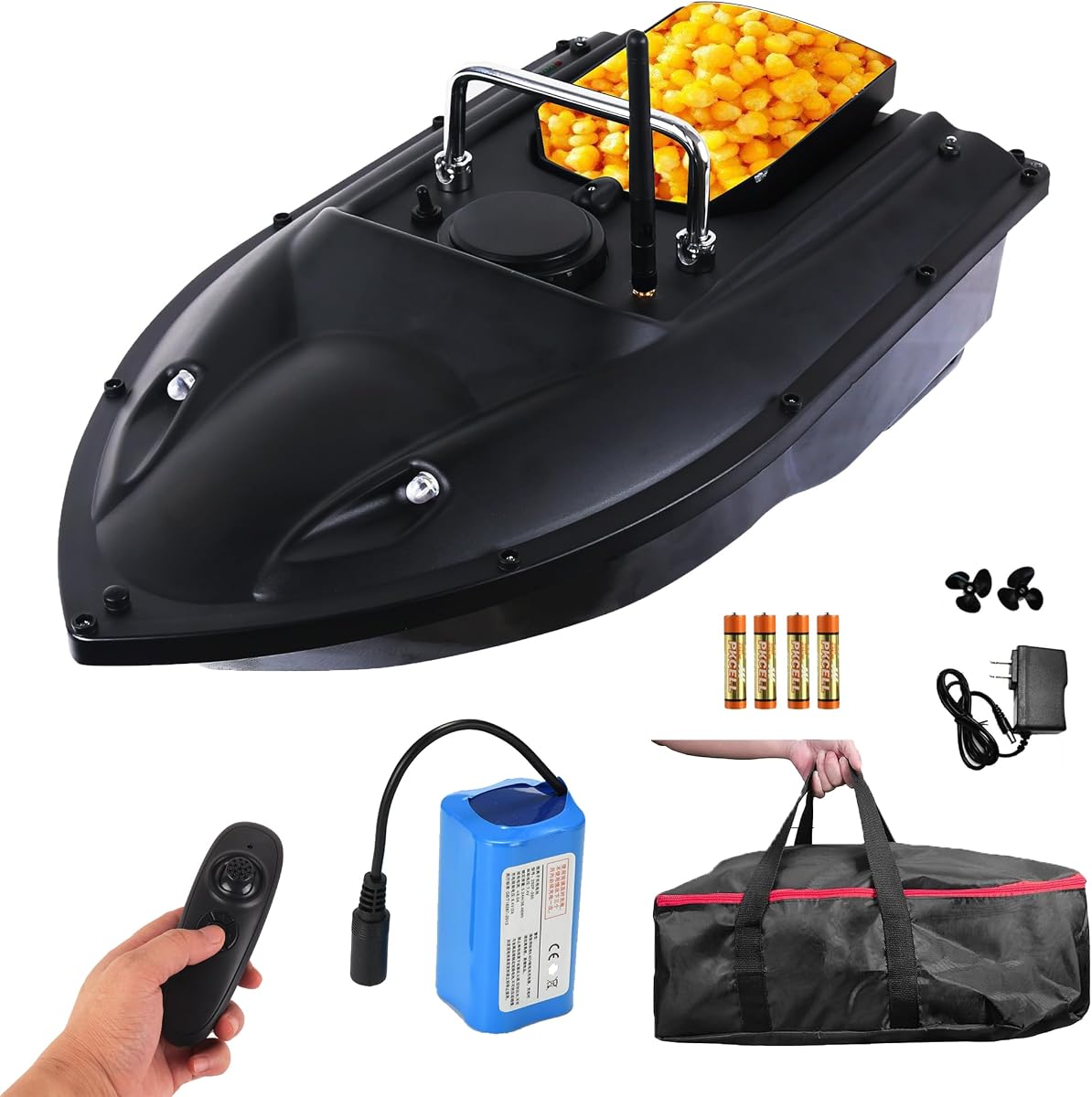
The Airshi boat earns the highest recorded rating in this roundup at 4.0, while offering a relatively focused set of features for general fishing. Its ABS and stainless steel construction is intended to withstand wind, waves, and the minor impacts that occur during launching and recovery at the shoreline.
We may earn a commission when you buy through this link, at no additional cost to you.
The advertised remote-control range reaches 500 meters, and the description emphasizes stable signal transmission with reduced interference between multiple control systems. A 5200mAh 18650 battery is positioned in the middle of the hull for stability, with stated standby time of up to two to three hours. A large bait tank accepts up to 1.5 kilograms.
A twin-screw arrangement provides steering response and stability, while LED lighting offers steady and flashing modes for locating the fishing area after dark. The trade-off is that this boat does not describe GPS waypoints, automatic return, or independent multi-hopper control. Its one large tank also limits staged bait deployment compared with the more compartmentalized alternatives.
For a buyer seeking an approachable, well-reviewed boat without advanced digital navigation, this model offers the strongest overall balance. It is suitable for lakes, pools, and coastal fishing when a moderate bait load and dependable remote handling are the priorities. More demanding route repetition would favor a GPS-capable model.
ABS helps keep the hull manageable, while stainless steel adds strength and corrosion resistance to appropriate structural components. A careful buyer should still rinse the boat with fresh water after salt-water exposure and dry it before storage.
The twin-screw layout is intended to deliver quick steering and good stability. It is particularly helpful when placing bait near banks, structure, or weed edges where small course corrections matter.
We may earn a commission when you buy through this link, at no additional cost to you.
This package is built around four independently controlled bait compartments, a 6.6-pound combined payload, and a stern-mounted fish finder. That combination targets anglers who want to survey underwater structure before delivering bait, rather than simply carrying a hopper to a predetermined spot.
We may earn a commission when you buy through this link, at no additional cost to you.
The 18,000mAh battery is stated to support as much as six hours of continuous use, reducing the need for frequent charging during a full day. Dual motors, a 500-meter range, a precision gyroscope, and a sealed hull support propulsion and navigation. The stern system accepts the included fish finder and can also accommodate a bait trap, according to the supplied description.
Four independent compartments offer a high level of delivery flexibility. Different bait types can remain separated, or multiple drops can be made along one route. This makes the package well suited to varied fishing strategies, although no marketplace rating is available and the exact contents should be confirmed with the seller.
The fish-finder integration is the defining feature. It gives the boat a scouting role as well as a bait-delivery role and may be especially attractive to anglers targeting deeper water, changing structure, or unfamiliar lakes. Buyers seeking a simpler, lighter boat or a confirmed long-term customer rating may prefer a less elaborate model.
A stern-mounted fish finder can help identify underwater contours and fish activity before the operator commits to a delivery point. Its usefulness depends on local conditions, transducer placement, and the angler's ability to interpret the display.
Independent compartments can hold different bait mixes and support precise staged releases. The 6.6-pound maximum should be treated as a combined limit rather than a per-compartment rating.
We may earn a commission when you buy through this link, at no additional cost to you.
This model holds the highest confirmed customer rating in the group at 4.4. Its central selling points are a stated 2.5-kilogram load, 500-meter control range, quiet travel, and a large bait bin that is positioned for carp-fishing applications.
We may earn a commission when you buy through this link, at no additional cost to you.
A 5200 high-capacity battery provides the stated power supply, and an onboard indicator shows the balance of the power left. The controller supports a fixed-speed auto-cruise function, while a built-in gyroscope corrects yaw to help the boat track a straighter course. A waterproof ring and fully enclosed cabin are intended to improve wave resistance.
The single-bin design simplifies loading and can accommodate a larger total load than many smaller hoppers. It does not offer the staged delivery control of a four-compartment boat, however, and it lacks GPS waypoints, automatic return, and real-time distance feedback. The design is therefore best for straightforward delivery to one or a few chosen locations.
This is a compelling pick for carp anglers who want a strong customer-rating history, useful load capacity, and relatively simple controls. The 500-meter range gives ample reach on many lakes, while auto-cruise reduces steering effort. For repeated routes or multiple bait types, a more electronically advanced boat would be a better match.
The large bin makes it easy to prepare a substantial bait delivery before launching. Because it is a single compartment, anglers needing separate bait types or multiple release points should consider a divided-hopper design.
Quiet movement reduces the chance of disturbing nearby fish during the approach. Gyroscopic yaw correction complements the fixed-speed cruise, although crosswinds and current can still shift the intended landing point.
We may earn a commission when you buy through this link, at no additional cost to you.
The ZV9 is the most digitally capable model in this guide, with GPS positioning, 100 saved points, one-key return, automatic cruise, and automatic return functions for low battery or signal loss. These features make it well suited to anglers who repeatedly work a lake and want the boat to return to established bait locations.
We may earn a commission when you buy through this link, at no additional cost to you.
Its 25,000mAh battery is intended to extend operating time, while dual motors and twin propellers provide the thrust for a stated load of approximately 2 kilograms. The remote offers real-time distance feedback and a 500-meter range. Four independently controlled hoppers allow different bait types to be released separately or in combination.
Visibility is another strength. A bright white headlamp and adjustable two-side lights with seven colors make the boat easier to identify at night. Automatic return is particularly valuable in difficult conditions, but it should not be treated as a substitute for a sound maintenance routine, clear radio path, and sensible emergency plan.
This is the premium choice for tech-oriented anglers who value stored routes, safety automation, and independent bait control. There is no customer rating to provide historical context, and first-time users may need time to understand GPS, return, and signal-loss behavior. Even so, it offers the broadest navigation-focused feature set among the ten products.
GPS positioning allows up to 100 points to be stored, making it practical to reproduce productive routes. Repeatability works best when the same shoreline, current pattern, and seasonal conditions are present.
Low-battery and signal-loss returns can reduce the risk of leaving the boat behind. Operators should still test these functions in a safe area and understand how the boat behaves when a stored home point is unavailable.
We may earn a commission when you buy through this link, at no additional cost to you.
The V070 combines a 12,000mAh battery, 500-meter control range, and GPS navigation in a relatively compact two-hopper format. It can save up to 40 baiting points, move directly to a selected point, and return home with one button, offering the core advantages of route-based bait delivery without the four-compartment complexity of the ZV9 and V803.
We may earn a commission when you buy through this link, at no additional cost to you.
Two independent hoppers hold up to 1.5 kilograms and can release bait separately or simultaneously. They also support hook and line delivery, which makes the boat useful when the terminal tackle needs to arrive at a precise location rather than merely a loose pile of feed.
The remote's LCD screen shows real-time battery levels, while low-power and signal-loss warnings help maintain awareness. A one-key home return and automatic return after power or signal problems improve safety. Constant-speed cruise supports straighter movement between stored points, and LED headlights and tail lights make the boat easier to locate in low light.
This model is a strong choice for anglers who want GPS waypoints and dual-hopper flexibility but do not need the ZV9's 100 points or four independently controlled compartments. No customer rating is available, so prospective buyers should examine current user feedback and confirm the package contents and operating procedures.
Forty points are enough to map a bank, cove, or series of productive areas. Saving locations can save time on repeated sessions, though anglers should recheck the actual conditions because fish and underwater structure change.
Independent hoppers allow staged bait drops or separate treatment of two target points. They also support hook delivery, which broadens the boat's usefulness beyond bulk feed placement.
We may earn a commission when you buy through this link, at no additional cost to you.
The V803 prioritizes segmented bait delivery and robust remote communication. Four independently controlled hoppers allow different bait types to be released at separate points, making the boat suitable for flexible feeding strategies and precise staged presentations.
We may earn a commission when you buy through this link, at no additional cost to you.
Dual high-gain antennas support the stated 500-meter control distance and are designed to improve signal stability and resistance to interference. Forward, backward, left, and right controls provide standard maneuvering, while a high-precision gyroscope corrects yaw for smoother travel in choppy water.
A dual power interface accepts two batteries for extended runtime, and low-battery alerts provide advance notice during long sessions. The front navigation light and rear directional indicators support day-and-night operation. The boat also supports fish-finder compatibility, although the supplied information states that sonar is sold separately.
This model is best for anglers who want more bait compartments than a dual-hopper design but do not necessarily need a large GPS waypoint library. Its four compartments and antenna system are compelling, but no customer rating is available. Buyers should therefore give extra attention to independent reviews, warranty information, and the practical difference between the stated maximum control range and reliable real-world operation.
Four independent hoppers can separate bait types and create multiple release points along one route. This control is more useful than a large undivided bin when different baits need to remain unmixed.
Dual high-gain antennas are intended to maintain a dependable connection over large lakes and reservoirs. Terrain, vegetation, humidity, and interference can affect actual range, so operators should retain visual awareness of the boat.
We may earn a commission when you buy through this link, at no additional cost to you.
The right bait boat depends on the distance, precision, payload, and route complexity of your fishing. Compare the operating features below against your usual water, available storage, and need for navigation assistance rather than focusing on any single specification.
Bait capacity determines whether a boat can carry the amount of feed or the number of rigs required for a single delivery. Pay attention to whether the stated limit applies to one hopper or the complete boat, because several models use separate compartments while others advertise one large bin. Loose particles, pellets, groundbait, hooks, and rigs also occupy different amounts of space for the same stated weight, so the practical volume of the hopper is as important as the maximum load.
Choose a divided hopper when you use multiple bait types or want to stage separate drops. A single large bin is simpler to load and can be useful for delivering a uniform feed mix. Match the layout to your fishing strategy rather than selecting the largest number printed on the packaging.
A stated range of 500 meters appears frequently in this category, but the advertised maximum does not guarantee an equally strong connection in every environment. A clear line of sight, suitable antenna placement, and freedom from heavy interference help maintain control, while obstacles around the launch area can make the usable range shorter. Dual antennas may improve confidence on large open water, but they do not remove the need to keep the boat within sight.
Treat maximum range as one factor among several. If you fish a small lake, range may be less important than payload and simplicity; if you routinely cross a broad reservoir, robust radio control and directional feedback become much more valuable.
Basic boats rely on manual steering and fixed-speed cruise, which works well when the operator can watch the boat and compensate for wind or current. GPS-enabled models add stored bait points, direct navigation, and one-key return, making them better suited to repeated routes and unfamiliar groups of anglers. Automatic return following a low-battery or signal-loss event adds another layer of protection, but these functions still require setup and occasional verification.
Select GPS when route accuracy and repeatability are central to your method. A conventional cruise-controlled model may be sufficient when you deliver bait to one nearby target, and it often involves fewer electronic systems to learn and maintain.
Dual motors are intended to improve thrust, straight-line travel, and response when the boat is carrying a load. Automatic course correction or gyroscopic yaw control helps compensate for uneven acceleration, light wind, and small waves. These systems cannot eliminate drift caused by current, but they can reduce the amount of manual correction required during a crossing.
Look for a combination of adequate thrust, balanced propulsion, and course correction rather than judging power only by advertised speed. A full hopper changes handling characteristics, so stability under load is especially important for accurate bait placement.
Battery specifications indicate the scale of the power system, but runtime also depends on travel speed, payload, current, signal strength, and the age of the cells. A larger battery can support long sessions and repeated routes, while two-battery systems may offer flexibility and extended operation. Low-battery warnings and visible power indicators are valuable because they provide time to return before a forced recovery becomes necessary.
Choose a capacity that comfortably exceeds your normal outing, with a margin for detours and slower travel. Familiarize yourself with the warning system before a long trip and avoid leaving a boat at its limit when a safer return buffer is still possible.
A sealed or waterproof hull, corrosion-resistant release hardware, and protected electronics are especially important for salt-water use. Stainless components are beneficial in marine environments, while ABS construction can keep the boat easier to transport. The release system deserves particular attention because it determines whether bait or a hook arrives cleanly and whether the boat can continue without manual resetting.
Match the construction to the environment, but inspect seals and fittings before every launch. Rinse a marine-use boat with fresh water after the session, remove excess moisture, and store the battery and electronics according to the manufacturer's instructions.
LED headlights, tail lights, flashing modes, and directional indicators make the boat easier to locate in darkness, fog, or glare. They also help the operator judge orientation, which is useful when the hull is difficult to distinguish against the water. Lighting does not improve radio range or remove the need for situational awareness, but it can make recovery and route monitoring much safer.
Frequent dawn, dusk, and night anglers should regard visible lighting as an important feature. Day-only users can prioritize bait capacity, navigation, and battery system instead of paying attention to a broader lighting package.
A feature-rich boat is not automatically the most convenient choice. Consider the packed size, carrying weight, removable parts, and whether a single person can launch it safely from the bank or trailer. ABS construction can reduce weight, while stainless hardware and a streamlined hull may improve long-term resilience. Warranty terms, replacement-part availability, and seller support also matter because RC boats contain batteries, motors, radio systems, and release mechanisms that may need attention.
Choose a design you can carry and maintain consistently. A simpler model that is easy to transport and already suits your fishing pattern may deliver more value than a more advanced platform that creates storage or learning difficulties.
Before the first launch, read the included instructions, identify the battery connectors, inspect the hull and release mechanism, and test the remote at a short distance. Charge the battery according to the supplied guidance, confirm that the control direction matches the boat's movement, and set a conservative range limit if the controller supports one. For a GPS model, establish the home point in an open area and test each automatic-return function before relying on it during a fishing session.
Load the bait only after the boat is stable and the release area is clear. Distribute loose material evenly when using a divided hopper, and do not exceed the stated combined load. Select a route that avoids swimmers, swimmers' toys, low bridges, submerged cables, heavy weed, and other hazards. Use cruise control for long straight sections, but continue watching the heading because wind and current can still alter the path. Release the bait once the boat reaches the intended position and is stable rather than relying exclusively on an automatic setting.
After use, switch off the boat and remote, disconnect the battery as directed, and remove loose bait from the hopper. Rinse the hull and release pin with fresh water after use in salt water, paying particular attention to sand, salt, and corrosion. Dry the boat fully, check the propeller and release pin for damage, and store the battery and electronics in a dry, temperate place. Periodic inspection of seals, wiring, antenna mounts, and controls helps prevent a minor maintenance issue from becoming a failed trip.
A GPS system is most valuable when you want to save productive locations, repeat routes, or return to a launch point automatically. Manual steering and cruise control can work well on smaller waters and when the operator can maintain a clear view of the boat. GPS adds convenience rather than correcting every effect of wind, current, or changing underwater conditions.
The correct amount depends on the bait, the target species, and the distance between delivery points. Dense pellets and groundbait produce more weight than the same volume of light loose particles, so a stated weight limit may not reflect usable hopper space. A divided hopper is useful for multiple baits, while one large bin is convenient for a uniform bait delivery.
Several models in this guide are specifically described for salt water or beach fishing, including boats with stainless hardware and waterproof hulls. Coastal use still requires care because salt, sand, and salt spray can damage electronics and moving parts. Fresh-water rinsing, complete drying, and regular inspection of the release pin are especially important after marine use.
Cruise control is intended to maintain a selected speed and direction, but the operator may still need to correct for wind or current. GPS navigation uses satellite positioning to relate the boat to mapped or stored points, allowing it to travel toward a selected bait location or return to a home point. GPS provides greater route repeatability, while cruise control is simpler and less dependent on a satellite connection.
The maximum range is normally measured under favorable conditions with a clear signal path. Terrain, shoreline structures, trees, antenna placement, electronic interference, and the condition of the batteries can reduce effective control distance. For a large lake, dual antennas and clear positioning of the remote may improve reliability, but the boat should still be monitored visually.
Choose a single hopper for simple, high-volume delivery of one bait type or a uniform mix. Select multiple independently controlled compartments when using different baits, placing several rig types, or making staged drops along one route. More compartments provide flexibility, but a larger and more complex boat may be less convenient to transport and operate.
Charge it according to the manufacturer's instructions and avoid leaving a depleted battery connected for extended periods. A partial or full check before each outing helps identify damaged cells and confirms that the runtime is sufficient. Frequent short outings may require less frequent charging, but a periodic full cycle can help maintain a consistent state of charge when the supplier recommends it.
Models with automatic return can attempt to navigate back after a low-battery or signal-loss event, while conventional models require manual recovery. Test the alert and return behavior in a safe area, keep the launch point in view when possible, and follow a conservative power plan. If the boat becomes unresponsive, never improvise by connecting incompatible electrical components.
The Airshi ABSStainless Steel is the most approachable pick for anglers who want strong customer feedback, a manageable 1.5-kilogram load, long-range control, and useful night lighting. The Bait Boat, RC Bait Boat is the most balanced general-purpose option, combining a 4.4-pound hopper, 328-yard reach, dual motors, and two rechargeable batteries. The ZV9 is the premium choice for users who value GPS waypoints, automatic return functions, extensive battery capacity, and four independently controlled hoppers.
Prioritize the operating problem you actually need to solve. Choose generous hopper space for bulky bait deliveries, multiple compartments for staged feeding, and GPS when reproducible routes are important. Motor stability, low-battery warnings, a secure release mechanism, and visibility features are equally important for safe and precise operation, especially on open water or during evening sessions.
Ratings and specifications can change as models are revised, and seller bundles may differ over time. Before buying, verify the exact battery configuration, payload, included accessories, control range, water-use guidance, and warranty terms on the current listing. Those checks will help ensure that the chosen RC fishing bait boat matches the intended water, fishing style, and transport needs.
