
ANENG AN9002
4.3Editor score
Bluetooth phone connectivity
6000-count display
Compact true RMS design
Our Bluetooth Smart Multimeter guide compares ten connected meters for accuracy, app support, safety, data logging, portability, display quality, and troublesho
A Bluetooth smart multimeter combines familiar electrical testing with wireless readings, remote monitoring, and downloadable records. A worthwhile model should deliver dependable measurements, offer a useful connected workflow, and fit the environments where you work. App compatibility, TRMS accuracy, display readability, and safety features matter as much as the traditional measurement range.
We compared ten current options using their stated specifications, measurement functions, connectivity, display features, safety ratings, and intended applications. The list includes handheld multimeters, clamp meters, rechargeable models, and professional instruments designed for HVAC, automotive, industrial, household, and educational troubleshooting. Every model in the comparison offers Bluetooth or a related connected-meter workflow.
Each review explains what distinguishes the product, where it is strongest, and where its compromises may matter. The selections range from portable meters for quick checks to advanced logging instruments for demanding technical work. Product features and prices can change, so confirm the current specifications, accessories, app requirements, and safety markings before purchasing.
4.3Editor score

4.8Editor score
4.6Editor score
The table below compares all ten connected meters by measurement capability, display resolution, logging or app support, and physical format. Use it to identify the right combination of features for routine troubleshooting, field service, HVAC work, or professional data capture.




The Klein Tools MM460S is a professional-style smart digital multimeter built around an efficient automatic workflow. Its 4.8 rating reflects a strong overall balance, while its most notable quality is the smart mode, which automatically switches among continuity, voltage, and resistance without manual dial changes. That convenience makes it particularly effective for technicians who move between diagnostic tasks throughout the day.
We may earn a commission when you buy through this link, at no additional cost to you.
The measurement set is broad for a handheld meter, covering AC and DC voltage to 600 volts, AC and DC current to 10 amps, and resistance to 50 megohms. It also includes capacitance, frequency, duty cycle, temperature, and diode testing. True RMS and auto-ranging support dependable work on modern electronics and non-linear loads, while the large reverse-contrast LCD remains legible in bright sunlight and other difficult lighting conditions.
Hands-free operation is a meaningful advantage for solo electrical work. Built-in test lead holders, a kickstand, and compatibility with an optional magnetic hanger give the user several ways to position the meter. The slim, rugged body is easier to carry than a full-size clamp meter. The principal limitation is that the supplied information does not detail a phone app or explicit Bluetooth remote-logging capability, so buyers focused strictly on connected records should verify that requirement before choosing it.
This is our leading recommendation for professionals and serious DIY users who value automatic mode, a highly visible display, and practical hands-free construction. It is less compelling for someone whose primary requirement is remote measurement from outside an arc-flash zone, but for a broad range of electrical diagnostics it is a focused and capable instrument.
Smart mode removes the need to reposition the rotary selector for common voltage, resistance, and continuity checks. This reduces setup time and makes the meter easier to handle when moving from a basic circuit check to a more involved fault-finding sequence.
The reverse-contrast backlit display improves readability in dim areas and direct sunlight. Integrated lead storage, a kickstand, and optional magnetic positioning allow the meter to remain visible while both hands are occupied.
We may earn a commission when you buy through this link, at no additional cost to you.
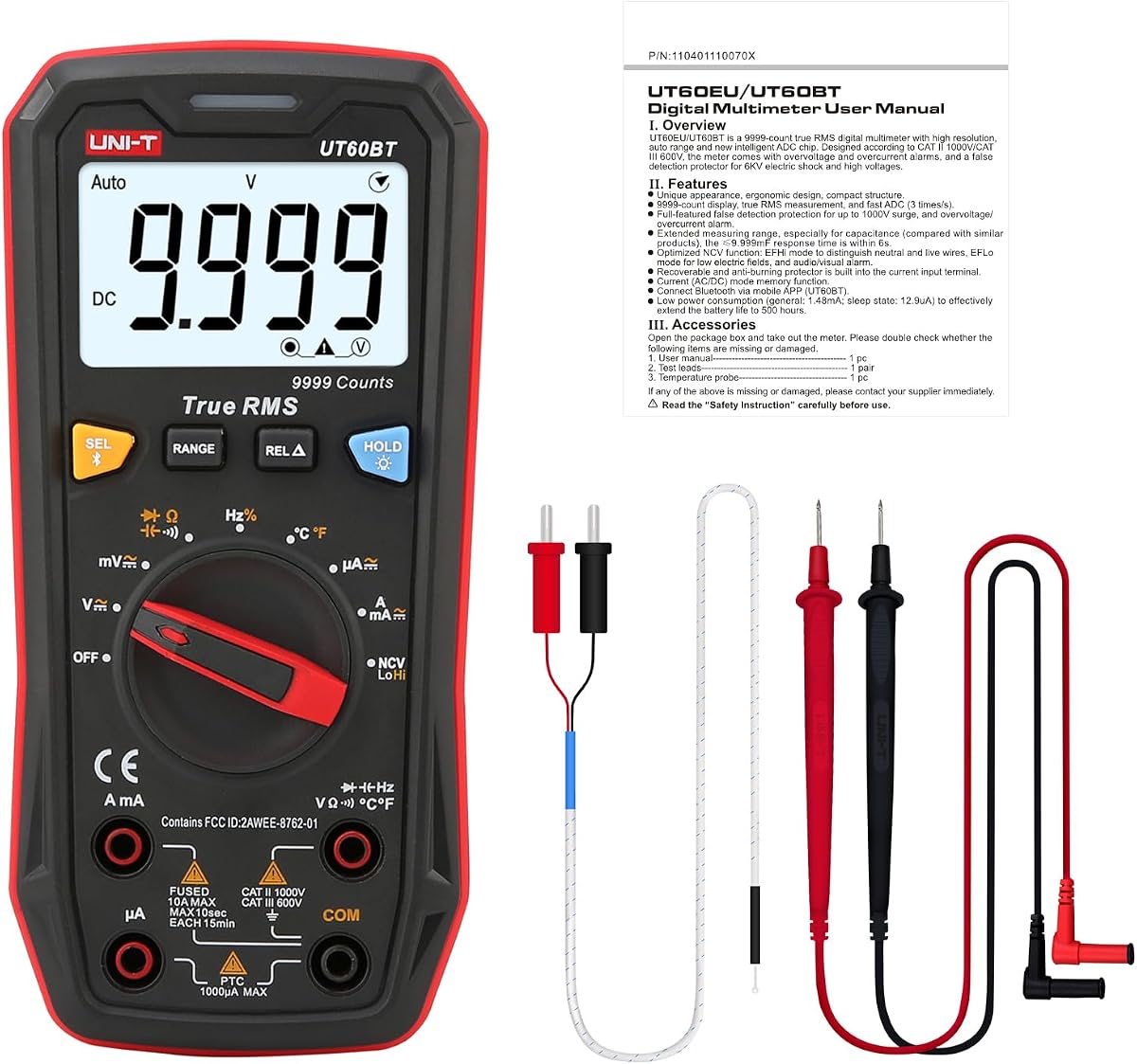
The UNI-T UT60BT is a connected handheld multimeter for users who need to view and record measurements away from the test point. It links to a smartphone over Bluetooth, allowing readings to be monitored remotely and logged without copying values by hand. Its 4.6 rating places it among the stronger choices in this collection, particularly for routine troubleshooting and supervised diagnostic work.
We may earn a commission when you buy through this link, at no additional cost to you.
Its 9999-count display provides a useful step up from many 6000-count designs. True RMS measurement and a fast three-times-per-second ADC are suited to electrical troubleshooting, while the measurement suite includes AC and DC voltage, current, resistance, capacitance, frequency, duty cycle, diode testing, continuity, temperature, and non-contact voltage detection. Data hold preserves a reading for later review when diagnosing an intermittent condition.
The supplied specifications also mention false-detection protection for surge and overvoltage conditions, along with low power consumption and an advertised battery life of up to 500 hours. That efficiency makes it appealing for traveling technicians who want to limit battery changes. On the other hand, the connected workflow requires a compatible phone, and the meter may be less physically rugged than models specifically presented as jobsite instruments.
Choose the UT60BT when remote visibility and convenient measurement records are central to your workflow. It is a strong fit for maintenance staff, educators, and advanced users who need more display resolution than a typical entry-level meter without moving to a premium clamp format.
Remote viewing makes it easier to observe a changing signal while keeping attention on the equipment. Logging also creates a more reliable record than manually copying values during a long diagnostic session.
A 1000-volt capability and 9999-count display provide additional range and precision. The broad function set means one meter can handle voltage, current, resistance, temperature, frequency, and non-contact checks.
We may earn a commission when you buy through this link, at no additional cost to you.
The ANENG AN9002 combines a broad measurement set with a genuinely portable palm-sized form. Its 4.3 rating makes it a credible option for household repairs, automotive tinkering, and technicians who want Bluetooth support without carrying a full-size professional instrument. The automatic range selection and true RMS capability are especially useful for users who do not want to manage a manual range dial.
We may earn a commission when you buy through this link, at no additional cost to you.
It measures AC and DC voltage to 600 volts, AC and DC current to 10 amps, and resistance to 60 megohms. Additional functions cover temperature, capacitance, frequency, duty cycle, continuity, and diode testing. A large backlit LCD, data hold, illuminated jack indicators, adjustable support frame, and auto shutoff improve usability, while the 6000-count display offers familiar midrange precision.
The included accessory set is unusually extensive for this class, with combination leads, alligator clips, needle probes, test leads, a temperature line, batteries, an instruction manual, and a storage bag. Its main technical limitation is the 10-amp current range, which is modest for motor and industrial work. The lower rating than several premium picks also suggests buyers should pay close attention to the final certification, warranty, and support details.
The AN9002 is best for portable, connected troubleshooting where a user values phone access, physical size, and a complete set of accessories. It is a strong alternative to a larger service meter when daily current measurements are not the primary requirement.
The body is only a little larger than a typical phone and is designed for one-handed use. An adjustable rear support and auto shutoff make it convenient for quick checks in garages, utility areas, and around the home.
The supplied probes, clips, connection sockets, and temperature line allow the meter to tackle continuity, diode, temperature, and general electrical checks without requiring a separate set of basic accessories.
We may earn a commission when you buy through this link, at no additional cost to you.
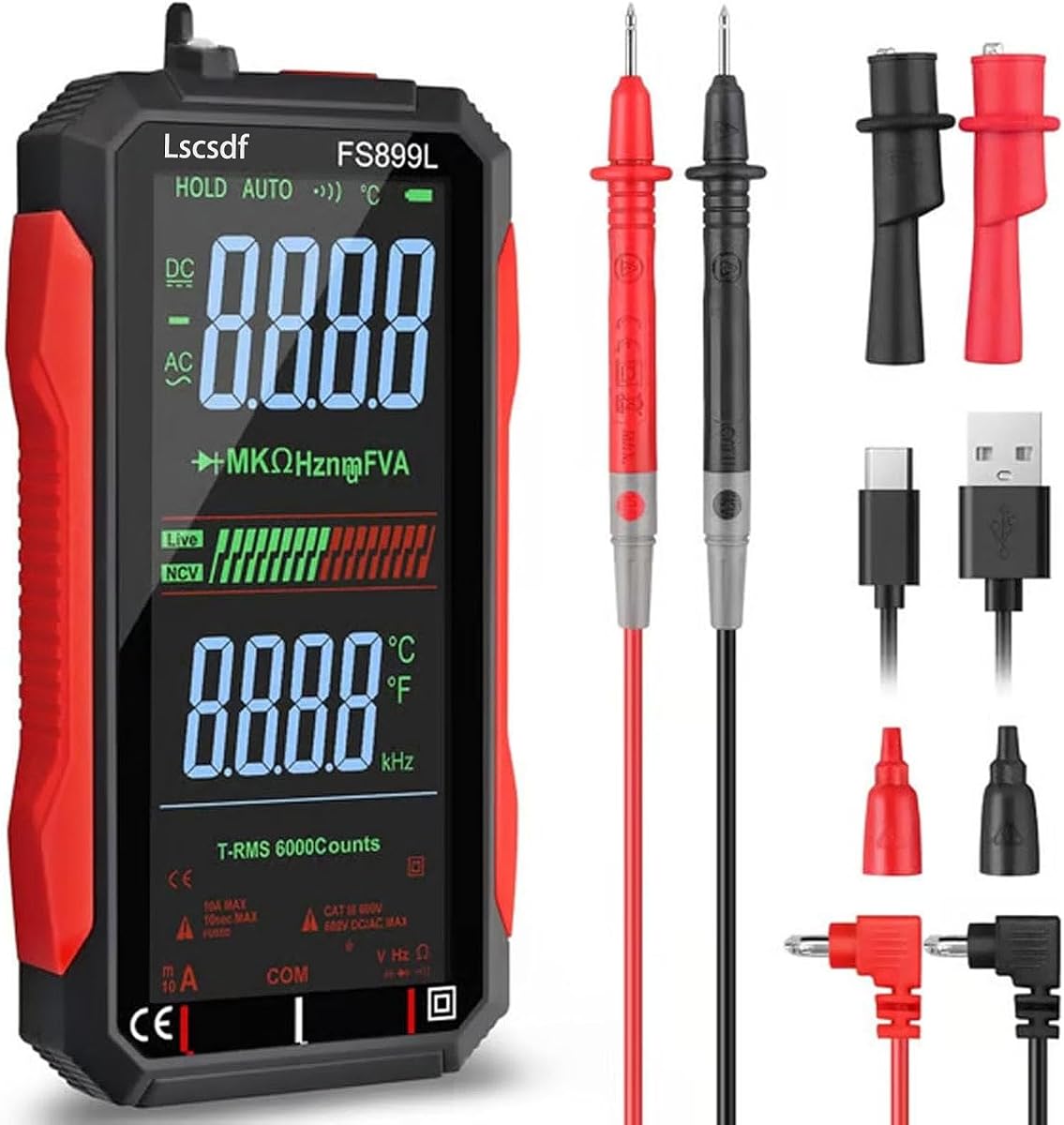
The Lscsdf FS899L is a portable 6000-count smart multimeter designed around a large, colorful 4.8-inch LCD. Its 4.5 rating and visual design make it attractive for users who want more screen information than a traditional segment display. The screen remains easy to read in dim environments, while the built-in flashlight helps illuminate dark panels and hard-to-reach spaces.
We may earn a commission when you buy through this link, at no additional cost to you.
Its measurement capabilities include AC and DC voltage and current, resistance, capacitance, non-contact voltage, temperature, diode and continuity testing, plus live-wire and null-wire recognition. Smart auto-ranging reduces setup, and the supplied description identifies the meter as true RMS. A soft protective cover and seismic-protection function add practical protection for automotive, household, and light industrial use.
The built-in 200mAh battery is charged through an included micro data cable, avoiding routine battery replacement. That is convenient, although the relatively small battery capacity may be less persuasive for extended field sessions than a larger rechargeable system. More importantly for this particular roundup, the product information does not explicitly describe Bluetooth connectivity. Buyers who require remote viewing or data export should confirm that feature with the seller rather than assuming it is present.
The FS899L is a compelling option for DIY users and automotive hobbyists who prioritize screen size, charging convenience, and a broad range of checks. It works well as a general-purpose portable meter, but the purchase is less secure for anyone whose defining requirement is wireless app integration.
The 4.8-inch display gives test results, warnings, and menus more visual space than a compact monochrome LCD. Backlighting improves use in low light, while the flashlight supports work around obstructions.
The internal battery can be reused through a standard micro data cable instead of being replaced regularly. This keeps the meter ready for intermittent household and automotive checks.
We may earn a commission when you buy through this link, at no additional cost to you.
The KAIWEETS KM602 offers a flexible combination of automatic and manual operation. It receives a 4.4 rating and distinguishes itself through a 6000-count true RMS display, a 1200mAh rechargeable battery, and a smart mode that identifies voltage, resistance, and continuity measurements. The manual range gives users additional control when a specific diagnostic procedure calls for it.
We may earn a commission when you buy through this link, at no additional cost to you.
Manual functions cover AC and DC voltage, current, resistance, continuity, capacitance, frequency, diode testing, duty cycle, temperature, non-contact voltage, and live-wire detection. Min, max, and average recording are useful for watching a fluctuating signal, while the analog-style bar display, real-time temperature display, low-battery warning, and data hold add everyday convenience. The full-screen color display and integrated flashlight improve operation in dark areas.
Safety is a notable strength. The meter is rated CAT III 1000V and CAT IV 600V, with double-fuse and overload protection, and it carries CE and RoHS certifications. These ratings make it more clearly positioned for professional diagnostic work than many compact consumer meters. The package also includes leads, a charging cable, thermocouples, batteries, a manual, and a storage case, while the seller provides three years of after-sale service and lifetime technical support.
As with the FS899L, the product data does not explicitly state that Bluetooth is included. That makes the KM602 a strong smart multimeter but a less certain match for this specifically connected category. It is most appropriate for buyers who prioritize smart selection, rechargeable endurance, recording, and safety over remote phone monitoring.
Smart mode automatically identifies common test types and selects a range, which is useful during fast diagnostics. Manual mode gives experienced users direct control when following a defined testing procedure.
CAT III 1000V and CAT IV 600V ratings provide clear categories for the environments in which the meter is intended to be used. Double-fuse and overload protection add another layer of defense during demanding measurements.
We may earn a commission when you buy through this link, at no additional cost to you.
The Testo 770-3 is a premium connected clamp meter built for electrical and HVAC diagnostics. Its 4.6 rating reflects a well-rounded professional instrument, with a particular strength in fine current resolution. The 0.01-amp clamp capability is valuable when checking comparatively small loads or watching HVAC systems operate in more demanding conditions.
We may earn a commission when you buy through this link, at no additional cost to you.
True RMS measurement covers AC and DC current to 600 amps and voltages to 1000 volts. Automatic detection identifies AC or DC and can select resistance, continuity, diode, and capacitance functions, while a two-line LCD keeps multiple values visible. A retractable pincer arm helps the user capture conductors in tightly packed equipment without struggling to position a full-size jaw.
Bluetooth connectivity is integrated with the Testo Smart App and other Testo HVAC tools. Users can monitor real-time data, display measurement curves, and generate reports on a phone or tablet. The specified compatibility is iOS 11.0 or newer and Android 6.0 or newer. The delivery scope is also extensive, including leads, crocodile clips, micro clips, a Type K thermocouple, magnetic holder, carrying case, batteries, and a test report.
This meter makes the most sense for HVAC contractors, facilities teams, and engineers who need a credible combination of clamp access, precision, and app-based reporting. The premium cost may be difficult to justify for occasional household checks, but for recurring professional work the complete kit and documented connected workflow add meaningful value.
The 0.01-amp clamp resolution helps distinguish subtle changes in lower-current ranges. That makes the instrument more useful for equipment performance checks where a coarse reading might hide important variation.
Real-time monitoring, curves, and reports turn the meter into more than a standalone display. Technicians can preserve results and present them in a consistent format for analysis, maintenance notes, or customer documentation.
We may earn a commission when you buy through this link, at no additional cost to you.
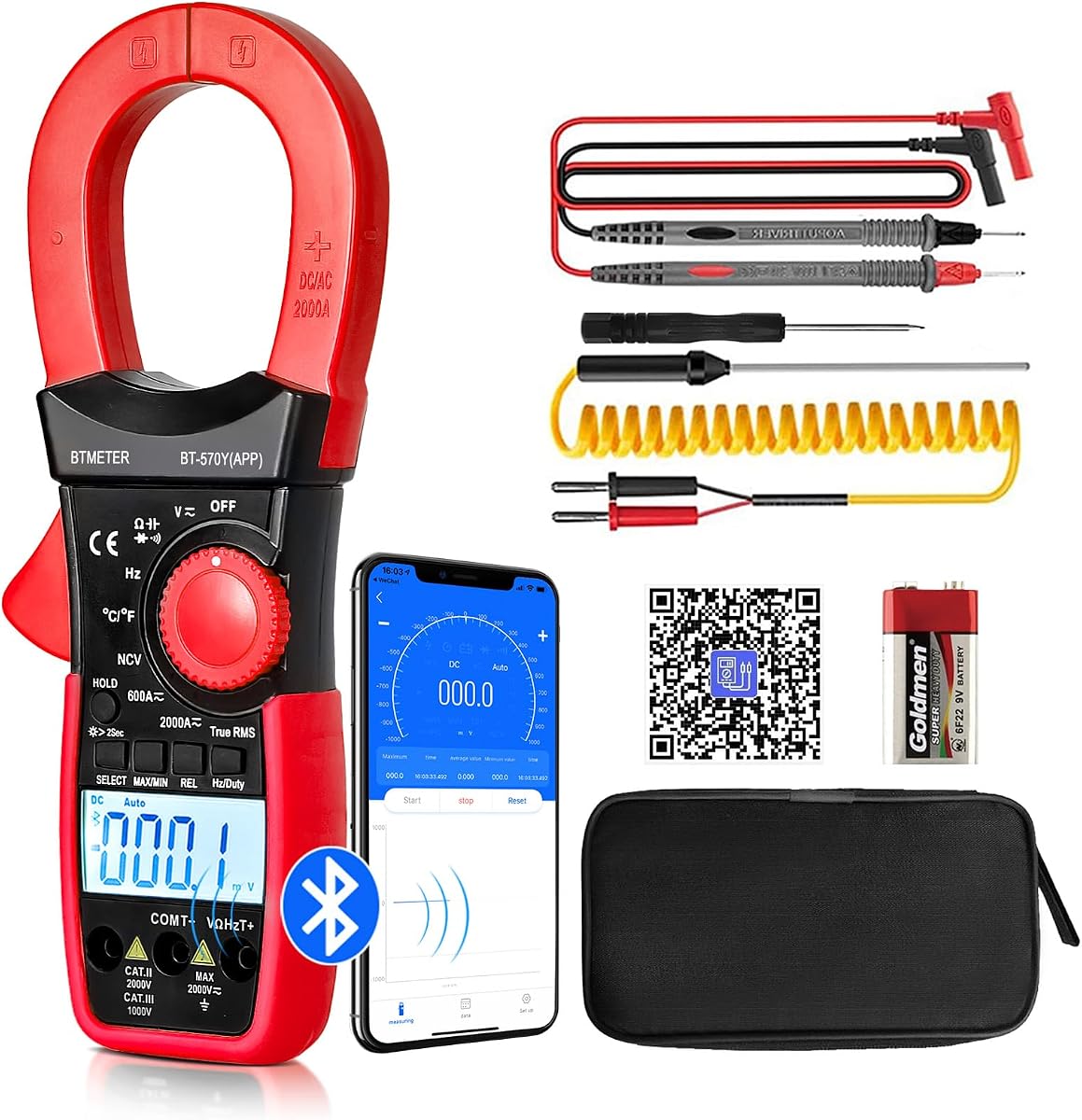
The BTMETER 570Y-APP is a high-current connected clamp meter with a 5.0 rating. It is designed for users who need to monitor substantial AC or DC loads while keeping their phone at a distance. Its 2000-amp capability and 54mm jaw set it apart from ordinary handheld multimeters, while 6000-count true RMS measurement provides useful resolution across electrical maintenance tasks.
We may earn a commission when you buy through this link, at no additional cost to you.
Bluetooth data syncing supports real-time monitoring, historical recording, and export to TXT or Excel. The stated wireless range is 33 to 50 feet, giving the user room to move away from energized equipment while continuing to watch a changing measurement. Maximum, minimum, and average values can be displayed with timestamps, which helps reveal short-lived fluctuations that might be missed by watching only the live number.
The measurement suite covers AC and DC current, voltage, resistance, capacitance, frequency, temperature, duty cycle, diode testing, continuity, and non-contact voltage. A 54mm jaw fits thick cables, while the included test leads and K-type thermocouple support conventional probes. The backlit display, data hold, relative measurement mode, audible continuity indicator, and light-and-sound NCV alerts make the meter practical in busy environments.
This is an attractive choice for industrial maintenance, automotive diagnostics, and users who specifically need high-current measurement with remote records. The same high capacity demands careful instrument selection and safe operating practice, and the listed iOS and Android baselines should be checked against current devices before purchase.
A phone can display the reading from across the room, reducing the need to remain directly in front of the test point. This is particularly useful when watching a load cycle or gathering a sequence of readings during maintenance.
TXT and Excel export makes logged information easier to organize outside the meter. Timestamped maximum, minimum, and average readings help identify unstable loads and document how a system changes over time.
We may earn a commission when you buy through this link, at no additional cost to you.
The Fluke 902 FC is an HVAC-focused true RMS clamp meter with wireless connectivity through Fluke Connect. Its 4.7 rating reflects a strong result, and its defining technical advantage is the ability to measure down to 200 microamps of DC current. That range is especially useful for testing low-current circuits such as flame-sensing systems.
We may earn a commission when you buy through this link, at no additional cost to you.
The extended resistance range reaches 60 kiloohms, supporting checks involving thermistors and other temperature-sensitive components. The meter also captures flue gas temperature when used with the appropriate temperature accessory, while true RMS voltage and current measurements help with non-linear signals. Bluetooth links the clamp to a phone so readings can be viewed and managed more conveniently.
Its focus is narrower than that of a general-purpose clamp meter with a broad capacitive and frequency feature list, but that concentration is an advantage for HVAC technicians who regularly work with heating systems. It is not designed around 2000-amp capacity or a 54mm jaw, so buyers needing high-current motor or industrial work should look at a larger clamp.
The 902 FC is a compelling choice for HVAC service professionals who value low-current capability, temperature-related work, and a trusted professional platform. Its connected functionality can reduce manual note-taking and make results easier to review on a phone.
A 200-microamp DC range supports testing the small currents commonly encountered in flame-sensing and similar low-power HVAC circuits. This focused range is more useful for that work than a general clamp focused only on larger loads.
Flue gas temperature capture and resistance measurement to 60 kiloohms help complete system diagnostics. These functions make the meter more practical for a service visit centered on heating and temperature-related faults.
We may earn a commission when you buy through this link, at no additional cost to you.
The BTMETER BT-7200APP is a connected clamp meter designed for remote observation and continuous data logging. Its 4.1 rating is the lowest among the ten products here, but its specification set still covers many needs. It connects to Android or Apple devices and can display and save measurements from approximately 15 meters away, allowing a user to monitor data outside the immediate arc-flash zone.
We may earn a commission when you buy through this link, at no additional cost to you.
The meter measures AC and DC current, voltage, resistance, capacitance, frequency, duty cycle, temperature, continuity, diode function, and non-contact voltage. Real-time values can be shown alongside maximum and minimum readings, while a timed curve graph provides a visual representation of changes in current or voltage. Adjustable logging rates are useful for balancing detail against record length and battery life.
True RMS measurement is paired with 0.1-amp resolution from 0.1 to 60 amps and one-amp resolution from 60 to 400 amps. The clamp-on current method requires the hot and neutral conductors to be separated so the meter surrounds only the live wire. That instruction is critical: clamping both conductors can cancel their magnetic fields and produce a misleading zero reading.
This model is well suited to motor, vehicle, boat, appliance, and HVAC troubleshooting where remote logs and trend curves are important. It should be compared carefully with higher-rated alternatives, and users should confirm its app support, documentation, and safety markings match the work they intend to perform.
The timing graph turns a sequence of readings into a visible trend. It can help a technician identify cycling behavior, intermittent changes, or load spikes that are difficult to understand from isolated values.
For current measurements, place the jaw around only the live conductor. Keeping hot and neutral together causes opposing fields to cancel, so following this procedure is essential for a valid result.
We may earn a commission when you buy through this link, at no additional cost to you.
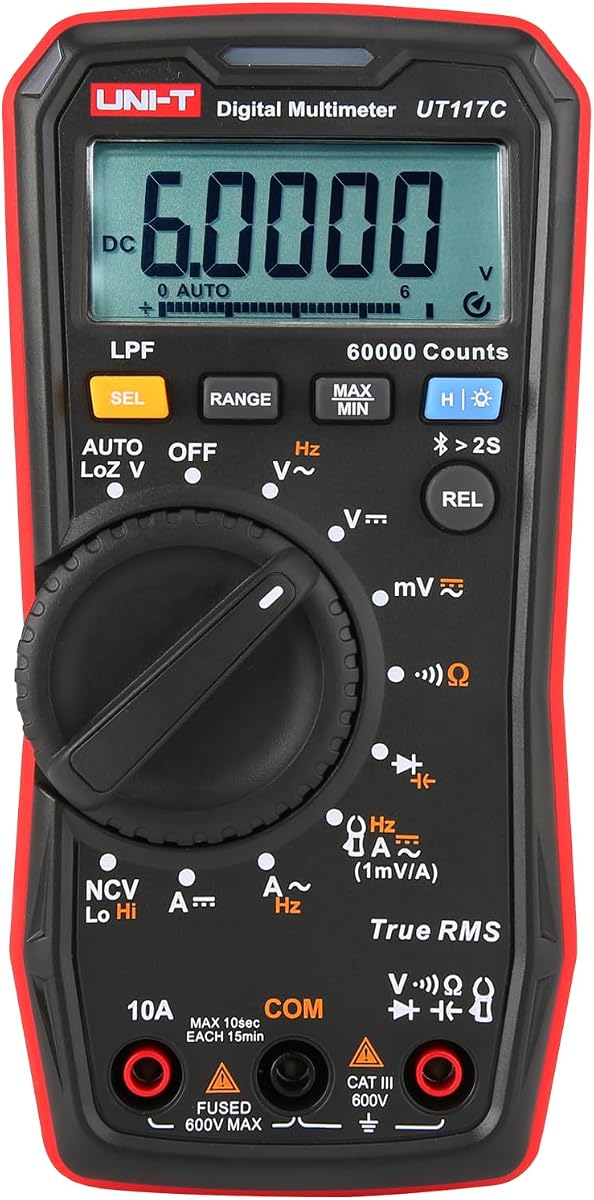
The UNI-T UT117C is a high-resolution connected multimeter for engineers, technicians, educators, and serious advanced users. Its 4.6 rating reflects a technically strong instrument, with 60,000 counts and a high-resolution analog-to-digital converter providing much greater display detail than the common 6000-count format. True RMS measurement supports accurate work on non-linear loads such as those produced by variable-speed drives.
We may earn a commission when you buy through this link, at no additional cost to you.
A low-pass filter reduces high-frequency noise, making the meter especially useful in industrial diagnostics where a raw signal can fluctuate rapidly. It measures AC and DC voltage, current, resistance, capacitance, and frequency, while automatic AC/DC identification, NCV detection, LoZ low-input impedance, continuity, diode testing, relative measurement, and min-max-average recording cover a broad set of diagnostic needs.
Bluetooth 5.0 connects with the UNI-T Smart App for real-time recording, report generation, remote monitoring, and historical trend analysis. A magnetic buckle attaches the meter to panels, solar combiner boxes, vehicle hoods, and other metal surfaces, supporting hands-free work in tight or elevated spaces. The white LED backlight and ergonomic one-handed body improve field usability.
The UT117C is a top recommendation for users who need traceable records and unusually detailed readings rather than simply a connected display. Its CAT III 600V rating is an important limitation for users who may work on higher-category circuits, so prospective buyers should compare the required installation category with the meter's rating before use.
A 60,000-count display provides finer numerical detail and a more useful analog bar presentation. This helps when values fluctuate by small amounts that a lower-resolution display would visually compress.
The LPF function helps suppress high-frequency noise during industrial measurements. It can produce a steadier result when diagnosing inverter-driven equipment or signals that change too quickly for a simple numerical reading to explain.
We may earn a commission when you buy through this link, at no additional cost to you.
The right connected multimeter depends on the measurements, environment, and recording workflow you need. Compare measurement precision, safety categories, app behavior, power design, and physical format rather than judging solely by display size or the number of listed functions.
Prioritize a documented app with the recording and export functions your work actually requires.
Choose ranges that cover your work with room to operate, rather than selecting a model by display resolution alone.
True RMS is the priority for modern non-linear loads; a noise filter is valuable for industrial signals.
Match the safety category, voltage rating, and protections to the installation and equipment being tested.
Select handheld or clamp form based on how you actually measure current and how much portability you need.
Choose a display that remains readable in your usual working light and controls that support your testing style.
Balance convenience with reality: rechargeable cells reduce replacements, but logging and backlighting affect actual runtime.
Confirm that the supplied probes, temperature sensors, clips, and case meet the demands of your normal work.
Before testing, inspect the meter, leads, probes, batteries, and Bluetooth connection for visible damage. Select a function and range appropriate to the expected voltage or current, confirm the test leads are inserted into the correct jacks, and verify the display starts at a safe zero or appropriate reference value. For connected work, install the specified app, pair the meter, and confirm that readings on the phone match the physical display before relying on remote monitoring.
Turn power to the circuit only after the meter is correctly configured, keep fingers away from conductive probe tips, and measure in a way that does not leave exposed contacts or hands near energized components. When using a clamp for current, separate the hot and neutral conductors and clamp only the live wire; otherwise, opposing magnetic fields can cancel and create an incorrect zero reading. For a smart or auto-ranging meter, confirm that the detected function matches the property you intend to measure.
After use, disconnect the test leads, switch the meter off, and use auto shutoff or remove the batteries if the product uses replaceable cells. Keep the instrument away from moisture, excessive heat, conductive dust, and impact. Wipe the case and probes with a dry or lightly damp cloth, avoid flooding openings, and store test leads loosely rather than tightly wrapped around the meter. Review saved records periodically and back up exported files before clearing the meter's memory.
The main benefit is the ability to view, monitor, or record readings without manually copying every value. Depending on the model, a phone or tablet can display live measurements, track changes over time, and export results for later analysis. This can make long diagnostic sessions more consistent and reduce transcription errors, especially when the test point is difficult to reach.
No. Some products in this category provide explicit Bluetooth measurement and logging, while others are described primarily as smart meters with automatic functions. The FS899L and KM602, for example, have useful connected-tool features but their supplied specifications do not explicitly confirm Bluetooth app logging. Check the app name, operating-system support, recording functions, and export format before buying.
A clamp meter is usually better when current measurement is central to the task because it can measure a conductor without opening the circuit. A handheld meter is more versatile for voltage, resistance, diode, continuity, and many other checks in a smaller package. Some technicians carry both, while others choose a clamp with test-lead inputs for a broader service workflow.
True RMS measures the effective value of AC waveforms directly rather than estimating them from a simplified average. It is especially useful for non-linear signals produced by electronic circuits, variable-speed drives, and modern energy-efficient equipment. A meter with true RMS usually provides more dependable results in those applications than a non-true-RMS model.
Open the jaw and place it around only the live or hot conductor, not both hot and neutral together. The two conductors create opposing magnetic fields that can cancel and produce a misleading zero reading. If the circuit cannot be separated safely, use an appropriate line splitter or another measurement method and follow the manufacturer's safety guidance.
No. Display count indicates numerical resolution, while accuracy depends on the manufacturer's specified test specifications and the selected function and range. A higher count can make small changes easier to see, but it does not guarantee better overall accuracy. Check the measurement specifications, calibration information, safety certifications, and warranty alongside the display resolution.
A rechargeable model is convenient for frequent use because it avoids routine battery replacement. The tradeoff is dependence on a charging cable and potentially less capacity than a model using replaceable cells. For traveling technicians, compare the stated battery capacity, auto shutoff behavior, low-battery warning, and expected logging or backlight use.
Check the CAT rating, maximum voltage, current range, fuse configuration, and environmental limits before touching a circuit. Connected features such as remote monitoring can reduce exposure, but they do not replace correct category ratings or safe work procedures. Use insulated probes, avoid touching conductors, and consult the product documentation whenever a measurement exceeds the stated limits.
The Klein Tools MM460S stands out as the most balanced choice, combining automatic smart mode, true RMS measurement, a highly visible display, and hands-free features. The ANENG AN9002 is a practical connected option for portable household, automotive, and general field use, while the UNI-T UT117C offers the strongest combination of display resolution, filtering, app-based reporting, and detailed technical measurement.
Your priorities should determine which feature set deserves the most attention. Choose a large clamp for high-current work, a focused HVAC meter for microamp and temperature diagnostics, a rugged handheld for broad electrical testing, or a connected model with explicit logging when remote observation and retained records are essential. Verify Bluetooth behavior, app compatibility, safety category, accessories, and measurement range before finalizing your choice.
Specifications, app versions, accessories, and prices can change over time, so review the current product listing and manufacturer documentation before purchasing. With those checks completed, you can select a Bluetooth smart multimeter that fits your workflow rather than choosing solely on the largest feature list or the most prominent screen.