
EVAPLUS 54.6V Safe Charger
4.4Editor score
UL-certified 48V charger
54.6V charging output
Dual LED status lights
100-240V universal input
Our 2026 guide compares the best electric bike chargers for 48V ebikes, including output, connector fit, safety features, charging speed, and ease of use.
Electric bike chargers for 48V ebikes are designed around the specific charging requirements of 13-series lithium-ion battery packs. A suitable charger should deliver the correct 54.6V output, match the battery connector, and provide dependable protection against charging faults. The best options also balance useful charging speed with clear status indicators and straightforward operation.
We compared all ten chargers by examining their voltage, current, connector coverage, battery compatibility, protection features, charging behavior, portability, and certification claims. The list includes chargers from EVAPLUS, Hyleton, QKIIP, and other listed brands, ranging from compact single-plug units to multi-adapter replacements designed for popular electric bicycle and scooter platforms.
Each pick highlights a different reason to consider it, such as straightforward backup charging, broad connector support, higher-current charging, or a durable replacement design. Ratings reflect the supplied customer feedback, while product details are based on the available listing information. As with all Amazon products, prices and offers can change, so check the current listing before purchasing.
4.4Editor score

4.4Editor score
4.3Editor score
The table below compares all ten chargers by output, connector coverage, primary protection features, and indicator behavior. Use the information as a quick shortlist, then confirm your battery voltage, chemistry, original charger label, and charging-port shape before ordering.




The EVAPLUS 54.6V Safe Charger is a compact 48V lithium battery charger with a supplied rating of 4.4. Its appeal comes from a focused combination of UL certification, automatic charging control, and a simple barrel-style connector. It is designed for electric bikes, scooters, and other compatible devices that use a 48V lithium battery and either a 5.5 x 2.5mm or 5.5 x 2.1mm DC connector.
We may earn a commission when you buy through this link, at no additional cost to you.
The charger uses a 100-240V AC input, making it suitable for a broad range of international locations. Its listed protections include over-voltage, over-current, and short-circuit protection, while automatic shutoff is provided when the battery reaches a full charge. A red LED indicates active charging and a green LED signals completion, allowing users to check the process without repeatedly handling the charger or connector.
Its main limitation is connector coverage. Unlike several multi-plug options in this guide, the EVAPLUS includes only the two barrel sizes listed in its product information. That makes it a sensible choice when your ebike uses one of those common ports, but a poor match for a proprietary 3-pin, aviation-style, RCA, or XLR connection. The stated 4-6 hour charging time is also less compelling for riders who need especially rapid turnaround.
This is a good budget-oriented replacement or backup charger for owners who already know their bike uses a 5.5mm barrel connector. It offers fewer compatibility options than the more elaborate chargers here, but it combines certification, clear status lights, and essential protections in a straightforward package. Confirm the port shape and voltage before ordering.
The red and green LED arrangement makes charging status easy to understand at a glance. Once the green light appears, the charger is designed to shut off automatically, reducing the need for constant supervision.
Its compact format and universal AC input make it convenient for home, office, or travel use. It is especially useful as a backup when the original charger has been misplaced or damaged.
We may earn a commission when you buy through this link, at no additional cost to you.
This 54.6V 2A fast charger combines a 48V lithium-battery focus with one of the broader connector selections in the guide. It carries a supplied rating of 4.2 and uses a UL-certified model designation. Compatibility information specifically calls out models from Lectric, Ecotric, and Evercross, while the included connector formats cover common barrel, aviation-style, and Cannon-style connections.
We may earn a commission when you buy through this link, at no additional cost to you.
A 2A output offers a more useful charging rate than many basic 48V chargers, and the listed CC-CV mode manages the transition between bulk charging and voltage-controlled charging. The safety list includes over-voltage, over-current, short-circuit, over-temperature, reverse-connection, and fuse protection. Automatic stopping when the battery is fully charged adds another layer of convenience.
The main drawback visible in the supplied information is the lower 4.2 rating compared with most products in the top half of this list. The description also repeats the battery-life and safety bullet points, making the listing less polished. While five connectors improve the chance of compatibility, owners should still verify the precise port dimensions rather than relying only on a listed bike brand.
Choose this option if your ebike is from one of the specifically named brands or uses one of the five included connector formats. It offers a more versatile package than a basic barrel charger and includes comprehensive fault protection. For riders who value connector selection at a moderate current, it is a practical alternative to the higher-rated options.
The supplied DC barrel, 12mm aviation-style, and Cannon options cover several connector formats encountered on 48V electric bicycles and scooters. This reduces the chance of buying the wrong replacement.
Protection against reverse connection, temperature problems, and short circuits is especially useful for a device that may be stored in varied environments. The fuse adds another layer of electrical fault management.
We may earn a commission when you buy through this link, at no additional cost to you.
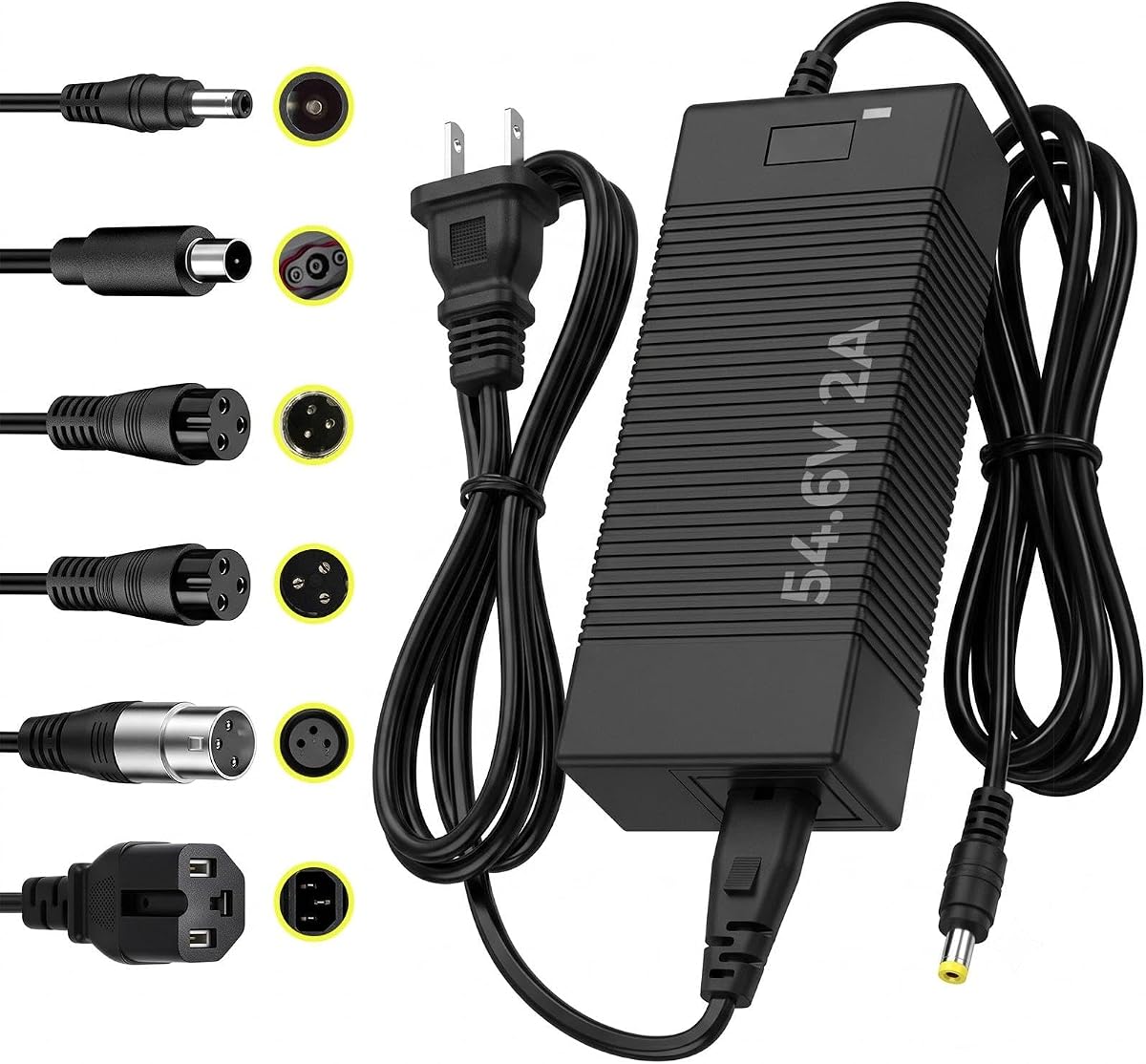
The Hyleton 48V Lithium Battery Charger is the most complete general-purpose option in this guide, combining a supplied 4.4 rating with a 54.6V 2A output and three connector formats. It is specifically designed for 48V lithium-ion e-bike batteries, with explicit compatibility across many common brands and a long list of named Lectric, TST, Aipas, and Qlife models.
We may earn a commission when you buy through this link, at no additional cost to you.
Its 3-in-1 connector system includes a 5.5 x 2.5mm/2.1mm DC plug, a 12mm 3-pin plug, and an 18mm XLR plug. The charger also uses smart temperature control, runs without a fan, and is claimed to charge faster than a comparable 1.5A unit. Additional protections cover over-voltage, over-current, short circuits, and overheating.
Compatibility is carefully limited. The product information excludes 24V, 29.4V, 36V, 42V, 52V, 58.8V, 60V, 67.2V, 72V, and 84V batteries, as well as lead-acid, LiFePO4, scooters, hoverboards, and golf carts. These exclusions are important because a connector match alone does not establish electrical compatibility. The 2A current also requires reasonable battery support, even though the listing covers a wide range of lithium capacities.
This is the strongest overall recommendation for riders with a mainstream 48V lithium e-bike and one of the three covered connector types. It combines quiet operation, thoughtful protection, useful model guidance, and a storage bag. Before ordering, compare the battery label with the stated 54.6V requirement and verify the charging-port shape.
The fanless design is useful in a bedroom, garage, or workspace where audible fan noise would be distracting. Smart temperature control is intended to manage heat without relying on continuous forced-air cooling.
The listing goes beyond a basic voltage claim by naming many supported ebike brands and specific models. That detail can make connector matching more straightforward, provided buyers still confirm their own battery label.
We may earn a commission when you buy through this link, at no additional cost to you.
The QKIIP 54.6V 2A Charger stands out for its seven-plug approach and a supplied 4.4 rating. It is designed specifically for 48V 13S lithium-ion battery packs and provides a 54.6V output. Its connector selection includes 5.5 x 2.1mm and 5.5 x 2.5mm barrel plugs, a 12mm 3-prong plug, a 9mm mini 3-prong, an 8mm RCA plug, a 3-pin XLR, and a female universal connector.
We may earn a commission when you buy through this link, at no additional cost to you.
The included tips give it one of the broadest physical compatibility ranges among the 48V chargers reviewed. The listing names Lectric, Ecotric, Rad Power, Aventon, Ancheer, Jetson Haze, Evercross, Jasion, Velotric, Ridstar, Yozma, and Ninebot among compatible brands. Smart CC/CV three-stage charging is designed to protect battery health, while over-voltage, overload, over-current, over-temperature, and short-circuit protection address common electrical faults.
The strict battery limitations are worth emphasizing. This charger must not be used with lead-acid batteries or packs labeled 36V, 42V, 24V, or 52V. Its broad connector assortment could create a false impression that every connected device is safe; voltage and chemistry still need to match. The green and red lights are also described differently from some chargers, with green indicating full, disconnected, or not charging.
This is a strong choice for someone who owns more than one 48V device or wants future replacement flexibility. The seven tips and detailed compatibility guidance reduce guesswork, while the 2A output suits riders seeking a practical balance of speed and portability. Always perform the three checks listed in the product information before ordering.
Seven interchangeable tips make this a useful shared charger for households with different 48V e-bikes or scooters. Having the common connector formats together can prevent the inconvenience of keeping several separate chargers.
The stated CC/CV process manages current and voltage as the pack approaches full charge. This approach is intended to reduce unnecessary charging stress and support long-term battery health.
We may earn a commission when you buy through this link, at no additional cost to you.
The SGS 54.6V 2A Fast Electric Bicycle Charger provides a 54.6V output and seven plug options for 48V 13S lithium-ion packs. It has a supplied rating of 3.9, which is lower than the other products in the guide, so it requires a more measured recommendation. Its strengths are nevertheless clear: broad connector coverage, explicit safety protections, and a simple red-and-green indicator system.
We may earn a commission when you buy through this link, at no additional cost to you.
The included connection formats include 5.5 x 2.1mm and 5.5 x 2.5mm DC plugs, a 9mm mini 3-prong, a 12mm standard 3-prong, an 8mm RCA plug, a 3-pin male XLR, and a universal IEC plug. The listing states that the charger passed UL testing, while the product name identifies SGS certification. It also includes over-voltage, over-current, short-circuit, and temperature protection plus a flame-retardant V-0 enclosure.
Compatibility is intentionally narrow in terms of battery design. It is only for a device using a 48V 13S lithium-ion battery pack and must not be used with 24V, 25V, 29.4V, 36V, 42V, or lead-acid packs. The 3.9 rating may reflect the relatively limited history or less favorable feedback for this listing, although that cannot be determined from the supplied data alone.
Consider this charger if you need several connector formats and prioritize documented protections. Its 2A output and automatic shutoff make it a functional daily charger, but the lower customer rating makes it less compelling than higher-rated alternatives when direct connector compatibility is all that matters. Verify the voltage and port before ordering.
The adapter assortment covers barrel, aviation-style, RCA, XLR, and IEC-style connections. That variety is particularly useful for owners of less common 48V charging ports.
The flame-retardant enclosure and multiple electrical protections provide a reassuring combination for routine charging. Automatic shutoff also helps prevent continued charging after the battery is full.
We may earn a commission when you buy through this link, at no additional cost to you.
The Five-Adapter 54.6V Charger is a direct replacement option for 48V lithium-ion e-bikes and scooters, with a supplied rating of 4.3. It provides a 54.6V 2A output and includes five adapter plugs. The product information names Rad Power Bikes, Velotric, Heybike, Juiced, and Ecotric as compatible brands, giving buyers a useful starting point for identifying a likely fit.
We may earn a commission when you buy through this link, at no additional cost to you.
The charger's main selling points are its 2A output, straightforward plug-and-play operation, and clear status lights. A solid red LED indicates charging, while a solid green LED signals that the battery is fully charged and ready for use. Listed safeguards cover overcharging, short circuits, over-voltage, and over-current, addressing the most common concerns in a daily charging setup.
The supplied information is less detailed than that of several other products. It does not state the AC input range, identify the individual connector dimensions, or name a particular certification standard, even though the title includes UL Listed. As a result, buyers should review the product images and current listing carefully before purchase. The five adapters are also fewer than the seven-tip designs offered by a few alternatives.
This is a good option for a rider who recognizes one of the named brands and has one of the included connector types. It is straightforward, compact enough for a replacement role, and offers a more useful charging current than many entry-level 1.5A units. Confirm every detail on the original charger label and compare it with the listing before connecting it.
The 54.6V 2A output is designed to recharge compatible 48V lithium-ion packs more quickly than lower-current alternatives. It remains important to follow the current limits specified by the battery manufacturer.
The solid red and solid green states are easy to interpret. Riders can check the battery from a distance and know when charging has finished without interpreting a flashing pattern.
We may earn a commission when you buy through this link, at no additional cost to you.
Although the product title identifies this as a 54.6V charger for 48V ebike and scooter batteries, the supplied product details describe a completely different unit: a 14.6V, 20A charger for a 12.8V nominal four-cell LiFePO4 battery. That contradiction makes this one of the least suitable products in the guide for a standard 48V lithium-ion ebike, despite its supplied 4.4 rating.
We may earn a commission when you buy through this link, at no additional cost to you.
The described charger uses a constant-current and constant-voltage three-stage algorithm, with tail-current cut-off below 0.5A. It includes protection against over-voltage, over-current, short circuits, reverse polarity, and high temperature, plus 0V recovery for deeply discharged LiFePO4 packs. Heavy-duty Anderson connectors and M8 ring terminals are joined by an aluminum housing and two cooling fans.
Those are meaningful features for a high-power 12.8V LiFePO4 charging setup, such as the product listing's cited RV, golf cart, marine, and off-grid applications. They do not make the charger suitable for a conventional 13S 48V battery. Connecting it to a 48V pack could present a severe voltage mismatch and should not be attempted. The listing also conflicts with the claims made by other chargers in this roundup, which explicitly exclude LiFePO4 batteries.
This product should not be selected as an electric bike charger for a standard 48V lithium-ion pack. Its listing would need clarification from the seller, and any current listing should be treated cautiously because the title and technical specifications directly conflict. Even if the physical plug appeared to fit, electrical compatibility would remain unverified. It is better suited only to the exact 12.8V LiFePO4 system described in the detailed bullet points.
The stated 20A output and 300W continuous capacity reflect a much more specialized charger than the other 48V options here. Those characteristics make sense for large 12.8V LiFePO4 systems, not ordinary 13S ebike packs.
A charger title is not enough to establish compatibility. The output voltage, battery chemistry, connector, and current rating must all agree, so conflicting listing information calls for caution before any connection is attempted.
We may earn a commission when you buy through this link, at no additional cost to you.
The Five-Plug 54.6V Charger has the highest supplied rating in the guide at 4.6. It is designed for 13S 48V lithium battery packs and combines a 54.6V 2A output with five interchangeable plugs. The stated applications include electric bicycles, scooters, one-wheel devices, and Rad Power Bike models, giving it broader appeal than a connector-specific replacement.
We may earn a commission when you buy through this link, at no additional cost to you.
Its charging design emphasizes high efficiency and reduced waiting time, while the safety list covers over-voltage, over-current, short circuits, and overheating. Stable DC output is intended to protect battery health, and the low-noise structure is promoted for long charging sessions. The shell is described as durable, wear-resistant, and resistant to drops, while the compact body supports storage and travel use.
The listing offers less certification and model-specific information than some competitors. It does not identify a UL, ETL, SGS, or equivalent certification in the supplied description, nor does it enumerate the dimensions of all five plugs. Its claimed suitability for one-wheel devices should also be checked against the original charger, since not every one-wheel product uses the same battery configuration or charging protocol.
For buyers who want a portable 2A charger with several connector choices and the strongest customer rating in this selection, this is an attractive option. It appears particularly well suited to riders who value compact storage and straightforward replacement. Verify the battery label, port type, and current requirements before buying, and confirm the included tips in the product images.
The lightweight, compact construction makes it easier to keep in a garage, drawer, backpack, or travel case. A second charger can be useful at hotels, workplaces, or temporary lodging.
The low-noise design and heat-dissipation structure are presented as supporting safe, extended charging sessions. This can be useful when the charger must remain connected indoors for several hours.
We may earn a commission when you buy through this link, at no additional cost to you.
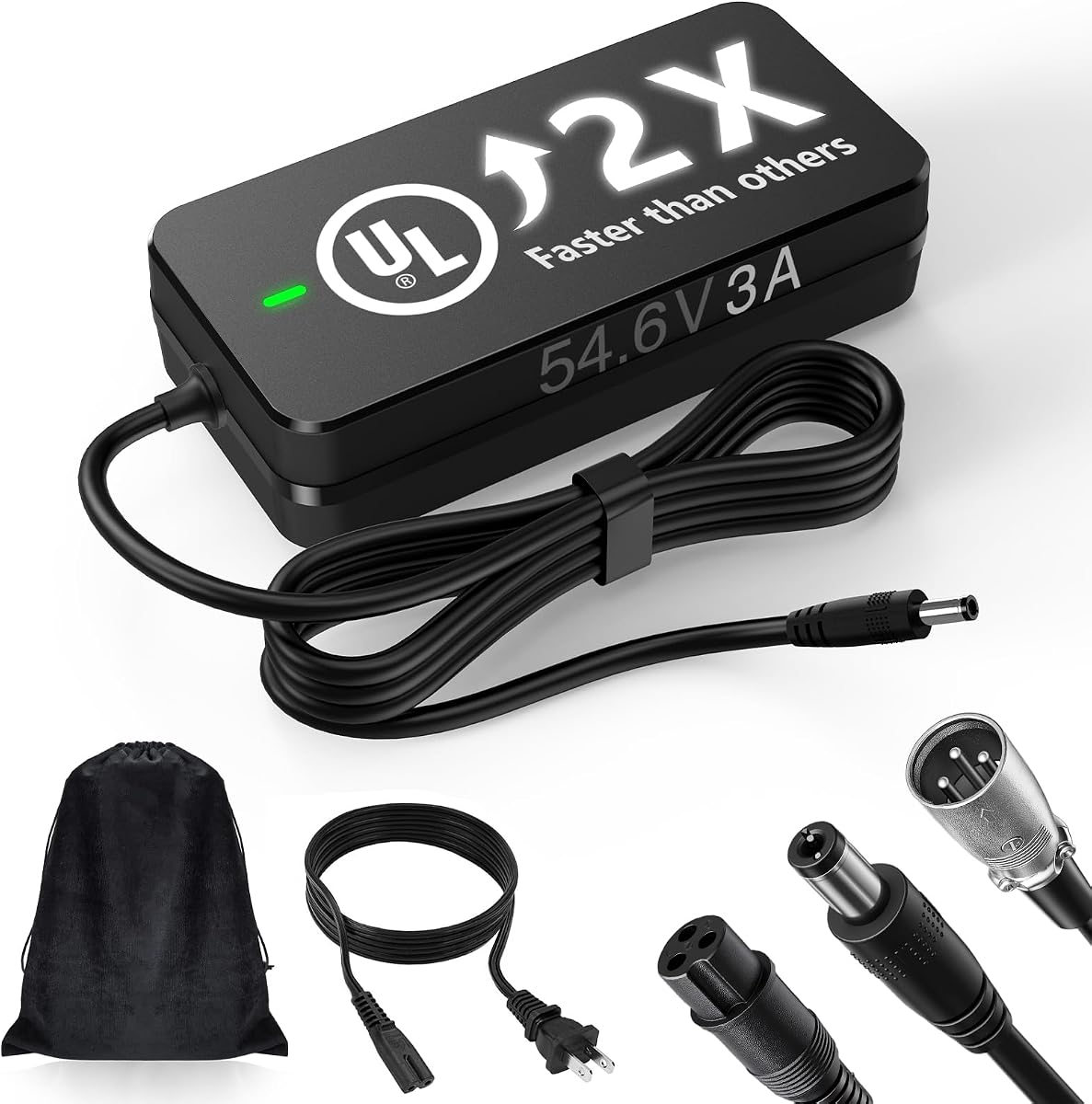
The Hyleton 54.6V 3A charger is the premium, higher-current selection in this guide, with a supplied rating of 4.3. It is designed for 48V lithium-ion battery packs and provides a 54.6V 3A output. The listing states that a 48V 15Ah battery can be fully charged in about five hours, positioning it as a faster alternative to lower-current chargers.
We may earn a commission when you buy through this link, at no additional cost to you.
Its notable feature is intelligent temperature control, which is intended to reduce heat stress during charging. The product also carries UL certification and lists over-voltage, over-current, short-circuit, and over-temperature protection. A V0 fire-resistant enclosure, aging tests, automatic shutoff or trickle behavior, and simple red-and-green indicators add to its premium feature set.
A 3A output should not be chosen solely because it is higher. Battery manufacturers specify acceptable charging current, and some packs or controllers may require a lower rate. Compatibility remains limited to 48V lithium-ion batteries, with lead-acid and LiFePO4 expressly excluded. The included connector selection consists of a 5.5 x 2.5mm/2.1mm plug plus 12mm 3-pin and 18mm XLR adapters.
This charger is best for riders with a compatible 48V lithium-ion battery that supports a 3A input and for whom reduced charging time is the priority. Its certification, temperature management, detailed model list, and robust construction justify considering it over a standard 2A unit. Confirm current limits and connector shape before purchasing.
The 3A output can meaningfully reduce charging time compared with common 1.5A and 2A alternatives. The benefit is most relevant when the battery and charging system are designed to accept that current.
Intelligent temperature control is particularly valuable when pushing a higher charging current. It is designed to manage heat and complement the charger's over-temperature protection.
We may earn a commission when you buy through this link, at no additional cost to you.
The ETL Certified 48V Electric Bike Charger offers a 54.6V 2A output, a supplied 4.4 rating, and seven interchangeable plugs. It is intended for 13S 48V lithium-ion batteries used in e-bikes, scooters, and hoverboards. Compatible brands named in the listing include Razor, Gotrax, Xiaomi, Jetson, and Ninebot.
We may earn a commission when you buy through this link, at no additional cost to you.
The connector set covers 5.5 x 2.1mm, 5.5 x 2.5mm, 9mm 3-prong, 12mm 3-prong, 8mm RCA, 3-pin XLR, and IEC formats. That makes this one of the most versatile physical designs in the guide. ETL certification is accompanied by listed over-voltage, over-current, short-circuit, and temperature protection, while intelligent temperature control supports stable charging.
The charger has an especially broad device list, but the electrical restriction remains strict. It must not be used with 24V, 25V, 36V, or 42V batteries, and the listing explicitly excludes lead-acid chemistry. The red and green indicators communicate active charging and full-charge status, and the product information says the charger will maintain the battery automatically after connection.
This is a compelling universal replacement for owners of several compatible 48V devices or those who want to keep different connector tips on hand. Its 2A output is a more widely practical level than a 3A model, and the ETL certification provides a clear safety credential. Verify the chemistry, voltage, port, and manufacturer current limit before use.
The seven adapter formats cover common connections found across e-bikes, scooters, and hoverboards. This makes the charger convenient for mixed-device households or keeping a single adaptable backup.
Aviation aluminum plugs and high-density wires are designed to resist corrosion and wear. Those material choices suit a charger that will be connected and disconnected frequently.
We may earn a commission when you buy through this link, at no additional cost to you.
Choosing a replacement charger is primarily an exercise in matching electrical specifications. Voltage, battery chemistry, connector geometry, and acceptable current must align before secondary features such as faster charging, certification, or included adapters become relevant.
A 48V ebike typically uses a 13-series lithium-ion pack, which is charged with a 54.6V charger. The name printed on the battery or original charger label is the best place to confirm this. Do not assume that a connector fitting means the charger is electrically compatible. The products in this guide are designed primarily for 48V lithium-ion packs, and most explicitly exclude lead-acid and LiFePO4 chemistry.
The plug must match both the diameter and pin arrangement of the charging port. Common formats in this category include 5.5 x 2.1mm and 5.5 x 2.5mm DC barrels, 12mm aviation-style plugs, 9mm mini 3-prong connectors, RCA-style plugs, XLR connectors, and universal IEC connections. Measure the port or compare it with the original charger, and do not rely solely on the ebike brand name.
Most of the reviewed chargers provide 2A, which is a practical middle ground between modest charging speed and broad battery compatibility. The Hyleton 54.6V 3A model offers a faster 3A output, while some systems may support only 1.5A or another manufacturer-specified rate. Higher current can shorten charging time, but it should never override the battery maker's recommended limits.
Useful protections include over-voltage, over-current, short-circuit, over-temperature, reverse-polarity, and overcharge prevention. Several products in the guide also identify UL, ETL, or SGS certification, while one listing references TUV, FCC, and RoHS standards. Certification offers additional assurance, but it should complement rather than replace correct battery matching.
A charger with one barrel plug may be sufficient for a single known ebike. Seven-plug designs are more useful for owners of multiple devices, unusual proprietary ports, or anyone who wants a flexible backup. The trade-off is slightly more complexity when selecting the tip. Keep adapters organized and make sure the correct connector seats fully without forcing it.
A CC/CV charging profile manages bulk current and then controls voltage as the battery approaches capacity. Automatic shutoff or trickle behavior helps avoid continued charging after full. Red and green LEDs are common: red usually means charging and green means complete, though the exact meaning should always be checked in the listing or manual.
A compact charger is easier to store and more useful for travel or workplace charging. Low-noise fans can reduce distraction, while fanless models may be quieter but should provide adequate heat dissipation. Look for a durable shell, wear-resistant cables, and corrosion-resistant plugs, particularly if the charger will be transported regularly.
Before connecting any charger, inspect the battery, charging port, cable, and plug for visible damage. Compare the battery voltage and chemistry with the charger's required input, and confirm that the connector matches. If the original charger is available, compare its output label, especially the voltage and current, with the replacement. Do not connect the charger to a battery that is swollen, leaking, unusually hot, or physically damaged.
Place the charger on a stable, dry, nonflammable surface with adequate ventilation. Connect the charger to the wall outlet first when the manufacturer recommends that sequence, then attach the charging plug to the ebike battery. Observe the LED indicator: red generally denotes active charging, while green generally indicates completion or standby. Never leave the connection unattended if there is an unusual smell, buzzing, visible cable damage, or a charger that becomes excessively hot.
After charging, disconnect the battery connector before removing the charger from the wall, following the instructions for your specific charger and battery. Wipe the connector with a dry cloth, keep the charging port free of dirt and moisture, and store the unit in a dry location. Inspect the cable and plug periodically because repeated bending near the strain relief can damage wires even when the charger housing still looks sound.
Most 48V lithium-ion ebike batteries use a 13S pack and require a charger with a 54.6V DC output. Always confirm the label on your battery or original charger because some products marketed as 48V use different chemistries or voltage configurations. Never substitute a charger based only on the ebike brand or connector appearance.
A 54.6V charger is normally appropriate for a standard 13-series 48V lithium-ion battery. The charger's voltage regulation and battery management system bring the pack to full charge safely. This does not apply to lead-acid, LiFePO4, or unusually configured batteries, which require different charging voltages and profiles.
A 3A charger can deliver up to 50% more current than a 2A model, so it may reduce charging time when the battery supports that input. A 2A charger is generally a more conservative and widely compatible choice. Check the battery manufacturer's charging-current specification before using a higher-current replacement.
Ebike charging ports can look similar while differing in diameter, center-pin size, pin count, or locking mechanism. Compare the replacement tip with the original charger and measure the port rather than relying on color or brand. Chargers with multiple adapters include more than one connector format, but you must still select the exact match.
Only when the scooter uses the same 48V lithium-ion chemistry, 54.6V charging profile, compatible current, and matching connector. Some scooters use proprietary plugs or batteries with different cell arrangements even when they are marketed as 48V. Verify the original charger label and the battery specifications before connecting a replacement.
On most of the chargers in this guide, red indicates that charging is underway and green indicates that the battery is fully charged, on standby, or disconnected. The precise behavior can differ by model, so follow the product listing or manual. If the light remains abnormal or the battery does not charge, disconnect it and verify compatibility.
Certification by a recognized body such as UL, ETL, or SGS provides useful evidence that the charger has been evaluated for safety. It should be considered alongside voltage, current, connector fit, and battery chemistry. A certified charger with the wrong output or connector is still unsuitable for the battery.
First disconnect the charger and check for physical damage, a loose connector, and any status-light behavior. Confirm the battery is still a 48V lithium-ion pack and that the charger is correctly rated and matched. A battery stored unused for an extended period may have entered a deeply discharged state and may require manufacturer-supported recovery or replacement.
The EVAPLUS 54.6V Safe Charger is the straightforward budget choice when a common 5.5mm barrel connector is all you need. The Hyleton 48V 2A Charger is the strongest overall recommendation because it combines a solid rating, three connector types, quiet temperature-controlled operation, extensive model guidance, and strong protection features. For riders seeking faster charging with a compatible battery, the Hyleton 54.6V 3A Charger provides the premium feature set.
Whichever option you choose, prioritize the original charger label, battery voltage, chemistry, connector geometry, and permitted charging current before focusing on speed or included accessories. Chargers with seven tips, such as the QKIIP, SGS, and ETL models, can be especially useful for multi-device households, while simpler barrel chargers are easier to operate once the correct fit has been confirmed.
Ratings, product availability, and offers can change over time, so review the current listing before purchasing. Also verify that any certification claim, connector list, and compatibility information still appears in the live product page. Taking a few minutes to compare the replacement with the original charger is the simplest way to avoid an incompatible purchase.