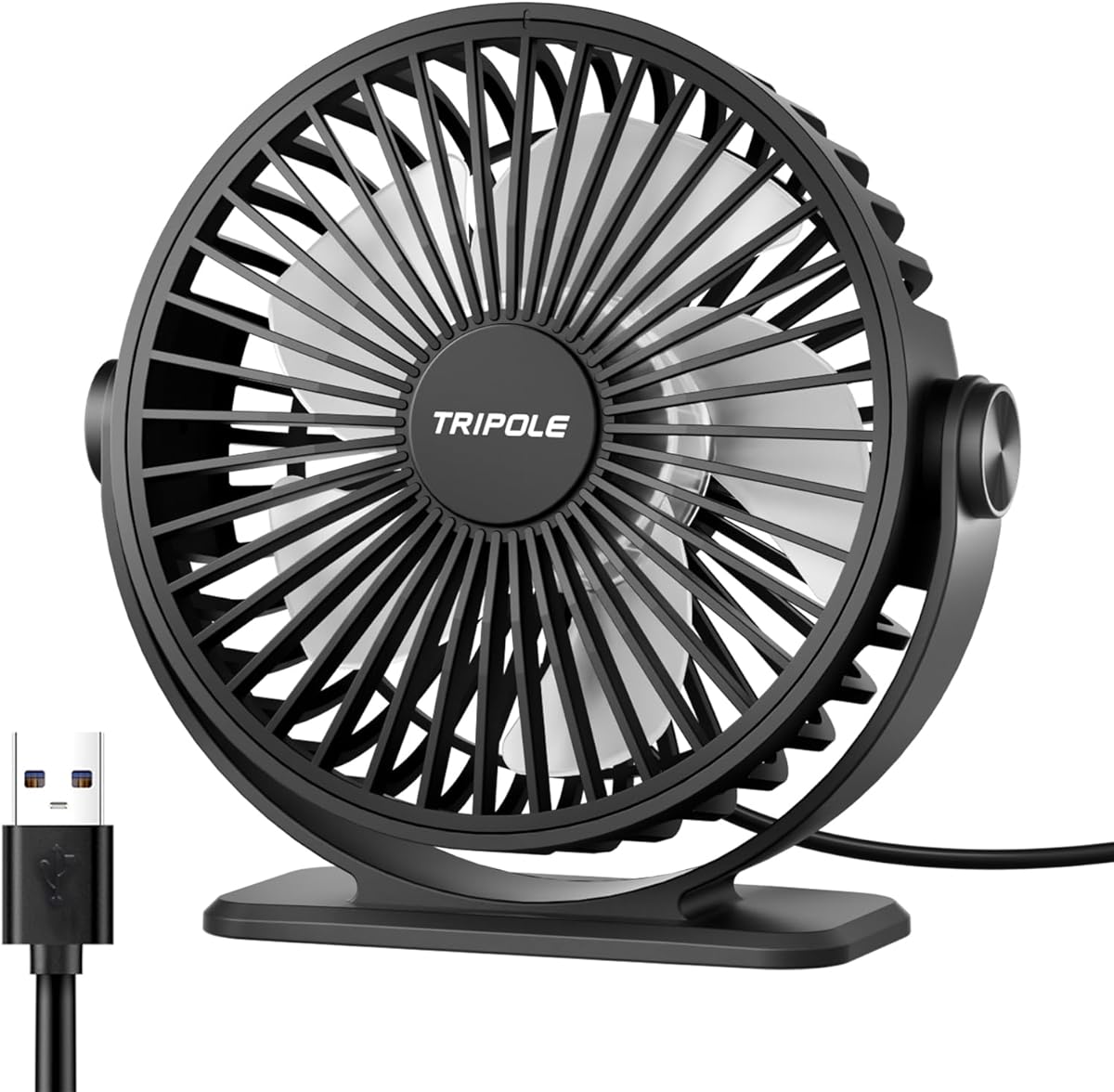
TriPole USB Desk Fan
4.6Editor score
Three speed settings
360-degree head rotation
USB-A powered operation
Detachable cleaning cover
A low wattage fan can deliver a welcome breeze while using relatively little power, making it useful for bedrooms, offices, kitchens, travel, and other spaces where conventional cooling is unnecessary. The best models balance airflow strength, quiet operation, directional control, sturdy construction, and simple maintenance rather than focusing on a single specification.
We compared ten personal, desk, table, and tower fans using the information supplied for each product. The list covers wired and USB-powered options, compact portable designs, broader room circulators, different speed controls, and models designed to remain quiet during work or sleep. Explicit power information appears only where the product data provides it.
Each review identifies the feature that sets the fan apart, along with practical advantages and trade-offs. The top three picks represent a budget-friendly USB fan, a versatile air circulator, and a premium tower fan. Product ratings reflect the supplied data, while prices and availability can change, so readers should confirm current details before purchasing.
4.6Editor score
4.6Editor score

4.4Editor score
As an Amazon Associate we earn from qualifying purchases.
The table below compares all ten fans by format, power method, adjustment, and ideal use, making it easier to identify the model that best matches your space and priorities.


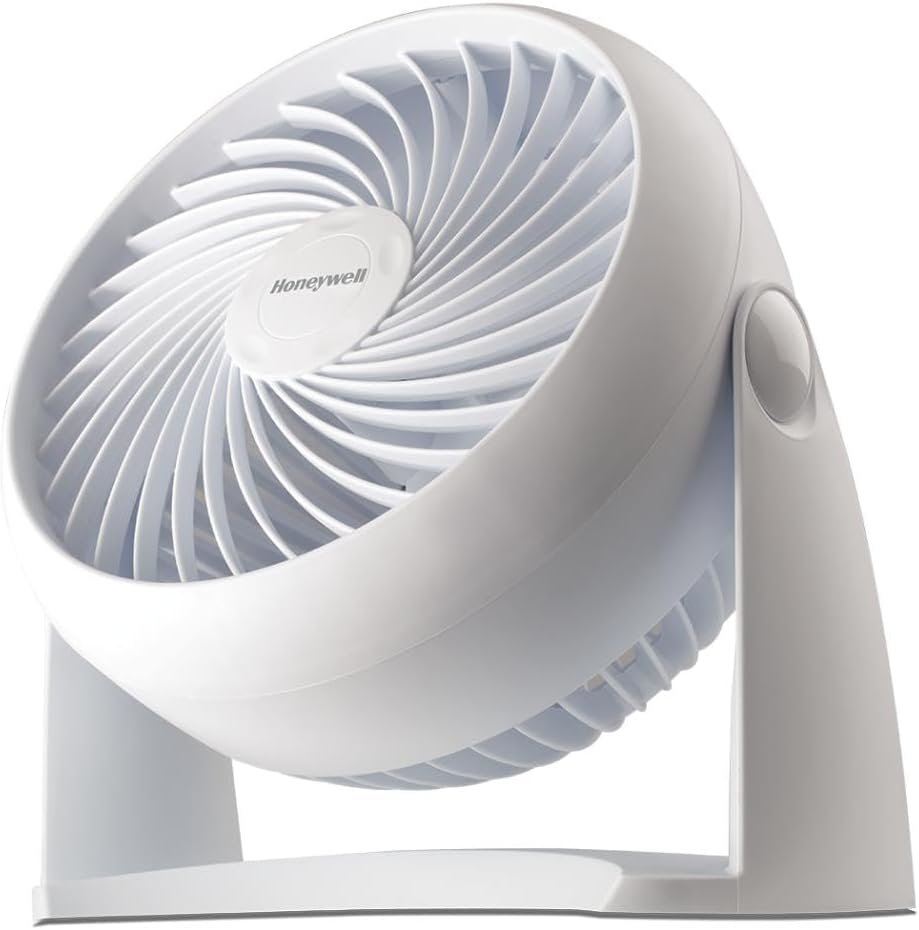


The Honeywell TurboForce HT900 is a compact air circulator with a 4.6 rating that combines focused airflow, adjustable direction, and a space-conscious body. Its three speeds and 90-degree pivoting head make it easy to move between a direct personal breeze and broader air movement in a small or medium-sized room.
We may earn a commission when you buy through this link, at no additional cost to you.
The aerodynamic turbo design is intended to maximize air movement, and Honeywell states that the fan can be felt from as far as 25 feet away. That makes the HT900 more capable than its small footprint may initially suggest. The head can also be mounted on a wall, providing an option for directing circulation into a room without devoting a table surface to the fan.
Its primary trade-off is that it offers a conventional three-speed setup rather than granular digital controls or a battery. It must also be connected to power during use, and no exact wattage figure is supplied. Even so, its compact footprint, wall-mounting versatility, and adjustable head make it a strong all-around choice for a desk, nightstand, office, or kitchen.
Choose the HT900 when you want a dependable circulator that is quiet enough for personal spaces but capable of sending air across a room. It is particularly attractive for readers who value recognizable design, straightforward controls, and flexible placement over flashy features or portable battery operation.
The 25-foot stated reach shows that the HT900 is designed for more than face-level cooling. Its adjustable head lets you point the circulation toward a seating area, workstation, or shared part of a room without moving the entire fan.
Use it on a table, desk, or floor, or mount it on a wall when fixed airflow would be more useful. This flexibility makes the compact design practical for rented rooms and workspaces where every surface matters.
We may earn a commission when you buy through this link, at no additional cost to you.
The TriPole USB Desk Fan is a compact personal fan rated 4.6 by shoppers. It is designed for people who want direct cooling at a desk, beside a bed, or during travel without carrying a larger circulation appliance. Its three wind modes and movable head make it more versatile than a basic fixed-breeze fan.
We may earn a commission when you buy through this link, at no additional cost to you.
Power comes through USB-A, allowing use with a wall charger, computer, or power bank. The supplied 4.9-foot cord adds placement flexibility, while the 4.5-inch diameter keeps the fan small enough for a crowded desktop or nightstand. A wide base and four silicone pads help maintain stability and limit vibration during operation.
The most important limitation is its power requirement. The fan needs 0.8A while operating, and the product guidance notes that the third speed may not function with every charger. A source supporting 5V/1A is recommended for testing. The detachable cover is a welcome feature, but regular access to the blades makes cleaning more convenient.
Pick the TriPole when portability and direct control matter most. It is a sensible low-cost option for a home office, dorm, travel bag, or bedside table, particularly if you already have a reliable USB power source nearby.
The head rotates through 360 degrees, allowing the breeze to follow your position instead of remaining fixed. Three speed modes provide a simple choice between lighter airflow and stronger cooling.
Common USB sources make the fan convenient to move between locations, while the detachable cover exposes the fan mask and blades for routine cleaning. Confirm that your adapter can support the current required for the highest setting.
We may earn a commission when you buy through this link, at no additional cost to you.
The Gaiatop USB Desk Fan is a lightweight personal fan with a 4.5 rating. Weighing less than eight ounces, it is especially suited to travel, cars, offices, and nightstands where portability is more important than whole-room circulation. Its classic appearance and small footprint avoid taking over the surrounding space.
We may earn a commission when you buy through this link, at no additional cost to you.
Three settings provide low, medium, and high airflow, and the stated noise level remains below 50dB even when providing strong wind. The head can move vertically from zero to 30 degrees, which is sufficient for changing the direction of a desk breeze but does not offer the wider positioning of some competing fans.
USB compatibility is broad: the fan can draw power from PCs, laptops, mobile power banks, AC adapters, car chargers, and other compatible USB supplies. As with the TriPole, users should ensure that the source supports 5V/1A if they want reliable operation on the third speed.
This is a strong choice for travelers and anyone who wants a simple personal breeze in a very small package. It lacks the range of a circulator and the fine speed control of a rechargeable model, but its low weight, modest size, and broad power compatibility make it highly portable.
At less than eight ounces, the fan is easy to place in a carry-on bag, backpack, or vehicle. Its small body also suits dorm rooms and shared offices where counter space is limited.
A stated sub-50dB output makes the three-speed fan suitable for many work and rest settings. The 30-degree tilt also allows a modest change in airflow direction without taking up more space.
We may earn a commission when you buy through this link, at no additional cost to you.
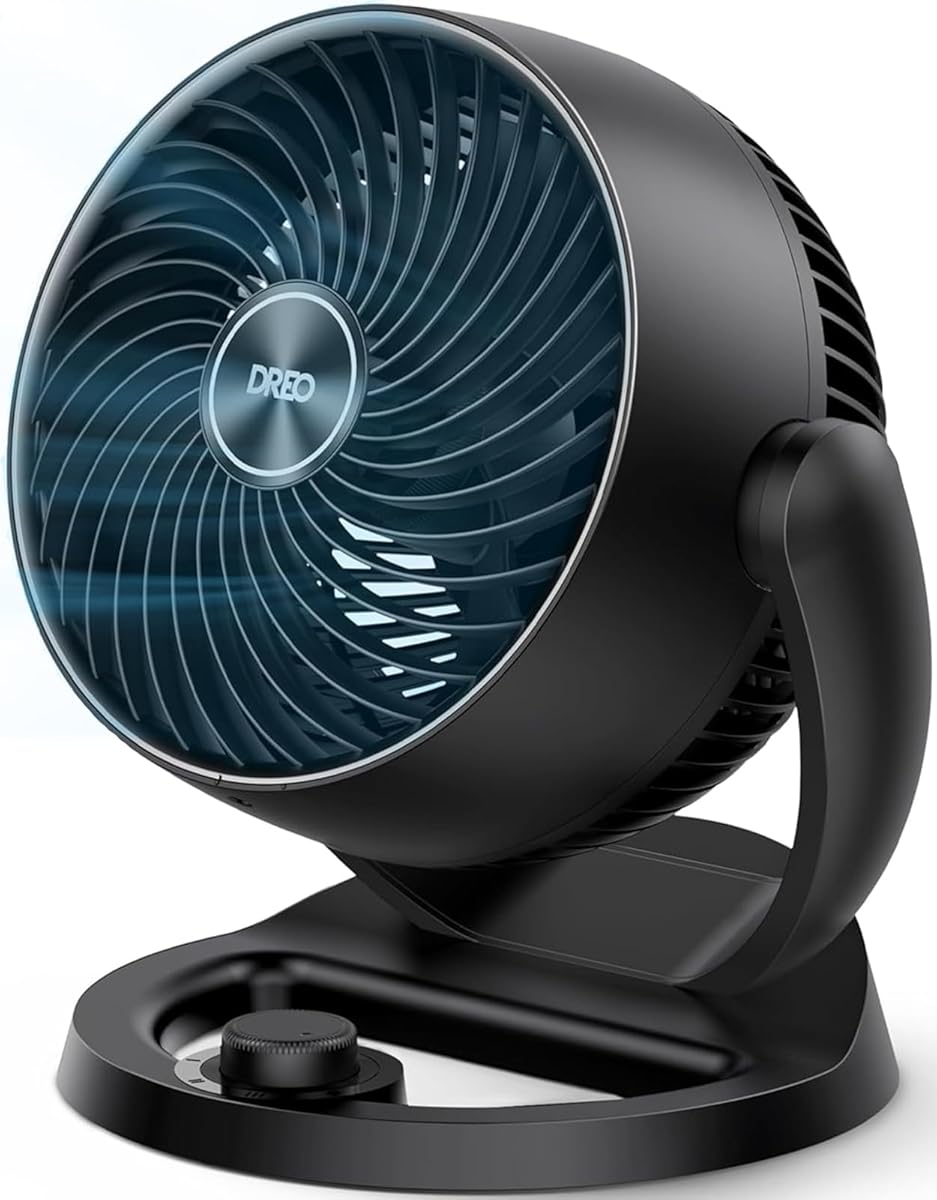
The DREO 11-Inch Circulator combines a low 20dB minimum noise level with airflow capable of reaching 60 feet. Its turbine-inspired design and 800 CFM rating distinguish it from small fans intended only to cool one person. It is a practical option for bedrooms, offices, kitchens, and other spaces that need steady air movement.
We may earn a commission when you buy through this link, at no additional cost to you.
The head has a manual tilt range of minus 30 to 90 degrees, covering 120 degrees of adjustment. That range allows air to be directed upward, downward, or across the room. An integrated handle also provides wall-mounting support, while a three-speed knob gives users straightforward control over the strength of the breeze.
Its footprint and wired design are less convenient than a battery-powered mini fan, especially for travel. The supplied information also does not state an exact wattage, so shoppers who need a numerical consumption figure should verify that detail before buying. Even so, the strong circulation and very low stated noise are meaningful advantages.
Choose this DREO model for a bedroom or office where low noise and broad airflow are priorities. It is especially useful for circulating air around other appliances or directing a steady breeze without relying on a small personal fan.
The 20dB operating noise and stated 60-foot airflow distance combine to make the fan suitable for shared or restful spaces. Its 800 CFM output is designed to move room air rather than merely create a close-range breeze.
A 120-degree tilt range provides substantial control over where the air travels. The included handle expands placement options by allowing the fan to be mounted on a wall for uninterrupted circulation.
We may earn a commission when you buy through this link, at no additional cost to you.
The Amazon Basics Air Circulator is a straightforward 35-watt desk fan with a 4.3 rating. Its three speeds, rear-mounted control knob, and 90-degree tilt make it easy to operate while still providing enough directional adjustment for a bedroom, home office, kitchen, or living area.
We may earn a commission when you buy through this link, at no additional cost to you.
The compact body measures 11.1 inches wide, 6.3 inches deep, and 10.9 inches high, and it uses three seven-inch blades. A weight of three pounds keeps it relatively easy to move between rooms. Unlike many portable alternatives, however, it requires a wired connection and is not designed for cordless travel.
The clear 35-watt specification makes this model attractive to shoppers who want to know its maximum power draw, but that number alone does not guarantee superior efficiency. The 90-degree tilt is helpful, though the model lacks the wider vertical adjustment and oscillation offered by the two DREO circulators in this list.
Buy the Amazon Basics model for a straightforward, recognizable fan with transparent power information and simple controls. It is a sensible middle choice for readers who do not need battery operation, extensive oscillation, or dozens of speed levels.
The stated 35-watt rating at 120V provides a clear operating figure for energy-conscious shoppers. It helps compare this model with fans that publish no wattage, though actual conditions can affect overall consumption.
The rear control knob changes among four positions, including off and three speeds. Its relatively compact dimensions and portable weight make it easy to store away when the fan is not needed.
We may earn a commission when you buy through this link, at no additional cost to you.
The Honeywell TurboForce HT-904 is the white version of a compact circulator offering three speeds and a 90-degree pivoting head. It carries a 4.6 rating and is positioned as a quiet personal fan for a home or office, with a stated feel of air from up to 25 feet away.
We may earn a commission when you buy through this link, at no additional cost to you.
Its aerodynamic turbo design is intended to create stronger air movement than the small housing might imply. The adjustable head makes it possible to redirect that flow as seating, work, or sleeping positions change. Like the black HT900, it can sit on a table or desk and can be wall-mounted for more continuous room circulation.
It shares the same basic limitations as a conventional wired circulator: there is no battery, digital display, or extensive speed selection, and the supplied data does not state exact power consumption. The benefit of the HT-904 over many compact alternatives is its established feature set and understated white appearance.
Choose it for a bedroom, office, or kitchen where a light-colored appliance fits the décor better than a black fan. It is also a solid choice for shoppers who want the Honeywell TurboForce format and a highly adjustable head without a tower-style footprint.
The white finish can blend more naturally with light furnishings and office décor. Its small size preserves counter and nightstand space while retaining a capable pivoting head.
The 25-foot stated reach and wall-mounting option make the fan useful for moving air through a room. Three speeds let users balance stronger circulation with quieter personal cooling.
We may earn a commission when you buy through this link, at no additional cost to you.
The Levoit Tower Fan is the most explicitly low-power premium option here, with a maximum operating figure of 7.5 watts. It pairs that compact power rating with a DC motor, VortexAir Technology, and airflow reaching up to 23 feet per second, making it suitable for focused cooling in bedrooms and offices.
We may earn a commission when you buy through this link, at no additional cost to you.
The user can select five standard speeds plus a Turbo mode, and the multi-angle oscillation offers 30-, 60-, and 90-degree positions. Noise ranges from 20 to 43dB across the speed settings according to the supplied information. Optional sound and display-off functions are useful when a visible interface would be distracting.
A soft carrying handle makes the tower easy to move between rooms, although it must remain plugged into an outlet while operating. The larger vertical format also occupies more space than a mini desk fan, so its design is better for a corner, nightstand, or dedicated floor position.
This is the pick for shoppers who want finely controlled airflow, multiple oscillation choices, and an explicit low maximum wattage. The tower format and broad feature set justify considering it over simpler three-speed models when quiet operation and personalization are especially important.
The stated 7.5-watt maximum is particularly relevant to a low wattage fan guide. Six speed choices and optional display and sound controls let users retain useful features without always using the strongest or most noticeable settings.
Wind of up to 23 feet per second provides a strong personal breeze, while three oscillation angles let you direct it across a bed, desk, or seating area. A soft handle simplifies movement between rooms.
We may earn a commission when you buy through this link, at no additional cost to you.
The DREO 12-Inch Air Circulator pairs a stated 70-foot airflow reach with a 4.6 rating. Its WingBoost system, deep-pitched blades, and aerodynamic design target whole-room circulation rather than a narrow personal breeze, making it a strong option for living rooms, bedrooms, and shared workspaces.
We may earn a commission when you buy through this link, at no additional cost to you.
Noise is listed as low as 25dB, which supports use during quiet evening or bedtime periods. A 120-degree tilt range gives users considerable control over the vertical direction of the airflow, while a knob controls three speed levels. The fan can also be wall-mounted, and its base and handle support use in multiple rooms.
Routine maintenance is another strength because several parts can be removed for cleaning. The main compromises are its larger body compared with mini desk fans and the need for a wired power connection. No exact wattage appears in the supplied specifications, so buyers focused solely on consumption should seek additional product documentation.
Choose this DREO model when a quiet but forceful circulator is more valuable than portability. It is a particularly compelling bedroom option because it combines long reach, low stated noise, directional tilt, and straightforward three-speed control in a desktop format.
The 70-foot stated reach suggests the fan is intended to distribute air across a room, not merely toward one seated person. Its three speeds allow the airflow to be moderated for different activities.
A 25dB minimum is suitable for many sleep and work environments. Removable parts make it easier to clean the blades and housing, helping maintain consistent performance over time.
We may earn a commission when you buy through this link, at no additional cost to you.
The KIMMOO Rechargeable Fan is a cordless personal fan with a 4.4 rating and an unusually broad control range. It offers 100 selectable wind levels, operates at 35dB on its lowest setting, and includes a digital display that shows battery status and the current speed.
We may earn a commission when you buy through this link, at no additional cost to you.
A high-speed motor is paired with a stated 200% power boost and a wide range of 2,000 to 2,900 RPM. The fan rotates through 90 degrees, allowing the airflow to be aimed in different directions, while a protective dual guard rail supports safer use around children and pets.
Its battery provides up to eight and a half hours of continuous cooling and recharges in about two and a half hours with a 5V/2A adapter. This cordless experience is more flexible than a standard USB desk fan, but the 0.92-pound weight and approximately 5.5 by 3.11 by 6.58-inch size are larger than the smallest models in the list.
Buy the KIMMOO for travel, outdoor use, or any location where outlet access is uncertain. Its fine speed control is also useful when you want a very gentle breeze, while the rechargeable design avoids dependency on a continuously connected power source.
One hundred levels provide much more control than a standard three-speed switch. This is helpful for matching a very light breeze to desk work or increasing airflow gradually as conditions change.
The battery lasts for up to eight and a half hours and charges in approximately two and a half hours. A digital display keeps both battery level and selected speed visible, which is especially helpful while traveling.
We may earn a commission when you buy through this link, at no additional cost to you.
The Honeywell QuietSet HTF210B is a compact 13-inch oscillating personal fan designed for bedrooms, desks, and nightstands. Its four sound-and-power levels make it easy to choose between softer background airflow and stronger cooling, while oscillation expands the area the breeze can reach.
We may earn a commission when you buy through this link, at no additional cost to you.
The automatic shutoff timer is especially valuable for overnight use because it can turn the fan off after a selected period. Its slim form is easier to integrate into a bedside setup than a large tower or broad room circulator, and the Honeywell brand gives the design a familiar, established appearance.
Compared with the KIMMOO, it does not offer cordless operation, a digital display, or exceptionally fine speed control. It also needs a wired power connection, and the supplied product information does not include an exact wattage. Its strengths are instead centered on oscillation, timer convenience, and straightforward personal cooling.
Choose the QuietSet when sleep and bedside use are the main goals. It is a practical pick for readers who want the fan to move air across a bed automatically and shut off without requiring them to remember to switch it off.
The moving head broadens the area reached by the breeze without requiring you to reposition the fan. That makes the model useful when two people share a bed or when you want coverage across a pillow area.
The automatic shutoff timer adds convenience during naps and nighttime use. Four sound-and-power settings provide a choice between stronger cooling and quieter background circulation.
We may earn a commission when you buy through this link, at no additional cost to you.
The right low wattage fan depends on whether you need a personal breeze, broad room circulation, cordless portability, or particularly quiet operation. Consider the power source, control range, airflow reach, noise level, adjustment, maintenance, and available space before choosing.
A published wattage gives shoppers the clearest way to compare potential energy use. The Amazon Basics model is specified at 35 watts, while the Levoit Tower Fan has a stated maximum of 7.5 watts. Other products do not include an exact power figure, so readers should not infer one from their size, speed settings, or airflow claims.
Choose a model with a clearly stated consumption level when energy use is a primary concern. Lower wattage can support extended operation, but airflow quality, noise, and controls still determine how useful the fan feels.
Personal fans prioritize a close, directed breeze and usually need less space. Air circulators use larger housings, longer airflow reach, greater tilt ranges, and stronger room distribution. The 11-inch and 12-inch DREO models are designed for broader circulation, while the TriPole and Gaiatop are better suited to desks and nightstands.
Match the format to the area that needs cooling. Choose a personal fan for a workstation or bedside table, and consider a circulator when you want to move air throughout a bedroom, office, or kitchen.
Power requirements determine where a fan can be used. USB-powered models work with compatible computers, adapters, power banks, and car chargers. A rechargeable fan offers cordless operation but depends on battery capacity and charging access. Wired circulators provide consistent operation but need an outlet or extension cord within reach.
Prioritize freedom from outlets when travel or outdoor use matters. For stationary use, a wired model may be simpler, especially if the power source supports the fan's highest speed without underpowering it.
Noise matters most in bedrooms, quiet offices, and study areas. The 11-inch DREO lists a 20dB minimum, the 12-inch DREO lists 25dB, the Levoit ranges from 20 to 43dB, the KIMMOO reaches 35dB at its lowest setting, and the Gaiatop remains below 50dB according to the supplied information.
Look for the lowest setting as well as the maximum. A fan that is quiet at minimum may still become noticeable at high speed, so speed selection is just as important as the headline noise figure.
Useful adjustment can include a tilting head, vertical rotation, oscillation, or multiple oscillation angles. The TriPole rotates 360 degrees, the DREO circulators provide 120-degree tilt, the Honeywell TurboForce models pivot 90 degrees, and the Levoit offers 30-, 60-, and 90-degree oscillation.
More adjustment is helpful when people move around a shared room or when a fixed breeze becomes uncomfortable. Choose the controls that match the situation rather than paying attention to the number alone.
Three-speed controls are the most common configuration in this roundup and offer a simple balance between stronger and gentler airflow. The Levoit adds a Turbo mode, while the KIMMOO provides 100 levels and a digital display. These differences matter when you want very fine control or a clear view of the selected setting.
Basic controls are easier to operate for many households, while granular control can improve comfort during work or sleep. Select the number of settings based on how much you value customization versus simplicity.
A fan must fit the intended surface and be easy to move when needed. The TriPole has a 4.5-inch diameter, the Gaiatop weighs under eight ounces, and the Amazon Basics model weighs three pounds. Tower and circulator designs occupy more room but provide wider airflow and mounting options.
Measure the desk, shelf, or nightstand before purchasing. For portable models, also consider the weight and whether a carrying handle or cord length will make the fan easier to reposition.
Dust on blades and vents can reduce airflow and affect the appearance of a fan. The TriPole has a detachable cover, the 12-inch DREO has removable parts, and the Levoit adds a sound and display-off function for less distracting operation. Routine access to the fan face is valuable in homes where pets, cooking, or open windows add dust.
Choose a design that allows regular cleaning without complicated disassembly. Unplug the fan before removing covers or touching blades, and follow the manufacturer's cleaning instructions to avoid damaging the housing or motor.
Place the fan on a stable, level surface with enough clearance around the grille and blades. For a circulator, aim the tilted head across the area that needs airflow rather than directly into a fragile surface. USB models should be connected to a compatible power source that meets the required output, while rechargeable models should be charged before extended use.
Start on a low setting and increase the speed only as needed. Adjust the tilt, rotation, or oscillation to keep the breeze comfortable as people move. If a USB fan does not operate properly on its highest speed, test it with a source that meets the specified current and voltage before assuming the fan is defective.
Disconnect power before cleaning. Remove the cover or accessible components according to the product instructions, then wipe the blades, grille, and housing with a lightly dampened cloth. Do not immerse the motor or electrical parts, and allow every piece to dry fully before reassembly or operation.
The Levoit Tower Fan is the only product here with an explicitly stated maximum of 7.5 watts, making it the clearest choice for readers comparing published power figures. The Amazon Basics model is rated at 35 watts, while the remaining products do not provide exact wattage in the supplied information. A smaller wattage figure does not by itself determine comfort, so airflow reach and noise should also be considered.
A low wattage fan can move air through a room, but it should not be expected to replace air conditioning in extreme heat. The 11-inch and 12-inch DREO circulators are the strongest room-oriented choices here, with stated reach of 60 and 70 feet. Personal USB fans are better for cooling one desk, bedside, or seating area.
The DREO 11-Inch Circulator and Levoit Tower Fan both list a 20dB minimum operating level, making them strong candidates for quiet use. The 12-inch DREO lists 25dB, while the Honeywell QuietSet includes four sound-and-power levels and an automatic shutoff timer. Actual perceived noise depends on the selected speed, room acoustics, and distance from the fan.
A USB desk fan can run from a compatible computer, laptop, power bank, car charger, or AC adapter, provided the source meets its voltage and current requirements. The TriPole needs 0.8A while operating, and its guidance recommends testing the third speed with a 5V/1A source. Always confirm the supply specifications before travel.
The TriPole USB Desk Fan is a compact choice for one workstation, while the 12-inch DREO is better when you want to circulate air beyond a single person. The Levoit Tower Fan offers the most detailed speed and oscillation controls among the products with a clearly stated low maximum wattage. Consider outlet access, noise, and desk space before choosing.
A rechargeable model is more convenient for travel, outdoor areas, and places without a nearby outlet. The KIMMOO provides up to eight and a half hours of stated runtime and uses 100 speed levels. Plugged-in models avoid battery charging and provide uninterrupted operation, but their cords can limit placement.
Moving air can make a room feel more comfortable and help distribute conditioned air more evenly. Several models in this guide are also described as useful alongside space heaters, humidifiers, or purifiers. They still require regular cleaning and sensible placement, and they do not change the cooling capacity of the air conditioner itself.
Clean the blades and grille whenever visible dust accumulates, and more frequently in dusty environments, kitchens, or homes with pets. Always disconnect the power before removing any cover or cleaning accessible parts. Avoid immersing the motor, using excessive liquid, or reassembling the fan while any component remains wet.
The top three picks cover distinct priorities: the TriPole USB Desk Fan is the budget-friendly portable choice, the DREO 12-Inch Air Circulator is the strongest overall room-circulation option, and the Levoit Tower Fan is the premium selection with an explicit 7.5-watt maximum and refined controls. Each serves a different kind of space and user.
Prioritize the features that affect daily comfort: clear power information, enough airflow reach, acceptable noise, and controls that fit the room. Personal users may value USB power or a rechargeable battery, while households seeking room-wide movement will benefit from a larger circulator with a wide tilt range or oscillation.
Ratings, promotions, availability, and prices can change, so check the current listing and product details before buying. Verify connector requirements, power-source output, dimensions, and cleaning instructions to ensure that your selected low wattage fan fits the intended location.