
SteriPen Adventurer Opti
4.4Editor score
Two included CR123 batteries
Built-in LED flashlight
Automatic optical water sensor
Portable UV water sterilizer guide comparing ten UV water purifiers for travel, camping, emergency kits, aquariums, and under-sink use plus features, limits
Portable UV water sterilizers are compact treatment devices that use ultraviolet light to reduce microorganisms in clear drinking water without requiring chemical tablets. The best model depends on whether you need a lightweight pen, an integrated bottle, or a fixed purification system for home, vehicle, or aquarium use.
We compared all ten products by examining their intended use, treatment method, power source, portability, capacity, installation requirements, and supplied safety features. The list covers handheld travel purifiers, rechargeable bottles, under-sink systems, a multi-purpose cartridge purifier, and an aquarium clarifier.
Each pick reveals how it fits into a portable water-treatment strategy, along with any important limitations. Ratings reflect the supplied customer feedback, while specifications and features come from the listed product information. Product availability, configuration, and pricing can change, so confirm current details before buying.
4.4Editor score

4.1Editor score

3.9Editor score
The table below compares all ten listed products by application, power method, capacity, and notable design features, making it easier to separate true travel water-treatment tools from fixed plumbing and aquarium accessories.




The SteriPen Ultralight is a compact pen-style UV water purifier for backpackers, fast packers, and solo travelers. Its listed rating is 4.1, and its standout quality is simplicity: at only 3 ounces, it can fit into a pack pocket, vest pouch, or hydration bottle without taking up much room.
We may earn a commission when you buy through this link, at no additional cost to you.
The purifier activates automatically when it contacts water, removing the need to remember a button before treatment. It uses an 8,000-treatment UV lamp to purify clear water in approximately 90 seconds without chemical tablets or flavor changes. USB recharging is another strong feature for trips where carrying loose batteries would be inconvenient.
One charge is listed as providing about 20 treatments, which is less than the battery capacity of the Adventurer Opti. The unit also cannot make cloudy or sediment-heavy water suitable without pre-filtering, so it should be paired with a separate filter for muddy sources. Those limitations are normal for a device this small and focused.
This is the most balanced recommendation for a traveler who prioritizes low weight and minimal operating complexity. Choose it for hiking, international travel, and emergency kits where charging access is reasonably available. Users expecting many consecutive treatments away from power should instead consider a replaceable-battery model.
Because the Ultralight activates on contact with water, there is no startup button to forget during a tiring trail stop. That automatic behavior also helps prevent unnecessary battery use while the pen is stored in a pack.
USB charging lets the unit recharge from a wall adapter, power bank, or other USB source, while its pen-shaped body remains easy to organize. Carry a pre-filter separately if your itinerary may include cloudy water.
We may earn a commission when you buy through this link, at no additional cost to you.
The SteriPen Adventurer Opti combines a six-inch purifier with replaceable-battery operation and an emergency light. It carries a 4.4 rating, making it one of the stronger-rated entries in this guide. At 3.6 ounces, it remains compact enough for camping, backpacking, travel, and emergency-preparedness kits.
We may earn a commission when you buy through this link, at no additional cost to you.
The purifier runs on two included CR123 lithium batteries, which are widely available in cameras and outdoor retailers. One set is listed as supporting approximately 60 treatments without USB charging or access to a wall outlet. An optical sensor detects when the lamp is submerged, and a built-in LED flashlight provides useful backup illumination during nighttime travel.
Compared with the rechargeable Ultralight, the Adventurer Opti is slightly heavier and depends on battery availability. It also has the same important limitation associated with UV treatment of clear water: cloudy sources should be pre-filtered. Even so, the larger treatment capacity and replaceable power make it adaptable to long trips and remote destinations.
This is a strong pick for hikers who expect several daily treatments and would rather carry spare batteries than recharge a purifier. It works particularly well for international travel, scouting, camping, and emergency kits where a built-in flashlight adds value. Choose the Ultralight instead when every ounce and the need for USB access outweigh battery capacity.
CR123 lithium batteries offer a practical advantage for extended travel because spare cells can be carried without relying on a generator, vehicle outlet, or community charging station. The listed battery set supports around 60 treatments.
The built-in LED flashlight gives the purifier a secondary function when a headlamp is unavailable. It makes the device especially convenient for camp setup, early-morning departures, and household emergency bags.
We may earn a commission when you buy through this link, at no additional cost to you.
This listing for the SteriPen Adventurer Opti offers the same broad travel-oriented design as the higher-ranked Adventurer model, with a 4.5 customer rating. Its 6-inch pen format is intended for camping, backpacking, travel, and emergency-preparedness use rather than permanent installation.
We may earn a commission when you buy through this link, at no additional cost to you.
Two included CR123 lithium batteries provide roughly 60 treatments, eliminating the need to find USB power during an outing. The optical water sensor activates the lamp only when it is submerged, while the button-and-stir procedure remains familiar and direct. A neoprene case and belt loop make the unit easy to keep accessible at camp or in a day pack.
The same constraint applies to most compact UV personal purifiers in this roundup: the water should be clear, and cloudy water should be pre-filtered. The device is also a little heavier than the 3-ounce Ultralight. Travelers who require a small dedicated flashlight may need to carry one alongside it.
This version is a solid choice for campers and international travelers who prioritize replaceable batteries and high customer feedback over minimum weight. Compared with the other Adventurer Opti listing, the supplied title is shorter, but the listed operating features and weight are effectively the same. Check the current package contents and configuration before ordering.
The neoprene carrying case and belt loop keep the purifier close at hand without requiring a separate pocket in a larger bag. That is useful when water needs to be treated during a hike or campsite stop.
Replaceable CR123 cells let the purifier operate far from reliable charging infrastructure. Keeping a spare set in an emergency kit helps prevent an otherwise healthy device from becoming unusable when its batteries expire.
We may earn a commission when you buy through this link, at no additional cost to you.
The UV Water Filter is a 1 GPM UVC-LED add-on for under-sink and point-of-use installations, not a handheld travel sterilizer. Its 4.2 rating is supported by a clear set of installation-oriented features, including a flow sensor, blue and green status lights, and compatibility with existing reverse-osmosis systems.
We may earn a commission when you buy through this link, at no additional cost to you.
The listed UV wavelength is between 270 and 280 nanometers. According to the product information, this can disrupt the DNA or RNA structure of microorganisms and is stated to eliminate up to 99.999% of bacteria, viruses, and protozoa within seconds. The flow sensor activates the UVC-LED only while water is running, which the manufacturer says can reduce energy use by as much as 90%.
The system is designed as an add-on rather than a complete primary filtration system. It does not replace sediment or carbon filtration, and the supplied information explicitly says it is unsuitable for whole-house water filter systems. Installation also requires compatible under-sink plumbing and space beneath the sink.
Home users with an existing RO setup may value this as a final disinfection layer, while renters should confirm installation permissions before purchasing. It is not the right choice for a backpack or emergency bag because it requires a fixed water line and continuous power. Its strength is automated point-of-use treatment rather than portability.
The system uses a blue status light when powered without flow and a green light when water is running and UV disinfection is active. This makes operating status easier to identify during normal use.
Adding a UV stage after existing filtration can provide an additional disinfection step. It is most appropriate for users who already understand their plumbing and want a compact chemical-free treatment stage.
We may earn a commission when you buy through this link, at no additional cost to you.
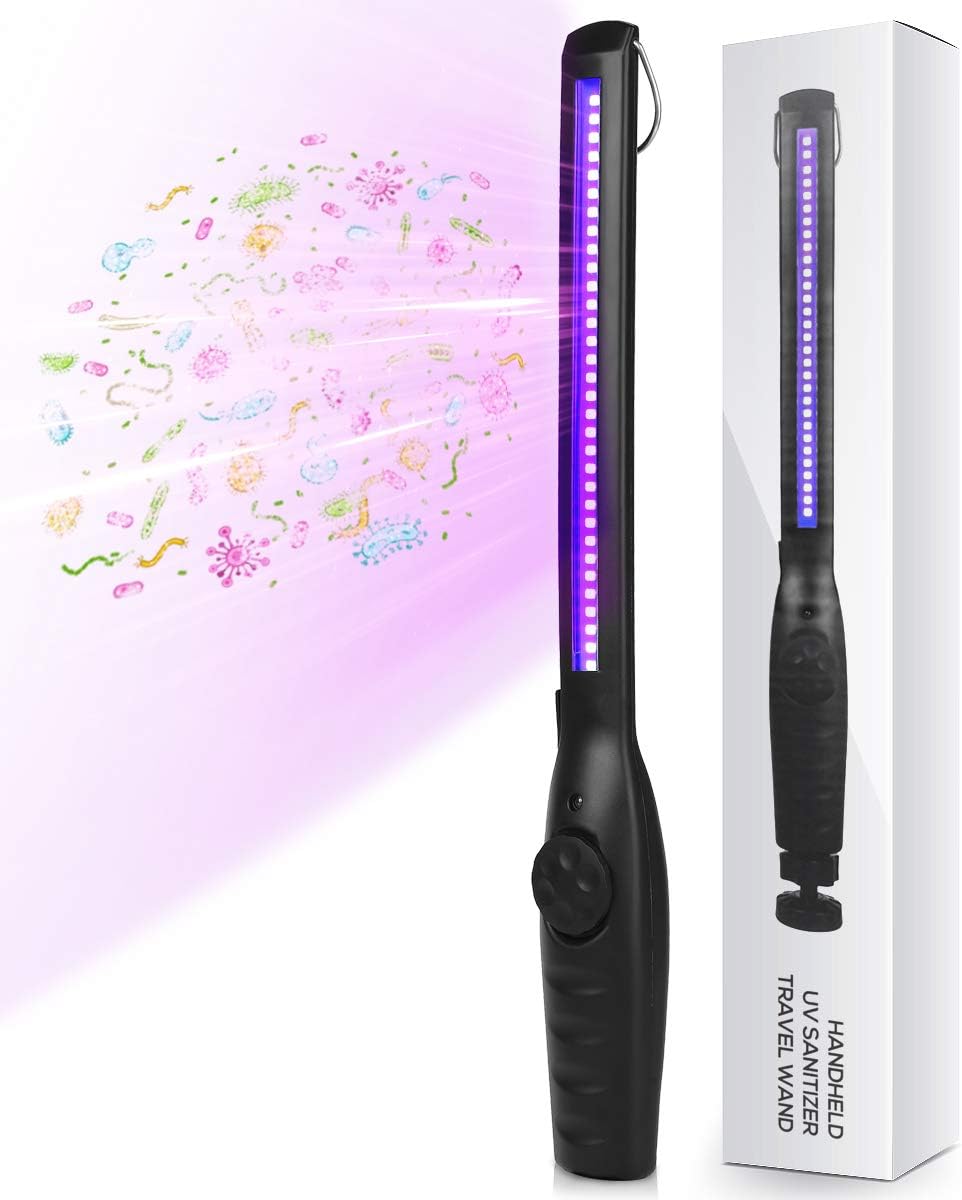
The Portable UV Light Wand is a general-purpose UV disinfection lamp for homes, offices, hotels, vehicles, and travel surfaces. It has a 4.3 rating, but it should not be confused with a portable drinking-water purifier. The supplied information does not describe a water chamber, submerged lamp, treatment cycle, or contaminant-reduction claim for drinking water.
We may earn a commission when you buy through this link, at no additional cost to you.
Its rechargeable wand format measures 37.5 by 4 by 3.5 centimeters and weighs 0.22 kilograms. A one-hour charge is listed as supporting up to five hours of use. The device is designed for portable surface sanitization and is operated by turning it on and exposing the intended area to the light.
A major limitation is that this is not a substitute for a certified water-treatment device, and the instructions explicitly say not to use it on people, pets, or plants or to direct it into eyes. As with any UV surface tool, effectiveness depends on appropriate distance, angle, exposure, and unobstructed contact with the treated surface.
Choose this wand for travel hygiene, hotel-room surfaces, dashboards, or other non-food sanitation tasks. Do not choose it as the primary safeguard for water collected outdoors. Travelers who need potable-water treatment should select a purpose-built SteriPen, an integrated UV bottle, or another purifier with documented water-treatment specifications.
The wand's elongated shape and rechargeable design make it convenient to keep in a carry-on or vehicle for targeted surface disinfection. Its simplicity is useful for travelers who want a compact device with quick one-button operation.
UV light should never be directed at eyes, people, pets, or plants. Follow the supplied warnings and use the product only on surfaces for which UV sanitization is appropriate.
We may earn a commission when you buy through this link, at no additional cost to you.
The UVBrite UV Bottle combines an 18.6-ounce insulated stainless-steel bottle with a rechargeable UV-C purification cap. It has a 3.9 rating, the lowest listed among these ten products, but its integrated design appeals to travelers who prefer not to carry a separate purification pen and drinking container.
We may earn a commission when you buy through this link, at no additional cost to you.
The bottle's self-cleaning cycle uses a UV-C system that the product information says reduces microbes by up to 99.99%. A single press starts normal sterilization, while a double press selects blitz mode for water that may need greater treatment. Food-grade 304 stainless steel, BPA-free cap materials, a quartz lens, and a leak-proof silicone gasket support its outdoor orientation.
A safety lock is the feature that most distinguishes this model. The UV-C light cannot be activated when the cap is removed, reducing the chance of accidental exposure to the lamp. The trade-offs are a fixed 18.6-ounce capacity, a rechargeable cap that must be kept charged, and a customer rating that trails the handheld purifiers.
This is the most convenient option for everyday commutes, campsite use, and emergency bags where one container must do several jobs. It is less suitable for groups or long-distance travel requiring large volumes. Buyers should confirm recharge compatibility and battery availability before relying on it away from a power source.
Combining the vessel and purifier removes the need to transfer treated water into a separate bottle. That simplicity can improve routine use, particularly for office commutes and short outdoor outings.
The cap cannot activate UV-C while removed from the bottle. This is a meaningful design feature for a device intended to travel in bags and be handled frequently in public or domestic settings.
We may earn a commission when you buy through this link, at no additional cost to you.
The iSpring UVF11A is an inline 11-watt UV water filter intended for under-sink and reverse-osmosis systems. It is not a portable UV water sterilizer, but it is one of the highest-rated products in the guide at 4.6. The device is aimed at households seeking a final purification stage within an existing filtration setup.
We may earn a commission when you buy through this link, at no additional cost to you.
A smart flow-sensor switch activates the ultraviolet system when water flows and switches it off when flow stops. The stainless-steel chamber houses the lamp, and quarter-inch inlet and outlet quick-connect fittings support common plumbing configurations. The stated flow rate is 1.0 GPM, while the lamp is listed as having an 8,000-hour lifespan.
This product should be evaluated as an add-on rather than a complete well-water or whole-house treatment system. The supplied information describes it as suitable for well water, lakes, streams, and other problem sources, but appropriate pre-filtration and installation remain important. It also needs a nearby electrical supply and sufficient cabinet space.
Best suited to homeowners with an existing RO system, under-sink setup, or compatible inline plumbing, the UVF11A offers a straightforward way to add ultraviolet disinfection. It is a poor choice for backpacking, travel, or emergency kits because it cannot operate without plumbing and power. Users should verify connections, flow requirements, and local installation conditions before purchasing.
The flow sensor prevents the UV lamp from operating continuously when no water is moving. This is particularly useful in an under-sink system that may remain connected to a household supply throughout the day.
Quarter-inch quick connections make the system relatively easy to incorporate after compatible filtration equipment. The intended installation position is within a household water-treatment train where flow and power are reliable.
We may earn a commission when you buy through this link, at no additional cost to you.
The iSpring UVF8 is an inline UV-C LED water filter for under-sink systems, RVs, boats, and other compatible installations. Its 4.6 rating places it among the most well-reviewed products here, though it fills a home and vehicle plumbing role rather than a backpack-oriented role.
We may earn a commission when you buy through this link, at no additional cost to you.
The product information highlights several advantages of LED UV technology. The lamp contains no mercury, does not produce ozone or associated odors, needs no warm-up period, and does not transfer heat to the water in the way a traditional mercury-vapor lamp can. The system is also described as compact, and its on-and-off cycling is not presented as shortening LED life.
The UVF8's intelligent flow sensor turns on the light when water passes through, and the listed lamp service life is up to 7,000 hours. The manufacturer states a 99.9% elimination rate in two seconds. As with any inline UV device, the actual result depends on correct installation, suitable water clarity, dosage, and the condition of the complete treatment system.
Choose the UVF8 for homeowners, RV owners, or boaters with an existing under-sink arrangement and a quarter-inch connection. Its low-maintenance LED design and compact form are attractive for fixed installations. It is not a substitute for a portable pen when the goal is treating water in a stream, at a campsite, or during travel.
Without mercury, a warm-up period, or the same heat-transfer profile of a conventional UV lamp, the UVF8 is positioned as a low-attention option. Its flow-triggered operation further limits unnecessary runtime.
The stated suitability for RVs and boats makes this model relevant to mobile households, provided the plumbing and electrical arrangement can accommodate it. Its compact inline form may be easier to integrate than a larger purifier assembly.
We may earn a commission when you buy through this link, at no additional cost to you.
The GRAYL GeoPress is a 24-ounce portable water purifier and filter bottle for camping, hiking, fishing, global travel, vehicle kits, and household emergencies. It has a 4.6 rating. Although it appears in this UV-focused comparison, the supplied information does not identify UV technology as part of its treatment process.
We may earn a commission when you buy through this link, at no additional cost to you.
Its primary strength is mechanical simplicity: fill the bottle, press, and drink. No setup time, pump, hose, straw, batteries, or chemicals are required. The product information states that it removes pathogens such as rotavirus, norovirus, hepatitis A, E. coli, salmonella, dysentery, giardia, cryptosporidium, and amoebae, while also filtering particulates and adsorbing volatile organic compounds, PFAS, pesticides, herbicides, heavy metals, flavors, and odors.
The replaceable purifier cartridge is listed as good for 65 gallons, or 250 liters. That creates a meaningful ongoing limit, and replacement availability matters for long-term use. The 24-ounce body is also larger than the pen-shaped UV purifiers, so it consumes more pack volume even though it does not require electrical charging.
This is an excellent choice for travelers who value no-battery operation and want one handheld device for diverse water sources. It is also relevant to homes and cars because cartridge treatment can handle more total volume than a typical personal UV pen. If ultraviolet treatment specifically is required, choose a documented UV model instead.
The fill-press-drink format avoids batteries, chemicals, and prolonged setup. That makes the bottle useful in locations where power is unavailable and in emergency kits meant to remain ready for an extended period.
The stated capability to filter particulates and adsorb numerous chemical categories gives the GeoPress a different role from a UV-only device. It is particularly useful when the source water is not simply clear but microbially contaminated.
We may earn a commission when you buy through this link, at no additional cost to you.
The Fluval In-Line UVC Clarifier is designed specifically for aquarium filter systems rather than drinking-water treatment. It has a 4.5 rating and uses inline UV treatment to address algae, bacteria, and cloudiness while helping maintain healthier freshwater and saltwater environments.
We may earn a commission when you buy through this link, at no additional cost to you.
The unit connects to most filter hoses with a five-eighth-inch connection, making it compatible with many common canister and sump-based aquarium arrangements. Its stated functions include reducing green water, breaking down harmful bacteria and algae, improving water clarity, and supporting better circulation. The bulb is removable for replacement and routine maintenance.
The most important limitation is intended application. The product is not a portable drinking-water sterilizer, and it should not be used as one. It also requires continuous connection to an aquarium filtration circuit rather than a bottle, stream, or household faucet. Aquarium water and drinking water have different treatment requirements and exposure conditions.
Choose the Fluval when your goal is clearer aquarium water and stronger control of microorganisms within an established filtration system. Confirm hose diameter, tank type, and flow compatibility before installation. For camping, travel, or emergency drinking water, select one of the purpose-built personal purifiers or cartridge purifiers in this guide instead.
The clarifier is intended to work within a continuously circulating aquarium system. That focus distinguishes it from devices designed to treat a finite quantity of water during a 90-second exposure cycle.
A five-eighth-inch connection and removable bulb make it straightforward to add to many common filter layouts. Users without compatible tubing or a suitable filter position should consider a different aquarium circulation solution.
We may earn a commission when you buy through this link, at no additional cost to you.
The most useful choice depends on portability, source-water quality, available power, and whether the device must treat drinking water, household water, or an aquarium. These factors narrow the field before you compare weight, treatment speed, and maintenance requirements.
A portable UV water sterilizer should be designed to treat water for drinking, while surface sanitizers and aquarium clarifiers serve different purposes. The UV Light Wand in this list is intended for surfaces, and the Fluval UVC Clarifier is designed to control microorganisms in aquarium water. Neither should be treated as a portable drinking-water device. The SteriPen models and UVBrite bottle include explicit water-purification functions, whereas the GRAYL GeoPress is a portable purifier and filter without UV being identified in the supplied data.
For backpacking and fast hiking, every gram and cubic inch matters. The SteriPen Ultralight weighs 3 ounces, making it the smallest dedicated personal UV purifier in the group. The Adventurer Opti is 3.6 ounces and adds battery weight, but it includes a protective case and emergency light. The UVBrite bottle is larger because it doubles as a drinking vessel, while the GRAYL GeoPress also occupies substantial bottle space but requires no batteries. Fixed under-sink products are clearly intended for installation rather than mobility.
USB charging offers easy routine use when a power bank or wall outlet is available, and it avoids managing disposable cells. The SteriPen Ultralight provides about 20 treatments per charge, so a long expedition may require planned charging or a backup device. The Adventurer Opti uses two CR123 lithium batteries and is listed at around 60 treatments per set, making spare batteries more practical in remote regions. The UVBrite also uses a rechargeable cap, while the GRAYL and aquarium clarifier do not depend on portable battery charging for operation.
The supplied SteriPen descriptions specify treatment of clear water and advise pre-filtering cloudy water. Sediment, organic material, and turbidity can reduce the effective UV dose by shielding microorganisms from the lamp. If your source may be muddy, pair a UV purifier with a separate filter or select a device explicitly designed to filter particulates and adsorb chemical categories. The GRAYL GeoPress has a different stated treatment approach, while inline UV systems depend on appropriate upstream filtration and adequate flow.
A treatment cycle should cover the full recommended exposure time, and a purifier should be able to treat the amount of water you expect to consume. The SteriPen Ultralight and Adventurer Opti use a 90-second stirring process for clear water. The Adventurer's listed battery capacity is larger, while the UVBrite has an 18.6-ounce vessel and two selectable modes. The GRAYL purifies 24 ounces without batteries and uses a cartridge rated for 65 gallons, making it suited to higher long-term use.
A true portable sterilizer should work without permanent plumbing. The SteriPen pens and UVBrite bottle operate with a bottle or container, while the GRAYL works from a spigot, sink, lake, river, or well. The UV Water Filter, iSpring UVF11A, and iSpring UVF8 are under-sink add-ons with flow sensors, quick connections, and electrical requirements. The Fluval clarifier belongs in an aquarium loop. These fixed products can be excellent within their intended systems but are poor choices for mobile water collection.
Automatic activation can prevent incorrect operation and unnecessary energy use. The SteriPen Ultralight activates on contact with water, while the Adventurer Opti uses an optical water sensor. The inline UV filters activate in response to flow, and the UVBrite's interlock prevents the UV-C cap from activating when removed. Any UV device also requires responsible use: do not expose eyes or living tissue to the lamp, and follow the manufacturer's instructions.
Battery cells, rechargeable lamps, cartridges, and replacement bulbs create different ongoing requirements. A disposable-battery purifier is simple to recharge by carrying spare cells. A USB device is convenient but depends on access to a suitable power source. A cartridge purifier such as the GRAYL requires timely cartridge replacement after its stated 65-gallon capacity. The inline UV systems use lamps with listed service lives of 8,000 hours or 7,000 hours. Budget for consumables and confirm their availability in the regions where the device will be used.
Start by choosing the correct water source and inspecting the device, battery, battery compartment, lamp housing, and storage case. For a pen-style purifier, use clear water and place the UV lamp in a compatible wide-mouth container according to the manufacturer's directions. Submerge the lamp, activate the unit, and stir the water for the full 90-second treatment cycle described in the product information. Do not shorten the cycle because proper exposure is central to the treatment process.
Treat cloudy or sediment-heavy water with a suitable filter before using a UV-only device. For the UVBrite bottle, fill the vessel, close the cap securely, and select the normal or blitz mode as appropriate. For the GRAYL GeoPress, fill, press, and drink as directed while observing the cartridge's capacity. The under-sink UV units should only be installed with compatible fittings, adequate flow, appropriate upstream filtration, and a safe electrical connection.
After each use, disconnect the power or remove the batteries as appropriate, wipe accessible surfaces dry, and store the unit in its case away from children and pets. Recharge before an outing rather than waiting until departure, keep spare CR123 batteries if the SteriPen Adventurer Opti is your chosen device, and follow the supplied guidance for lamp or cartridge replacement. Never point a UV lamp toward eyes, and do not use surface or aquarium UV products for drinking water.
The SteriPen Ultralight is the lightest dedicated handheld UV water purifier listed, weighing 3 ounces. It is USB rechargeable and provides about 20 treatments per charge. The SteriPen Adventurer Opti weighs 3.6 ounces and offers a larger listed battery capacity, so the best choice depends on whether minimum weight or treatment volume matters more.
The supplied SteriPen product information specifically calls for pre-filtering cloudy water. Suspended particles can prevent microorganisms from receiving the intended UV exposure. Use an appropriate filter first, then treat the clearer water with UV, and follow the full treatment cycle and all local drinking-water guidance.
The Portable UV Light Wand in this guide is listed for home, office, hotel, car, and travel surface sanitization. Its product information does not describe a drinking-water chamber or a water-treatment cycle. Use a device explicitly labeled and specified for potable-water treatment rather than assuming a general UV lamp can treat water safely.
A UV bottle is convenient when you want purification and drinking storage in one item, and the UVBrite model includes a safety interlock and two modes. A pen-style purifier is usually smaller and can treat water moved into another bottle. The bottle is more convenient for routine commuting, while the pen is easier to minimize in a pack.
It depends on the model. The SteriPen Ultralight and UVBrite bottle use rechargeable power, the Adventurer Opti uses replaceable CR123 lithium batteries, and the GRAYL GeoPress requires no batteries. Choose a rechargeable unit if power is readily available, spare cells if you will be far from charging, or a battery-free purifier for dependable emergency use.
No. The Fluval In-Line UVC Clarifier is designed for aquarium filter hoses and water circulation, not human consumption. Its purpose, exposure conditions, housing, and flow arrangement are not equivalent to a drinking-water purifier. Choose a purpose-built personal or cartridge purifier for water you intend to drink.
Replacement timing depends on the product and usage. The iSpring UVF11A lists an 8,000-hour lamp life, the UVF8 lists up to 7,000 hours, and the GRAYL cartridge is rated for 65 gallons. Rechargeable personal purifiers also have battery life considerations. Follow the manufacturer's specified service interval and replace consumables when required.
The featured UV treatment systems do not add chemical tablets to the water. UV light inactivates microorganisms through exposure, but that does not mean every source contaminant is removed. Chemical, mineral, sediment, and heavy-metal concerns may require other filtration stages, so assess the source and use an appropriate complete treatment system.
The SteriPen Ultralight is the strongest dedicated choice for travelers who want the smallest dedicated UV purifier, automatic activation, and USB charging. The SteriPen Adventurer Opti is more compelling for longer trips because its replaceable batteries provide a larger treatment capacity, while the UVBrite bottle offers the convenience of combining water storage and UV-C purification.
Your priority should determine the category. Choose a lightweight pen for backpacking, a rechargeable bottle for routine mobile use, a battery-free cartridge purifier for varied source water, and an inline UV system for household or vehicle plumbing. Do not substitute a surface wand or aquarium clarifier for a drinking-water device, and pre-filter cloudy water before UV treatment.
Finally, check the current product configuration, replacement availability, and treatment specifications before purchasing. Product features, package contents, customer ratings, and pricing can change over time, so use the guide as a framework for matching the device to your water source, trip length, power access, and maintenance preferences.