
Dayton Audio XO3W-500/4K
4.9Editor score
Fixed 500 Hz crossover
Fixed 4 kHz crossover
Four or eight-ohm woofers
Our 3 Way Crossover Speaker guide compares passive crossovers for home audio, car audio, and DIY speaker builds, covering power, impedance, adjustments, and
A 3 way crossover speaker network divides an audio signal into bass, midrange, and treble bands so each driver receives a more appropriate range of frequencies. A well-matched passive network can improve clarity, reduce overlap, and help protect sensitive drivers in a carefully built three-driver enclosure.
We compared the supplied ten products by examining power handling, impedance compatibility, crossover frequencies, component design, adjustment options, mounting requirements, and installation method. The list includes board-only units, dual-packs, fixed-frequency designs, and adjustable models intended for home audio, car audio, PA cabinets, and DIY projects.
Each review explains where the crossover stands out, where its specifications create limitations, and whom it is best suited for. Ratings and product details reflect the available listings, while configurations and fit should always be confirmed before installation. Product pricing and availability can change, so compare current listings.
4.9Editor score

4.8Editor score
4.5Editor score
The comparison below highlights each network's power rating, impedance, crossover design, and most important installation feature, helping readers narrow the field before selecting a model for their speakers and enclosure.


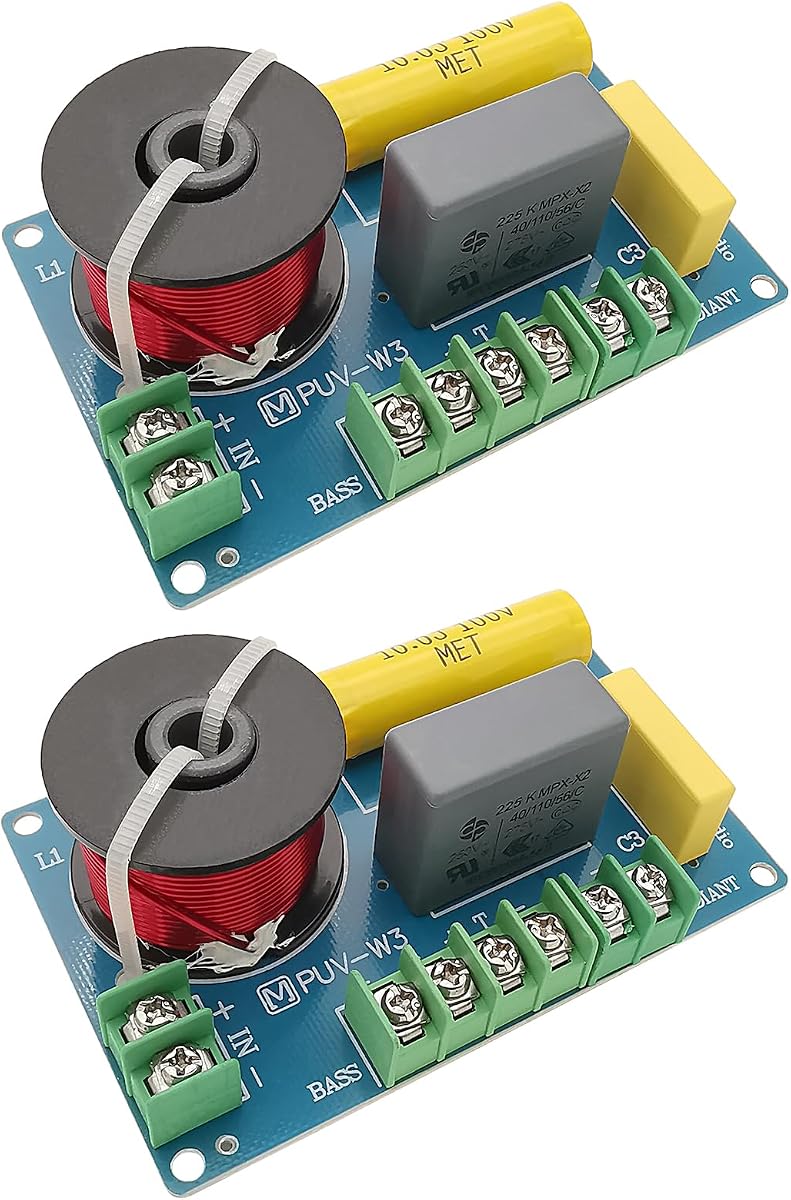
The HiQltyla 3 Way Speaker Crossover combines a 200-watt passive network with a two-board package and a 4.5 rating. Its appeal comes from the balance of useful features rather than a single headline specification: it covers 4–8 ohm systems, separates the signal at 860 Hz and 6000 Hz, and uses screw terminals that simplify installation compared with a solder-only board.
We may earn a commission when you buy through this link, at no additional cost to you.
The component list includes a bass inductor, dedicated MPX capacitor, and a 100-volt, 10-microfarad high-current capacitor. That arrangement is particularly relevant when the crossover is used in a passive home-audio or car-audio system where component quality and current handling influence both signal delivery and the durability of the network. The listing identifies the product as suitable for home and car audio and states a frequency range of 45 Hz to 25 kHz.
Its main trade-off is the relatively modest 200-watt peak rating compared with several higher-capacity boards in this guide. The crossover points are fixed rather than adjustable, so it suits builders who have already selected drivers around those stated divisions or who want a ready-made network rather than a tuning platform. The listing also recommends a mediant speaker larger than 4.5 inches for the intended experience.
This is a strong choice for a first three-way passive build, a matched pair of compact home speakers, or a car-audio project where solderless terminal connections are valued. Buyers should verify driver impedance, enclosure dimensions, and crossover compatibility before purchase. For most general-purpose applications, it is the most balanced entry in this roundup because it provides two networks, clear electrical specifications, and straightforward connections at the same time.
Because the package includes two passive crossover networks, it is especially practical when both left and right speakers need matching three-way division. The dual format also gives installers a spare option without requiring a separate purchase for the second enclosure.
Screw terminals remove one common obstacle in passive speaker work: joining relatively substantial driver leads to a circuit board. They do not make enclosure design or impedance matching automatic, but they can make the electrical connections more approachable and less dependent on soldering equipment.
We may earn a commission when you buy through this link, at no additional cost to you.
This two-pack 3 Way Crossover for Speaker earns a 4.4 rating and is built around a 400-watt power target with 4–8 ohm compatibility. Its distinguishing feature is a degree of user adjustment: the crossover point can be selected between 2550 Hz and 2600 Hz, while separate treble and bass switches let the installer shape the balance without replacing components.
We may earn a commission when you buy through this link, at no additional cost to you.
Three blue-framed, high-temperature-resistant inductors form the filtering foundation, while the board uses multiple audio-specific capacitors. The listing says these components are intended to stabilize output and preserve high-fidelity performance. Eight solderless terminals provide the input and output connections, making this model more accessible than a board that must be wired directly at every pad.
The trade-off is that the adjustment range is relatively narrow. Buyers should not mistake the switches for a fully customizable crossover capable of covering arbitrary bass-to-mid or mid-to-treble transitions. The product is described as a three-way network with one high and two low-frequency outputs, and the precise bass and midrange division behavior must be evaluated against the chosen drivers rather than inferred from the wattage figure.
This two-pack works well for builders who want matching networks, recognizable controls, and a higher 400-watt target than the top budget selection. It is particularly suitable for a stereo DIY project in which the same adjustable architecture will be used on both sides. Confirm the enclosure layout, terminal meanings, and driver response before final wiring.
Dedicated treble and bass adjustment switches can make it easier to account for different driver sensitivities and listening preferences. They are most useful when the network has been selected with some knowledge of the woofer, midrange, and tweeter response curves.
The package contains two crossovers, which is convenient for a left-right pair. Using matching networks in both cabinets can also help preserve tonal consistency as long as the driver selections and enclosure construction are consistent.
We may earn a commission when you buy through this link, at no additional cost to you.
The EMINENCE PXB33K5 stands out as one of the most technically substantial options in the guide, carrying a 4.8 rating and a stated 400-watt capacity. Designed for high-wattage passive PA cabinets, it divides the signal at 500 Hz and 3.5 kHz and uses different filter slopes for the low-pass, mid-pass, and high-pass sections.
We may earn a commission when you buy through this link, at no additional cost to you.
Its 12 dB low-pass, 6 dB mid-pass, and 18 dB high-pass arrangement offers more deliberate band control than a basic fixed network. That design can reduce unwanted frequency overlap and help protect drivers by presenting each one with a more appropriate operating range. The 8-ohm crossover impedance is an important requirement that must be respected during speaker design.
As a board-only component, it is not a ready-made plug-in network or a complete loudspeaker. No cabinet mounting hardware is included, so the installer must plan the board position, wiring paths, airflow, and internal clearances. It is better suited to an experienced builder assembling or modifying a professional-style passive enclosure than to a quick household installation.
The PXB33K5 is our Editor's Choice for builders who value a clearly specified, multi-slope passive architecture and a high stated power capacity. It is a compelling choice for a carefully selected set of PA drivers when the system is designed around 8-ohm impedance. Less experienced users should first understand crossover layout, driver power compatibility, and enclosure volume requirements.
Using 12 dB low-pass, 6 dB mid-pass, and 18 dB high-pass filters gives each frequency section a defined transition. The result is better suited to controlled PA cabinet design than a generic network with one undifferentiated filtering approach.
Because the product is supplied as a crossover board without cabinet mounting hardware, enclosure builders gain layout freedom. That freedom also creates responsibility: the board needs secure mounting, proper connections, and enough clearance from other internal components.
We may earn a commission when you buy through this link, at no additional cost to you.
The HiQltyla WEAH-3505A provides a 300-watt passive crossover with a 4.3 rating and a stated operating range of 40 Hz to 20 kHz. It is intended for 4–8 ohm car or home-audio systems and divides the signal at 850 Hz and either 5800 Hz or 6000 Hz depending on the position of its 3 dB tweeter switch.
We may earn a commission when you buy through this link, at no additional cost to you.
Its component selection is extensive for a consumer-oriented board: a 66 mm bass inductor, dual alto inductors, a treble inductor, an MKP capacitor, dual non-inductive capacitors, a ceramic resistor, a tweeter protector, a high-power resistor, a metallized film capacitor, and a professional audio capacitor. The listing also notes a 3 dB adjustable switch and screw terminals for installation.
The main limitation is that adjustment focuses on the treble section rather than providing broad control over every transition. The listing also says the system's midrange horn should fall within a three-inch range. That makes driver and enclosure compatibility a central consideration rather than a minor installation detail.
This crossover is best suited to a builder who wants some tonal adjustment without moving to a much more elaborate network design. Its 300-watt peak rating is appropriate for many home and car systems, while the terminal connections simplify hookup. Confirm that the selected midrange horn meets the stated size requirement and that the enclosure can accommodate the crossover correctly.
The switch changes the stated tweeter crossover from 5800 Hz to 6000 Hz while offering a 3 dB adjustment option. This can provide useful flexibility when balancing a particular tweeter against the rest of the system.
Separate inductors, film and non-inductive capacitors, resistors, and protection components are all identified in the product information. Such variety indicates a purpose-built passive network rather than a simple wired divider.
We may earn a commission when you buy through this link, at no additional cost to you.
This HiQltyla 3 Way Speaker Crossover has a 4.4 rating and an ambitious 800-watt stated capacity. Designed for 4–8 ohm systems, it separates the mixed signal into treble, alto, and bass paths and is listed as suitable for speakers in the 10–15 inch range, making it a potentially useful choice for larger DIY speaker cabinets.
We may earn a commission when you buy through this link, at no additional cost to you.
The board uses wire-wound ceramic resistors and metal film capacitors, components presented as capable of handling substantial loads while reducing the risk of burnout. Its open circuit-board design provides visible openings and connection lines, giving a builder room to inspect and work with the layout. The product information also specifically frames the board as suitable for welding during DIY construction.
The biggest uncertainty is that no exact crossover frequencies are included in the supplied specifications. A buyer therefore cannot determine the transition points solely from this listing. The stated 10–15 inch compatibility is broad rather than a precise driver recommendation, so woofer selection, enclosure tuning, and actual network behavior require additional research.
This board is best for experienced DIY builders who want a high-power, visibly accessible circuit board and can determine the required crossover values from the selected drivers and enclosure. It is less suitable for beginners seeking a known, fixed division without documentation. Confirm terminal arrangement, crossover points, and component tolerances before installation.
The stated 800-watt capacity gives this board a clear distinction from lower-power home-audio networks. It is most relevant to larger driver combinations, although the system amplifier and individual drivers must still be matched to the network.
The exposed board and visible circuit lines can make component placement and connections easier to understand. That is advantageous for builders who prefer soldering directly to a clearly laid-out network rather than working with an enclosed module.
We may earn a commission when you buy through this link, at no additional cost to you.
The HiQltyla WEAH-3509A is a 350-watt passive 3 way crossover with a 4.3 rating, a 4–8 ohm load range, and a stated frequency coverage of 40 Hz to 22 kHz. It gives installers more transition choices than many fixed designs, with the bass-to-mediant point selectable at 780 Hz, 850 Hz, or 900 Hz.
We may earn a commission when you buy through this link, at no additional cost to you.
Its upper section also has selectable crossover points of 5500 Hz or 5800 Hz. Separate mediant and tweeter adjustment switches allow the user to tune the balance around those divisions. The component list includes bass, alto, and treble inductors, CBB and non-inductive capacitors, a ceramic resistor, a tweeter protector, a high-power resistor, and a dedicated HiFi capacitor.
Those controls add useful flexibility, but they also make correct setup more involved. Switch positions do not replace the need to understand each driver's power handling and frequency response. The board is better viewed as a configurable passive network for someone who has already selected suitable bass, midrange, and high-frequency drivers, rather than a universal answer for any enclosure.
The WEAH-3509A is a strong fit for DIY home-audio and car-audio builders who want several crossover positions without moving to active crossover equipment. It supports 4–8 ohm systems and offers a higher power target than several competing models. Verify the enclosure dimensions, switch states, and terminal functions before final assembly to avoid inconsistent left-right or left-right pair behavior.
Three bass-to-mediant options and two tweeter options give the installer more ways to align the network with different driver characteristics. This is helpful when one transition point would place too much energy near a driver's least effective region.
The inclusion of a tweeter protector and high-power resistor gives the passive network more than a minimal filtering function. These components are intended to support stable operation, though correct setting remains essential.
We may earn a commission when you buy through this link, at no additional cost to you.
The 2pcs 3 Way Speaker System has a 4.6 rating and packages two 350-watt passive crossover boards. It appeals to builders creating a matched stereo pair because both cabinets can use networks from the same package, reducing the chance that different crossover components will create avoidable tonal differences.
We may earn a commission when you buy through this link, at no additional cost to you.
The bass divider uses a large inductance, high-frequency porcelain resistance, and a metal capacitor. The midrange section uses a rectangular hollow-core inductor, while the overall design includes high-inductance inductors, metal film capacitors, and a self-resetting fuse for overcurrent protection. The listing also notes tin wiring added to the back of the divider to help larger currents pass quickly and without loss.
A key limitation is that the supplied information does not state exact crossover frequencies, nominal impedance, terminal layout, or enclosure dimensions. Those details matter greatly in passive speaker construction. This board therefore demands more preliminary research than a model with a complete, clearly specified electrical profile, and it should not be assumed to fit a 4-, 6-, or 8-ohm system without further evidence.
This product is a compelling choice for experienced DIY builders seeking two protected, substantial passive networks in one package. The self-resetting fuse and large-current wiring are especially notable for users who want a board designed with thermal and electrical robustness in mind. Confirm the missing electrical specifications and internal layout before committing to the design.
A self-resetting fuse is intended to interrupt excessive current and then restore normal operation when the condition clears. It does not remove the need for correct impedance matching, but it adds a protective feature not described for every board.
The added tin wire on the rear of the board is described as helping large currents pass quickly and without loss. This detail suggests attention to the power path rather than treating the board only as a low-level control circuit.
We may earn a commission when you buy through this link, at no additional cost to you.
The Dayton Audio XO3W-500/4K carries the highest rating in this selection at 4.9. Its straightforward design uses a 500 Hz bass crossover and a 4,000 Hz tweeter crossover, a three-octave spread between the stated points. That clarity makes the network easier to evaluate against a specific set of drivers than a board with vague or undisclosed divisions.
We may earn a commission when you buy through this link, at no additional cost to you.
Metallized polyester film capacitors are used in the critical midrange and tweeter signal paths. The low-pass section accepts either 4 or 8 ohm woofers, giving builders some flexibility in bass-driver selection while retaining a passive, three-way architecture.
The main limitation is its fixed frequency structure. Unlike models with adjustment switches, the Dayton unit is not presented as a tuning platform for changes after installation. It is most appropriate when the selected woofer, midrange driver, and tweeter are known to work well with these nominal divisions. Even then, crossover slopes, enclosure acoustics, and sensitivity matching affect the final result.
This is our premium pick for builders who value clear specifications, specialized film capacitors, and a focused fixed network rather than numerous adjustment controls. It is especially suitable for a carefully planned home-audio or DIY three-way speaker. Confirm driver power ratings and enclosure design, and do not expect the crossover frequencies alone to guarantee perfect tonal balance.
Published crossover points make it possible to evaluate the network before building. A woofer with suitable response around 500 Hz and a tweeter designed for a 4 kHz transition can be considered on technical grounds rather than guesswork.
The use of metallized polyester film capacitors in the midrange and tweeter paths highlights attention to those sections. Their inclusion is a meaningful detail for a passive crossover because those frequencies carry much of the detail in music and speech.
We may earn a commission when you buy through this link, at no additional cost to you.
The 3 Way Adjustable Crossover offers a 400-watt target, 4–8 ohm support, and a 4.4 rating. Its one-high, two-low output arrangement is designed to divide a full-range signal among three speaker sections, while the adjustable crossover section lets an installer make limited changes between 2550 Hz and 2600 Hz.
We may earn a commission when you buy through this link, at no additional cost to you.
Three blue-framed inductors rated for high temperatures form the main filtering hardware, supplemented by multiple audio-specific capacitors. Dedicated treble and bass switches provide level or tonal controls, and eight solderless terminals remove the need to solder every conductor to the board. These details make the product appealing for home builders who want a ready-made passive network with user controls.
Its limitation is that the available crossover adjustment is confined to a narrow 100 Hz interval, and no full frequency-response range is stated. The switches should not be mistaken for an unlimited tuning platform. Correct use still depends on driver compatibility, amplifier loading, and enclosure behavior, none of which can be resolved by the board controls alone.
This crossover is a good option for a home-audio DIY project where convenient connections and moderate adjustment are more important than specialist PA construction. The 400-watt target provides more headroom than lower-rated models, while the 4–8 ohm range accommodates common passive drivers. Before installation, verify the exact crossover behavior and terminal map against the selected speaker set.
Eight accessible terminals allow the main input and driver leads to be connected without soldering each wire to a small board pad. This can reduce setup time and make the network easier for first-time passive-speaker builders to service.
Independent treble and bass switches make it possible to compare two output settings quickly. They are most useful when modest driver-sensitivity differences need correction during initial setup.
We may earn a commission when you buy through this link, at no additional cost to you.
The 3 Way Speaker Crossover has a 4.2 rating and a stated 150-watt capacity, making it the most modest power target among the products reviewed. It is aimed at home-speaker applications where the drivers and amplifier operate well below the handling levels associated with larger PA or high-output networks.
We may earn a commission when you buy through this link, at no additional cost to you.
Its high-frequency section uses a German EPCOS thousand-layer film non-inductive capacitor, with a 100-volt, 1.5-microfarad capacitor connected in parallel. The stated tolerance of minus 3 percent to plus 3 percent reflects attention to component matching, which can help preserve consistent behavior between sections. The low-frequency path uses an inductor before reaching the output terminal.
The main concern is the lack of stated nominal impedance and exact crossover frequencies. Those omissions make it difficult to verify compatibility solely from the supplied product information. The relatively low 150-watt rating also limits the product to appropriately matched systems, so it should not be chosen for a high-output PA cabinet without further technical confirmation.
This crossover is best considered for a small home-audio build, a low-power three-driver enclosure, or a project where component tolerance and film-capacitor construction matter more than high power handling. It is a less obvious choice for large installations, but it may provide a sensible foundation for a compact passive speaker when the drivers are selected around its limits.
The stated tolerance of minus 3 percent to plus 3 percent gives buyers more information than an unspecified capacitor. Closely matched parts can help the network maintain predictable filtering behavior across its operating range.
The 150-watt rating is appropriate only when the amplifier, drivers, and enclosure remain within compatible limits. It is better viewed as a compact home-audio solution than as a high-output professional network.
We may earn a commission when you buy through this link, at no additional cost to you.
Choosing a passive 3 way crossover requires matching electrical specifications, driver behavior, enclosure design, and installation methods. The most important principle is that a crossover network must complement the speakers it connects rather than simply deliver a high wattage figure or attractive control layout.
The crossover's stated wattage indicates the power level it is designed to handle, but the correct comparison is against the amplifier's maximum clean output and every connected driver's continuous or peak rating. A network with a 150-watt target should not be treated as interchangeable with a board listed for 400 or 800 watts. Match the amplifier appropriately, avoid sustained operation beyond the documented capability, and consider the weakest driver rather than relying only on the woofer rating.
Choose a crossover whose power class comfortably covers the intended amplifier output and driver limitations.
Passive crossover impedances affect how the speaker network loads the amplifier and how the filters are designed. Several products in this guide support 4–8 ohm drivers, while the EMINENCE PXB33K5 is specifically described as an 8-ohm design. The Dayton Audio unit allows 4 or 8 ohm woofers in its low-pass section. Users should verify the full system's nominal impedance and ensure that every connected driver and the complete network operate within the amplifier's supported range.
Confirm the complete cabinet impedance, not just one driver's rating, before installation.
The two division points determine which frequency bands reach the woofer, midrange unit, and tweeter. Examples include 500 Hz and 3.5 kHz in the EMINENCE board, 860 Hz and 6000 Hz in the HiQltyla two-pack, and 500 Hz and 4 kHz in the Dayton Audio model. These values should be checked against the response and power limits of the selected drivers, then considered alongside crossover slope and enclosure behavior.
Match both transition points to driver response rather than choosing by appearance alone.
Adjustable switches can make it easier to balance driver output levels or refine a transition, but they should not be mistaken for substitutes for proper design. The WEAH-3505A offers a 3 dB tweeter setting, the WEAH-3509A provides several midrange and tweeter positions, and other boards include dedicated treble and bass controls. These are useful secondary tools after the main drivers and crossover architecture have been selected.
Use adjustment controls for fine-tuning, not for compensating for incompatible drivers.
The filter network's inductors, capacitors, and resistors directly influence its electrical behavior and thermal performance. Products in this guide mention inductors, metal film capacitors, MKP or CBB capacitors, non-inductive capacitors, ceramic or porcelain resistors, and protection components. For a compact or high-power application, pay particular attention to stated tolerances, current handling, heat resistance, and whether the crossover includes protection for sensitive tweeters.
Look for clearly identified component types and credible electrical specifications.
Screw terminals are easier for many builders than solder-only boards, while open or board-only designs can suit makers who want direct access to the circuit. Some listings emphasize solderless or screw-terminal connections, while the 800-watt board specifically mentions welding as part of the DIY process. The chosen method should reflect both the builder's experience and the space available inside the enclosure.
Choose connections you can complete reliably and fit within the cabinet.
A crossover board is only one part of a functioning three-way speaker. The enclosure must provide suitable internal volume and mounting space, while the selected drivers must physically fit the baffle and suit the planned frequency ranges. Some listings offer broad driver-size guidance, such as 10–15 inches, while others specify a midrange-driver or horn size. Those dimensions are useful starting points but do not replace a full enclosure design.
Check baffle cutouts, cabinet depth, driver depth, and airflow before ordering.
Two-pack products can be more convenient for a stereo build because both speakers receive matching crossover networks. Single-board options may suit a one-speaker project, a replacement, or a builder who wants to choose each network separately. Quantity should be considered alongside the complete parts list: one board may still need separate input and output wiring, while a two-pack does not necessarily include every cable or connector required for installation.
Count enclosures first, then verify what connectors and hardware are included.
Begin by disconnecting amplifier power and identifying the input, bass, mediant, and tweeter terminals on the crossover. Compare the manufacturer's wiring guidance with the driver impedance and connection polarity, then test each driver outside the enclosure if possible. Do not rely on wire colors alone because manufacturers may label or arrange connections differently.
Mount the board securely in the enclosure without placing it where vibration, moisture, or loose wiring could create a problem. Keep wiring routes short where practical, maintain clearance from magnet structures, and ensure the board cannot contact the baffle or cabinet lining. For screw terminals, tighten each conductor firmly without stripping too much insulation or damaging the clamp.
After wiring, check continuity and polarity with the amplifier disconnected, then reconnect power at a low level and listen for balance, distortion, or unintended silence. Make modest adjustments using the provided switches. If a driver sounds weak, rough, or excessively loud, stop and recheck the network, amplifier loading, solder joints, and driver selection rather than compensating with excessive system volume.
A 3 way passive crossover divides an amplified full-range signal into three frequency bands. One path serves the woofer, another serves the midrange driver or horn, and the third serves the tweeter. Passive networks perform this filtering with components inside the speaker cabinet without requiring separate external crossover channels.
A 2 way crossover normally divides the signal into only two bands, so it cannot independently optimize three different drivers. One driver may receive a broader range, but that is not equivalent to a proper 3 way network. For independent bass, midrange, and treble control, use a designed 3 way crossover matched to all three drivers.
Start with each driver's recommended crossover range and look for a transition point where it can operate safely and efficiently. The low-pass and mid-pass sections should also avoid creating excessive overlap, while the tweeter's sensitivity and power requirements need to be considered. Enclosure tuning and the actual crossover slope can change the final result, so listening tests remain important.
No. A higher rating matters when it matches the amplifier and drivers, but it does not guarantee better sound. Component quality, crossover slopes, frequency placement, driver compatibility, and enclosure design can have a greater effect on the result. An underpowered crossover used within its limits may still provide a more coherent speaker than an oversized network paired with poorly matched drivers.
They do not always have to be identical, but the complete passive network must present a load compatible with the amplifier. Drivers with different impedances can alter filter behavior because each frequency section sees a different load. Use the crossover manufacturer's guidance and calculate the intended system impedance before connecting unequal drivers.
Screw terminals are generally easier to connect, inspect, and service, especially for first-time builders. Properly soldered connections can also create a secure and reliable installation. The better method is the one that can be executed cleanly, with correct polarity, strong mechanical strain relief, and no loose conductor strands.
Only if the enclosure has sufficient space, the existing drivers are compatible, and the amplifier will still support the resulting impedance. Existing wiring and internal clearances may also need modification. If the cabinet was designed for a different crossover or has an unsuitable driver arrangement, replacing it can be less reliable than rebuilding it with an appropriately designed network.
Keep the board dry, securely mounted, and away from pressure or conductive debris. Use suitable wire for the load, maintain good solder or terminal quality, and avoid repeatedly bending connections near their anchors. Inspect it if the amplifier, wiring, or enclosure is serviced, and replace the network if components show heat damage, discoloration, cracking, or corrosion.
The Dayton Audio XO3W-500/4K is the premium selection for its 4.9 rating, clearly stated 500 Hz and 4 kHz divisions, film capacitors, and support for 4 or 8 ohm woofers. The EMINENCE PXB33K5 is the Editor's Choice for sophisticated 500 Hz and 3.5 kHz filtering, different slopes for each band, and a stated 400-watt capacity designed for passive PA cabinets.
For value and accessibility, the HiQltyla 200-watt two-pack stands out with screw terminals, 4–8 ohm support, and two matching networks. Buyers prioritizing broader controls may prefer the WEAH-3505A or WEAH-3509A, while those needing two protected boards may consider the 350-watt dual pack. In every case, prioritize driver compatibility, correct impedance, and enclosure design over wattage alone.
Final specifications should always be confirmed against the current product listing and the manufacturers' available instructions. Configuration choices, included accessories, and current pricing can change, so compare the live listing before purchasing. Most importantly, ensure that the selected crossover's power class, frequency divisions, connections, and physical dimensions fit the complete speaker system you intend to build.