
Donner Stereo Audio Amplifier MAMP2
4.0Editor score
Dedicated turntable phono input
Bluetooth 5.3 connectivity
Flexible digital and analog inputs
Best amplifier for turntable guide comparing 10 models for phono support, sound quality, connectivity, speaker compatibility, power, and ease of setup.
An amplifier for turntable should do more than make a record louder. It must accept the low-level phono signal correctly, provide clean amplification, and drive your chosen passive speakers without introducing distracting noise or coloration. The right model can also add useful controls, digital inputs, Bluetooth, and a compact design suited to modern listening spaces.
This guide compares ten amplifiers and phono solutions based on their stated connectivity, power configurations, tone controls, speaker support, and turntable compatibility. It includes full stereo amplifiers, compact power amplifiers, and dedicated phono preamplifiers, because the best choice depends partly on whether your turntable already includes a built-in phono stage.
Each review explains the product's strongest features, practical limitations, and ideal listener. The top recommendations range from a feature-rich receiver to a dedicated tube preamp and a compact Class D amplifier. Product specifications and prices can change, so readers should verify the current listing and compatibility details before making a purchase.
4.0Editor score

4.5Editor score
4.7Editor score
The following comparison covers all ten products, emphasizing the distinctions that matter when connecting a turntable: built-in phono support, signal routing, speaker capability, amplification style, and convenient control options.



The Sony STRDH190 is a conventional stereo receiver that treats vinyl as a first-class source rather than an afterthought. Its 4.5 rating reflects a balanced combination of useful power, flexible switching, and straightforward operation. The built-in phono input, four stereo RCA inputs, and full-size headphone output make it especially suitable for a turntable-centered home audio system.
We may earn a commission when you buy through this link, at no additional cost to you.
Power is specified at 100 watts per channel into 8 ohms, giving it ample capability for typical bookshelf speakers and many floorstanding models. Speaker impedance support extends from 6 to 16 ohms, while A/B switching allows two pairs of speakers to be connected. The low-profile chassis is only 5.25 inches tall, making it easier to place inside conventional media furniture.
The main limitation is its focus on analog and wireless sources. It has Bluetooth, FM radio, and High-Resolution Audio support, but no HDMI, optical, or coaxial digital input. Some listeners may also find that it offers less fine-grained phono adjustment than a dedicated preamp. Nevertheless, for most turntable owners who also want radio and convenient Bluetooth playback, those compromises are reasonable.
This is the strongest all-around recommendation for buyers who want one box to handle records, a TV, a CD player, a computer, and additional components. Connect a turntable with a compatible moving-magnet cartridge to the phono input, attach the amplifier to the speakers, and use the receiver for convenient source switching. For a flexible, full-sized home system, the STRDH190 is difficult to overlook.
The built-in phono stage removes the need for a separate signal box in many systems. Bluetooth adds convenient streaming, while four RCA inputs leave room for other analog components such as a CD player, tuner, or tape deck.
The 100-watt-per-channel rating and support for 6- to 16-ohm speakers make the receiver versatile with common passive bookshelf and floorstanding models. A/B switching also helps listeners compare or serve two speaker pairs.
We may earn a commission when you buy through this link, at no additional cost to you.
The Donner MAMP2 is the most accommodating amplifier in this guide for listeners who want a turntable connection without giving up modern digital sources, wireless audio, or entertainment features. Its 4.0 rating reflects a broad equipment package rather than a minimalist hi-fi design. The dedicated phono input makes it a natural center for a mixed analog and digital listening room.
We may earn a commission when you buy through this link, at no additional cost to you.
Connectivity is unusually extensive for this category. It supports Bluetooth 5.3, USB storage up to 64 GB, RCA, AUX, optical, coaxial, two quarter-inch microphone inputs, FM radio, and a phono input. The optical and coaxial connections are useful for televisions and digital components, while USB playback can provide convenient access to locally stored music without requiring a computer.
Its power specification is 60 watts per channel RMS, with a stated 600-watt peak total. Two channels can be controlled independently, and the product supports two groups of four speakers rated from 4 to 16 ohms, plus a subwoofer. A prominent limitation is the absence of HDMI, which means it cannot accept audio through a television's most common digital connection.
This amplifier is best for users who value flexibility and entertainment functions over a strictly minimal audiophile approach. The remote can adjust treble, midrange, bass, echo, and talk-over settings, and the unit remembers its input, volume, and EQ configuration. For a budget-conscious turntable system that also needs karaoke, radio, Bluetooth, and multiple digital sources, the MAMP2 delivers an unusually complete package.
The combination of phono, Bluetooth, USB, optical, coaxial, RCA, and AUX inputs allows the MAMP2 to serve as the central component of a varied system. It can accept a turntable directly while remaining ready for television and stored digital music.
Independent channel control, selectable EQ bands, four-speaker groups, and subwoofer support provide more routing options than a basic mini amplifier. The settings memory also reduces repeated adjustments after startup.
We may earn a commission when you buy through this link, at no additional cost to you.
The Nobsound NS-13G MAX combines a surprisingly substantial power claim with a very small enclosure, making it appealing for compact vinyl systems. It carries a 4.1 rating and is built around a Texas Instruments TPA3255 Class D amplification chip. A moving-magnet phono input allows a compatible turntable to connect directly.
We may earn a commission when you buy through this link, at no additional cost to you.
The stated output is 300 watts per channel at 4 ohms, while the listed distortion and signal-to-noise figures are 0.005% THD and 107 dB SNR. Those specifications suggest a design aimed at hi-fi and monitor use. The included 48-volt, 5-amp adapter provides the high-current supply needed for its larger power capability.
Physical size may be its most important practical benefit. The CNC-milled aluminum chassis measures just 5.1 by 4 by 1.5 inches, so it can fit on a desk, bookshelf, or in a small AV rack. Bass and treble controls provide broad tonal adjustment, and a 3.5 mm AUX passthrough is available for a subwoofer or multi-room setup.
The tradeoff is that this is primarily a focused analog amplifier. It has RCA and phono connections but no Bluetooth, streaming service, or digital audio input. Buyers should also ensure they are comfortable with an external power supply and should not interpret the maximum wattage as a guarantee that every speaker will be driven ideally. It is a strong pick for a small footprint, substantial power, and direct turntable support.
The TPA3255 platform and 48-volt supply allow the NS-13G MAX to make a strong power-per-volume claim. That makes it useful for listeners who need more headroom than a conventional small desktop amplifier provides.
Separate bass and treble controls make it easy to adapt the output to different rooms and speaker characteristics. A 3.5 mm AUX passthrough can also feed a subwoofer when a more complete low-frequency setup is desired.
We may earn a commission when you buy through this link, at no additional cost to you.
The Pyle PP999 is not a full stereo amplifier but a dedicated phono preamplifier, making it useful when an existing receiver lacks a phono input or when a listener wants to control the turntable signal separately. Its 4.3 rating reflects a focused product with a clear purpose. It converts the low-level phono signal from a magnetic cartridge into a line-level signal suitable for another amplifier.
We may earn a commission when you buy through this link, at no additional cost to you.
The stereo RCA input and output arrangement makes setup straightforward. Connect the turntable's output cables to the preamp, attach the ground wire, and then feed the RCA outputs into a receiver, powered amplifier, computer, or other line-level input. The product is designed for magnetic pickups with an input sensitivity of 3 mV at 50 k ohms, so it should not be assumed to support every moving-coil cartridge.
Low-noise operational amplifiers form the core of the design, and the stated maximum output is 2 volts peak-to-peak at 10 k ohms. Pyle recommends placing the preamp close to the source to reduce unwanted noise and interference. That advice is important because every extra cable and connection offers another opportunity for hum or interference to enter the system.
This is the most budget-conscious route for adding vinyl to an existing setup, but it is not a one-box solution. The listener still needs a power amplifier and passive speakers. The PP999 is best for someone with a good audio chain that lacks phono support, especially in a compact installation where a small, dedicated signal box is easier to accommodate.
The PP999 gives existing receivers and powered speakers a purpose-built way to accept moving-magnet turntables. Its line-level output can be routed into familiar stereo equipment without relying on an unsuitable microphone-style input.
Stereo RCA connections, a grounding post, and an included power approach keep the installation approachable. Keeping the unit close to the turntable can also help minimize noise pickup and unwanted interference.
We may earn a commission when you buy through this link, at no additional cost to you.
The Fosi Audio MC331 is an all-in-one amplifier, DAC, preamplifier, and headphone amplifier with a visual design centered on glowing tubes and a VU meter. Its 4.4 rating suits listeners who want the appearance and experience of a traditional component alongside modern source flexibility. The stated maximum output is 105 watts per channel into 4 ohms.
We may earn a commission when you buy through this link, at no additional cost to you.
Bluetooth, USB, coaxial, optical, and RCA inputs allow the unit to serve computers, phones, CD players, and other sources. A pre-out and 3.5 mm headphone output increase its usefulness beyond basic speaker amplification. The included remote adjusts bass and treble, while the replaceable tube design gives owners some ability to influence the unit's sound character.
Turntable compatibility requires attention. The product information specifically identifies turntables with built-in phono preamps as compatible, indicating that the MC331 itself does not provide the necessary moving-magnet gain and equalization. A turntable with an internal phono stage can be connected through RCA, but a line-level model with a moving-magnet cartridge will need an external preamp.
This amplifier is best for a listener who values aesthetics, source versatility, and a traditional integrated-amplifier presentation. It can serve bookshelf speakers while offering enough connectivity for a complete desktop or living-room system. The lack of a dedicated phono stage is the decisive limitation, so prospective buyers should confirm their turntable's output before ordering.
The VU meter and replaceable tubes give the MC331 a distinctive identity, while USB, optical, coaxial, Bluetooth, and RCA connections make it practical in a digital listening room. It offers more source variety than a basic analog-only integrated amplifier.
The pre-out can feed another amplifier or powered stage, while the headphone output supports private listening. Remote bass and treble adjustment and replaceable tubes add further control over the listening experience.
We may earn a commission when you buy through this link, at no additional cost to you.
The Fosi Audio BT20A is a compact Class D amplifier designed for uncomplicated speaker installations, with Bluetooth and RCA inputs that make it convenient for casual listening. Its 4.5 rating is strong for a simple mini amplifier. The stated maximum output is 100 watts per channel, and the unit can power multiple passive speaker cabinets.
We may earn a commission when you buy through this link, at no additional cost to you.
Installation is straightforward: connect the speakers, choose an input, and use the front controls or included power switch. Bluetooth allows music to be streamed directly from a phone, while the RCA input can carry a line-level source. Separate bass and treble controls provide enough adjustment to accommodate different speaker tonalities and room conditions.
The major limitation for this particular roundup is the absence of a built-in phono input. A turntable can only be connected directly if it has its own phono preamp and outputs a line-level signal. Otherwise, the listener must add a separate phono preamp, such as the dedicated models also included in this guide.
The BT20A is a strong choice for secondary listening areas, patios, offices, bedrooms, garages, or any space where a small amplifier and two passive speakers are desired. It is particularly appealing when wireless playback is more important than vinyl. For a turntable-first system, choose a version with a built-in phono stage or plan to include a separate preamplifier.
The compact chassis is easy to place near a pair of bookshelf, ceiling, garage, or outdoor-compatible speakers. Its simple front-panel layout keeps setup approachable for listeners who do not want to manage a large receiver.
Bluetooth covers convenient phone streaming, and RCA accepts other line-level sources. Independent bass and treble controls allow basic tonal matching without navigating a complex menu.
We may earn a commission when you buy through this link, at no additional cost to you.
The Qlearsoul HiCore H2 is a compact and thoughtfully engineered Class D amplifier with a 5.0 rating. It uses a Texas Instruments TPA3255 chip to provide a rated 100 watts per channel into 4 ohms, with a stated signal-to-noise ratio of at least 95 dB and total harmonic distortion plus noise no greater than 0.1%. A 30-volt, 5-amp adapter is included.
We may earn a commission when you buy through this link, at no additional cost to you.
Its most distinctive feature is the anti-hijack Bluetooth mode. The amplifier accepts Bluetooth 5.4, RCA, and 3.5 mm AUX input, and switching to either wired mode physically cuts the Bluetooth signal. A long press can erase the pairing history. This is useful in offices, hospitality spaces, or homes where unwanted reconnection could interrupt another source.
The main-function knob rotates for volume, short-presses to cycle inputs, and can clear Bluetooth pairings when held. Separate bass and treble knobs provide direct, independent control. The CNC-machined aluminum chassis measures 17 by 13 by 10 centimeters, uses passive side ventilation, and sits on non-slip silicone feet.
As with the other compact Class D amplifiers in this guide, the H2 does not include a phono stage. It can accept a turntable only through a line-level output or with an external preamp. Its higher-voltage architecture also deserves careful attention: the included supply is optimized for rated output, while a compatible higher-voltage supply can unlock the chip's greater peak potential. It is a premium compact choice for mixed-source listening, not a turntable-first unit.
Physically disabling Bluetooth in wired-input mode prevents a paired phone from interrupting another source. The ability to clear pairing history quickly adds further convenience in shared listening environments.
The multi-function knob and separate bass and treble controls make everyday adjustment immediate. A broad 24-to-51-volt input range also allows compatible higher-voltage supplies to unlock additional peak-power capability.
We may earn a commission when you buy through this link, at no additional cost to you.
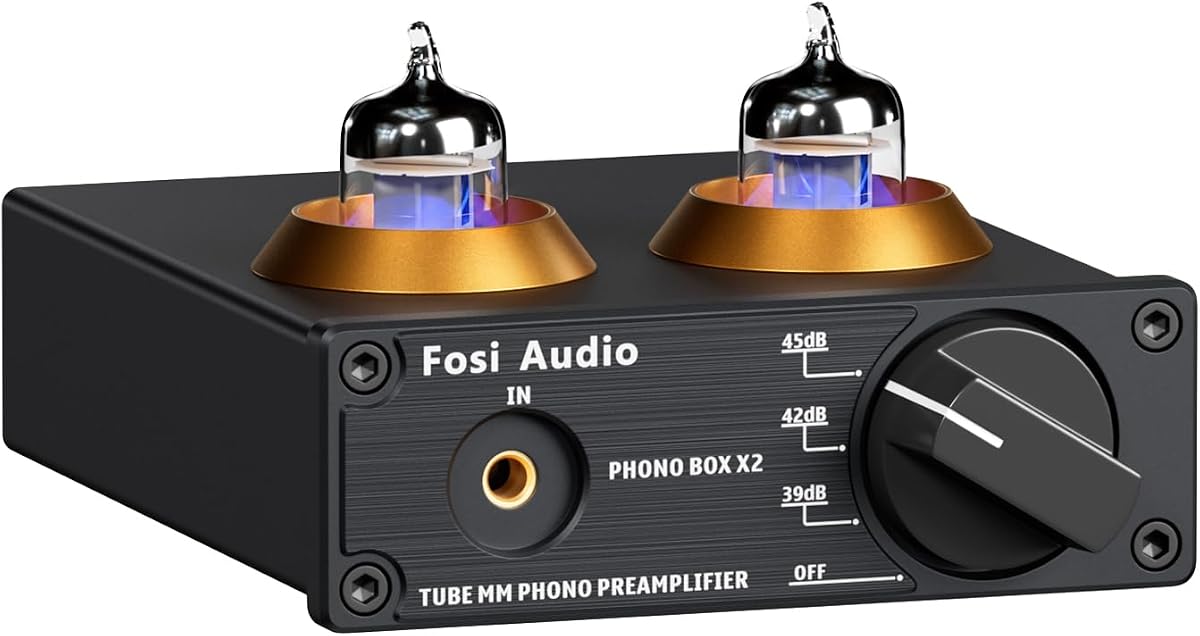
The Fosi Audio Box X2 is a dedicated tube preamplifier designed primarily for moving-magnet turntables. Its 4.5 rating reflects a focused analog design with useful gain selection and replaceable tubes. It converts the cartridge's low-level output into a line-level signal for a power amplifier or receiver.
We may earn a commission when you buy through this link, at no additional cost to you.
Three gain settings—39, 42, and 45 dB—give the listener some flexibility when matching different moving-magnet cartridges and system levels. The grounding post helps establish a stable connection with the turntable, reducing the chance of hum. Compatible tube models include 6K4, 6J1, 6J4, GE5654, 6AK5, and 66.
The Box X2 also functions as a tube preamp through its 3.5 mm AUX input. This allows it to serve as an analog control point for another line-level source, although it still does not replace a speaker power amplifier. The package includes the preamp, two vacuum tubes, an RCA cable, a power adapter, and a manual.
This is an attractive option for a serious turntable setup where the existing amplifier lacks a phono stage or offers too little control. The dedicated signal path, selectable gain, and tube presentation create a more specialized experience than a general receiver. Buyers should confirm that their cartridge is moving-magnet compatible and keep in mind that a separate amplifier and speakers are still required.
The three gain positions make it easier to match a moving-magnet turntable to a line-level amplifier. This is more specialized than using an improvised RCA connection and helps the preamp handle the cartridge signal appropriately.
Replaceable vacuum tubes allow owners to experiment with different compatible tube types. The box's small footprint, grounding post, and included cables make it a practical addition to an existing vinyl system.
We may earn a commission when you buy through this link, at no additional cost to you.
The Fosi Audio BT20A Pro is a compact, upgradeable Class D amplifier for listeners who want more control over an otherwise simple mini-amplifier design. It has a 4.4 rating, Bluetooth 5.0, and a stated maximum output of 300 watts across two channels. The TI TPA3255 platform is specified at an SNR of at least 108 dB and THD no greater than 0.005%.
We may earn a commission when you buy through this link, at no additional cost to you.
Its standout feature is the pair of plug-in NE5532 op-amps. Compatible replacements include LME49720HA, MUSES02, OPA2604AP, OPA2134PA, LM4562, and NJM4556AD. This gives technically inclined listeners a way to explore different sound characteristics without replacing the main amplification platform.
Bass and treble controls are placed on the unit, with the center position providing a neutral starting point. Bluetooth pairing can be erased by holding the volume control for five seconds, and a memory function assists with reconnection. A 32-volt, 5-amp adapter, Bluetooth antenna, power cord, and manual are included.
The limitation for vinyl listeners is again the lack of a phono input. A turntable with a built-in preamp can feed the RCA input, while a standard moving-magnet model requires a separate phono stage. This amplifier is ideal for upgrading a small speaker system, experimenting with op-amps, or adding wireless playback to an existing analog chain.
The replaceable op-amp modules are the defining feature. Listeners can keep the efficient TPA3255 power stage while trying alternative modules associated with different response characteristics and preferred listening styles.
A 300-watt maximum claim, low idle loss, and a small Class D enclosure make the BT20A Pro practical for a bookshelf speaker system or other compact installation. The included 32-volt supply supports the unit's power configuration.
We may earn a commission when you buy through this link, at no additional cost to you.
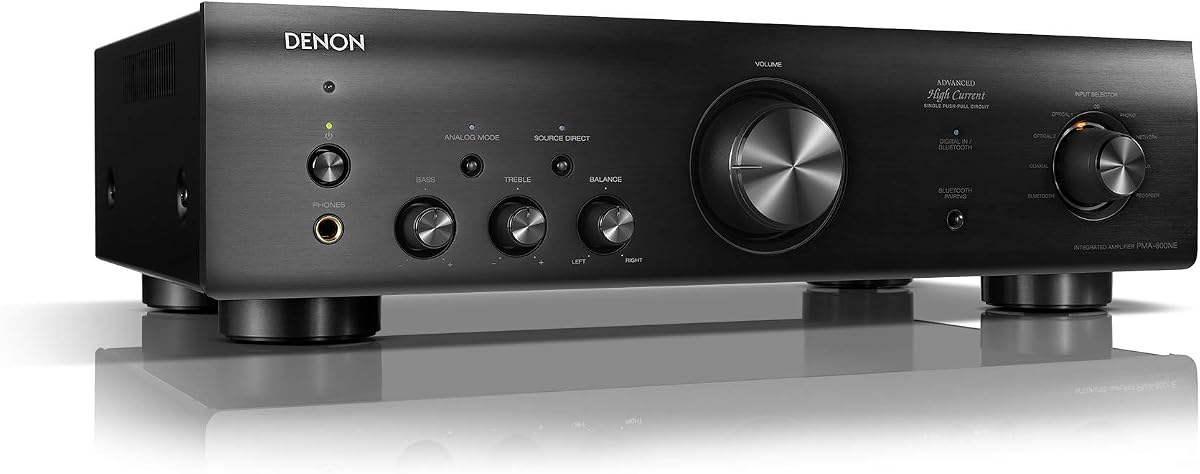
The Denon PMA-600NE is a dedicated two-channel amplifier for listeners who want a focused stereo system rather than a home theater receiver. Its 4.7 rating is the highest among the products reviewed. It includes a phono input, Bluetooth, optical and coaxial digital connections, and a slim enclosure designed for an audio component arrangement.
We may earn a commission when you buy through this link, at no additional cost to you.
Denon's Advanced High Current push-pull circuit is the central amplification feature, with 70 watts specified at 4 ohms. Divided circuitry can disengage the digital circuits, including Bluetooth, for a more analog-focused listening experience. This is a useful feature for owners who want a straightforward vinyl path without digital circuitry influencing the signal chain.
The PMA-600NE is built around high-grade audio components and a vibration-resistant enclosure. Its connectivity makes it appropriate for a turntable, CD player, Blu-ray component, television, computer, or phone. The dedicated two-channel layout also avoids the distractions of surround processing, zone controls, and video switching found in many larger receivers.
Compared with the Sony STRDH190, it offers a more purist stereo concept and a higher rating, although its stated 70-watt output is lower and it does not offer the same four-speaker switching. Compared with the mini Class D models, it is a more traditional full-size component with a built-in phono stage. It is especially well suited to dedicated listeners who value clean design, focused connectivity, and analog purity.
The PMA-600NE is designed around two-channel music listening rather than a broad receiver feature set. That focus reduces unnecessary controls and makes it easier to build a clean, dedicated vinyl or mixed-source system.
Bluetooth and digital inputs provide modern source access, while the divided circuit can disable those digital sections. The phono input then becomes the core of a focused, predominantly analog listening experience.
We may earn a commission when you buy through this link, at no additional cost to you.
The right amplifier depends on cartridge type, available power, speaker characteristics, room size, and the other sources you want to connect. Start by separating true power amplifiers from dedicated phono preamplifiers, then match the available inputs and outputs to your system.
Choose a built-in phono stage for the simplest, most unified installation. If you want more gain control, cartridge matching, or a dedicated analog signal path, consider a standalone phono preamp instead.
For most systems, a moving-magnet-compatible phono input is the safest target. Use a separate preamp with adjustable gain when cartridge requirements or grounding are more involved.
Match impedance first, then use power as a practical headroom guide. A clean 60 to 100 watts per channel is often more meaningful than a very large headline number with limited clean output.
Prioritize the inputs required by your current and planned system. For a focused vinyl setup, a phono stage and reliable speaker connections may matter more than a large menu of digital options.
Measure the shelf, cabinet opening, and power-supply area before ordering. A small chassis is valuable only when it can be placed safely and ventilated properly.
Use tone controls sparingly and begin from a neutral setting. Room placement, speaker positioning, and cartridge matching usually produce larger improvements than aggressive EQ.
Choose a headphone output or pre-out when it serves a real need. Otherwise, prioritize the turntable signal path and amplification quality.
Serviceable components reward listeners who enjoy experimentation. For a simple setup, prioritize reliable operation and straightforward controls over internal upgrade options.
Begin by placing the amplifier on a stable, ventilated surface and connecting the speakers with the correct polarity. Check each speaker's impedance against the amplifier specifications. If using an external phono preamp, connect the turntable's left and right outputs to the preamp, attach the ground wire, and then run the preamp's line-level outputs to the amplifier. Turntables with a built-in phono stage should connect directly to a line-level RCA input instead.
Power everything down before rearranging cables. Select the correct input on the amplifier, set its volume low, and start the turntable. If the sound is quiet, distorted, or excessively bass-heavy, verify that the phono input and ground connection are being used. For wireless sources, pair the phone or computer first, then play at a moderate device volume to avoid abrupt level changes. Use the amplifier as the primary volume control once the system is operating normally.
For maintenance, keep the unit away from moisture, direct sunlight, and crowded cable spaces that can strain connectors. Dust the exterior with a soft dry cloth rather than spraying cleaner into ventilation openings. Check that cables remain firmly seated, particularly the turntable ground lead. With tube amplifiers, allow the tubes to cool before moving the chassis, and use only listed compatible replacements. Finally, compare the sound with and without bass or treble adjustments, reset the controls to neutral, and establish a comfortable level for future listening.
No. The turntable's output type must match the amplifier's input and gain requirements. A turntable with a built-in phono preamp produces a line-level signal that can enter an RCA input directly. A moving-magnet turntable without a built-in preamp needs a phono input or a separate phono preamp. Moving-coil cartridges may require a different stage with more gain and suitable loading.
A phono preamp converts a cartridge's tiny electrical signal into a line-level signal and applies the equalization needed for recorded music. A power amplifier receives that line-level signal and drives passive speakers. A phono preamp alone cannot power speakers, while a power amplifier without a phono stage cannot directly accept most turntable outputs.
Turntable output level is not determined solely by wattage; the phono stage supplies the necessary gain before the power amplifier drives the speakers. Speaker sensitivity, room size, listening distance, and musical dynamics are more relevant when judging amplifier power. Choose an amplifier with adequate clean power and verify that the speakers' impedance falls within its supported range.
The full stereo amplifiers and power amplifiers in this list are designed to drive passive speakers. The Pyle PP999 and Fosi Audio Box X2 are dedicated phono preamplifiers and require a separate power amplifier. The Fosi Audio MC331 and the Sony and Denon units are intended to drive compatible passive speakers, so their impedance and power specifications should be checked before connection.
Bluetooth is useful for adding phone and computer streaming to an otherwise focused vinyl setup. It does not improve the turntable's analog signal and should not be used in place of a wired connection when diagnosing analog noise. Several products also support wired RCA or AUX sources, allowing the listener to keep Bluetooth available without making it the primary input.
Connect the turntable's ground wire to the amplifier or phono preamp grounding terminal, and make sure the connection is secure. Keep the phono preamp close to the turntable, avoid running its signal cable parallel to power cables, and check that the correct phono input is selected. A loud hum can also result from a loose RCA connection, a ground loop, or placing a turntable too close to an amplifier's power transformer.
A tube preamp can be used with a digital power amplifier as long as its line-level output matches the amplifier's input. The combination may be appealing to listeners who enjoy tube-based sound and want flexible cartridge gain. It also adds another enclosure, power connection, and signal stage, so the benefit should justify the added complexity and cost.
First confirm your cartridge type and whether the turntable has a built-in phono stage. Next, check the amplifier's phono compatibility, input connections, speaker impedance range, and available power. Consider the other sources you want to use, the size of your room, and the space available for the amplifier and its power supply. Always consult the current product listing because specifications and accessories can change.
The Sony STRDH190 is the most complete recommendation for a conventional home stereo because it combines a built-in phono stage, generous stated power, multiple analog inputs, Bluetooth, and A/B speaker switching. The Donner MAMP2 offers an even broader mix of source and entertainment features, while the Denon PMA-600NE delivers a more focused two-channel experience with a strong rating and analog-circuit separation.
Prioritize compatibility before features. A moving-magnet turntable without a built-in preamp needs a moving-magnet-compatible phono input, while the Pyle PP999 and Fosi Audio Box X2 can provide a dedicated signal stage to an existing amplifier. Then check speaker impedance, required power, ventilation, and the other sources you plan to connect. A simpler amplifier that suits the room and speakers is usually more satisfying than a feature-heavy unit with unsuitable capabilities.
Finally, verify the current listing, included accessories, warranty information, and technical specifications before ordering. Product configurations, ratings, and prices can change, and accessories such as power adapters, RCA cables, or tubes may vary. Comparing the current product page with the priorities in this guide will help narrow the field without overlooking a crucial turntable compatibility detail.