
FNIRSI HRM-10
4.4Editor score
Simultaneous voltage and resistance
Four-wire Kelvin measurement
Historical record storage
Color TFT display
This Battery Internal Resistance Tester guide compares ten models for accuracy, battery compatibility, data functions, portability, and professional diagnostic
A battery internal resistance tester helps reveal the condition of a power source by measuring both voltage and resistance under controlled connections. The right instrument can distinguish a healthy cell from one that has begun to deteriorate, making it useful for automotive work, electronics repair, battery packs, laboratories, and routine household maintenance.
The products in this guide were compared using their stated measurement ranges, connection methods, supported battery types, display features, recording functions, power options, safety limits, and intended applications. The list includes dedicated internal resistance meters, combined multimeters, and automotive battery analyzers, giving readers a practical view of both specialized and multipurpose choices.
Each review highlights the capabilities that distinguish its featured tester, while also identifying limitations that may affect a particular purchase. Ratings, specifications, and availability can change over time, and market conditions may alter product offerings, so readers should confirm the latest specifications and current listing details before ordering.
4.4Editor score

4.5Editor score

5.0Editor score
This side-by-side comparison covers dedicated resistance meters, multimeter combinations, and an automotive analyzer, with particular attention to measurement method, supported voltage, range, records, display, portability, and battery compatibility.




The ZOYI ZT-XR1 is a two-in-one instrument that combines a 25,000-count True RMS digital multimeter with a four-wire battery internal resistance tester. Its 4.5 rating reflects a strong balance of capability, portability, and versatility. Rather than limiting users to a single resistance reading, it provides the broader electrical functions expected by electricians, battery repair technicians, and advanced hobbyists.
We may earn a commission when you buy through this link, at no additional cost to you.
Battery measurements cover a 0-to-100-volt range and resistance readings from 0.1 milliohm to 200 ohms, with stated accuracy of ±0.5% for resistance and ±0.2% for voltage. The dedicated aviation-style test port and Kelvin sensing method are especially useful when lead-wire and contact resistance could distort a result. Its 2.4-inch adjustable-brightness TFT screen presents information clearly, while waveform recording, MAX/MIN/AVG modes, and data logging support more analytical workflows.
The trade-off is complexity. A buyer interested only in checking occasional household cells may find more controls than necessary, and its 191 g body is less pocketable than a simple handheld battery checker. Nevertheless, the rechargeable 2000mAh battery, Type-C charging, configurable auto power-off, bilingual menus, HOLD and REL functions, and separate ports for battery and multimeter work make the instrument well suited to repeated professional or technical use.
This is the most versatile choice in the roundup for someone who wants more than battery resistance. It is especially appropriate for electronics repair, battery pack evaluation, and general electrical troubleshooting where a dedicated True RMS multimeter would otherwise be a second purchase. The stated CAT II 1000V and CAT III 600V ratings, self-calibration support, firmware upgrades, and manufacturer warranty further strengthen its case for a broad diagnostic kit.
The integrated multimeter adds AC and DC voltage, resistance, capacitance, frequency, diode, continuity, and thermocouple temperature measurements. That breadth means users can move from checking internal resistance to investigating the surrounding circuit without changing tools.
Waveform curve recording, maximum, minimum, and average displays, plus a recording log, help reveal changes that a single instantaneous reading may miss. These tools make the ZT-XR1 more useful for trend analysis and repeated service comparisons.
We may earn a commission when you buy through this link, at no additional cost to you.
The WESTOBIG Battery Tester is a dedicated internal resistance meter with a 4.3 rating and a clear emphasis on four-terminal Kelvin sensing. It can test car batteries as well as AA, AAA, button, lithium, and lead-acid batteries, making it a practical choice for users who need broad compatibility without carrying a full digital multimeter.
We may earn a commission when you buy through this link, at no additional cost to you.
Its stated voltage range extends from 0 to ±100 volts, while resistance covers 0 to 200 ohms. The Kelvin clip line is designed to eliminate inherent resistance in the connecting leads, supporting measurements below 0.1 ohm. Automatic and manual resistance and voltage settings give users flexibility, and eight data presets can serve as pass-or-fail standards when checking groups of batteries.
Record management is another strength. Test results are automatically saved and can be transferred to a PC through Excel-compatible output, which is valuable for fleet maintenance, battery inventories, or repeated quality checks. The color HD display has a deliberate layout for presenting simultaneous voltage and resistance results. Its limitation is that it remains a specialized tester rather than a general multimeter, so measuring capacitance, temperature, or other electrical quantities would require another instrument.
The WESTOBIG is best for technicians and advanced consumers who prioritize low-resistance accuracy, repeatable acceptance thresholds, and historical reporting. It is less compelling for someone who wants one device to cover every electronics measurement, yet it delivers focused battery analysis with features often associated with higher-end dedicated meters.
Four-terminal sensing is valuable for small cells and aged batteries because it reduces the influence of wire and contact resistance. The stated ability to measure below 0.1 ohm is especially relevant when distinguishing subtle changes in resistance.
Eight preset data sets let a user define expected voltage and resistance values. Combined with automatic history and PC transfer, this makes the meter well suited to sorting batteries according to a consistent standard.
We may earn a commission when you buy through this link, at no additional cost to you.
The Dlyfull Universal Battery Tester focuses on the batteries found around the home, workshop, and electronic device shelf. It has a 4.4 rating and supports common cylindrical cells, 9V batteries, lithium formats, Ni-MH batteries, alkaline cells, and a wide selection of button cells. Unlike many automotive-focused meters, it is designed to make everyday battery identification convenient.
We may earn a commission when you buy through this link, at no additional cost to you.
The large LCD presents voltage, internal resistance, and a capacity percentage so users can estimate whether a battery is charged, depleted, or declining in quality. Test leads connect directly to the cell, and a rotary dial selects the appropriate voltage, removing the need to place batteries into a dedicated compartment. That approach is helpful when testing unusual shapes or cells that are difficult to fit in a holder.
Its limitations are tied to the same simplicity that makes it approachable. It is not a vehicle battery load tester, and it does not offer the specialized recording, export, or four-wire Kelvin features found in the professional choices. Users needing analysis of starter batteries, large lithium packs, or detailed trend data should choose a more advanced instrument.
For checking controllers, flashlights, cameras, toys, and other everyday devices, this is a strong general-purpose option. The included preinstalled AAA cells, welcome guide, 18-month warranty, and lifetime technical support also make it straightforward to begin using right away.
The unusually long compatibility list includes AA, AAA, AAAA, C, D, 9V, numerous lithium sizes, rechargeable cells, and button batteries. This makes it convenient for a home where several battery chemistries and form factors are in regular use.
Displaying voltage, resistance, and a capacity estimate can quickly show whether a malfunctioning device is caused by a depleted battery. It also helps users avoid routinely recharging or reusing cells that are no longer in good condition.
We may earn a commission when you buy through this link, at no additional cost to you.
The ZOYI XR1 combines a battery internal resistance tester with a 25,000-count digital multimeter. Its 3.9 rating is lower than those of several alternatives, but the stated functions remain attractive for users who want one device to check batteries and conduct broader electrical measurements. Voltage and resistance can be shown simultaneously during battery testing.
We may earn a commission when you buy through this link, at no additional cost to you.
The resistance range extends from 0.1 milliohm to 200 ohms, with a maximum input voltage of 100 volts. Four-wire Kelvin clips are used to reduce lead and contact resistance, and users can manually adjust ranges as needed. The integrated multimeter supports AC and DC voltage, resistance, capacitance, frequency, temperature, diode testing, and continuity checks.
Compared with more advanced professional models, the XR1's supplied information offers fewer details about safety categories, warranty, calibration, and enclosure protection. Its 3.9 rating may also reflect mixed experiences that are not fully explained in the product description. For that reason, buyers who depend on certified electrical protection should examine the manual and current documentation before using it on high-energy systems.
Despite those concerns, the XR1 offers a compelling combination of battery analysis, familiar electrical functions, and a color TFT display. Its adjustable brightness, buzzer volume, and auto-shutdown timer make it adaptable to different working environments. It is best for experienced hobbyists and repair technicians who value a multifunction device and understand the importance of following voltage limits.
The automatic simultaneous display of voltage and resistance reduces the need to switch modes or repeat measurements. That efficiency is useful when evaluating several cells and comparing their condition side by side.
Screen brightness can be adjusted from 10% to 100%, helping with readability in bright work areas or dim garages. The configurable buzzer and five-to-120-minute power-off timer make the meter more adaptable to long service sessions.
We may earn a commission when you buy through this link, at no additional cost to you.
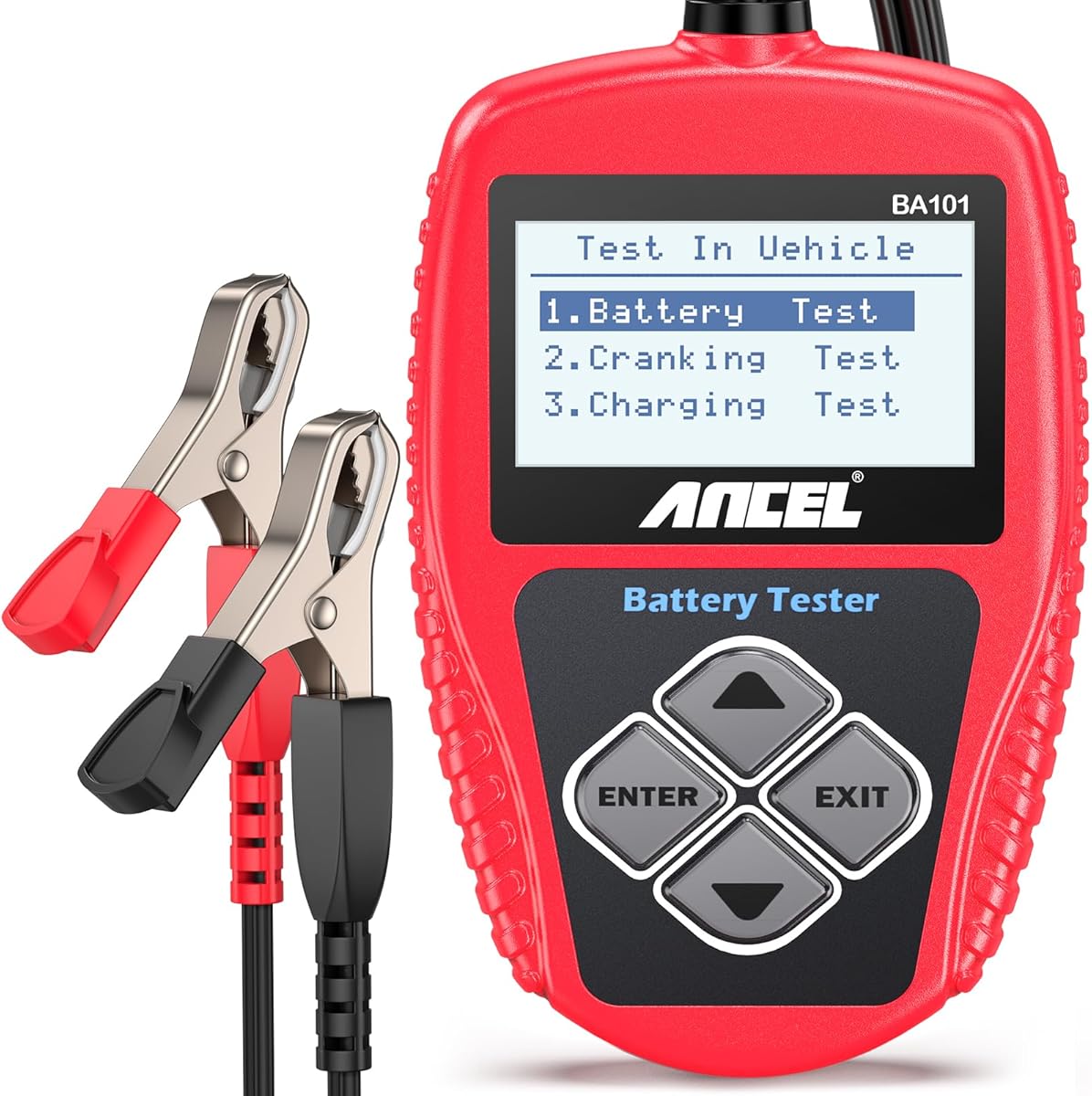
The ANCEL BA101 is built around a different purpose from the laboratory-style resistance meters in this roundup: diagnosing 12-volt starter batteries and related vehicle systems. It carries a 4.5 rating and reports state of health, state of charge, voltage, current, and cold cranking amperes while supporting cranking and charging system tests.
We may earn a commission when you buy through this link, at no additional cost to you.
Its 100–2000 CCA load-capacity range covers common cars, trucks, boats, recreational vehicles, ATVs, lawnmowers, golf carts, and motorbikes with compatible 12-volt batteries over 30Ah. Flooded, AGM, GEL, and EFB types are supported, along with JIS, EN, DIN, SAE, BCI, GB, CA, MCA, and IEC standards. Entering the battery's actual type, rating, and temperature improves interpretation.
This tester is not a general internal resistance meter. It explicitly does not support lithium batteries, 6V or 24V systems, or motorcycles below 30Ah. It also differs from the FNIRSI, ZOYI, and YR1035 models, which focus more directly on resistance measurement across smaller cells and battery packs. Its strengths instead center on starting, charging, and cranking performance.
The BA101 is the right choice for a vehicle owner, mechanic, or fleet technician who wants one compact instrument to assess a starting battery and the surrounding charging system. Direct power from the vehicle means there is no internal battery to maintain, while reverse-polarity, short-circuit, overcurrent, and overvoltage protection adds reassurance during hands-on testing.
Cranking and charging system analysis gives the meter a broader diagnostic role. It can help separate a weak battery from alternator or charging issues, making it useful before a roadside breakdown rather than only after one.
The manufacturer's guidance emphasizes entering the correct battery type, CCA or Ah rating, and temperature. This is essential because an incorrect configuration can make a diagnostic reading less representative of the battery's actual condition.
We may earn a commission when you buy through this link, at no additional cost to you.
The RC3563 Battery Resistance Tester has a 4.9 rating, making it one of the most favorably reviewed products in the list. It is a compact dedicated meter designed to measure battery internal resistance and voltage at the same time, with a four-wire test clamp intended to reduce the influence of contact and wire resistance.
We may earn a commission when you buy through this link, at no additional cost to you.
Its intelligent control, liquid crystal display, and Kalman filter algorithm are presented as supporting accurate and efficient measurements. The device is powered by a built-in 1000mAh lithium battery and charges through a 5V connection compatible with an Android phone charger. That makes it suitable for field service, production lines, maintenance teams, and laboratory work without relying on a mains outlet.
The RC3563 is also listed for measuring the AC resistance of capacitors and low-resistance resistors. This expands its usefulness beyond battery analysis, although buyers focused strictly on laboratory-grade documentation, extensive exports, or advanced range customization may find less information in the supplied description. It is primarily a straightforward meter with a clear clamp-based workflow.
For users who value portability, simplicity, and a strong customer rating, the RC3563 is a compelling selection. It is particularly appropriate for technicians who routinely clamp onto battery terminals, need to compare voltage and resistance quickly, and work in environments where a bench instrument would be inconvenient.
The four-wire clamp helps isolate the measured component from resistance introduced by the leads. This is especially important for small cells and packs whose healthy internal resistance may be quite low.
Ability to measure the AC resistance of capacitors and low-resistance resistors gives the RC3563 additional utility in electronics service. It can therefore serve as more than a single-purpose battery checker.
We may earn a commission when you buy through this link, at no additional cost to you.
The YR1035+ Digital Battery Internal Resistance Tester has a 5.0 rating and a focused design centered on accurate four-wire measurement. It displays internal resistance and voltage simultaneously, allowing users to compare two important battery-health indicators without taking separate readings or changing test modes.
We may earn a commission when you buy through this link, at no additional cost to you.
A true four-wire system reduces the effect of resistance in the test leads by separating current and voltage paths. This makes the meter appropriate for battery screening, performance evaluation, configuration tasks, and other work where a meaningful low-resistance result is required. The large LCD is designed to present real-time results clearly, which helps when working in a workshop or field environment.
This Combination 2 package includes probes and clips, offering more connection flexibility than a meter supplied with only one attachment type. Probes are useful for reaching recessed terminals, while clips can simplify repeatable measurements on exposed battery posts. The compact, lightweight construction supports both field work and bench testing.
The main limitation is the limited technical detail in the supplied listing. It does not describe a battery compatibility list, exact resistance and voltage ranges, recording functions, or a warranty. Buyers needing a broad range of supported cells should verify the manual or manufacturer documentation. Even so, the 5.0 rating, simultaneous display, and four-wire method make this one of the most attractive dedicated meters for users who value a simple and potentially precise workflow.
Simultaneous voltage and resistance display is useful because a meaningful diagnosis should consider both values together. A battery's voltage can change with load, while internal resistance adds another perspective on its condition.
The included probes and clips let users select an attachment that suits the battery and workspace. Clips support hands-free repeat testing, while probes offer precise positioning around smaller or less accessible contacts.
We may earn a commission when you buy through this link, at no additional cost to you.
The T-685 is the most specialized precision analyzer in the lineup. Its 2.2 rating is the lowest shown, but its stated measurement capabilities target demanding users who need a resistance range beginning at one microohm, voltage measurements from one millivolt to ±100 volts DC, and both AC and DC resistance testing.
We may earn a commission when you buy through this link, at no additional cost to you.
Automatic range switching, six resistance gears, three voltage gears, and a stated test speed of five readings per second support efficient analysis. The instrument works with lithium, nickel-hydrogen, nickel-cadmium, alkaline, lithium iron phosphate, lead-acid, 18650, and supercapacitor ESR applications under low-current conditions. A Kelvin four-wire clamp is included for precision work.
Professional features extend beyond measurement. A balanced input system, USB computer connection, and Chinese-English interface support laboratory and production workflows. The unit weighs 2.43 pounds and uses AC110V or AC220V power, so it is better suited to a fixed workbench than to mobile field work. It also offers more measurement modes than most competing products, but the low rating indicates that real-world satisfaction may be less consistent than the specification sheet suggests.
Despite that concern, the T-685 deserves consideration for battery research, quality control, cell screening, and technical analysis where microohm-level range is essential. Buyers should inspect the full documentation, verify their connection requirements, and consider whether AC and DC resistance modes add enough value to justify a dedicated bench instrument.
Starting at one microohm allows the analyzer to examine resistance changes that many general-purpose meters cannot resolve. This is useful for advanced cell testing, research, and controlled production comparisons.
USB connectivity, balanced inputs, automatic ranging, and bilingual menus support structured analysis. The mains-powered format and 2.43-pound weight are more suitable for a permanent bench than for frequent mobile use.
We may earn a commission when you buy through this link, at no additional cost to you.
This WESTOBIG Kelvin Tester listing shares the same 4.3 rating, four-terminal platform, 100-volt ceiling, and 200-ohm range as the second-ranked listing, with particular emphasis on universal battery screening. It supports car batteries alongside AA, AAA, button, lithium, and lead-acid cells, making it useful for users who test different power sources with the same instrument.
We may earn a commission when you buy through this link, at no additional cost to you.
The upgraded Kelvin clip test line is designed to reduce the inherent resistance of the lead wires. Automatic voltage gears include 1V, 10V, and 100V, while resistance settings cover 20 milliohms through 200 ohms. These user-selectable and automatic options help match the meter to different cell sizes and expected resistance levels.
It is important to note the safety boundary: the tester must not be used above 100 volts DC and must not be connected to AC voltage. It also lacks the broader electrical functions of the ZOYI combination meters. Users whose work includes frequency, capacitance, temperature, or general circuit diagnosis should plan to use a separate multimeter.
For battery-focused users who value broad format support, four-wire sensing, and simple range selection, this is a capable option. The color display, auto mode, and compact dedicated design make it a practical companion for a garage, repair bench, or collection of frequently tested batteries.
Support for small alkaline cells, button batteries, lithium formats, and lead-acid batteries means users do not need to change instruments every time they move between household and larger power sources.
Automatic mode simplifies routine measurements, while manual voltage and resistance gears provide control when evaluating unusual cells. This combination supports both quick screening and more deliberate troubleshooting.
We may earn a commission when you buy through this link, at no additional cost to you.
The YR1035+ Accessories Set is a specialized configuration with a 5.0 rating for measuring resistance and voltage across common lead-acid, lithium, Ni-MH, Ni-Cd, and button batteries. Its stated voltage range reaches 99.999 volts, while internal resistance coverage extends to 200 ohms, giving it broad utility for different cell types.
We may earn a commission when you buy through this link, at no additional cost to you.
The defining feature is the Kelvin clamp. It is designed for battery lead ends and sheet-electrode lugs, as well as positive and negative battery terminals. Clamping the contacts frees both hands and can make repeated testing more consistent than trying to maintain a probe on a small or irregular terminal.
A Type-C charging port provides a familiar power connection, though the supplied information does not clarify the internal battery capacity, runtime, or charging time. The listing also provides limited information about the display, data functions, measurement accuracy, and safety certification. Those details should be verified before the unit is used in a regulated or high-voltage workflow.
This configuration is most attractive to users who work with unusual battery connections or need a hands-free Kelvin approach across several chemistries. It pairs well with a battery screening routine, particularly when cell tabs, sheet lugs, or small button batteries would be awkward to test with conventional probes.
The clamp design makes it easier to maintain a consistent connection to lead ends, electrode lugs, or small terminals. This can improve workflow speed and reduce the chance of a probe slipping during a reading.
The listed compatibility with lead-acid, lithium, Ni-MH, Ni-Cd, and button cells makes the set useful for mixed inventories. It is a practical option for comparing disparate batteries under the same resistance-and-voltage workflow.
We may earn a commission when you buy through this link, at no additional cost to you.
Choosing a battery internal resistance tester means balancing measurement method, supported battery types, range, portability, records, and safety. The best choice for a technician is not necessarily the simplest or least expensive model; it is the instrument that matches the batteries, workload, and diagnostic detail required.
A four-wire Kelvin system separates the current-carrying and voltage-sensing paths. This reduces the influence of lead-wire and contact resistance on the displayed result, making it especially important for small cells, healthy lithium batteries, and precision comparisons. Dedicated meters such as the FNIRSI HRM-10, ZOYI models, RC3563, YR1035+ configurations, and T-685 emphasize this approach.
Choose a Kelvin-connected meter whenever low internal resistance matters, readings must be compared over time, or lead lengths vary between tests. A simple two-lead checker may be adequate for rough household screening, but it is less suitable for serious battery-health analysis.
The meter should cover the expected voltage and resistance of your batteries without approaching its absolute limits. Most dedicated products in this roundup support DC battery testing up to roughly 100 volts and resistance readings into the hundreds of ohms. The ZOYI ZT-XR1 extends down to 0.1 milliohm, while the T-685 begins at one microohm and supports unusually broad precision ranges.
Check the minimum resistance as well as the maximum. A wide upper limit is less useful if the meter cannot resolve the small values common in modern cells. Also verify the stated voltage ceiling and never exceed it during testing.
Compatibility should be considered at both the chemistry and format level. AA, AAA, C, D, 9V, button, 18650, LiPo, LiFePO4, Ni-MH, alkaline, lead-acid, and vehicle starter batteries do not all have the same voltage or construction. The Dlyfull tester is particularly broad for household cells, while the ANCEL BA101 focuses on 12-volt starter batteries and excludes lithium.
Match the tool to the actual inventory. A technician working with lithium packs should seek explicit LiPo and LiFePO4 support, while an automotive user should look for CCA, cranking, and charging-system functions as well as suitable battery chemistry ratings.
A dedicated meter focuses on battery voltage and internal resistance, often with a simple workflow and specialized clamp connections. A combined tester adds AC and DC voltage, capacitance, frequency, diode, continuity, and temperature functions, making it more convenient for electronics repair. The ZOYI ZT-XR1 and XR1 are the leading combined examples in this list.
Choose a dedicated model for repeated battery screening, a workshop bench, or tasks where connection method and battery presets are central. Choose a combined meter for technicians who also diagnose circuits and want to avoid carrying two separate instruments.
Historical data can reveal degradation that isolated readings cannot. The FNIRSI HRM-10 supports stored records and table export, while the WESTOBIG listing describes automatic saving, PC transfer, and eight preset data sets. These features are valuable for maintenance inventories, warranty claims, production screening, and comparing batteries before and after a charge cycle.
If your work depends on traceability, confirm both memory capacity and the export format before buying. A display-only meter may be sufficient for occasional checks, but a technician comparing many cells benefits greatly from defined pass-or-fail limits and exportable records.
A large, well-organized display helps users read values quickly and avoid misinterpreting a test. Color TFT screens add visual clarity to the FNIRSI, ZOYI, and WESTOBIG products, while the YR1035+ and RC3563 use LCD displays. Adjustable brightness is useful in garages and bright outdoor workspaces, and backlighting improves visibility in dim conditions.
Consider more than screen size. Look for simultaneous readings, clear range indicators, readable units, and simple controls. For field work, also weigh device size, probe or clamp storage, internal battery life, charging method, and whether the housing feels comfortable to operate one-handed.
An automotive battery tester may need to evaluate more than internal resistance. The ANCEL BA101 provides state of health, state of charge, voltage, current, CCA, cranking, and charging tests. These functions help determine whether a starting problem originates in the battery, starter draw, alternator output, or another related part.
These broader diagnostics are necessary for vehicles but do not make the tool a better laboratory resistance meter. Choose a dedicated four-wire instrument for battery research, cell manufacturing, or electronics repair, and choose the automotive analyzer for roadside and garage diagnosis.
A meter connected directly to a battery must be used within its voltage limit and with the correct connection method. The FNIRSI and WESTOBIG listings explicitly prohibit DC operation above 100 volts and any use with AC voltage. The ZT-XR1 adds CAT II 1000V and CAT III 600V ratings, while the ANCEL includes protection against reverse polarity, short circuits, overcurrent, and overvoltage.
Check the manual, stated protection, accessories, and warranty before deployment in a professional setting. Portable models generally need an internal battery and charging cable, whereas the T-685 uses AC mains power. The most reliable purchase is one whose documentation and safety limits clearly match the intended environment.
Before testing, identify the battery chemistry, rated voltage, and terminal arrangement. Inspect the battery for swelling, leakage, corrosion, or physical damage, and do not test a visibly damaged unit. Review the meter manual, confirm that the battery falls within its supported voltage and resistance ranges, and make sure the instrument has adequate charge or external power.
Connect the tester with the battery disconnected from its normal load when the instructions recommend it. For a four-wire meter, attach the current and voltage leads exactly as shown in the manual, clean the terminals, and keep the clips or probes stationary during the reading. Start with the highest suitable range or automatic mode, then observe the voltage and internal resistance together rather than interpreting one number in isolation.
After testing, disconnect the leads, clean any corrosion from the probes and clips, and store the instrument in a dry area away from extreme heat, moisture, and direct sunlight. Charge the internal battery as directed, inspect cables for damage, and update or verify calibration when required. For accurate comparisons, keep the connection method, test timing, temperature, and selected range consistent across a battery set.
It measures a battery's internal resistance and can also display its voltage. Internal resistance helps indicate whether a cell is becoming harder to charge or deliver current, while voltage provides context for its present electrical state. A useful diagnosis considers both readings together rather than treating either number as a complete answer.
Kelvin four-wire testing separates the current path from the voltage-sensing path. That reduces the influence of resistance in the test leads and terminal contacts, which can otherwise be mistaken for resistance inside the battery. The method is especially useful for small cells, healthy batteries, and precise before-and-after comparisons.
No. A tester may support many formats but still be limited by voltage range, chemistry, current level, or connection method. Household cells, lithium packs, supercapacitors, and vehicle starter batteries have different requirements. Always confirm chemistry, voltage, size, and terminal compatibility before using a meter on a new battery type.
A rising internal resistance can be a sign of aging, but readings should be compared under consistent conditions. Temperature, state of charge, test current, probe placement, and meter range can influence the result. Many professionals compare several readings over time or use a battery-specific reference value rather than relying on one isolated number.
It depends on the diagnostic goal. A four-wire internal resistance meter is useful for battery packs and cell-level analysis, while an automotive analyzer can evaluate CCA, cranking behavior, state of charge, and charging-system performance. The ANCEL BA101 is designed around the latter role, so it may be more useful for a complete vehicle diagnosis.
A dedicated battery tester emphasizes voltage and internal resistance and may include battery presets, specialized clamps, and compatibility guidance. A multimeter measures broader electrical properties such as AC voltage, current, continuity, capacitance, frequency, and resistance. A combined instrument offers both approaches, as seen in the ZOYI ZT-XR1 and XR1.
Only if the instrument's documentation explicitly approves that chemistry, voltage range, and connection method. Some automotive testers are restricted to 12-volt lead-acid starter batteries and may not be appropriate for LiPo, LiFePO4, or multi-cell lithium packs. Using the wrong category of tester can produce misleading results or create safety concerns.
Use the same meter, attachment method, range, test timing, and environmental conditions whenever possible. Record both voltage and internal resistance, note the battery's chemistry and temperature, and compare results against a baseline for that specific battery. Consistent methodology is more meaningful than comparing raw readings taken under unrelated conditions.
The ZOYI ZT-XR1 is the strongest all-round choice because it combines four-wire battery testing with a 25,000-count True RMS multimeter, waveform tools, and a rechargeable power source. The WESTOBIG model is a compelling dedicated option for users who prioritize low-resistance measurement, presets, and exported records, while the YR1035+ offers a focused four-wire design with a strong customer rating and flexible probe-and-clip accessories.
Prioritize compatibility and measurement method before any secondary feature. Confirm that the meter accepts your battery chemistry, voltage, size, and resistance level, and look for Kelvin four-wire sensing when precision matters. Automotive users should consider a tester with cranking and charging functions, while electronics technicians may gain more from a combined True RMS multimeter and battery analyzer.
Finally, review the current listing, manual, accessory contents, warranty, and safety information before purchasing. Ratings and specifications can change, product configurations may vary, and market conditions can affect availability. Comparing the present listing with your actual testing workflow is the surest way to choose a battery internal resistance tester that remains useful and reliable.