
YesBes Cord Hider Kit
4.4Editor score
116-inch total raceway length
Tool-free adhesive installation
Cuttable and paintable
Looking for a cable hider for wall mount TV? Our expert guide compares 10 top-rated raceways, in-wall kits, capacities, finishes, and installation methods.
A wall-mounted television can still look unfinished when HDMI, power, Ethernet, and speaker cables hang visibly behind the screen. A cable hider for wall mount TV conceals those cords in a surface-mounted raceway or carries them behind the wall, creating a cleaner entertainment area while keeping frequently connected cables more protected and easier to manage.
We compared ten products across two main installation approaches. Surface-mounted options range from compact raceways for short cable runs to extensive kits designed for several cords, while in-wall systems provide a more concealed finish but require wall cutting, compatible cavities, and more involved installation. Capacity, profile, mounting method, and paintability were central to the comparison.
Each selection below shows a distinct way to solve the exposed-cable problem, including tool-free adhesive covers, low-profile hinged channels, and pre-wired in-wall modules. The list includes general-purpose raceways, larger multi-cable systems, and installation-oriented kits. Marketplace listings and product availability can change, so confirm dimensions and wall requirements before purchasing.
4.4Editor score

4.8Editor score

4.7Editor score
This side-by-side comparison covers surface-mounted raceways and in-wall concealment kits, with particular attention to cord capacity, total coverage, wall requirements, and installation method.
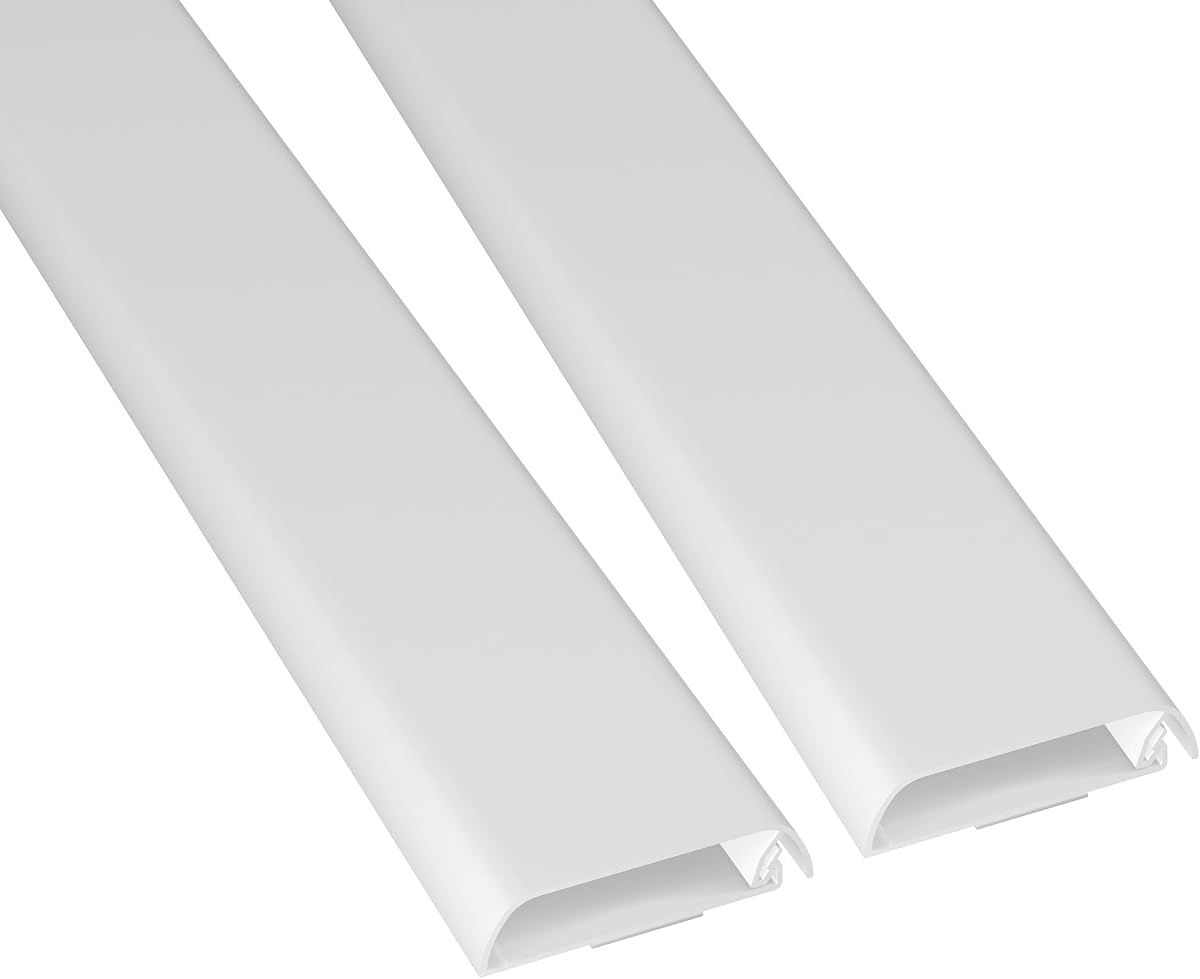


The YesBes Cord Hider Kit is a versatile surface-mounted raceway with a 4.4 rating and 116 inches of total coverage. Its channel measures 0.96 inches wide by 0.57 inches high internally, making it a practical choice for one or a few relatively slender TV cables rather than a bundle of oversized power cords. The kit is particularly useful when the cable route includes turns, branches, or several separate sections.
We may earn a commission when you buy through this link, at no additional cost to you.
One of its strongest features is the included hardware. Six couplings allow separate raceway pieces to be joined, while two L-elbows accommodate right-angle routes and a T-fitting supports a branch. The adhesive-backed design avoids screws and drilling, which can simplify installation on a finished wall. The channel can also be cut with sharp scissors or a saw and painted to blend with the surrounding surface.
There are important limitations. The supplied guidance specifically advises against using the tape on textured walls, so this kit is better suited to smooth painted drywall in a conventional room. Its internal width is narrower than that of several larger options, and the relatively slim profile may not accommodate thick HDMI cable bundles, large power plugs, or multiple bulky adapters without careful measurement.
This is a sensible selection for a viewer who wants a low-effort way to conceal a long TV cable run without making a large wall cut. Measure the cables and intended path first, use the junction pieces to plan corners before peeling the adhesive, and choose a separate in-wall kit if a completely concealed power connection is required.
The couplings, elbows, and T-fitting make the 116-inch set more adaptable than a single straight channel. Planning the full route before installation helps minimize repositioning and reduces the chance of lifting adhesive from the wall.
The white channel can be cut to the required length and painted to match the wall. Its UL94 V-0 flame-retardancy rating also sets it apart from many conventional plastic covers, although the rating does not replace safe cable-handling practices.
We may earn a commission when you buy through this link, at no additional cost to you.
The D-Line TV Wall Mount Cord Hider has a 4.3 rating and uses a broad, low-profile channel designed specifically for the visual demands of a wall-mounted television area. The set contains two 15.7-inch sections for 31.4 inches of total coverage. At 2.36 inches wide and 0.59 inches high, it offers a roomier interior than slim raceways while remaining shallow enough for many entertainment walls.
We may earn a commission when you buy through this link, at no additional cost to you.
Its most distinctive feature is the patented low-profile design with a hidden flexible hinge. The lid opens for cable placement and snaps shut using a click-lock mechanism, producing a cleaner uninterrupted surface than exposed fittings. Strong self-adhesive backing eliminates the need for drilling once the wall has been cleaned of dust and residue.
The main drawback is total length. Thirty-one inches of coverage may suit a compact media wall or one focused cable run, but it can be insufficient for a larger television, a wall-mounted entertainment center, or a route that descends from the screen to an entertainment unit. The adhesive installation also means the route should be planned carefully because repositioning can pull at the wall surface.
The D-Line product is most attractive when visual continuity matters more than extensive coverage. It is a strong fit for renters, modern rooms, and installations with a short vertical or horizontal run. Confirm the cable bundle diameter and measure the wall route before ordering, then paint the surface lightly for a more integrated finish.
The hidden hinge and click-lock cover keep the channel visually continuous after installation. This is especially useful beside a flat-panel display, where visible joints and uneven covers can make an otherwise tidy setup look temporary.
The lid can be opened whenever a device needs to be connected or disconnected. This makes the raceway more useful than a permanently sealed conduit, particularly for entertainment systems that are updated regularly.
We may earn a commission when you buy through this link, at no additional cost to you.
The Delamu 157-Inch Cord Hider combines generous coverage with a compact 0.95-by-0.55-inch profile. Its 4.5 rating reflects a generally well-received product, and the extensive raceway kit is aimed at readers who want one system for several rooms, longer wall runs, or a mix of television and office cables. It is designed to conceal two to four wires depending on their diameter.
We may earn a commission when you buy through this link, at no additional cost to you.
An upgraded snap structure allows the cover to open and close repeatedly, making cable adjustments easier. The raceway is pre-sectioned for splicing and comes with matching connectors, while its cuttable, paintable construction lets the installer adapt the route to the room. Its material carries a UL94 V-0 rating, adding a useful safety specification to the product information.
The main compromise is internal width. While 157 inches of total coverage is ample, the channel is narrower than the D-Line and large-format options in this guide. Thick HDMI cables, multiple power adapters, and oversized Ethernet plugs may crowd the interior or prevent the lid from closing fully. The installation should therefore begin with a test fit of the actual cable bundle.
This Delamu kit is a good all-around choice for extensive surface-mounted cable management without a wall-cutting project. It suits homeowners and dorm or office users who want more than one short cover but do not need recessed power. Use the supplied connectors to create clean corners, and paint the channel only after confirming the final route and cable fit.
The 157-inch total length gives buyers more freedom to continue a route across a room or tackle several low-visibility cable runs. It is more versatile than a compact cover without approaching the bulk of an in-wall system.
The cover can be cut to fit and painted to match the wall. Its snap-open structure also makes it practical to add or remove a cable after installation, avoiding the need to replace the entire raceway.
We may earn a commission when you buy through this link, at no additional cost to you.
The Delamu Large Cord Hider earns a 4.6 rating and is designed for households with several TV, audio, or network cables. Its six included sections each measure 1.18 inches wide by 0.67 inches high, creating enough interior space for three to four cables such as HDMI, Cat6 Ethernet, optical, or USB wires. The larger profile makes it more accommodating than the slim 157-inch Delamu kit.
We may earn a commission when you buy through this link, at no additional cost to you.
Installation follows a straightforward adhesive process: clean the wall, apply the raceway, place the wires inside, and close the cover. A useful feature is the combination of snap-on and slide-on access, allowing the lid to be opened or moved when cables need to be adjusted. The cover is also cuttable and paintable, so the final installation can follow the wall route closely.
The product information notes that the kit does not include accessories, which may matter if the route requires elbows or branching points. Its adhesive is also described as very sticky, so moving a piece after placement can potentially mar the wall. Buyers should map the path, confirm the corner strategy, and position each section before applying it.
This Delamu option is well suited to a wall-mounted television with a substantial cable bundle, especially when the installer wants a surface-mounted solution that can be opened later. It is less appropriate for a short route where a narrower profile would look more refined, or for a user who expects factory-supplied corner fittings.
The roomy interior is the defining advantage of this set. It provides space for several common connection types, reducing the need to maintain multiple narrow channels beside the television.
Both snap-on and slide-on handling make the cover convenient for service access. Once the route is planned, each section can be positioned quickly with no drilling required.
We may earn a commission when you buy through this link, at no additional cost to you.
The TV Wire Hider Kit for Wall Mount TV has the highest rating in this comparison at 4.8. It takes a focused approach to the most noticeable part of a mounted television setup: the short cable section immediately behind the display. Rather than placing a long external channel on the wall, the kit uses pass-through fittings to carry cables into the wall cavity, where a more nearly invisible result can be achieved.
We may earn a commission when you buy through this link, at no additional cost to you.
The package includes two pass-throughs and a hole-saw drill attachment intended to create suitable openings. The fittings are designed for perforated walls with a thickness of 12 to 18 millimeters, including plaster and wood-plank walls. This makes the kit especially relevant to flat-panel televisions, gaming systems, and entertainment consoles where an external raceway could spoil the appearance of a minimalist media wall.
Unlike adhesive raceways, this system is a permanent construction project. Cutting the correct location, checking for concealed obstacles, and matching the pass-through to the wall thickness all require care. It also does not provide the same level of cable routing flexibility as a long surface-mounted channel, and a complete concealed power system may require additional components not listed with this kit.
This is the strongest recommendation for a homeowner seeking a polished, permanent in-wall result and who is comfortable with basic drilling. Verify the wall construction, confirm the permitted thickness, and locate potential wiring or plumbing before cutting. For the cleanest result, coordinate the pass-through positions with the exact location of the television mount and connected devices.
Pass-throughs eliminate the need to run a visible raceway down the most noticeable section of the wall. The result suits modern displays and carefully planned entertainment alcoves where exposed hardware would be conspicuous.
Including two pass-throughs and a hole-saw attachment makes the installation more focused than assembling a generic wall kit. The installer still needs to check the wall material and avoid hidden utilities before drilling.
We may earn a commission when you buy through this link, at no additional cost to you.
The ECHOGEAR In-Wall Cable Management Kit has a 4.7 rating and is a more complete concealed-cable solution than a basic pass-through. It includes upper and lower modules, each measuring 3.75 inches wide by 3.25 inches deep, along with a six-foot extension cord, a driver bit, and a drywall hole-saw attachment. Its goal is to move both TV power and low-voltage connections behind the wall.
We may earn a commission when you buy through this link, at no additional cost to you.
The system is pre-wired and ETL certified for in-wall use. Its flexible cavity can accommodate up to four large HDMI cables, plus Ethernet and audio cords. Paintable grommets and locking wings create a finished appearance, while the included extension cord removes the need to route a separate power lead from the television to an existing receptacle.
This is a substantial installation that requires a drill and enough room inside the wall for the modules. It is not a surface cover that can be peeled into place, and it may be unsuitable where studs, masonry, shallow cavities, or shared walls prevent a suitable cutout. The product information states that it can be installed in under 30 minutes and does not require an electrician, but careful measurement remains essential.
The ECHOGEAR kit is ideal for a dedicated media wall where the owner wants a professional concealed finish and has room for a larger opening. It is a better fit for new construction or renovation than a quick rental upgrade. Confirm cavity depth, stud position, and the path to a safe outlet before starting.
The pre-wired modules are designed to carry both power and low-voltage connections behind the wall. This makes the kit more practical for a finished entertainment center than a pass-through used by itself.
Paintable grommets and locking wings produce a neat final surface. When placed carefully around the television mount, the system keeps most of the visible cable path out of sight.
We may earn a commission when you buy through this link, at no additional cost to you.
The EVEO 306-Inch Cable Hider provides the greatest total surface-mounted coverage in this guide. Its 4.6 rating and construction as twenty separate 16-inch sections make it a natural choice for managing cables in several rooms or along a long, complex route. The 0.95-by-0.5-inch profile keeps the raceway visually restrained on a wall.
We may earn a commission when you buy through this link, at no additional cost to you.
Installation flexibility is another advantage because the raceway can be secured with tape or screws. Adhesive is convenient for quick projects, while screws can be preferable for long routes, high-traffic areas, or installations where a stronger mechanical attachment is desired. The channel is paintable, allowing the final result to blend with the surrounding decor rather than remain a conspicuous white accessory.
The trade-off is that twenty pieces may be much more than a typical television installation requires, and the narrow internal dimensions are best suited to relatively slim cables. A bundle containing several large HDMI cables or bulky power connectors may not fit comfortably. The numerous joints must also be aligned carefully for a continuous appearance.
This EVEO set is most useful for buyers who want one cable-management system across a home, office, or multiple entertainment areas. Its modular construction makes it easy to use only the needed length and discard the rest. For one compact TV wall, a smaller kit may be more convenient; for extensive coverage, this one offers exceptional flexibility.
Twenty sections can cover long runs, separate rooms, and multiple types of wiring. The modular format lets installers avoid stretching a single channel across a route that would be difficult to align.
Supporting both tape and screws provides useful flexibility. The appropriate method depends on the wall material, the length of the run, and how firmly the channel needs to remain attached.
We may earn a commission when you buy through this link, at no additional cost to you.
The Mount-It! In-Wall TV Cable Concealer is a polished integrated solution with a 4.7 rating. Unlike a simple raceway, it provides a recessed power connection, a triple outlet, and room for multiple HDMI, Ethernet, and audio cables. It is designed for living rooms, bedrooms, and dedicated home theater areas where a mounted television should have as little visible wiring as possible.
We may earn a commission when you buy through this link, at no additional cost to you.
The plug-in system connects to an existing outlet through a nine-foot extension cord rather than requiring hard-wiring. The package contains a large wall plate measuring 6.3 by 7.9 inches, a smaller 4.5-inch plate, preinstalled screws, a drywall saw, a cutting template, and instructions. The recessed opening gives users convenient access while keeping the main cable run behind the wall.
The main consideration is wall construction. The large plate requires a cutout between studs and a minimum cavity depth of 2.4 inches, while standard walls are often approximately 3.5 inches deep. Because the cutout is permanent, users should confirm the full dimensions, identify obstructions, and ensure the television position will leave the outlet accessible.
This is the premium choice for a homeowner who wants a permanent, professionally integrated result and wants power at the television location rather than simply covering an exposed power cord. The included template, saw, and plate sizes make the package more complete than a basic in-wall box. Installation still calls for care, but it avoids the need to run new electrical wiring.
The recessed triple outlet addresses a common weakness of wall-mounted TV setups: the lack of a nearby, discreet power source. Its plug-in design supplies that convenience without requiring a new hard-wired circuit.
A cutting template, drywall saw, extension cord, two plate sizes, and installation hardware are included. The system gives the installer most of the essential components needed to create a finished media wall.
We may earn a commission when you buy through this link, at no additional cost to you.
The Yecaye TV Cord Hider is a focused 42-inch solution with a 4.5 rating. It is designed for the common situation in which a wall-mounted television has a short group of HDMI, power, or Ethernet cables hanging below it. The channel measures 1.18 inches wide by 0.6 inches high and can accommodate approximately three to four cords, depending on their thickness.
We may earn a commission when you buy through this link, at no additional cost to you.
Three raceway sections can be installed separately or spliced together. Each section can slide on or snap on, which helps in the restricted space immediately beneath a television. Pre-applied adhesive makes the installation tool-free, while the wider profile provides more usable capacity than a very narrow decorative channel.
Its limitations relate mainly to length and interior clearance. Forty-two inches is enough for a focused run but not a comprehensive whole-room routing project. The stated internal length is approximately 1.1 inches with an internal width of 0.52 inches, so large power adapters and tightly packed cable bundles should be tested before installation. Like other adhesive products, it is best not to reposition repeatedly.
This Yecaye set is a good choice for a compact television wall, dorm room, or single entertainment unit where a short vertical run needs a neat finish. Measure both the route and the widest part of the cable bundle. If all cables fit comfortably and the wall is smooth, the installation can be completed quickly without tools.
The compact 42-inch format avoids installing a much larger channel than the route requires. It can conceal a small bundle directly below or beside a mounted display.
Users can slide the cover on or snap it closed, making it easier to work in a tight area. That flexibility is useful when the television is mounted close to furniture or another wall.
We may earn a commission when you buy through this link, at no additional cost to you.
The Large Cord Hider is the most generously proportioned surface-mounted channel in this guide, with a 4.6 rating. It measures 1.6 inches wide by 0.8 inches high and can hide between one and five cables. The product information specifically notes capacity for up to four HDMI cables or five Cat6 Ethernet cables, making it suitable for a dense entertainment-center bundle.
We may earn a commission when you buy through this link, at no additional cost to you.
The kit contains three 15.7-inch sections that splice together for 47 inches of total coverage. Strong pre-applied adhesive provides a tool-free installation, while a smooth, glazed PVC surface can be painted to match the wall or surrounding decor. The larger interior also makes it easier to conceal several cables without forcing the lid closed against a bulky bundle.
The trade-off is visual bulk. A channel this wide is more noticeable beside a slim television than a narrow raceway, particularly if the wall color differs. Its adhesive should not be removed and reapplied repeatedly because that can damage the finish. The product guidance also suggests warming the tape slightly at low temperature for a stronger bond.
This large-format set works best for televisions with several connected devices or a visible cable bundle that must remain accessible. It is a good middle ground between a basic surface cover and a recessed in-wall system. Position the three sections carefully, ensure the route is final, and test the largest cable connector before attaching the adhesive.
The high-capacity cross-section makes it easier to group several HDMI, Ethernet, and power cables in one cover. That reduces visual clutter without forcing a large bundle into a narrow channel.
The smooth, paintable exterior can blend into the wall, though the wider profile remains more noticeable than slim options. A sample of the finish should be tested before painting the full set.
We may earn a commission when you buy through this link, at no additional cost to you.
The most suitable cable hider depends on the wall type, cable bundle, installation tolerance, and desired level of concealment. Measure the route and cords before choosing a system.
Surface-mounted raceways attach to the visible wall with adhesive or screws and are the easiest option for finished rooms, rentals, and short cable paths. They leave a slim or rectangular channel on the wall but can be painted and opened for cable changes. In-wall pass-throughs, pre-wired modules, and recessed outlets carry connections behind the wall and create a more integrated result, but they require drilling, compatible wall construction, sufficient cavity depth, and a willingness to make a permanent cutout.
In general, choose a surface raceway for flexibility and choose an in-wall system when a clean media-wall appearance outweighs the installation work.
Do not rely only on the advertised cable count. A raceway that fits four slim Ethernet cables may not accommodate two HDMI cables, a power cord, and a bulky connector. Check the internal width and height, then measure the thickest cable and any adapter that must pass through the channel. Products described for three to four cables, or for multiple large HDMI leads, offer more room than ultra-slim decorative channels.
Measure the entire bundle at its widest point and test the cover before committing to the wall.
Total length should correspond to the complete visible path from the television toward the power outlet, entertainment unit, or wall edge. Short sets are convenient for one compact TV wall, while extensive kits make sense for several rooms or complicated routes. Modular raceways offer flexibility because unused sections can be left out, but many short pieces demand more careful alignment than a small number of longer sections.
Add a little extra length for turns, vertical drops, and imperfect measurements before deciding which coverage level to purchase.
Adhesive-backed channels work best on smooth, clean, painted drywall. Some products explicitly warn against textured walls, and a rough or dusty surface can weaken the bond. Screw-mounted raceways offer an alternative when the channel is long, placed high, or expected to remain attached for a long time. In-wall installations require checking whether the wall is drywall, plaster, wood plank, or another material, as well as locating studs and avoiding concealed wiring or plumbing.
Clean the intended surface, verify its material, and use the mounting method best suited to the wall and location.
Entertainment systems are not always connected once and left untouched. A snap-open, hinged, or slide-on cover makes it easier to reconnect HDMI, adjust Ethernet, or service a device without dismantling the entire channel. Permanently enclosed conduits can protect cables more thoroughly but may require cutting the raceway whenever a connector needs to be added. For gaming consoles, streaming devices, and frequently rearranged components, convenient access is a practical advantage.
Prioritize a reusable hinged or removable lid when your connected equipment changes often.
A white raceway can disappear into a white wall without further work, but paintable PVC or plastic allows the channel to match another wall color. For the most natural result, cut and fit every piece before painting, use a compatible primer when recommended, and apply thin, even coats. Hinged covers, couplings, elbows, and corner fittings should be aligned carefully because small mismatches can be more noticeable than the cable problem itself.
Consider the television’s position, lighting, and wall texture when deciding between a slim white cover and a paintable one.
A complete surface-mounted kit may include couplings, elbows, T-fittings, end pieces, and cutting tools. In-wall systems may include grommets, modules, wallplates, hole saws, templates, driver bits, or extension cords. These accessories can make a project smoother, but they also need to match the route. A long straight raceway without corner fittings may be awkward to connect around an entertainment unit, while a pass-through kit does not necessarily include a recessed power outlet.
List the corners, branches, wall openings, and power needs before choosing a kit based only on its headline capacity.
A closed raceway keeps cords away from curious hands, reduces opportunities for pets to chew exposed cables, and can help remove trip points near floor-level routes. Flame-retardancy information and in-wall safety certifications are useful differentiators, but they do not remove the need to avoid overloaded outlets, damaged cables, and improper in-wall installations. Low-voltage and power wiring should never be forced into a channel that lacks adequate space or is not approved for that use.
Choose a sturdy, properly sized cover and inspect the installation so concealed cables remain protected without creating electrical strain.
Begin by identifying every cable that must be hidden, including the television power lead, HDMI connections, Ethernet, audio, and speaker wires. Disconnect the devices, arrange the cables in the order they will enter the channel, and test the bundle inside the raceway. Confirm that connectors can pass through each opening and that the lid closes without pressing against the cables. For an in-wall kit, also verify the wall material, cavity depth, stud location, and opening dimensions before cutting.
For a surface-mounted installation, clean and dry the wall thoroughly, mark the complete route, and position each section temporarily. Remove the adhesive liner and press the raceway firmly into place rather than shifting it repeatedly. If the route needs a corner, align the included elbow or coupling before securing the adjoining piece. Once the channel is secure, feed the cables through the openings, arrange them neatly inside, and close the hinged or snapping cover.
After installation, inspect the cable path periodically and reopen the cover whenever a device is moved or a connector is changed. Do not force a lid shut over a swollen bundle, and avoid hanging objects from the channel. For painted raceways, use a light touch when cleaning so the finish is not scratched. Check adhesive-mounted covers for movement and in-wall fittings for looseness, particularly in high-humidity or high-traffic areas.
A low-profile surface raceway is easiest to install and works well for a short cable path or a room where drilling is undesirable. An in-wall pass-through or recessed power system creates a more seamless finish but requires compatible walls, adequate cavity space, and careful installation. The best choice depends on how much permanent work you are willing to do and whether the television has several connected cables.
Measure the complete visible route from the television connection point to the outlet, entertainment unit, or lower wall edge. Include vertical drops, turns, and any space needed around corners. It is better to add a little extra coverage than to finish with a conspicuously short channel, particularly when the cable bundle may expand when new devices are connected.
Most of the surface-mounted raceways in this guide are described as paintable. Fit and align all pieces before painting, and test the finish on an inconspicuous section. Use compatible primer and thin coats if the manufacturer recommends them, and allow the surface to dry fully before installing cables or closing the cover.
Not every adhesive system is suitable for texture. The YesBes kit specifically warns against tape use on textured walls, and rough surfaces can reduce adhesion on many other products. Clean the wall thoroughly and consider a screw-mounted raceway or in-wall solution if the surface is heavily textured, painted with a troublesome finish, or exposed to temperature changes.
Yes, if the raceway has enough internal space and is approved for the cable types involved. Measure the bundled diameter, including any power adapter or large HDMI connector, and ensure the cover closes without compressing the cords. In-wall power solutions should use certified components, and all wiring must remain within the manufacturer’s stated limits.
It is more involved than applying a surface raceway because the wall must be cut correctly. The installation may require checking for studs, wiring, and plumbing, using the supplied template or hole saw, and confirming adequate cavity depth. Mount-It! is a plug-in system rather than a hard-wired one, while other in-wall modules are pre-wired and ETL certified.
Snap-on, slide-on, and hinged raceways allow repeated access to the cables inside. This is particularly useful for changing HDMI sources or servicing a game console. Permanently sealed channels may require cutting, so buyers who expect frequent cable changes should favor a reusable lid and a channel large enough for the full bundle.
They can by enclosing loose cords and keeping them away from open walking areas, furniture edges, and curious hands. No cover can compensate for damaged wiring, overloaded outlets, or an unsafe installation. Secure the raceway firmly, keep cables undamaged, and ensure the cover does not create its own loose or sharp hazard.
The YesBes Cord Hider Kit is the most practical surface-mounted starting point for a long, adaptable route that needs multiple fittings. The TV Wire Hider Pass-Through Kit stands out when the priority is a polished in-wall appearance around the display, while the Mount-It! In-Wall Cable Concealer is the strongest premium option for a dedicated media wall needing integrated recessed power.
For most removable installations, choose based on the actual bundle diameter, wall texture, route length, and need for frequent access rather than cable count alone. Larger raceways handle more connections, narrow channels look more discreet, and hinged covers make service work easier. In-wall solutions are worth the added planning when a permanent, professional-looking result is more important than a fast installation.
Before buying, measure the route, test the largest connectors, identify the wall material, and review the included fittings and mounting requirements. Product details and marketplace listings can change, so verify the current specifications and manufacturer instructions before cutting a wall or applying adhesive.