
VICAL 1000 Calcite Media
4.0Editor score
NSF/ANSI 60 certified media
Uniform 16-by-40 mesh
Designed for neutralizer tanks
Approximately 96% calcium carbonate
Calcium filters for well water take several different forms because hardness, acidity, sediment, iron, and mineral content can vary dramatically from one private well to another. The right solution may be a calcite neutralizer, ion-exchange cartridge, sediment prefilter, or a complete whole-house treatment system.
This guide compares ten products based on filtration purpose, treatment media, capacity, flow rate, compatibility, certification, and suitability for well water. It covers complete systems as well as individual replacement media and cartridges, because the most effective setup often depends on water chemistry rather than a one-size-fits-all product.
Each review explains the product's strongest use case, practical limitations, and who should consider it. Ratings and specifications reflect the supplied product information, while product availability and prices can change, so readers should confirm current details and installation requirements before purchasing.
4.0Editor score

4.7Editor score

4.4Editor score
As an Amazon Associate we earn from qualifying purchases.
The table below compares all ten products by treatment type, media or cartridge format, practical capacity, and the well-water problem each is best suited to address.
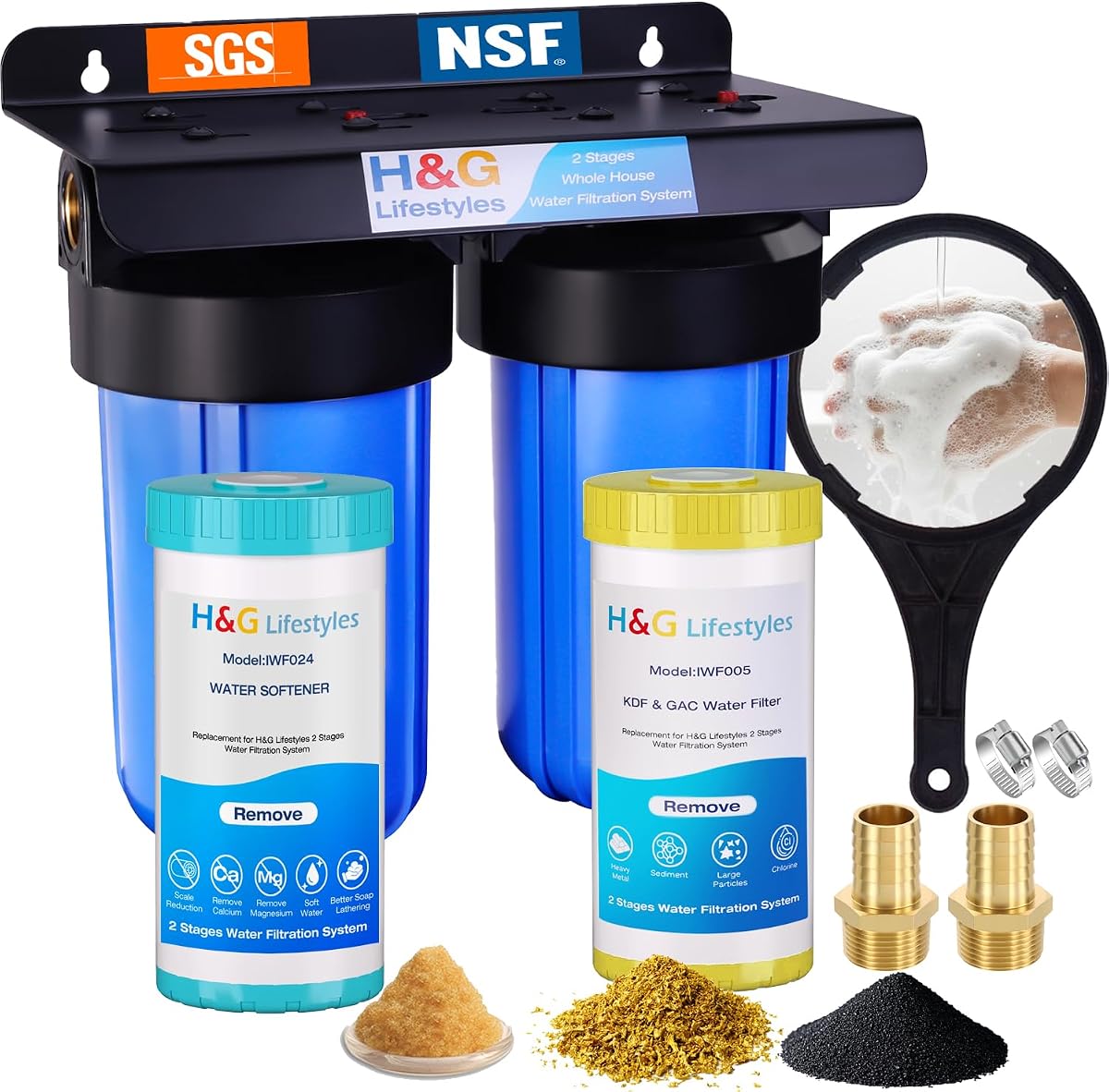


The H&G Lifestyles Whole House Water Filter and Softener Filtration System combines two treatment stages in a compact 10-by-4.5-inch format. Its 3.9 rating is the lowest among the rated products in this guide, but that figure should be considered alongside the system's broad scope: it addresses hardness, scale, chlorine, odors, heavy metals, and some sulfur-related concerns rather than performing as a single-purpose cartridge.
We may earn a commission when you buy through this link, at no additional cost to you.
One stage uses cation resin to reduce calcium and magnesium, while the second contains KDF and granular activated carbon. The listed operating range is 20 to 100 PSI, with an anticipated flow range of 7 to 12 GPM and a maximum filtration claim of 70,000 gallons. These are meaningful advantages for homeowners who want point-of-entry treatment without assembling several separate housings.
The tradeoff is that a two-stage cartridge system is not a substitute for a properly sized professional softener, reverse-osmosis system, or laboratory-guided treatment plan. The manufacturer notes that actual capacity depends on local water quality and usage, and the cation resin is described as particularly suitable for chlorinated municipal water. A well owner should therefore verify hardness, iron, manganese, pH, and contaminant levels before expecting the system to address every issue.
This is a practical choice for a homeowner seeking an integrated starting point with room for meaningful flow and multiple treatment goals. It is less suitable when the well has severe hardness, high iron, or unknown contaminants that require dedicated media. Despite the lower listed rating, its combination of scale inhibition, carbon filtration, whole-house placement, and high stated capacity makes it worth serious consideration.
Combining cation resin with KDF and GAC media can simplify a point-of-entry setup while addressing both hardness minerals and common aesthetic or metal-reduction concerns. It does not eliminate the need to match treatment capacity to actual household demand.
A stated flow range of 7 to 12 GPM is more useful for whole-house use than the lower throughput of many standard cartridges. The system should still be sized around simultaneous fixture use, pressure conditions, and the treatment demands measured at the well.
We may earn a commission when you buy through this link, at no additional cost to you.
The PUREPLUS 10-by-4.5-inch Whole House Scale Inhibitor and Sediment Water Filter is a three-pack built around polyphosphate or silica-phosphate media. It is intended to bind with calcium, magnesium, and other hardness-related ions so they are less likely to form scale inside pipes and heating equipment. Its listed rating is 4.0, but no customer rating was supplied for this listing.
We may earn a commission when you buy through this link, at no additional cost to you.
The cartridge uses three polypropylene density layers, coconut-shell activated carbon, and food-grade Siliphos. It fits numerous standard 10-by-4.5-inch housings and most systems using 9.75-by-4.5-inch filters, making it attractive for owners of compatible equipment. The listed capacity is up to 30,000 gallons, with a suggested replacement interval of three to six months for an average household.
The most important limitation appears directly in the supplied information: the manufacturer warns that this filter may not deliver the expected result for well water and directs well-water shoppers toward another dedicated product. Well water can carry sand, iron, organic matter, and other deposits that may load a scale-inhibitor cartridge quickly or create conditions the media was not designed to handle. A sediment prefilter may also be needed.
Choose this multipack for compatible point-of-entry housings and scale control where a full ion-exchange softener is unnecessary. It is less convincing as a stand-alone well-water solution because of the manufacturer's own warning. Confirm your housing dimensions, test the source water, and consider a dedicated sediment stage before installation.
The unusually broad list of compatible housings makes this an attractive maintenance option for a household already equipped with a standard 10-by-4.5-inch system. Verify both the cartridge length and housing diameter rather than relying only on the nominal size.
Polyphosphate-based media helps discourage mineral scale rather than providing the capacity of a dedicated ion-exchange softener. It should not be described as a complete solution for severe hardness or for every well-water contaminant.
We may earn a commission when you buy through this link, at no additional cost to you.
VICAL 1000 is a granular calcite medium intended for acid neutralizer tanks and other compatible treatment vessels. Its 4.0 rating reflects a focused product rather than a complete household system, and its strongest feature is the supplied NSF/ANSI Standard 60 certification for drinking water treatment applications when properly installed.
We may earn a commission when you buy through this link, at no additional cost to you.
The uniform 16-by-40 mesh supports consistent water distribution and contact time in a neutralizer bed. Made from natural limestone under controlled processing, the media has an indicated calcium carbonate content of approximately 96%. As water passes through, the calcite gradually dissolves and helps raise the pH of acidic water, which can help reduce the corrosive conditions that attack copper pipes and metal fixtures.
Calcite neutralization is not the same as hardness removal. The media raises or stabilizes pH but does not provide the ion-exchange capacity required to reduce calcium and magnesium throughout a household. It also must be placed in a properly sized tank with suitable underdrain and controls; buying the media alone does not create a functioning filter.
This is a strong choice for a homeowner who already has a compatible neutralizer system or wants to refill one with certified, consistently graded material. It is especially relevant to well water that tests acidic and causes corrosion concerns. It is not the right standalone choice for a household seeking substantial softening, sediment removal, or iron reduction.
Low-pH well water can create a corrosive environment in metal piping and fixtures. Calcite gradually dissolves as water passes through the bed, helping neutralize acidity and create conditions that are less aggressive to household plumbing.
A controlled 16-by-40 mesh size supports even flow distribution and useful contact time within a neutralizer tank. Tank design, water velocity, backwashing, and media depth still influence actual performance.
We may earn a commission when you buy through this link, at no additional cost to you.
The Aqua-Pure C-050P Calcium Carbonate Media is designed for use with 3M Aqua-Pure automatic backwash filters. Its 4.6 rating is among the strongest in this list, although the supplied product information is brief and focuses on the media's intended function rather than detailed specifications.
We may earn a commission when you buy through this link, at no additional cost to you.
Its primary job is neutralizing moderate acidity in water. That can be valuable where acidic supply water contributes to corrosion of copper pipes and fixtures. Automatic backwash capability is a practical advantage because it supports routine media cleaning without requiring the owner to remove and manually rinse the media as with a basic cartridge vessel.
The product is only suitable when paired with the specified equipment, so compatibility is essential. It should not be confused with a complete system because media, tank, controls, and plumbing are all required. The information provided also does not state a precise mineral capacity, particle size, certification, or recommended service interval, making those details important to confirm before making a purchase.
This media is a good fit for well owners who own a compatible 3M Aqua-Pure automatic backwash filter and need help controlling moderate acidity. It may be particularly useful in a treatment train that also includes sediment and oxidation-stage filtration. For a first-time system buyer, choose a packaged neutralizer and confirm all compatible components before ordering replacement media.
Neutralizing moderate acidity can help limit the conditions that corrode copper piping and fittings. The effect is most relevant when the source-water pH is consistently low and the broader treatment design addresses sediment and metals.
Using calcium carbonate media in an automatic backwash filter makes routine maintenance more convenient than servicing some simple vessels. Equipment compatibility must be confirmed before the media is ordered.
We may earn a commission when you buy through this link, at no additional cost to you.
The AFWFilters Acid Neutralizer for Well Water is a packaged acid-neutralizing system associated with the Clack brand. Unlike bulk calcite media, it arrives as a complete treatment arrangement, which can simplify the search for a homeowner who wants an integrated pH solution rather than a replacement cartridge.
We may earn a commission when you buy through this link, at no additional cost to you.
Its central purpose is to treat acidic well water, a condition that can make metal plumbing more susceptible to corrosion and affect the performance of downstream treatment components. A packaged neutralizer can therefore serve as a useful early stage, particularly when other filters will follow.
The supplied information is limited, so buyers should request the complete specifications before purchase. Important questions include tank size, media volume, supported flow rate, backwash controls, inlet and outlet dimensions, and whether a separate pump or additional treatment is required. The 4.3 rating is encouraging but does not replace verifying product-specific details.
This system is best suited to a well owner who has confirmed low-pH water and wants a dedicated calcite neutralizer rather than adding bulk media to an existing vessel. It can be paired with sediment filtration and other treatment stages, but it should not be expected to soften hard water or remove iron on its own. Professional consultation is sensible when corrosion, staining, or pH problems are substantial.
A packaged neutralizer removes the guesswork of selecting bulk media and a separate vessel. It offers a more direct starting point for correcting confirmed acidic well water, provided the system's specifications fit the home's flow and plumbing requirements.
A neutralizer can be valuable before iron removal or other stages that work more effectively when incoming water chemistry is under control. The correct sequence depends on a complete water analysis rather than visible symptoms alone.
We may earn a commission when you buy through this link, at no additional cost to you.
This 20-by-4.5-inch cation resin filter is designed to reduce calcium, magnesium, and total dissolved solids associated with hard water. Its 4.0 rating and stated 4,500-grain capacity make it a meaningful softener cartridge, but its maximum flow of 2 GPM is a major consideration for whole-house use.
We may earn a commission when you buy through this link, at no additional cost to you.
The cartridge fits Big Blue filter housings and can be installed at the point of entry or near sensitive appliances that benefit from softer water. Cation resin exchanges sodium ions for hardness ions, helping reduce scale-forming calcium and magnesium. The manufacturer suggests positioning it after sediment filtration and before carbon treatment to improve cartridge life and taste.
A cartridge softener requires proper preparation, periodic regeneration, brine, and a suitable drain connection. It is not simply a passive sediment filter that can be installed and forgotten. With a maximum flow of 2 GPM, it may be better suited to protecting a specific appliance or a small, carefully selected portion of the home than supplying every fixture at once.
Choose this product if you have a compatible Big Blue housing, need a compact ion-exchange stage, and can manage the plumbing requirements of regeneration. It is not the strongest choice for unrestricted whole-house demand, and it will not remove iron, sediment, or acidity unless separate treatment stages are added. A water test should establish whether hardness reduction is the priority.
The stated 4,500-grain capacity separates this product from simple scale-inhibitor cartridges that merely discourage deposits. Actual useful capacity and service interval depend on incoming hardness, water use, resin regeneration, and operating conditions.
A maximum of 2 GPM encourages targeted installation or use in homes with modest simultaneous demand. For a busy whole-house system, the flow rating is likely to be the most important specification to compare.
We may earn a commission when you buy through this link, at no additional cost to you.
The iSpring WSP-50SL is a 50-micron spin-down sediment filter intended as the first stage of a residential whole-house treatment train. Its 4.6 rating reflects a well-regarded basic prefilter, and the clear housing makes it easy to see when the screen needs cleaning.
We may earn a commission when you buy through this link, at no additional cost to you.
The unit targets sediment, rust, dirt, sand, and larger particles before they reach finer filters. Because the screen is flushable and reusable, it can divert a significant workload from downstream cartridges. It also includes Siliphos intended to assist with softening, scale prevention, and corrosion resistance, making it somewhat more comprehensive than a plain sediment screen.
Installation details are straightforward: one-inch male NPT and three-quarter-inch female NPT connections, a garden-hose flush fitting, and an operating range of 40 to 100 degrees Fahrenheit and 20 to 100 PSI. The product is for indoor use only, and the manufacturer recommends replacement every three to six months to limit scale accumulation on the Siliphos component.
This filter makes sense as the protective first stage of a well-water system, particularly where sand or rust is present. It is not a substitute for a five-micron cartridge when very fine sediment must be removed, nor is it a dedicated softener. Homeowners seeking a complete calcium-treatment solution should use it alongside appropriately selected media rather than expect it to perform every function alone.
Removing sand, rust, and larger particles before they reach finer media can reduce clogging and extend the service life of downstream cartridges. That preventive role is particularly valuable on well systems where sediment loads are unpredictable.
The see-through housing makes it easy to determine when the screen needs flushing, while the garden-hose fitting supports routine cleaning. This reduces the maintenance burden compared with replacing a disposable prefilter every time it loads.
We may earn a commission when you buy through this link, at no additional cost to you.
The Membrane Solutions 5 Micron String Wound Whole House Water Filter is a six-pack of polypropylene cartridges made specifically for sediment protection in well-water and whole-house applications. Its 4.7 rating is the highest listed among the reviewed products, making it an appealing choice when the immediate need is reliable particulate filtration.
We may earn a commission when you buy through this link, at no additional cost to you.
The string-wound design uses a deep graded honeycomb structure that is denser near the core and more open toward the outside. This allows larger particles to be captured before finer material reaches the core. The cartridge is made from food-grade polypropylene described as lead- and BPA-free, and the manufacturer claims up to four times the dirt-holding capacity and twice the flow rate of a conventional polypropylene sediment filter.
Each five-micron cartridge fits most 10-inch housings and can serve as a prefilter for reverse osmosis, whole-house systems, and commercial equipment. Stated service life is up to 15,000 to 20,000 gallons, although the information correctly notes that actual capacity depends heavily on incoming water quality. A replacement is suggested at least every six months, which may be an important consideration for sediment-heavy wells.
This product is an excellent first stage for protecting downstream softeners, neutralizers, carbon filters, and appliances from sand, silt, rust, and undissolved particles. It is not a calcium-removal treatment by itself, so buyers should pair it with hardness or pH media when necessary. The six-cartridge pack and strong rating make it the most attractive sediment-focused option in this guide.
The graded string-wound structure captures progressively finer particles as water moves inward. This design helps protect downstream treatment media from premature blockage and makes the cartridge a strong choice for sediment-heavy well sources.
Owners of compatible 10-inch housings can maintain several replacement stages or keep a ready supply. Care intervals should be based on measured sediment levels and pressure changes rather than waiting for complete flow restriction.
We may earn a commission when you buy through this link, at no additional cost to you.
The Waterdrop WHF21-FG is a two-stage, 10-by-4.5-inch whole-house filtration system designed for both municipal and well water. Its 4.4 rating reflects a well-rounded package, while the supplied specifications are notably detailed: the first stage targets iron and manganese, and the second uses natural coconut-shell granular activated carbon.
We may earn a commission when you buy through this link, at no additional cost to you.
Third-party testing is cited for reductions of up to 96.4% iron, 98.2% manganese, and 95.63% chlorine, with additional claims concerning rust, sediment, particles larger than five microns, and select heavy metals including mercury, lead, cadmium, chromium, and copper. The system has one-inch NPT connections, supports up to 15 GPM, and offers a stated capacity of 50,000 gallons or six months per pair of cartridges.
The product includes numerous certification references, including NSF/ANSI 372, 61, 42, 44, 53, and 58 for the iron and manganese media, while the second stage meets NSF/ANSI 372 and 42 requirements. That certification coverage is a major advantage. However, the system is still not a complete hardness softener, and treatment performance varies with source-water quality and usage.
For a homeowner with a well that has iron, manganese, sediment, or taste-and-odor concerns, this is the most feature-rich point-of-entry system in the group. It offers a strong flow rate, clear certification information, a one-year warranty, and lifetime technical support. Buyers should still test the water and place a suitable sediment prefilter ahead of it if the well carries heavy sand or grit.
Pairing iron and manganese media with coconut-shell carbon addresses two common well-water categories in one point-of-entry system. The staged arrangement can improve taste and odor while reducing dissolved metals that may stain fixtures or create operational problems.
A stated capacity of up to 15 GPM suits households with several fixtures operating at once, while the extensive standards references offer useful documentation for buyers comparing treatment claims. Certification should still be checked against the exact component and claim being evaluated.
We may earn a commission when you buy through this link, at no additional cost to you.
The H&G Lifestyles Water Softener Cartridge is a 20-by-4.5-inch replacement ion-exchange unit for compatible whole-house housings. Its 4.1 rating indicates a positive customer response, while the product data emphasizes NSF-certified food-grade resin, hardness reduction, and compatibility with several common 20-inch filtration systems.
We may earn a commission when you buy through this link, at no additional cost to you.
The cartridge uses 10% crosslink cation resin, which the manufacturer describes as more chlorine-resistant and durable than conventional 8% crosslink media. Ion exchange reduces calcium and magnesium, helping limit scale in pipes, heaters, appliances, and fixtures. The listed compatibility includes WGB32B, WCB32C, DB20P-3, AB-WH, and WH-300RS models, as well as standard 20-inch systems.
Several details are not included in the supplied information. There is no stated grain capacity, maximum flow, regeneration method, required salt dosage, or service interval, all of which are essential when comparing this cartridge with other ion-exchange products. The silver ion enhancement is also described broadly, so buyers should distinguish that feature from certified contaminant-reduction claims.
This cartridge is best for existing owners of a compatible H&G or standard 20-inch softener housing who need a replacement resin unit. It is less appropriate as a first purchase because the tank, brine, drain, control valve, and complete system design must already be in place. Confirm model compatibility and regeneration requirements before ordering.
The 10% crosslink formulation is designed to resist chlorine and wear better than standard 8% resin. That makes it relevant for systems where chlorinated water or oxidizing conditions may shorten the useful life of untreated resin.
Because this is a replacement cartridge, compatibility and regeneration hardware matter more than appearance. Confirm the housing model, brine control, drain route, and replacement interval before making a purchase.
We may earn a commission when you buy through this link, at no additional cost to you.
The most useful calcium filter is the one that matches the problem confirmed by a water test and fits the home's flow, plumbing, and maintenance expectations. Hardness treatment, pH correction, sediment removal, and iron control are related but distinct jobs.
Test before buying, then retest after installation. Match the treatment media to the measured problem and use the results to establish a realistic replacement schedule.
Choose a scale inhibitor for modest scale prevention and a properly sized ion-exchange system for substantial hardness reduction. Review the complete flow and regeneration requirements before buying either.
Use certified calcite or a complete neutralizer when low pH is confirmed. Do not substitute a pH-neutralizing mineral for a softener or an iron filter.
Install sediment filtration ahead of finer media whenever possible. Select the pore size and capacity from measured sediment conditions, then monitor pressure drop to determine when service is needed.
Prioritize steady, simultaneous household flow over a long capacity claim. Oversizing may improve service life, but the plumbing and treatment sequence must remain realistic.
Verify the relevant standard for the media or product in question. Also check whether a claim applies to the entire system, one cartridge, or a specific contaminant under defined test conditions.
Treat iron and manganese separately unless the product explicitly addresses them. Order the stages according to a laboratory analysis and the recommendations of a qualified water-treatment professional.
Estimate annual ownership cost before choosing. Choose media and housings that are widely supported and that you can service without extensive plumbing modifications.
Begin with a complete water test and a clear treatment plan. Confirm the filter's dimensions, flow rating, connection sizes, and media requirements before installation. Most whole-house systems should be installed after the pressure tank or well pump and before the pressure tank where plumbing configuration allows, but the pump manufacturer's and installer's instructions should take precedence. Shut off power or water supply as appropriate before cutting pipe, and use compatible fittings and thread seal tape.
Flush and condition the equipment according to the manufacturer's instructions. New carbon media may release fine particles, ion-exchange resin needs proper conditioning and regeneration, and calcite systems may require an initial rinse. Check for leaks, verify flow direction, and confirm that bypass valves operate correctly. After start-up, test the water again if the treatment objective is hardness or pH, and record baseline pressure, hardness, iron, and taste observations for future comparisons.
Establish a service schedule based on usage and measured water quality rather than a fixed date alone. Inspect sediment filters for pressure loss, flush spin-down units regularly, regenerate or replace softener resin as recommended, and service calcite and carbon media on the stated schedule. Replace cartridges when flow falls, leakage occurs, or contaminant reduction no longer meets expectations. Keep replacement parts, model numbers, and installation notes together so future maintenance is straightforward.
The best type depends on whether the well has hard water, acidic water, sediment, iron, or several conditions at once. A calcite neutralizer is intended for low-pH water, an ion-exchange cartridge reduces hardness minerals, and a sediment cartridge protects downstream treatment components. A complete water analysis is the only reliable way to identify the correct starting point.
No. Calcite is primarily used to neutralize acidity and raise the pH of water. It does not provide the ion-exchange action required to remove substantial calcium and magnesium. If hardness reduction is the goal, select a proper softening cartridge or properly sized ion-exchange system.
Some multi-stage systems address several of these concerns, but no product should be assumed to solve every well-water issue. For example, the H&G two-stage system combines cation resin with KDF and carbon media, while the Waterdrop WHF21-FG focuses on iron, manganese, chlorine, sediment, and taste concerns. Confirm the exact claims and test results for the chosen model.
A sediment prefilter is often highly recommended because sand, rust, and grit can clog resin and interfere with valves. A flushable fifty-micron spin-down filter can capture larger material, while a five-micron string-wound cartridge offers finer protection. The appropriate stage depends on the sediment level and the protection required by downstream equipment.
Choose a system that can maintain acceptable flow when several fixtures and appliances operate at once. Compact 20-inch cation cartridges may be limited to about 2 GPM, while some 10-inch systems advertise substantially higher flow. Actual performance also depends on pressure, plumbing, filter condition, and the treatment stage involved.
No. Different standards address different aspects of a product or material. NSF/ANSI 42 covers certain aesthetic and structural claims, NSF/ANSI 60 applies to eligible drinking-water treatment media, and NSF/ANSI 372 addresses lead-free requirements. Review the certification report and the specific claim it supports rather than looking only for a certification logo.
Replacement timing depends on media type, incoming hardness, iron, sediment, flow, and water use. Sediment cartridges may need attention every three to six months, while larger systems may have longer stated intervals under favorable conditions. A rise in pressure drop, reduced flow, changed taste, or failing treatment tests should prompt inspection or replacement.
Some cartridge and media systems are designed for straightforward installation, but complete treatment trains may require cutting and soldering pipe, connecting drain lines, setting up brine controls, or working with pump and pressure-tank equipment. If local code, plumbing complexity, or system design is uncertain, a qualified plumber or water-treatment professional can reduce the risk of leaks and incorrect sizing.
The three strongest starting points depend on the treatment goal. VICAL 1000 Calcite Media is a focused, budget-conscious choice for correcting acidic water, Membrane Solutions 5 Micron cartridges provide excellent sediment protection for a compatible housing, and the Waterdrop WHF21-FG offers the most comprehensive two-stage system for iron, manganese, chlorine, taste, and sediment concerns.
For a whole-house approach, prioritize measured water chemistry, household flow, and the correct order of treatment. Calcite handles pH, ion exchange handles hardness, sediment filters protect equipment, and specialized oxidation or filtration stages may be needed for iron and manganese. A cartridge-only solution may be adequate for one concern, but complex well water usually benefits from a staged system and professional guidance.
Product ratings, availability, prices, and replacement intervals can change, so check the current listing and manufacturer instructions before ordering. Verify dimensions, certification scope, flow capacity, and required accessories, and use the latest water test to make the final decision.