
2.4G Wireless Saxophone Microphone System
3.6Editor score
Low-latency 2.4GHz transmission
Automatic wireless pairing
Fifteen-hour battery life
Our guide compares 10 clip on saxophone microphones, covering wireless systems, wired condensers, clip design, sound pickup, range, and battery life.
A clip on saxophone microphone can transform rehearsal, teaching, recording, and live performance by capturing the instrument without requiring a stand. The best model balances accurate tone pickup, a secure and non-damaging mount, dependable signal transmission, and controls that remain usable under performance conditions.
This guide compares ten wired and wireless clip on saxophone microphones. We evaluated the supplied specifications for pickup method, instrument compatibility, transmission range, latency, battery life, mounting design, and connection options, covering options for stages, classrooms, practice sessions, and fixed studio setups.
Each review explains the strongest reasons to consider a particular microphone alongside its practical limitations. The highest-rated products do not suit every situation, so the guide also highlights budget alternatives, premium wired models, multi-channel systems, and accessories for players who already own a microphone.
3.6Editor score

4.7Editor score
4.6Editor score
The comparison below covers ten clip on saxophone microphones, ranging from permanently wired condenser models to compact UHF and 2.4GHz wireless systems. It highlights the connection style, pickup approach, mounting features, and practical power or range characteristics that distinguish each option.


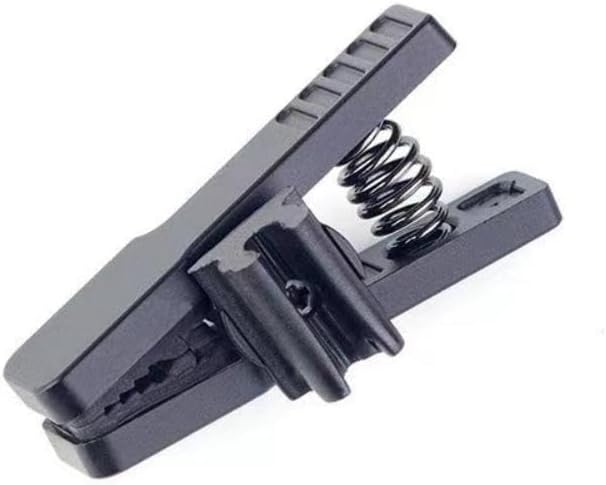


The SGPRO TR15 is a wireless clip on saxophone microphone system rated 4.3 out of 5. It combines a clip-mounted gooseneck microphone, rechargeable transmitter, and receiver in a portable package aimed at performers who need freedom from a cable. Its support for soprano, alto, tenor, and baritone saxophones, along with trumpet, French horn, tuba, and trombone, makes it one of the more broadly compatible systems in the guide.
We may earn a commission when you buy through this link, at no additional cost to you.
Stable UHF transmission is specified as reaching as far as 196 feet, while 20 preset channels in the 863–865 MHz band offer some control in crowded wireless environments. The LCD panel displays volume, signal strength, channel, echo, sensitivity, and battery information, which is considerably more useful than a basic power light when a performer needs to diagnose a weak or noisy connection quickly.
The mounting system uses virgin rubber padding to avoid scratching the instrument, and the bronze gooseneck is designed to remain in position after adjustment. These details make the TR15 attractive for players who move frequently between saxophones. On the other hand, the listed battery endurance of approximately 4.5 hours may not cover a full rehearsal or extended event without charging.
This system is best for mobile musicians, outdoor performers, teachers, and players who value broad instrument compatibility and clear status displays. The regional note about a fixed gooseneck and transmitter on upgraded units is worth checking before ordering. For most users seeking a complete wireless package, however, the TR15 offers a strong combination of range, controls, and instrument-friendly mounting.
The TR15 is unusual among compact wireless systems because it supports so many wind instruments, including saxophones at multiple sizes plus four other brass families. That makes it easier to share one system between a woodwind player and a brass section.
Its LCD indicators reduce guesswork by showing channel, signal, sensitivity, echo, volume, and battery status. Echo and EQ controls also provide some latitude for adapting the output to different rooms and playing styles.
We may earn a commission when you buy through this link, at no additional cost to you.
The 2.4G Wireless Saxophone Microphone System is rated 3.6 out of 5 and is positioned as an accessible solution for practice, teaching, and small performances. It includes a clip-on microphone, transmitter, and receiver, with a reinforced flexible gooseneck that can be adjusted through 360 degrees to place the pickup head more precisely.
We may earn a commission when you buy through this link, at no additional cost to you.
Its strongest specification is the stated 12-millisecond latency, which is short enough to support the near-real-time monitoring expected during instruction and live amplification. Automatic frequency hopping and anti-interference features are intended to improve stability, and the product description says multiple sets can operate simultaneously. The exact operating range is not clearly specified, however, making this model less immediately compelling for large stages or expansive performance areas.
A rechargeable battery rated for up to 15 hours of continuous use is another major advantage. The included Type-C dual charging cable can charge the transmitter and receiver together, while LED indicators simplify battery monitoring. Plug-and-play automatic pairing and click-based volume adjustment also reduce the learning curve for students and teachers.
Choose this model when battery life, low latency, and simple setup matter more than maximum range or premium construction. It is especially practical for daily lessons, home practice, rehearsals, and compact venues. The lower rating suggests some compromises, so buyers should consider the Audio-Technica PRO 35 or Shure BETA 98H/C when their priority is dependable wired sound quality.
The advertised 15-hour operating time removes charging anxiety from lengthy lessons and rehearsal schedules. Simultaneous charging also helps keep the complete wireless package ready between uses.
Automatic pairing and one- or two-click volume adjustment are convenient when a musician is already occupied with an instrument. The system does not require an app or complicated configuration.
We may earn a commission when you buy through this link, at no additional cost to you.
The Audio-Technica PRO 35 is a wired cardioid condenser clip-on instrument microphone with a 4.7 rating, the highest customer rating among the products compared. It is a natural choice for rehearsals, recording sessions, home practice amplification, and fixed installations where a dependable cable is preferable to wireless complexity.
We may earn a commission when you buy through this link, at no additional cost to you.
Its cardioid polar pattern reduces pickup from the sides and rear, helping the microphone isolate the intended instrument source. Extended frequency response is designed to capture subtle performance details, while the UniMount clip provides accurate positioning and shock resistance. These characteristics make it a refined alternative to general-purpose lavalier microphones that may pick up excessive room noise or nearby instruments.
The permanently attached six-foot cable is both a limitation and a strength. It will not offer the mobility of a UHF or 2.4GHz system, and there is no integrated battery or channel control. Conversely, a hardwired connection eliminates pairing, radio interference, charging, and latency concerns, making the signal path especially straightforward for practice and recording.
This is a strong recommendation for saxophonists who want natural instrument capture and do not need to roam while playing. The PRO 35 can also serve as a dependable reference microphone for lessons or home recording. Players performing on an unrestricted stage should examine one of the wireless systems, while those seeking the highest level of positioning refinement may prefer the Shure BETA 98H/C.
The cardioid pattern helps isolate the saxophone from sounds arriving from the sides or rear. This can be especially helpful in shared rehearsal rooms or when nearby instruments create competing sound sources.
A permanent cable removes the possibility of lost pairing and radio congestion. It also provides a direct, uncomplicated path to an amplifier, interface, or powered speaker.
We may earn a commission when you buy through this link, at no additional cost to you.
The HHLPRO Wireless Saxophone Microphone System for Clarinet and Brass Instrument is rated 4.3 out of 5. It distinguishes itself with a detachable microphone and transmitter arrangement, allowing the lightweight mic to remain on the instrument while the transmitter attaches to a strap or waist. This can preserve a more natural posture and reduce the burden carried by the saxophone.
We may earn a commission when you buy through this link, at no additional cost to you.
Its stated 260-foot range is the longest in this comparison, and the included external antenna is intended to support stable reception in complex wireless environments. Latency is listed below 5 milliseconds, making the system appealing for live amplification where obvious delay would interfere with performance. The 32 built-in channels and automatic scanning function also serve ensembles that need several systems to operate together.
The mini cardioid condenser microphone offers 360-degree positioning and vibration damping. Independent volume controls for transmitter and receiver add useful flexibility, while a Shure-compatible XLR adapter broadens connection options. The main drawback is the listed 5–8-hour battery life, which may be limiting for all-day festivals even though both units can charge simultaneously and operate while charging.
This system is best for ensembles, teachers, church groups, and touring players who require extensive range, low latency, or multiple channels. The detachable arrangement also gives it an advantage for players concerned about weight. Casual users who only need one reliable microphone at home may find the simpler wireless designs easier to manage.
The 260-foot specification, external antenna, and 32-channel system target situations that require more flexibility than a compact practice microphone. Automatic scanning helps identify cleaner channels in busy venues.
Separating the transmitter from the clip-on mic allows the player to move the heavier component to a strap or waist. That can improve comfort during long rehearsals and performances.
We may earn a commission when you buy through this link, at no additional cost to you.
The UHF Wireless Clip-on Saxophone Microphone System with 164ft Range is rated 4.6 out of 5, making it one of the strongest-rated products in the guide. It offers a conventional wireless instrument setup: a clip-on gooseneck microphone, compact bodypack transmitter, and receiver that connects to a sound system.
We may earn a commission when you buy through this link, at no additional cost to you.
The microphone is designed for saxophone, French horn, trumpet, and trombone. Its lightweight adjustable gooseneck and universal clip let the player position the pickup head without adding excessive weight. A 164-foot operating range is specified for UHF transmission, offering ample room for stage movement and freedom from a cable running back to an amplifier.
Setup is intentionally uncomplicated. The transmitter and receiver power on, the receiver connects to the sound system, and the system is designed to begin working without software or drivers. That makes this option attractive for musicians who need quick deployment in rehearsals, gigs, services, and recording sessions rather than advanced RF configuration.
The product description does not provide a detailed battery-life figure or a sophisticated status display, so its appeal depends more on straightforward operation than on extended feature lists. It is a good fit for players who prioritize ease of use, solid customer feedback, and a generous range. Those who need multiple-channel management or long battery endurance should look to the HHLPRO or 2.4G systems.
The plug-and-play format is valuable for performers who may use unfamiliar equipment at short notice. No app or driver installation is required before the system can be connected.
The stated 164-foot range allows a player to move around a room or stage without trailing a cable. A compact bodypack transmitter helps limit the physical burden.
We may earn a commission when you buy through this link, at no additional cost to you.
The Instrument Microphone Clip Mic Stand for Saxophone is rated 4.5 out of 5 and is fundamentally a mounting accessory rather than a complete microphone system. It is included in this roundup because a clip on saxophone microphone setup depends on a secure, correctly positioned mount, but it does not include the microphone, transmitter, receiver, or electronics described in the other entries.
We may earn a commission when you buy through this link, at no additional cost to you.
Its clip-and-stand format provides a simple way to position a compatible microphone near a saxophone. This can be useful for a player who already owns a suitable instrument microphone, wants to experiment with placement, or prefers a stand that remains independent from the instrument. It may also be useful in educational settings where a fixed position helps students compare the sound of different pickup locations.
The very limited specification makes a detailed performance assessment impossible. The supplied information confirms only that it is an instrument microphone clip for saxophone, so compatibility with a particular microphone capsule, adapter, or wireless transmitter should be verified before purchase. Buyers should not expect cardioid pickup, frequency response, range, battery life, or latency from this product.
This accessory is best for saxophonists who need a basic mount and already own appropriate audio equipment. It is not the right choice for someone seeking a complete amplification solution. For that purpose, the Audio-Technica PRO 35 or one of the wireless systems provides a clearer path to a usable microphone and stand setup.
The accessory can complete a setup when a musician already has a compatible microphone but needs a sax-oriented clip or stand. Its value should be judged as part of an existing system rather than as a microphone in its own right.
Because the supplied data does not identify a microphone thread, connector, capsule size, or included hardware, compatibility should be confirmed before buying. It is not a complete wireless or wired recording package.
We may earn a commission when you buy through this link, at no additional cost to you.
The UHF Clip Condenser Microphone for Horn, Trumpet, Saxophone, and Cello is rated 4.0 out of 5. It provides a wireless clip-on solution with a stated 131-foot range and is described as suitable for instrument amplification, concerts, broadcasts, outdoor performances, karaoke, and presentations.
We may earn a commission when you buy through this link, at no additional cost to you.
The microphone uses a high-sensitivity, wide-frequency pickup head designed to capture instrumental tone. Its 360-degree rotatable silicone clip and steel collar provide a firm hold with some shock protection. The silicone treatment also reduces the chance of scratching an instrument compared with an unprotected hard clip. Automatic connection and multiple-device operation make the system approachable for rehearsals and events.
One important detail is that the receiver must be connected to an amplifier or other audio device. Its supplied 3.5mm plug accommodates many small systems, while an included 6.35mm adapter broadens compatibility with larger equipment. The stated battery life is approximately four hours, and charging takes about three hours, which limits its suitability for long sessions without a power source nearby.
The system is best for saxophonists and other wind players who need a simple UHF microphone for moderate-size performances or teaching. Its broad instrument list and dual plug options add flexibility. Players requiring long battery life should examine the 2.4G system, while those prioritizing a polished stage mount may prefer the HHLPRO detachable design.
The rotatable silicone clip is intended to secure the microphone while protecting the instrument from scratches. Steel collar construction supports a firm hold during regular playing.
Both 3.5mm and 6.35mm receiver options make it easier to connect the system to compact speakers, mixers, and larger amplification equipment. An audio connection remains required for sound to reach the room.
We may earn a commission when you buy through this link, at no additional cost to you.
The YXG Wireless UHF Saxophone Microphone System is rated 4.3 out of 5 and provides a 100-foot wireless range with EQ and echo controls. It is a practical option for rehearsals, lessons, church performances, and moderate stages where a rechargeable system is preferred over a permanently wired microphone.
We may earn a commission when you buy through this link, at no additional cost to you.
The 20 available UHF channels cover 550–573 MHz, and the LCD presents operating information including volume, RF and AF signal strength, channel, echo, sensitivity, and battery status. That level of feedback helps a player identify interference or adjust the output without interrupting a performance. The advertised battery life of up to eight hours comfortably handles many rehearsals and typical sets.
Its clip uses virgin rubber padding to protect the saxophone from damage, while the bronze gooseneck is designed to resist unwanted rebound after adjustment. These are meaningful details for a product worn directly on a valuable instrument. The main limitation is the 100-foot range, which is shorter than the 196-, 260-, and 164-foot systems elsewhere in the list.
Choose the YXG when an eight-hour battery, informative display, and moderate UHF range align with your rehearsal or performance space. It is less suitable for large venues where performers roam widely. The 2.4G model offers a longer battery specification, while the HHLPRO and SGPRO TR15 provide greater range for mobile players.
The LCD consolidates signal, channel, output, and battery information into one display. Players can make faster decisions when diagnosing performance changes or choosing among available channels.
Rubber padding helps protect the saxophone, and the stable gooseneck supports repeatable placement. Together, these details make the clip more suitable for sustained direct attachment.
We may earn a commission when you buy through this link, at no additional cost to you.
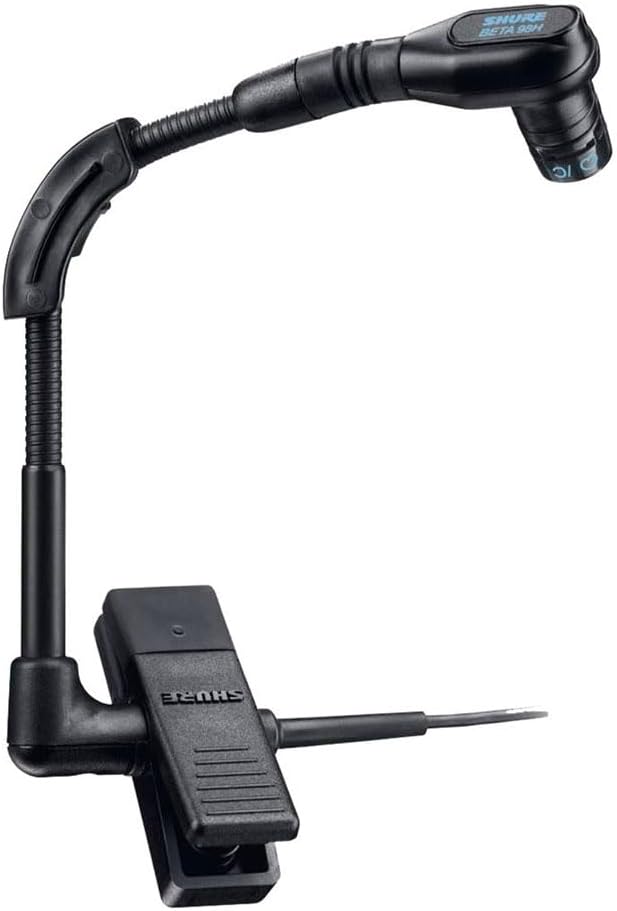
The Shure BETA 98H/C is a premium wired miniature instrument microphone rated 4.6 out of 5. It is designed for saxophone, brass, and percussion applications, combining a cardioid condenser capsule with a clip, gooseneck, ratcheting swivel joint, and angle brace for stable placement.
We may earn a commission when you buy through this link, at no additional cost to you.
Its tailored frequency response supports open, natural sound reproduction, while the cardioid pickup pattern offers high gain before feedback and rejection of unwanted noise. The transformerless preamplifier circuitry improves linearity across the frequency range, and a high maximum SPL allows the microphone to handle demanding brass, woodwind, and percussion sources.
The attached 10-foot cable and XLR connection provide a professional, wired signal path to mixers, interfaces, and properly configured amplifiers. Compact, lightweight construction keeps the microphone visually discreet on stage. The included 3-meter length offers more placement flexibility than the shorter Audio-Technica PRO 35 cable, although neither model permits unrestricted wireless movement.
This is the strongest premium recommendation for a saxophonist who values refined positioning, feedback resistance, and a proven professional signal path. The microphone is particularly well suited to controlled stages, rehearsals, and recording. A mobile player who requires untethered operation should instead examine one of the UHF systems, while budget-conscious home users may find the PRO 35 more practical.
The cardioid pattern's rejection of unwanted sound can improve gain before feedback in appropriate setups. High maximum SPL capability also provides headroom for loud brass and forceful woodwind playing.
The ratcheting swivel joint and angle brace are designed to establish and preserve an accurate pickup angle. This is particularly valuable during rehearsals, services, and performances where repeated adjustments would be inconvenient.
We may earn a commission when you buy through this link, at no additional cost to you.
The UHF Wireless Saxophone Instrument Microphone System with 196ft Range is rated 4.0 out of 5. It combines a clip-on cardioid condenser microphone with a UHF transmitter and receiver, providing a mobile solution for indoor or outdoor playing, stages, recordings, streaming, and teaching.
We may earn a commission when you buy through this link, at no additional cost to you.
Its 200 adjustable UHF channels across 510–590 MHz offer considerable flexibility in crowded wireless environments, and the system supports multiple instruments or performers. Infrared automatic pairing streamlines setup, while a receiver LED displays frequency, battery power, and volume. The 24-bit/48kHz audio format and stated 30 Hz–20 kHz frequency response indicate a technically ambitious signal specification.
The clip uses virgin rubber padding and a shock-absorbing spring, while the flexible gooseneck is intended to resist rebound after adjustment. Both 6.35mm and 3.5mm receiver plugs support a wide range of audio devices. The system charges in roughly two to three hours and offers about six hours of use, which is enough for many rehearsals but not every long event.
This system is best for mobile performers who want extensive channel choice and extended range without the complexity of a multi-channel ensemble package. The Audio-Technica PRO 35 is simpler for stationary capture, while the HHLPRO offers more advanced group features. For an individual player needing generous wireless freedom, this model is a credible all-around choice.
The large adjustable channel bank can be valuable in venues where many wireless devices are active. It gives the operator more opportunity to avoid interference than a basic fixed-frequency system.
Including both large and small receiver plugs allows the system to work with a wider selection of speakers and audio devices. The digital screen provides useful operating information at a glance.
We may earn a commission when you buy through this link, at no additional cost to you.
Choosing a clip on saxophone microphone means balancing capture quality, mounting security, signal reliability, mobility, and the environment in which it will be used. The best choice for a fixed rehearsal room may differ substantially from the right system for a moving stage performer or a teacher working with several students.
A wired microphone provides the simplest and most consistent signal path, with no pairing, channel selection, charging, or radio interference to manage. The Audio-Technica PRO 35 includes a permanently attached six-foot cable, while the Shure BETA 98H/C has a 10-foot cable and XLR connection. Wired models are well suited to practice rooms, lessons, recording desks, and fixed amplification positions, although the cable can restrict movement on stage.
Wireless systems remove the trailing cable and provide much greater freedom to walk around a venue. They require attention to transmitter and receiver power, operating frequency, latency, and connection compatibility. A complete wireless package may also be more complex to carry, but it is usually the better choice for mobile musicians, outdoor events, and large stages.
A cardioid pattern focuses sensitivity toward the intended sound source and reduces pickup from the sides and rear. The Audio-Technica PRO 35, Shure BETA 98H/C, HHLPRO mini mic, and UHF 196ft Sax System all use cardioid-style pickup, which can help isolate the sax in a shared room. The exact resulting tone still depends on placement, the instrument, the player, and the acoustic environment.
Look for a pickup pattern that matches the performance space rather than assuming one pattern is universally clearer. Narrow directional control can help in rehearsal rooms with competing instruments, but a very restrictive pattern also makes precise microphone placement important. A clip-mounted mic should be aimed toward a useful sound-producing area without interfering with keys, bell, or player movement.
Wireless range figures describe maximum or favorable operating conditions, not guaranteed performance through every wall or around every piece of stage equipment. The HHLPRO system claims 260 feet, the SGPRO TR15 and UHF 196ft model claim 196 feet, the UHF 164ft model claims 164 feet, the UHF Horn Sax Mic claims 131 feet, the YXG system claims 100 feet, and the 2.4G system's range is not clearly stated.
For most small venues, a practice room, and classroom use, differences between 100 and 164 feet will matter less than stable operation in the actual space. For stages with large backstage areas, reflective surfaces, or substantial wireless congestion, look for clear channel controls, automatic scanning, strong signal indicators, and a stated latency figure.
Latency is the delay between playing a note and hearing it through the amplified system. The 2.4G system specifies 12 milliseconds, while the HHLPRO system claims less than 5 milliseconds. The remaining wireless products do not provide a clear numerical latency specification in the supplied information. Very low latency is particularly useful for teaching because students can respond to the amplified sound while playing.
A microphone used only for recording may not require the same immediate monitoring performance as one used for live amplification. Still, low latency is broadly desirable because it keeps the player's perception of the instrument natural. Test the complete chain, including the receiver, amplifier, speakers, and any effects or digital processing, since those components can add delay of their own.
The clip should hold the microphone firmly without slipping, scratching the instrument, or obstructing the player's fingers. The SGPRO TR15 and YXG use rubber-padded clips, the UHF 196ft model adds a shock-absorbing spring, and the UHF Horn Sax Mic uses a rotatable silicone clip. The Audio-Technica and Shure models emphasize controlled positioning through their UniMount and ratcheting joint systems respectively.
A stable gooseneck is equally important. A microphone that rebounds after being moved can change the tone without the player noticing. Look for a short, firm, adjustable neck and a clip opening that fits the relevant portion of the instrument. Confirm compatibility with soprano, alto, tenor, baritone, or other sizes before finalizing a purchase.
Battery specifications range from about four hours for the UHF Horn Sax Mic to 15 hours for the 2.4G model. Between those endpoints, the YXG is rated for eight hours, the HHLPRO for five to eight hours, the UHF 196ft system for six hours, and the SGPRO TR15 for four and a half hours. A useful comparison should include charging time, included cables, and whether the system can operate while charging.
Long advertised operating time does not guarantee identical performance throughout the entire stated period. Battery condition, volume, transmission power, and environmental conditions can all affect runtime. Bring a charging plan for festivals and teaching days, especially when the microphone is responsible for the only amplified sound. Confirm that the required charging connector and power source are included or readily available.
Single-player systems do not always need extensive channel controls, but teachers and ensembles benefit from automatic scanning and multiple available frequencies. The HHLPRO lists 32 built-in channels and one-to-more pairing, the UHF 196ft model offers 200 adjustable channels, and the SGPRO and YXG systems each provide 20 preset channels. The 2.4G model uses frequency hopping and states that multiple sets can operate simultaneously.
More channels are useful only if the interface makes them understandable. Look for automatic scanning, a readable channel display, and clear signal-strength feedback. A performer who does not need group support may find these extras unnecessary, while a sax teacher or ensemble director will likely value them more.
The receiver connector determines which amplifiers, mixers, interfaces, recorders, and speakers can be used. The Shure BETA 98H/C terminates in XLR, the HHLPRO includes a Shure-compatible XLR adapter, and several wireless systems provide 3.5mm or 6.35mm receiver plugs. The UHF Horn Sax Mic includes both sizes, while the UHF 196ft system supports both as well.
Before buying, trace the entire signal path from microphone to receiver to the final sound system. Check connector size, channel requirements, microphone input support, and whether the destination device supplies suitable gain. A receiver that appears compatible may still require an adapter, powered speaker, or preamp to produce usable sound.
Begin by mounting the microphone where it will not interfere with finger movement, keys, or the bell. Secure the clip without forcing it, inspect the padding for grit, and position the pickup head toward the sound source recommended for that model. For a wireless unit, power the transmitter and receiver, complete pairing or channel selection, and confirm signal strength before beginning the rehearsal.
Set the output level conservatively. Start with low volume, raise it gradually, and listen from different positions in the room for unwanted feedback, handling noise, or excess room sound. Use the available sensitivity, EQ, echo, or volume controls as starting points rather than as substitutes for correct placement. For wired models, connect to an appropriate XLR input, 3.5mm connection, or adapter and confirm that the destination can accept the microphone signal.
After each use, disconnect power, remove the microphone gently, and wipe the clip and capsule with a dry or lightly dampened cloth. Do not immerse the microphone, flood openings with liquid, or use harsh cleaners. Keep transmitters and receivers charged, remove batteries from long-term storage if applicable, and store the complete system in a protective case away from excessive heat, moisture, and impact.
Yes, many models are specifically designed for stage amplification, rehearsals, teaching, and outdoor performance. Wireless systems offer the most freedom, while wired condenser microphones can provide a stable signal in fixed positions. Choose based on room size, movement, feedback control, and the other audio equipment available.
The 2.4G Wireless Saxophone Microphone System and the UHF 164ft Clip System emphasize plug-and-play or automatic pairing. Wired models are also straightforward because they require only a physical connection, although their cable can limit movement. Always confirm that the receiver works with the intended amplifier or audio input.
No. A wired model such as the Audio-Technica PRO 35 can be ideal for a fixed practice room, lesson, or recording setup because it has no charging or pairing process. Wireless is more useful when the player needs to move freely or when avoiding a floor cable is important.
Choose a clip with rubber, silicone, or other protective padding, and clean both the clip and instrument before attaching it. Do not overtighten a clamp around a delicate finish. Models such as the SGPRO TR15 and YXG specifically highlight padded contact surfaces for this reason.
It depends on the receiver or microphone output and the amplifier input. XLR, 3.5mm, and 6.35mm options appear across the guide, and some wireless receivers include adapters. Check both the physical connector and whether your amplifier can accept a microphone-level signal through that input.
A cardioid pattern can help emphasize the saxophone and reduce pickup from the sides or rear. The Audio-Technica PRO 35 and Shure BETA 98H/C are explicit cardioid condenser examples. Placement still matters, since aiming a directional microphone away from the intended source can produce a weak or uneven result.
That depends on the model and how it is used. The listed products range from about four hours to a stated 15 hours, while the HHLPRO is rated for five to eight hours. For long events, check charging time and carry a charging plan, and verify whether the model can operate while charging.
Some systems are better suited to multiple players than others. The HHLPRO lists 32 built-in channels and support for multiple transmitter and receiver sets, while the 2.4G model uses automatic frequency hopping. Confirm compatibility, channel behavior, and receiver requirements before building an ensemble setup around one model.
The Audio-Technica PRO 35 stands out for focused cardioid pickup, solid mounting, and the highest customer rating in the group, making it a strong choice for stationary practice and recording. The Shure BETA 98H/C is the premium wired option, adding tailored response, high-SPL capability, and refined ratcheting positioning. For mobile players seeking wireless freedom without premium-tier complexity, the SGPRO TR15 and UHF 164ft system offer useful combinations of range, control, and straightforward operation.
Prioritize the use case rather than the longest specification. Choose a wired condenser when signal consistency and detailed capture matter most, a wireless model when movement is essential, and a high-channel system for teaching or ensemble work. Battery life, latency, clip protection, output connectors, and accurate placement can matter more in daily use than a headline range figure.
Prices and product availability can change, so check current listings, included accessories, compatibility, and the latest product details before purchasing. The final choice should fit the instrument, performance space, amplification equipment, and mobility of the player rather than rely on one universal specification.