
DaierTek Waterproof DC Voltmeter
4.4Editor score
8–48V DC measurement range
0.1V stated voltage accuracy
Blue backlit round display
Waterproof panel-mount design
Compare 10 digital battery gauges for voltage, capacity, current, temperature, waterproofing, installation, and compatibility across cars, boats, RVs, and
A digital battery gauge gives vehicle owners a clearer view of electrical-system health than a traditional analog meter, often adding capacity, current, temperature, alarms, or data retention. The right model depends on your battery chemistry, system voltage, mounting environment, and whether you need a simple voltage display or a complete energy monitor.
We compared the ten featured digital battery gauges by examining their supported voltage ranges, measurement functions, display types, protection features, installation requirements, and stated applications. The list covers compact panel meters, golf-cart monitors, waterproof inline units, and shunt-based systems for cars, boats, RVs, motorcycles, trucks, and other equipment.
Each pick below highlights the product's most useful capabilities and honest limitations. Ratings reflect the supplied customer feedback, while product availability and configuration may change over time, so readers should verify compatibility and included accessories before purchasing.
4.4Editor score

4.2Editor score

4.9Editor score
The comparison below highlights the major differences among these ten gauges, including supported battery systems, measurement depth, environmental protection, display style, and installation demands.



The DROK 48V Golf Cart Battery Meter is a versatile inline monitor for 10–100V systems, earning a supplied customer rating of 4.2. It is particularly relevant to golf carts, but its broad voltage range also makes it useful for cars, marine equipment, RVs, and DIY electrical projects. The LCD combines voltage information with a configurable percentage and an internal temperature reading.
We may earn a commission when you buy through this link, at no additional cost to you.
Its compatibility is the standout feature. The monitor supports 12V, 24V, 36V, 48V, and 60V systems, as well as lithium, lead-acid, lithium iron phosphate, and NiMH battery types. That makes it a practical choice for someone who may move between equipment or wants one gauge to cover several installed systems. Programmable percentage values also make the display more informative than a pure voltmeter.
There are trade-offs. The temperature shown is the meter's internal temperature rather than a remote battery or ambient sensor, so it should not be treated as a precise battery-temperature probe. Configuration is also important: owners must program the relevant voltage-to-percentage relationship, and the stated default is for a 48V lead-acid battery. The unit is therefore more involved than a basic panel voltmeter.
This is a strong recommendation for owners of 48V golf carts who want both voltage and an approximate state-of-charge display without moving to a full shunt-based energy monitor. It is equally suitable for multi-voltage boat, RV, or automotive projects when its supported chemistry and voltage settings match the installation. Buyers should confirm wire routing, panel space, and the correct percentage mapping before installation.
The unusually broad 10–100V range reduces the need to change monitors when moving between 12V, 24V, 36V, 48V, or 60V equipment. Support for several battery chemistries adds flexibility, although the selected settings must still match the connected pack.
A programmable percentage can make day-to-day status checks easier than interpreting voltage alone. The estimate depends on accurate programming and correct battery behavior, so it should be treated as a useful reference rather than a laboratory-grade measurement.
We may earn a commission when you buy through this link, at no additional cost to you.
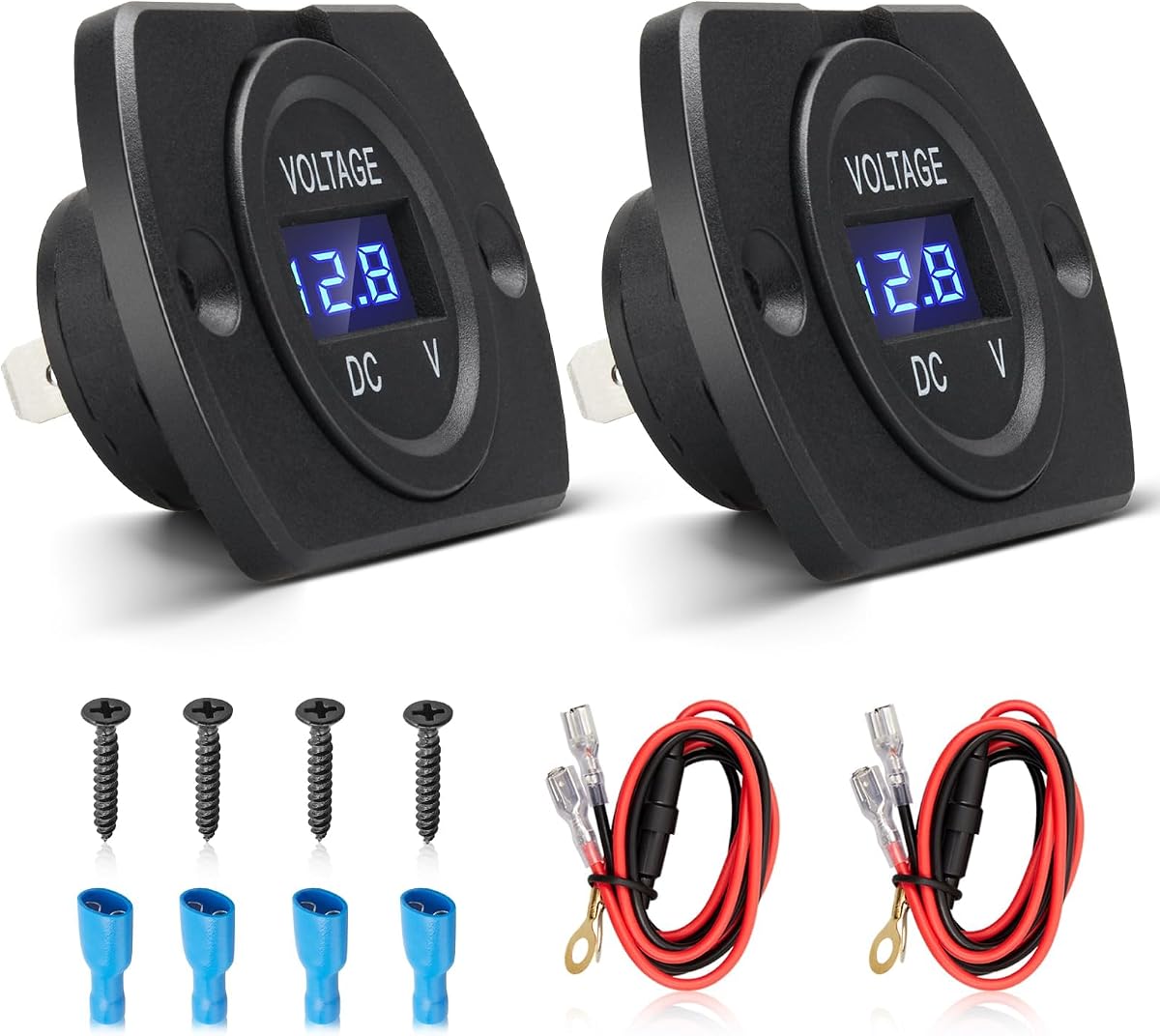
The DaierTek Waterproof DC Voltmeter is a straightforward dashboard gauge rated 4.4 by customers. It provides a bright, three-digit blue LED readout across an 8–48V DC range, with stated accuracy of 0.1V. Its compact round format is aimed at panel-mounted installation in cars, motorcycles, boats, RVs, trucks, and similar vehicles.
We may earn a commission when you buy through this link, at no additional cost to you.
The most appealing feature is its balance of visibility and environmental protection. Blue illumination is easy to read in dark conditions, while the sealed construction suits exposed or moisture-prone installations. The meter can be fitted into a 29mm mounting hole or secured to the included panel, and the package includes wires, screws, a matching panel, and a nylon nut.
This is a voltage monitor rather than a complete battery-management system. It does not calculate current, consumed energy, or remaining capacity, and the product information does not describe a state-of-charge percentage. Users who only need to see whether the system voltage is unexpectedly high or low will find that focused design convenient; users needing load diagnostics should look toward a shunt-based model.
The DaierTek is our budget-oriented recommendation for a boat, vehicle, or recreational machine that needs an uncomplicated waterproof voltage indicator. It is especially attractive when dashboard illumination and quick nighttime readability matter. Ensure the system stays within the supported range, place the opening where it will not be exposed to excessive pressure or heat, and confirm that the intended mounting hole is approximately 29mm.
The illuminated blue digits remain easy to distinguish during daytime operation and in darker cabins or helm areas. A three-digit format also provides a clean, uncluttered view without unnecessary menus or controls.
The waterproof housing is particularly relevant to marine applications, where splashes and damp conditions are common. It also makes the gauge useful for exposed automotive, ATV, UTV, and off-road installations.
We may earn a commission when you buy through this link, at no additional cost to you.
The BM280 Digital Battery Gauge is a backlit, 12–72V monitor designed with golf carts and other high-voltage equipment in mind. It has a supplied rating of 4.3 and supports lead-acid and lithium battery systems. The display provides live voltage and an estimated remaining-power percentage, making it more informative than a basic voltmeter.
We may earn a commission when you buy through this link, at no additional cost to you.
Installation flexibility is one of its strongest attributes. It supports a 37x25mm embedded cutout as well as a direct plug-in position, and a mounting template is included. Compatibility with key switches can simplify integration with selected EZGO and Club Car setups. Its high-definition LCD, color status indicators, and backlight are designed to remain readable from different viewing angles.
The monitor is not as analytically comprehensive as a shunt-based energy meter. Its percentage is inferred from voltage and therefore cannot account for every factor associated with battery age, load, and chemistry. Reverse-connection, overvoltage, and low-power sleep protections add safeguards, while IP65 waterproofing and heat resistance suit outdoor use, but owners must still configure the correct voltage level.
This model is an attractive option for golf-cart owners seeking a modern display without complex wiring, especially those who value embedded installation options. It may also suit RVs, forklifts, trucks, yachts, and energy-storage systems within its 12–72V range. Before buying, confirm the cart's battery configuration, available dashboard opening, key-switch layout, and the required lead connections.
Live voltage and percentage information help a driver recognize a weakening battery before the vehicle becomes unexpectedly inoperable. Separate red and green indicators communicate battery and voltage status more quickly at a glance.
Embedded mounting creates a factory-style dashboard appearance, while the plug-in approach can simplify retrofit work. The included template helps reduce errors when cutting a panel opening.
We may earn a commission when you buy through this link, at no additional cost to you.
The HiLetgo DC Ammeter Voltmeter is a multifunction energy monitor rated 4.5 by customers. Unlike simple voltage-only gauges, it measures voltage, current, power, and energy across a 6.5–100V operating range. Its current measurement extends to 20A, and the product includes a built-in shunt for sensing the circuit's electrical activity.
We may earn a commission when you buy through this link, at no additional cost to you.
A large LCD presents the principal readings together, while a blue backlight improves visibility in low-light conditions. The power button can control the backlight and clear data, and the backlight can be turned off manually. Overvoltage alarm thresholds add a warning layer, and power-off memory retains recorded energy until it is reset, which is useful for tracking consumption over time.
The main limitation is its 20A current ceiling. This is appropriate for monitoring smaller loads and battery systems, but it is not appropriate for high-current charging, starter loads, or large traction systems. Shunt-based monitoring also requires correct placement in the electrical path; a poor connection can introduce measurement problems. The high operating voltage range should not be confused with an unlimited current capacity.
The HiLetgo is a strong middle-ground choice for users who want more information than voltage alone without moving to a large, configurable marine monitoring system. It suits energy-storage workbenches, smaller DC installations, solar projects, and selective accessory monitoring. Check the expected current draw, wire routing, alarm settings, and local electrical requirements before installation.
Showing current, power, and energy together helps identify whether a circuit is merely energized or actively consuming power. This makes the monitor useful for diagnosing abnormal loads and understanding energy use.
Configurable voltage thresholds can flag conditions outside the preferred operating range, while power-off memory preserves accumulated energy. Together, these features support ongoing monitoring rather than momentary testing.
We may earn a commission when you buy through this link, at no additional cost to you.
The IPX7 Waterproof 7-100V Battery Monitor is a protected inline gauge designed for electric motorcycles, golf carts, cars, boats, RVs, and other equipment. It has a supplied customer rating of 4.2. Its primary strengths are its wide voltage range, sealed housing, audible alarms, and ability to display temperature alongside battery status.
We may earn a commission when you buy through this link, at no additional cost to you.
The enclosure is dustproof and rated IPX7 for water protection, while reverse-connection protection reduces the risk of wiring mistakes. High and low voltage alarm thresholds can be programmed to match the battery system, and the M key switches between voltage and Celsius temperature. Power-off memory retains the chosen settings after the power is removed.
Setup deserves attention. The supplied information specifically notes that the unit must be configured according to the instructions or its percentage may remain at 100%. The red lead connects to positive and the black lead to negative. Installation hardware includes a mounting bracket, double-sided adhesive, screws, and approximately 23.62-inch wires, giving reasonable flexibility for routing through a vehicle.
This monitor is best suited to owners who want a protected gauge with audible warnings and who value straightforward bracket mounting. It can cover 12V, 24V, 36V, 48V, 60V, 72V, and 84V systems and supports ternary lithium, lead-acid, AGM, and LiFePO4 batteries. Buyers should confirm the correct chemistry setting, alarm thresholds, temperature interpretation, and wire path before relying on the displayed percentage.
Programmable high and low voltage buzzers make abnormal battery conditions noticeable without continuous dashboard observation. This is valuable on boats, carts, and parked equipment where a visual reading may not be watched.
The IPX7 enclosure and reverse-connection protection suit demanding outdoor installations. The included bracket, adhesive, and screws provide several practical ways to position the unit.
We may earn a commission when you buy through this link, at no additional cost to you.
The 12V–48V Capacity Indicator is a compact LCD battery monitor rated 4.1 by customers. Despite its shorter product name, the stated operating range extends from 12V to 84V and supports 3S–26S lithium configurations as well as lead-acid, polymer, lithium-ion, and storage batteries. It is intended for gauges that need both voltage and an approximate capacity reading.
We may earn a commission when you buy through this link, at no additional cost to you.
The large green backlit display can show a battery symbol with either a percentage or a voltage value. Controls provide access to those display modes, backlight behavior, sleep mode, and battery type selection. A built-in approximately 30cm power cable simplifies basic connection, while reverse-protection design is intended to prevent damage from an incorrect connection.
As with most voltage-based capacity indicators, the percentage is an estimate rather than a measurement of remaining energy under load. Different chemistrics and battery ages can alter the voltage-to-capacity relationship, so users must select the appropriate battery type and interpret the figure as guidance. The button layout is functional but may take a little practice to master.
This indicator is a useful choice for golf carts, cars, marine applications, and other systems that need a simple percentage and voltage display. Its broad compatibility and low-power construction are appealing for compact installations. Prospective buyers should verify battery series count, available panel space, cable reach, and whether the controls are easier to use than a fixed-display voltmeter.
Switching between voltage and percentage lets users confirm the raw electrical reading while also seeing an easier-to-interpret state-of-charge estimate. The green backlight improves dashboard visibility.
The stated compatibility covers several common lithium arrangements and lead-acid systems. This makes the gauge useful across mixed equipment, provided the selected settings match the installed pack.
We may earn a commission when you buy through this link, at no additional cost to you.
The Victron Energy BMV-702 is the most advanced monitoring system in this guide, with a supplied customer rating of 4.9. It monitors battery systems from 6.5 to 95V DC and combines a shunt with a dedicated display. The screen provides state of charge, voltage, current, energy or time remaining, and additional operating information.
We may earn a commission when you buy through this link, at no additional cost to you.
Its programmable auxiliary input is one of the most useful features. Depending on the configuration, this input can measure battery temperature, battery midpoint voltage, or the voltage of a second battery. A programmable relay can also control another device. For users who want remote visibility, the monitor can work with a separately sold VE.Direct Bluetooth Smart dongle or connect through VE.Direct to a GX device and VRM.
This sophistication brings installation considerations. The shunt is housed in a special enclosure because of the potentially hazardous high-voltage application, and the manufacturer warns that incorrect installation can be dangerous. A licensed professional and compliance with applicable electrical codes may be appropriate, particularly in permanently installed vessel or energy-storage systems.
The BMV-702 is the premium choice for serious boat, RV, off-grid, or stationary battery installations where current, energy use, state of charge, remote monitoring, or custom alarm behavior matter. It offers much more than a basic voltage gauge and provides the strongest basis for long-term electrical-system management. Confirm the voltage range, shunt placement, sensor options, and connectivity requirements before installation.
State of charge, current, voltage, remaining energy, and time estimates offer a much broader picture than a single voltage reading. This is particularly useful for detecting abnormal consumption and planning charging or generator use.
The programmable input and relay create paths for temperature sensing, midpoint monitoring, a second battery, or external control. Optional connectivity hardware extends visibility to phones, tablets, and remote VRM monitoring.
We may earn a commission when you buy through this link, at no additional cost to you.
The Minn Kota MK-BM-1D is a portable digital battery meter with a supplied rating of 4.6. It focuses on a single, common task: checking the voltage and state of charge of a 12V battery. Rather than requiring a fixed panel installation or complex configuration, it uses touch operation directly on the battery terminals.
We may earn a commission when you buy through this link, at no additional cost to you.
The LED display shows the current voltage, while separate state indicators divide the battery status into zero, one-third, two-thirds, or fully charged. This segmented presentation is easy to interpret at a glance and is particularly useful for a boater, angler, workshop technician, or vehicle owner who wants a quick answer without navigating a menu.
The limited feature set is appropriate to the product's purpose but important to recognize. It is intended for 12V batteries and does not provide current measurement, energy consumption, temperature, alarms, or remote monitoring. Because it is portable, it also cannot continuously watch a battery while driving or operating equipment.
This gauge is best for occasional battery checks in a boat, workshop, garage, or around a vehicle. It is ideal for anyone who values simplicity and portability over permanent dashboard integration. Users with 24V or 48V systems, or those who need ongoing electrical diagnostics, should choose a more capable fixed monitor instead.
Touching the leads to the appropriate terminals is the entire basic procedure. This makes the meter convenient for routine spot checks in a boat, garage, or roadside toolkit.
The four-level charge indication avoids requiring users to interpret a continuous percentage. It is a quick visual summary that helps identify whether a battery needs attention or charging.
We may earn a commission when you buy through this link, at no additional cost to you.
The Anina Two-Pack Voltmeter includes two compact round panel gauges rated 4.5 by customers. Each provides a blue LED reading across an 8–48V range, with stated accuracy of 0.1–0.2V. The dual pack gives owners the option of monitoring two locations or vehicles, such as a boat and a tow vehicle.
We may earn a commission when you buy through this link, at no additional cost to you.
The illuminated display is designed to remain legible in direct sun and darkness, a useful characteristic for dashboard or console installations. The sealed housing is intended to tolerate rain, splashes, and off-road conditions, making it relevant to cars, trucks, motorcycles, ATVs, UTVs, RVs, and boats. Installation uses a standard 29mm dashboard opening or the supplied panel.
These meters show voltage only. They do not report current, state of charge, consumed energy, or temperature, so they are best used as quick health indicators rather than comprehensive energy-management systems. The stated accuracy also includes a slight range: 0.1V in one portion of the scale and up to 0.2V elsewhere, which is normally adequate for identifying broad voltage changes.
The Anina package is well suited to owners who need one or two straightforward gauges and prefer a clean panel-mount appearance. It may be particularly useful in a multi-vehicle household or for monitoring a secondary battery. Check the system's voltage, available panel space, and wire routing before installation.
The two included gauges can be installed in different panels, used on different vehicles, or positioned to monitor two electrical areas. This adds flexibility without changing the basic voltage-only design.
Bright blue digits support quick reading in changing light, while the sealed construction protects against rain and splash. The standard 29mm opening simplifies dashboard integration.
We may earn a commission when you buy through this link, at no additional cost to you.
The DC 100A Monitor Shunt is a higher-current energy monitor rated 4.4 by customers. It measures DC voltage from 8 to 100V, current from 0 to 100A, power up to 10kW, and energy up to 9999kWh. A large LCD shows all four values simultaneously, making it useful for tracking substantial DC loads.
We may earn a commission when you buy through this link, at no additional cost to you.
Power-off memory retains accumulated energy, which can be reset to zero when a new measurement period begins. The blue backlight can be controlled manually. An overload alarm provides another layer of awareness by flashing the backlight and power value when active power exceeds the configured threshold.
The included components require careful attention. Only the display and 100A shunt are supplied; wires and other installation accessories are not included. The shunt must be placed correctly in the circuit, and the wiring should be sized and terminated appropriately for the intended current. High-current installations also warrant attention to fuse placement, conductor routing, and applicable electrical safety practices.
This monitor is best for users who need more current range than a 20A model and want simultaneous power and energy readings. It can suit larger DC installations, trailers, equipment projects, or energy-storage monitoring when appropriately rated. It is less convenient for a quick dashboard-only installation because the shunt and additional wiring make the setup more involved.
The 100A measurement range makes the unit more appropriate for larger loads than compact inline meters. Monitoring power alongside current reveals how much energy the connected system is actively using.
Keeping accumulated energy through a power interruption supports longer-term tracking, while the overload indication draws attention to unexpectedly high power draw. The display and shunt are provided, but the installer must supply suitable wiring.
We may earn a commission when you buy through this link, at no additional cost to you.
The right digital battery gauge depends on the electrical system you are monitoring, the information you need, and where the device will be installed. Voltage range, battery chemistry, current handling, environmental exposure, and display access should be evaluated together before choosing a model.
Start with the nominal voltage and configuration of the battery pack, not merely the vehicle type. A 12V lead-acid car battery, a 48V golf-cart pack, and a multi-cell lithium system can present very different operating characteristics. Some listed monitors cover only a specific nominal voltage, while others accept a broad range or allow selectable levels. The input range must safely cover the pack's resting voltage, charging voltage, and any transient peaks without exceeding the manufacturer's limits.
Confirm the required configuration for lithium systems as well. A model advertised for 3S–26S lithium may cover a wide series range, but a 12V lead-acid setting should not automatically be used for a lithium pack. Correct matching prevents inaccurate percentage readings and ensures that alarms or voltage thresholds operate on a meaningful scale.
Basic voltmeters display one number: the current system voltage. Battery-capacity monitors add a percentage estimate, and full energy monitors can show current, active power, consumed energy, and sometimes time remaining. These deeper measurements help distinguish a low charge from a failing battery, identify an abnormal load, and track consumption over a trip or service interval. A shunt-based model is the most relevant choice when current flow and energy use are central to the diagnosis.
Do not confuse a calculated percentage with a full battery-management system. Percentage displays are generally derived from voltage and are only as reliable as the battery type, programming, and actual load. If accurate load analysis is the main objective, prioritize a gauge with a properly rated shunt, current measurement, and retained energy data.
Lead-acid, AGM, lithium-ion, ternary lithium, and lithium iron phosphate batteries can follow different voltage curves. A gauge that supports the correct chemistry can map voltage to a more meaningful percentage and set appropriate alarm thresholds. This matters most for lithium systems, where a generic lead-acid curve may produce an incorrect state-of-charge estimate.
Look for a monitor that explicitly names your battery type and provides a way to select it. Also confirm the default configuration, because an incorrect default can leave the display showing an unrealistic percentage. Models that support several chemistries are more flexible, but their menus may require more careful setup than a dedicated single-chemistry gauge.
Current capacity is the difference between a simple voltage display and a shunt-based energy monitor. Inline and panel voltmeters generally do not measure current at all. Some compact multifunction meters support only 20A, which may be adequate for smaller systems but insufficient for chargers, inverters, starter batteries, or other heavy loads. A 100A model provides more headroom for substantial DC equipment.
Use an appropriately rated shunt and wiring when measuring high current. Fuse the circuit correctly, minimize unprotected cable length, and follow electrical codes and manufacturer instructions. If the intended load is unknown, estimate the maximum current before choosing a meter so that it does not become the limiting component in the electrical system.
Marine installations, open vehicle dashboards, golf carts, and workshop equipment can expose a gauge to rain, dust, vibration, heat, and accidental knocks. Waterproof or water-resistant construction is particularly important in a boat cockpit or exterior panel. The degree of protection varies, so use the stated rating as guidance rather than assuming every model can tolerate the same exposure.
Also consider temperature, sunlight, and vibration. A backlit LCD or bright LED display is easier to read in changing light, while a sealed housing reduces the chance that moisture or debris will affect operation. A protective screen film can add useful scratch resistance in high-contact installations, and the enclosure should be mounted where it is not exposed to excessive heat.
Decide whether the gauge needs to be permanently visible or is simply a portable diagnostic tool. Panel meters usually require a correctly sized opening, attached wiring, and a secure connection to the electrical system. Inline monitors are generally routed near the battery and may include brackets, adhesive, screws, or templates. Some models support embedded cutouts as well as plug-in or direct connections.
For portable checking, a touch-terminal meter can be the simplest approach because no dashboard installation is required. For permanent monitoring, check cable length, routing, panel depth, and whether the display remains readable from the operator's position. Recessed, direct-connection gauges can look integrated, but they may require more cutting and wiring than a standalone round voltmeter.
A backlight is useful for nighttime readability, but audible alarms and automatic thresholds can be more important when a battery condition needs attention without constant observation. Low-voltage warnings can help prevent an unexpected shutdown, while high-voltage thresholds can flag charging or configuration issues. A color-coded status display may offer a faster indication of battery condition than interpreting numbers alone.
Power-off memory preserves programmed chemistry, voltage, and alarm settings across a power interruption. Energy meters may also retain accumulated consumption until reset. These features are particularly valuable in permanent installations because they reduce repeated configuration and preserve a record of system behavior.
The gauge itself may be only one part of a complete installation. Some products include a panel, screws, nylon nut, bracket, adhesive, wires, or a mounting template. Others provide only the display and shunt, leaving the owner responsible for sourcing appropriate conductors, terminations, and fuse protection. Check the stated contents before assuming a monitor is installation-ready.
Also verify whether connectivity hardware is included. Advanced monitoring systems may support phones, tablets, or remote dashboards through separately sold adapters and cables. Those extras can be worthwhile for long-term visibility, but they should be considered part of the project rather than assumed to accompany the base unit.
Begin by identifying the battery's nominal voltage, chemistry, and series configuration. Power down the relevant circuit when practical, connect the positive lead to the positive terminal or designated positive connection, and connect the negative lead to negative. Never rely on appearance alone to distinguish terminals. For panel-mounted meters, route the wires away from sharp edges, moving suspension components, exhaust heat, and water-collection points.
After making the connections, restore power and enter the correct voltage, chemistry, percentage curve, and alarm settings. If the display offers a hold, lock, or calibration function, complete that process before relying on the readings. Check the displayed voltage against a known reference, confirm that the percentage changes sensibly, and test any buzzer or backlight controls. A brief test under the intended load is advisable for current-capable models.
For ongoing care, inspect wiring, crimp or solder joints, mounting points, and the display for corrosion, cracks, loose fittings, or condensation. Periodically compare the gauge with the battery's resting voltage and verify that alarms still function. Clean the exterior with a soft damp cloth, avoid spraying liquid directly into the enclosure, and follow the manufacturer's guidance for cleaning agents. Recalibrate or reset the energy total when starting a new measurement cycle.
The gauge should cover the full operating range of the connected battery, including resting and charging voltages. Common systems include 12V automotive batteries and 24V, 36V, 48V, 60V, 72V, and higher packs used in carts and equipment. Match the stated chemistry and series configuration as well, since a broad voltage range alone does not guarantee accurate percentage readings.
Not necessarily. Most percentages are calculated from voltage, and voltage can change with load, temperature, battery age, and chemistry. Voltage is the raw measurement, while the percentage is a convenience estimate based on a programmed curve. A shunt-based monitor that also measures current can provide a more complete view of energy consumption and remaining runtime.
Only if the monitor is specifically rated and configurable for 48V operation. Connecting an unsupported gauge to a higher-voltage pack can damage the device, produce false readings, or create a safety hazard. Look for explicit 48V compatibility and verify the battery chemistry, series count, and percentage settings before connection.
Yes, a meter that measures current normally requires a shunt or other current-sensing component in the electrical path. The shunt produces a measurable voltage drop that the display converts into an amperage reading. It must be installed correctly, and the circuit should be properly wired and fused according to electrical codes and the manufacturer's instructions.
A voltmeter primarily displays voltage. A digital battery monitor may add a state-of-charge percentage, temperature, programmable alarms, power-off memory, or current and energy measurements. A full monitor with a shunt can distinguish a healthy battery under load from one that is nearly depleted, while a simple voltmeter is better suited to quick status checks.
They can be, provided the stated water-resistance rating and installation location are appropriate. Marine environments expose equipment to spray, standing moisture, salt, vibration, and changing temperatures. A sealed panel gauge may suit a cockpit, while an inline monitor should be mounted where its enclosure and wire connections are not routinely submerged.
The most common cause is incorrect configuration. The voltage level, battery chemistry, series count, or percentage mapping may not match the installed pack, and a gauge with a lead-acid default can misread a lithium system. Review the manual, reset the relevant settings, and disconnect the battery before correcting stored configurations if the manufacturer advises doing so.
A portable model can be moved between compatible vehicles, while a fixed gauge normally serves only the system to which it is wired. A product sold in a multipack can be installed in two locations or on two vehicles. Make sure each system falls within the same voltage and chemistry range supported by the meter.
The DaierTek Waterproof DC Voltmeter is the practical budget choice for a bright, simple voltage display in a vehicle or boat. The DROK 48V Golf Cart Battery Meter stands out for broad voltage, chemistry, and percentage support across multi-system projects, while the Victron Energy BMV-702 is the premium selection for detailed state-of-charge, current, energy, temperature, programmable, and remote-monitoring capabilities.
Prioritize compatibility before features. Confirm the battery's nominal voltage, chemistry, series arrangement, and maximum charging level, then choose a gauge whose measurement range and settings match exactly. After that, decide whether you need only a voltage readout, a percentage estimate, audible warnings, or true current and energy monitoring, and account for moisture, panel space, wiring, and included accessories.
The best model is the one that provides the information you need without unnecessary complexity or incompatible safeguards. Recheck the manufacturer's latest instructions, product contents, and electrical requirements before installation, and remember that product configurations and availability can change over time. Taking those final precautions will help ensure a useful and dependable monitoring setup.

