
Numark Mixtrack Platinum FX
4.6Editor score
Serato DJ Lite included
Four-deck controller layout
Color touch jog displays
Our Digital Dj Turntables guide compares 10 leading controllers and turntables for standalone sets, vinyl control, streaming, portability, and club-style
Digital DJ turntables come in several distinct forms, from compact controllers with illuminated jog wheels to full-size direct-drive decks and standalone systems that can perform without a laptop. A useful model should feel responsive, offer the controls you understand, and suit the way you source, prepare, and perform your music.
This guide compares ten products based on control layout, platter behavior, software and media compatibility, creative features, connectivity, portability, and practical workflow considerations. It covers both traditional DJ turntables and modern all-in-one controllers, since people searching for digital DJ equipment may prioritize scratch feel, streaming access, or laptop-free operation.
Each recommendation reveals a different route into modern DJing: expressive standalone performance, authentic vinyl-style control, accessible learning features, or high-resolution digital decks. Ratings and product details reflect the supplied information, while availability and pricing can change, so readers should confirm the current listing before purchasing.
4.6Editor score
4.4Editor score

4.5Editor score
This side-by-side comparison spans standalone DJ systems, direct-drive turntables, DVS decks, and laptop-oriented controllers, making it possible to compare the most relevant capabilities without pretending every product serves the same purpose.


The DJTECH USOLOMKII Digital DJ Turntable is a compact digital deck with a 4.1 rating and a feature set aimed at straightforward, hands-on performance. Its defining attraction is the combination of a multi-function jog wheel and five DSP effects: Filter, Flanger, Echo, Brake, and Scratch. That gives users several ways to shape playback without requiring every advanced effect to be reached through software menus.
We may earn a commission when you buy through this link, at no additional cost to you.
The jog wheel can handle scratching, FX parameter changes, track searching, or pitch bending, depending on the selected function. This flexibility makes the deck useful for experimenting, although it also means the controls take on different meanings during a set. The variable pitch fader offers 6, 12, 25, and 100% ranges, allowing a single control to suit different tempos and mixing styles.
Seamless Loop and Reloop functions can be programmed in real time, which helps keep live transitions organized. The honest limitation is that the USOLOMKII is not presented as a full club system with a large screen, extensive pad bank, or broad software ecosystem. Its appeal lies in immediacy rather than complexity, and its 4.1 rating reflects a less universally strong reception than the leading products in this comparison.
This is a sensible choice for a learner or mobile DJ who wants dedicated tactile effects and a jog wheel without committing to a large all-in-one controller. It may also suit someone who prefers direct hardware control over screen-based workflows. For club-standard operation or extensive streaming integration, one of the more specialized systems in the guide would be a better fit.
Five onboard DSP effects let a performer add movement, texture, and transitions directly from the deck. The included Brake and Scratch options are especially useful for adding an expressive, turntable-inspired element to an otherwise digital performance.
Because the jog wheel can switch among scratching, searching, parameter control, and pitch bending, the deck can cover several performance roles. Users should learn the active mode before a live set to avoid making an unintended adjustment.
We may earn a commission when you buy through this link, at no additional cost to you.
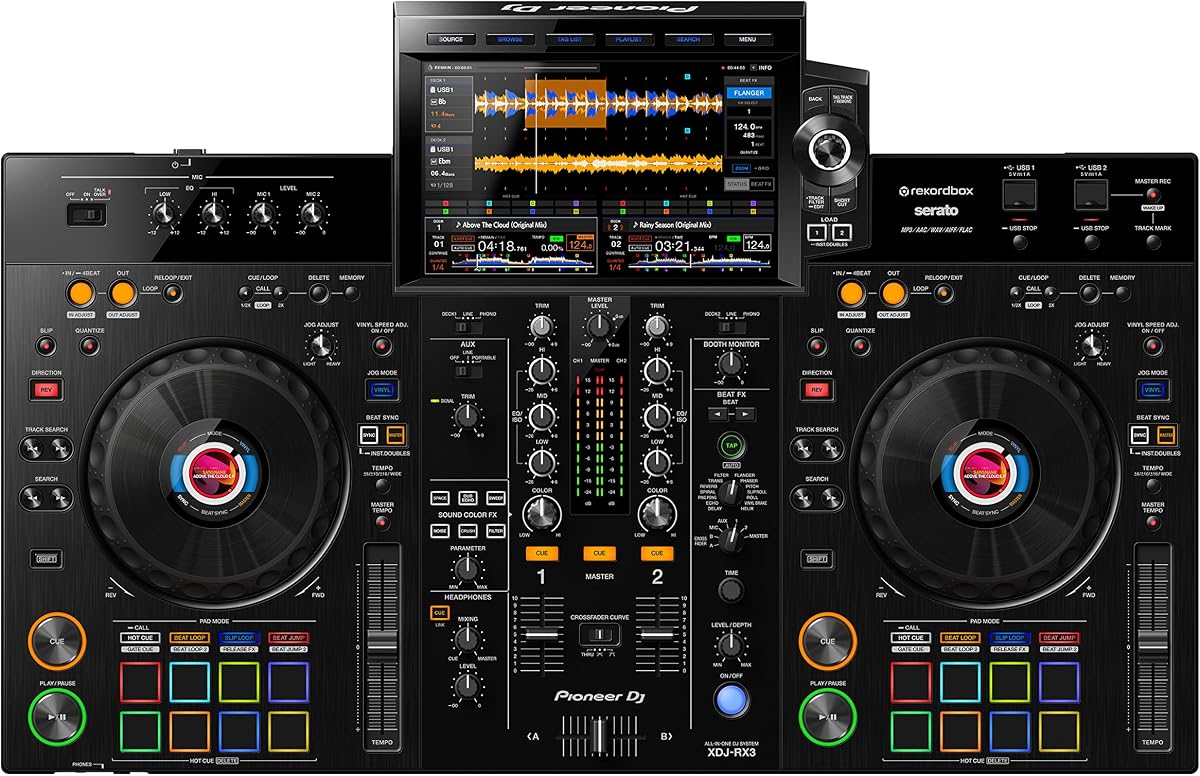
The Pioneer DJ XDJ-RX3 All-In-One DJ System is the most complete general-purpose option in this guide, carrying a 4.4 rating and a large feature set. It brings a club-style layout, a 10.1-inch touchscreen, two platforms, 16 Performance Pads, and professional outputs into a single two-channel system designed to transition naturally from home practice to mobile or small-venue work.
We may earn a commission when you buy through this link, at no additional cost to you.
Its most important advantage is standalone USB playback. DJs can take prepared rekordbox sets to a USB drive and perform without a laptop, reducing setup demands and eliminating the need to depend on a computer during a live event. Hardware Unlock for rekordbox Performance mode supports a familiar standalone approach, while Serato DJ Pro computer control provides a path for software-based mixing.
Creative tools include Beat FX, Sound Color FX, and the Performance Pad bank, allowing the XDJ-RX3 to handle effects, hot cues, and other performance actions without relying exclusively on a small laptop screen. The trade-off is size: the XDJ-RX3 is a substantial all-in-one system rather than a lightweight controller. It also has more features than a beginner may initially need.
The XDJ-RX3 is best for DJs who want flexible rekordbox and Serato workflows, want to perform from USB media, and appreciate a layout that resembles professional booth equipment. It is less appropriate for someone who requires a compact travel unit or authentic vinyl manipulation. For those priorities, the RANE Twelve MKII or PLX-CRSS12 offers a more specialized experience.
The ability to run prepared rekordbox sets directly from USB makes the XDJ-RX3 suitable for locations where carrying a computer is inconvenient. Proper media preparation is still essential, but the hardware reduces the number of components required at the booth.
The 10.1-inch touchscreen provides more room for browsing and on-screen control than a typical compact controller. Combined with a CDJ-style layout and 16 Performance Pads, it creates a workflow that can feel familiar to experienced club DJs.
We may earn a commission when you buy through this link, at no additional cost to you.
The RANE Twelve MKII Motorized DJ Turntable earns a 4.6 rating by combining a traditional turntable appearance with contemporary digital control. Its full 12-inch black acrylic platter is not merely decorative: a high-torque motor drives it with 3,600 ticks of resolution, giving the deck a direct, physical feel for scratching, nudging tracks, and other performance techniques.
We may earn a commission when you buy through this link, at no additional cost to you.
The platform support is broad for a digital deck. DVS and USB MIDI control work with Serato DJ Pro, Traktor, and VirtualDJ, while the OLED display presents BPM and control status. A dual-mode touch strip handles track search and activates eight hot-cue triggers, and the pitch slider offers 8, 16, and 50% ranges with two-resolution adjustment.
The main caveat is that this is primarily a software-controlled instrument rather than a self-contained standalone player. A computer and compatible application are central to many workflows. Its substantial control surface may also be more than a casual listener needs, and the traditional layout focuses attention on the platter rather than on a large visual interface.
The RANE Twelve MKII is an excellent choice for a scratch-influenced or vinyl-minded DJ who wants modern software flexibility with a large tactile platter. It is particularly compelling for performers who value hands-on manipulation over touchscreen workflows. Buyers should verify that their preferred software and audio setup are compatible before committing.
The 12-inch motorized disc gives performers more physical surface for scratch-like movement and track control than a compact jog wheel. Its high and low torque adjustments let users move between precise digital control and a more traditional turntable response.
Two-resolution pitch control, selectable platter speeds, and high motor resolution support accurate adjustments. These details are particularly valuable for detailed mixing, beat-oriented work, and users accustomed to the feel of a full-size deck.
We may earn a commission when you buy through this link, at no additional cost to you.
The Pioneer DJ DDJ-FLX4 2-Channel DJ Controller is built around an approachable, user-friendly layout derived from professional Pioneer DJ equipment. Its 4.6 rating reflects a strong balance of useful assistance, modern connectivity, and a versatile two-channel feature set, making it a particularly approachable choice for learners building toward larger systems.
We may earn a commission when you buy through this link, at no additional cost to you.
The standout learning feature is Smart Fader, which can automatically adjust volume, bass, and BPM as the fader moves. That assistance may help new DJs experience smoother transitions, while the familiar physical arrangement and 16 Performance Pads provide room to learn Hot Cues, Pad FX, Beat Jump, and Sampler functions over time.
Streaming support covers Apple Music, Tidal, and Beatport, and the controller can connect to PC, Mac, iPhone, iPad, or Android through USB or Bluetooth. Its built-in sound card simplifies speaker connections. The trade-off is that only two decks are controlled, and a Smart Fader user must eventually develop manual mixing judgment rather than relying on automation.
Smart Fader gives beginners a structured way to experiment with transitions. As confidence grows, DJs can bypass the assistance and control the relevant parameters manually while retaining the familiar layout and pad assignments.
USB and Bluetooth connectivity allow the controller to work with computers and mobile devices rather than locking the user into one platform. The built-in sound card also reduces the number of external components needed for a straightforward home setup.
We may earn a commission when you buy through this link, at no additional cost to you.
The Pioneer DJ PLX-500 Direct-Drive Turntable in black combines a traditional DJ layout with a direct-drive motor and USB recording output. Its 4.6 rating and accessible feature set make it well suited to home listening, first DJing steps, and DJs who want to preserve vinyl collections as digital files.
We may earn a commission when you buy through this link, at no additional cost to you.
The direct-drive mechanism provides a stable, club-inspired platform for records without the complexity of belt-driven operation. A USB output records vinyl directly to a computer, while phono and line outputs give users flexibility in how the deck connects to an amplifier, mixer, or active monitors. Starter accessories are included to simplify initial setup.
This is not a standalone digital DJ system. It cannot perform a rekordbox set or replace a software controller by itself, and scratching still requires the appropriate cartridge, interface, and software. Its strength is the physical deck experience, especially for people who enjoy handling records and learning traditional cueing and speed control.
The black PLX-500 is a strong fit for vinyl-focused home users and DJs establishing a familiar, professional-style layout. It is less suitable for someone who wants a single device to handle streaming, effects, and laptop-free performance. Those needs are better met by the XDJ-RX3, Denon DJ SC LIVE 4, or another modern all-in-one system.
The real DJ layout introduces proper cueing, pitch control, and record handling from the beginning. That familiarity can make later transitions to club equipment more intuitive, while the direct-drive motor supports consistent everyday use.
The USB output removes some of the complexity associated with converting a record collection to digital files. A computer is still required, but the turntable handles the audio capture directly.
We may earn a commission when you buy through this link, at no additional cost to you.
The white Pioneer DJ PLX-500 Direct-Drive Turntable offers the same core functionality as the black version, pairing a traditional DJ layout with direct-drive operation and USB recording. Its 4.6 rating makes it one of the strongest options in the list for a home vinyl setup where the physical feel of a full-size turntable is the priority.
We may earn a commission when you buy through this link, at no additional cost to you.
Its direct-drive system provides a consistent platform for playing records, and the familiar layout helps users learn the controls used across professional DJ equipment. USB recording can capture vinyl to a computer, while the phono and line output expands connection options. Included starter accessories help reduce the setup burden for first-time owners.
The limitations are inherent in the product category rather than defects in this version. A PLX-500 is a turntable, not a self-contained digital controller: it lacks a built-in mixer, effects engine, and standalone media playback. Vinyl DJing with digital files would also require a compatible interface, software, and control records or an alternative DVS arrangement.
Choose the white model if its visual finish fits your room and you want a direct-drive deck for both listening and DJ practice. It is especially appropriate for a learner who values real turntable technique, record handling, and a setup that can grow into a larger home system. A modern controller would be a better choice for mobile streaming and software-based effects.
The direct-drive motor provides a consistent platform for everyday playback and record-based practice. Its familiar pitch and cueing arrangement also encourages techniques that transfer well to other professional-style turntables.
Phono and line outputs support different speaker and amplifier arrangements. The USB connection adds a direct computer-recording path, making the deck useful for both listening and collection digitization.
We may earn a commission when you buy through this link, at no additional cost to you.
The Pioneer DJ PLX-CRSS12 Direct-Drive Turntable with DVS and Magvel Clamp is the premium specialist in this guide. Its 4.5 rating reflects a focused combination of traditional deck mechanics and modern digital performance, allowing DJs to manipulate digital files on a full-size platter without using conventional timecode records.
We may earn a commission when you buy through this link, at no additional cost to you.
Built-in DVS and the included Magvel Clamp are the defining features. The clamp communicates platter control to the software so scratches, stops, and track positioning can be applied to digital audio. Compatibility with Serato and rekordbox gives experienced users a choice of established DVS workflows rather than a closed ecosystem.
The high-torque direct-drive motor and professional layout support an authentic response, but this is not a casual all-in-one appliance. Users need compatible software, an appropriate audio setup, and a computer or supported performance environment. The feature density may also feel excessive to someone who only wants to mix prepared files and trigger simple effects.
The PLX-CRSS12 is the right recommendation for a serious turntablist or vinyl-minded digital DJ who wants the physical response of a full platter. It bridges analog and digital rather than treating them as separate activities. Buyers should confirm their preferred DVS software and hardware ecosystem before purchase, then invest time in learning the clamp and motor behavior.
The Magvel Clamp translates platter movement into software commands, allowing digital files to be scratched without a timecode record. This preserves the tactile relationship between hand, platter, and track while keeping the source in a digital library.
A high-torque direct-drive motor provides a stable response for both traditional mixing and scratch-oriented movement. Serato and rekordbox support gives users a choice of performance ecosystems, although each requires appropriate setup.
We may earn a commission when you buy through this link, at no additional cost to you.
The Numark Mixtrack Platinum FX DJ Controller is a capable entry into software-based DJing, earning a 4.6 rating through a generous hardware feature set. Serato DJ Lite is included, four decks are controllable, and a built-in 24-bit audio interface streamlines connections to a computer running Mac or Windows.
We may earn a commission when you buy through this link, at no additional cost to you.
The 6-inch capacitive-touch jog wheels contain high-resolution color displays that show BPM, platter position, remaining beats, and pitch or key information. Eight Performance Pads per deck support cues, loops, fader cuts, and samples, while six quick-launch effects and dual paddle triggers provide additional tactile performance control.
Subscription access is available through Serato DJ Lite from services including Apple Music, Tidal, Spotify, SoundCloud, Beatport Link, and Beatsource Link. The controller also includes a microphone input, headphone output, RCA output, a three-band EQ, filter knobs, channel faders, and a crossfader. Its central limitation is dependence on a computer and the distinction between Serato Lite and the more advanced Pro ecosystem.
The Mixtrack Platinum FX is a well-rounded choice for a beginner who wants extensive controls without moving to a premium all-in-one system. It is also appropriate for a hobbyist who values four-deck flexibility, visual information, and streaming integration. Users seeking a full-size motorized platter, genuine standalone media playback, or a larger touchscreen should look elsewhere.
Serato DJ Lite, USB connectivity, and the integrated audio interface provide the essential parts of a computer-based setup in one controller. This reduces compatibility friction for a new DJ learning the basics of mixing and track preparation.
Four-deck control creates room for layered performances, while the color displays make timing and navigation information easier to read. Performance pads per deck add sample, cue, loop, and fader-cut actions without requiring a larger computer display.
We may earn a commission when you buy through this link, at no additional cost to you.
The Gemini USB DJ Controller & Media Player, VirtualDJ LE (GMX) is a portable hybrid designed to work from a USB drive or alongside DJ software. It weighs less than seven pounds, includes VirtualDJ LE, and combines touch-sensitive high-resolution jog wheels with a screen-equipped, performance-focused control surface for mobile use.
We may earn a commission when you buy through this link, at no additional cost to you.
Standalone USB playback is a major advantage for DJs who do not want to depend on a computer at every event. Each deck supports hot cues, auto loops, and filter effects, while fully mappable MIDI control lets users tailor buttons, knobs, and jog-wheel behavior. Dual high-contrast screens show waveforms and track information, and the built-in 24-bit audio interface supports professional-style connections.
XLR and RCA outputs, a compact enclosure, and plug-and-play connectivity make the GMX practical for parties, clubs, and mobile work. On the other hand, its 3.9 rating is the lowest among the products reviewed, and its high-contrast displays are less information-dense than the color touchscreens found on newer systems. VirtualDJ LE also represents a specific software tier rather than every advanced feature available to compatible hardware.
The GMX makes sense for a mobile DJ who values independent USB playback, compact transport, and broad output options. It can also suit a home user who wants to begin with software but retain a laptop-free fallback. Those wanting a more modern screen, richer pad workflow, or one of the leading all-in-one ecosystems should examine the Numark or Pioneer alternatives instead.
The GMX weighs less than seven pounds and combines standalone media capability with computer control. That balance makes it easier for a mobile DJ to carry one device and choose the appropriate playback method for each venue.
Mappable MIDI controls let users adapt the surface to a preferred workflow, while XLR and RCA outputs support a range of speaker systems. The dual displays provide essential waveform and track feedback without the bulk of a large touchscreen.
We may earn a commission when you buy through this link, at no additional cost to you.
The Denon DJ SC LIVE 4 Standalone DJ Controller is a feature-rich performance system with a 4.5 rating. Engine DJ OS provides a 7-inch touchscreen interface, while the ability to browse media from an SD card or two USB inputs allows professional-style performance without a computer.
We may earn a commission when you buy through this link, at no additional cost to you.
Streaming access spans Amazon Music Unlimited, Apple Music, Tidal, Beatsource, Beatport, SoundCloud Go+, and other providers. The system also supports standalone stems for vocal, melody, bass, and drum layers prepared with Engine DJ Desktop, while a one-time software license applies to that capability. RGB waveforms, star ratings, and integrated Engine DJ profiles help organize and read the music library.
Its built-in speakers are unusual for a device in this category and make practice or small casual performance more convenient. Professional connectivity includes Bluetooth audio input, Wi-Fi streaming, USB and SD media inputs, microphone connections, RCA main outputs, a quarter-inch booth output, and an XLR main output. Engine Lighting enhancements can synchronize supported Philips Hue, Nanoleaf, and DMX lighting.
The SC LIVE 4 is a strong option for a mobile, club, or streaming DJ who wants laptop-free operation and extensive library features. It is less suitable for a beginner who wants the smallest possible learning surface or a purist seeking a traditional full-size platter. Software access, licensing, and setup should be reviewed carefully before purchase.
Engine DJ OS, local media inputs, and streaming services let performers work directly from the hardware. The touchscreen provides room to browse tracks and inspect waveforms without recreating a full club setup around a laptop.
Integrated speakers support practice and smaller settings, while XLR, RCA, booth, microphone, and lighting connections serve more demanding mobile work. This broad connection set can simplify system planning for a DJ who moves between venues.
We may earn a commission when you buy through this link, at no additional cost to you.
The right digital DJ turntable depends on whether you want a full-size deck, a computer-connected controller, or a self-contained performance system. These factors help narrow the field according to control style, music source, experience, portability, and output requirements.
A standalone system performs its core functions without a laptop, often using prepared USB media, an SD card, streaming applications, or built-in media controls. The Pioneer DJ XDJ-RX3, Gemini GMX, and Denon DJ SC LIVE 4 fit this category in different ways. Computer-connected controllers generally offer deeper integration with DJ software and may provide more granular effects, waveform display, and library control. The Pioneer DJ DDJ-FLX4 and Numark Mixtrack Platinum FX are built around that software-based model.
Choose standalone operation for mobile reliability, compact event logistics, or a preference for performing directly from the hardware. Choose computer-connected control when you want extensive software workflows, detailed waveform navigation, and the flexibility to change or prepare tracks in the moment.
Full-size platters provide a broad surface for hand control and can feel more natural to turntablists and vinyl-oriented performers. The RANE Twelve MKII uses a 12-inch motorized acrylic disc, while the Pioneer DJ PLX-CRSS12 combines a conventional platter with DVS and the Magvel Clamp. Compact jog wheels are more portable and often include screens showing track information. Their smaller size is convenient for learning and mobile work but offers less physical room for elaborate scratch techniques.
Prioritize platter size when tactile expression is central to your style. Prioritize jog-wheel displays and compact controls when portability, lower learning barriers, and software navigation matter more. A large platter is valuable only if the surrounding software and audio workflow can support it fully.
The included or supported software determines which preparation tools, effects, streaming services, and performance modes are available. Serato DJ Lite appears with the Numark Mixtrack Platinum FX, while the RANE Twelve MKII supports Serato DJ Pro, Traktor, and VirtualDJ. The PLX-CRSS12 works with Serato and rekordbox, and the XDJ-RX3 supports rekordbox Performance mode as well as Serato DJ Pro computer control. The Denon DJ SC LIVE 4 centers on Engine DJ OS.
Check your existing software habits before buying. A device can have excellent hardware but still be a poor match if its supported application does not fit your library organization, streaming services, or live-performance needs. Also verify operating-system requirements and any software license details.
Modern DJ systems may draw from streaming subscriptions, locally stored tracks, USB media, SD cards, or multiple connected sources. The XDJ-RX3 can run prepared rekordbox sets from USB, the GMX supports standalone USB playback, and the SC LIVE 4 combines SD and USB inputs with broad streaming access. The DDJ-FLX4 and Mixtrack Platinum FX also support major streaming ecosystems through their software platforms.
List the sources you actually use before choosing. Confirm service support, media formats, and whether prepared media can be played without a computer. A device that handles every source but feels confusing may be less useful than a simpler model that covers your normal set perfectly.
Performance pads, effect buttons, pitch controls, loop tools, and jog-wheel modes shape how quickly a DJ can act during a set. The USOLOMKII includes five DSP effects and a multi-function jog wheel, the XDJ-RX3 offers Beat FX, Sound Color FX, and 16 Performance Pads, and the DDJ-FLX4 includes 16 pads with multiple assigned functions. The Mixtrack Platinum FX provides eight pads per deck and six quick-launch effects.
Prioritize controls that match your intended performance style. A beginner may benefit from a smaller set of clear, labeled functions, while an active performer may want rapid access to samples, loops, beat jumps, and fader cuts. Having many controls is only an advantage when their assignments are intuitive and reachable.
Every setup needs a dependable path to the sound system, headphones, and any microphone or auxiliary equipment. The PLX-CRSS12, RANE Twelve MKII, and GMX emphasize DVS, MIDI, XLR, or RCA connectivity for more specialized rigs. The XDJ-RX3 includes professional outputs, the SC LIVE 4 offers XLR and booth outputs, and the DDJ-FLX4 uses a built-in sound card for direct computer and mobile connections.
Make a simple diagram of the intended signal path before buying. Verify whether your speakers need XLR, RCA, or another connection, whether the deck supplies a phono-level or line-level signal, and whether a computer interface is required. Check headphone and microphone connections as well.
A large all-in-one system may provide a premium, familiar interface but take more room than a compact controller. The Gemini GMX, at less than seven pounds, emphasizes road-ready transport, while the Numark Mixtrack Platinum FX is a straightforward desktop controller. The RANE Twelve MKII and Pioneer direct-drive decks need more physical space, and the SC LIVE 4 integrates speakers for a more self-contained presentation.
Consider both the device and the complete setup. Include stands, covers, cables, the computer, and any speakers when measuring storage or planning a mobile load-in. Choose the largest layout only when its ergonomics and controls provide more value than the extra footprint creates.
Begin by placing the unit on a stable, level surface and connecting the correct audio path before powering it up. Confirm that the software, media source, output level, and control mode match your intended workflow. For a computer-connected controller, install the required application, authorize it, and test the built-in audio interface. For a standalone system, format the media and confirm that the library appears correctly.
Begin with a low monitoring level and learn the deck's central controls before performing. Practice setting cue points, matching tempo, adjusting pitch, triggering loops, switching effects, and moving between performance pads. For DVS or vinyl-style systems, learn how platter movement affects the software and keep hands clear of pinch points while the platter is moving. Use headphones to monitor cues and maintain awareness of the main output.
For maintenance, keep the surface dry and free of dust, and do not use liquid cleaners directly on electronic controls. Protect the platter, display, and touch surfaces from impact, and follow the manufacturer's instructions for cleaning the record area or acrylic disc. Store cables separately to prevent stress on connectors, back up prepared libraries, and update software only when the current workflow is stable. Before every event, test the audio route, storage media, software connection, and power supply.
A digital DJ turntable usually imitates a full-size deck with a platter and DJ-style control layout, while a DJ controller is generally more compact and computer-centered. Some modern all-in-one systems blur the distinction by offering large screens, standalone playback, and multiple software platforms. The right choice depends on whether authentic platter handling or portability and software flexibility matters more.
No. Standalone operation is a specific feature rather than a universal capability. The XDJ-RX3 can run prepared rekordbox sets from USB, the GMX supports standalone USB playback, and the SC LIVE 4 uses Engine DJ OS with SD and USB media. The DDJ-FLX4, Mixtrack Platinum FX, RANE Twelve MKII, and PLX-CRSS12 are primarily designed around compatible computer software for their principal performance workflows.
DVS is not required by every DJ controller, but it is essential when the goal is to control digital playback through a physical platter. The PLX-CRSS12 includes built-in DVS and a Magvel Clamp, while the RANE Twelve MKII supports DVS control through compatible software. Software controllers can also simulate scratch behavior, but the tactile and control experience is different.
The Pioneer DJ DDJ-FLX4 is particularly approachable because it has a simple layout derived from professional equipment and a Smart Fader that can assist with volume, bass, and BPM blending. The Numark Mixtrack Platinum FX is another accessible option, offering a complete Serato DJ Lite setup with four-deck control, displays, and performance pads. The best choice still depends on the learner's comfort with software and streaming accounts.
Several models in this guide support major streaming providers, including Apple Music, Tidal, Beatport, Spotify, SoundCloud, and other services through their associated software or operating systems. Availability depends on the product's platform, account, region, and current software support. Confirm compatibility before relying on a subscription for a performance, and prepare local media as a backup when appropriate.
Most controller-based products require a sound system, although the Denon DJ SC LIVE 4 includes built-in speakers for practice and smaller use. The XDJ-RX3, RANE Twelve MKII, PLX-CRSS12, and GMX include professional output connections but do not provide a complete monitor speaker setup. The PLX-500 models are turntables for use with an existing amplifier, mixer, or powered speakers.
A direct-drive turntable is valuable if you want tactile vinyl-style control, physical record handling, or DVS performance. The PLX-500 is aimed at home listening and record digitization, while the PLX-CRSS12 is designed for modern DVS workflows. If your priority is streaming, pad effects, and screen-based library control, a controller or standalone all-in-one may be more direct.
Two decks are enough for conventional mixing and provide a simple starting point, while four-deck control supports more elaborate layering and remixing. The XDJ-RX3, DDJ-FLX4, and SC LIVE 4 use a two-channel approach, whereas the Mixtrack Platinum FX controls four decks. More deck capability is useful only if the performance style and software workflow genuinely benefit from it.
The Pioneer DJ XDJ-RX3 is the strongest all-around recommendation for its combination of standalone USB playback, a large touchscreen, a club-style layout, and support for both rekordbox and Serato DJ Pro. The Numark Mixtrack Platinum FX stands out for affordable, computer-based learning with four-deck control, while the Pioneer DJ PLX-CRSS12 is the premium choice for tactile DVS performance on a full-size platter.
Your priorities should determine the category. Choose a compact controller for learning, mobility, and streaming; a standalone all-in-one for laptop-free events; or a direct-drive and DVS turntable for authentic hand control and vinyl-inspired performance. Output connections, software compatibility, screen usefulness, and practice environment are more important than a long specification list.
Before buying, verify the current product listing, software requirements, included accessories, service availability, and output connections. Prices and configurations can change, and a final choice should reflect where you will perform, which music sources you use, and how much hands-on control you want rather than a single universal specification.