
Midea 3.1 Cu.ft Mini Fridge with Freezer
4.5Editor score
270 KWh/Y published consumption
Separate adjustable freezer zone
Reversible door with LED light
Our Energy Efficient Mini Fridge guide compares ten compact refrigerators for energy use, capacity, noise, storage, freezer performance, and room-friendly
An energy efficient mini fridge brings everyday cooling to small spaces without the operating demands of a full-size refrigerator. The right model balances compact dimensions, useful storage, quiet operation, reliable temperature control, and responsible energy consumption. For dorms, offices, bedrooms, studios, and secondary kitchen zones, these differences can matter every day.
We compared ten mini refrigerators using the specifications and product information available for this guide. The list covers freezer and refrigerator-only formats, capacities from 1.6 to 3.3 cubic feet, different thermostat systems, low-noise operation, reversible doors, and published energy-use figures where manufacturers provide them. It also considers practical storage details that often influence daily convenience.
Each review explains where a particular model fits best, along with the compromises worth considering. The top selections balance efficiency with useful capacity, while alternatives offer specialized advantages such as a larger freezer zone, a very small footprint, or especially quiet operation. Product details and pricing can change, so confirm the current listing and specifications before making a final purchase.
4.5Editor score

4.4Editor score

4.1Editor score
The table below compares all ten refrigerators by format, capacity, energy-related specifications, and user-focused features, making it easier to identify the model that best matches your space and daily routine.




The Upstreman 3.2 Cu.Ft Mini Fridge with Freezer combines a useful 3.2-cubic-foot capacity with ENERGY STAR certification and a 4.4 customer rating. Its dimensions are designed to preserve floor space while providing 2.9 cubic feet of refrigeration space and a dedicated 0.3-cubic-foot freezer compartment, making it a strong all-around option for dorms, offices, bedrooms, and apartments.
We may earn a commission when you buy through this link, at no additional cost to you.
Efficiency is supported by a design that avoids unnecessary room consumption, while the five-level thermostat lets users select temperatures from 32°F to 50°F. The 38 dB operating level is particularly useful in bedrooms and study spaces. Two adjustable glass shelves, a crisper drawer, a reversible door, leveling feet, and a tight door seal contribute to the practical appeal.
The most important limitation is that the manufacturer specifically says the refrigerator is not suitable for storing ice cream or ice cubes. The freezer is also smaller than a dedicated upright freezer compartment, and routine defrosting is required. Buyers who primarily need chilled drinks, fruit, snacks, and dairy can accept these trade-offs more readily than households expecting serious frozen-food capacity.
This is the strongest general recommendation because it combines certification, quiet operation, flexible placement, and organized storage without making any one feature feel like an afterthought. It is especially appropriate for someone who wants a full-featured mini refrigerator in a small room and values a quiet, adaptable installation more than a large freezer.
A 38 dB rating makes this model well suited to bedrooms, offices, and dorm rooms where compressor noise could be distracting. Its 18.7-inch width and 17.4-inch depth preserve a compact footprint while still providing 3.2 cubic feet of total storage.
The reversible door, adjustable shelves, crisper drawer, and leveling feet allow the refrigerator to adapt to awkward rooms and changing layouts. A dedicated defrost tool also simplifies routine freezer maintenance.
We may earn a commission when you buy through this link, at no additional cost to you.
This 3.2 Cu Ft Mini Fridge with Freezer stands out because its dedicated 0.35-cubic-foot upright freezer reaches -6°F to -11°F. With a 4.4 rating, it gives shoppers a clearer division between frozen and refrigerated goods than a conventional top-freezer-style compartment, while the larger 3.2-cubic-foot body remains suitable for compact spaces.
We may earn a commission when you buy through this link, at no additional cost to you.
The manufacturer lists average energy consumption of 0.6 kWh per day, making published operating data a useful point of comparison. A simple mechanical thermostat uses five settings, and setting three is recommended for normal use. Adjustable shelves, door bins, and a reversible door make the interior practical for everyday beverages, groceries, and meal preparation.
Manual defrosting means owners must periodically address ice buildup, and the manufacturer describes the upright freezer as best for ice making and short-term frozen storage. That makes it less suitable for long-term keeping of sensitive frozen foods. Standard 115V, 60Hz operation and ETL safety certification add useful practical information for shoppers.
Choose this model when a genuinely separate freezer section matters more than a broader refrigerator-only format. It offers a clear efficiency-and-storage compromise for dorm rooms, offices, and apartments where users regularly want ice or a few frozen items alongside chilled groceries.
The upright freezer compartment reaches temperatures between -6°F and -11°F. That makes the model more useful for ice cubes and short-term frozen goods than many micro-freezer alternatives.
A clear mechanical dial with five settings keeps operation uncomplicated. The recommended setting three provides a useful starting point for normal daily use.
We may earn a commission when you buy through this link, at no additional cost to you.
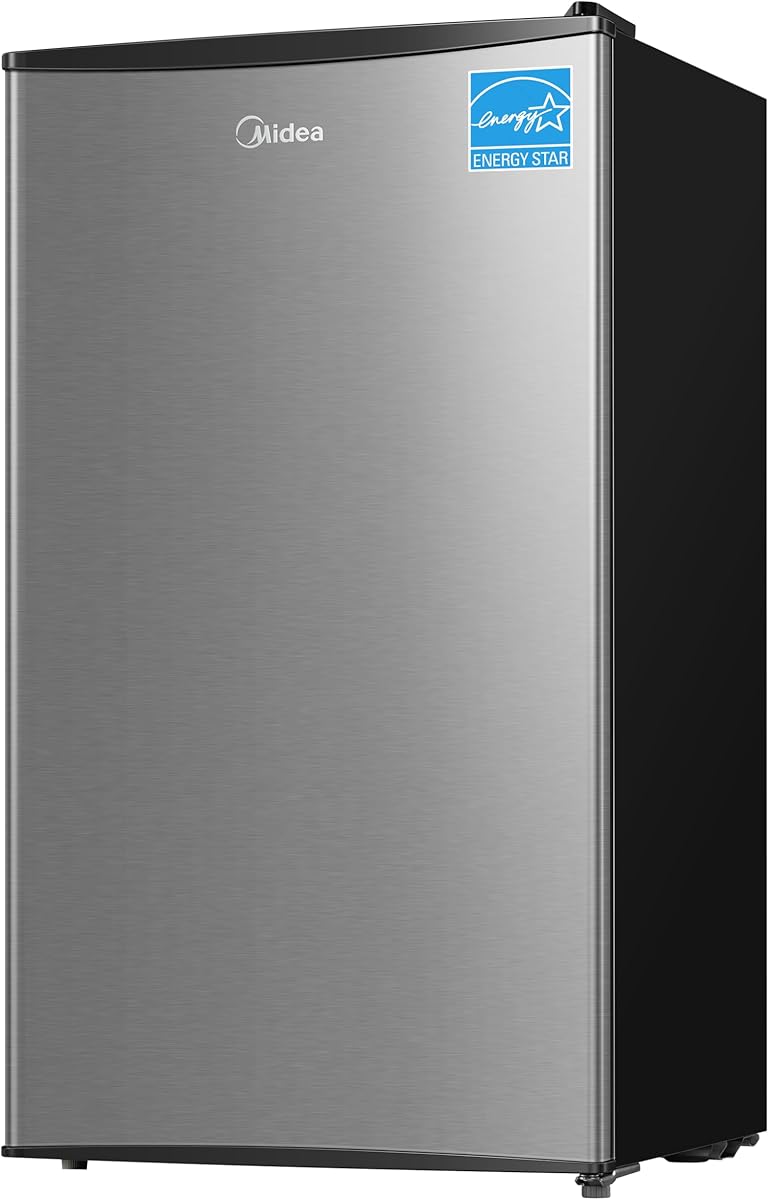
The Midea 3.1 Cu.ft Mini Fridge with Freezer pairs ENERGY STAR certification with a 4.5 customer rating, the highest listed rating among these picks. It is a polished, thoughtfully equipped option for dorms, offices, apartments, and bedrooms where both chilled food and frozen items need dedicated space.
We may earn a commission when you buy through this link, at no additional cost to you.
Its R600A high-efficiency compressor is associated with annual energy consumption of 270 KWh/Y. A multi-air-flow system is intended to distribute air more evenly, while the mechanical thermostat provides separate ranges of 32°F to 50°F for the refrigerator and -11.2°F to 5°F for the freezer. That level of zone control is more versatile than a single dial governing every section.
The trade-off is the relatively small 3.1-cubic-foot total footprint. Detachable glass shelves, a crisper drawer, and a 2L bottle rack improve organization, but this is not a large-capacity model. The reversible door and interior LED are particularly welcome in compact rooms where orientation and visibility matter.
This refrigerator is recommended for shoppers who want the strongest blend of certification, separate temperature zones, and customer feedback in the group. It is a premium fit for daily dorm or office use, particularly when the room has enough space for a narrow upright format but not a full-size refrigerator.
ENERGY STAR certification and 270 KWh/Y consumption support a lower-impact approach to compact cooling. Separate refrigerator and freezer ranges provide more precise control than a shared temperature setting.
The reversible door supports different room layouts, while the LED interior light helps users find drinks and food in a dark space. A 2L bottle rack and removable shelves improve everyday organization.
We may earn a commission when you buy through this link, at no additional cost to you.
The Igloo 3.2 Cu.Ft. Mini Fridge with Freezer offers a straightforward 3.2-cubic-foot format with a 4.4 rating. Its main appeal is familiar single-door operation: a separate freezer compartment for frozen foods, adjustable mechanical temperature control, and glass shelves for organized everyday storage.
We may earn a commission when you buy through this link, at no additional cost to you.
The refrigerator section operates across a 32°F to 50°F range, which covers common settings for drinks, dairy, fruit, and snacks. Compressor static cooling keeps the internal design simple, while the glass shelves help make better use of the vertical space. The broad 3.2-cubic-foot capacity is useful in dorms, offices, and secondary kitchen areas.
The listing does not provide a specific energy-consumption number or ENERGY STAR certification, so shoppers seeking documented efficiency may find other options easier to compare. Static cooling without a fan also places the focus on basic refrigeration rather than advanced air distribution. These are not necessarily flaws, but they limit the detailed efficiency comparison.
This model is a practical choice for buyers who prefer recognizable single-door convenience and do not need complex temperature zones. It works best when the priority is straightforward chilled storage, a separate frozen-food area, and a relatively roomy interior rather than published operating data.
The single-door layout places chilled items and frozen foods in one accessible unit. Adjustable glass shelves add flexibility without introducing complicated controls.
At 3.2 cubic feet, the refrigerator offers useful storage for snacks, beverages, and household staples. The mechanical thermostat keeps temperature selection direct and easy to understand.
We may earn a commission when you buy through this link, at no additional cost to you.
The Midea 3.3 Cu.ft Mini Fridge provides the largest stated capacity in this comparison, combining a 3.3-cubic-foot interior with ENERGY STAR certification and a 4.3 rating. It is aimed at users who want more chilled storage than the smallest refrigerators can offer without stepping up to a full-size appliance.
We may earn a commission when you buy through this link, at no additional cost to you.
Published consumption is 260 KWh/Y, slightly below the figure listed for the 3.1-cubic-foot Midea model in this group. A multi-air-flow system is designed to improve air distribution, and the thermostat covers 33.8°F to 50°F. The interior includes a 2L bottle rack and an easy-access can rack for the kinds of drinks commonly kept in offices and dorm rooms.
Unlike the freezer-equipped Midea model, this is a refrigerator-only format. Buyers wanting separate frozen storage will need to consider another option. Its under-42 dB noise remains appropriate for offices and bedrooms, although several competing models specify quieter 37 to 38 dB operation.
Choose this refrigerator when chilled capacity is the priority and frozen storage is unnecessary. The reversible door, internal light, and certified efficiency make it a balanced option for apartments, garages, dorms, and home offices.
The 3.3-cubic-foot interior gives this model a slight capacity advantage over the common 3.2-cubic-foot format. That additional room benefits users who keep multiple drinks, snacks, and fresh foods on hand.
ENERGY STAR certification and a published 260 KWh/Y consumption figure make operating efficiency easier to assess. Noise below 42 dB suits shared and quiet environments.
We may earn a commission when you buy through this link, at no additional cost to you.
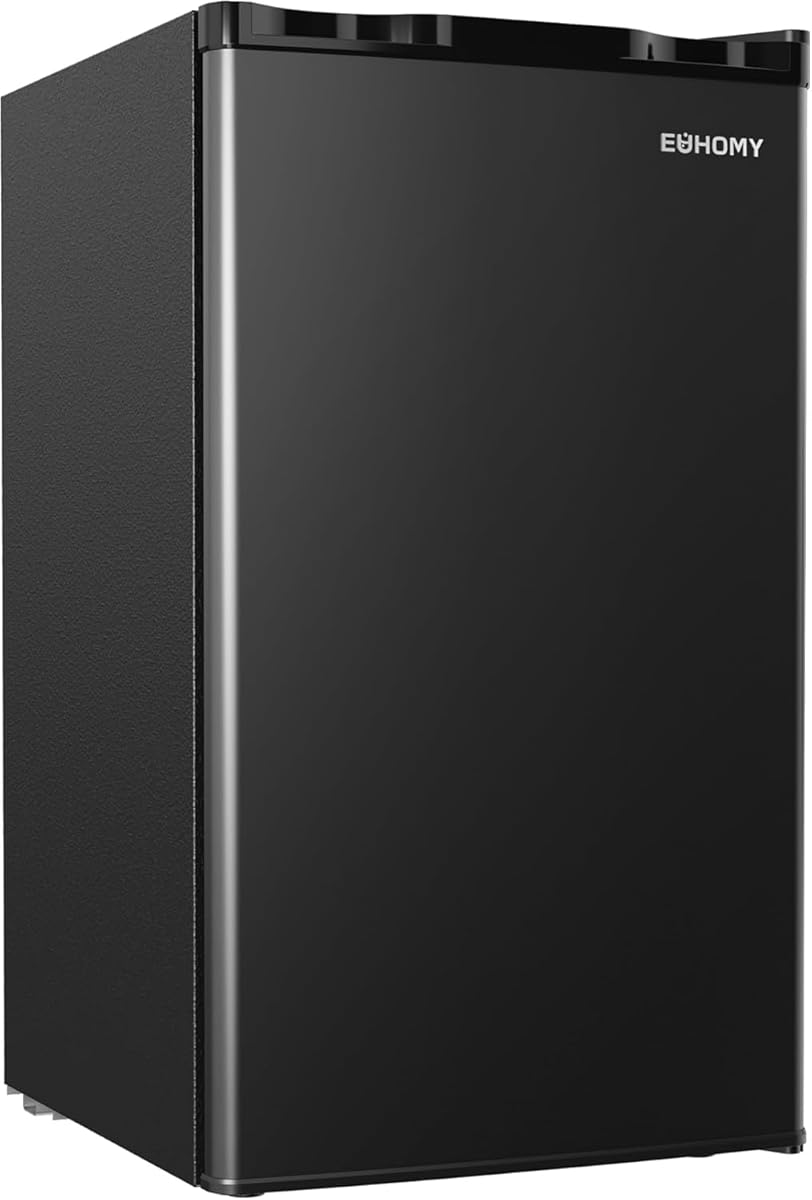
The EUHOMY 3.2 Cu.Ft Mini Fridge with Freezer combines a compact footprint with published consumption of as little as 0.66 kWh per day. Its 4.3 rating and 38 dB operating noise make it a credible option for energy-conscious dorm residents and office users who want a little frozen storage as well.
We may earn a commission when you buy through this link, at no additional cost to you.
The 2.9-cubic-foot refrigeration section operates from 25°F to 44°F, while the 0.3-cubic-foot micro-freezer runs from 23°F to 41°F. The freezer is designed for short-term storage and includes a water catch pan for easier defrosting or cleaning. A seven-position control knob gives users more adjustment than a basic two-position dial, with model three recommended for daily use.
The 19-inch-deep, 17.5-inch-wide body occupies about 2.2 square feet, and the top hinges can be reversed. Adjustable feet help stabilize the unit on uneven floors. However, the micro-freezer does not reach the subzero temperatures of a dedicated upright freezer, and its relatively warm range is better for brief chilled-frozen storage than long-term preservation.
This model is most appropriate for dorm rooms and offices where a narrow footprint, low noise, and a separate small frozen section are useful. It is a sensible choice for short-term frozen goods, drinks, snacks, and fresh produce rather than households needing a full freezer.
The body occupies only about 2.2 square feet, helping preserve valuable floor space. Within that compact frame, most of the capacity is devoted to refrigerated storage.
A water catch pan sits below the micro-freezer to collect condensation. It assists with cleaning and defrosting when the appliance is switched off.
We may earn a commission when you buy through this link, at no additional cost to you.
The Midea 1.7 Cu.ft Mini Fridge is designed for buyers who need only a modest amount of chilled storage. Its ENERGY STAR certification, 4.0 rating, and 1.7-cubic-foot capacity make it an efficient option for bedrooms, offices, dorms, and other locations where a larger refrigerator would be intrusive.
We may earn a commission when you buy through this link, at no additional cost to you.
A door shelf accommodates a 2-liter bottle or similarly large beverage container, addressing one of the most common mini-fridge storage needs. The adjustable shelf can be removed to create space for taller bottles, cans, or irregular containers. A reversible door allows the refrigerator to be installed on either side, which helps in narrow rooms and awkward corners.
The 1.7-cubic-foot capacity is the smallest in this roundup, so it is not appropriate for frequent grocery shopping, family food storage, or users wanting frozen goods. The rating is also lower than those of the other options, although it remains positive. The main benefit is the focus on a small, efficient appliance rather than maximizing capacity.
This refrigerator is best for a desk, bedside area, small office, or dorm room where the primary requirements are drinks, snacks, medication requiring refrigeration, and a narrow footprint. Buyers should choose it for focused use rather than expecting a full range of household refrigerator functions.
The 1.7-cubic-foot format is useful when energy conservation and space efficiency matter more than storing several days of groceries. It provides enough room for targeted everyday essentials.
Built-in 2L bottle storage keeps a large container upright and accessible. Removing the adjustable shelf makes it easier to accommodate taller or irregular items.
We may earn a commission when you buy through this link, at no additional cost to you.
The DUMOS 3.2 Cu.Ft Mini Fridge with Freezer stands out for its published consumption of as little as 0.41 kWh per day, the lowest daily figure listed in this comparison. Its 3.2-cubic-foot capacity, 38 dB operation, and 4.1 rating make it a compelling budget-oriented choice for bedrooms, offices, and dorm rooms.
We may earn a commission when you buy through this link, at no additional cost to you.
Five thermostat settings provide useful control, with level three recommended for general home and office use. The 2.9-cubic-foot refrigerator area covers 33.8°F to 44°F, while the 0.3-cubic-foot freezer section operates from 23°F to 35°F. Storage includes a crisper drawer, two adjustable shelves, and a door compartment, all within a footprint of only 2.15 square feet.
The freezer does not reach true subzero temperatures, making it better suited to short-term chilled-frozen items than serious frozen-food storage. The 4.1 rating is also the second-lowest in the group. Those factors are worth considering, but the low energy figure, quiet operation, and flexible interior preserve the model's value for routine use.
This is the recommended budget pick for a shopper who wants a full-sized compact format, everyday chilled storage, and a small freezer without paying for the features found in premium models. It is best for snacks, beverages, fruit, and occasional short-term frozen items rather than intensive frozen-food storage.
At 0.41 kWh per day, the DUMOS model offers the most favorable stated daily energy figure in the group. That makes it an attractive baseline for energy-conscious comparisons.
Two adjustable shelves, a crisper drawer, and a door compartment organize common food and beverage items. The narrow 2.15-square-foot footprint supports placement in tight rooms.
We may earn a commission when you buy through this link, at no additional cost to you.
The 3.2 Cu. Ft. Mini Fridge with Freezer in grey is a low-noise compact refrigerator with a 4.3 rating. Its listed noise level of below 37 dB makes it the quietest figure in this group, while the 0.55 kWh daily consumption offers another clear efficiency benchmark.
We may earn a commission when you buy through this link, at no additional cost to you.
Its 17.83-inch width, 16.73-inch depth, and 33.27-inch height preserve a narrow footprint, but the 3.2-cubic-foot capacity still provides useful room for beverages, vegetables, fruit, and snacks. Six thermostat positions offer more adjustment than many basic models. Detachable glass shelves, a crisper drawer, LED lighting, reversible hinges, and leveling legs support everyday organization and installation.
The one-touch defrost system is a meaningful convenience for a small freezer compartment, and the detachable door seal is easier to clean. The appliance does not claim ENERGY STAR certification, however, and the compact freezer is not a substitute for a full-size freezer. Its published energy figure remains useful, but certification may carry extra importance for some shoppers.
This model is recommended for bedrooms, study spaces, offices, and dorm rooms where quiet operation and simple defrosting are priorities. It is also a strong choice for shoppers who want many storage and placement features in a compact package without focusing primarily on a large freezer.
A noise level below 37 dB is well suited to sleeping, studying, and working spaces. It is the lowest published operating figure among the selected models.
The center button on the temperature control initiates the one-touch defrost function. Detachable shelves and a removable door seal simplify cleaning as well.
We may earn a commission when you buy through this link, at no additional cost to you.
The Midea 1.6 Cu.ft Mini Fridge is the smallest-capacity model here, but it brings a 4.5 customer rating, ENERGY STAR certification, and a published annual consumption figure of 207 KWh/Y. It is a focused choice for bedrooms, dorms, offices, and other spaces that need a small dedicated cooler rather than a multipurpose refrigerator.
We may earn a commission when you buy through this link, at no additional cost to you.
The refrigerator measures 18.6 inches wide, 17.7 inches deep, and 19.4 inches high, allowing placement on counters, shelves, or compact furniture. Its thermostat covers 28.4°F to 35.6°F, and an internal chiller box is designed to cool drinks faster. A 2L bottle rack provides dedicated space for a large beverage container.
The single glass shelf can be removed to accommodate irregular or tall items, while the reversible door supports different room layouts. With 1.6 cubic feet of total capacity, this refrigerator is not intended for bulk grocery storage, and the under-42 dB specification is quieter than some mini fridges but not as quiet as the 37 to 38 dB alternatives.
This model is best for drinks, snacks, medication, and a small personal assortment in a bedroom or office. Its low annual consumption figure and compact external dimensions make it attractive for users whose priority is a small, certified appliance rather than substantial food capacity.
The 207 KWh/Y consumption figure is the lowest annual estimate provided in this comparison. That makes the refrigerator appropriate for users seeking a small, certified cooling solution.
A 2L bottle rack, dedicated chiller box, and removable shelf prioritize common beverage and container use. Its short height also supports countertop and compact-furniture placement.
We may earn a commission when you buy through this link, at no additional cost to you.
The most efficient mini fridge is one that meets your storage needs without occupying unnecessary space, and the right choice depends on capacity, climate, layout, noise sensitivity, and how often you use the appliance.
Capacity is the first filter because it determines both usefulness and energy demand. The models here range from 1.6 to 1.7 cubic feet for drinks and snacks to approximately 3.1 to 3.3 cubic feet for broader household storage. Larger refrigerators generally hold more groceries and containers, but they also require more floor space and may not suit counters, dorm rooms, or narrow alcoves. A smaller unit is usually appropriate for a bedroom, office, or personal refreshment area, while a 3.2-cubic-foot model is better for people who want chilled food, snacks, and a small freezer in one appliance.
Published energy figures make efficiency comparisons more concrete, but check the units and period carefully. Some manufacturers provide daily kWh estimates, while others list annual KWh consumption. ENERGY STAR certification is another meaningful indicator because the product has been evaluated against applicable government energy-efficiency standards. A low daily figure should not be considered in isolation; capacity, compressor technology, usage patterns, room temperature, and door-opening frequency also affect actual consumption. Comparing like-for-like figures gives shoppers the most useful picture.
A refrigerator-only design is simpler and can be appropriate for drinks, snacks, fresh produce, and items requiring only light chilling. A freezer-equipped model adds valuable short-term frozen storage, but the available compartment may be too small for bulky meals or long-term food preservation. A dedicated upright freezer can reach substantially colder temperatures, while a micro-freezer often operates closer to refrigerator temperatures. Consider whether you genuinely need frozen storage before accepting the extra size, maintenance, and energy demands.
Published dimensions are more useful than capacity alone when deciding whether a model will fit. Check width, depth, and height, including space needed to open the door and reach shelves. Reversible doors can solve many orientation problems, while adjustable leveling feet help stabilize the appliance on uneven floors. Some listings also indicate that a compact unit can fit on countertops or under desks, but only do so after confirming the room, ventilation clearance, and outlet location.
Noise is essential in bedrooms, home offices, libraries, and shared dorm rooms. Specifications among these products range from below 37 dB to below 42 dB, with several models landing at 38 dB. Lower figures generally suggest a better fit for sleeping and concentration. A quiet compressor does not eliminate every sound, and room acoustics, floor vibration, and door seals can affect the experience. Placement away from a bedside or desk can also improve perceived quietness.
A mechanical thermostat keeps operation simple and is common in compact refrigerators, but the number of settings affects control. The models here offer five, six, seven, or dial-based temperature systems, and separate controls for refrigerator and freezer sections provide greater flexibility. Look for a clearly marked recommended setting and note whether the listed range applies to the entire unit or each compartment. Users storing sensitive foods should avoid models whose published ranges are unusually warm for their needs.
Look beyond the total capacity and examine how the space is divided. Adjustable or removable glass shelves help accommodate tall bottles and irregular containers, while a crisper drawer separates produce from other items. Door bins and dedicated bottle racks are useful for beverages, and an interior LED makes nighttime access easier. A separate freezer takes some space away from the chilled section, so compare the practical refrigerator compartment rather than relying only on the advertised total.
Compact freezers usually require occasional thawing, and the method matters for long-term convenience. A one-touch defrost system can simplify the process, while models with a water catch pan or a supplied defrost tool make cleanup more manageable. Reversible doors, detachable seals, and removable shelves improve routine cleaning. Check the manufacturer's guidance for defrosting, ventilation, temperature settings, and storage so that the appliance remains efficient and dependable.
Allow the refrigerator to stand upright for the period recommended in its manual before plugging it in, particularly if it has just been transported. Position it with adequate ventilation and away from direct sunlight, heaters, and hot kitchen surfaces. Use a dedicated outlet where appropriate, and avoid overloading it with extension cords or power strips. After power is restored, set the thermostat to the manufacturer's recommended everyday position and allow the appliance to cool before loading it heavily.
Organize the interior with airflow in mind. Keep commonly used drinks in the door or bottle rack, place taller items on adjustable shelves, and use the crisper for produce. Avoid blocking vents with containers or paper bags. Leave room around food packages so cold air can circulate, and minimize prolonged door opening. For freezer compartments, use only items suited to the published temperature range and avoid loading warm food directly into the cold section.
Clean the shelves, drawers, door bins, and interior surfaces regularly with mild cleaning products appropriate for refrigerator interiors. Wipe the door seal regularly, and follow the manual's defrosting guidance for the freezer. Use the supplied tools or built-in defrost control where provided, unplug the unit if required, and dry surfaces before restarting it. Keep the exterior vents clear, level the appliance with adjustable feet, and check current manufacturer instructions before using any cleaning method.
Among the models with a published daily consumption figure, the DUMOS 3.2 Cu.Ft model is listed at as little as 0.41 kWh per day. The 3.2 Cu. Ft. grey model states 0.55 kWh per day, while the dedicated upright-freezer model states 0.6 kWh per day. These figures are useful for comparison, but actual results depend on capacity, ambient temperature, usage, and how the refrigerator is installed.
ENERGY STAR certification indicates that a model meets applicable government energy-efficiency standards. It is a strong starting point when comparing refrigerators with similar capacities and features. It does not guarantee an exact monthly cost, and daily operating patterns still matter. Models that also publish consumption figures can be evaluated more precisely.
Not necessarily. A freezer adds cooling capability, and it may increase energy use depending on the compressor and operating conditions. It can still be efficient if you genuinely use the frozen compartment. If your needs are limited to drinks and fresh food, a certified refrigerator-only model may be simpler and more appropriate.
Follow the manufacturer's ventilation and clearance instructions, because the requirements can vary by model. Avoid enclosing the unit in a tight cabinet or placing it directly beside a heat source. Leave enough room to open the door fully, access shelves, and clean the exterior. Good airflow also helps the compressor operate efficiently.
The 3.2 Cu. Ft. grey model lists operation below 37 dB, making it the quietest stated figure in this group. The Upstreman and EUHOMY models specify 38 dB, while the Midea 1.6 and 3.3 models specify less than 42 dB. Actual noise varies with the room and installation, so position the unit away from the head of the bed if possible.
Some compact models may be suitable for countertop placement, but you should verify the dimensions, weight, ventilation, and manufacturer guidance. A unit that fits physically may still need more space around its vents and door. Check the listing and manual rather than assuming that a mini-fridge format is automatically suitable for countertop use.
Several products recommend setting three for daily operation, while the Upstreman offers five levels and the grey model offers six positions. Start with the manufacturer's recommendation and adjust according to the food, room temperature, and freezer range. Avoid selecting an unnecessarily cold setting if the published refrigerator range cannot be maintained precisely.
Many compact models, including the Upstreman, dedicated upright-freezer model, and EUHOMY, use manual defrosting. The grey model offers a one-touch defrost control, which makes the process more convenient. Follow the product instructions and defrost when ice accumulation is present rather than waiting for performance or temperature to decline.
The Upstreman 3.2 Cu.Ft Mini Fridge is the strongest overall choice because it combines ENERGY STAR certification, 38 dB operation, flexible storage, a reversible door, and useful temperature control. The Midea 3.1 Cu.ft model is a strong premium option with separate temperature zones and a 4.5 rating, while the DUMOS 3.2 Cu.Ft model represents the best budget-oriented balance and lists the lowest daily consumption figure.
Your priority should determine the rest of the shortlist. Choose the dedicated upright-freezer model for colder frozen storage, the Midea 1.6 or 1.7 models for very limited chilled-storage needs, and the grey 3.2-cubic-foot model for low noise and one-touch defrosting. Always check dimensions, ventilation requirements, storage configuration, and the published energy information before ordering.
Product details, availability, and pricing can change, so review the current Amazon listing before purchasing. This guide is intended to simplify the selection process, but the best energy efficient mini fridge is ultimately the model that fits your room, holds what you need, runs quietly enough for daily life, and matches your consumption habits.