
Lowrance Eagle Fish Finder
4.3Editor score
Auto-Tuning sonar controls
Portable four-inch IPS screen
Wide-coverage skimmer transducer
Fish finders for small boats can turn an unfamiliar stretch of water into a more productive fishing area by revealing fish, submerged structure, depth, and bottom contours. The most useful unit is not necessarily the largest or most advanced model, but the one that fits your craft, available console space, fishing style, and skill level without making operation unnecessarily complicated.
This guide compares ten portable, transom-mounted, and wireless fish finders based on the features listed in their product information. The comparison covers sonar technology, screen size, GPS navigation, mapping, transducer placement, mounting options, portability, and special features such as fish identification, down imaging, and phone connectivity. It also considers how practical each unit is likely to be for anglers fishing from small motorboats, kayaks, canoes, and pontoons.
Each review identifies the strongest reasons to consider a particular model, along with its important trade-offs. The three leading picks show how a straightforward color unit, an automated sonar system, and a more advanced chartplotter can serve different needs. Product prices and availability can change, so readers should confirm current listing details, compatibility, and installation requirements before purchasing.
4.3Editor score

4.7Editor score

4.4Editor score
As an Amazon Associate we earn from qualifying purchases.
The table below compares all ten models by display, sonar, navigation, and installation, making it easier to identify the unit that matches a particular small boat or portable-fishing setup.
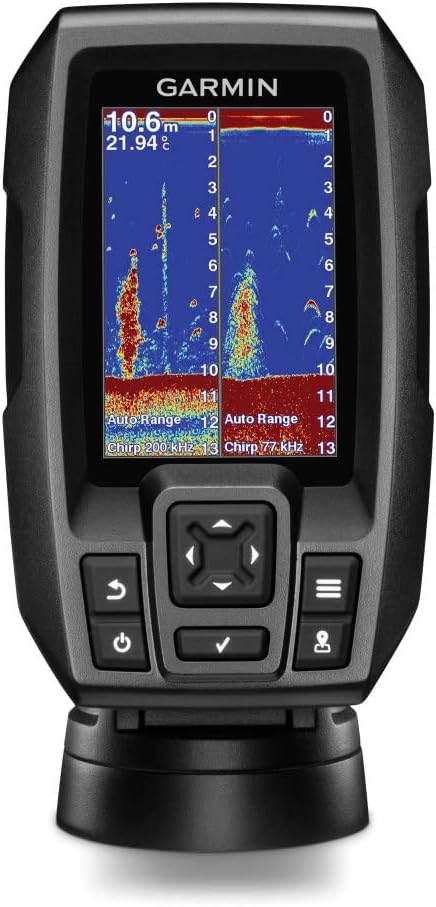

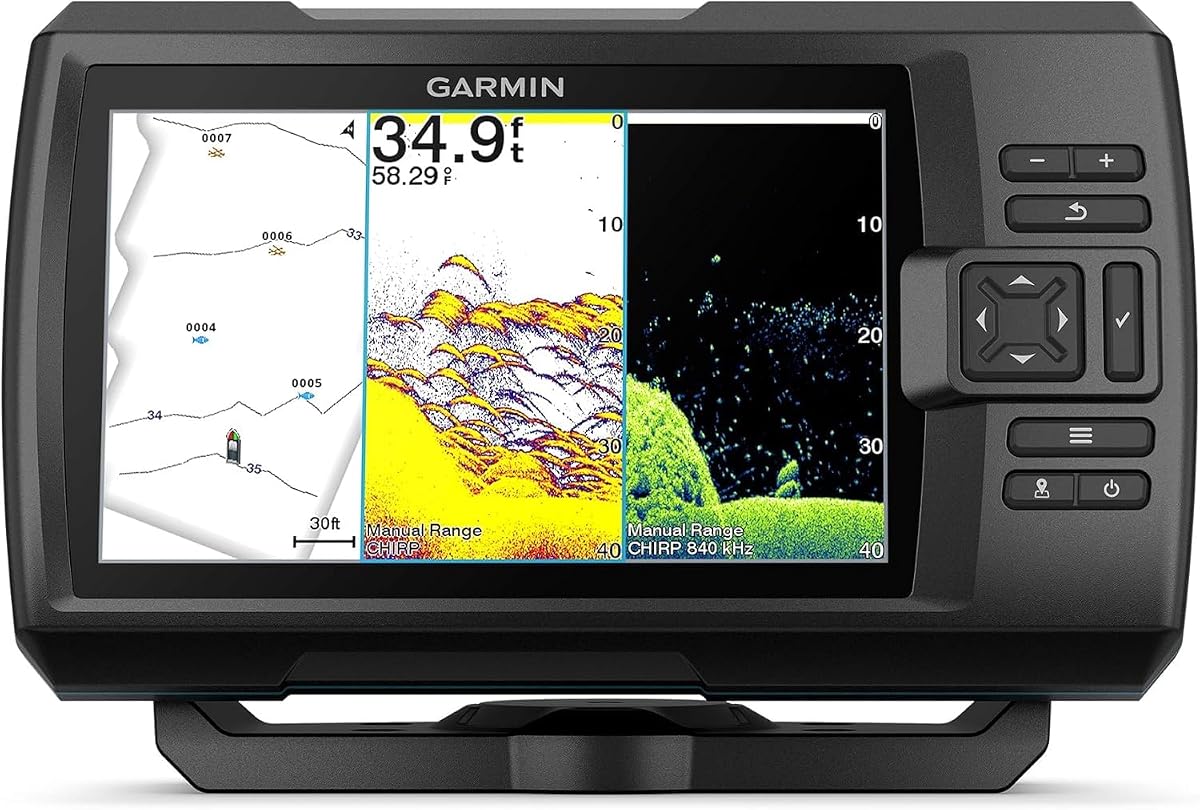


The Garmin Striker 4 combines a compact 3.5-inch GPS fishfinder with CHIRP sonar and ClearVü scanning in a straightforward package. Its 4.6 rating reflects a strong balance of compact size, approachable controls, and useful fish-finding features. It is particularly attractive for anglers with limited dashboard space who still want more capability than a basic depth display can provide.
We may earn a commission when you buy through this link, at no additional cost to you.
The unit's ClearVü scanning sonar is designed to create near-photographic views of fish, structure, and underwater objects, while CHIRP sends a continuous frequency sweep for crisper arches and better target separation. The waypoint map allows anglers to mark and revisit locations such as brush piles, stumps, and docks. Dedicated physical buttons and a simple interface keep navigation practical, and the stated maximum depth reaches 1,600 feet in freshwater.
The principal limitation is screen size. A 3.5-inch diagonal display can fit neatly into a compact console, but it provides less room for reading detailed sonar imagery than a four- or five-inch model. The feature set is also intentionally focused, with no advanced chartplotter functionality or Wi-Fi connection mentioned. For many small-boat anglers, those omissions are acceptable because portability and straightforward operation matter more.
Choose the Striker 4 when space is tight, installation should be uncomplicated, and you want reliable sonar with GPS waypoints rather than a full navigation console. It is a particularly sensible first fishfinder or secondary unit for a compact boat, pontoon, or kayak setup. The included transducer and easy-to-install design reduce the number of separate components a new owner must purchase.
The 3.5-inch screen is small enough for a crowded console, but the unit still provides CHIRP and ClearVü rather than limiting the owner to a bare depth readout. That balance makes it useful for finding structure as well as checking depth.
The waypoint map helps preserve productive locations. An angler can mark brush piles, docks, stumps, and other targets, then navigate back to them during a later trip.
We may earn a commission when you buy through this link, at no additional cost to you.
The Humminbird PiranhaMAX 4 is a focused dual-beam fishfinder designed to help anglers identify fish, structure, and bottom contours. Its 4.6 rating indicates a well-regarded unit within the traditional sonar category. For a small boat, its principal appeal is a readable 4.3-inch display and uncomplicated installation without the feature demands of a full GPS chartplotter.
We may earn a commission when you buy through this link, at no additional cost to you.
Dual Beam sonar lets the user choose between a narrow beam for detail and a wide beam for broader coverage. This flexibility is useful in small lakes, coves, and areas where the angler wants either to examine a specific target or scan more water efficiently. The included tilt-and-swivel mount makes it easy to adjust the viewing angle, while the supplied XNT 9 28 T transom-mount transducer supports a conventional installation.
Its limitations are important for buyers comparing it with modern GPS units. The supplied information does not list built-in GPS, waypoint storage, mapping, or chart support, so it is better suited to immediate sonar use than to route navigation. It also lacks the advanced scanning or down-imaging features found on higher-end models. Those omissions may actually be beneficial for an angler who wants a straightforward tool without a learning curve.
This PiranhaMAX 4 is best for anglers seeking a dependable, uncomplicated fishfinder that installs on a transom and offers useful beam selection. It also makes sense as a first unit for a small fishing boat where navigation is handled with a separate GPS device. Its included mount and transducer make the core package easier to get into the water.
The narrow beam is suited to closer examination, while the wide beam provides greater coverage. Switching between them makes the unit flexible across shallow structure and larger fishing areas.
The tilt-and-swivel bracket lets the display change with the angler's position. The included transom transducer avoids requiring a separate purchase for a basic setup.
We may earn a commission when you buy through this link, at no additional cost to you.
The Humminbird Helix 5 Chirp GPS G3 is the most feature-oriented unit in this guide, combining a five-inch display, Dual Spectrum CHIRP, extensive navigation options, and real-time mapping. Its 4.4 rating reflects a capable premium package. It suits anglers whose small boats have a usable console and whose fishing regularly depends on understanding structure or returning to mapped underwater features.
We may earn a commission when you buy through this link, at no additional cost to you.
Dual Spectrum CHIRP offers wide and narrow search modes. Wide Mode maximizes coverage, while Narrow Mode supports detailed scanning and precise two-dimensional target separation through the Low-Q transducer. The built-in Humminbird Basemap covers more than 10,000 lakes and the continental U.S. coastlines, while compatibility with LakeMaster, CoastMaster, and Navionics charts expands navigation options. AutoChart Live can create depth contours, bottom hardness, and vegetation maps while boating, with eight hours of built-in recording time.
The trade-off is complexity and physical size compared with compact units. A five-inch display demands more mounting space, and the menu system offers far more than a new angler may initially need. Premium chart compatibility and mapping are optional features rather than essential parts of basic fish finding, so buyers should focus on whether they genuinely need detailed charts and custom bottom maps.
The Helix 5 Chirp GPS G3 is the strongest choice for a small boat used as a serious fishing platform rather than only a tender or occasional runabout. It rewards anglers who want CHIRP detail, reliable controls, and navigation in one unit. A first-time owner may begin with sonar and waypoints, then add mapping capabilities as familiarity grows.
AutoChart Live records depth contours, bottom hardness, and vegetation during a boating trip. This is valuable for anglers who want to understand changing bottom conditions rather than simply locate fish.
The included basemap provides substantial coverage, and compatibility with established chart platforms extends that value. The five-inch display is better suited to route review and map detail than the smallest screens in the guide.
We may earn a commission when you buy through this link, at no additional cost to you.
The Garmin STRIKER Vivid 4cv stands out with a 4.7 rating, a four-inch color display, and a capable mix of scanning sonar, GPS, and mapping. It is a particularly balanced recommendation for small-boat anglers who want modern visuals and navigation features without moving to a large chartplotter. The supplied GT20 transducer supports both CHIRP traditional and CHIRP ClearVü scanning sonar.
We may earn a commission when you buy through this link, at no additional cost to you.
Vivid scanning sonar palettes help distinguish fish from structure, making the display more informative when investigating a drop-off, weed edge, submerged timber, or rocky area. High-sensitivity GPS allows anglers to mark waypoints, create routes, and view boat speed. Quickdraw Contours mapping adds another layer of utility by allowing users to create maps, while the included tilt/swivel bailmount supports flexible positioning.
This model does not include the large basemap library or phone connectivity associated with more advanced units. Buyers who need only an effective fishfinder with waypoint navigation may see that as a benefit because the controls and menu remain focused. However, anglers planning extensive route plotting or detailed chart use should consider whether they need a more navigation-oriented system.
The STRIKER Vivid 4cv is a strong all-around pick for compact motorboats and larger kayaks with mounting space. It is especially attractive to anglers who want clearer color imagery, flexible sonar modes, and basic route creation in a four-inch unit. The included transducer and bracket help simplify ownership, while the relatively conventional dimensions should be easier to accommodate than a seven-inch display.
Vivid scanning sonar color palettes help separate fish, structure, and bottom features visually. This makes the four-inch screen more useful than a simple monochrome or depth-only display.
Quickdraw Contours provides built-in custom mapping, while GPS supports waypoints, routes, and speed. The result is a useful middle ground between a basic sonar unit and a full navigation console.
We may earn a commission when you buy through this link, at no additional cost to you.
The Garmin Striker Vivid 7cv brings a large color display and connected features to a boat that can support them. Its 4.5 rating indicates a strong result, while the seven-inch panel provides more room for sonar imagery, waypoints, routes, and speed information. It is less appropriate for a minimalist kayak console but well matched to a small fishing boat with a broad dash.
We may earn a commission when you buy through this link, at no additional cost to you.
Its GT20-TM transducer supports CHIRP traditional and CHIRP ClearVü scanning sonar, and the vivid palettes help reveal differences between fish, structure, and bottom. The major addition is Wi-Fi connectivity to the ActiveCaptain app on a compatible smartphone. Owners can transfer waypoints, receive smart notifications and software update notices, and access the Garmin Quickdraw Community.
Screen size is the central compromise. A seven-inch unit is easier to read but may dominate a small console and require a suitable mounting area. Connectivity also does not make the device independent of the phone; the value comes from working with a compatible device and supported app. For anglers who never use their phone aboard, the added features may matter less than the physical footprint.
Choose the 7cv when a small boat has a proper dashboard and you want a large sonar display with convenient waypoint transfer. It is a strong option for family fishing, guide use, or an angler who regularly consults maps while moving between areas. The GT20-TM transducer and tilt/swivel bailmount are included, keeping the core installation package together.
The seven-inch color screen offers more visual space for reading arches, structure, and bottom changes. It is particularly useful when the angler wants to compare several parts of the sonar picture without moving between tiny screens.
Wi-Fi supports waypoint transfer, notifications, software notices, and Quickdraw Community access through a compatible smartphone. Core fish-finding functions remain in the unit, while the phone expands navigation and data-transfer options.
We may earn a commission when you buy through this link, at no additional cost to you.
The Lowrance Eagle Fish Finder prioritizes visibility, automation, and installation convenience. Its 4.3 rating reflects a practical design for anglers who do not want to adjust multiple sonar settings every time conditions change. The compact portrait screen is particularly relevant to small boats, kayaks, and canoes where horizontal console space is limited.
We may earn a commission when you buy through this link, at no additional cost to you.
The four-inch IPS panel is designed to remain clear in bright sunlight, at wide viewing angles, and through polarized sunglasses. Auto-Tuning Sonar automatically optimizes settings so attention can remain on finding fish. The included 200 kHz Bullet Skimmer provides broad 44-degree coverage, and fish icons with depth and zoom help simplify target identification without relying on an audible alarm.
Installation is streamlined by a twist-lock connector for attaching and removing the display. That design is valuable for portable use because the screen can be moved or removed more easily than with a permanently mounted system. On the other hand, C-MAP options suggest additional chart choices, but the supplied feature list emphasizes basic sonar and quick fish identification rather than a full suite of premium navigation tools.
The Eagle is a good fit for a first-time angler or a boater who values automatic settings and a compact screen. It also works well where portability matters more than large-chart navigation. The included skimmer transducer and straightforward connection process create a complete basic package, while the wide beam helps cover more water from a small craft.
The IPS portrait screen is built to remain visible in sunlight, from wide angles, and through polarized glasses. That visibility can be more valuable than sheer display size during active fishing.
Auto-Tuning Sonar handles the setup automatically, reducing menu adjustments between fishing locations. The 44-degree beam from the included skimmer adds coverage without requiring manual sonar configuration.
We may earn a commission when you buy through this link, at no additional cost to you.
The LUCKY MT-202 is the most unconventional fishfinder in the guide, using a wireless floating sensor and handheld display instead of a permanently mounted transom system. Its 4.5 rating indicates that the portable approach has meaningful appeal for anglers who fish from kayaks, canoes, pontoons, shorelines, and small boats that lack installation space.
We may earn a commission when you buy through this link, at no additional cost to you.
The sensor can be cast from the boat or tied to the fishing line with the included safety tether. Its stated wireless operating distance reaches 853 feet, while the wide 90-degree beam scans a depth area from three to 147 feet. The 3.5-inch horizontal LCD scrolls from right to left, providing a continuous history of the sonar signal, fish icons with depth numbers, and a way to track movement relative to structure.
Unlike a conventional transom fishfinder, this unit does not provide a full chartplotter, GPS route display, or broad mapping suite in the supplied specifications. It also depends on battery power and wireless communication, so readiness and range become important operating considerations. The small screen also gives less detail than a larger color display when numerous targets appear simultaneously.
The MT-202 is best for anglers who value flexibility over installation and want to cast the sensor toward specific target zones. It is useful when directly checking depth, fish position, and structure from shore, a kayak, or a compact boat. Its floating sensor and pocket-sized design also make spontaneous trips easier to equip.
Because the sensor can be tethered and cast, an angler can place it near weed beds, structure, or channels that are difficult to reach from the hull. This differs from conventional boat-mounted scanning.
The scrolling history and depth-marked fish icons help show whether targets are moving or holding near structure. That information can guide casts as fish positions change.
We may earn a commission when you buy through this link, at no additional cost to you.
The Garmin Striker Plus 4 combines a sunlight-readable 4.3-inch display, dual-beam CHIRP sonar, GPS navigation, and substantial contour mapping capacity. Its 4.6 rating makes it one of the strongest general-purpose units for small boats. It is particularly appealing to anglers who want modern controls and detailed custom maps without moving to a much larger chartplotter.
We may earn a commission when you buy through this link, at no additional cost to you.
The dual-beam transducer uses traditional CHIRP and supports 50, 77, 83, and 200 kHz frequencies with 200 watts RMS transmit power. Built-in GPS handles waypoints, routes, and boat speed. Quickdraw Contours software can create and store maps with one-foot contours for as much as two million acres, giving users more room to preserve detailed bottom information.
Touch operation is the main usability consideration. Anglers should ensure the display is mounted where it can be operated safely and that controls remain easy to use in changing conditions or when wet. The supplied information does not mention Wi-Fi connectivity, so this model is less oriented to phone-based waypoint transfer than the seven-inch Striker Vivid 7cv.
The Striker Plus 4 suits small-boat anglers who want a capable sonar and navigation unit with a relatively compact screen. It is a strong option for mapping familiar water, marking offshore structure, and using different sonar frequencies. It may appeal particularly to users who prefer direct touchscreen selection over a keypad-only interface.
Support for 50, 77, 83, and 200 kHz traditional frequencies allows the display to work with different sonar modes. The dual-beam transducer also supports more detailed target separation than a single-beam setup.
Quickdraw Contours can store one-foot contours for up to two million acres. That capacity is useful for preserving extensive custom maps without relying only on saved waypoints.
We may earn a commission when you buy through this link, at no additional cost to you.
The Humminbird PiranhaMAX 4 DI adds Down Imaging to the familiar PiranhaMAX format, giving small-boat anglers a detailed view of timber, brush, bridge pilings, rocks, and other structure. Its 4.6 rating indicates a well-balanced product, and the 4.3-inch color LCD makes those images easier to interpret than a small monochrome display.
We may earn a commission when you buy through this link, at no additional cost to you.
Down Imaging provides the sharp structural detail that differentiates this model from a basic dual-beam unit. At the same time, the selectable narrow and wide Dual Beam modes support both focused examination and wider coverage. Fish ID+, fish alarms, depth alarms, and zoom help identify targets and focus attention, while the XNT 9 DI T transom transducer is included for installation.
The PiranhaMAX 4 DI remains a fishfinding tool rather than a complete navigation system because the listed features do not include GPS, waypoints, routes, or detailed mapping. It is therefore most appropriate for anglers who prioritize seeing structure and fish but already use another navigation method. It also occupies more console space than a compact portable unit.
This model is a strong match for small boats fishing around drop-offs, timber, rocks, and vegetation. The combination of down imaging and selectable beams provides a useful picture of both what is below the boat and how targets are positioned. Buyers who need navigation should compare it with a GPS fishfinder in this guide.
Down Imaging is the defining feature, producing detailed views of timber, brush, pilings, and rocks. These images help anglers understand habitat rather than relying only on fish arches.
Fish ID+, zoom, fish alarms, and depth alarms make it easier to recognize and monitor returns. Anglers can also rely on the narrow or wide beam when the situation calls for a different view.
We may earn a commission when you buy through this link, at no additional cost to you.
The Garmin STRIKER 5CV balances a larger five-inch color display with CHIRP traditional and ClearVü scanning sonar, GPS, and Quickdraw Contours. Its 4.5 rating reflects a versatile unit that can serve as both a fishfinder and a basic navigation system. It is a logical option for small boats with a dash capable of supporting a medium-sized screen.
We may earn a commission when you buy through this link, at no additional cost to you.
CHIRP traditional sonar provides continuous frequency information, while ClearVü scanning adds detailed views of fish and structure. The combination helps anglers scan broad water while also examining particular returns. GPS supports waypoints, routes, and boat speed, while Quickdraw Contours lets users create custom maps with one-foot contours for up to two million acres.
The five-inch display requires more physical space than the compact models in this guide, and the supplied information does not list Wi-Fi or phone connectivity. It therefore falls short of the Helix 5's chart library and the seven-inch Vivid's ActiveCaptain features. For buyers who want a capable sonar display without a complex navigation ecosystem, that simplicity can be an advantage.
The STRIKER 5CV is well suited to anglers who want more room to interpret sonar and occasionally navigate marked routes. It offers a useful middle ground between the four-inch STRIKER models and larger chartplotter-style displays. The included transducer reduces setup ambiguity, while the traditional controls and rugged design support straightforward operation in varied fishing environments.
CHIRP traditional sonar covers continuous frequency information, while ClearVü emphasizes detailed scanning images. Using both gives the angler a broader understanding of targets and bottom structure.
GPS waypoints, routes, speed, and Quickdraw Contours provide a practical navigation package. The absence of stated wireless functions keeps the focus on onboard fish-finding and mapping.
We may earn a commission when you buy through this link, at no additional cost to you.
The best fishfinder for a small boat depends on available space, installation style, target species, and how much navigation detail you need. These factors help narrow the options before you choose a transducer, display, and mounting arrangement.
Start by measuring the usable area rather than focusing only on screen diagonal. A seven-inch unit such as the Garmin Striker Vivid 7cv needs considerably more dashboard space than the 3.5-inch Garmin Striker 4, while the Lowrance Eagle uses a compact portrait format suited to tighter layouts. Consider the full housing, bailmount or swivel bracket, sun hood, cable routing, and the hand clearance needed to operate controls safely.
Choose the largest display your actual mounting area can support without crowding other instruments. A five-inch model can be easier to read for sonar detail, but a four-inch unit may be the more practical choice for a compact center console or kayak.
Traditional, dual-beam, CHIRP, ClearVü, and Down Imaging technologies reveal different aspects of the underwater environment. CHIRP and scanning sonar are useful for separating targets, while Down Imaging provides detailed structure views. Dual Beam units offer a practical narrow-or-wide choice, and the LUCKY MT-202 uses a portable wide-beam sensor instead of a hull-mounted traditional transducer.
Select advanced imaging when structure recognition is a priority, and choose a more conventional sonar system when simple depth and fish detection are enough. The best option is the one whose information directly supports the water and targets you plan to fish.
A transom-mount transducer is the common choice for small motorboats because it can be installed without cutting into the hull. The Humminbird PiranhaMAX 4 and PiranhaMAX 4 DI include transom-mount transducers, while Garmin's selected units include compatible transducers. A portable or castable sensor offers a different advantage: it can be moved to promising areas without permanent hardware.
Confirm the transducer type, mounting hardware, cable length, and boat compatibility before buying. Small boats can have limited transom space, unusual hull shapes, or shallow mounting areas, so the complete installation package matters as much as the display.
GPS waypoints are useful for returning to brush piles, stumps, docks, or other productive marks. Basic units such as the Garmin Striker Plus 4 and STRIKER 5CV support GPS navigation and custom contours, while the Humminbird Helix 5 Chirp GPS G3 offers a much larger basemap and real-time mapping. The seven-inch STRIKER Vivid 7cv adds wireless transfer and phone notification options.
Separate fish finding from full route planning. If you only need to revisit a marked location, a compact GPS fishfinder may be sufficient. If you regularly navigate unfamiliar lakes or coastlines, premium chart support, phone connectivity, and a larger screen may justify a more advanced unit.
Look beyond raw screen size and consider color, brightness, viewing angle, and control visibility. The Lowrance Eagle emphasizes sunlight visibility and wide viewing angles, while the Garmin STRIKER Vivid models use color palettes to distinguish fish from structure. A larger panel is useful when reviewing detailed imagery, but it should remain readable from the angler's normal operating position.
Color can make structure easier to interpret, particularly with ClearVü or Down Imaging. Ensure the display can be viewed comfortably without blocking gauges, controls, visibility, or safe operation of the boat.
A small-boat fishfinder should reduce distraction rather than add it. The Lowrance Eagle's Auto-Tuning Sonar handles settings automatically, and the Garmin Striker 4 uses a straightforward keyed interface. The Humminbird Helix 5 offers weather-friendly keypad controls but a broader menu system, making it more appropriate for anglers who want to adjust and explore multiple functions.
Choose automatic controls for quick setup and fewer menu adjustments. If you enjoy creating routes, comparing charts, or studying detailed sonar, a more flexible interface may be worth the additional learning.
Portable systems are ideal for spontaneous trips, shared boats, kayaks, and anglers who do not want to run cables. The LUCKY MT-202 has a floating wireless sensor and handheld screen, while the Lowrance Eagle's twist-lock connector simplifies attaching and removing its display. Permanently mounted systems are generally easier to power and keep ready for every outing.
Choose portability when storage, transport, or shared access matters. Choose a fixed installation when you want reliable power, continuous mounting, and no concern about assembling the system each time you launch.
All fishfinders used around water need sensible storage practices, but small-boat users should also think about available storage. A permanently mounted display may remain on the boat, while a portable unit must be protected from impact, moisture, and prolonged sun exposure. The specified Garmin models include rugged designs, but the mount and display still benefit from a protective cover when not in use.
Dry connectors before storage, secure loose transducers, and keep portable components in a padded case. Proper care reduces avoidable damage and helps keep the unit ready for the next outing.
Begin by mounting the display where it can be seen without obstructing controls or line of sight. Install the transducer according to its instructions, route the cable away from sharp edges and moving parts, and confirm that the unit receives power reliably. On a portable system, charge the display and sensor fully before leaving shore and learn the connection process while still on land.
After launch, run the unit in an open area and confirm that it produces a coherent bottom image. Adjust brightness and sensitivity gradually, using the narrow or detailed sonar mode for close inspection and a wider mode for coverage. Mark useful locations as waypoints, but avoid creating excessive points that make navigation harder to interpret.
After the trip, remove portable equipment, rinse permitted components with fresh water, and dry connectors before storage. Secure a transom-mounted transducer and cover the display to protect it from sun and accidental impact. Periodically inspect the mount, cable, and power connection, and follow the manufacturer's instructions for cleaning, firmware updates, and replacement accessories.
A four- to five-inch screen is the most common compromise for a small fishing boat because it provides readable sonar without demanding a large dashboard. Compact 3.5-inch models suit very limited spaces, while a seven-inch display is most appropriate when the console has ample room. Measure the mounting area and consider the size of the bracket, not only the screen diagonal.
CHIRP can improve target separation and provide detailed fish arches, making it valuable when anglers need to distinguish fish from structure. It is not essential for simply locating a bottom contour, however. A conventional dual-beam unit can still provide useful depth and fish information for straightforward fishing.
Down Imaging is especially effective for revealing structure such as timber, rocks, brush, and bridge pilings. Traditional sonar remains useful for bottom contours, depth, and general target detection. The Humminbird PiranhaMAX 4 DI combines down imaging with dual-beam sonar, allowing an angler to gain both structural detail and broader coverage.
Yes. The LUCKY MT-202 is explicitly designed for portable use from kayaks and other small craft, while the Lowrance Eagle includes a transducer suited to kayaks and small boats. The LUCKY sensor can be cast toward selected areas, whereas a conventional transducer scans below the boat. Check local rules and avoid loose equipment that could snag.
GPS is not necessary for immediate depth and sonar readings, but it becomes valuable when you want to return to a productive location. Several fishfinders in this guide can mark waypoints and create routes. The more advanced Humminbird Helix 5 adds extensive charting and live mapping for anglers who need fuller navigation.
A transom mount suits a boat used regularly because the display and transducer remain ready for immediate use. Portable sonar is better for kayaks, shore fishing, shared boats, or anglers who want to move the sensor to different target areas. Consider how often you fish, where you store the boat, and whether you prefer permanent wiring or a quick connection.
A simple angler may need only GPS waypoints, while a frequent boater may value custom contours and automatic bottom mapping. The Garmin STRIKER Plus 4 and STRIKER 5CV provide Quickdraw Contours, and the Helix 5 adds AutoChart Live plus compatibility with premium chart platforms. Choose mapping depth based on how often you revisit changing water.
Keep the display protected from impact and direct sun when it is not in use, inspect cables for wear, and make sure transducer connections remain secure. Portable displays and sensors should be protected according to their instructions, while wet connectors should be dried before storage. Follow the manufacturer's guidance for cleaning, charging, and software maintenance.
The Garmin STRIKER Vivid 4cv offers the strongest balanced recommendation for many small boats, combining a readable color display, CHIRP ClearVü scanning, GPS, and Quickdraw Contours. The Humminbird Helix 5 Chirp GPS G3 is the premium option for anglers who want deeper navigation and real-time mapping, while the Lowrance Eagle is a practical budget-focused choice built around automation and portability.
Prioritize installation reality before feature count. Measure the console, confirm transducer compatibility, and consider whether you want a fixed transom unit or a wireless sensor you can cast. Choose scanning sonar or Down Imaging when structure recognition matters, and choose GPS mapping when returning to productive spots is essential to your fishing routine.
Finally, check current product details, availability, and installation requirements before purchasing, because prices and configurations can change. The most suitable fishfinder is not necessarily the most advanced model; it is the one that fits your boat, reveals the information you need, and remains simple enough to use every time you go fishing.
