
Uniden UM385BK Marine VHF
4.6Editor score
Twenty-five watt transmit power
Digital selective calling included
Weather alert functionality
This Flush Mount VHF Radio guide compares 10 marine radios for installation, channels, DSC, GPS, AIS, audio, and overall value.
A flush mount VHF radio gives a fixed marine communications console a clean, integrated appearance while keeping essential ship-to-ship and ship-to-shore communication close at hand. The best unit combines a practical control layout, clear audio, useful safety features, and protection suited to the demanding conditions found around open water.
This guide compares ten products using the supplied specifications, customer ratings, channel support, emergency functions, mounting considerations, integrated technology, and intended level of equipment. The list includes conventional fixed-mount radios, highly compact models, GPS-equipped units, networked premium systems, and one dedicated flush mount installation kit.
Each review explains the product's most useful attributes, practical compromises, and likely owner. The leading choices range from a value-oriented Uniden to feature-rich Icom and Garmin models, while availability, configurations, and prices can change, so readers should verify current listing details before purchasing.
4.6Editor score

4.8Editor score

4.3Editor score
The comparison below highlights the supplied channel, safety, connectivity, protection, and control features across all ten products. Because these listings represent different roles—from a basic fixed-mount transceiver to a premium black-box system and a mounting accessory—the best choice depends on console space, network requirements, and desired functions.
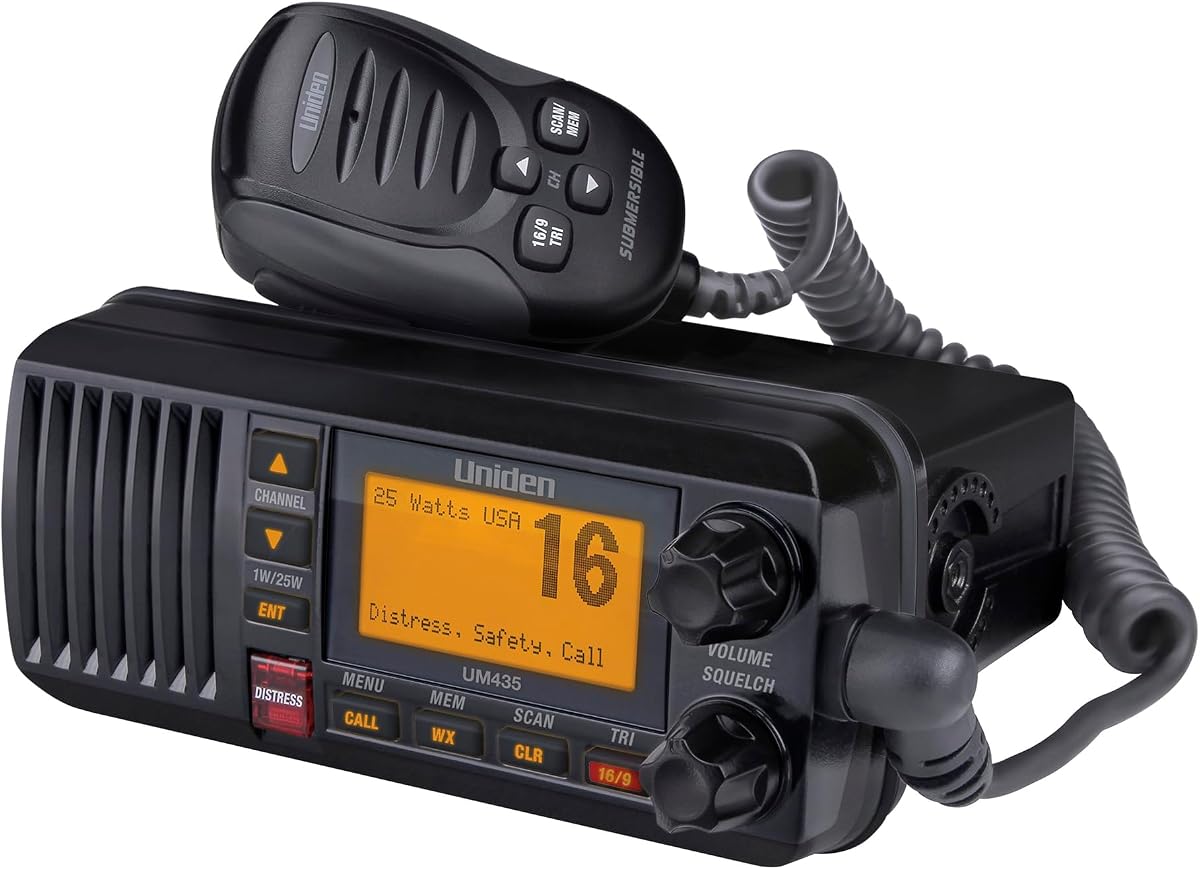




The Uniden UM435BK is a fixed-mount marine radio built around practical coverage, durable protection, and a broad set of working channels. It carries a 4.6 customer rating, and its defining advantage is the combination of USA, international, and Canadian marine channels, including four-digit and Canadian B channels. The radio also supports selectable one-watt and twenty-five-watt transmit power, giving users a way to balance range against power consumption in different operating situations.
We may earn a commission when you buy through this link, at no additional cost to you.
Its fully submersible design and IPX8 rating are especially meaningful for marine equipment because a console can be exposed to spray, rain, and occasional immersion. The supplied information also highlights a three-year water protection warranty. Communication features include memory channel scanning, triple and dual watch, digital selective calling, position sending, and position requesting. These functions go beyond basic push-to-talk communication and place the UM435BK among the more feature-conscious models in this roundup.
The trade-off is that it does not present the same network integration or advanced audio processing as the Icom IC-M605. It also lacks the clearly described integrated GPS feature found in the M424G models. Nevertheless, those omissions are reasonable for a radio that emphasizes robust construction, broad channel access, and emergency DSC functions. The UM435BK is a strong fit for a boat owner who wants a capable, straightforward fixed-mount radio without moving into a premium black-box system.
Overall, the UM435BK is a convincing all-around option and our best budget recommendation. It provides more channel flexibility and stronger stated water protection than many conventional alternatives, while its low one-watt setting can be useful for close-range work. Choose it when durability, DSC functionality, and international coverage are the priorities, and confirm the available channel programming and console fit before installation.
The IPX8 submersible construction is the standout physical feature of the UM435BK. Its stated three-year water protection warranty also adds confidence for installations where spray and rain are routine operating conditions rather than isolated possibilities.
Memory channel scanning, triple-watch, and dual-watch support make the radio more adaptable to different communication priorities. The choice of one-watt or twenty-five-watt transmission also gives operators a practical way to manage power and range across varying conditions.
We may earn a commission when you buy through this link, at no additional cost to you.
The Uniden UM385BK is a fixed-mount 25-watt VHF marine radio aimed at owners who prioritize accessible emergency communication and familiar marine controls. It has a 4.6 customer rating and includes a rugged handheld microphone that lets the operator transmit without leaving the helm. Its supplied specifications emphasize S.A.M.E. weather alerts, triple-watch operation, international channels, and digital selective calling in a compact design.
We may earn a commission when you buy through this link, at no additional cost to you.
The DSC implementation is one of its most important strengths. A dedicated distress button, position send and request functions, and full Class D DSC capability make it suitable for participating in a modern marine safety and calling system. Weather alerts add another layer of situational awareness, while the twenty-five-watt transmitter provides a conventional high-power option for communication with other vessels and shore stations.
Its IPX4 rating means it is resistant to damage from rain and splashing water, making it a sensible model for a protected helm or console. That protection is not as extensive as the IPX8 rating claimed by the UM435BK, so the model with the higher protection level may be more reassuring for exposed installations. It also does not state an integrated GPS receiver, which can be a consideration for modern navigation-network upgrades.
The UM385BK is a compelling choice for a boat with a straightforward communication requirement and limited console space. It delivers the core fixed-mount radio experience, including DSC, weather information, triple watch, and a convenient remote mic, without introducing a more complex architecture. Buyers should compare its available control and microphone options with their current console layout before finalizing the installation.
The dedicated distress control, position send and request functions, and Class D DSC capability put important safety functions within reach. This makes the UM385BK a practical choice for vessels that need modern digital calling without a premium networked system.
The rugged handheld microphone is designed for easy transmission while the operator keeps attention on the water. That remote-control approach is especially useful in a compact cockpit where reaching a side-mounted radio would be inconvenient.
We may earn a commission when you buy through this link, at no additional cost to you.
The Icom M424G is a fixed-mount VHF radio with an internal GPS receiver, giving it a useful advantage for vessels that want position-related convenience without depending entirely on a separate GPS display. It has a 4.5 customer rating, IPX7 protection for one meter of submersion for up to thirty minutes, weather channels with an alert function, and both dual-watch and tri-watch monitoring.
We may earn a commission when you buy through this link, at no additional cost to you.
Its compatibility with the MA-500TR AIS transponder broadens the installation's potential. The AquaQuake draining function is another marine-focused detail, helping remove water that collects inside the housing after immersion so the unit can operate more effectively. Together, the GPS, weather alerting, watch functions, and AIS compatibility create a well-rounded package for a fixed console.
This model does not list NMEA connectivity, active noise cancellation, or call recording, so it will not deliver the same networking and audio conveniences as the IC-M605. Its protection rating is also less demanding than the IPX8 specification of the UM435BK. Even so, the M424G addresses a distinct need: a conventional fixed-mount radio with integrated positioning and a strong marine feature set.
The M424G is best for a boat owner who wants a neatly integrated radio with GPS already built in and values the established Icom feature set. Verify the M424G configuration, included controls, and compatibility with existing marine equipment before installation, particularly if the console will also house AIS or navigation displays.
The internal GPS receiver is the defining convenience of the M424G. Integrating positioning directly into the radio can streamline a console and support position-related DSC workflows without adding another screen to the helm.
IPX7 protection and the AquaQuake function address two realities of fixed marine radios: exposure to water and the need to recover from it. The system is designed for demanding wet environments where dependable operation matters.
We may earn a commission when you buy through this link, at no additional cost to you.
The Icom IC-M330 is built for installations where console space is at a premium. Its palm-sized chassis is designed to fit small consoles and tight helm spaces, while its 4.3 customer rating reflects a well-regarded but less universally favored feature set. The supplied details emphasize a new speaker design, Class D DSC, continuous Channel 70 monitoring, and a straightforward directional keypad with soft keys.
We may earn a commission when you buy through this link, at no additional cost to you.
Audio receives particular attention in this model. The speaker is described as producing loud, clear sound with rich bass and crisp treble, with distortion-free output even at high volume. That matters in a marine environment where wind, engine noise, and conversation at the helm can easily obscure weak or distant calls. The receiver's selectivity and interference rejection are also presented as important benefits in crowded marinas and harbors.
Its lack of integrated GPS is the clearest limitation, and the listing explicitly identifies the radio as being without GPS. Users who require that capability may prefer the M424G or a network-capable premium model. The compact form can also mean less physical separation between controls, although the one-touch soft-key assignments are intended to keep frequently used functions easy to reach.
The IC-M330 is an excellent candidate for a small boat or crowded helm where low-profile integration and strong audio matter more than maximum connectivity. Its Class D DSC monitoring adds essential safety capability, while the compact chassis helps the radio blend into the console rather than dominate it. Confirm the available white housing and installation dimensions against the intended mounting opening.
The defining benefit is the ultra-compact chassis. A radio that occupies less console space can make navigation displays and other controls more accessible while maintaining a clean, integrated appearance.
The new speaker design emphasizes clarity at elevated volume, with a full-bodied tonal presentation. This is particularly useful when a radio call arrives over engine noise, wind, or the chatter of a crowded harbor.
We may earn a commission when you buy through this link, at no additional cost to you.
The Icom IC-M605 is the most technically advanced conventional fixed-mount radio in this list, with features aimed at premium vessels, integrated navigation systems, and demanding communications environments. It has a 4.3 customer rating and stands out through active noise cancellation, automatic recording of the last incoming call, NMEA 2000 and 0183 connectivity, and a waterproof speaker designed for strong marine audio.
We may earn a commission when you buy through this link, at no additional cost to you.
Active noise cancellation can improve both transmitted and received speech by reducing background sound. Automatic last-call recording is another useful safeguard: the radio can store up to two minutes of the most recent incoming audio for immediate playback. The large keypad and soft keys are intended to make channel entry, MMSI numbers, and other identifiers efficient, while the receiver's selectivity and interference rejection are engineered for busy RF environments.
This level of capability brings additional complexity and requires more deliberate system planning. The optional voice scrambler, external SP-37 horn speaker, and network connections are not interchangeable with basic radio functions. Boat owners should also consider the M510BB if they need a black-box design with multiple command microphone ports, because the M605's architecture may suit a different installation strategy.
The IC-M605 is our best premium recommendation for an owner who wants advanced audio processing, network integration, hailer capability, and call recovery in one fixed-mount package. It is most attractive to a boat already equipped for NMEA data or planning a full electronics upgrade. Confirm accessory requirements and control configuration before finalizing a larger helm installation.
Digital active noise cancellation targets background sound during both transmission and reception. The goal is not simply louder audio, but cleaner speech that remains intelligible in rough conditions and busy marine traffic.
NMEA 2000 and 0183 connectivity allows the radio to exchange GNSS, DSC, and frequency data with compatible marine systems. This creates a more integrated helm and can reduce duplication between navigation devices.
We may earn a commission when you buy through this link, at no additional cost to you.
The Garmin VHF 215 is a fixed-mount marine radio with a 4.8 customer rating, the highest listed rating among the complete radios in this guide. That makes it the Editor's Choice for shoppers seeking a well-regarded model from a major marine-electronics brand. It is particularly relevant to a console that already uses Garmin devices or is intended to become part of a broader Garmin navigation setup.
We may earn a commission when you buy through this link, at no additional cost to you.
The supplied product data is intentionally limited and identifies it simply as the Garmin 0100209700 VHF 215 Marine Radio. It does not provide a detailed channel list, water-resistance rating, GPS status, power output, or network specifications. As a result, the strongest evidence available here is its fixed-mount format, marine-radio identity, established Garmin platform, and strong customer rating. Those strengths make it a credible lead choice, but buyers should still confirm the complete specification sheet.
Compared with the information-rich entries in the list, the VHF 215's listing requires more verification before installation. A prospective owner should check its current channel plan, DSC capability, connectivity, mounting dimensions, microphone arrangement, and compatibility with existing equipment. It would be inappropriate to infer specifications solely from the Garmin name, particularly when a flush mount must fit a specific console opening.
We still recommend the VHF 215 because its 4.8 rating and clear alignment with the fixed-mount marine category make it an attractive general choice. It is best for a buyer who values a reputable marine platform and wants to review the product against other integrated-navigation options. Confirm current configuration and compatibility before purchase, and treat the supplied rating as a strong signal rather than a substitute for the full manual.
A 4.8 customer rating gives the VHF 215 a clear advantage in the supplied dataset. It suggests broad appeal, although ratings should still be considered alongside verified specifications, warranty terms, and installation requirements.
For boats using Garmin marine electronics, ecosystem continuity is often more valuable than a feature comparison based only on headline specifications. The VHF 215 is best evaluated as part of a complete helm design rather than as an isolated control.
We may earn a commission when you buy through this link, at no additional cost to you.
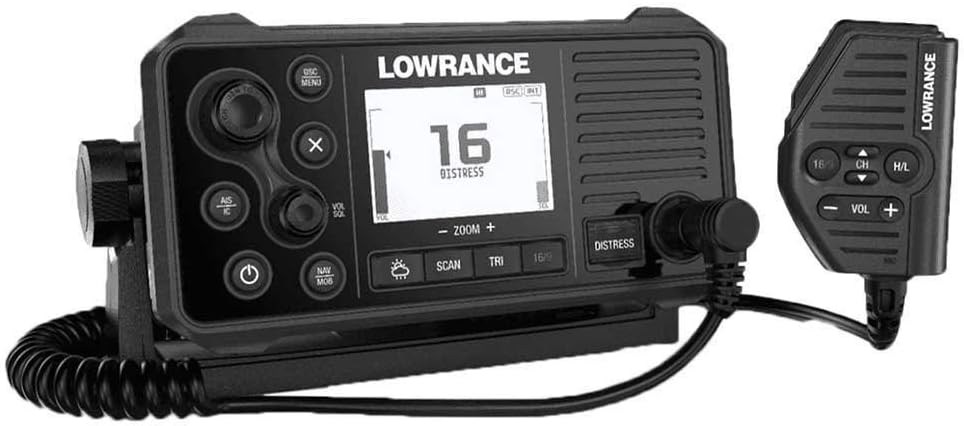
The Lowrance Link-9 listing presents a marine radio with DSC, AIS reception, and a large white dot matrix LCD. Its 4.7 customer rating is among the strongest in the group, and the supplied model number LOW00014472001 provides a specific identifier for shoppers. The beige housing also distinguishes it visually from the many black and white radios available for flush-mounted installations.
We may earn a commission when you buy through this link, at no additional cost to you.
AIS receiver functionality is a notable addition because it allows the radio to receive AIS information from nearby vessels rather than serving solely as a voice and DSC communications device. Combined with digital selective calling, this gives the unit a broader marine awareness role. The large white dot matrix display is designed to present information clearly, which can be helpful for reading channel and status data at the helm.
The supplied data contains little further information. It mentions two channels, but the wording is ambiguous and should not be interpreted as the radio's complete channel capacity without checking the manual. Transmit power, ingress protection, GPS integration, hailer support, and network connections are not stated. Those omissions require careful verification, especially for a boat with a complex electronics architecture.
With a 4.7 rating and a clearly defined combination of DSC and AIS reception, the Link-9 is a strong candidate for a console that benefits from a larger display and marine traffic awareness. It is particularly attractive to buyers already familiar with Lowrance equipment, though compatibility should be confirmed. Review the manual, mounting cutout, antenna requirements, and navigation connections before making this your final choice.
AIS reception lets compatible displays use information transmitted by participating vessels. That capability can enrich a multi-function helm and make the radio part of a broader situational-awareness system.
The large white dot matrix screen is designed for clear console reading. Exact menu layout and display dimensions should be confirmed in the product documentation, but the screen format is a meaningful distinction in the supplied specifications.
We may earn a commission when you buy through this link, at no additional cost to you.
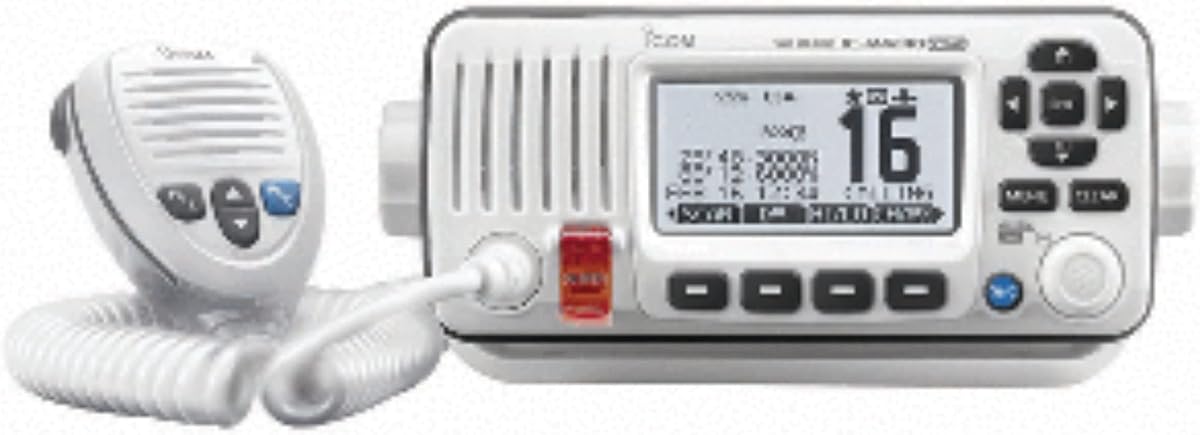
The Icom M424G42 is a white version of the M424G fixed-mount VHF radio with built-in GPS, and it carries a 4.8 customer rating. The 42 designation identifies a particular configuration of the wider M424G family. Its strongest combination is straightforward: a high customer rating, integrated positioning, and a white housing that may pair naturally with a light-colored helm or a coordinated electronics layout.
We may earn a commission when you buy through this link, at no additional cost to you.
Built-in GPS is the most important functional distinction in the supplied title. It can make position-related radio operation more convenient by reducing the need to treat GPS input as a separate accessory. Since this listing points directly to the M424G platform, buyers may also refer to the more detailed M424G entry in this guide for documented features such as IPX7 protection, AquaQuake drainage, weather alerts, watch functions, and MA-500TR AIS transponder compatibility.
Care is still necessary when relying on information from a related platform listing. The supplied data for this specific product does not restate those technical details, so compatibility with a particular antenna, AIS transponder, control head, or navigation network should be verified for the M424G42. Likewise, no NMEA support or active audio processing is stated for this variant, and it should not be assumed merely because another Icom model offers those features.
The M424G42 is an attractive option for a boat that wants GPS within the VHF radio and prefers a white installation. It is particularly relevant to owners selecting a complete Icom-based helm, where coordinated equipment can simplify control and compatibility decisions. Confirm the exact mounting configuration, included microphone, regional channel programming, and network requirements before purchasing.
The integrated GPS receiver gives the radio a more complete standalone role at the helm. It can simplify position-related communications while keeping the vessel's electronics visually coordinated.
The white housing can complement light-colored panels, instrument bezels, and display surrounds. Beyond appearance, matching equipment can create a more intentional console and make future control changes easier for the owner.
We may earn a commission when you buy through this link, at no additional cost to you.
The Icom M510BB is a black-box VHF radio that separates the radio unit from its command microphone, offering a flexible approach to fixed-mount installation. It has a 5.0 customer rating and is supplied with a white command mic and three command mic ports. That port count is particularly notable for a boat with multiple helm locations or a plan to distribute radio control around the vessel.
We may earn a commission when you buy through this link, at no additional cost to you.
A black-box architecture allows the core radio to be placed where it is practical while the controls are positioned for convenient access. This can be valuable on a complex console, at an aft station, or on a larger vessel where one hardwired location does not serve every operating area. The AquaQuake feature and anchor monitoring function add marine-specific utility to the supplied specification list.
This flexibility is not without trade-offs. A distributed installation requires more careful cable routing, control placement, and configuration than a straightforward console-mounted radio. The exact size of the black-box unit, its heat and moisture requirements, antenna connections, and power requirements are not provided here, so they must be checked against the vessel's available space. A good-looking flush-mounted radio in the wrong location can be less practical than a less integrated system.
The M510BB is best suited to a boat owner who values control-location flexibility and may need multiple command positions. Its 5.0 rating makes it a particularly compelling listing, but the best marine installation is determined by physical layout and system design rather than rating alone. Confirm microphone range, mounting requirements, network options, and control compatibility before commissioning the system.
The three command microphone ports allow radio control to be distributed according to the vessel's layout. This is useful for larger boats or installations where separate helm, bridge, and secondary operating positions are beneficial.
The black-box format separates the transceiver from the user interface. That can improve console aesthetics and open installation options, but it also makes cable planning and equipment placement more important.
We may earn a commission when you buy through this link, at no additional cost to you.
The Icom MBF5 Flush Mount Kit is not a complete marine radio, but it deserves consideration because it is specifically intended to support a flush-mounted installation. It has a 4.4 customer rating and the supplied product type is two-way radio. Its stated package dimensions are 3.2 centimeters long, 6.1 centimeters wide, and 8.3 centimeters high.
We may earn a commission when you buy through this link, at no additional cost to you.
A dedicated mounting kit can be important when the goal is a clean, integrated console. It may help position or secure compatible equipment correctly and avoid improvising a mounting solution with generic hardware. That matters because a flush-mounted radio must fit the opening, align with the panel, route cables appropriately, and remain accessible for service.
The limitation is obvious but essential: a mounting kit does not provide VHF voice communication, DSC, weather information, GPS, AIS reception, or any of the functions buyers expect from a marine radio. It should be treated as an accessory rather than an alternative to one of the complete units in this guide. Compatibility with the intended Icom model should be confirmed before ordering.
The MBF5 Flush Mount Kit is best for a boat owner who has already selected a compatible radio or needs a dedicated replacement mounting component. It can be a sensible part of a complete console project, but it should not be counted as a tenth radio. Buyers seeking actual marine communications should choose a complete fixed-mount unit and use this kit only if their installation plan calls for it.
A purpose-built kit is generally preferable to improvised brackets when a radio is intended to sit flush within a panel. Correct positioning and secure attachment contribute to both appearance and long-term usability.
The kit's value depends on using it with a compatible radio and the intended mounting arrangement. Owners should check model numbers, cutout dimensions, supplied hardware, and the radio manufacturer's installation instructions before purchase.
We may earn a commission when you buy through this link, at no additional cost to you.
Choosing a flush mount VHF radio requires balancing console fit, marine safety features, audio quality, connectivity, and environmental protection. The most attractive specification sheet is not always the most practical unit for a particular boat, so installation planning should come before final selection.
A flush-mounted radio is designed to sit within a console panel, but the available opening, control-head arrangement, and required depth must match the boat. Some entries are conventional front-mounted units, while the Icom M510BB is explicitly a black-box design with a separate command microphone. The Icom MBF5 is only a mounting kit and cannot serve as a standalone radio. Measure the intended panel opening, inspect the area behind it, and account for the microphone, antenna lead, power wiring, and any speaker connections before choosing a model.
Digital Selective Calling is central to modern marine safety communications. The Uniden UM435BK and UM385BK both highlight DSC with distress, position send, and position request functions, and the Icom IC-M330 includes Class D DSC monitoring on Channel 70. Buyers should understand the radio's MMSI setup, programming process, distress operation, and compatibility with their vessel's equipment. A DSC-capable radio is valuable, but it must be correctly configured and maintained to deliver useful emergency signaling.
Integrated GPS can simplify position reporting and reduce dashboard clutter, making the Icom M424G and M424G42 notable choices. The IC-M330 is explicitly sold without GPS, while the IC-M605 supports NMEA 2000 and 0183 exchanges of GNSS, DSC, and frequency data. A separate GPS source may work well for a boat with an established navigation network, while an integrated receiver may suit a simpler console. The deciding factor is not merely whether a radio can display position, but how reliably it obtains, shares, and maintains that data.
AIS reception can help a compatible navigation system display information from nearby transmitting vessels. The Lowrance Link-9 listing explicitly includes AIS-RX, and the Icom M424G is listed as compatible with the MA-500TR AIS transponder. AIS reception and AIS transmission are different functions, so buyers should not treat one as proof of the other. Consider whether a standalone radio, integrated transponder, chartplotter, or networked display already handles AIS and how the radio should complement it.
Marine electronics face rain, spray, humidity, and occasional immersion, making the stated ingress rating a central buying factor. The Uniden UM435BK uses IPX8 submersible protection and includes a three-year water protection warranty, the UM385BK is IPX4 resistant to rain and splashing, and the Icom M424G has IPX7 protection for one meter for thirty minutes. The M424G's AquaQuake draining function and the M510BB's similar feature address recovery after moisture enters the unit. Buyers should also account for the orientation of the console and the manufacturer's installation guidance.
Marine radio quality is best judged by intelligibility rather than specifications alone. The IC-M330 emphasizes a new speaker design with clear sound, rich bass, crisp treble, and distortion-free high-volume output. The IC-M605 goes further with active noise cancellation for transmission and reception, a powerful waterproof speaker, and two-minute recording of the last incoming call. Remote microphones are important too: the UM385BK includes a rugged handheld mic, and the M510BB supports three command microphone ports. Think about where the operator will listen and how engine, wind, and weather noise affect the installation.
Marine radio usefulness depends on access to the channels required in the vessel's operating region. The Uniden models emphasize USA, international, and Canadian marine channels, with the UM435BK also noting four-digit and Canadian B channels. The Icom M424G and IC-M330 provide dual or tri-watch monitoring, while the UM385BK highlights triple watch. Review the complete channel list, regional activation, memory programming, scan behavior, and watch priorities. A radio with broad theoretical coverage is more useful when its local channels and programming process are clear.
The IC-M330 uses a directional keypad and soft keys, with frequently used functions assigned for one-touch access. The IC-M605 provides a large keypad and soft keys for entering channels, MMSI numbers, and IDs. The M510BB moves the radio into a black box and uses a separate white command microphone, offering more control-location flexibility but requiring more deliberate cable and equipment planning. Choose the interface that the helmsman can understand quickly and the architecture that the boat can support without a crowded or improvised console.
Begin with a careful installation plan. Read the radio and mounting instructions, verify the console cutout and depth, and make sure the power, antenna, microphone, speaker, GPS, and network cables can reach their intended connections without sharp bends or strain. If the unit includes an integrated GPS, place it where it can obtain an appropriate satellite signal. If it relies on NMEA data, confirm the required network cable and equipment before connecting power.
After mounting, configure the radio for the vessel rather than leaving it at basic defaults. Set the correct channels, channels and country code where applicable, scan list, watch priorities, and output power. Enter the correct MMSI and any required identity information for DSC, then test position sending and requesting with compatible equipment. Record the programming steps somewhere secure so the settings can be restored after a service visit. A professional installer can also be valuable when the console contains a complex network or the wiring must pass through a bulkhead.
Care for the radio by keeping the face, microphone, connectors, and ventilation areas clean and free of salt residue. Use a soft damp cloth rather than harsh chemicals, and never spray cleaner directly into openings. After exposure to water, consult the manual and use any supplied drainage function as directed. Inspect seals, wiring, antenna connections, and mounting hardware periodically, and have the unit serviced if the display, audio, transmission, or DSC behavior becomes unreliable.
A flush mount VHF marine radio is designed to be installed into a navigation-console panel so the radio face appears integrated with the surrounding equipment. It provides ship-to-ship and ship-to-shore VHF communication and may also support DSC, GPS, weather alerts, AIS reception, hailer functions, and NMEA connectivity. The correct cutout, depth, wiring, and controls must be confirmed for every installation.
It depends on the vessel's navigation setup. A boat with a dependable standalone GPS source may not need the radio to include GPS, while an integrated receiver can simplify position reporting and reduce console clutter. The Icom M424G and M424G42 include built-in GPS, whereas the IC-M330 is explicitly listed without GPS. NMEA-equipped radios can also obtain and share position data through compatible marine electronics.
The ratings describe different levels of water protection, with higher numbers generally indicating more demanding protection. The Uniden UM385BK is rated IPX4 for resistance to rain and splashing, the Icom M424G is rated IPX7 for one meter of submersion for up to thirty minutes, and the Uniden UM435BK is rated IPX8 for full submersibility. Installation orientation and manufacturer instructions still matter because seals and connected accessories can affect real-world performance.
Look for a complete Class D DSC implementation with a dedicated distress control, MMSI programming, position send and position request, and continuous monitoring of the DSC distress channel. The Uniden UM435BK, UM385BK, and Icom IC-M330 all highlight important DSC functions. The radio must be correctly programmed and the vessel's MMSI information must remain accurate for emergency signaling to be useful.
A black-box radio is not automatically better, but it offers more flexibility in control placement. The Icom M510BB separates the transceiver from its white command microphone and supports three command microphone ports, making it useful for distributed control on complex vessels. A conventional front-mounted radio may be simpler and easier to service, so the best format depends on console design, available space, and control requirements.
The answer depends on the radio's connectivity. The IC-M605 supports NMEA 2000 and 0183, which can allow it to exchange GNSS, DSC, and frequency data with compatible marine equipment. Other models may use different connections or may not support external data at all. Confirm the radio's manual, connector layout, and compatibility with the existing chartplotter or navigation network before connecting equipment.
The Icom MBF5 is a mounting accessory, not a complete VHF marine radio. It is intended to support a compatible flush-mounted installation and is listed as a two-way radio accessory with compact package dimensions. It does not provide voice communication, DSC, GPS, AIS reception, or other radio functions, so owners need a separate compatible radio to create a working marine communications system.
The supplied products show that power needs can vary by installation. The Uniden UM435BK supports one-watt and twenty-five-watt operation, while the UM385BK is specified at twenty-five watts, and the other listings do not provide output-power details. A low-power setting can be appropriate for close-range communication, while higher power is generally more useful for greater range. Antenna placement, line-of-sight conditions, and regulatory limits also influence effective communications.
The Garmin VHF 215 stands out with a 4.8 customer rating and earns the Editor's Choice position, while the Uniden UM435BK is the best budget option for buyers prioritizing IPX8 protection, broad channel access, flexible power, and DSC functions. The Icom IC-M605 takes the premium position with active noise cancellation, last-call recording, NMEA connectivity, and hailer features. Different needs may still favor the Icom M424G for internal GPS, the IC-M330 for compact consoles, or the M510BB for distributed black-box control.
The most important priorities are installation fit, dependable communication, correct DSC configuration, and compatibility with the boat's existing navigation system. Start with the physical console, then decide whether the vessel needs integrated GPS, AIS reception, NMEA connectivity, multiple command microphones, advanced audio processing, or a particular water-protection level. More features do not improve the fit if the radio cannot be installed or connected correctly.
Finally, check current prices, availability, included microphone and hardware, regional channel programming, warranty terms, and the latest manufacturer documentation before ordering. Marine radio requirements and configurations can change, and the current listing is the best place to confirm what is actually included with the chosen model.