
TWSURE Silicone Glue
5.0Editor score
Preserves ultra-soft flexibility
Fine needle-point applicator
Transparent colorless finish
Designed for TPR and TPE
Discover the best glue to fix squishies, with expert comparisons of flexible, clear, quick-curing adhesives for TPR, silicone, TPE, and TPU repairs.
Glue to fix squishies should form a strong bond without turning soft, slow-rising toys into rigid, brittle objects. The right adhesive also needs controlled dispensing, a clear finish, and compatibility with the exact material inside the damaged squishy. A successful repair should look neat and continue stretching when squeezed.
This guide compares ten options based on the supplied product information, focusing on material compatibility, flexibility, curing behavior, precision, finish, and intended repair applications. It covers clear silicone adhesives and flexible TPR repair products for tears, splits, loose seams, and surface damage rather than comparing unrelated general-purpose glues.
Each review explains the standout benefits, practical trade-offs, and best-fit user for all ten products. The table offers a quick side-by-side view, while the buying guide and care instructions explain how to choose and apply adhesive. Product details and availability can change, so check the current listing before purchasing.
5.0Editor score

4.4Editor score

5.0Editor score
The comparison below highlights the supplied material compatibility, applicator style, finish, and repair focus of each adhesive so readers can quickly identify the option that best matches their squishy, toy, model, or household repair.




INSOIA Super Silicone Glue is the broadest all-around option in this guide, carrying a 4.4 rating and a feature set aimed directly at squishy repairs. Its clear, flexible cyanoacrylate formula is intended to mend splits, tears, and broken seams without creating the brittle surface associated with rigid adhesives. The product also accommodates silicone, TPR, rubber, plastic, and metal, giving it more reach than an adhesive formulated for only one soft polymer.
We may earn a commission when you buy through this link, at no additional cost to you.
Precision is the most distinctive practical advantage. Four tips range from narrow access points to broader application needs, and the anti-clogging cap helps keep the nozzles usable. The supplied instructions recommend a thin layer on clean, dry surfaces, followed by an initial set in 10 to 45 seconds and a full cure in 12 to 24 hours. Its waterproof, flexible final bond is also described as suitable for repeated squeezing, humidity, and hand washing.
There are some reasonable compromises. The bottle must be kept uncontaminated and handled carefully because cyanoacrylate adhesives can bond to unintended surfaces. It is also expressly unsuitable for PP and PE plastics, so material identification matters. In addition, handling the item before the stated full-cure period could stress a repair, particularly on a heavily stretched squishy.
This is a strong recommendation for parents, collectors, and hobbyists who want one bottle capable of handling common squishy damage and related silicone or rubber projects. Choose it when quick placement, clean appearance, and flexible curing are all important. Users repairing only one small TPR fissure could select a smaller dedicated option, but most buyers will appreciate the versatility and multiple precision tips.
Controlled tips are particularly valuable along molded seams, narrow splits, and stress-ball punctures. Applying a small amount directly to the damaged area reduces overflow, while the clear finish helps the repair blend into colored or transparent toys.
Because the cured adhesive is described as flexible, it is better suited to a slow-rising squishy than a rigid bond. This matters because the repaired region will expand, bend, and compress each time the toy is handled.
We may earn a commission when you buy through this link, at no additional cost to you.
This 20ml squishy glue combines a 5.0 rating with a simple repair proposition: apply it to small cracks, splits, loose edges, or surface damage, and allow the clear adhesive to restore a flexible finish. It is specifically formulated for soft, flexible items, making it easier to recommend for general squishy maintenance than an adhesive that might remain hard under repeated pressure.
We may earn a commission when you buy through this link, at no additional cost to you.
The controlled nozzle is a meaningful feature for small repairs. It allows a user to place adhesive directly into a crack or along an edge without flooding the surrounding area, which is especially useful for detailed DIY work. The supplied information also describes a quick-drying, waterproof, transparent formula and compatibility with TPR, TPE, TPU, rubber, plastic, and other flexible materials.
Compared with the INSOIA option, this product offers fewer explicit application details. Its listing does not state a precise initial set time or a complete curing window, so users should follow the current package instructions and avoid stressing the toy too soon. The stated compatibility with plastic should also be interpreted carefully, because flexible plastics and polyethylene or polypropylene respond differently to adhesives.
It is a good general choice for someone who wants a straightforward, clear, flexible glue for a squishy, soft model, or small household repair. The 5.0 rating is encouraging, although ratings alone do not prove performance. The controlled nozzle, discreet finish, and multi-material focus make it convenient for detailed work where visible glue would be undesirable.
A transparent cure can be especially helpful on bright-colored or clear toys where a white, yellow, or opaque adhesive line would stand out. The advertised waterproof finish also supports use on items that may see occasional moisture.
Compatibility with soft balls, models, rubber items, and crafts broadens the adhesive's role. It can serve as a dedicated repair solution for small household items where a rigid general-purpose glue would be unsuitable.
We may earn a commission when you buy through this link, at no additional cost to you.
TWSURE Silicone Glue has a 5.0 rating and the clearest material-specific positioning in the group. It is formulated as a zero-degree Shore TPR glue, meaning the supplied description emphasizes a very soft, elastic cure designed to avoid the stiff or crusty patches that standard glues can create. That focus directly addresses the central concern when repairing a squishy.
We may earn a commission when you buy through this link, at no additional cost to you.
Its fine needle-point tip is the product's standout feature. Targeted drops can be placed into micro-cracks, fissures, and deep seams without flooding the repair or leaving sticky residue around it. The adhesive is also described as crystal clear, so it can blend into colored or transparent soft items without introducing an obvious patch.
The trade-off is specialization and bottle size. At 0.68 fluid ounces, it may require more than one bottle for frequent repairs, and its stated focus is TPR, TPE, and TPU. It is not presented as the broadest option for hard materials or general household bonding. The supplied listing also does not provide a specific curing time, making careful handling and full curing essential.
This is an excellent choice for collectors restoring valuable compressible figures, crafters handling small stress balls, or anyone fixing a narrow tear where excess adhesive would be especially troublesome. Its material focus makes it a strong pick when preserving the original slow rebound and squeezable feel matters more than broad repair versatility.
The zero-degree Shore formulation is designed to remain elastic rather than turn rigid. For slow-rising toys, that helps the repaired area continue compressing and rebounding instead of behaving like a hard insert.
The needle-point applicator is well suited to micro-cracks and narrow seams. A controlled drop can cover the damaged area without flowing across decorative details or creating a bulky visible patch.
We may earn a commission when you buy through this link, at no additional cost to you.
Flexible Squishy Repair Glue is a straightforward option for slow-rising squishies, silicone items, and handmade projects. It has a 5.0 rating and is described as creating a durable bond while retaining flexibility, with cracks, tears, and loose parts identified as its primary repair targets. The product keeps the repair visually understated by drying clear.
We may earn a commission when you buy through this link, at no additional cost to you.
A smooth, controlled applicator helps users regulate the amount deposited. This is important for small repairs because too much adhesive can spread beyond a seam, obscure a surface, or make the repair area feel different from the surrounding material. The listing also emphasizes durability under repeated squeezing and handling, making it relevant for toys that are actively played with rather than merely displayed.
The available product information is less specific about cure time and exact material limits than some competing descriptions. Users should therefore follow the package directions, apply a thin amount to clean, dry surfaces, and allow adequate time before putting the toy under pressure. Its compact presentation and simple approach may not satisfy users who need multiple applicator sizes or detailed curing guidance.
Collectors and crafters who want a clear, flexible adhesive for a familiar squishy will find this product easy to recommend. It is a good general option for cracks, tears, and loose components, provided the user verifies material compatibility and follows the current instructions. It pairs well with slow, careful application rather than hurried assembly.
A flexible cured bond is essential on a toy that is meant to compress. The product listing specifically says it helps repaired areas avoid becoming stiff, which can reduce cracking around the adhesive line.
The transparent finish helps preserve the visual character of collectibles and crafted pieces. It is a sensible choice when the repaired toy remains on display and every visible surface defect is undesirable.
We may earn a commission when you buy through this link, at no additional cost to you.
This two-bottle adhesive is built around precision and versatility. It has a 2.5 rating, the lowest supplied score among the rated products, but its described ultra-fine metal needle tips and flexible clear cure may still make it relevant for intricate work on TPR, TPU, TPE, soft rubber, and silicone objects.
We may earn a commission when you buy through this link, at no additional cost to you.
Each 20ml bottle provides a dedicated applicator, and the metal needle tips can reach into tight areas where a conventional nozzle may be difficult to position. The product is also listed for squishy toys, phone cases, watch bands, models, and craft repairs. After application, the parts are pressed firmly and cured at room temperature without mixing.
The rating warrants caution, although the available information does not explain what feedback produced it. Users should therefore treat this as an option requiring careful evaluation, particularly for an important collectible. A fine metal tip can also demand more control than a blunt applicator, and the listed quick-curing language does not provide a precise full-cure interval.
This product makes the most sense for a craft bench or repair kit that benefits from two separate bottles and very narrow application. It may be appropriate for detailed models and soft accessories where control is the priority. For the most delicate squishy restoration, one of the dedicated needle-point or multi-tip products may provide clearer material-specific guidance.
A narrow metal needle can enter tight seams, recessed areas, and detailed model joints. This makes the dual-bottle set appealing for repairs that require pinpoint placement rather than a broad bead of adhesive.
Keeping one bottle dedicated to one repair can reduce contamination and make it easier to work on multiple items. The pairing is convenient for hobbyists who handle several soft-material projects.
We may earn a commission when you buy through this link, at no additional cost to you.
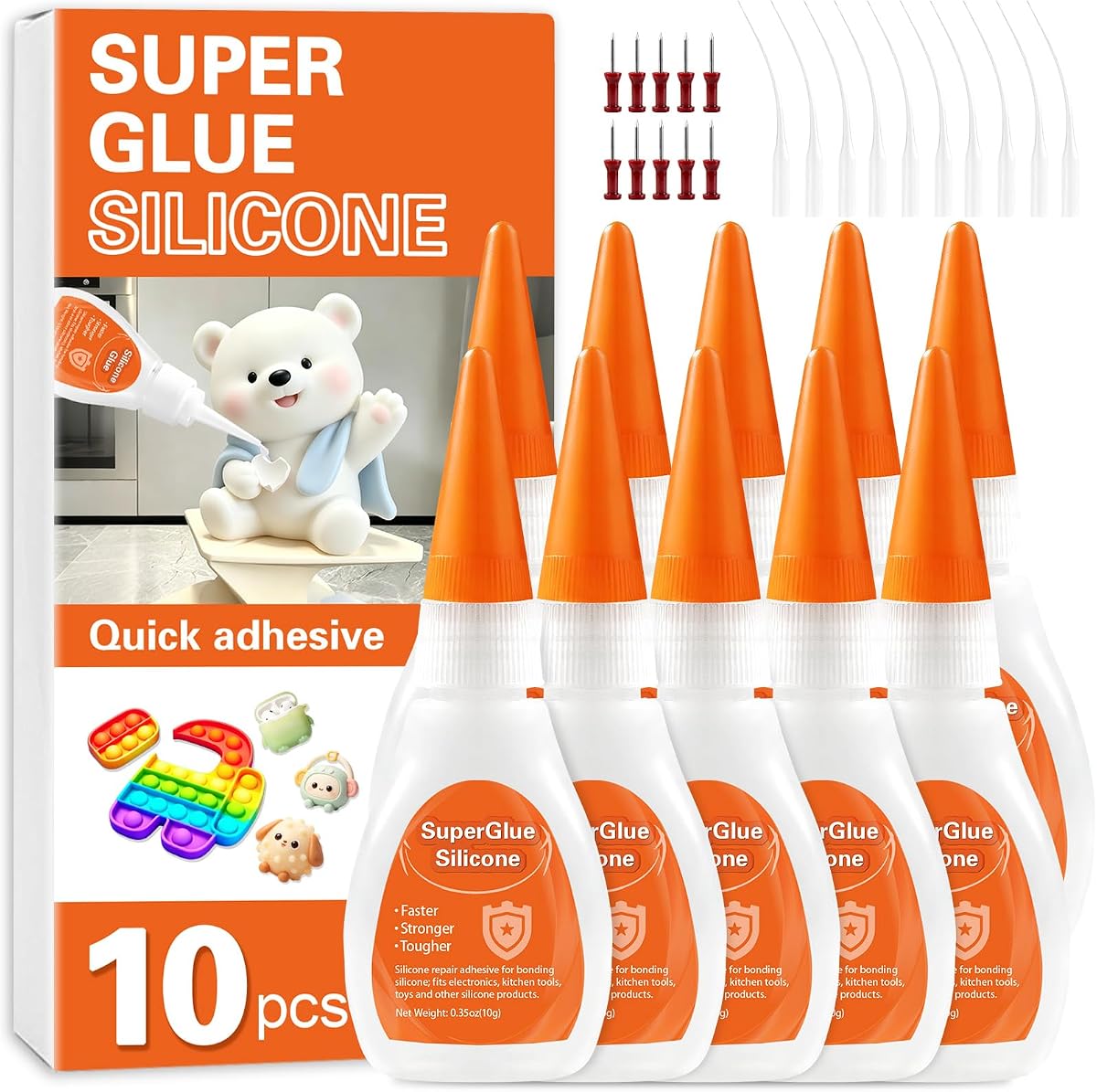
The Ten-Tube Silicone Glue Set is built for frequent use, shared workstations, and users who prefer fresh adhesive for each repair. It has a 2.5 rating, but its supplied specifications describe a flexible, waterproof silicone bond across silicone, TPR, TPE, rubber, plastics, metals, glass, and ceramics. Each 10g tube is designed for controlled dispensing.
We may earn a commission when you buy through this link, at no additional cost to you.
The multi-tube format has practical value for a classroom, craft group, family repair box, or collector who works on many items. Individual tubes can be kept separate, reducing the chance that a used nozzle will contaminate later repairs. The adhesive reportedly sets in 10 to 45 seconds and fully cures in 12 to 24 hours, while remaining clear and flexible after curing.
The 2.5 rating is the main reason to proceed carefully, especially since the supplied information does not reveal the underlying customer feedback. Ten small tubes also require more storage space than a single bottle, and a multi-material claim should never be treated as universal. Users must still confirm that the material and specific adhesive combination are suitable.
This set is most attractive to someone who repairs squishies regularly, distributes tools among hobbyists, or wants multiple sealed tubes on hand. For a single household repair, a single-bottle product would be simpler. For a high-volume or shared repair kit, however, the individual tubes and broad advertised bonding range offer notable convenience.
Single-use tubes can limit residue and repeated nozzle contamination. That makes the format useful when many repairs happen in succession or when several people share a workbench.
The listed cure is designed to remain soft while resisting moisture, stretching, and everyday wear. Once fully cured, it is presented as a durable seal for indoor and outdoor soft-material repairs.
We may earn a commission when you buy through this link, at no additional cost to you.
Fast-Set Flexible Squishy Glue has a 5.0 rating and presents one of the most complete repair profiles in the guide. It is formulated for TPR, TPE, TPU, rubber, and silicone, with squishies, stress balls, action figures, and soft pet toys named as key applications. The advertised 20g tube combines a precision tip, a quick-drying process, and a clear flexible finish.
We may earn a commission when you buy through this link, at no additional cost to you.
The waterproof barrier is a significant strength. It is described as sealing out moisture, dust, and dirt while remaining flexible enough for bonded areas to bend, stretch, and move naturally. A low-odor, non-toxic formula also makes the product appealing for family craft work and repairs to children's toys, subject to sensible adult supervision and safe handling.
Fast setting is both a benefit and a practical consideration. The repair pieces must be aligned accurately before the adhesive grabs, and the repaired toy should not be squeezed until sufficient curing time has passed. The supplied information does not give a precise full-cure duration, so the current package guidance should be followed. Material compatibility should also be checked on items containing less common plastics.
This is a strong choice for people who want a dependable, discreet repair for frequently handled soft toys. The combination of precision, flexibility, waterproofing, and low odor makes it more rounded than many basic clear adhesives. It works especially well when the damaged item needs to continue moving after the bond has fully cured.
The cured adhesive is advertised to withstand bending and stretching without whitening or breaking. That combination of elasticity and sealing performance is valuable for seams that experience frequent movement.
The precision tip helps place a small amount exactly where needed. The low-odor, non-toxic formula is also described as suitable for kids' toys and craft projects, although children should not handle the adhesive unsupervised.
We may earn a commission when you buy through this link, at no additional cost to you.
Two-Piece Squishy Repair Glue is a practical option for localized damage across toys, models, silicone accessories, crafts, and compatible household items. No customer rating is supplied for this product, so its appeal rests on the described features: a clear flexible cure, precision nozzle, and support for TPR, TPE, silicone, TPU, soft rubber, and compatible plastics.
We may earn a commission when you buy through this link, at no additional cost to you.
The nozzle gives users a measured way to address tears, cracks, splits, loose seams, and damaged edges. The instruction to use a thin, even layer on clean, dry surfaces is sensible, and the absence of mixing simplifies the process. Two 20ml bottles are also practical for separating jobs or keeping one bottle reserved for a particularly delicate item.
The lack of a rating makes direct comparison harder, and the listing does not provide a detailed curing schedule. Users should not assume that the material list means every plastic is compatible. The safety instructions also call for avoiding eye and skin contact and keeping the product away from children, which is standard but important for anyone repairing toys.
This product is a reasonable choice for straightforward localized fixes where controlled application and a neat appearance are the main priorities. It lacks the detailed elasticity claims and specialized soft-cure positioning of the TWSURE option, but it may be more convenient for users who want two bottles and a wider range of small repair tasks.
A clear flexible finish is useful when a squishy is brightly colored, transparent, or displayed prominently. Keeping the repair neat can make the item feel usable again rather than visibly patched.
Cleaning and drying the surfaces before application improves consistency and helps the thin adhesive layer behave predictably. It is a simple step that can make a meaningful difference in a localized repair.
We may earn a commission when you buy through this link, at no additional cost to you.
TPR Squishy Repair Glue is a focused, uncomplicated option with a 5.0 rating. Its supplied information centers on one goal: bonding squishy toys with a flexible, lasting repair that moves with the material instead of cracking. The adhesive is also described as drying transparent, helping tears and breaks remain visually unobtrusive.
We may earn a commission when you buy through this link, at no additional cost to you.
The application process is refreshingly simple. Apply the glue to the damaged area, press the parts firmly, and allow it to cure. There is no mention of mixing or a complicated preparation process, making this an accessible choice for a first squishy repair or a user who wants one purpose-built bottle for TPR items.
The product description offers less detail than the leading options. It does not identify a precision applicator, provide a specific set or cure time, or list a broad material range. A user dealing with a particularly narrow fissure may want more control than a standard opening offers, and a collector may want additional guidance before applying it to a valuable item.
This adhesive is best for straightforward tears and breaks in confirmed TPR squishies. It should suit users who value a simple procedure, a flexible clear finish, and a product explicitly formulated for the task. For tiny seams, mixed materials, or demanding waterproof conditions, a more specialized precision product may be a better match.
A flexible cured bond reduces the chance that the repaired area will feel rigid or crack as the toy is squeezed. This is the defining benefit for a product developed around TPR squishies.
The direct workflow is approachable: apply, press firmly, and allow curing. This simplicity makes the product suitable for routine household repairs when the damaged material is known to be compatible.
We may earn a commission when you buy through this link, at no additional cost to you.
High-Elasticity Squishy Adhesive is designed around a central requirement: the finished repair should continue stretching and squeezing with the toy. It is offered in two 20ml bottles and carries no supplied customer rating. Its listed applications include slow-rebound toys, silicone, TPR, PU foam, soft rubber, vinyl, and elastic craft materials.
We may earn a commission when you buy through this link, at no additional cost to you.
The adhesive is described as curing into a crystal-clear, highly elastic rubber bond rather than hardening. A fine needle nozzle cap provides pinpoint application into tight tears, cracks, and seam splits. Together, the soft cure and controlled delivery make this a plausible choice for especially stretchy items where a rigid patch would change the way the toy feels.
There is no supplied rating or detailed cure schedule, which means a cautious approach is warranted. The user should confirm that every material involved is compatible and allow the bond to cure fully before stretching. Although the low-odor, non-toxic characterization is positive for hobby work, responsible handling and ventilation are still important with any liquid adhesive.
Choose this product for highly elastic squishies, foam crafts, and soft accessories where the repaired area must move dramatically. Its multi-material focus is useful for mixed craft projects, while the clear finish protects appearance. For a standard TPR toy with a small split, a simpler dedicated TPR adhesive may be easier to evaluate, but this option better targets extreme flexibility.
The highly elastic cure is intended to compress, expand, and return alongside the original toy. That makes it relevant for slow-rebound figures and craft pieces subjected to frequent handling.
Fine needle nozzle caps help users place small amounts inside a split without coating the surrounding surface. This precision supports cleaner results on decorated toys and dimensional craft pieces.
We may earn a commission when you buy through this link, at no additional cost to you.
The best adhesive for a squishy is not simply the strongest clear glue available. Material compatibility, cured flexibility, dispensing control, finish, and curing conditions all determine whether a repair survives squeezing while preserving the toy’s original feel.
Begin by determining what the squishy is made from. Many slow-rising toys use TPR, but other examples may use silicone, TPE, TPU, rubber, PU foam, or vinyl. The glue should explicitly identify the relevant material, and users should check any limitations carefully. INSOIA is listed as bonding silicone, TPR, rubber, plastic, and metal while excluding PP and PE, whereas the TWSURE product is focused on TPR, TPE, and TPU. A broadly worded multi-material claim should never be treated as permission to use a product on every plastic.
Choose an adhesive that names the exact polymer whenever possible. If the material is unknown, inspect the shell, packaging, or manufacturer information before applying a repair.
A squishy is repeatedly compressed, stretched, bent, and handled. A rigid repair can feel like a hard insert, create stress concentrations, or crack around the edges even when the initial bond looks secure. Products specifically described as ultra-soft, highly elastic, or flexible are better aligned with the use case. The TWSURE product goes furthest in its supplied description by highlighting a zero-degree Shore cure, while the High-Elasticity option emphasizes a bond that stretches and squeezes with slow-rebound toys.
Look for words such as flexible, elastic, and soft-cure rather than simply strong. The repaired region should continue moving with the surrounding material.
Precision matters because squishy seams, punctures, and stress-ball cracks can be very small. A fine needle tip can deliver a controlled drop into a narrow fissure, while multiple tips offer more flexibility when dealing with different gap sizes. Broad openings may be easier for larger tears, but they increase the chance of excess glue, overflow, or a visible repair. The INSOIA bottle includes four precision tips, while several competing products use a single controlled or needle-point nozzle.
Match the applicator to the repair. Use a narrow tip for pinpoint splits and seams, and consider a broader tip for larger edge repairs. Test the flow on a disposable surface before committing to an important toy.
A clear adhesive is essential when the squishy is transparent, brightly colored, or kept on display. A transparent cure can blend into the surrounding surface, although the repaired area may still be detectable through texture or slight thickness. Most products in this guide advertise a clear finish. Some also specifically state that they avoid yellowing, residue, or noticeable patches, which can be useful for long-term display pieces.
For visible toys, favor a product explicitly described as crystal clear, colorless, or free of yellowing. Avoid assuming that all clear adhesives will blend equally well with every color.
An initial set and a full cure are not the same thing. INSOIA and the ten-tube set list an initial setting period of 10 to 45 seconds and a full cure of 12 to 24 hours. During that difference, a repair can look secure while remaining vulnerable to stretching. Users should follow the current package instructions, keep the parts aligned, and avoid squeezing, washing, or playing with the toy until the adhesive has fully cured.
When a listing provides only a general fast-set or quick-dry claim, allow extra time before handling. Faster positioning does not mean the bond is ready for immediate stress.
A squishy may be wiped, washed, exposed to humidity, or used near food, making moisture resistance relevant. The INSOIA, Quick-Drying, ten-tube, and Fast-Set products describe waterproof or moisture-resistant cured bonds. A waterproof seal can be useful for stress balls and frequently handled toys, but it does not change the need to respect the full cure period. Check whether the toy will be washed before or after the repair and follow safe care instructions.
For toys that regularly encounter water or humidity, choose an adhesive with an explicit waterproof claim. For a dry indoor collectible, precise application and flexibility may matter more.
The available formats serve different habits. A single bottle is convenient for occasional repairs, while two bottles make it easier to separate projects or keep a dedicated applicator for delicate work. Ten individual tubes can be useful for frequent users, classrooms, or shared craft kits because each tube starts fresh. Small tubes and dual sets also require more storage, and fine tips need careful handling to avoid bending or contamination.
Choose the format that matches your repair frequency. Occasional users can favor simplicity, while frequent hobbyists may value sealed individual tubes or separate bottles.
Even a flexible premium adhesive performs best when it can contact clean, dry material. Gently remove loose debris, avoid oily residue, and make sure the damaged area is dry. Do not flood the crack merely because the product sets quickly. A thin, even layer is the common recommendation across the supplied listings, and it reduces the chance of overflow, stiffness, or an uneven visible finish.
Always work in a ventilated area, keep the adhesive away from eyes and skin, and follow the instructions on the current product packaging. A successful repair begins with controlled preparation.
First, identify the toy and repair material, then work in a well-ventilated area away from children and pets. Clean and fully dry both sides of the tear or split. If the squishy contains a filling, avoid squeezing it while applying adhesive, and place the damaged area in a position where you can see the seam clearly. Read the instructions supplied with the selected adhesive because cure times and material limits can vary by formulation.
Next, secure or support the toy so it does not move, then attach the appropriate tip and dispense a very small amount directly into the crack, seam, or detached edge. INSOIA specifically recommends a thin layer for faster and stronger curing. Immediately bring the broken parts together and hold them in position without stretching the material. Do not test the bond by squeezing it; instead, allow the product to reach the stated full-cure stage before normal use.
After curing, inspect the repair in good light and test it gently, increasing pressure gradually. A clear repair line may remain visible even when the bond is strong. Avoid washing the toy until the adhesive manufacturer permits it, and do not expose the repair to heat, solvents, or sharp edges. If a bond fails, remove the old adhesive carefully from suitable surfaces before attempting a clean reapplication, and replace the toy if the tear is structural or continues to open.
A clear, flexible adhesive designed for the squishy’s material is usually preferable to rigid super glue. TPR squishies require a product that explicitly supports TPR, while silicone, TPE, TPU, rubber, foam, and vinyl items may need different compatibility. The repaired area should be able to compress and stretch without the bond hardening, whitening, or cracking.
Ordinary super glue may create a hard, rigid repair that changes the toy’s feel and can crack under repeated squeezing. A dedicated flexible silicone or TPR adhesive is a better match when the goal is to preserve a soft, squeezable texture. Even dedicated cyanoacrylate-style products should be applied sparingly because excess adhesive can spread beyond the seam.
Check the original packaging, manufacturer listing, or product care label for terms such as TPR, TPE, TPU, silicone, rubber, foam, or vinyl. If the material is unknown, inspect the shell for a printed code and consider contacting the manufacturer. Do not rely on appearance alone, because different flexible polymers can look and feel almost identical.
Wait until the adhesive has completed its full cure, not merely formed an initial grip. INSOIA lists a 10-to-45-second setting period followed by a 12-to-24-hour full cure, so a quick set should not be mistaken for readiness. Products without a stated timing should be allowed the maximum period given on their current packaging and kept free of pressure in the meantime.
A clear adhesive can blend the color of the squishy, but complete invisibility is never guaranteed. The repair may remain noticeable because of texture, thickness, trapped air, or a change in how the surface reflects light. Applying less adhesive, choosing a needle-point tip, and placing the glue inside rather than over the seam can minimize visible residue.
Several products in this guide list silicone cases, watch bands, models, crafts, rubber items, and other household objects as compatible uses. The repair should still be appropriate for the exact material and the expected conditions. A toy-safe, low-odor adhesive is not automatically approved for food contact, electrical components, or load-bearing assemblies.
A repeatedly opening seam may have a structural tear, an incompletely cleaned surface, or too much movement around the damaged area. Allow the old bond to cure fully, remove residue using a method safe for the toy, and inspect whether the edges can meet without forcing them. If the tear continues to propagate, replacing the squishy may be safer than repeatedly adding more adhesive.
A fine needle-point tip is often easier to control around micro-cracks, deep seams, and narrow punctures because it can place a small drop exactly where needed. It can also reduce overflow and visible residue. The tip must still be used gently, since forcing the nozzle can deposit too much adhesive or cause the tip to bend.
INSOIA Super Silicone Glue is the most versatile overall recommendation because it combines a flexible clear cure, several precision tips, quick initial setting, and broad compatibility for common squishy materials. TWSURE is the standout for delicate work requiring a very soft elastic cure and pinpoint placement, while the Fast-Set Flexible Squishy Glue offers a particularly complete combination of waterproofing, low odor, precision, and flexibility.
Prioritize confirmed material compatibility, a flexible finished bond, and an applicator that suits the size of the repair. For a tiny crack or deep seam, a needle-point tip can prevent mess; for a larger split, a broader applicator may be more practical. Apply only a thin layer, align the pieces carefully, and respect the full curing period before returning the toy to regular use.
Product details, ratings, and availability can change, so review the current listing and package instructions before buying. Comparing the material claims, dispenser style, and cure requirements against the specific squishy will lead to the most reliable result and help extend the life of a favorite toy.