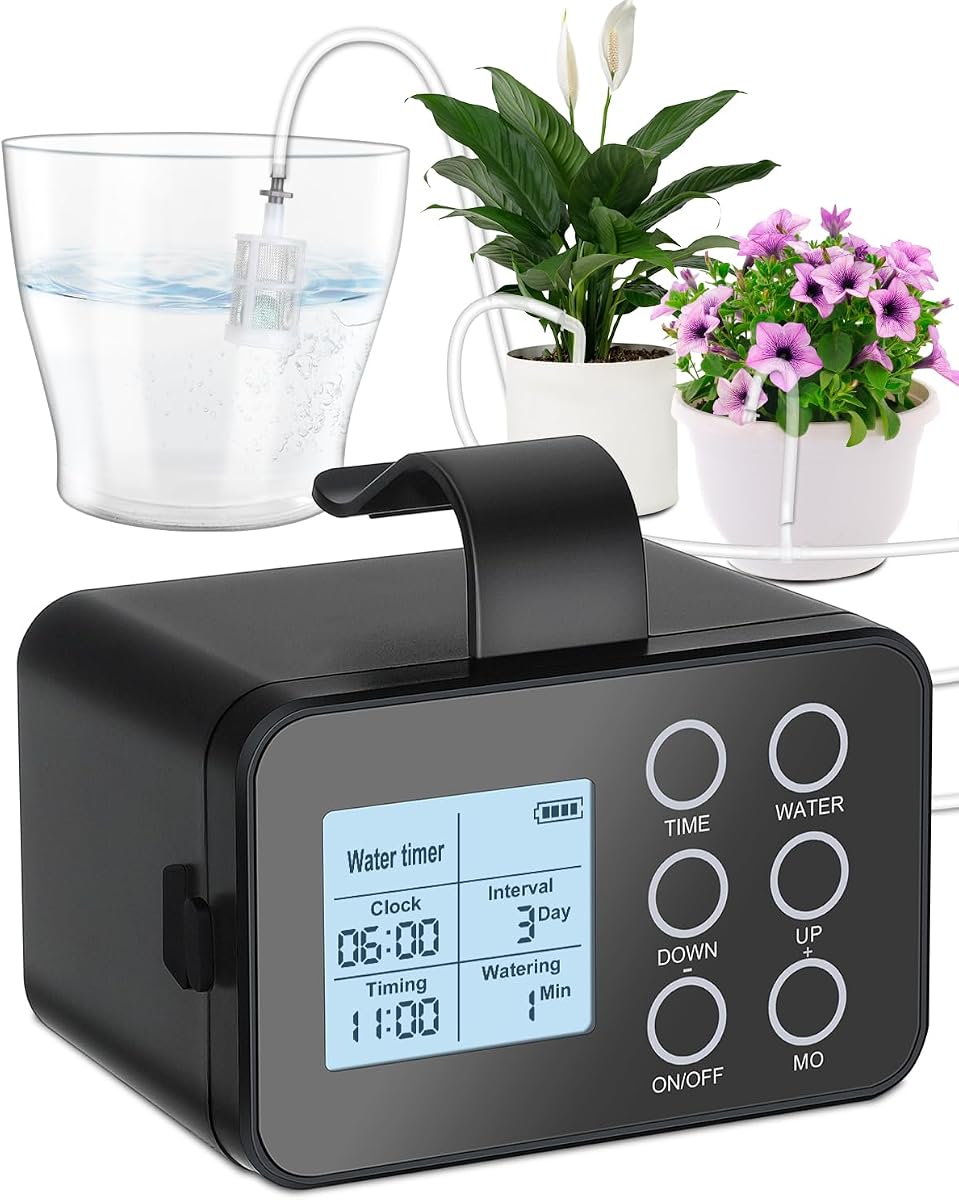
Automatic Plant Waterer Indoor with Timer
4.5Editor score
No app required
Thirty-day interval range
Rechargeable 2600mAh battery
Supports fifteen planters
Indoor Automatic Plant Watering System guide comparing ten automatic watering systems for plant capacity, scheduling, sensors, power, and smart control.
An indoor automatic plant watering system can keep thirsty houseplants consistently hydrated while you work, travel, or manage a busy household. The best models combine drip delivery, customizable schedules, reliable pumps, and simple setup, but the right choice depends on plant count, pot size, and monitoring needs.
We compared ten indoor automatic plant watering systems across capacity, programmable timing, moisture sensing, power options, tubing, drip emitters, and setup considerations. The list includes budget timer-based systems, rechargeable models, dual-pump arrangements, and app-connected options for indoor plant collections.
Each review highlights the features that distinguish a particular model, along with practical limitations to consider before installation. Ratings reflect the supplied customer feedback, while availability, promotions, and prices change, so compare current product details before making a final purchase.
4.5Editor score

4.4Editor score

4.2Editor score
The following side-by-side comparison identifies plant capacity, control methods, notable features, and practical limitations across all ten systems, helping readers narrow the field according to collection size, scheduling needs, and budget priorities.




The Moistenland Automatic Plant Waterer is a straightforward indoor drip system with a 4.3 rating. Its strongest qualities are an internal clock, customizable watering schedules, and an installation process described as taking about 15 minutes. It is aimed at plant owners who want dependable automation without an app or complicated network setup.
We may earn a commission when you buy through this link, at no additional cost to you.
Water is delivered directly into the root zone through drip lines and adjustable emitters. The slow, controlled flow is designed to reduce evaporation and runoff, while the supplied information states that the system can save up to 70% of water compared with traditional watering. Because the emitters and lines can be arranged according to the layout, the system is more versatile than a basic single-saucer reservoir.
The most important limitation concerns siphoning. The internal pump does not include anti-siphon protection, so continued dripping can occur after the timer stops if the water source is above an outlet. The installation guidance is clear: keep the water level below the potted plants, or ensure the first dripper sits higher than the source. Buyers who cannot control that relationship should consider a model with a dedicated anti-siphon valve.
Moistenland is a sensible choice for beginners and households seeking scheduled drip irrigation without smartphone dependence. It is best suited to indoor arrangements where the reservoir can sit below the pots and where gradual, root-directed watering is preferred. Setup, emitter positioning, and source elevation deserve attention, but once configured correctly, the core system offers useful automation at a straightforward level.
The drip approach sends water close to plant roots rather than across the soil surface. This helps limit evaporation and surface runoff while allowing the growing medium to absorb moisture gradually.
The number of drip lines and emitters can be adjusted to suit the collection. Buyers should plan the tubing route first, especially when pots sit on shelves or at several different heights.
We may earn a commission when you buy through this link, at no additional cost to you.
This fifteen-plant automatic waterer has a 4.2 rating and combines scheduled watering with a humidity-detection mode. Its appeal lies in the ability to serve multiple pots from a single unit, including plants positioned farther from the water source, while retaining the straightforward setup of a conventional drip system.
We may earn a commission when you buy through this link, at no additional cost to you.
The kit includes 33 feet of tubing, fifteen T-joints, fifteen droppers, a filter, anti-siphon components, a Type-C cable, and a manual. Its pressure characteristics are designed to distribute water to pots around a room. Users can select between scheduled watering and humidity mode, with the latter adjusting watering based on the detected environment to help reduce the guesswork involved in plant care.
Compared with fully app-based products, this model offers fewer remote features and less detailed oversight. That limitation is acceptable for someone who wants sensor-assisted watering but does not want to manage another mobile application. Because its specifications do not describe individually adjustable emitters as prominently as some competing kits, buyers should confirm that its delivery pattern suits mixed pot sizes and plant types.
This system is a good fit for households with a medium-to-large indoor collection that values both timers and humidity response. It also includes anti-siphon components, an advantage over systems that rely solely on careful reservoir positioning. It is less appropriate for users who require remote notifications, family sharing, or detailed watering history through a phone.
Scheduled mode provides routine coverage, while humidity mode responds to changing conditions. This combination makes the system useful both for predictable daily care and for collections whose moisture needs are not identical.
With fifteen droppers and 33 feet of tubing, the system can serve a substantial group of houseplants. Long tubing runs and distant placements should be arranged carefully to maintain consistent delivery.
We may earn a commission when you buy through this link, at no additional cost to you.
The 770-Combination Plant Waterer earns a 4.3 rating through its broad selection of programmable combinations, adjustable drip emitters, and intelligent humidity mode. It supports as many as 15 plants and includes 49 feet of flexible tubing, making it one of the more adaptable options for shelves, hanging baskets, and widely dispersed pots.
We may earn a commission when you buy through this link, at no additional cost to you.
Its large LED display and control knob provide access to watering durations from 20 seconds to 30 minutes and intervals from one hour to 15 days. A soil humidity sensor enables a responsive mode intended to reduce unnecessary watering. The included 2200mAh rechargeable battery and USB-C charging remove the need to keep the controller beside an outlet during operation.
The package is thorough: controller, 49-foot tubing, fifteen adjustable emitters, a humidity sensor, filter, anti-siphon device, fifteen three-way connectors, screws, and a Type-C cable are included. The trade-off is that more features require more deliberate setup. The sensor must be placed in an appropriate pot, while tubing must follow a coherent route that does not create kinks or pull against pots.
This is a strong all-around pick for plant owners who want sensor assistance without mandatory app use. Its fine timer ranges make it suitable for varied watering needs, and the rechargeable design adds placement flexibility. It is especially attractive for those willing to configure the layout carefully and check sensor behavior during the first weeks.
Watering can run from 20 seconds to 30 minutes, with intervals from one hour to 15 days. That range allows short cycles for thirsty small pots and longer sessions for larger containers.
The rechargeable controller can be positioned near the plant arrangement rather than tethered to an outlet. A full charge provides a useful degree of independence during short absences.
We may earn a commission when you buy through this link, at no additional cost to you.
The Sainlogic Automatic Plant Waterer is an Editor's Choice pick because it combines precise visual feedback, humidity-responsive irrigation, and travel-friendly protection in a well-rounded package. Its 4.4 rating is the highest among the ten listed products, and the oversized 3.07-inch display makes schedule and moisture information easy to check.
We may earn a commission when you buy through this link, at no additional cost to you.
Fifteen emitters deliver water near plant roots, reducing surface runoff and waste. In humidity mode, the controller responds when the soil becomes dry and pauses once the display indicates that the soil is wet. Scheduled mode is also available. Unlike systems offering independently variable emitters, this model relies on overall watering duration and interval settings, so mixed plant types need careful grouping.
IP64 waterproofing and built-in backflow prevention make it more suitable for patios and balconies as well as indoor spaces. The kit supplies 33 feet of tubing, fifteen T-connectors, fifteen drippers, a filter, an anti-siphon valve, a soil moisture sensor, and a Type-C cable. The lack of individually adjustable emitters and the need for a power connection are the main considerations.
This is an excellent recommendation for frequent travelers who want a readable display and automatic humidity-based watering. It is also attractive to indoor gardeners who value backflow protection and weather resistance. Buyers with highly varied watering requirements should divide plants into compatible groups or choose a model offering per-emitter flow adjustment.
The large display presents watering settings and soil status clearly. This is particularly useful during vacations, when the system needs to communicate its condition without requiring an app or repeated physical checks.
IP64 waterproofing and backflow prevention add useful resilience. The system can therefore suit sheltered balconies and patios as well as protected indoor plant areas.
We may earn a commission when you buy through this link, at no additional cost to you.
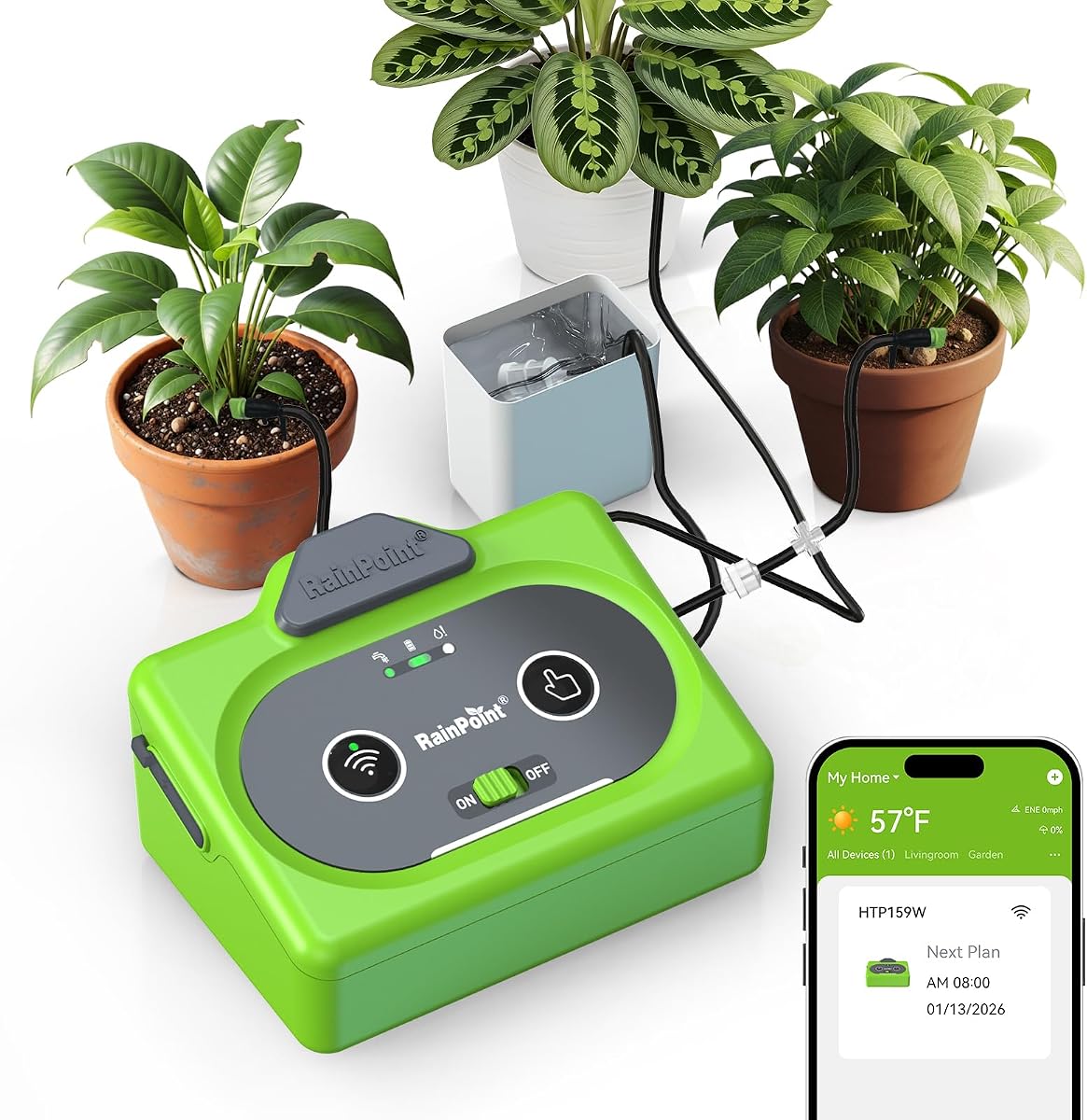
The RAINPOINT Direct WiFi Waterer is the premium pick for shoppers who want app-based control without losing automation when connectivity falters. It has a 4.3 rating, connects directly to a 2.4GHz WiFi network, and stores preset schedules locally so watering can continue during an internet outage.
We may earn a commission when you buy through this link, at no additional cost to you.
Remote monitoring and notifications provide awareness when the reservoir needs attention. The system also includes a rechargeable battery and USB-C power, allowing it to remain operational during unexpected power loss. Scheduling options range from standard drip programs to seasonal adjustments and unit-based settings, while adjustable emitters accommodate different pot sizes and plant types.
The kit is designed around ten plants and includes 32.81 feet of tubing, ten T-barb fittings, ten adjustable emitters, support stakes, a cross fitting, anti-siphon valve, filter, end plugs, and a USB cable. Family members can receive shared access through the app. The dependency on compatible WiFi and the need to remain within range of the RainPoint Home app may not suit every household.
This model is ideal for tech-oriented plant owners, shared homes, and anyone who wants remote alerts alongside dependable scheduling. It balances connected convenience with local control and power resilience. The key question is whether app-based management provides enough value to justify the greater setup complexity compared with a simple timer.
The app provides status information, alerts, and remote scheduling, while local memory preserves programmed cycles when the internet is unavailable. This dual approach supports both convenience and operational resilience.
Shared permissions allow household members to monitor watering and receive alerts. That is useful in homes where several people share responsibility for plant care.
We may earn a commission when you buy through this link, at no additional cost to you.
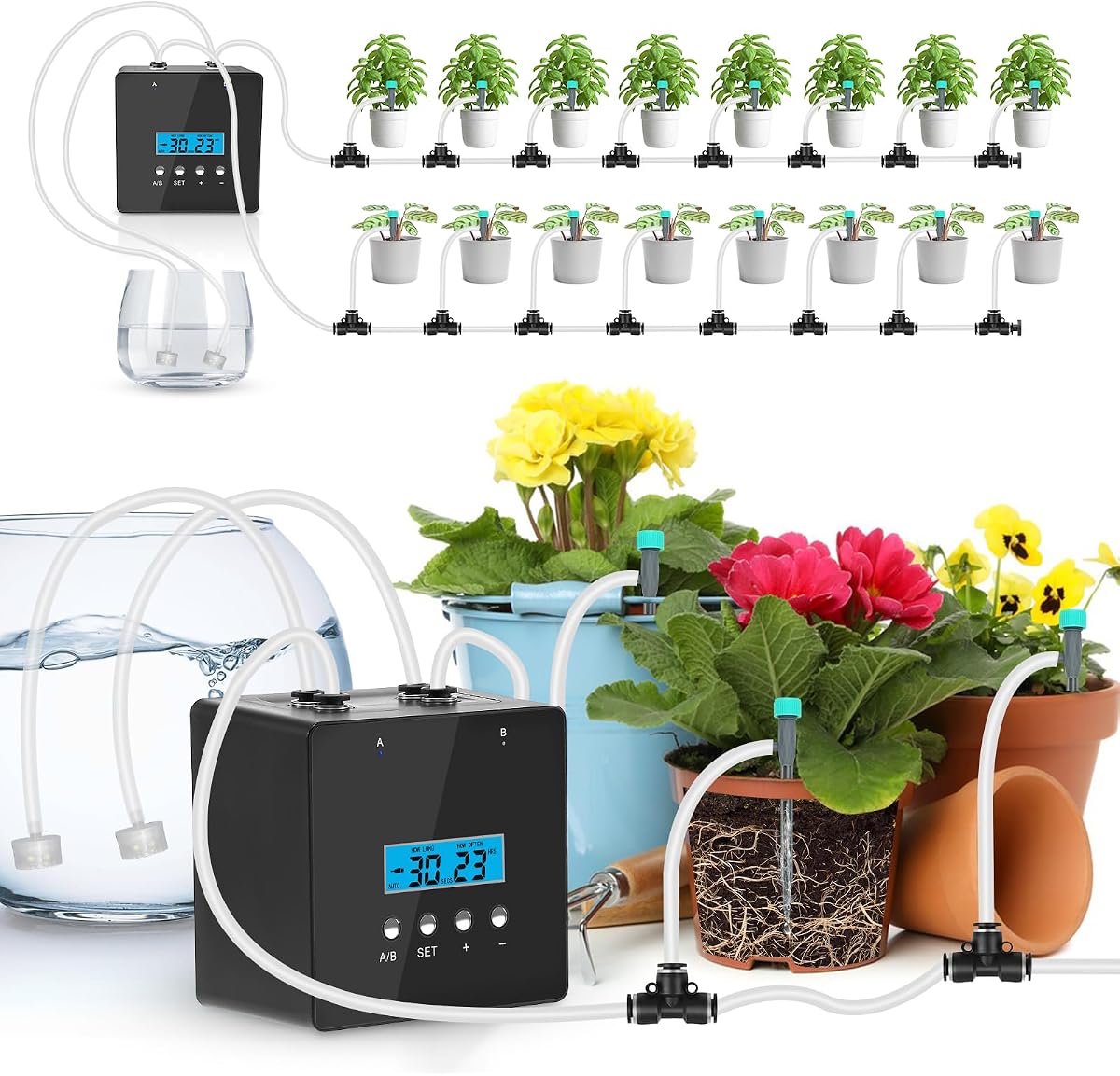
This two-zone automatic plant waterer is built for collections that benefit from separate watering schedules. It has a 4.2 rating, can water up to 30 potted plants across two zones, and uses a stated flow rate of 0.15 gallons per minute. A large LED display and rechargeable design make status easy to inspect.
We may earn a commission when you buy through this link, at no additional cost to you.
Both zones can be programmed across durations from five seconds to 30 minutes, with intervals ranging from every one to 23 hours or every one to 15 days. Manual mode offers immediate watering without replacing the saved schedule. Flow controls allow different water volumes within the arrangement, while the automatic cutoff detects an empty tank and stops the pump.
The listed power-loss capability extends watering for up to 90 days, which is unusually long for this category. The included package contains 32.81 feet of quarter-inch tubing, two filters, two check valves, fifteen adjustable drippers, fifteen barbed tees, five cross connectors, and five end caps. It covers up to 15 plants initially; reaching 30 requires separately sold accessory kits.
The two-zone design is the model’s defining strength, allowing thirsty and less thirsty plants to receive different schedules. It is a strong choice for large indoor collections or users who want manual control without giving up automation. Buyers with only a few pots may find its controls and expansion plan unnecessarily elaborate.
Two independent zones make it easier to water high-moisture plants separately from those needing less frequent irrigation. This reduces the need to force every plant into one schedule.
Automatic cutoff detects when the tank runs dry and stops operation. The feature helps protect the pump and provides a useful warning that the reservoir needs attention.
We may earn a commission when you buy through this link, at no additional cost to you.
The LetPot Automatic Watering System is a premium option focused on polished smart-home integration and quiet operation. Its 4.2 rating reflects a feature-rich kit that supports WiFi and mobile control, permits up to five simultaneous watering tasks, and includes adjustable drip modes for intermittent or continuous watering.
We may earn a commission when you buy through this link, at no additional cost to you.
The upgraded 2.0 chip is intended to improve connectivity and stability, while an anti-backflow valve helps prevent siphon-related dripping. Low-water alerts notify users when attention is required. Additional app features include plant information and a plant diary, making the system more engaging for users who want to record their indoor gardening routine.
IP66 waterproofing allows use on balconies and in varied weather conditions, and the German-imported silent pump is designed to minimize disturbance in bedrooms and living spaces. The box includes a 10-meter pipe, ten adjustable drippers, ten connectors, ten brackets, a filter, and an adapter plug. Despite its capacity claims, the included accessories are sized for roughly 10 to 20 pots rather than every larger installation.
LetPot suits smart-home enthusiasts who value remote control, quiet pumping, and flexible programs. It is less attractive to buyers seeking a simple appliance-free timer or a large kit with enough emitters to cover many plants immediately. The warm-water assembly tip is also worth noting, as it makes fitting accessories to the thickened PE tubing easier.
Up to five simultaneous tasks allow separate schedules for different plant groups. Intermittent and continuous drip modes add further control over how moisture reaches the soil.
The silent pump is a meaningful advantage for bedrooms, offices, and other quiet rooms. Its waterproof construction also extends placement beyond the protected indoor environment.
We may earn a commission when you buy through this link, at no additional cost to you.
The Dual-Pump Plant Watering System has a 4.1 rating and differentiates itself with two independent self-priming pumps. It can water up to 20 plants, allowing separate schedules and flow levels for groups with different moisture requirements, such as succulents, herbs, and larger houseplants.
We may earn a commission when you buy through this link, at no additional cost to you.
Its programmable timer handles routine watering, while the pumps can run independently at the same time. Drip emitters adjust from low to high flow, and locking T-connectors are intended to reduce leaks. The system can draw from buckets, bottles, or water jugs, which makes reservoir selection flexible and permits larger capacities than a small built-in tank.
Power can come from USB-C or four AA batteries, although batteries are not included. Keeping the container below the pots is necessary to prevent unwanted dripping. This is a practical configuration, but the two pumps, multiple hoses, and separate schedules require more setup than a single-line system.
This model is a good option for indoor gardeners with numerous pots or noticeably different water requirements. It is especially useful when a household wants to water fast-draining herbs separately from moisture-loving plants. Buyers should prepare a stable reservoir location and account for the cable or battery footprint before installation.
Independent pumps allow one group to run while the other follows a different schedule. This is particularly helpful when a collection includes both moisture-loving and drought-tolerant plants.
The intake can sit in a bucket, bottle, or jug. A larger container reduces refill frequency, making the arrangement practical for longer periods away from home.
We may earn a commission when you buy through this link, at no additional cost to you.
The Tipkook Indoor Plant Waterer has the highest customer rating in this group at 4.5 and is the Best Budget pick because it delivers the essential automation without requiring WiFi or an app. Its LCD display makes timing information visible, while the physical controls reduce setup friction for first-time users.
We may earn a commission when you buy through this link, at no additional cost to you.
Watering duration ranges from one to 300 seconds, with time-based intervals from one to 23 hours or day-based intervals from one to 30 days. The manual button provides an immediate watering option without disrupting the saved schedule. A 2600mAh battery is advertised to last more than 30 days on one Type-C charge in energy-saving mode.
The kit supports up to 15 planters and includes 33 feet of clear four-millimeter tubing, fifteen three-way connectors, fifteen drippers, a filter, Type-C cable, blue anti-siphon valve, and straight connector. The anti-siphon valve should be installed above the water source as directed. A meaningful limitation is the absence of a moisture sensor, so scheduled watering must be calibrated carefully.
Tipkook is an excellent recommendation for anyone who wants dependable timer-based care without managing another app. It fits collections of up to 15 planters and offers enough scheduling range for varied routines. Users should monitor the first few cycles and adjust duration or emitter placement according to the soil, pot size, and plant type.
Scheduling happens through the display and physical controls, with no account, network, or software update required. That makes the system especially approachable for beginners and reliable plant-care routines.
Short one-second increments and long thirty-day intervals provide broad scheduling control. The immediate manual mode is convenient for a quick drink or a spot check after travel.
We may earn a commission when you buy through this link, at no additional cost to you.
The RAINPOINT WiFi Plant Waterer offers compact app-based automation for up to 15 pots. Its 4.0 rating is the lowest among the listed systems, but the product's core design is appealing for travelers who want cordless operation, remote scheduling, and notifications without carrying a separate power adapter during an extended trip.
We may earn a commission when you buy through this link, at no additional cost to you.
The 2400mAh rechargeable battery is advertised to operate the system for up to 60 days on a single charge. A bucket or other suitable container can serve as the water source, while the included pump, tubing, and drip stakes create a flexible layout for ten to 15 potted plants. The dedicated anti-siphon valve is designed to stop flow immediately after the pump turns off.
Remote management requires a 2.4GHz WiFi network, and the lowest rating suggests some buyers may have encountered issues or simply offered less enthusiastic feedback. App-only operation may also be less appealing to users who prefer physical controls. Nevertheless, the included valve, cordless design, and straightforward assembly reduce common sources of setup friction.
This system is best for frequent travelers who want to check and adjust watering remotely. It is also a reasonable choice for a moderate collection that benefits from anti-siphon protection. Buyers should confirm 2.4GHz WiFi compatibility, monitor the battery through the app, and test a complete watering cycle before leaving.
The rechargeable battery can keep the system operating away from an outlet for up to 60 days according to the supplied information. This supports vacation use without requiring continuous proximity to household power.
The app allows watering routines to be scheduled and monitored from a smartphone, with notifications providing awareness. A compatible 2.4GHz network is required before setup.
We may earn a commission when you buy through this link, at no additional cost to you.
The right indoor automatic plant watering system depends on plant count, watering consistency, available space, and the degree of control you want. Reviewing these factors before buying helps prevent an installation that is too small, overly complicated, or poorly matched to your plants.
Start by counting the pots that genuinely need automated watering and measuring where each one sits. Many systems support approximately 10, 15, or 20 plants, but included tubing length determines whether that capacity can be reached without improvised extensions. Plants on high shelves, hanging baskets, or opposite sides of a room may require longer runs and more careful pressure management.
Choose capacity with room for growth rather than filling every outlet immediately. Verify the number of included emitters and connectors because the stated maximum may depend on separately sold expansion accessories.
Timer-based systems are predictable and easy to program, making them suitable for collections with similar watering needs. Sensor-controlled systems add responsiveness by pausing or adjusting according to soil moisture, but they still require proper sensor placement and periodic verification. App-based systems may provide more scheduling detail and remote alerts.
Prioritize a model with both timed and moisture-responsive modes if your collection includes mixed plants. For uniform plants, a broad timer range may be simpler and more reliable than unnecessary smart features.
A useful pump should deliver water steadily across all connected lines without requiring repeated adjustment. Adjustable emitters are valuable when small pots and large planters need different flow rates. Systems with independently controlled pumps or zones also allow two plant groups to receive different schedules.
Avoid assuming that every emitter can be finely tuned. Some kits regulate flow only at the system level, which means plants needing very different amounts should be grouped on separate circuits or watered manually.
Consider how long the system must operate without an outlet. Rechargeable controllers add placement flexibility and can continue during short outages, while AC-powered systems may be simpler but more dependent on household electricity. Systems supporting both USB-C and disposable batteries provide another layer of operational choice.
Check battery capacity, stated battery life, and charging requirements. Longer advertised run times generally depend on energy-saving modes and realistic watering schedules, so avoid leaving the system untested before a long trip.
Anti-siphon components help stop residual water from continuing to drain after the pump stops. This matters most when the water source sits above an emitter, but a dedicated valve is valuable even when the arrangement is correctly positioned because it adds protection against spills and unwanted watering.
Check whether a valve is included or only recommended. If it is not supplied, make sure the reservoir remains below the first dripper, or plan to purchase a compatible anti-siphon device before installation.
Some automatic systems have a built-in reservoir, while others draw from buckets, bottles, or water jugs. A separate container offers flexible capacity and makes refilling easier, but it must be stable, clean, and positioned close enough to the tubing layout.
Look for a filter in the kit because debris can affect the pump and narrow drip channels. Choose a transparent container if you want to monitor water level easily, and ensure the intake reaches the bottom without the pump drawing in sediment.
The best kit is one whose tubing, connectors, and pump layout make sense for your room. Measure before cutting, flush the lines as directed, and avoid sharp bends that restrict flow. Filters should be checked periodically, and emitters should be checked for mineral buildup or blockage.
Look for clear instructions and enough connectors for the intended route. A system advertised as easy to assemble may still take longer if it crosses multiple shelves or requires many branches, so allow time for careful setup and testing.
WiFi and app control are valuable for remote monitoring, alerts, seasonal adjustments, and shared household access. They are less necessary for a small collection that can operate reliably on a timer. App-dependent systems may also require a compatible network, account setup, and ongoing software support.
Check network compatibility carefully; some products support only 2.4GHz WiFi. Favor smart features that solve a real need, such as local schedule backup, low-water alerts, or independent plant-care access, rather than choosing an app merely because it is available.
Begin by reading the product instructions and planning the complete watering route. Place the controller where its display or app status remains accessible, position the reservoir securely, and arrange tubing before cutting it to length. Keep the water source below the pots whenever possible, and install the supplied anti-siphon component at the position specified by the manufacturer.
Connect the tubing, T-joints, and drip emitters, then place each emitter near the relevant root zone without leaving it pressed directly against a stem or exposed where it can be knocked over. Fit the intake into a clean water container, fill it to the required level, and prime the system if the pump requires self-priming. Run a short manual cycle and inspect every connection for leaks before trusting the programmed schedule.
Calibrate the system over several watering cycles. Check the soil after a short interval to see how quickly moisture reaches the root zone, then adjust duration, frequency, emitter flow, or plant grouping as needed. Clean the filter regularly, remove debris from the reservoir, and inspect the tubing for kinks or mineral deposits. For sensor-equipped models, confirm that the probe remains properly seated in the soil.
Yes, provided the system offers adjustable flow, multiple zones, or independently controlled pumps. Small succulents, leafy herbs, ferns, and large floor plants may require substantially different amounts of water. Group plants with similar needs where possible, or use separate circuits to prevent overwatering.
Many do, including the Moistenland, Sainlogic, Tipkook, and dual-pump options, which can operate through physical controls and programmed schedules. The RAINPOINT models require compatible 2.4GHz WiFi for app functions, although the Direct WiFi model also stores schedules locally for use during internet outages.
A siphon effect can occur when the water source is higher than the drip outlet. Keep the reservoir below the first dripper or install an anti-siphon valve as directed. If the unit has no anti-siphon protection, changing the reservoir height or adding a compatible valve is especially important.
Run at least two complete watering cycles while checking moisture, flow, and leaks. Adjust the duration if water reaches the drainage holes too quickly or remains dry near the roots. A trial period also confirms that the display, timer, sensor, app, battery, and reservoir arrangement work together as expected.
The exact container depends on the system, but many kits accept buckets, bottles, water jugs, or other clean vessels that fit around the intake. Use a stable, appropriately sized container with a secure lid if pets or children are present. The filter should remain submerged so the pump does not draw in debris.
Some can. The Sainlogic system has an IP64 rating, the LetPot system has an IP66 rating, and the RAINPOINT Direct WiFi model includes water-shortage and backflow protections. Outdoor use still requires a sheltered or appropriately rated controller, a stable reservoir, secure tubing, and protection from extreme weather.
Automatic systems reduce routine watering but do not replace all plant care. Check soil moisture during the first weeks, adjust settings as seasons change, inspect filters and emitters, and refill the reservoir as required. Newly repotted plants, recovering plants, and changing seasonal needs may still need manual attention.
A humidity sensor can respond to actual moisture conditions, while a timer follows a fixed program. Sensors add convenience but depend on correct placement and maintenance, whereas timers are simpler and highly predictable. Many useful systems combine both modes so the user can choose routine watering or moisture-responsive operation.
The Sainlogic Automatic Plant Waterer stands out as the most balanced overall choice because its large display, humidity mode, backflow protection, and weather-resistant construction suit frequent travelers and varied indoor collections. The Tipkook system is the straightforward Best Budget option for buyers who want excellent scheduling without an app, while the LetPot kit offers the most refined premium smart-home experience.
Before deciding, prioritize the features that match your plants rather than the largest stated capacity. Confirm tubing reach, consider separate watering groups, check anti-siphon provisions, and select the power option that suits your setup. Sensor control, quiet pumps, dual zones, local schedule memory, and app access can all be valuable, but each adds complexity that should match a real need.
Finally, review the current listing, included components, customer feedback, and support information before purchasing. Prices, promotions, bundle contents, and availability can change, and manufacturer updates may alter software or hardware details. A complete trial at home is the best way to ensure the selected system provides consistent watering without leaks or overwatering.