
DEPSTECH 2K Endoscope Camera
4.2Editor score
2560 by 1440 resolution
Five-meter semi-rigid cable
Eight-plus-one LED lights
Our iPhone Endoscope Camera guide compares 10 leading borescopes for image quality, cable reach, lighting, waterproofing, connectors, app support, and ease of
An iPhone endoscope camera turns a smartphone into a practical inspection tool for pipes, engines, wall cavities, HVAC ducts, and other areas that are difficult to reach. A useful model should combine clear imaging, controlled lighting, a manageable probe, dependable phone connectivity, and enough water resistance for the intended job.
The products in this guide were compared using the specifications and feature information supplied for each listing. We considered resolution, probe diameter, lens configuration, cable length and rigidity, LED lighting, waterproof limits, connector coverage, app requirements, accessories, and practical inspection applications.
Each review explains where the camera stands out and where compromises may matter. The list includes dual-lens, articulating, long-cable, and budget-oriented options, helping readers match the scope to a specific inspection task. Product availability and prices can change, so confirm current details before buying.
4.2Editor score

4.7Editor score

4.2Editor score
This side-by-side overview compares the key specifications that distinguish the ten scopes, including image resolution, lens design, probe size, cable reach, lighting, and water resistance.


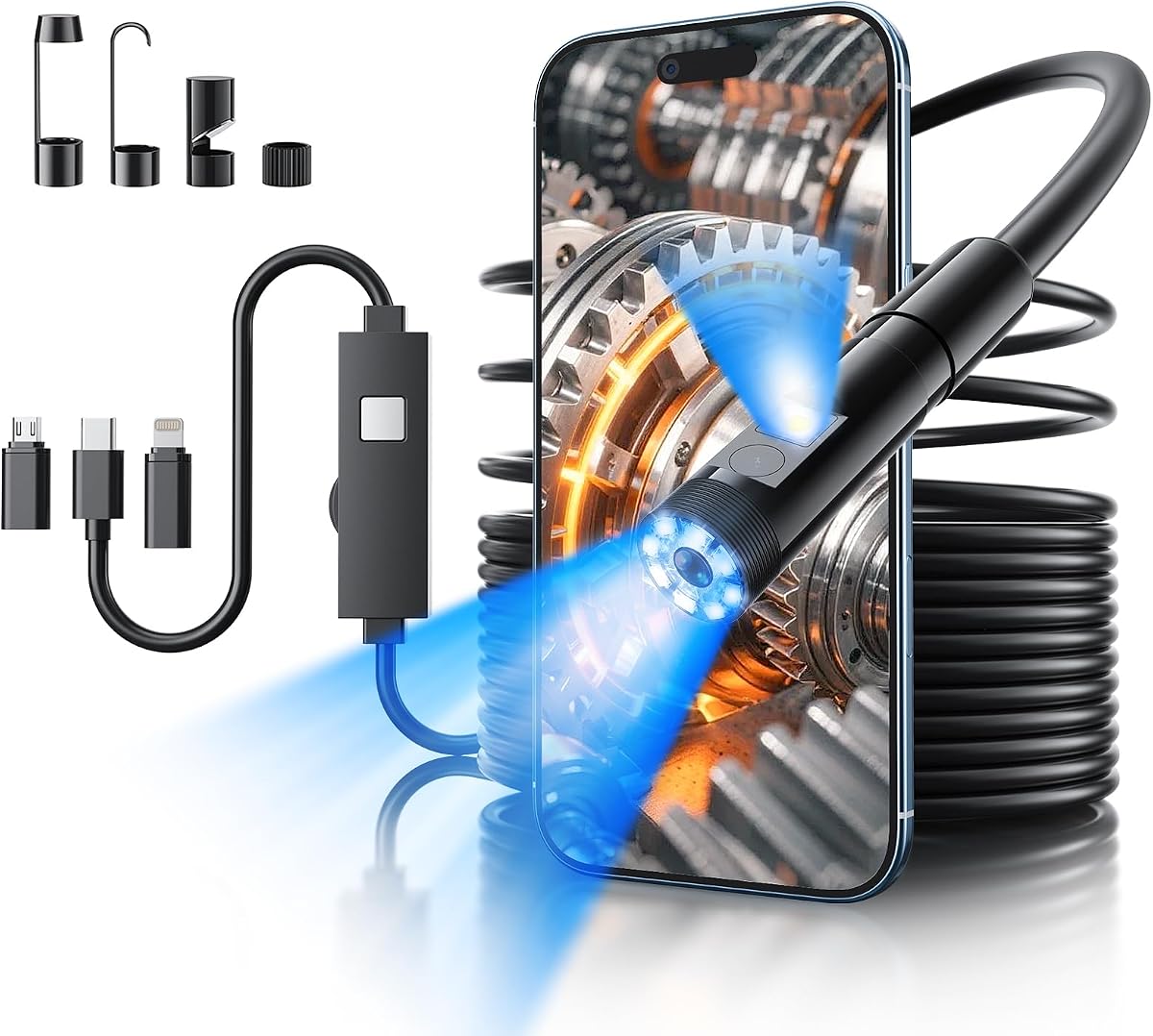


This scope combines a 1920 by 1440 camera, dual lenses, and eight adjustable LEDs in a conventional phone-connected design. Its 4.3 rating reflects a generally capable package, particularly for users who want both forward-looking and side-view inspection without moving the probe.
We may earn a commission when you buy through this link, at no additional cost to you.
The 7.9mm probe fits narrow channels, while the 16.4-foot semi-rigid cable provides enough reach for drain lines, engine compartments, wall spaces, and household wiring. The IP67-rated camera can operate underwater to 3.28 feet for up to one hour, making it suitable for damp locations and short submerged inspections.
Connection options include Android, Lightning, and USB-C connectors. The camera works through the SUP-ANESOK app, which supplies live viewing, and the supplied magnet, hook, mirror, and protective cap broaden its usefulness. The manufacturer notes that some Android phones may display slight blurriness because of system differences.
This is a strong general choice for homeowners, plumbers, and mechanics who need dependable lighting and two viewing directions without moving to a specialized articulating system. Buy it when a 5-meter-class semi-rigid cable, water resistance, and broad phone compatibility are more important than maximum image resolution.
Dual lenses let the user alternate between a forward view and a side perspective, which is especially helpful around pipe bends, wiring edges, and engine components where a single forward-facing camera may miss nearby detail.
The cable bends while retaining enough shape to follow a route around corners. This balance makes the probe easier to direct than a completely flexible cable without giving up the reach associated with rigid scopes.
We may earn a commission when you buy through this link, at no additional cost to you.
The DEPSTECH NTC55 is the list's clearest option for detailed image capture, offering 2560 by 1440 video and photographs with 3.69 million pixels. Its 4.2 rating reflects a feature-rich design that prioritizes resolution, dual perspectives, and a five-meter semi-rigid cable.
We may earn a commission when you buy through this link, at no additional cost to you.
Two 7.9mm lenses provide front and side views, while an 80-degree viewing angle broadens the field of view. The DEPSTECHCAM app adds two-times zoom, 90-degree rotation, capture controls, and gallery review. Eight-plus-one adjustable LEDs help illuminate dark pipes, engine bays, ducts, and confined wall spaces.
Compatibility includes USB-C and Lightning adapters for supported iOS and Android devices. The app works locally without registration or an internet connection, which is a meaningful privacy advantage. Android phones must support and enable OTG, however, and the camera cannot operate independently of the app.
This model is best for users who scrutinize small defects, document findings, or need more detail than a standard 1920P scope can provide. It is less suitable for buyers who want effortless operation with an older phone or no need for the extra resolution and app-based controls.
The higher pixel count can make hairline cracks, corrosion, loose connections, and pipe-wall damage easier to examine. It is particularly valuable when recording evidence for a repair professional or comparing a suspect area before and after maintenance.
Zoom, rotation, live capture, and gallery review create a more organized workflow than a basic live-view app. Local operation also allows the camera to function without creating a required online account.
We may earn a commission when you buy through this link, at no additional cost to you.
This model offers a balanced set of inspection essentials: 1920 by 1440 imaging, eight adjustable LEDs, a semi-rigid 16.4-foot cable, and connectors for several phone standards. Its 4.2 rating indicates a solid general-purpose scope for plumbers, mechanics, and home maintenance tasks.
We may earn a commission when you buy through this link, at no additional cost to you.
The camera is positioned as a tool for pipes, HVAC passages, wiring, and engine compartments. Its semi-rigid construction helps preserve direction around bends while remaining flexible enough to negotiate confined routes. The resolution is specified as sharper than standard 1080P for short-range inspection work.
The package includes Type-C, Micro-USB, and Lightning connectors, a magnet, hook, protective cap, and manual. A QR code leads users to the required app for real-time viewing. The listing highlights manufacturer support and professional service, although its IP67 claim is less fully described than on several competing models.
This is a practical selection when connector flexibility, a useful accessory set, and traditional semi-rigid handling matter. It is not the leading choice for maximum image detail, side-view imaging, or articulated steering, but it covers many conventional inspection needs with a straightforward design.
Including Type-C, Micro-USB, and Lightning connectors broadens compatibility across phone models. This is helpful for users who do not want to rely on a single connector or repeatedly purchase separate adapters.
Eight adjustable LEDs improve visibility inside pipes, ducts, and engine bays. Adjusting brightness also helps prevent close surfaces from appearing washed out when the probe is near the subject.
We may earn a commission when you buy through this link, at no additional cost to you.
BAZO combines a 1920P camera with an 18.04-foot semi-rigid cable, giving it the longest reach among the listed scopes. Its 4.4 rating and 6.9mm probe position it as a capable choice for long pipes, deep wall cavities, and larger inspection routes.
We may earn a commission when you buy through this link, at no additional cost to you.
Eight adjustable LEDs illuminate the probe tip, while the narrow diameter helps it enter confined channels. The camera supports Android 4.4 and later and iOS 9.0 and later through included adapters. The UseePlus app handles live viewing without Wi-Fi or Bluetooth, and no separate charging is required.
The accessory set includes a magnet, hook, mirror, mounts, and protective cap. These additions help with both inspection and object retrieval. The probe retains a bend rather than becoming floppy, giving users a reasonable amount of directional control, although it cannot articulate independently at the tip.
Choose this model when reach and a slim probe matter more than premium resolution or articulated steering. It is a sensible fit for car repair, plumbing, home repair, HVAC work, and inspections where longer routes are common. Users should update the app if connection or display issues arise.
At 18.04 feet, the cable can reach deeper into long drain lines, wall spaces, and service routes than the shorter alternatives. The added reach may reduce the need to reposition a camera repeatedly.
The 6.9mm tip is among the narrowest listed. It can pass through constrained gaps and openings that would challenge a thicker probe, while retaining enough rigidity to remain controllable.
We may earn a commission when you buy through this link, at no additional cost to you.
This 1920P endoscope offers a 4.4 rating, dual lenses, eight lights, and a 16.4-foot semi-rigid cable. It balances useful image detail with a relatively slim probe, making it appropriate for both domestic and light professional inspection work.
We may earn a commission when you buy through this link, at no additional cost to you.
The camera captures 1920 by 1440 photographs and video. Its 7.9mm probe is IP67 waterproof, and adjustable LEDs illuminate low-light interiors. The cable bends to follow routes through industrial machinery, air-conditioning appliances, wall structures, and sewer pipes.
A hook, magnet, side mirror, protective cap, and manual are included. The side mirror and retrieval tools are especially useful when the camera finds an object that cannot be reached directly. Users download the app recommended in the instructions and connect the scope directly to an iPhone or iPad.
This is a well-rounded option for people who want more than a basic forward-facing view without moving to a premium articulating model. The main limitation is that the semi-rigid cable must be repositioned to change direction, and the camera should not remain submerged beyond its stated depth guidance.
Switching between camera positions helps confirm whether a crack, blockage, wire, or loose component is present. The alternate angle also makes it easier to understand how nearby parts relate spatially.
The magnet can pick up ferrous metal, while the hook can catch lightweight objects. These tools expand the scope beyond visual diagnosis and make it more useful when a small item has fallen into a drain, engine bay, or wall opening.
We may earn a commission when you buy through this link, at no additional cost to you.
This scope delivers the essential features of a modern phone borescope without an articulating control system. Its 4.2 rating, 1920 by 1440 resolution, slim probe, and eight adjustable lights make it a practical option for common household and automotive inspection.
We may earn a commission when you buy through this link, at no additional cost to you.
The 7.9mm probe is described as IP67 waterproof and can be used in wet or dark environments. A 16.4-foot semi-rigid cable holds its route around corners and down pipes. Type-C, Micro-USB, and Lightning connections allow use with a broad range of compatible phones.
Users download the app and then view the camera feed on a phone or tablet. The included magnet, hook, protective cap, and side-view mirror create a useful basic kit. It is particularly suited to clogged drains, HVAC ducts, engine bays, wall cavities, pipes, and other confined spaces.
This model makes sense for buyers seeking a straightforward, lightweight inspection camera without paying for articulating mechanics or 2K resolution. Its compromises are predictable: the probe is not independently steerable, and the app must be installed before a phone can display the live image.
A 7.9mm diameter reduces the effort required to guide the camera through narrow gaps. It is a useful size for household openings, pipe interiors, and compact engine areas without becoming excessively delicate.
Variable LED brightness helps users see in dark cavities while avoiding excessive glare on reflective metal. A short side-view mirror can also help inspect surfaces that are difficult to approach directly.
We may earn a commission when you buy through this link, at no additional cost to you.
The Teslong is designed specifically for modern USB-C devices, including the iPhone 15, 16, and 17 series, USB-C iPads, and compatible Android phones. Its 4.4 rating reflects a straightforward setup, integrated lighting, and a practical three-meter semi-rigid cable.
We may earn a commission when you buy through this link, at no additional cost to you.
Eight high-brightness LEDs and integrated white balance support clear viewing in dark spaces. The camera is IP67 waterproof for use in damp or dusty environments, while the 10-foot semi-rigid cable provides a more compact package than the 16- to 18-foot alternatives.
Unlike universal kits, it does not include a Lightning adapter, making it less suitable for older iPhones or iPads. Windows computers and MacBooks are also not supported. Android users must confirm OTG support and enable it, while the corresponding app is required for the live display.
This camera is a good fit for someone whose devices are exclusively USB-C and who values a short, managed cable. It is less useful for mixed-device households or anyone needing to inspect deep, extended routes. For current USB-C iPhone users, the connection process is refreshingly direct.
A dedicated USB-C design avoids carrying several adapters and reduces uncertainty over which connector is correct. It is particularly convenient for newer iPhones and tablets that no longer use a Lightning port.
Integrated white balance helps colors remain more consistent under the probe's own LEDs. This can make rust, moisture, wiring, and surface damage easier to distinguish when the available light comes entirely from the camera tip.
We may earn a commission when you buy through this link, at no additional cost to you.
This five-meter borescope combines a 1920 by 1440 camera, 7.9mm probe, and eight adjustable LEDs. The 4.4 rating indicates a well-received general-purpose model, while 360-degree rotation adds some flexibility when orienting the view around internal obstructions.
We may earn a commission when you buy through this link, at no additional cost to you.
The scope supports Android 4.4 and later as well as iPhones and iPads running iOS 9 or later. An iPhone and Micro-USB adapter is included, and the UseePlus app handles live viewing. Compatible Android devices need OTG and USB UVC support, which can be checked with the suggested USB OTG Checker app.
The IP67 probe is designed for damp or dark environments, while the semi-rigid cable helps maintain control through long and curved routes. Suggested applications include drains, vehicle work, wall cavities, machinery, search and rescue, construction, agriculture, aviation, and electronics inspection.
This is a versatile choice for users who want a long cable and broad range of possible tasks. It is not suitable for computer connections, and buyers with Android phones should verify OTG support before purchasing. Within smartphone inspection cameras, the specification mix is notably well rounded.
Camera rotation lets the user change the image orientation as the probe moves, reducing the need to twist the entire cable around a difficult bend. This is particularly useful in long pipes and irregular cavities.
A 16.5-foot cable reaches substantial distances through drains, ducts, and service channels. The semi-rigid design helps preserve the chosen path, giving users more control over long inspections.
We may earn a commission when you buy through this link, at no additional cost to you.
The Dual-Lens Endoscope Camera with Light earns the highest rating in this comparison at 4.7. Its 1920P camera, front and side lenses, 115-degree field of view, and one-tap switching provide a strong combination of clarity and situational awareness.
We may earn a commission when you buy through this link, at no additional cost to you.
The stated optimal focal distance is 1.5 to 5 inches, so the tip should be held relatively close for the sharpest result. This is particularly useful for inspecting cracks, corrosion, leaks, and fittings rather than only viewing distant objects. A semi-rigid cable holds its shape around corners and supports extended routes.
Compatibility is broad: iPhone 8 through 16 models with either USB-C or Lightning, iPads, and Android devices with OTG. The camera can be submerged to 3.28 feet for up to one hour. Included adapters, a magnetic pickup, hook, and mirror create a complete inspection and retrieval kit.
This is the most balanced choice in the guide for users who want detailed short-range images, two perspectives, useful water resistance, and broad compatibility. It is the top pick for general inspections, while the DEPSTECH is preferable when higher resolution matters most and the Teslong articulating scope for motor-controlled cornering.
The stated one-and-a-half-to-five-inch focus range is unusually helpful for close diagnostic work. Bringing the lens near a suspected defect can expose hairline cracks, corrosion, loose material, and small leaks more clearly than distant viewing.
Front and side lenses can be switched with one tap, making it easier to inspect an object and the surface beside it. This is valuable in pipe corners, engine bays, wall voids, and around wiring junctions.
We may earn a commission when you buy through this link, at no additional cost to you.
The Teslong articulating borescope stands apart with a joystick-controlled probe that bends up to 180 degrees. Its 4.2 rating reflects a specialized design for navigating corners, wall voids, engine bays, and pipe interiors where manually flexing a cable is inconvenient.
We may earn a commission when you buy through this link, at no additional cost to you.
The 1.0-megapixel camera captures 1080P photos and video, while eight LEDs offer three brightness levels for dark ducts or reflective metal. A five-foot semi-rigid gooseneck holds shape but remains short compared with the five-meter alternatives. The articulating section supplies the additional directional control.
The phone holder, joystick, and capture button support one-handed use, and the SmartEndoscope app provides photo and video functions without requiring an account or subscription. USB-C compatibility covers iPhone 15 and later plus compatible Android devices. Thick cases on some large Pro and Ultra models may need to be removed.
Choose this camera when steering around sharp bends is the primary problem. It is less suitable for long pipe runs, older Lightning iPhones, or computer-based work. Despite the shorter cable, motorized tip control can make short, difficult inspections more precise and less frustrating.
The motorized tip can bend through 180 degrees, letting the camera look behind obstructions or around a bend without twisting the entire gooseneck. This is a major practical advantage in tight mechanical and plumbing spaces.
A phone holder, thumb-accessible joystick, and nearby capture button streamline the inspection process. The arrangement is particularly convenient for technicians who need to navigate and record without repeatedly repositioning the device.
We may earn a commission when you buy through this link, at no additional cost to you.
The right borescope depends on where you will use it, how you will connect it, and how much control you need at the probe tip. Resolution, lighting, reach, and compatibility should be evaluated together rather than in isolation.
Summary: Choose a model with adapters that match every device you intend to use.
A connector mismatch can prevent inspection entirely, regardless of image quality. A bundled adapter set offers more flexibility but adds items to carry, while a dedicated USB-C cable creates a simpler setup for modern-device-only households.
Summary: Favor dual views and good close focus over resolution alone.
A camera that is sharp at the correct working distance will often be more valuable than a higher-resolution model used too far from the subject. Consider what you need to inspect, such as tiny cracks, pipe walls, or engine components.
Summary: Match cable reach to the route and choose articulation for sharp bends.
A longer cable does not automatically make a scope easier to use because extra length can also complicate handling. Semi-rigid construction is a practical middle ground, while motor-controlled articulation is valuable where the tip must turn beyond the cable's natural bend.
Summary: Measure the smallest opening before buying and allow room for the cable.
Even a slim probe requires adequate clearance for its connector and cable. For walls, conduits, and appliance cavities, a narrow tip can be the difference between reaching an inspection point and being unable to enter.
Summary: Choose variable tip lighting for enclosed and reflective inspections.
A fixed light can be too dim in a large cavity or too harsh at close range. LED controls combined with a white-balance function generally produce a more usable image in changing conditions.
Summary: Verify the exact depth and duration before using the probe underwater.
For drain, plumbing, and pool work, confirmed submersion limits provide useful confidence. For dry inspections, water resistance is still beneficial because the camera may encounter condensation, leaks, or damp debris.
Summary: Check app requirements before purchase and keep it updated.
A dedicated app is not inherently a disadvantage, but it is part of the user experience. Consider whether photo and video storage, local operation, registration requirements, and controls fit your workflow.
Summary: Prioritize the accessories and probe behavior your task actually needs.
A well-chosen scope should fit the job rather than simply collect the most functions. Think through whether the primary need is deep reach, close detail, side visibility, underwater use, motorized steering, or recovering an object.
Begin by confirming phone compatibility, downloading the designated app, and completing a short test in a well-lit location. Inspect the camera tip and lenses for dust or damage, then connect the correct adapter. Android users should enable OTG where required. Keep the phone stable, open the live view, and confirm that images and recordings are being captured correctly before beginning the actual inspection.
Guide the probe slowly through the target area. For semi-rigid models, bend the cable into a smooth route rather than forcing a sharp fold. Use the side lens or articulating tip when the subject lies beyond the forward view. Adjust LED brightness to suit the space, and hold the tip within the camera's recommended focus distance for the clearest result. Record reference images before moving or disturbing suspected components.
After use, disconnect the probe and wipe the lenses with a clean microfiber cloth. Remove mud or debris from the connector and protective cap, allow the probe to dry before storage, and avoid pulling the cable sharply out of narrow openings. If the scope was submerged, confirm the stated water limits were observed and let all parts dry completely. Store the cable in a loose coil rather than a tight bend.
Yes, provided the opening is larger than the probe and its connector. Most models use a 7.9mm probe, while the BAZO has a 6.9mm tip. Measure the narrowest section of the route first, and avoid forcing the camera through an opening that could damage the lens or cable.
Most of the listed models use a wired USB connection and app-based live viewing, so they do not require Bluetooth or a Wi-Fi network. The DEPSTECH app is specifically described as operating locally without an internet connection. Downloading the app initially may still require an internet connection.
A semi-rigid cable bends when the user moves it and tends to retain the selected shape, but the tip cannot steer independently. An articulating borescope uses a control to bend the camera head, allowing it to turn around corners or behind obstacles. Articulation improves precision in tight spaces, while semi-rigid models are usually simpler and offer longer reach.
Yes, provided the probe diameter and cable length fit the pipe. Long semi-rigid models can navigate extended routes, and IP67 protection helps guard against moisture and debris. Check the camera's stated submersion limit before inspecting filled or flooded lines.
The phone may lack OTG support, have OTG disabled, or lack the USB camera function required by the app. Enable OTG in the device settings, verify compatibility using the suggested OTG checker where provided, and update the app. Some Android models may also display slight blurriness because of system-level camera differences.
No. Resolution is only one part of image quality. Close focus, lens viewing angle, LED brightness, white balance, and the distance between the tip and subject also matter. A dual-lens 1920P model may be more practical in a confined space than a higher-resolution camera used at an unsuitable distance.
Many of these cameras include a magnet or retrieval hook for this purpose. The magnet works best on small ferrous objects, such as screws or nuts, while the hook can catch lighter items. Position the camera close to the object, confirm its position visually, and attach the appropriate tool before pulling the probe back.
Do not exceed the manufacturer's stated depth or duration. Some models specify underwater use to 3.28 feet for up to one hour, while other listings mention only IP67 protection. Treat a connected phone as a non-waterproof device, keep it above the waterline, and dry the probe and connector after every wet inspection.
The Dual-Lens Endoscope Camera with Light is the strongest overall choice because it combines a 4.7 rating, 1920P capture, close-range focus, two lens perspectives, useful water resistance, and broad connector support. The DEPSTECH 2K model is preferable for maximum image detail, while the streamlined 1920P scope offers a practical lower-cost option for routine inspections.
Prioritize compatibility first, followed by the geometry of the inspection. A slim semi-rigid scope works well for long routes and narrow openings, a dual-lens model helps reveal side-facing details, and an articulating tip is valuable when the camera must turn around a hard corner. Lighting, water limits, accessories, and app requirements should then match the intended task.
Product details and prices can change, so verify the current connector package, operating-system support, app instructions, and specifications before ordering. Checking the phone model and the smallest opening in the intended route can prevent the most common compatibility disappointments.