
Jonard Tools WBK-100 Panel Buddy
4.5Editor score
Removes front and rear knockouts
Avoids drywall damage
Simple push operation
A knockout kit for electrical panel work ranges from simple tools that remove existing knockouts to hydraulic systems that create clean conduit openings in metal enclosures. The right choice depends on whether you only need to release a panel knockout, punch larger holes, work in confined spaces, or handle thicker steel and stainless steel.
The products in this guide are compared by their stated purpose, punch and die range, driving method, material capacity, included components, portability, and suitability for electrical panel or enclosure work. Manual removal tools, ratchet kits, compact hydraulic kits, and professional-grade hydraulic systems are all represented so readers can compare capabilities without overlooking basic panel access.
Each review highlights the product's most useful features, practical limitations, and ideal user. The list also distinguishes between knockout removal and hole punching, because these tasks require fundamentally different tools. Product specifications and availability can change, so readers should verify the current listing, compatibility, and safety requirements before purchasing.
4.5Editor score

4.2Editor score

4.5Editor score
As an Amazon Associate we earn from qualifying purchases.
This side-by-side comparison covers dedicated panel knockout removers, manual and ratchet hole punchers, and hydraulic punch kits, with emphasis on size coverage, drive force, material limits, and included accessories.


The VEVOR 15 T Hydraulic Knockout Punch Kit is the broadest all-purpose option in this guide, with 10 punches and dies covering conduit fitting sizes from 1/2 inch to 4 inches. Its 4.2 rating reflects a useful combination of substantial hydraulic force, flexible positioning, and a broad accessory set for users who need to create new openings rather than merely remove an existing knockout.
We may earn a commission when you buy through this link, at no additional cost to you.
The hydraulic mechanism produces 15 tons of pressure, which is the highest stated force rating among the complete kits featured here. That output supports the listed maximum thickness of 0.1 inch, or 10 gauge, in soft carbon steel and 0.08 inch, or 14 gauge, in stainless steel. The ram angle can be adjusted to accommodate different punching positions, and the manufacturer specifically identifies narrow workspaces as a suitable environment.
The kit includes a hydraulic punch, 10 punches and dies, a step drill bit, carrying case, two draw studs, piston shaft, spacer, and sealing rings. Alignment marks on the dies aid positioning, while slug-splitting dies are designed to make material removal easier. A quick-release on/off knob and anti-skid handle improve handling, although the full hydraulic arrangement remains bulkier than a simple manual punch.
This is the strongest fit for electricians, contractors, and maintenance teams that regularly install conduit through larger steel enclosures. Choose it when the 1/2-to-4-inch range, adjustable ram, and 15-ton output justify a larger kit. For occasional work limited to standard panel knockouts, one of the dedicated removal tools may be more direct.
Ten punch and die combinations make this kit useful across a much wider span of conduit sizes than the standard 1/2-to-2-inch sets. The included range reaches 4 inches, reducing the need for separate tooling when both routine and oversized openings are required.
The adjustable ram angle allows the operator to orient the driver for different access conditions. A 15-ton mechanism provides the force needed for the stated steel and stainless-steel limits while the quick pressure-release control helps manage the tool between operations.
We may earn a commission when you buy through this link, at no additional cost to you.
The Jonard Tools WBK-100 Panel Buddy is a focused solution for removing existing knockouts from electrical panels embedded in drywall. It carries a 4.5 rating and stands out for its straightforward push action, front-and-rear access, and ability to release knockouts without cutting into the surrounding wall.
We may earn a commission when you buy through this link, at no additional cost to you.
Rather than using a wrench, drill, or ordinary pliers, the operator presses the tool against the knockout to loosen and remove it. The tool is listed for electrical, security, alarm, and datacom panels, giving it broader relevance than a product made exclusively for one enclosure category. Its low-complexity design is particularly useful when access is limited or appearance matters.
The important limitation is that this is a knockout removal tool, not a conduit hole punch. It will not create a new opening or offer the die coverage of a hydraulic system. The product data also includes a clear caution against using it near live circuits, so the panel and connected circuits must be treated as energized until they have been appropriately verified and made safe.
This tool best suits installers who need to open a knockout already present in a panel after drywall installation. It is less suitable for a technician whose primary task is adding conduit to an enclosure without an existing knockout. For that scenario, choose a manual, ratchet, or hydraulic punching kit instead.
The defining benefit is the ability to remove front or rear panel knockouts without cutting a new opening in drywall. That makes the tool useful for finished commercial or residential installations where wall damage would require additional repair.
The tool works by pushing against the knockout to loosen it. There are no dies to align and no powered system to operate, making it an approachable choice for routine panel-access work.
We may earn a commission when you buy through this link, at no additional cost to you.
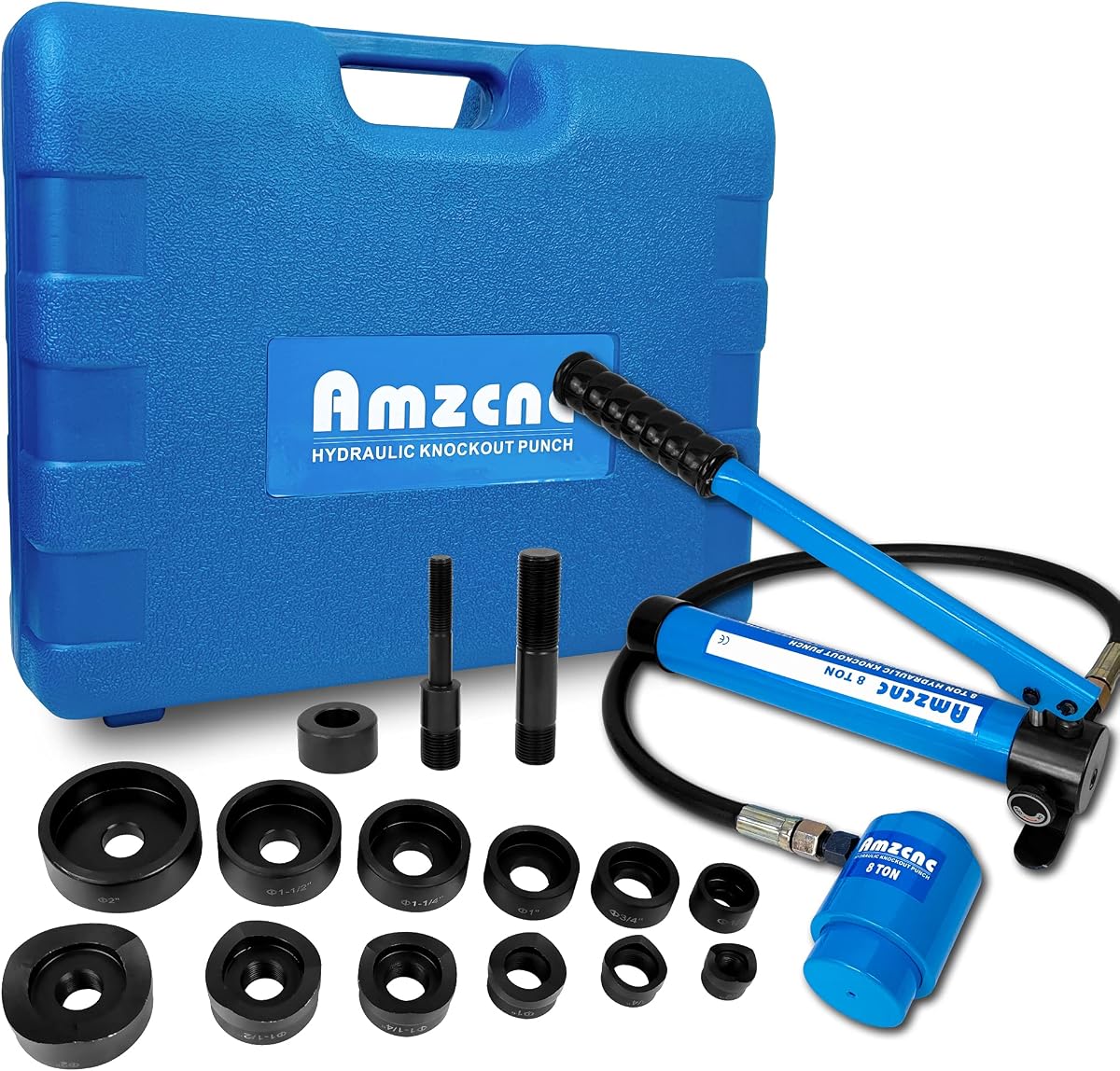
The AMZCNC 8 Ton Hydraulic Knockout Punch Kit offers a middle ground between manual kits and larger hydraulic systems. Its 4.4 rating reflects a six-die set covering 1/2-inch through 2-inch conduit sizes, along with an 8-ton punching capacity and compatibility with common 3/4-inch-16 threaded tooling.
We may earn a commission when you buy through this link, at no additional cost to you.
The stated punching capacity reaches 1/8 inch in steel and 1/16 inch in stainless steel. Listed compatible materials include steel, stainless steel, brass, copper, aluminum, fiberglass, and plastic, although soft alloys are specified for aluminum. The design works with a drill bit and driving bolt, while a long plastic handle is intended to reduce sliding and support effective force transfer.
Tooling compatibility deserves attention before purchase. The kit is designed to work with Greenlee and other domestic punch tooling that uses the specified thread standard. Users should also confirm the exact drive arrangement and accessories needed for their drill. While the hydraulic mechanism is more substantial than a manual ratchet, it remains focused on a 2-inch maximum size.
This is a good choice for electricians and installers who regularly create conduit openings in thin metal enclosures but do not need a 3- or 4-inch punch. It is particularly attractive when a hydraulic system and drill-assisted setup are desired without carrying the broadest kit in the guide.
The 8-ton mechanism supplies more force than a purely manual arrangement while retaining a useful six-size standard range. This makes it a practical choice for common conduit work on light-gauge enclosures.
Because the kit is designed around 3/4-inch-16 threading and drill-assisted operation, users should verify their drill, bolt, and tooling compatibility. Confirming these details helps prevent setup problems on the job.
We may earn a commission when you buy through this link, at no additional cost to you.
The Rack-A-Tiers Panel Buddy is built specifically to remove knockouts from electrical, security, alarm, and datacom panels. Its 4.3 rating reflects a straightforward purpose, broad enclosure applicability, and support for both lipped and non-lipped panel designs.
We may earn a commission when you buy through this link, at no additional cost to you.
The product is categorized as a knockout removal kit rather than a conduit hole punch. That distinction makes it a practical accessory for technicians working on installed panels where an existing knockout must be opened cleanly. Supporting both lipped and non-lipped panels can be useful because enclosure construction varies between applications and manufacturers.
The supplied information is concise and does not describe a multi-size die set, hydraulic mechanism, or material-specific punching capacity. It should therefore be evaluated as a dedicated removal tool rather than a general fabrication system. Users who need to make new holes in sheet metal should select a manual or hydraulic punch kit instead.
This option makes sense for maintenance technicians, security installers, and electricians who repeatedly remove knockouts from finished enclosures. It is not the right solution when the task involves creating a fresh conduit opening or when a tool set must support several punching sizes.
Compatibility with both lipped and non-lipped panels broadens the tool's usefulness across different enclosure constructions. That is valuable for service work involving more than one panel format.
A dedicated removal tool avoids the need to align a punch, die, and driver on a small knockout. It is a simpler solution when the enclosure already contains the opening you need.
We may earn a commission when you buy through this link, at no additional cost to you.
The Ratchet Knockout CC-60 Kit earns a 4.7 rating, making it one of the highest-rated products in this guide. It is a manual ratchet-driven solution with six punches, a wrench, two pull rods, and a connector designed to create round holes from 1/2 inch through 2 inches.
We may earn a commission when you buy through this link, at no additional cost to you.
Its ergonomic long handle and ratchet structure are designed to reduce the effort and awkwardness associated with manual punching. The included punch sizes are listed as 22.5 mm, 28.3 mm, 34.6 mm, 43.2 mm, 49.6 mm, and 61.5 mm, corresponding to a 1/2-to-2-inch range. A durable red plastic case keeps the components together and makes storage easier.
The tool is listed for mild steel, aluminum, fiberglass, and plastic, with potential uses across industry, professional equipment drilling, personal DIY projects, and furniture installation. Unlike a hydraulic system, however, it does not offer a stated tonnage rating, so it should not be assumed to equal the cutting force of a hydraulic product on thicker or harder material.
The CC-60 is a strong fit for electricians and installers who want a complete manual set with no drill, battery, or hydraulic pump dependency. It is especially useful when a ratchet action and clean round holes are priorities. Users working routinely with heavier-gauge steel should compare its limitations against a hydraulic system.
The package includes six punches, a wrench, two pull rods, a connector, and a storage case. That combination covers the basic steps of manually punching and removing a slug without requiring a separate hydraulic unit.
A long handle and ratchet mechanism are intended to make repeated hand-driven punching more comfortable and efficient. This can be especially helpful when a powered system would be excessive for the task.
We may earn a commission when you buy through this link, at no additional cost to you.
The VEVOR 10-Ton Hydraulic Knockout Punch Kit provides a 10-ton hydraulic system with six punch and die combinations for 1/2-inch through 2-inch conduit sizes. Its 4.4 rating indicates a balanced option for users who want hydraulic assistance without carrying the larger size range of the 15 T kit.
We may earn a commission when you buy through this link, at no additional cost to you.
The stated maximum punching thickness is 0.1 inch, or 10 gauge, in soft carbon steel and 0.04 inch, or 20 gauge, in stainless steel. The hydraulic pump is designed to deliver consistent punching force and speed, while the ram can be angled to suit different access positions. The product information identifies narrow places among its intended working environments.
Included items include the hydraulic punch, six knockout punches and dies, a step drill bit, carrying case, two draw studs, piston shaft, spacer, sealing rings, and a manual. Deep draw dies are designed to reduce the force needed to cut. A quick-release knob controls pressure after each hole, and the anti-skid grip is intended to improve handling.
This kit is a sensible middle ground for electricians and installers working with standard conduit sizes in thin metal. It offers more force than a manual ratchet and a smaller overall scope than a 4-inch hydraulic system. It is less attractive when larger openings or heavier material limits are required.
The six included dies cover 1/2, 3/4, 1, 1-1/4, 1-1/2, and 2 inches. These familiar sizes cover many routine enclosure and conduit-punching tasks without an oversized kit.
Although the hydraulic mechanism is more substantial than manual tools, the kit is described as compact and lightweight, with a durable carrying case. The adjustable ram also supports use where straight access is limited.
We may earn a commission when you buy through this link, at no additional cost to you.
The Manual Knockout Hole Punch Driver Kit is a six-size hand-operated set designed for 1/2-inch through 2-inch conduit openings. It carries a 4.3 rating and differentiates itself through forged 5140 steel punches, studs, and ratchet wrenches that are heat treated to HRC48 hardness.
We may earn a commission when you buy through this link, at no additional cost to you.
The listed material range includes steel, stainless steel, brass, copper, soft aluminum alloys, fiberglass, and plastic. Maximum thickness is stated as 1/8 inch for steel and 1/16 inch for stainless steel. Its long handle and ergonomic construction are designed to reduce fatigue and simplify operation without a hydraulic or cordless drive system.
The complete kit contains one wrench, six punches, two pull rods, and a compact plastic case. The absence of a pump, battery, or complex drive train makes the system easier to transport and simpler to deploy. The trade-off is that the user must provide the physical force needed to drive the punch through the material.
This kit is best suited to electricians, installers, and DIY users who need standard conduit holes but do not want a powered tool. Its combination of hardened components, six sizes, and a carrying case is appealing for a compact workshop collection. For frequent work in heavier-gauge steel, a hydraulic alternative may offer greater practical headroom.
Forged 5140 steel and HRC48 heat treatment are notable specifications for a manual set. These details indicate an emphasis on durable working components rather than a lightweight disposable design.
The kit needs no separate power source and includes the wrench, pull rods, punches, and case required for the core manual workflow. That makes it convenient to carry between jobs or keep in a service vehicle.
We may earn a commission when you buy through this link, at no additional cost to you.
The Greenlee 7906SB 8-Ton Hydraulic Knockout Punch Kit is the premium choice in this guide. Its 4.5 rating reflects a thoughtfully engineered package designed for precise work, quick one-person operation, and difficult access around electrical enclosures.
We may earn a commission when you buy through this link, at no additional cost to you.
The Quick Draw 90 driver supports 1/2-inch through 2-inch conduit sizes, and the new die design is optimized for a broad material range. Stated capacity reaches 10-gauge mild steel and 12-gauge stainless steel, with aluminum, brass, copper, fiberglass, and plastics also listed. Knurled edges on the punches provide a better grip during setup and removal.
Two design details stand out for field use. A dog-point tip is intended to reduce cross-threading when drawing studs, while hex-key access simplifies stud removal. Most importantly, the right-angle hydraulic punch driver head rotates more than 180 degrees, allowing the tool to be maneuvered in tight work spaces. The compact, lightweight design supports portable use.
The package includes the driver, Slug-Buster punches and dies, 7/16-inch and 3/4-inch short hydraulic draw studs, and a marked KCC-QD2 case. This is the best pick for professional users who prioritize access, handling, and organized tooling. It is less suited to openings larger than 2 inches, for which the 15 T kit offers broader coverage.
The right-angle driver head rotates over 180 degrees, allowing the tool to approach the work from multiple positions. This is particularly useful when a panel's mounting position or surrounding structure limits a straight approach.
Dog-point stud drawing, hex-key stud access, and a marked case reduce friction during setup and organization. The driver is also designed for compact, one-person operation.
We may earn a commission when you buy through this link, at no additional cost to you.
The Milwaukee 49-16-2695 M18 Exact 2-1/2 to 4-Inch Knockout Set holds a 5.0 rating, the highest numeric rating in this comparison. It is built for larger conduit openings and uses the M18 cordless platform, separating it from the manual and compact hydraulic sets that cover more sizes.
We may earn a commission when you buy through this link, at no additional cost to you.
Its 2-1/2-inch to 4-inch range fills the upper end of the size spectrum represented in this guide. The product information emphasizes straightforward handling and high durability, while the cordless M18 design can be useful for contractors who already work within that platform and want to avoid carrying a large hydraulic assembly.
Detailed information about the included dies, material thickness limits, and exact accessories is not provided in the supplied listing, so those points should be verified before purchase. It is also important not to assume that compatibility with other brands' tooling extends simply because the product is labeled as an Exact knockout set.
This Milwaukee set is most appropriate for professionals who routinely need 2-1/2-to-4-inch openings and prefer a cordless system. It is a specialist complement to smaller ratchet or hydraulic kits rather than a replacement for every standard conduit size. Users should confirm the complete kit contents and their specific power-tool requirements.
The set concentrates on 2-1/2-, 3-, and larger openings up to 4 inches within the stated range. It is therefore most relevant when routine conduit work involves the larger end of the size spectrum.
M18 compatibility places this product in a familiar cordless tool ecosystem. That can simplify tool organization for professionals who already use the platform, although the current battery and accessory configuration should be confirmed.
We may earn a commission when you buy through this link, at no additional cost to you.
The Milwaukee M18 Forcelogic 6T Knocko is a cordless hydraulic knockout tool built around the M18 platform and a stated 6-ton force rating. It carries a 4.3 rating and offers a different approach from both complete hose-and-pump kits and fully manual ratchet punchers.
We may earn a commission when you buy through this link, at no additional cost to you.
Forcelogic operation distinguishes the tool from an ordinary ratchet and allows hydraulic-style force without a separate floor pump, subject to the exact configuration supplied. The listing states that the product is brand new in the box and ships with relevant accessories, giving the buyer a foundation for adding compatible punch and die components.
The available product information does not specify the included conduit sizes, material thickness limits, or detailed accessory list. Those omissions make compatibility verification especially important. A 6-ton rating should also not be treated as equivalent to every complete kit in this guide, because punch design, die geometry, and material thickness all affect actual performance.
This product is best considered by a professional who already uses M18 tools and wants cordless hydraulic capability for knockout work. It may be especially useful where carrying a conventional pump and hose assembly is inconvenient. Before ordering, confirm the required knockout and die sizes, stud compatibility, and whether batteries or other platform accessories are already owned.
The 6-ton Forcelogic system delivers hydraulic-style force through the M18 platform. This can make the tool more portable for users who need powered punching without a separate pump assembly.
The listing confirms relevant accessories are included but does not provide a detailed inventory. Buyers should review the current package contents and confirm the punch and die sizes required for their specific panel openings.
We may earn a commission when you buy through this link, at no additional cost to you.
The best knockout kit for electrical panel work depends on the task, material, opening size, available power, and working environment. Distinguishing knockout removal from new-hole punching is the essential first step.
A knockout remover loosens and extracts a preformed opening in an enclosure. It is the correct choice for a finished panel that already contains the required knockout, especially when the panel is surrounded by drywall. A punching kit is designed to create a new opening by driving a shaped punch through sheet metal against a receiving die. Choosing between these categories based on the actual task prevents an unnecessary and mismatched purchase.
Most complete manual and hydraulic kits cover 1/2 inch through 2 inches, which includes common conduit fitting sizes. Larger systems may extend to 4 inches, while cordless specialist sets can focus on 2-1/2 through 4 inches. Measure or identify the intended conduit size before buying, and verify whether the listed punch and die measurements correspond to conduit size or physical hole diameter.
Steel, stainless steel, aluminum, brass, copper, fiberglass, and plastic do not all punch in the same way. Hydraulic products list separate thickness limits for soft carbon steel and stainless steel, often with stainless capacity lower than mild-steel capacity. Manual kits also state maximum steel and stainless-steel thicknesses. Check the enclosure material and gauge against those limits before selecting a tool.
Manual ratchet kits are portable, self-contained, and appropriate for lighter-gauge work and occasional use. Hydraulic systems provide greater force and are better suited to repeated punching or tougher material. Cordless hydraulic tools combine powered force with platform convenience but may require separately owned batteries and compatible accessories. The best option is the one that matches the workload without adding unnecessary equipment.
A panel mounted close to a wall, ceiling, framing member, or other obstruction may not accept a long straight driver. Adjustable or rotating ram heads, compact right-angle drivers, and dedicated panel removers can make a major difference in restricted areas. Consider the available approach angle and the need to remove the slug before selecting equipment for a confined installation.
A complete punching kit should include the driver, required punches and dies, pull rods or draw studs, a connecting tool, and storage. Hydraulic kits may also include a step drill bit, piston shaft, spacer, sealing rings, a user manual, and a carrying case. Marked cases and well-fitted components simplify job-site selection and reduce setup time.
Knockout systems are not universally interchangeable. Some hydraulic kits work with 3/4-inch-16 threaded tooling, including compatible domestic punch equipment, while others use specific draw studs or branded components. Cordless models may require particular batteries, adapters, and accessory platforms. Check thread size, stud dimensions, drive connection, and brand compatibility before combining tools.
Electrical panels may contain energized conductors even when a task appears to involve only a mechanical knockout. Follow applicable electrical safety procedures, verify the circuit condition, and use appropriate personal protective equipment and insulated tools as required by the work. Dedicated panel removal products also carry explicit cautions, so their instructions should be followed even when the operation seems minor.
Begin by identifying whether the task is removing an existing knockout or punching a new opening. Inspect the enclosure, determine its material and thickness, and select the correctly sized punch and die. For a manual or hydraulic punching system, position the die on the intended line so the slug can fall away cleanly, then secure or support the workpiece so it cannot shift while force is applied.
For a hydraulic puncher, install the appropriate draw studs, punch, and die according to the manufacturer's instructions, then check the ram angle and tool clearance. With a manual ratchet kit, attach the wrench, punch, and pull rod correctly before applying steady force. Remove the slug only after the hole is fully cut, and keep fingers clear from the punch, die, and falling material.
For a panel knockout remover, place the tool squarely against the knockout and push in the designed direction. Do not use such a tool near live circuits. After the job, remove debris, wipe the components clean, lubricate moving metal parts only as directed by the manufacturer, inspect punches and dies for damage, and return each component to its marked case before storage.
A knockout kit for electrical panel work contains tools for releasing a factory-made knockout or creating a new conduit opening in an enclosure. Dedicated removers push against an existing knockout, while punching kits combine a shaped punch, receiving die, driver, and studs or pull rods to cut a round hole. The correct tool depends on whether the opening already exists.
A dedicated removal tool is generally the simpler and more appropriate choice for an existing knockout. A puncher is designed to create a new hole and may be unnecessary for this task. If the enclosure is already finished and surrounded by drywall, a front-and-rear panel removal tool can help avoid damaging the wall.
Manual ratchet punchers can be suitable for suitable enclosures within their stated material and thickness limits. The listed manual kits cover common conduit sizes and can handle light-gauge steel, stainless steel, aluminum, brass, copper, fiberglass, and plastic to varying degrees. Check the enclosure gauge and the tool's specified maximum thickness before use.
A hydraulic kit is preferable when force consistency, repeated punching, thicker material, or more demanding installation work makes manual operation difficult. Hydraulic systems produce controlled pressure and often include adjustable ram geometry for access. The added equipment may be unnecessary for occasional work on thin-gauge enclosures or for simply removing a factory knockout.
Start with the conduit size that must pass through the enclosure, then verify the manufacturer's punch and die dimensions. Most kits cover 1/2, 3/4, 1, 1-1/4, 1-1/2, and 2 inches, while larger systems extend to 4 inches. Do not assume that every branded punch and die is interchangeable without checking thread and stud compatibility.
No knockout tool should be used around live circuits unless the product instructions explicitly permit it, and the supplied panel-removal tools specifically warn against use near live circuits. Electrical work should be de-energized, locked out, and verified in accordance with applicable safety procedures before mechanical work begins.
Capacity depends on the specific product, material, punch, die, and driving system. The hydraulic kits in this guide list up to 0.1 inch in soft carbon steel, with separate lower limits for stainless steel. The manual kits list maximums of 1/8 inch for steel and 1/16 inch for stainless steel. Always use the lowest applicable material limit as the guide.
The VEVOR 15 T Hydraulic Knockout Punch Kit is the most complete all-around choice because it combines 15-ton hydraulic force with an unusually broad 1/2-to-4-inch range. The Jonard WBK-100 Panel Buddy is the most focused option for clean removal of existing front or rear knockouts without damaging drywall, while the Greenlee 7906SB is the premium professional pick for organized tooling and tight-space maneuverability.
Prioritize the job before the feature count. A simple panel remover is enough when an opening already exists, a manual ratchet kit is useful for standard sizes in suitable material, and a hydraulic or cordless system is better for frequent punching, tougher limits, or restricted access. Always check conduit size, material thickness, included components, and thread or platform compatibility.
Finally, review the current product listing before ordering. Specifications, package contents, and commercial terms can change, and accessories may be sold or configured differently. Confirm that the chosen kit includes the punch or removal capability, die sizes, driver parts, studs, and accessories required for your specific electrical panel installation.