
ST to LCU Fiber Optic Adapter
5.0Editor score
Single-mode ST/UPC to LC/UPC
Tool-free connector transition
Ceramic sleeve metal housing
Compare Lc to St Fiber Optic Adapter options by connector type, fiber mode, wavelength, duplex design, construction, and testing needs to help you select.
An Lc to St Fiber Optic Adapter bridges two common connector formats so technicians can connect legacy ST-terminated equipment with compact LC interfaces without replacing an entire cable assembly. A suitable adapter should match the fiber mode, wavelength, connector polish, and cable configuration involved in the installation or test setup.
This guide compares ten options, including compact hybrid couplers, duplex patch-cable adapters, and a broader interchangeable testing kit. The evaluation considers connector direction, single-mode or multimode construction, supported wavelengths, insertion-loss information, physical design, and usefulness with optical power meters, visual fault locators, OTDRs, and other fiber tools.
Each review identifies the product's most useful traits and any practical limitations, while the comparison table provides a faster way to scan important specifications. The list includes direct adapters for specific ST-to-LC conversions as well as cable-based and multi-format solutions. Product prices and availability can change, so confirm current details before purchasing.
5.0Editor score
5.0Editor score

5.0Editor score
The table below compares all ten adapters by format, fiber type, wavelength, and intended testing role. It highlights the difference between compact inline couplers, duplex transition cables, and the versatile Sabary interchangeable kit.



The Poyiccot 3-Pack ST to LC Adapter is a compact single-mode hybrid coupler rated at 4.8 stars. It connects an ST/UPC male interface with an LC/UPC female interface, making it especially useful when an optical power meter, visual fault locator, patch cord, or legacy test lead uses a different connector format. Its three-piece format also provides useful spares for field work.
We may earn a commission when you buy through this link, at no additional cost to you.
The adapter is specified for 9/125 micrometer single-mode fiber and operation at 1310 and 1550 nanometers. Insertion loss is listed at no more than 0.2 dB across those wavelengths, while return loss is specified at 50 dB or greater. Ceramic sleeves and a metal housing provide a more substantial construction than a simple plastic coupler, and the stated insertion endurance exceeds 1,000 cycles.
The main limitation is that this is a simplex adapter, so it handles one fiber at a time rather than a complete duplex pair. UPC polish must also match the attached ST and LC connectors; mixing UPC and APC interfaces can create compatibility and reflection problems. Despite those constraints, the transparent loss ratings, three-unit pack, and broad testing applications make this a strong choice for technicians who need a dependable ST-to-LC transition.
Buy this option if your equipment and patch cords use ST/UPC on one side and LC/UPC on the other, particularly for optical power meter, continuity-checking, telecom maintenance, or CATV work. It is less suitable for a duplex installation unless two separate units are purchased. Overall, it offers a useful balance of compactness, documented performance, and the convenience of having spare adapters available.
The stated maximum insertion loss of 0.2 dB and return loss of at least 50 dB make this a practical inline transition for single-mode testing. These figures are particularly valuable when an adapter must be introduced between a patch cord and sensitive test equipment without materially degrading the link.
Connecting ST and LC patch cables through the hybrid adapter supports visual fault locator and optical power meter workflows. It is also suited to telecommunications, CATV, optical network maintenance, and general fiber-optic project work.
We may earn a commission when you buy through this link, at no additional cost to you.
The Poyiccot 2-Pack LC to ST Fiber Optic Adapter has a 5.0-star rating and reverses the connection direction found in the first product. It accepts an LC/UPC male connector and provides an ST/UPC female interface, which is useful when the cable attached to the instrument terminates in LC while the equipment or patch panel expects ST.
We may earn a commission when you buy through this link, at no additional cost to you.
Designed for 9/125 micrometer single-mode fiber, the adapter supports 1310 and 1550 nanometer wavelengths. Its listed maximum insertion loss is 0.2 dB, and its return loss is 50 dB or greater. The ceramic-and-metal sleeve construction, tool-free connection style, compact dimensions, and stated durability of more than 1,000 insertions make it suitable for repeated field use.
This option is limited to a single fiber and single-mode applications. Although the product description refers to additional multimode and PC availability, the specific adapter here is identified as LC/UPC and ST/UPC, so buyers should match the actual connector and fiber specifications rather than assume broader compatibility. The two-pack configuration is still convenient for keeping a spare at a workbench or carrying one as a backup.
It is a good choice for optical power meter connections, visual fault locator work, local area networks, and fiber-optic instrument test interfaces. Choose it when the male side must be LC and the female side must be ST, and when single-mode UPC connections are exactly what your equipment uses. Its rating, specifications, and practical two-adapter format make it a compelling budget selection.
An adapter is directional because one end is male and the other is female. Confirm whether the source cable needs a male LC or male ST plug before buying, as visually similar LC-to-ST adapters may be offered in opposite orientations.
The adapter can join LC and ST fiber patch cables for continuity checks and connect testing instruments to existing infrastructure. That makes it useful for both installation teams and technicians maintaining mixed connector environments.
We may earn a commission when you buy through this link, at no additional cost to you.
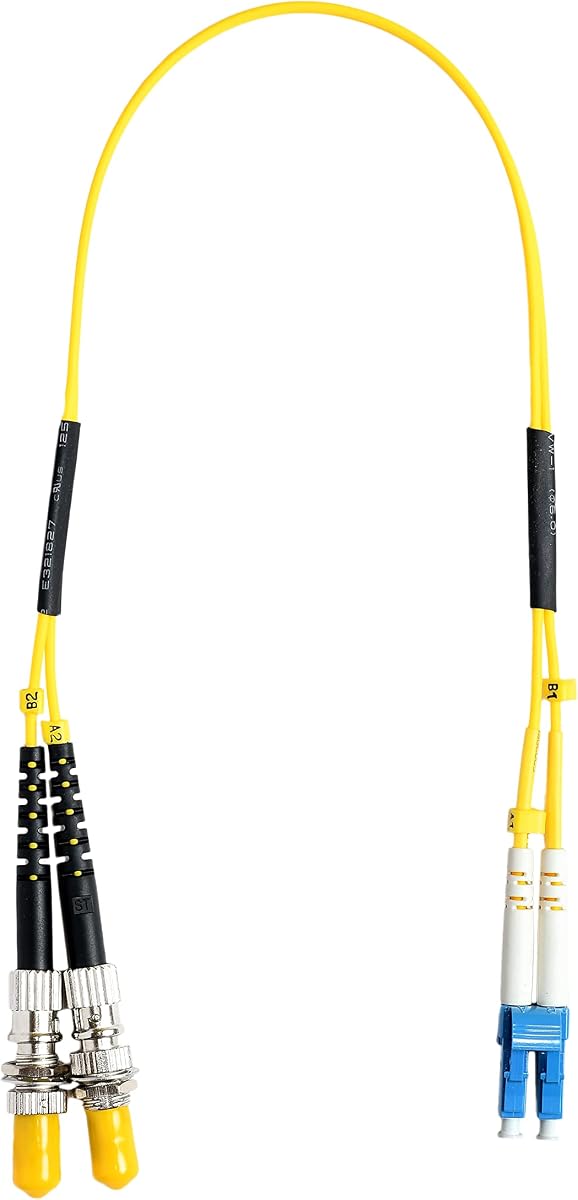
The OpZonik LC to ST Fiber Optic Adapter Cable is a one-foot duplex transition cable for single-mode 9/125 micrometer fiber. It connects an LC male end to an ST female end, providing a ready-made solution for duplex links where a separate inline coupler would not be convenient. No customer rating is supplied for this listing, so the product's stated construction is the main basis for evaluation.
We may earn a commission when you buy through this link, at no additional cost to you.
The 0.3-meter cable uses tight-buffered duplex zip cord with a 2.0 millimeter outer diameter and an LSZH jacket. The low-smoke zero-halogen construction can be advantageous in environments where cable fire performance is a concern. Factory termination and stated 100 percent testing for link loss and return loss offer additional assurance that the finished cable has been checked before shipment.
One limitation is its single-mode 1310 nanometer focus. It is not described as a multimode 850 nanometer cable, and the duplex form makes it larger and less flexible than a simplex inline adapter. It also has less connector-format flexibility than the Sabary interchangeable kit. Nevertheless, for a technician who specifically needs a short, factory-terminated duplex LC-to-ST transition cable, the dedicated format is a major advantage.
This is best for technicians connecting a duplex single-mode ST device or panel to an LC patch lead, especially where a short, neat transition is desired. Verify the connector orientation and the mating hardware at both ends before ordering. It is less appropriate for a one-fiber inspection or for equipment that requires multimode 850 nanometer fiber.
The two-strand cable addresses a full duplex link without requiring two individual simplex adapters. Its short length helps keep temporary test arrangements tidy and reduces excess cable that could snag in a work area.
The LSZH jacket is a notable construction feature for installations where low smoke and zero halogen are preferred. It also retains the practical benefit of factory termination and factory link-loss testing.
We may earn a commission when you buy through this link, at no additional cost to you.
The Ultra Spec Cables LC-to-ST Multimode Adapter Cable offers a duplex transition for 62.5/125 micrometer multimode fiber operating at 850 nanometers. It has a 4.8-star rating and uses an LC male connector on one end and an ST female connector on the other, making it appropriate for short links between multimode equipment and existing patch infrastructure.
We may earn a commission when you buy through this link, at no additional cost to you.
The standard zip cord duplex jacket and one-foot length make the product straightforward to use in temporary test configurations or compact installations. Because it is already terminated and duplex, it removes the need to pair two separate adapters and manage individual simplex leads. Its short form also helps avoid excess cable loops around optical power meters and visual fault locators.
The product does not support single-mode 9/125 micrometer links and is centered on the 850 nanometer operating window. The listing also does not provide specific insertion-loss or return-loss values, which limits technical detail compared with several inline adapters. The 4.8-star rating indicates generally favorable customer reception, but buyers should still verify their existing cable type before ordering.
Choose this cable for legacy multimode systems, short service loops, or test equipment that uses ST on one side and LC on the other. It is particularly appropriate for a complete two-fiber transition rather than a single-channel inspection. If the network is single-mode, select one of the 9/125 micrometer options instead.
The 62.5/125 micrometer core and cladding specification targets 850 nanometer multimode infrastructure. This makes the cable a better fit for older short-reach networks and compatible test equipment than a single-mode alternative would be.
At one foot, the adapter cable provides a short, orderly transition between connector formats. A duplex zip cord arrangement also simplifies installation where both transmit and receive strands need to cross between ST and LC systems.
We may earn a commission when you buy through this link, at no additional cost to you.
The Sabary Fiber Optic Adapter is the most versatile product in this roundup, with a 5.0-star rating and six interchangeable connector configurations. Instead of serving only one LC-to-ST transition, the kit covers LC, SC, ST, and FC formats, including male-to-female combinations for LC, SC, and ST use.
We may earn a commission when you buy through this link, at no additional cost to you.
Its durable metal housings are designed for corrosion resistance, structural stability, and repeated professional use. The manufacturer states insertion loss below 0.2 dB and return loss above 45 dB. It supports both single-mode and multimode fiber, which is useful for technicians who encounter varied plant equipment rather than maintaining one consistent network standard.
Because this is a general-purpose kit, buyers must identify the exact transition they need rather than assuming every included adapter has the same direction or polish. The 45 dB return-loss figure is also lower than the 50 dB or greater figures stated by some dedicated single-mode couplers, so it may not be the first choice when every specification point matters. Its genuine advantage is the breadth of formats in one package.
This kit is ideal for OTDR testing, optical power meters, visual fault locators, FTTX deployment, network construction, maintenance, and cable-production measurement. Choose it for a field technician who needs ST, LC, SC, and FC transitions on hand. For a permanent link with only one required ST-to-LC connection, a dedicated adapter is simpler.
The six interchangeable connectors let technicians adapt to several common termination standards without carrying separate specialty adapters. That flexibility is especially valuable during troubleshooting, when different test instruments and patch panels may use different connector combinations.
The kit is explicitly designed for OTDRs, optical power meters, and visual fault locators. Its stated low insertion loss and durable metal housings make it a broad field-service solution for installation, maintenance, and measurement work.
We may earn a commission when you buy through this link, at no additional cost to you.
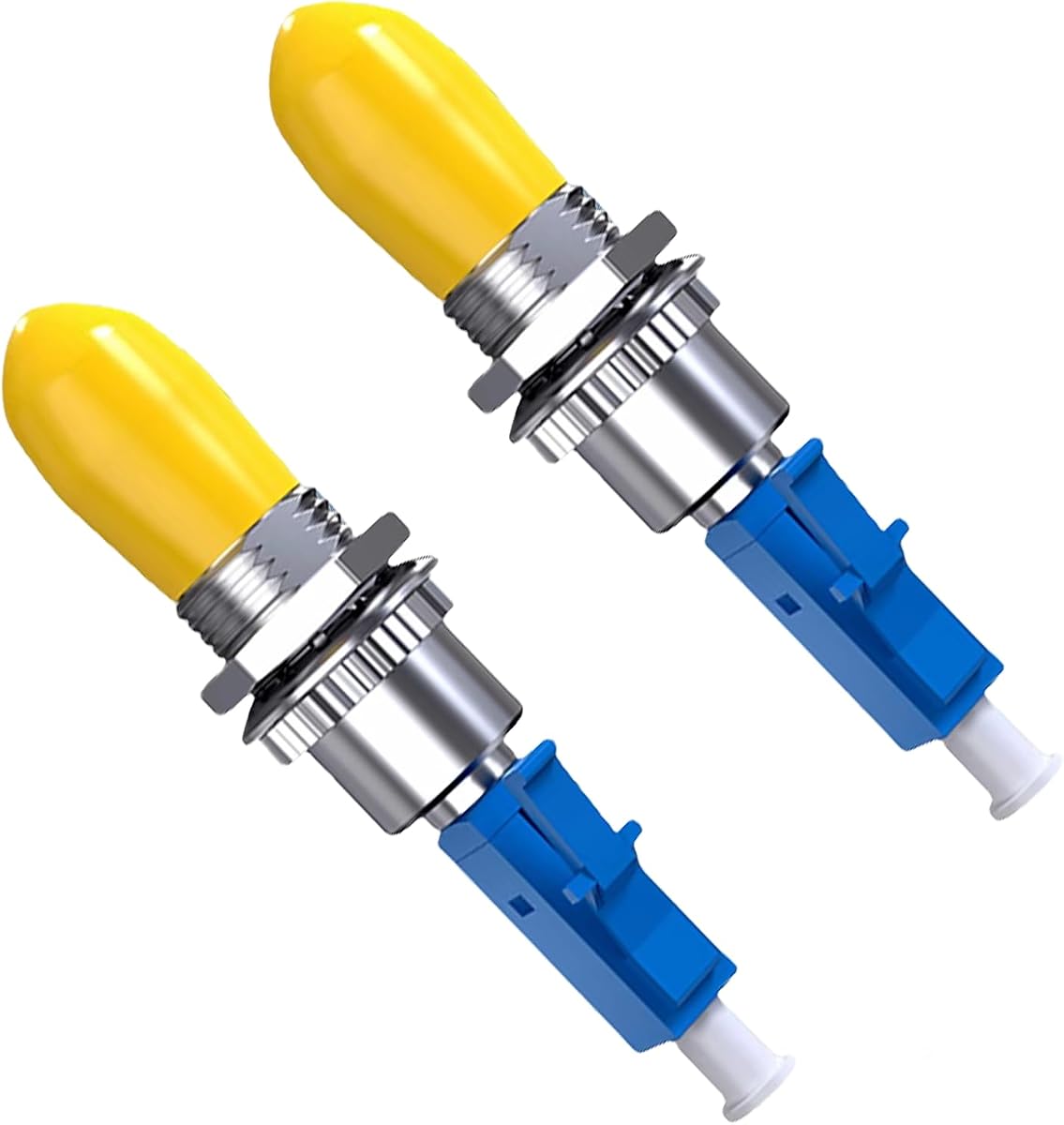
The ST to LCU Fiber Optic Adapter is a compact single-mode converter with a 5.0-star rating. It bridges ST/UPC and LC/UPC interfaces, using a push-pull connection on the LC side and a bayonet-style threaded coupling on the ST side. The result is a practical transition for telecommunications, enterprise backbone work, and mixed legacy-modern infrastructure.
We may earn a commission when you buy through this link, at no additional cost to you.
Precision ceramic sleeves and a metal housing support stable signal transmission and durability. The adapter is designed to fit standard adapter panels and wall outlets, which makes it relevant to high-density installations where a bulky transition cable would be inconvenient. Installation is tool-free, and the secure ST coupling is intended to remain stable under vibration.
Unlike several competing products, the listing does not state a numerical insertion-loss or return-loss specification. It also clearly focuses on UPC interfaces, so an APC-terminated cable should not be connected merely because the physical connector shape appears similar. The two-pack is still a practical advantage for technicians who want a spare or need to service two separate links.
This is a strong choice for network upgrades, panel transitions, and field repairs involving ST/UPC and LC/UPC equipment. Choose it when space, quick installation, and a secure connection are priorities. Buyers who need documented optical loss figures or work with APC polish should choose a more explicitly specified alternative.
The compact body is intended to fit standard adapter panels, wall outlets, and other space-constrained locations. This makes it more convenient than a short adapter cable when permanent panel integration or tidy cable management matters.
A push-pull LC interface and bayonet-style ST coupling allow quick installation without special tools. The threaded ST side is designed to resist vibration and maintain a dependable connection in demanding environments.
We may earn a commission when you buy through this link, at no additional cost to you.
The Ultra Spec Cables LC Female to ST Male Multimode Adapter Cable provides the reverse transition offered by several other entries in the comparison. It has a 4.9-star rating and uses a duplex 62.5/125 micrometer cable for 850 nanometer multimode applications, with an LC female end and an ST male end.
We may earn a commission when you buy through this link, at no additional cost to you.
Its one-foot standard zip cord design is practical when a technician needs a short adapter lead rather than a panel-mounted inline coupler. The duplex configuration supports two strands in one manageable cable, while the reversed gender arrangement can solve physical routing or equipment-panel problems that an LC-male-to-ST-female cable cannot.
As a multimode product, it is limited to 62.5/125 micrometer fiber and the 850 nanometer window, so it should not be selected for a 9/125 single-mode link. The listing also omits numerical insertion-loss and return-loss data. Those limitations make verification of the existing fiber type and connector arrangement especially important before purchase.
This cable is a good fit for short-distance legacy multimode networks and compatible optical test equipment requiring an LC female to ST male path. Its 4.9-star rating and clear duplex specifications set it apart from more generic transition descriptions. It is best chosen by a technician who knows this specific gender orientation matches the equipment and patch cords in the field.
An LC female to ST male cable can connect panels or equipment in arrangements that reject a male-to-female orientation. Having the correct gender physically available prevents unnecessary cable changes or improvised fittings.
The one-foot duplex lead offers a tidy temporary connection for multimode testing. Its paired strands reduce the number of separate transition cables needed when a full link must be bridged.
We may earn a commission when you buy through this link, at no additional cost to you.
The Ultra Spec Cables LC-to-ST Single-Mode Adapter Cable is a one-foot duplex transition built for 9/125 micrometer fiber at 1310 nanometers. It connects LC male to ST female, covers two strands, and offers a ready-made alternative to a pair of inline simplex adapters. Its 4.3-star rating is solid but lower than the ratings of the other Ultra Spec option in this list.
We may earn a commission when you buy through this link, at no additional cost to you.
The standard zip cord duplex jacket provides a straightforward way to create a temporary transition between single-mode equipment and patch infrastructure. The one-foot length is convenient for test-bench arrangements and compact service loops, while the duplex format ensures that both directions of a point-to-point link can use the same assembly.
Its 4.3-star rating suggests that most buyers consider it satisfactory, although it does not stand out as strongly as the 4.8-, 4.9-, and 5.0-rated alternatives. The listing provides no numerical insertion-loss or return-loss values, and the product is limited to the 1310 nanometer single-mode configuration. It is therefore a standard-purpose option rather than a heavily specified one.
Choose this cable for duplex single-mode networks that use LC on one side and ST on the other, particularly in temporary testing or maintenance work. It is a sensible direct transition for technicians who prefer a pre-terminated cable. Buyers requiring 1550 nanometer support or a detailed loss specification should examine a dedicated hybrid adapter with more published technical data.
The 9/125 micrometer construction and 1310 nanometer wavelength match common long-reach single-mode infrastructure. Using a cable with matching characteristics reduces the risk of connecting the transition to an incompatible fiber system.
Factory-formed duplex construction eliminates the need to coordinate two separate transition couplers. It is a practical way to create an organized temporary connection between ST and LC termination points.
We may earn a commission when you buy through this link, at no additional cost to you.
The QIANRENON ST Male to LC Female Hybrid Fiber Optic Converter is a simplex single-mode adapter with a 4.8-star rating. It is built around 9/125 micrometer fiber, UPC contacts, and a transition between ST/UPC male and LC/UPC female interfaces for use with patch cords, pigtails, and testing instruments.
We may earn a commission when you buy through this link, at no additional cost to you.
One of its strongest features is the detailed loss data. Insertion loss is listed as 0.12 dB at 1310 nanometers and 0.04 dB at 1550 nanometers, while return loss is specified as 53.3 dB and 52.3 dB, respectively. These values make the converter appealing for users who need more than a general compatibility claim when selecting an inline transition.
The adapter is simplex, so it is intended to handle one fiber at a time. It is also limited to single-mode 9/125 micrometer fiber and should be connected with compatible ST/UPC and LC/UPC patch cords or pigtails. Its listed uses include FTTH, FTTP, FTTA, LAN, broadband CATV, red light pens, optical power meters, and fiber-optic instrument interfaces.
This is a strong choice for a technician who values wavelength-specific optical specifications and frequently works with meters, visual pens, or pigtails. It is less appropriate when a complete duplex lead or multimode 850 nanometer connection is required. For the stated single-mode use case, however, it provides a compact and technically well-described solution.
Published insertion-loss and return-loss values give users a clearer basis for evaluating the converter. The listed figures are particularly useful for single-mode links operated at either 1310 or 1550 nanometers.
The adapter works with red light pens, optical power meters, and patch-cord pigtails, covering several routine troubleshooting tasks. Its UPC contact configuration allows it to pair correctly with ST/UPC and LC/UPC leads.
We may earn a commission when you buy through this link, at no additional cost to you.
The Ultra Spec Cables LC Female to ST Male Single-Mode Adapter Cable completes the roundup with a duplex transition for 9/125 micrometer fiber at 1310 nanometers. It has a 4.6-star rating and uses the opposite connector direction from the most common LC-male-to-ST-female single-mode cable, offering technicians another physically distinct option.
We may earn a commission when you buy through this link, at no additional cost to you.
The one-foot standard zip cord construction is practical for temporary links and compact service arrangements. Duplex strands provide both transmit and receive paths in a single cable, while the female LC and male ST ends can be useful where a panel receptacle or cable arrangement requires that particular gender combination.
The product is restricted to single-mode fiber in the 1310 nanometer operating window, and its listing does not provide specific insertion-loss or return-loss values. It therefore offers less technical visibility than the QIANRENON converter or the Poyiccot adapters. Its main advantage is the ready-made duplex cable in a reverse orientation, not a specialized performance claim.
Choose this cable for a short duplex single-mode transition where an LC female must connect to an ST male. It is suitable for users who need that exact gender orientation and do not need 1550 nanometer or multimode support. It is less suitable for general-purpose purchasing without prior knowledge of the required connector direction.
The LC female and ST male arrangement can be the correct fit for equipment that would not accept the conventional male-to-female transition. It provides a factory-terminated alternative to reversing or modifying existing patch leads.
The duplex jacket keeps both single-mode strands together in a short one-foot assembly. This supports cleaner temporary test setups and reduces the number of separate transition cables required.
We may earn a commission when you buy through this link, at no additional cost to you.
The right adapter depends less on the product label than on exact connector gender, fiber mode, wavelength, polish, and intended test role. Use the following factors to narrow the field before comparing listings or making a purchase.
ST and LC adapters are directional because each adapter pairs a male connector with a female connector. An LC male to ST female arrangement is not physically interchangeable with an LC female to ST male arrangement. Inspect the ports and cables in the intended setup, then match the required male side, female side, and interface gender. Connector shape alone is not enough; the equipment's receptacle design determines which transition can actually be installed.
Single-mode systems generally use 9/125 micrometer fiber, while the Ultra Spec multimode options use 62.5/125 micrometer fiber. These are not interchangeable merely because their external connector styles match. Check the fiber marked on the patch cable, pigtail, or equipment port, and verify that the adapter is designed for that core and cladding size. The Sabary kit is unusual in the list because it is explicitly designed to support both categories.
The listed wavelength indicates the optical environment the product is intended to support. Common single-mode adapters here cover 1310 and 1550 nanometers, while the shorter duplex multimode cables are specified for 850 nanometers. Select a product that covers the wavelength used by the link or test source. If a product only lists 1310 nanometers and the installation may use 1550 nanometers, confirm compatibility before purchase.
A simplex adapter carries one optical strand, while a duplex cable carries two. Inline couplers in this roundup are generally simplex and may require two units for a bidirectional link. Duplex patch-cable adapters provide both strands in one assembly, which can reduce clutter and make temporary test connections easier. Determine whether the application genuinely needs one strand or a matched pair before choosing the form.
Most of the adapters in this guide specify UPC interfaces. UPC and APC connectors differ in end-face polish, and forcing an APC connector into a UPC adapter can cause damage, poor performance, or excessive reflection. Check the labels and color conventions on both existing cables and the adapter being considered. If the system uses APC, purchase a matching APC adapter rather than relying only on the LC and ST connector shapes.
Insertion loss indicates how much optical power is lost through the transition, while return loss describes the amount of reflected light. The Poyiccot and QIANRENON products publish wavelength-specific figures, including a maximum insertion loss of 0.2 dB for the Poyiccot couplers and detailed values for the QIANRENON converter. The Sabary kit states less than 0.2 dB insertion loss and greater than 45 dB return loss. For demanding or measurement-sensitive work, these published values can be more useful than general claims.
An optical power meter, visual fault locator, and OTDR may not present the same connector interface. Dedicated ST-to-LC and LC-to-ST adapters are convenient for meter and locator connections, while the Sabary kit is particularly relevant to OTDR work and mixed connector environments. Look at the port on the instrument and the connector already fitted to the patch cable. A short duplex cable may also be easier to manage around a test instrument than two separate inline couplers.
Panel spaces, work areas, and temporary test benches have different physical requirements. A compact adapter with a metal housing is well suited to high-density panels and field repair kits, while a one-foot duplex cable provides a neat, flexible transition. Consider vibration, cable management, available space, and whether the adapter must remain mounted or simply support a temporary test. Ceramic sleeves and metal housings are useful indicators of a more robust field-oriented design.
Before installation, confirm that the adapter's male and female ends match the equipment, patch cords, or panel ports. Verify single-mode versus multimode construction, UPC versus APC polish, and the required wavelength. Inspect each connector end for dust, scratches, bent fibers, or contamination, and clean the mating surfaces according to the equipment manufacturer's fiber-optic cleaning procedure.
Install the adapter without forcing any connector. On a hybrid ST-to-LC adapter, seat the LC plug in the proper push-pull orientation and secure the threaded or bayonet-style ST coupling until it is snug. For a duplex cable, connect both strands in the same channel or labeled orientation used by the rest of the installation, and avoid sharp bends that exceed the cable's specified minimum bend radius.
After connection, test the link with the appropriate optical power meter, visual fault locator, or OTDR procedure. For a visible-light inspection, use the red light pen only as directed and never look directly into a fiber end. When finished, disconnect the adapter before cleaning it, keep dust caps on unused ports, store the assembly in a protective case, and inspect the connectors again before the next installation.
No. The labels describe the connector gender and direction of the transition. An LC-to-ST adapter has an LC male and ST female arrangement, while an ST-to-LC adapter has an ST male and LC female arrangement. Because connector gender affects physical compatibility, identify the required ends before buying and do not assume the two versions are interchangeable.
Only if the adapter is specifically designed for both fiber types and the proper mating connector is used. Many compact adapters are single-mode only, while the Sabary kit explicitly supports single-mode and multimode. The fiber designation must match the patch cable and equipment, since connector shape alone does not make incompatible fiber types safe to connect.
A simplex adapter carries one fiber strand through one male-to-female transition. A duplex adapter cable contains two strands and provides a complete paired connection. A duplex cable can be more convenient for a full link, while simplex adapters are useful for inspecting or testing one fiber at a time.
The wavelength identifies the optical operating range for which the adapter is specified. Single-mode links commonly operate at 1310 nm, 1550 nm, or both, while the 850 nm options in this guide support multimode fiber. Select an adapter that covers the wavelength used by your source, meter, or active network equipment.
No. UPC and APC connectors use different polish and should only be mated with the same polish type. Connecting mismatched end faces can increase reflection, degrade the link, and potentially damage the connector surfaces. Check the connector labels or color markings and obtain a matching adapter whenever the polish differs.
That depends on the connector arrangement. A duplex cable includes both strands, while a simplex inline adapter handles one strand. If your link requires one LC-to-ST transition and one ST-to-LC transition, you may need two appropriately oriented adapters or a duplex cable configured for the equipment and panel layout.
The best choice is the one that matches the OTDR port, the fiber type, and the connector at the far end of the link. The Sabary Multi-Connector Adapter Kit is especially versatile because it includes several transition formats for single-mode and multimode work. Dedicated adapters can also work when their connector direction and optical specifications precisely match the test arrangement.
Keep dust caps on unused ports and clean connector end faces with a proper fiber-optic cleaning method before every connection. Do not touch the ferrule end face or the fiber core. When storing an adapter, disconnect attached cables, cap the ports, and place the adapter in a clean protective case to prevent contamination and mechanical damage.
The Poyiccot ST to LC adapter stands out as a balanced dedicated coupling option, with three included units and useful 1310 and 1550 nanometer specifications. The reverse Poyiccot LC to ST adapter offers the same low-loss concept in a two-pack, while the Sabary Multi-Connector Kit leads when a technician needs a broader assortment for OTDR and mixed-format testing.
The best choice ultimately depends on the physical link and measurement task. Match connector gender, fiber mode, polish, wavelength, and simplex or duplex layout before comparing price or convenience. Compact inline adapters suit permanent transitions and instrument connections, whereas one-foot duplex cables are useful for tidy, temporary links between ST and LC-terminated systems.
Review the current product listing and specifications before ordering because prices, packaging, and availability can change. Confirm the adapter's exact direction, ensure that the fiber and polish match your equipment, and compare the published loss information with the requirements of the test or installation.