
Fluke 15B+ Digital Multimeter
4.8Editor score
CAT III 600V safety rating
Up to 1000V voltage measurement
Resistance, continuity, and capacitance
Explore the best Ohm Meter options by comparing resistance ranges, accuracy, safety features, display quality, portability, and household or professional uses.
An ohm meter is an essential diagnostic tool for measuring electrical resistance and investigating continuity, faults, components, wiring, batteries, and circuits. The best model depends on the measurements you need, the accuracy you expect, and the environment in which you will work, from simple household repairs to professional electrical maintenance.
We compared all ten featured instruments by examining their resistance limits, supported electrical functions, ranging methods, safety features, displays, lead systems, portability, and practical capabilities. The list includes general-purpose digital multimeters, an analog meter, a True RMS model, and a specialized insulation tester for users with different technical requirements.
Each review explains what distinguishes the instrument, including its most useful features and important limitations. The selections also show how practical designs range from simple manual controls to automatic ranging and specialized high-voltage testing. Product details and availability can change, so confirm the current listing information before purchasing.
4.8Editor score

4.7Editor score

4.5Editor score
The comparison below highlights the key differences in resistance capability, ranging, electrical functions, safety, and usability, helping you select an ohm meter suited to basic checks or advanced diagnostic work.

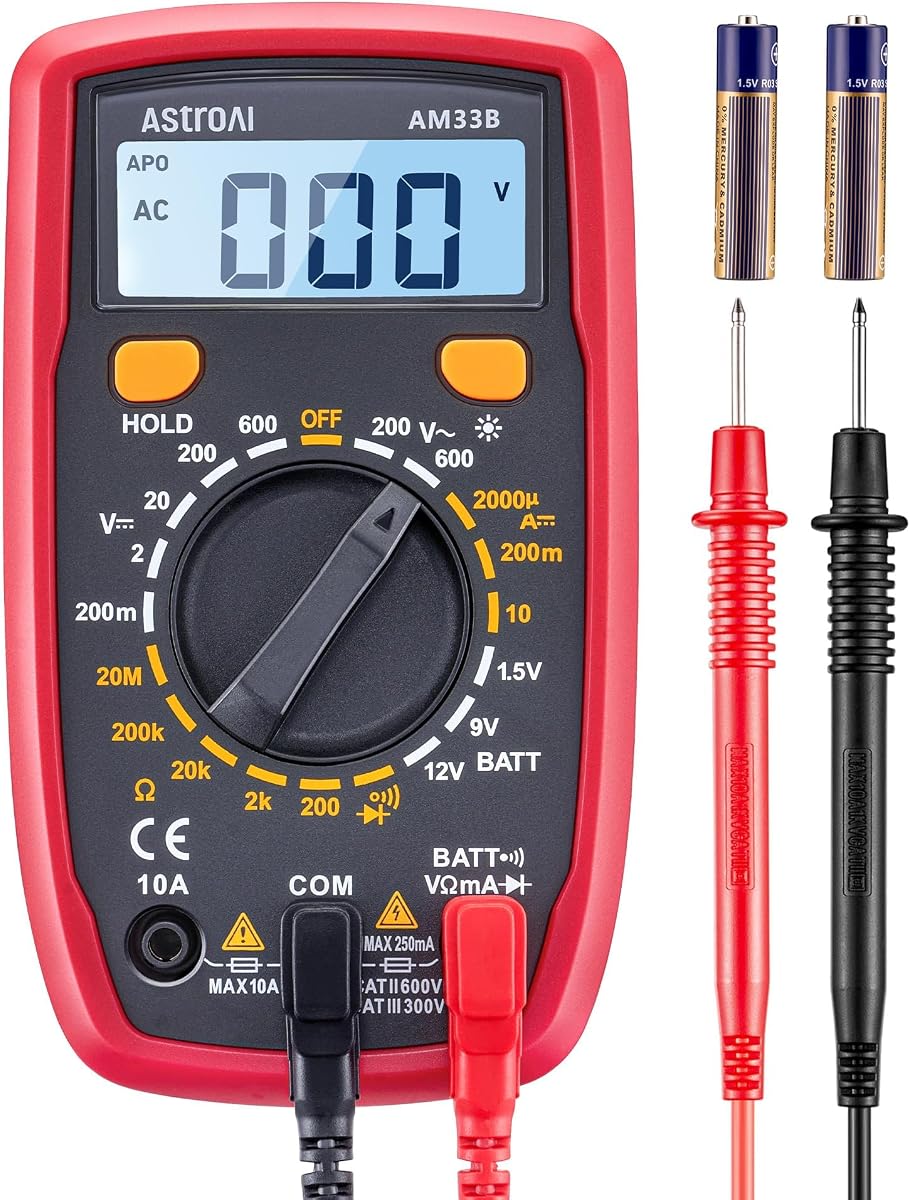


The AstroAI Digital Multimeter Tester 2000 Counts is a versatile entry point for anyone who needs resistance, voltage, current, continuity, and diode measurements in one instrument. Its 4.5 rating reflects a generally useful combination of readable display, straightforward controls, and enough protective design for common household and automotive diagnostic tasks.
We may earn a commission when you buy through this link, at no additional cost to you.
The 3½-digit, 1999-count LCD provides adequate resolution for routine resistance checks and a variety of electrical measurements. Its backlight is helpful in dim workspaces, while Data Hold allows a reading to remain visible while you reposition the probes. A continuity buzzer offers quick feedback when checking whether a conductive path is present.
The meter includes double-fuse protection, a silicone outer cover, and a low-battery indicator. Those protections do not make it appropriate for every energized system, but they add useful safeguards for general use. One notable limitation is that it cannot test AC current, and it also cannot accurately cover all AC current or AC voltage below 100mV.
This is a compelling selection for students, hobbyists, vehicle owners, and homeowners who want a capable ohm meter without moving into specialized instrumentation. Its manual rotary switch and broad measurement set make it particularly useful for learning and frequent household troubleshooting. Users who require automatic ranging or specialized insulation testing should choose one of the more advanced models instead.
Resistance and continuity are the core functions for identifying open circuits, failed components, and damaged wiring. The audible continuity indicator allows quick screening, while the display provides a numerical resistance reading when more detailed investigation is necessary.
The backlit screen improves readability in confined spaces, and the silicone cover adds a useful grip and physical protection. Double fuses and low-battery indication help support safer, more predictable operation during routine work.
We may earn a commission when you buy through this link, at no additional cost to you.
The Klein Tools MM325 Digital Manual-Ranging Multimeter combines a clear display with practical safety prompts and a broad set of electrical functions. Its 4.7 rating makes it an especially balanced option for electricians, technicians, and serious hobbyists who want more confidence than a basic tester without automatic-ranging complexity.
We may earn a commission when you buy through this link, at no additional cost to you.
Resistance measurement reaches 2MΩ, which is suitable for many circuit-board, component, switch, and wiring checks. The meter also measures AC and DC voltage up to 600V, DC current up to 10A, continuity, diodes, and batteries. Battery-test mode adds a convenient way to check whether common cells are working.
The lead-alert system is one of its most distinguishing features. Illuminated indicators show when the test leads are placed in the correct sockets, helping reduce setup mistakes. A backlit LCD makes readings easier to see, while the rear-mounted lead holders, kickstand, and optional magnetic hanger improve handling and hands-free use.
Because this is a manual-ranging model, users must select the appropriate range rather than relying on automatic detection. Its two-megohm resistance ceiling also falls short of models reaching 50MΩ or 200MΩ. Even so, the balance of diagnostics, safety prompts, and handling features makes the MM325 an excellent general-purpose ohm meter.
The illuminated lead-placement indicators make it easier to confirm that each probe is in the correct terminal before taking a measurement. This is particularly useful when you are troubleshooting unfamiliar equipment or working in poorly illuminated areas.
Beyond a two-megohm resistance range, the MM325 handles voltage, current, continuity, diode, and battery checks. That broad coverage makes it a useful primary instrument for electrical service, automotive work, and electronics troubleshooting.
We may earn a commission when you buy through this link, at no additional cost to you.
The AstroAI True RMS 6000 Counts Auto-Ranging Volt Meter is designed for users who want a broad diagnostic platform rather than a simple resistance tester. Its 4.6 rating reflects a capable combination of automatic operation, higher display resolution, and specialized measurements for household and automotive troubleshooting.
We may earn a commission when you buy through this link, at no additional cost to you.
Resistance is one of many supported functions, alongside AC and DC voltage and current, capacitance, frequency, duty cycle, continuity, diode testing, and temperature measurement. True RMS improves accuracy when working with non-sinusoidal AC signals, while automatic ranging reduces the need to select ranges manually.
A large backlit LCD, Data Hold, auto shutoff, and a built-in kickstand improve everyday usability. Double ceramic fuses are specified for overload protection, and the meter includes F400mA/600V and F10A/600V explosion-proof ceramic fuse tubes according to the supplied product information.
This model is well suited to automotive diagnostics, household electrical investigations, and electronics work where several measurement types may be needed. Its broad feature set can create a steeper learning curve for beginners, and the included test-lead cap must be removed before use. Even so, it offers an excellent balance of capability and convenience.
Automatic ranging lets the meter select the appropriate resistance or voltage range with less manual intervention. This is especially valuable when alternating between different components, circuits, and test conditions.
True RMS measurement is valuable when a signal does not follow a clean sine wave. Combined with frequency, duty-cycle, and current functions, it expands the meter beyond ordinary resistance and continuity testing.
We may earn a commission when you buy through this link, at no additional cost to you.
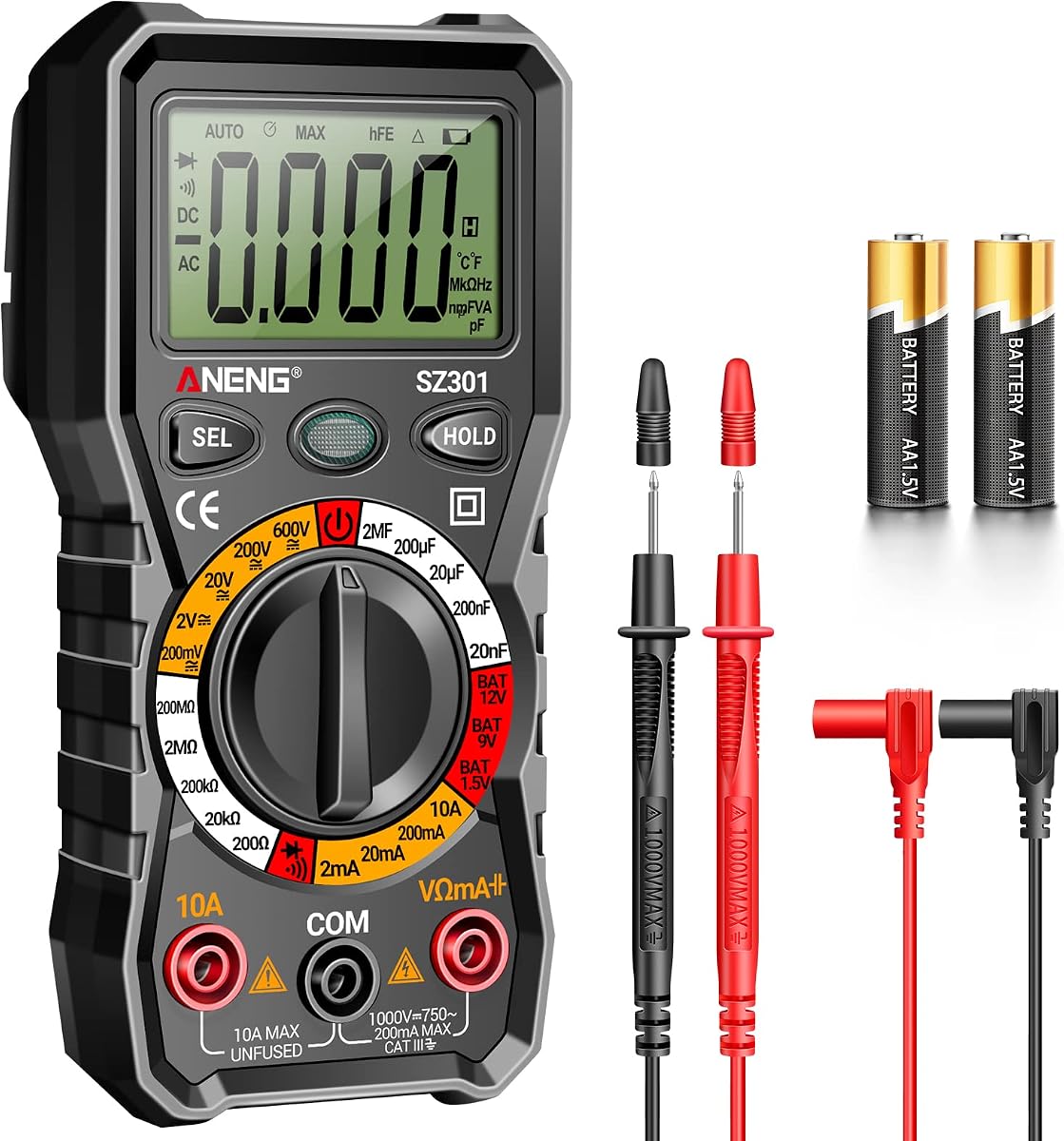
The ANENG Digital Multimeter with Case stands out for its extensive resistance range and generous measurement specifications. Its 4.4 rating makes it a practical choice for electronics learners, hobbyists, and technicians who need more resistance capability than the basic models provide.
We may earn a commission when you buy through this link, at no additional cost to you.
Resistance measurement extends from 0Ω to 200MΩ, with stated resolution ranging from 0.1Ω to 100kΩ and accuracy of ±(4.0%+10). It also supports AC and DC voltage from 200mV to 600V, AC and DC current from 2mA to 10A, capacitance from 0nF to 2mF, continuity, diode, and live-wire functions.
The included silicone case adds protection and simplifies storage, while two AA batteries arrive preinstalled. Double fuses, overload protection, and insulated probes support safer handling. The meter is compact and lightweight, making it portable for field repairs, student workbenches, and service kits.
Manual ranging means the user must choose the correct range, which can slow down rapid testing compared with an auto-ranging model. Its stated accuracy is also less refined than the higher-end options. Even with those trade-offs, the broad resistance limit and included case make this an attractive value for component and circuit testing.
A 200MΩ ceiling is especially useful for high-resistance components, insulation-oriented checks, and leakage investigations. It also gives beginners room to examine a wider measurement range without immediately reaching the instrument limit.
The compact body, preinstalled batteries, insulated probes, and silicone case create a convenient package for mobile troubleshooting. Keeping the meter and leads together can also reduce missing-accessory problems.
We may earn a commission when you buy through this link, at no additional cost to you.
The AstroAI Digital Multimeter Black is a straightforward 2000-count meter that combines standard electrical tests with dedicated battery evaluation. Its 4.6 rating and useful feature set make it appropriate for homeowners, automotive hobbyists, and technicians who regularly check common batteries.
We may earn a commission when you buy through this link, at no additional cost to you.
The meter measures AC and DC voltage, DC current, resistance, continuity, and diodes. Battery-test modes cover 1.5V, 9V, and 12V cells, with automatic detection and status display for the 1.5V and 9V modes. That makes it convenient for quickly sorting healthy and questionable batteries.
A backlit LCD, Data Hold, auto shutoff, and continuity buzzer support efficient use in dim spaces and on unstable readings. Double fuses protect against overload, the silicone cover improves grip and physical protection, and a low-battery indicator warns the user before operation becomes unreliable.
This instrument cannot test AC current, which is an important distinction from meters that cover both AC and DC amperage. It also uses a manual rotary selector, so users must understand the available ranges. For battery-heavy diagnostics and ordinary resistance work, however, it offers a practical and approachable feature set.
Dedicated modes for 1.5V, 9V, and 12V batteries reduce the need to interpret a general voltage reading. Automatic status detection for common battery sizes helps users make faster decisions.
The backlit display makes values easier to read in garages, cabinets, and other dim work areas. Data Hold preserves a measurement, while auto shutoff helps preserve battery life between tasks.
We may earn a commission when you buy through this link, at no additional cost to you.
The Fluke 15B+ Digital Multimeter is the premium choice in this collection, combining a 4.8 rating with a focused set of electrical measurements. It is built for users who work on residential, commercial, automotive, and panel-based systems and need more confidence than an entry-level meter offers.
We may earn a commission when you buy through this link, at no additional cost to you.
Resistance, continuity, diode, and capacitance measurements sit alongside AC and DC voltage up to 1000V and AC and DC current up to 10A. Its CAT III 600V safety rating supports use in common residential and commercial environments, making the rating system easier to match with the type of installation being investigated.
A dedicated input terminal for current measurements to 10A helps separate high-current work from the other input positions. This organization reduces confusion during setup and makes the instrument practical for repeat diagnostics involving overloads, short circuits, and faulty wiring.
The Fluke 15B+ is best suited to professionals, advanced students, and serious DIYers who value proven specifications and broad application coverage. The supplied information does not state its maximum resistance range, so buyers with unusually high-impedance requirements should verify that detail. For broad electrical work, it remains the strongest premium selection here.
The CAT III 600V rating gives users a clear way to evaluate the instrument for common residential and commercial applications. It is especially relevant when a multimeter will be used on panels, outlets, or other installed equipment.
Voltage, current, resistance, continuity, diode, and capacitance functions cover the core needs of electrical troubleshooting. Support for both AC and DC current broadens its usefulness beyond the simplest resistance tester.
We may earn a commission when you buy through this link, at no additional cost to you.
The Klein Tools MM420 Auto-Ranging TRMS Digital Multimeter is a rugged, feature-rich instrument suited to residential, business, HVAC, and light-industrial work. Its 4.7 rating reflects a strong balance of measurement breadth, automatic operation, True RMS capability, and physical durability.
We may earn a commission when you buy through this link, at no additional cost to you.
Resistance reaches 50MΩ, giving it considerably more headroom than the MM325. It also measures AC and DC voltage up to 600V, AC and DC current up to 10A, continuity, temperature, capacitance, frequency, duty cycle, and diodes. Auto-ranging makes it easier to move between disparate components without repeatedly changing the selector.
True Root Mean Squared technology provides more dependable results on non-linear AC waveforms, which are common in modern power electronics and variable-speed equipment. The backlit display remains legible in low-light settings, while illuminated lead-alert indicators help confirm correct terminal placement.
The MM420 is built to withstand a 6.6-foot drop and includes CAT III/CAT IV safety caps, a thermocouple, instructions, and two AAA batteries. Rear lead holders, a kickstand, and compatibility with an optional magnetic hanger support field work. It is a particularly strong choice for technicians who need high resistance limits, automatic ranging, and rugged construction.
Automatic range selection reduces configuration errors and makes the meter faster to use. Fifty-megohm resistance capacity is useful for insulation-related checks, high-value resistors, capacitors, and components that would exceed a two-megohm limit.
A two-meter drop rating gives the MM420 an advantage in busy field environments. The included safety caps, thermocouple, and rear-mounted accessories support a ready-to-work diagnostic setup.
We may earn a commission when you buy through this link, at no additional cost to you.
The Klein Tools ET600 Megohmmeter is the specialist choice for insulation-resistance diagnostics. Its 4.8 rating reflects a purpose-built design that extends far beyond ordinary continuity and component checks by measuring insulation resistance up to 4000MΩ.
We may earn a commission when you buy through this link, at no additional cost to you.
The tester supports DC insulation test voltages of 125V, 250V, 500V, and 1000V, allowing users to evaluate insulation under different test conditions. Test and lock buttons simplify the measurement sequence, while a warning alarm and high-voltage icon help identify potentially hazardous voltage before testing.
This is more than a simple ohmmeter. It can also measure up to 1000V AC or DC, resistance, and continuity. Automatic-ranging True RMS technology supports accurate results, and the backlit display includes a bar graph along with icons for auto power-off, high voltage, maximum/minimum readings, and Hold.
The ET600 is appropriate for electricians, facilities teams, maintenance personnel, and advanced users responsible for cable, motor, feeder, or equipment insulation. Because it generates high test voltages, it is not interchangeable with every everyday multimeter. Those working only on small circuits should instead consider a general-purpose model.
The 4000MΩ resistance limit and four selectable DC test voltages allow users to evaluate insulation more comprehensively than a conventional continuity test. This makes the ET600 relevant to preventive maintenance and commissioning work.
The warning alarm, high-voltage icon, and dedicated test controls help make the testing process more deliberate. Proper training and safe isolation procedures remain essential because these outputs exceed ordinary measurement voltages.
We may earn a commission when you buy through this link, at no additional cost to you.
The Gardner Bender GMT-318 Analog Multimeter offers a traditional alternative to the digital meters dominating this list. Its 4.4 rating makes it relevant to users who prefer a straightforward needle movement and want to observe changing values rather than only fixed digital readings.
We may earn a commission when you buy through this link, at no additional cost to you.
The color-coded analog display helps users interpret values at a glance, which can be particularly useful when monitoring a signal while adjusting a component or following a gradual change. The meter includes replaceable test leads and operating instructions, making basic ownership and maintenance straightforward.
It offers six functions across 14 ranges, with manual range selection through a 15-position rotary dial. Agency approval and integrated fuse overload-protection circuitry add important safeguards. AC and DC voltage measurement is identified up to 500V, while resistance and other electrical checks are handled through the multi-range interface.
Analog readings require more interpretation and generally lack the precision, logging convenience, and specialized features of modern digital instruments. However, the GMT-318 can still be an effective teaching, training, or maintenance tool for someone who values the direct response of a moving needle and uncomplicated physical operation.
The analog needle makes gradual changes and unstable behavior visible. That can help during learning, component adjustment, and troubleshooting where the direction and movement of a reading provide useful context.
A 15-position rotary dial and replaceable leads keep the instrument approachable. Integrated fuse protection supports dependable use, although training is still important when navigating manual ranges.
We may earn a commission when you buy through this link, at no additional cost to you.
The Westinghouse 600V True RMS Auto-Ranging Digital Multimeter is designed with commercial and residential electricians in mind. Its 4.7 rating reflects a versatile measurement platform, strong physical specifications, and useful functions for household, automotive, and light-industrial circuits.
We may earn a commission when you buy through this link, at no additional cost to you.
The meter handles AC and DC voltage up to 600V, current up to 10A, resistance, continuity, frequency, temperature, diode, and capacitance measurements. Automatic ranging reduces setup requirements, while True RMS accuracy supports standard and non-linear waveforms commonly encountered in modern electronics and power equipment.
The 4000-count backlit LCD is easy to read in low-light conditions. Maximum/minimum mode captures fluctuating signals, and temperature can be shown in Celsius or Fahrenheit, making the instrument relevant to appliances, HVAC systems, and electronic components. Overload protection adds another layer of operational assurance.
The stated standards include UL 61010-1, CSA C22.2, and UL/CSA 61010-2-033. A two-year warranty, 24/7 customer service, and two-meter drop resistance add support for professional ownership. The resistance maximum is not stated in the supplied information, so buyers with high-impedance needs should verify that specification.
Voltage, current, resistance, continuity, frequency, capacitance, and temperature cover common diagnostic tasks. The MAX/MIN mode is especially useful when checking intermittent or changing conditions in a circuit.
True RMS measurement helps produce dependable results when AC signals contain harmonics or other non-linear elements. This is valuable for diagnosing modern electronic controls, variable-speed equipment, and power supplies.
We may earn a commission when you buy through this link, at no additional cost to you.
Choosing an ohm meter requires balancing resistance range, accuracy, electrical functions, safety, and handling against the kinds of circuits and components you routinely test.
Resistance range determines the smallest and largest values the instrument can display. General-purpose meters with a two-megohm limit are often suitable for ordinary circuits and components, while 50MΩ and 200MΩ models provide more headroom for high-value resistors, capacitors, leakage checks, and insulation-oriented diagnostics. Resolution also matters: finer display increments can make closely related values easier to distinguish, although the full accuracy specification remains more important than resolution alone.
Choose a resistance limit that comfortably covers your normal work, not merely the largest theoretical value you can imagine. Verify that the meter also provides useful low-end resolution for short measurements.
Manual ranging gives the user direct control over the selected interval and can be useful when learning how meter ranges work. It also adds a step to every measurement and creates more opportunities for range-selection mistakes. Automatic ranging is faster and simpler, particularly when testing unknown component values or moving between several diagnostics, though it may be less suitable when precise range selection is needed.
Automatic ranging favors convenience, while manual ranging favors deliberate control. Consider your experience and the frequency of mixed measurements.
True RMS measurement calculates the effective value of an AC signal more accurately than a simplified average-based method. This matters for nonlinear waveforms produced by variable-speed drives, switching power supplies, dimmers, and modern electronics. If you work primarily with DC or standard clean sine-wave AC, True RMS may add less practical value. If AC power electronics form a large part of your diagnostics, it is a worthwhile priority.
Select True RMS for complex AC signals and modern electronic systems. For straightforward DC and basic household checks, the extra capability may be optional.
A meter should match the type of circuits you intend to test. A CAT rating provides information about the instrument's suitability for particular installation categories and voltage levels, while fuse protection helps limit damage from overloads. Silicone covers, insulated probes, lead-position warnings, high-voltage alarms, and overload indicators add practical safeguards. Safety features support good procedure but never justify working beyond a meter's limits.
Match the safety rating to the environment, verify lead placement, and isolate hazardous circuits before testing. Never treat a protective feature as a substitute for safe work practices.
A clear display is essential because resistance values can be difficult to interpret on small or dim screens. Backlighting helps in garages, cabinets, and outdoor work areas. Display count indicates how much information the meter can present at once; 1999-count and 4000-count screens cover routine needs, while 6000-count models offer greater resolution. Data Hold, MAX/MIN capture, bar graphs, and color-coded scales can make changing values easier to monitor.
Prioritize a readable screen, straightforward controls, and features that make unstable or changing readings easier to observe. A larger display is useful, but menu complexity matters too.
An ohm meter becomes more useful when it also measures voltage, current, continuity, and diode performance. Capacitance, temperature, frequency, duty cycle, battery testing, and AC current can further reduce the need for separate instruments. A dedicated battery-test mode may be convenient for maintaining a large collection of cells, while temperature is valuable for HVAC and appliance diagnostics. Extra functions are beneficial when needed but can increase cost, complexity, and opportunities for setup errors.
List the measurements you perform regularly, then choose the smallest feature set that covers them. Avoid paying for capabilities you will never use.
A compact meter is easier to carry between a toolbox, vehicle, workbench, and client site. A kickstand, rear test-lead storage, and hands-free hanging options support practical field use. Physical durability is especially important in demanding environments. Specifications such as drop resistance, replaceable leads, and replaceable fuses indicate attention to longevity. Analog meters may provide a direct visual response but often occupy more space and require more interpretation than digital models.
Choose a size and construction that suit your working environment. Durability and organized accessories are especially valuable for frequent field use.
A standard multimeter is appropriate for most resistance, voltage, continuity, and current tasks. A megohmmeter is different because it applies controlled high test voltages to evaluate insulation resistance in cables, motors, feeders, and equipment. Specialized insulation testing requires appropriate procedures and awareness of the hazards involved. Buying a general-purpose instrument is simpler for broad home and electronics work, while maintenance professionals may benefit from keeping both types available.
Buy a megohmmeter only when insulation testing is part of your regular duties. Otherwise, a dependable general-purpose multimeter offers more practical versatility.
Before measuring, identify the circuit or component and verify that the meter, leads, and selected mode are appropriate. Connect the leads to the correct input terminals, turn on the instrument, and confirm that the resistance mode appears on the display. If the meter provides lead-alert indicators, use them to verify placement before touching the circuit.
For a resistance measurement, isolate the component from power where practical, discharge any stored energy, and connect the probes across the two points you want to evaluate. Do not measure resistance in an energized circuit unless the instrument explicitly supports the required procedure. Read the result, compare it with the expected value or component tolerance, and record additional information such as temperature if it affects the diagnosis.
After use, switch the meter off, remove the leads, and store accessories together in a dry case. Replace test leads promptly if insulation is damaged, and change batteries according to the manual or low-battery indicator. Inspect the rotary selector, sockets, casing, and fuses periodically, and have specialized meters serviced or recalibrated when required.
An ohm meter measures electrical resistance, usually expressed in ohms. It can also support continuity testing, helping you determine whether a conductive path exists between two points. Most useful models also measure voltage and current, turning them into versatile digital multimeters.
No. Multimeters may display ohms, kilohms, or megohms, often with an automatic prefix on the screen. The prefix indicates scale. A reading of 2kΩ means 2,000 ohms, while 2MΩ means 2,000,000 ohms.
Generally, no. Disconnect power, isolate the component when appropriate, and discharge stored energy before measuring resistance. An incorrect resistance measurement can damage the meter or produce a misleading result, and testing energized conductors may also create personal safety hazards.
Continuity testing checks whether a path exists, usually through a beep or other indicator. Resistance testing provides a numerical value describing how strongly current is opposed. Continuity is useful for quick open-circuit screening, while resistance values help evaluate components, windings, and insulation.
True RMS is most valuable when measuring AC signals with non-sinusoidal waveforms, such as those from electronic controls, dimmers, switching supplies, and variable-speed drives. For standard DC checks and many simple AC circuits, a conventional meter may be adequate. True RMS provides an advantage when waveform complexity matters.
A two-megohm range covers many common electronics and component tasks. A 50MΩ or 200MΩ range is preferable for high-value resistors, capacitor charging behavior, leakage investigations, and some insulation-related checks. Choose based on the components you regularly test rather than the highest available number alone.
Some models include a dedicated battery-test function that compares measured voltage with a battery's expected condition. Others can still check basic battery state using their voltage range, but they may not provide a clear pass-or-fail status. The AstroAI Digital Multimeter Black, for example, includes modes for 1.5V, 9V, and 12V batteries.
A megohmmeter is better for formal insulation-resistance testing of cables, motors, feeders, and electrical equipment. It applies controlled high DC test voltages and reports insulation values over a much broader range. A standard multimeter remains more convenient for routine voltage, current, resistance, and continuity checks.
The Fluke 15B+ is the premium all-around selection for broad electrical diagnostics, while the Klein Tools MM325 offers a balanced combination of resistance testing, lead-placement protection, and daily usability. For buyers seeking a capable entry instrument, the AstroAI Digital Multimeter Tester 2000 Counts provides useful resistance, continuity, voltage, and current functions in an approachable design.
Prioritize the resistance range, accuracy, safety rating, display, and measurement functions that match your actual work. Automatic ranging is convenient, True RMS helps with complex AC signals, and a megohmmeter becomes important only for dedicated insulation testing. Analog displays, battery modes, and high resistance ceilings can be valuable when they match a specific workflow.
Before purchasing, review the current product listing, confirm accessories and stated specifications, and consider the latest availability information. Product configurations and technical details can change, so checking the manufacturer's guidance and the meter's manual helps ensure safe, accurate use.