
Miuzei MG90S 9G Micro Servo Motor
4.5Editor score
2.0 kg-cm stall torque
Metal gear construction
180-degree rotation range
Compact micro-servo format
Explore the best servos for Rc Planes with detailed comparisons of torque, speed, voltage, gearing, size, control precision, and installation features.
Servos for RC planes must balance light weight, responsive movement, reliable centering, and enough torque to hold a control surface against the loads created by airflow. The right choice also depends on aircraft size, receiver compatibility, available voltage, and whether the model uses conventional steering or a more demanding control configuration.
This guide compares ten metal-gear and digital servo options based on the supplied specifications, including stall torque, transit speed, operating voltage, rotation range, dimensions, deadband, wiring, and stated aircraft applications. It covers compact 9g micro servos for small planes as well as higher-power standard servos suited to larger sport models and demanding control surfaces.
Each review explains the strongest reasons to consider a particular servo while also identifying practical limitations from its published specifications. The top picks represent the most balanced choices for different needs, including budget-friendly micro models, versatile everyday installations, and higher-voltage aircraft systems. Product prices and availability can change, so verify current listings before purchasing.
4.5Editor score

4.6Editor score

4.6Editor score
The comparison below places the ten servos side by side, emphasizing the differences that matter in an RC aircraft: torque, speed, voltage, gearing, weight, rotation, and control precision. It also shows which products are sold in larger packs for multi-control installations and which target higher-voltage standard-aircraft systems.




The Miuzei MG90S is a compact 9g micro servo that combines an aluminum metal-gear train with 2.0 kg-cm of stall torque at 6.0V. It carries a 4.5 rating, making it a well-rounded option for small RC planes that need more torque than a basic plastic-gear SG90 without moving to a substantially larger standard servo. Its advertised 180-degree rotation also gives an installer a familiar range for common control-surface linkages.
We may earn a commission when you buy through this link, at no additional cost to you.
The key strength is the balance between physical size and mechanical capability. According to the supplied specifications, the servo reaches 0.08 seconds per 60 degrees at 6.0V, which should provide crisp response when the receiver and control throws are configured correctly. The coreless motor and aluminum teeth are intended to reduce noise and improve durability, particularly useful in small aircraft where component weight and operating sound can both matter.
Power management is the main trade-off. The MG90S operates from 4.8V to 6.0V, and the manufacturer specifically recommends a stable 5V supply for smooth, reliable performance. For several servos, the product information advises using an external stable supply rather than drawing all starting and stall current from the receiver or flight battery. That makes installation planning essential, especially in compact models with limited space for a separate regulator.
This is a strong general choice for lightweight trainers, small park flyers, and other micro aircraft using conventional PWM servos. It is particularly attractive when a builder wants a two-servo pack, metal gearing, and straightforward compatibility with Arduino, Raspberry Pi, and RC receivers. For a single simple aircraft, the compact two-pack is sensible; for a multi-control model, a larger pack may offer better convenience.
The aluminum gear train is the defining feature of this micro servo. It provides more resistance to tooth wear and breakage than a basic plastic-pinion design while retaining the small dimensions required by lightweight RC aircraft and compact robotics projects.
A continuous, stable supply helps the servo start predictably and move smoothly. For multi-servo installations, use a suitable external regulator or BEC rather than relying on the receiver alone to supply peak current.
We may earn a commission when you buy through this link, at no additional cost to you.
This Smraza SG90 kit provides ten compact digital servos, making it particularly useful for builders completing a multi-control aircraft or keeping several spares on hand. It has a 4.4 rating and shares the familiar SG90 format used in many small RC planes, micro robots, boats, and classroom electronics projects. The set is aimed at users who want consistent hardware across multiple installations rather than a single replacement servo.
We may earn a commission when you buy through this link, at no additional cost to you.
Its motor pinion gear and shaft are upgraded to metal to resist the tooth breakage and heat deformation associated with some plastic-gear units. The published performance figures are 0.08 seconds per 60 degrees and 1.9 kg-cm of stall torque across a 180-degree range. An improved 5-microsecond deadband is another meaningful feature because it can reduce unwanted servo movement around the commanded center position, which is valuable for stable control surfaces.
The main limitation is electrical demand. Smraza states that the servo requires a continuous PWM signal and a supply capable of more than 1A of starting current. Ten servos operating together make good power distribution even more important. A BEC with adequate margin, solid wiring, and a reliable connection to the receiver battery are needed to avoid resets, erratic movement, or inadequate voltage during rapid control deflection.
For fixed-wing and KT planes, gliders, or compact RC mechanisms, this kit is a practical choice when several servos are required. It also works with Arduino and Raspberry Pi through the standard three-pin PWM connection and is compatible with JR and Futaba receivers. The included arms and leads help organize a compact installation, although builders should still select the correct arm and horn spacing for each aircraft.
Ten matching servos are useful for a full-size control layout, multiple models, or a workshop inventory. Standardizing on one type simplifies spare-part decisions and makes it easier to keep a consistent feel when moving between projects.
The stated 5-microsecond deadband helps minimize jitter around the center command. That can improve the appearance and effectiveness of a centered aileron, elevator, or rudder, although correct linkage geometry remains equally important.
We may earn a commission when you buy through this link, at no additional cost to you.
The four-pack SG90 digital servo combines a 4.6 rating with the type of refined control characteristics often sought in small RC aircraft. It produces 1.9 kg-cm of stall torque, travels 180 degrees, and is rated for 0.08 seconds per 60 degrees. Those figures place it in the highly responsive micro-servo category while its metal pinion gear and shaft provide a meaningful improvement over all-plastic mechanisms.
We may earn a commission when you buy through this link, at no additional cost to you.
This model is especially interesting for control precision. The listed deadband is no more than 5 microseconds, described as tighter than the more common 7-microsecond range, and the product is advertised for smoother aircraft, boat, and robotic movement. It also operates below 40 dB according to the supplied information, making it appropriate for quiet classroom work and home projects where continuous servo noise could be distracting.
The compromise is its scale. A 9g micro servo is designed for lightweight aircraft and compact mechanisms, not for recreating the holding power of an MG995 or an HV standard servo. The stall-torque figure also describes performance at the limit, so a control surface should be sized and balanced correctly rather than operated continuously against a mechanical stop. Rapid moves can draw enough current to make a stable supply essential.
For a small trainer, glider, micro plane, or educational build, this four-pack is a compelling balance of responsiveness, quiet operation, and included hardware. It suits users who need several matching servos but do not require the power of a standard aircraft servo. Confirm that the aircraft's receiver, voltage, mounting space, and control-surface loads match a 9g format before making it the final choice.
The tight deadband and fast response make this servo attractive where surface trim and immediate response are important. Those qualities are most useful in small, responsive models rather than heavy surfaces under constant aerodynamic load.
The stated sub-40 dB operation is useful in classrooms, libraries, and quiet home flying areas. Quieter movement can also make it easier to diagnose linkage rubbing or unwanted control jitter by ear.
We may earn a commission when you buy through this link, at no additional cost to you.
The Hosyond MG90S five-pack is a compact metal-gear option for small RC planes, helicopters, boats, and robot projects. It holds a 4.3 rating and is specified at 13.5 grams per servo. Each unit rotates approximately 180 degrees, with 90 degrees available in either direction, making it compatible with the broad movement expected from common micro-servo control linkages.
We may earn a commission when you buy through this link, at no additional cost to you.
The all-metal gear train is the primary reason to consider this set over a similarly sized plastic-gear alternative. It is intended to improve mechanical durability and rotational accuracy. Movement is listed at 0.1 seconds per 60 degrees at 4.8V and 0.08 seconds per 60 degrees at 6.0V, giving the set respectable response when supplied with adequate voltage.
Its listed dimensions are 22.8 by 12.2 by 28.5 millimeters, and the 26-centimeter leads help keep wiring manageable in compact airframes. The supplied package includes three swing arms and fixing screws for each servo. Although that makes the set practical for standard micro-servo installations, builders should verify that the arm style and mounting hole pattern suit the chosen receiver or linkage.
This pack is best for small aircraft that need multiple durable micro servos without moving to the weight and power of a standard servo. It is also relevant to mixed hobby projects involving helicopters, boats, or Arduino-controlled vehicles. The five-unit quantity is less convenient for a large six-control installation than the ten-pack, but it is a useful middle ground for a four-control model plus a spare.
Using metal gearing across the pack gives every servo the same basic durability advantage. It is particularly helpful for linkages that experience frequent movement or occasional binding during a long project build.
Five units can support a typical four-control plane plus a spare. That makes the pack practical for small models with ailerons, elevator, and rudder, or for builders who expect to need one replacement during setup.
We may earn a commission when you buy through this link, at no additional cost to you.
The Smraza SG90 six-pack is a well-proportioned kit for small fixed-wing aircraft that need more control channels than a four-pack can supply. It has a 4.4 rating, and each servo delivers 1.9 kg-cm of stall torque while completing a 180-degree movement range. The 0.08-second transit speed places it among the faster figures listed for the micro servos in this guide.
We may earn a commission when you buy through this link, at no additional cost to you.
Metal upgrades to the motor pinion gear and shaft are intended to resist the tooth breakage and heat deformation found in some plastic-gear units. The stated 5-microsecond deadband improves command resolution around the center point. For aircraft, that can translate into less visible jitter in a properly balanced control surface, provided the radio, receiver, and servo arm are configured consistently.
The six-servo count is a useful middle ground between a basic aircraft and a larger multi-model inventory. It can cover a four-channel layout with two spares, a six-control model, or several smaller projects. The kit includes servo arms and 24.5 mm leads and uses a standard three-pin PWM connection compatible with Arduino, Raspberry Pi, JR, and Futaba receivers.
As with the other Smraza SG90 sets, power supply design is the main installation issue. Starting current is stated to require more than 1A, and several servos moving at once can create a substantial transient load. A properly rated BEC or regulated receiver supply is necessary. This set is a good fit for small trainers, gliders, KT planes, micro robots, and compact mechanisms where weight is more important than maximum torque.
Six servos match many common aircraft and mechanism layouts without creating the excess inventory of a much larger pack. The included arms and leads simplify initial assembly in compact builds.
The combination of quick transit speed and a metal pinion gives the set a useful combination of responsiveness and mechanical strength. The tight deadband adds another layer of control refinement for small, sensitive surfaces.
We may earn a commission when you buy through this link, at no additional cost to you.
This eight-pack of 9g digital servos is the simplest choice in the group, and that simplicity comes with clear trade-offs. It has the lowest listed customer rating at 3.7, but it also provides a substantial quantity for large fleets, teaching kits, or multiple small aircraft. The servos weigh 9 grams each, making them easy to accommodate in lightweight fixed-wing models and compact mechanisms.
We may earn a commission when you buy through this link, at no additional cost to you.
The listed performance is 0.09 seconds per 60 degrees at 4.8V and 0.08 seconds per 60 degrees at 6.0V under no-load conditions. Stall torque is 1.0 kg-cm at 4.8V, which is lower than the other metal-gear micro options reviewed. The 7-microsecond deadband also permits more command variation around center than the 5-microsecond units in the group, potentially resulting in more visible jitter or a less settled surface.
What it does offer is flexibility. Full 180-degree rotation, a 4.8 to 6.0V operating range, and compatibility with JR, Futaba, Arduino, and Raspberry Pi interfaces make the set familiar to many hobby builders. The product information identifies fixed-wing aircraft, gliders, KT models, small boats, helicopters, robotic arms, and other model toys as possible applications.
This pack is most appropriate for light-duty applications, prototypes, classroom projects, and builders who value quantity over refined centering. It may work on a small plane with properly balanced and low-load control surfaces, but it is not the strongest choice for high-speed models, large control surfaces, or installations exposed to heavy vibration. Always provide a supply with more than 1A of starting capability, and avoid sustained operation near stall.
Eight matching servos are useful for fleet maintenance, multiple student builds, or a project with several mechanisms. Having matching spares can simplify troubleshooting and future replacement.
The 1.0 kg-cm stall figure is lower than that of the metal-gear micro servos. Use light linkages, correct horn spacing, and balanced surfaces to minimize the load placed on the motor.
We may earn a commission when you buy through this link, at no additional cost to you.
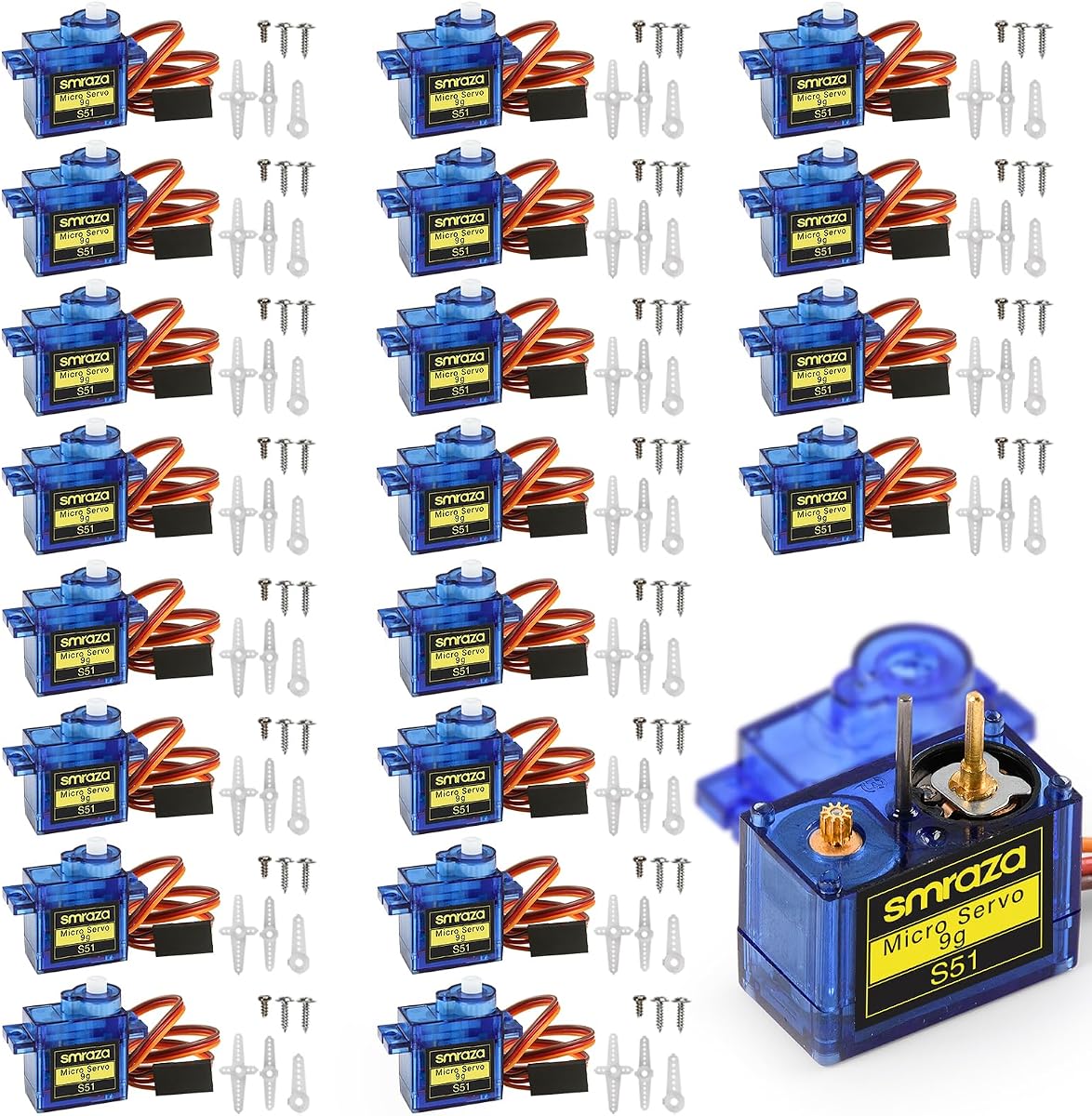
The twenty-piece Smraza SG90 kit is designed for builders who need a substantial inventory rather than a single or two-servo replacement. It carries a 4.4 rating and repeats the metal pinion gear, metal shaft, 1.9 kg-cm stall torque, 180-degree range, and 5-microsecond deadband found in the smaller Smraza sets. That consistency makes it convenient for schools, clubs, repair stocks, or several aircraft built to the same configuration.
We may earn a commission when you buy through this link, at no additional cost to you.
The key benefit is availability of matching units. If a project uses six servos, a builder can retain fourteen spares; if two aircraft are being completed, there is ample inventory for both. The set also includes servo arms and 24.5 mm leads, and the standard three-pin PWM interface works with Arduino, Raspberry Pi, JR, and Futaba receivers. The stated applications include fixed-wing and KT planes, gliders, small boats, robots, and compact mechanisms.
Buying many servos does not eliminate the need to test each one individually. Servo performance can vary, and incorrect travel settings or damaged horns may not be obvious until the unit is installed. Each servo should be checked for smooth movement, proper centering, and consistent response before flight. It is also wise to retain the original mounting accessories and identify any units used in a specific airframe.
For a single model, twenty units are more than necessary, so the ten- or six-pack may be the more focused purchase. For a workshop, club, classroom, or multi-aircraft project, however, this set is a convenient way to standardize on the same micro servo. The main operational requirement is a substantial and well-distributed power system capable of handling the starting current of many connected servos.
Using identical servos across several models simplifies spare-part management and makes troubleshooting more consistent. A large matched pack is especially useful for clubs, instructors, and builders working on multiple aircraft.
Twenty servos should never be treated as a single low-power accessory. Each can draw a significant starting current, so a robust BEC, appropriate wiring, and measured connection points become more important as the fleet grows.
We may earn a commission when you buy through this link, at no additional cost to you.
The MG995 four-pack is a substantial step up in torque from the 9g micro servos. It has a 3.8 rating and is built for larger control surfaces, robotic arms, boats, climbing vehicles, and RC aircraft that need more holding power. Stall torque reaches 9.4 kg-cm at 4.8V and 12 to 13 kg-cm at 6.0V, making it one of the strongest options in this comparison.
We may earn a commission when you buy through this link, at no additional cost to you.
Mechanical construction includes all-metal gears, a double coreless motor, and a ball-bearing design. The shock-resistant structure is intended to tolerate heavier loads and vibration, while a 180-degree range provides broad positioning flexibility. No-load speed is listed at 0.17 seconds per 60 degrees at 4.8V and 0.13 seconds per 60 degrees at 6.0V, so it is quick for a high-power servo even though it is not a micro-class speed leader.
The important drawback is weight and space. A standard MG995 is not a substitute for a 9g servo in a small trainer, because adding several of these units can materially change the aircraft's center of gravity and flight characteristics. Its 4.8 to 7.2V operating range also demands attention to battery chemistry, BEC output, and receiver compatibility. The manufacturer recommends an external adapter with sufficient current, such as a 1A to 2A supply.
This set makes sense for medium and larger aircraft with demanding surfaces, or for mixed-use projects involving heavy mechanisms. It is also useful when torque matters more than minimum weight. The four-unit count suits many common control layouts, and the 300 mm wires make routing through a larger airframe easier. Verify the mounting pattern, linkage loads, and aircraft's weight budget before installation.
The 12 to 13 kg-cm output gives the MG995 ample authority for larger surfaces and linkages that would overload a micro servo. Proper geometry is still necessary so the motor works against the intended leverage rather than a mechanical bind.
A high-power standard servo is beneficial only if the aircraft can accommodate its size and mass. A full four-pack can add significant weight, so control-line geometry and overall balance deserve careful review.
We may earn a commission when you buy through this link, at no additional cost to you.
The Spektrum A6380 is the most purpose-specific aircraft servo in this group. It carries a 4.6 rating and is designed for RC sport planes, with a high-voltage digital design that accepts 6.0 to 8.4V. Unlike the micro servos, it is positioned as a standard aircraft servo with metal gears, dual-bearing output support, and a coreless motor.
We may earn a commission when you buy through this link, at no additional cost to you.
Its torque output is a major advantage. The servo provides 102 oz-in, or 7.3 kg-cm, at 6.0V and reaches 160 oz-in, or 11.5 kg-cm, at 8.4V. Speed is listed at 0.17 seconds per 60 degrees at 6.0V and 0.13 seconds per 60 degrees at 8.4V. Those figures indicate a servo capable of combining strong holding power with rapid response, a useful combination for sport aircraft.
The premium feature is the high-voltage capability. Running an 8.4V system can reduce the current burden compared with forcing the same mechanical output from a lower-voltage supply, although actual results still depend on the complete power system and aircraft. The servo cannot be treated as a universal 5V drop-in. Its 6.0 to 8.4V range should be matched to a compatible battery, regulator, receiver, and radio setup.
For a larger sport plane with powerful controls, the A6380 is a compelling specialist choice. It is less appropriate for a lightweight micro model where size and mass would be disadvantages, and it is not designed to replace a basic 9g servo in a small trainer. It is best for builders who want an aircraft-focused servo, higher voltage headroom, and substantially more torque than a micro unit can provide.
The 6.0 to 8.4V operating range supports substantial output at the upper end. This is valuable for sport aircraft that need fast, positive surface control without relying on excessive mechanical leverage.
Metal gearing, dual-bearing output support, and a coreless motor focus on the durability and smooth operation expected in an RC aircraft installation. The larger format should be treated as a deliberate upgrade, not a universal micro-servo substitute.
We may earn a commission when you buy through this link, at no additional cost to you.
The four-pack MG90S combines a 9g micro format with 2.0 kg-cm of stall torque, putting it near the top of the micro-servo options for mechanical strength. It has a 4.3 rating and is marketed as a drop-in replacement for SG90-style installations. The 180-degree movement range and Futaba-compatible three-pin PWM connection make it familiar to many RC and DIY users.
We may earn a commission when you buy through this link, at no additional cost to you.
Its most attractive published feature is the tight 5-microsecond deadband, which is intended to reduce drift around the center position and produce steadier control in aircraft. The hardened copper-aluminum gears are specified to resist wear, while dual bearings support smooth shaft movement under load. The stated backlash of no more than 3 degrees further suggests attention to mechanical positioning precision.
Speed depends on voltage: the servo is rated at 0.08 seconds per 60 degrees at 6.0V, while the corresponding figure at 4.8V is 0.11 seconds per 60 degrees. That distinction matters when comparing it with micro servos that publish approximately 0.08 seconds at both voltages. At the lower supply, it remains responsive, but it is not the fastest option available in the same size class.
The 250 mm cable, three mini servo arms, and mounting screws make installation convenient, and the stated compatibility covers Arduino, Raspberry Pi, and RC receivers. This set is well suited to lightweight planes, small RC cars, and classroom robotics. It is a strong choice when a builder values centering precision, gearing strength, and a four-unit quantity, but it should not be used where true high-voltage aircraft servo performance is required.
The 5-microsecond deadband and stated low backlash are especially relevant to control surfaces that should settle cleanly around neutral. Correct centering and linkage setup remain necessary to realize the full benefit.
Combining hardened gears with dual-bearing output support targets smooth movement and durability. The construction is useful for compact aircraft where the servo must tolerate repeated movement in a restricted installation.
We may earn a commission when you buy through this link, at no additional cost to you.
Choosing an RC aircraft servo begins with the airframe rather than the specification sheet. Match the servo's size, torque, voltage, and travel to the aircraft's weight, control-surface area, receiver, and power system, then consider centering and installation requirements.
A 9g micro servo is appropriate for lightweight trainers, gliders, small park flyers, and other compact aircraft where every gram affects performance. It offers a familiar mounting pattern and is easy to fit around lightweight plywood or foam structure. A standard servo, such as the MG995 or Spektrum A6380, provides more torque and mechanical strength but adds size and mass. Standard servos are better suited to larger surfaces, sport models, and installations where the airframe can accommodate the extra weight without upsetting the balance.
Stall torque is the maximum twisting force available at the output shaft, and it should be high enough to move and hold the control surface without continuous strain. Published figures also depend on operating voltage, so compare equivalent conditions. A 1.0 kg-cm micro servo may handle a light, well-balanced surface, while a 2.0 kg-cm micro servo offers more reserve. The MG995 and A6380 provide much higher output for large or high-speed aircraft. Excessive torque is not automatically better because it can transmit shocks back into the airframe if the linkage binds.
Transit speed indicates how quickly the output travels through a stated angle under no-load conditions. Faster movement can make a responsive sport model feel immediate, but speed does not overcome poor linkage geometry or inadequate voltage. Micro-servo options in this guide reach approximately 0.08 to 0.11 seconds per 60 degrees at their respective test voltages. The MG995 and A6380 remain relatively quick for their greater power levels. Compare speed and voltage together, since many manufacturers list different values for 4.8V, 6.0V, and 8.4V.
The operating voltage must match the aircraft's battery and BEC or regulator. Most 9g micro servos here operate from 4.8V to 6.0V, making them suitable for common single-cell systems with appropriate regulation. The MG995 accepts 4.8V to 7.2V, while the Spektrum A6380 is a high-voltage unit designed for 6.0V to 8.4V. Running a servo above its range can damage its electronics, while running it below its intended range can reduce torque or produce inconsistent behavior. Receiver and battery connector ratings should also be checked.
Metal gears are generally preferable in aircraft because they are better able to withstand repeated loads, vibration, and occasional binding than basic plastic pinions. That distinction separates most of the metal-gear micro servos from the plastic-gear eight-pack reviewed here. For aircraft that carry greater loads or operate at higher speeds, an all-metal gear train and supported output bearings add further confidence. Gearing alone does not prevent damage from a jammed linkage, so mechanical free movement remains essential.
A tight deadband helps prevent the servo from reacting to tiny variations in the receiver's command around center. This is particularly useful for ailerons, elevators, and rudders that should settle without visible hunting. Servos with a 5-microsecond deadband include the four-pack SG90, the Smraza sets, and the four-pack MG90S, while the plastic-gear option lists 7 microseconds. Deadband is only one part of centering: horn placement, control throws, mechanical balance, and transmitter trim all influence how a control surface behaves.
A servo may need more than 1A of starting current, and several servos can overwhelm a receiver's integrated regulator when they move simultaneously. Use a BEC or receiver with a regulator rated for the combined load, with margin for stall transients. A separate supply is especially important for the two-pack MG90S and the larger Smraza sets. Poor power can cause resets, delayed movement, jitter, or a servo that fails to hold position. Secure connections, appropriate wire gauges, and short, well-supported leads help maintain reliable voltage.
Most of the reviewed servos offer 180 degrees of movement, but usable aircraft travel is normally set through the radio, receiver, or servo configuration and should remain well within the servo's mechanical range. Select a horn or arm that provides enough leverage without forcing the linkage to an awkward angle. The four-pack MG90S includes three mini arms and screws, while the Smraza kits include servo arms and 24.5 mm leads. Check the dimensions, mounting-hole pattern, cable length, and nearby structure before finalizing a purchase.
Before installation, confirm that the servo's voltage rating matches the aircraft's power system and inspect the case, connector, lead, horn, and output spline. Bench-test each servo at the intended supply voltage using the receiver and radio setup you plan to use. Confirm that it moves smoothly in both directions, holds position without buzzing, and returns predictably to neutral when the control command is released.
Mount the servo securely but avoid squeezing the housing in a way that could distort the spline or case. Use the correct screws and horn for the model, and keep the linkage free from rubbing, binding, or excessive slop. Set transmitter travel so the surface reaches its desired limits without the servo being driven hard against an internal mechanical stop. On a large aircraft, test the linkage under full control input while the power system is connected to its intended battery.
For flight preparation, verify that every control surface moves in the correct direction and that the aircraft's trim and control throws remain consistent. If a servo behaves erratically, disconnect it and inspect the linkage and power supply before changing radio settings. A separate BEC, properly rated for the number of servos, is usually more dependable than trying to power a large installation from a basic receiver output.
Yes, when the aircraft is appropriately small and the control surfaces are light and correctly balanced. A micro servo with roughly 1.9 to 2.0 kg-cm of stall torque can handle many trainers, gliders, and small park planes. Larger or faster aircraft generally benefit from a standard servo with more torque and stronger mounting support.
Metal gearing is usually the safer choice because it is better suited to repeated movement and the vibration common in RC aircraft. The plastic-gear option in this guide can still be suitable for light projects, but metal-gear micro servos offer a broader margin when a linkage is adjusted or briefly binds. Gearing does not excuse a binding linkage, so installation quality remains essential.
Only if the servo and the rest of the aircraft's electronics are rated for that voltage, or if a proper regulator supplies an appropriate lower voltage. Many micro servos accept 4.8V to 6.0V, while high-voltage aircraft servos such as the A6380 require 6.0V to 8.4V. Check the full system and never assume a receiver connector provides safe voltage.
Buzzing, delayed response, or resets commonly indicate inadequate supply voltage, excessive starting current, a weak connection, or a binding control linkage. The listed micro servos have starting-current requirements that may exceed 1A, so several units should use a suitably rated BEC. Disconnect the propellers and inspect the linkage, connectors, and supply under load when troubleshooting.
No. Speed is only one part of control performance, and published figures usually describe no-load movement. Torque, deadband, centering, voltage stability, linkage design, and the aircraft's control geometry can have a greater effect on how a servo feels in flight. Match speed to the aircraft rather than selecting the fastest unit regardless of the rest of the system.
Deadband is the small range of command changes around the center position that the servo may ignore. A narrower range can reduce jitter and help a control surface remain settled, especially in a small aircraft. The 5-microsecond deadband models in this guide are intended to offer more precise central control than the option listing 7 microseconds.
A basic trainer may use two or three servos, while a conventional four-channel model often uses four. Additional channels, flaps, retracts, or other mechanisms can increase the count. The four-, five-, six-, ten-, and twenty-packs in this guide cover common layouts, while larger quantities are best for multiple aircraft or spare inventories.
Using matching servos is generally helpful for consistent response, centering, and future maintenance. It also makes troubleshooting and replacement easier. The most important requirement is that each servo has sufficient torque and correct travel for its surface, with linkage geometry adjusted so both sides move symmetrically.
The four-pack SG90 stands out as the strongest budget-oriented balance, combining a 4.6 rating, metal pinion and shaft, 5-microsecond deadband, quick movement, and quiet operation. The Miuzei MG90S is an excellent general micro-servo alternative with 2.0 kg-cm of torque, while the Spektrum A6380 is the premium selection for larger sport aircraft that can use 6.0 to 8.4V and need substantially more holding power.
Prioritize the airframe's requirements before choosing a listing: match servo size and weight, ensure the voltage range fits the power system, provide enough torque without overstressing linkages, and use a BEC rated for the number of servos. Micro servos suit lightweight models, while the MG995 and A6380 are better choices when standard size, high torque, and higher-voltage capability are warranted.
Finally, check the current listing, package quantity, included hardware, connector style, and detailed specifications before ordering. Servo availability and product details can change, and the correct choice may shift as a model gains larger surfaces, additional mechanisms, or a different battery system. Use the comparison as a starting point, then verify that the chosen servo physically and electrically suits the completed aircraft.