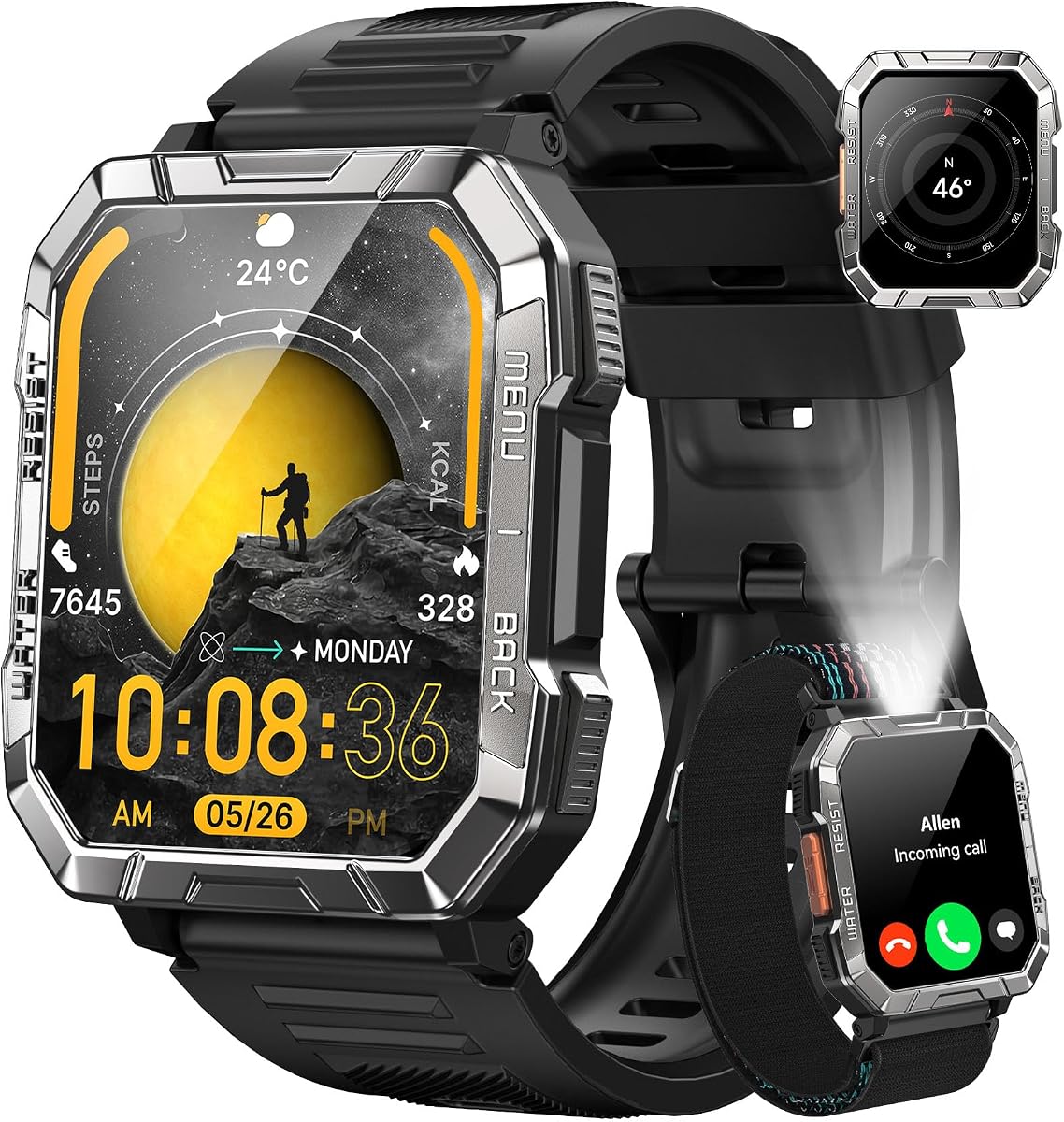
Blackview Military Smart Watch
5.0Editor score
Exceptional standby battery life
LED flashlight and compass
Two interchangeable wristbands
A smartwatch for extreme heat must do more than merely work outdoors. It needs a durable case, readable display, dependable sensors, long battery life, and controls that remain practical when heat, dust, sweat, or intense sunlight complicate every task. The right model can help monitor effort, navigation, communications, and personal safety.
We compared ten watches using only their listed specifications and product information, focusing on stated heat resistance, rugged construction, battery endurance, outdoor navigation, water resistance, fitness features, and everyday usability. The list includes military-style models, multipurpose fitness watches, running watches, and premium multisport devices suited to demanding environments.
Each pick highlights a different reason to consider it, from long battery life and emergency lighting to built-in GPS, advanced training metrics, or premium satellite communication. Ratings and availability can change, so check the current listing and manufacturer guidance before operating any watch in extreme heat or using its safety features.
5.0Editor score

4.6Editor score

4.1Editor score
As an Amazon Associate we earn from qualifying purchases.
The comparison below organizes all ten watches by their most relevant characteristics for hot-weather use: stated environmental tolerance, battery life, navigation, emergency equipment, water resistance, and health or fitness tracking. Exact operating limits vary, so the comparison should guide initial research rather than replace manufacturer instructions.




The Blackview Military Smart Watch for Men with 100-Day Standby/Flashlight/Compass combines unusually long stated endurance with a feature set aimed at camping, hiking, and demanding outdoor routines. Its 5.0 rating reflects an especially strong customer impression, while the aluminum frame, military testing, dust protection, and IP68 rating make it an intriguing option where severe heat and rough conditions are concerns.
We may earn a commission when you buy through this link, at no additional cost to you.
Its 900mAh battery is listed at up to 100 days of standby time and 30 days of daily use, reducing the likelihood that a multi-day trip will end with a depleted watch. A built-in LED flashlight with a listed range of 6–10 meters adds useful emergency illumination, while the compass provides basic orientation when familiar landmarks are difficult to see. Two straps—one silicone and one nylon—offer flexibility for sweat, skin sensitivity, and different activities.
The 2.01-inch full-touch TFT screen is larger than many basic fitness watches and should make time, messages, and workout data easier to inspect at a glance. Support for more than 100 sports modes, phone-connected route tracking through GloryFitPro, continuous heart-rate and SpO2 tracking, sleep-stage analysis, Bluetooth calls, and notifications makes it useful beyond a simple survival accessory. However, its IP68 protection expressly excludes saunas, hot water, swimming, and diving, which matters in genuinely hot conditions.
This is a strong choice for heat-exposed workers, campers, and travelers who prioritize battery life and emergency tools over premium navigation and specialized endurance analytics. Confirm the operating-temperature limits with the manufacturer, keep the watch away from extreme direct heat when not in use, and choose the nylon band if silicone becomes uncomfortable during heavy sweating.
The stated 30-day daily-use battery makes this watch practical for extended trips where charging access is uncertain. Standby endurance is even longer, although actual results depend on notification frequency, call use, display activity, and GPS settings.
The integrated flashlight and compass reduce the need to carry separate lighting for nighttime movement. They are backup tools rather than substitutes for a full navigation kit, planned routes, or emergency communication.
We may earn a commission when you buy through this link, at no additional cost to you.
The Garmin vívoactive 5 is a polished health and fitness smartwatch with a 42mm case, AMOLED display, and up to 11 days of battery life in smartwatch mode. Its 4.3 rating places it among the stronger all-purpose options here, especially for heat-exposed users who want insight into recovery and exertion rather than military styling or emergency hardware.
We may earn a commission when you buy through this link, at no additional cost to you.
Body Battery monitoring is a central feature, offering an estimate of energy availability using information such as sleep, naps, stress, and workouts. The watch also provides a sleep score, personalized sleep coaching, HRV status, wrist-based heart rate, stress tracking, a morning report, fitness age, and other wellness features. More than 30 indoor and GPS activity apps cover walking, running, cycling, HIIT, swimming, golf, yoga, and other common pursuits.
Its trade-offs are chiefly about environment and construction. The supplied information does not advertise a military-grade case, a flashlight, extreme-heat tolerance, or water-resistance certification, so it should not be treated as a dedicated field device. It also lacks the large case, protected lens, and satellite communication found in more expedition-oriented Garmin watches. Nevertheless, its efficient design and long battery life make it easier to wear consistently during hot weather.
Choose the vívoactive 5 if your priorities are daily health insight, recovery awareness, and familiar Garmin training features in a relatively compact package. For industrial work, desert travel, or activities involving falling equipment, a rugged model would be a safer choice. Users should also avoid deliberately overheating the watch and remove it during sleep or bathing if that is comfortable for them.
Body Battery can make it easier to recognize when accumulated fatigue suggests a need for rest. Because these metrics are close estimates rather than medical diagnoses, they are most useful as one input alongside hydration, rest, and personal judgment.
More than 30 preloaded activities and downloadable music support make the watch useful across workouts without demanding constant phone interaction. The five-day always-on-display battery mode also provides flexibility when quick glanceability matters more than maximum endurance.
We may earn a commission when you buy through this link, at no additional cost to you.
The WalkerFit Rugged Smart Watch for Men stands out because its supplied specifications explicitly state that the hardware was tested to withstand severe heat. That makes it one of the most direct matches in this guide for hot and dusty environments, while its 1.43-inch always-on AMOLED screen, zinc-alloy frame, and drop-resistant glass support a durable everyday profile.
We may earn a commission when you buy through this link, at no additional cost to you.
Battery life is listed at up to 15 days for daily use or 35 days on standby. Its 5ATM rating is stronger than the common everyday-use designation and permits swimming, surfing, and exposure to rain according to the product information. The watch supports more than 178 sports modes, real-time step, distance, and calorie tracking, Bluetooth calls, app notifications, and continuous heart-rate, SpO2, stress, and sleep monitoring.
The most important caveat is navigation: unlike several higher-ranked choices, the description does not claim built-in GPS. That means route and outdoor-position features may depend on a paired phone. It also provides less information about independent satellite communication, precise temperature limits, or sport-specific endurance analytics. The health readings are explicitly for wellness rather than medical use.
This WalkerFit model is a sensible pick for someone who values a rugged case, a higher water-resistance rating, severe-heat hardware testing, and extended battery life in an affordable general-purpose package. It is particularly relevant to workers, campers, and travelers who need a durable watch but do not require independent satellite messaging. Verify current operating limits and keep the charging contacts clear of dust and moisture.
The high-strength frame, scratch-resistant glass, and 5ATM rating create a reassuring combination for demanding outdoor use. The stated severe-heat testing is more relevant than general rugged language, but it does not replace following the manufacturer's recommended temperature and care limits.
A listed 15-day daily-use runtime reduces charging pressure during travel or work rotations. Feature-heavy use, continuous Bluetooth calls, and prolonged display activity can shorten actual endurance, so a power reserve before departure remains sensible.
We may earn a commission when you buy through this link, at no additional cost to you.
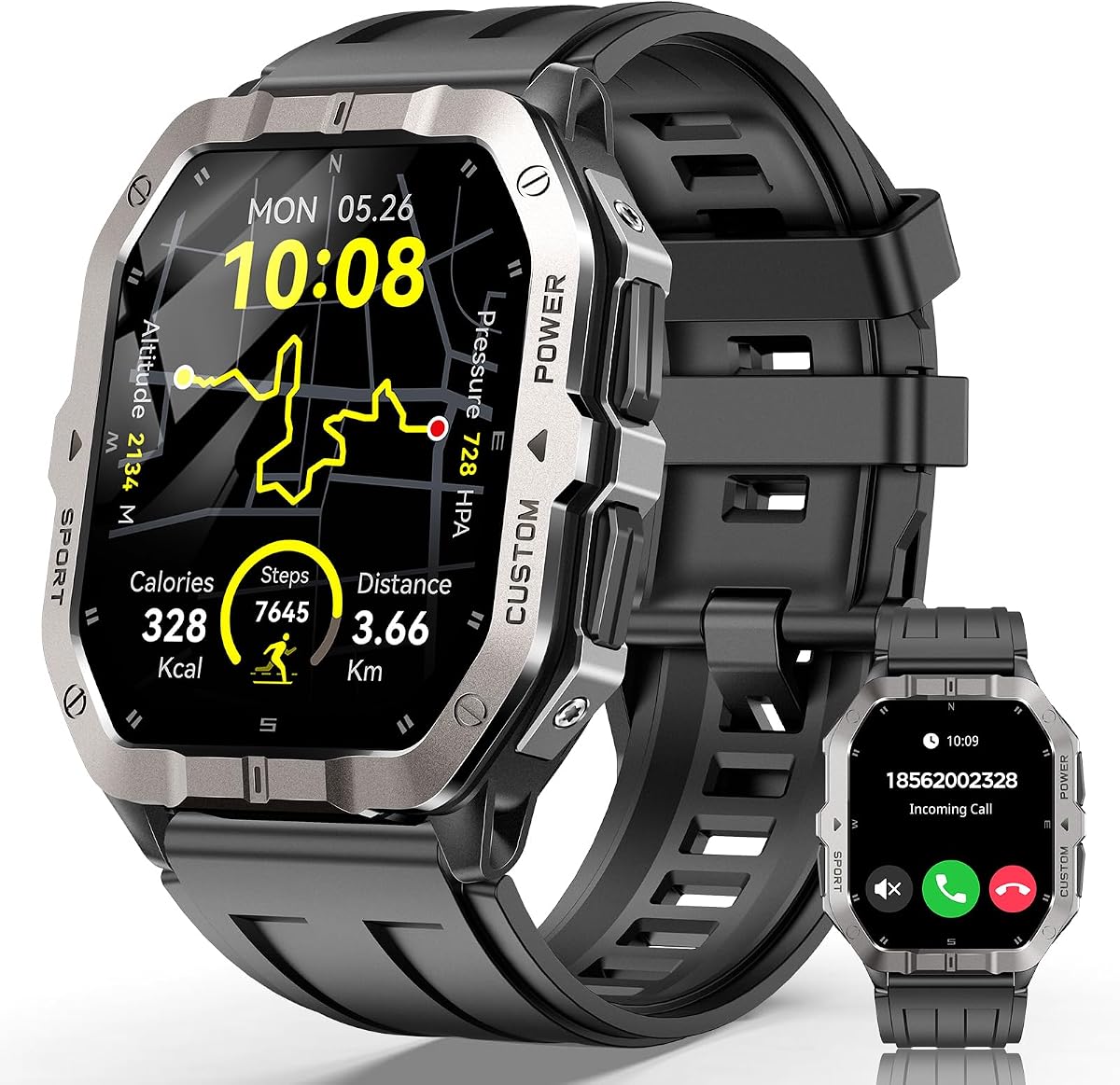
The Military Smart Watches for Men with Built-in GPS is among the clearest matches for the keyword because its description provides a specific heat-resistance figure of up to 187.96°F. Combined with cold resistance, low-pressure resistance, waterproofing, dust proofing, and an aluminum-alloy bezel, it presents a practical field-oriented design for harsh environmental conditions.
We may earn a commission when you buy through this link, at no additional cost to you.
Standalone GPS is a major advantage over phone-dependent route trackers. It records pace, distance, and routes without requiring a smartphone, while the compass, altimeter, and barometer provide additional environmental awareness. The 2.02-inch HD full-touch display uses enlarged fonts and strong contrast for sunlight visibility, and the screen is protected by scratch-resistant tempered glass. The watch also supports Bluetooth calls and message notifications.
For activity tracking, it offers more than 170 sport modes and daily metrics such as pace and distance. Health functions cover heart rate, blood oxygen, blood pressure, sleep, and seven-day sleep trends. Those readings are explicitly described as suitable only for exercise reference and not as equivalents of professional medical equipment. The watch is also not the smallest option, and its tactical size may feel substantial during sleep or all-day wear.
Choose this model when a documented heat limit, standalone navigation, and a long list of outdoor features matter most. It is especially relevant for hiking, cycling, field exercises, and remote work where leaving the phone behind is desirable. Keep it within its stated environmental limits, take regular sensor readings from the back of the wrist, and do not treat the watch's blood-pressure estimate as a substitute for a validated cuff.
Built-in GPS, a compass, altimeter, and barometer create a more independent outdoor toolkit. These tools support orientation and route awareness, but they do not replace topographic maps, route planning, or sound judgment in remote terrain.
The stated 187.96°F heat-resistance ceiling is unusually specific within this comparison. It should be understood as a product claim under stated conditions, not a guarantee against permanent damage from direct sun or elevated charging temperatures.
We may earn a commission when you buy through this link, at no additional cost to you.
The Samsung Galaxy Watch9 in Graphite is a 40mm Bluetooth smartwatch centered on personalized health, sleep, and fitness guidance. Its 4.5 rating reflects a favorable balance of feature depth and everyday design, although the supplied specifications do not identify it as a military or extreme-heat-certified device.
We may earn a commission when you buy through this link, at no additional cost to you.
Its Vitals feature tracks health metrics during sleep and compares changes with usual patterns, while Advanced Sleep Coaching offers recommendations intended to improve sleep habits. The Fitness Index adapts guidance to goals and fitness level, and Heart Health Score combines sleep time, BMI, activity, and vascular load into one metric. These functions can help users adjust workload and recovery routines when working or exercising in hot conditions.
The watch supports blood-pressure measurement after calibration with a separately sold cuff. That adds meaningful context for users who already own compatible equipment, but it should not be assumed that every region or wearer will obtain the same result. Natural AI assistance begins when the wrist is raised without a wake phrase, and the soft sports band includes a breathable air-pocket design for comfort during active use.
This Galaxy Watch9 is best for someone who values sophisticated wellness feedback and works primarily in the Samsung or broader Android ecosystem. It may be less compelling for expedition use because no specific heat tolerance, water-resistance rating, built-in GPS, emergency flashlight, or satellite communications are listed. Consider a rugged GPS watch instead for remote field work, while checking charging and operating guidance in high ambient temperatures.
Vitals and Advanced Sleep Coaching can reveal shifts in overnight measurements and suggest ways to improve rest. In hot work environments, a clearer picture of recovery may be more useful than simply adding more intense training.
The Fitness Index tailors recommendations to endurance, muscle-building, and other stated goals. It can make training plans more relevant, although heat adaptation still requires careful pacing, hydration, and awareness of symptoms.
We may earn a commission when you buy through this link, at no additional cost to you.
The Amazfit Bip 6 offers a compelling blend of large-display readability, built-in GPS, and up to 14 days of battery life. Its 1.97-inch AMOLED screen is designed to remain easy to read in bright sunlight, and the lightweight aluminum construction should suit users who prefer a less bulky watch during hot-weather activity.
We may earn a commission when you buy through this link, at no additional cost to you.
Navigation includes downloadable maps, turn-by-turn directions, and support for five satellite systems with a stated goal of precise tracking and fast GPS connections. The watch supports more than 140 workout modes, including HYROX Race and Strength Training, while providing personalized AI coaching. Continuous heart-rate, sleep, blood-oxygen, and stress monitoring make it useful as a daily wellness device as well as a workout tracker.
Its water-resistance rating of 50 meters is adequate for many active scenarios, but it does not offer the stronger 5ATM specification listed for the WalkerFit model. More importantly, the product information does not claim an extreme-heat operating limit, military-grade testing, or a rugged protective case. The long battery estimate may also vary significantly with GPS use, notifications, workouts, and display behavior.
The Amazfit Bip 6 is a good choice for commuters, runners, and travelers who want independent navigation and long battery life without moving into specialized expedition hardware. For construction work, rough handling, or direct environmental exposure, favor a watch with a documented ruggedness and heat-resistance specification. As always, test controls and readable information while wearing the watch before an important journey.
The combination of GPS, downloadable maps, and a 14-day stated battery life is especially useful on trips where charging opportunities are unpredictable. Route preparation should still be completed before leaving coverage.
The vivid AMOLED display combines a generous viewing area with sunlight readability. This helps keep essential information available without repeatedly waking a phone, although brightness settings may affect battery consumption.
We may earn a commission when you buy through this link, at no additional cost to you.
The Blackview Military Smart Watch for Men with 100 Days Battery/Flashlight/Compass offers a different balance from the first Blackview model. Its larger stated 960mAh battery, scratch-resistant plastic case, zinc-alloy housing, and single-button flashlight make it particularly appealing for camping, mountaineering, emergency lighting, and long periods away from charging facilities.
We may earn a commission when you buy through this link, at no additional cost to you.
The product information lists more than 100 days of standby time and more than 30 days of daily use. Its high-brightness LED flashlight provides nighttime illumination, while the compass offers a basic navigation aid when no signal is available. More than 100 sports modes cover running, cycling, basketball, rugby, skiing, and other activities, with daily statistics connected through the Da Fit app.
Calls, notifications, music and camera controls, weather forecasts, alarms, a stopwatch, and a timer expand its everyday utility. The 1.45-inch TFT display uses tempered glass and PET film for scratch and interference resistance. Health tracking includes heart rate, blood oxygen, stress, and sleep stages, with the company explicitly noting that the results are for reference and not diagnosis. IP68 protection is for daily use, but hot tubs, saunas, swimming, and diving are specifically excluded.
This watch is a practical selection for people who want longer endurance and a readily accessible flashlight without moving to a premium multisport device. Its route recording depends on the phone's GPS rather than an internal receiver, and it does not list satellite communication. For severe heat, stay within the manufacturer's recommended operating range and never leave a charging watch or the device itself in a hot vehicle.
A dedicated single-button light is useful when a headlamp is unavailable or its batteries have failed. It should still be treated as a backup source, with a separate light and charged power reserve carried for serious outings.
The 960mAh battery and stated 30-day daily runtime reduce charging frequency substantially. Actual life depends on how often calls, notifications, workouts, display time, and connected features are used.
We may earn a commission when you buy through this link, at no additional cost to you.
The Garmin fēnix 9 Pro is the most expedition-focused watch in this guide, combining a 51mm titanium case, sapphire lens, built-in flashlight, LTE connectivity, and inReach satellite communication. Its 4.1 rating does not lead the group, but the product is aimed at serious athletes and adventurers rather than buyers seeking a simple everyday fitness watch.
We may earn a commission when you buy through this link, at no additional cost to you.
The titanium construction offers a balance of low weight and durability, while the 1.5-inch AMOLED display is protected by scratch-resistant sapphire. The integrated flashlight supports white, red, and green lighting, with red being useful for preserving night vision and green offering an alternative signal. LTE can support phone-free messages and voice calls, while LiveTrack lets companions follow a route with location updates every 30 seconds.
The inReach feature provides messaging, location check-ins, and interactive emergency SOS over satellite. It requires an active plan, has coverage limitations, and is not available in every situation or jurisdiction. Users must also understand that satellite hardware cannot function everywhere, especially where the sky is obstructed. The watch adds advanced stamina curves, more than 100 activity profiles, VO2 max support for compatible rowing equipment, and expanded rucking calculations that account for pack weight.
The fēnix 9 Pro is the strongest premium recommendation for remote expeditions, mountain travel, and high-risk activities where independent emergency communication justifies the complexity. Its 51mm size may be too large for smaller wrists or sleep tracking, and the connected services create ongoing subscription considerations. Despite the harsh environment being motivating, users should test the watch, service, and satellite workflow before relying on it in a remote area.
LTE and satellite inReach options create layers of communication beyond ordinary Bluetooth range. Satellite service requires a plan and open-sky conditions, so it is a preparedness tool rather than an unlimited guarantee.
Stamina curves, recovery-oriented tools, and rucking metrics help quantify demanding outdoor work. These features are particularly relevant when heat adds fatigue to long hikes or carries, but they still require careful interpretation.
We may earn a commission when you buy through this link, at no additional cost to you.
The Garmin Forerunner 165 is a focused running smartwatch with a 4.6 rating, built-in GPS, wrist heart-rate tracking, a bright AMOLED touchscreen, and traditional button controls. Its 43mm lightweight design and up to 11 days in smartwatch mode make it an efficient everyday companion for runners who want meaningful training feedback without a bulky expedition case.
We may earn a commission when you buy through this link, at no additional cost to you.
Battery endurance reaches up to 19 hours in GPS mode, while the broader smartwatch experience can last up to 11 days. The watch offers personalized suggested workouts, Garmin Coach and race-adaptive plans, more than 25 activity profiles, training-effect labels, recovery-time estimates, and a morning report covering sleep, recovery, training outlook, weather, and HRV status. These tools help users balance hard efforts with appropriate rest during hot periods.
Safety features include incident detection during selected outdoor activities and Assistance, which can send live location to emergency contacts when a compatible phone has network coverage. Smart notifications and Garmin Pay add everyday convenience. However, the specifications do not advertise extreme-heat certification, a rugged fiber-reinforced case, a flashlight, or satellite communication, limiting its suitability for remote harsh-condition use.
The Forerunner 165 is a strong recommendation for recreational and serious runners, especially when training in warm weather and prioritizing accurate pace, distance, and recovery data. Pair it with a phone for emergency features and keep the phone protected from heat. For fieldwork involving impact, dust, or exposure beyond normal sports conditions, choose a more rugged watch instead.
Daily suggestions adapt to performance and recovery, while the morning report provides context before a workout. In heat, that balance is useful because additional training stress can compound fatigue created by high temperatures.
The touchscreen works alongside physical buttons, which can be easier to operate with sweaty hands or while running. The 43mm format also remains more compact than the oversized adventure models in this comparison.
We may earn a commission when you buy through this link, at no additional cost to you.
The Garmin Instinct 3 AMOLED combines rugged construction, up to 18 days of battery life, and advanced navigation in a 45mm package. Its 4.6 rating and balanced feature set make it an editorially strong choice for heat-exposed users who need a tough daily watch without moving into the much larger fēnix 9 Pro.
We may earn a commission when you buy through this link, at no additional cost to you.
A supertough fiber-reinforced polymer case and metal-reinforced bezel provide the foundation for demanding work and recreation. The vibrant 1.2-inch AMOLED display offers modern readability, while multi-band GPS with SatIQ is designed to improve positioning and optimize battery usage. A three-axis compass and barometric altimeter support orientation and elevation awareness.
The built-in flashlight includes variable intensities and strobe modes, making it useful around campsites, work sites, and nighttime routes. Health features cover wrist heart rate, advanced sleep monitoring, and Pulse Ox, with the company noting that the watch is not a medical device and that Pulse Ox availability varies by country. The longer battery reduces the need to carry a charging cable, while the rugged case tolerates more abuse than a conventional fitness watch.
Compared with the fēnix 9 Pro, the Instinct 3 lacks listed satellite messaging and some advanced endurance analytics, but it offers a more compact and versatile package. It is an excellent choice for search-and-rescue personnel, field technicians, outdoor workers, and travelers who want ruggedness, navigation, flashlight functionality, and long endurance. Confirm that all buttons, straps, and sensors remain secure before entering a hazardous environment.
Multi-band SatIQ GPS, a compass, and an altimeter form a capable outdoor navigation trio. SatIQ is particularly useful when conserving power is important during a long, hot-weather route.
Variable brightness and strobe modes make the integrated light more adaptable than a basic fixed-output flashlight. The reinforced 45mm case adds protection against the impacts common in work and adventure settings.
We may earn a commission when you buy through this link, at no additional cost to you.
Selecting a watch for extreme heat requires separating useful durability from marketing language. The most important factors are verified operating limits, battery endurance, physical construction, display readability, sensor reliability, water protection, and the navigation tools required for the intended environment.
The most useful evidence is a clear operating-temperature specification, not a generic claim that the watch is military grade. The Military Smart Watch with GPS is the clearest example here because its information states heat resistance up to 187.96°F. Other models emphasize severe-heat testing or rugged construction without publishing an equivalent numerical ceiling. Check the current manufacturer documentation, because the sales listing may not contain every limitation, and avoid assuming that a watch can remain powered on a hot vehicle dashboard.
Choose a documented range that comfortably covers your environment. Direct sunlight can make the watch much hotter than the surrounding air, while a watch charging inside a vehicle may face even higher temperatures. Stop using the watch if it becomes unusually hot, swells, or behaves erratically, and allow it to cool before charging.
Long battery life matters in heat because frequent charging can be inconvenient, and leaving a device in a hot vehicle or exposed to direct sun may accelerate wear or create unsafe charging conditions. The Blackview models lead the stated standby figures, while the Garmin Instinct 3 AMOLED offers up to 18 days and the Amazfit Bip 6 offers up to 14 days. GPS, Bluetooth calls, always-on display, and workout tracking can reduce those estimates substantially.
Compare endurance under the modes you will actually use. A watch with excellent standby life may be less useful if continuous GPS consumes it in a day, while a runner may prioritize Garmin Forerunner 165's stated 19-hour GPS runtime over general smartwatch duration.
A rugged case protects against impacts, abrasion, dust, and the repeated handling associated with fieldwork. The WalkerFit uses a zinc-alloy frame and drop-resistant glass; the Military Smart Watch with GPS combines composite material with an aluminum-alloy bezel; and the Garmin Instinct 3 uses fiber-reinforced polymer with a metal-reinforced bezel. Garmin fēnix 9 Pro adds a titanium case and sapphire lens for a more premium construction profile.
Screen type matters as well. Sapphire is highly scratch resistant, while tempered glass is more common in less expensive designs. Strap material also affects comfort during sweat: silicone can stay secure, while fabric may feel cooler against the skin. Choose a construction and fastening method suited to the work rather than relying on a military-style appearance alone.
Water resistance helps protect against rain, sweat, dust, and accidental splashing, but the rating should match the activity. A 5ATM watch is designed for swimming, surfing, and rain exposure, while a 50-meter rating supports a different level of protection. IP68 commonly refers to dust and temporary immersion resistance, yet both Blackview models explicitly exclude saunas, hot tubs, swimming, and diving.
Extreme heat and water do not mix casually. Steam, hot tubs, and heated pools can exceed the conditions assumed by a water-resistance rating, and seals can degrade with age, chemicals, and repeated impacts. Never charge a wet watch, and follow the stated restrictions even when the watch appears dry.
Phone-connected GPS is adequate for many daily workouts, but standalone GPS preserves route tracking when a phone is unavailable. The Military Smart Watch with GPS, Amazfit Bip 6, Garmin Forerunner 165, Garmin Instinct 3, and Garmin fēnix 9 Pro all provide dedicated positioning. For remote terrain, Garmin's multi-band or SatIQ systems add more refined positioning, while inReach offers satellite communication beyond cellular coverage.
More capability does not automatically mean better value. Bluetooth calls, basic route recording, downloadable maps, and interactive satellite SOS serve different needs. Match the navigation package to the risk and remoteness of the trip, and ensure any subscription, paired-phone, satellite-coverage, or jurisdiction requirements are acceptable.
Direct sunlight can make a dim watch impossible to read, leading users to interact with the phone more often. AMOLED screens on the Garmin vívoactive 5, WalkerFit, Amazfit Bip 6, Forerunner 165, and Instinct 3 generally offer vibrant information, while the two Blackview models use TFT displays at larger stated sizes. The Military Smart Watch with GPS specifically highlights enlarged fonts and strong contrast for sunlight visibility.
Consider whether you can operate the watch with sweaty hands. Physical buttons are useful during movement, while touchscreens provide faster access to menus. A larger display is easier to read but can consume more battery and feel bulky during sleep. Finding the right balance matters more than maximizing screen size alone.
Heart rate, blood oxygen, stress, sleep, and recovery metrics can help reveal how heat and exertion affect your day. Garmin Body Battery, Samsung Vitals, Amazfit's continuous monitoring, and Blackview's sleep-stage tracking each offer different levels of analysis. These metrics are generally wellness estimates, and the relevant product descriptions expressly warn against using them for diagnosis.
Wear the watch snugly but comfortably and keep the sensor area clean and dry. A secure fit improves signal quality, yet excessive pressure can become uncomfortable over a long shift. Use trends to inform decisions, not to override symptoms such as dizziness, confusion, weakness, or overheating.
An integrated flashlight is useful in power outages, nighttime work, and campsite navigation. The Garmin Instinct 3 offers variable intensities and strobe modes, the fēnix 9 Pro supports white, red, and green settings, and both Blackview watches use a single-button LED light. These are meaningful advantages in remote or high-risk work environments.
For emergencies, consider layered communication. Bluetooth calls require a phone, LTE depends on cellular coverage, and satellite messaging has plan and coverage limitations. Carry appropriate backup equipment, test contacts and messages before departure, and learn how the watch's emergency functions work rather than discovering them during an incident.
Before a hot-weather outing, fully charge the watch in a cool, dry environment, update its software, configure the required fitness profiles, and verify Bluetooth, GPS, notifications, and emergency contacts. Save offline maps or routes if the model supports them, and test satellite features before leaving cellular coverage. Review the stated temperature, water, and chemical restrictions rather than relying on assumptions.
Wear the watch securely enough for stable sensor readings while keeping the wrist cool when possible. Loosen or remove it during breaks if it traps heat, and do not use it during saunas, hot tubs, or other high-temperature immersion unless the manufacturer explicitly permits it. Keep the screen and sensors free of sand, salt, sunscreen residue, and industrial chemicals, and rinse only when the care instructions allow.
Protect the watch from direct sun when it is not being worn, especially while charging. Store it in a ventilated, temperature-controlled place and do not leave it on a hot dashboard. Use the battery and GPS modes realistically for your activity, maintain emergency contacts, and interpret health readings as estimates. If the watch becomes excessively hot or displays a warning, stop using it and allow it to cool in a safe environment.
Look for a manufacturer-published operating range that covers the actual temperature of the watch, not merely the reported air temperature. A watch left in direct sunlight or a closed vehicle can become much hotter than its surroundings. If a product does not publish a temperature limit, treat it as unsuitable for deliberate extreme-heat exposure until the manufacturer confirms otherwise.
A military-style appearance does not guarantee safe operation in extreme heat. Some models include meaningful claims, such as the Military Smart Watch with GPS stating resistance up to 187.96°F, while others describe severe-heat testing without a numerical limit. Check the specific model, follow its care instructions, and avoid leaving any watch charging in a hot vehicle.
Generally, no. Both Blackview models explicitly exclude saunas, hot tubs, swimming, and diving, and other watches may have similar restrictions. Heat and steam can exceed a watch's tested conditions, compromise seals, and interfere with sensors. Remove the watch before entering a sauna or hot tub unless the manufacturer expressly states that the activity is permitted.
GPS is valuable when route tracking, distance, pace, or location are important, especially if the phone may be unavailable. Standalone GPS models provide greater independence, while phone-connected watches are simpler for casual outings. Remote expeditions may justify multi-band positioning or satellite communication, but those features have greater cost, size, and coverage limitations.
Compare both general smartwatch endurance and GPS endurance because heavy route tracking uses more power than standby. The Garmin Instinct 3 lists up to 18 days of battery life, the Amazfit Bip 6 up to 14 days, and the Forerunner 165 up to 19 hours in GPS mode. Actual results depend on features, signal quality, brightness, notifications, and workout duration.
No. The listed health features are wellness and fitness estimates, and the relevant product information explicitly says the devices are not medical diagnostic tools. Heart rate, SpO2, stress, blood pressure, and sleep data may offer context, but they cannot confirm heat exhaustion or heatstroke. Seek appropriate medical help for concerning symptoms.
Yes, especially for night travel, campsite movement, outages, and low-light work. The Garmin Instinct 3, fēnix 9 Pro, and both Blackview military watches include integrated lighting, with some offering multiple brightness levels, colors, or strobe modes. It should still be treated as a backup light rather than the only emergency lighting equipment.
Charge the watch in a cool, shaded, well-ventilated area and avoid leaving it connected to power inside a hot vehicle. Follow the manufacturer's charging instructions and inspect the contacts for dust or moisture. If the watch becomes unusually hot while charging, disconnect it and allow it to cool before investigating the cause.
The Blackview Military Smart Watch for Men with 100-Day Standby/Flashlight/Compass offers the strongest value-oriented combination of long battery life, flashlight utility, and outdoor features. The Garmin Instinct 3 AMOLED stands out for rugged construction, 18-day battery life, multi-band SatIQ positioning, and a versatile flashlight, while the Garmin fēnix 9 Pro is the premium expedition choice with titanium construction and satellite inReach connectivity.
Prioritize a verified temperature range, dependable battery life, a readable screen, and the level of ruggedness required by your activity. Built-in GPS becomes more valuable away from a phone, while an integrated flashlight and emergency communication can materially improve remote preparedness. Match water resistance to actual activities and remember that sweat, sand, chemicals, and direct sun all affect long-term reliability.
Ratings, feature details, pricing, and availability can change, so review the current listing and manufacturer instructions before purchasing or taking a watch into extreme conditions. Whichever model you choose, test it thoroughly in a safe setting first and carry appropriate backup navigation, lighting, water, and communication equipment.