
Military Smart Watch 100-Day Battery
5.0Editor score
960mAh extended-life battery
Built-in LED flashlight
Dual-band tactical convenience
Explore the best smartwatches for law enforcement, comparing rugged builds, GPS, battery life, communications, health sensors, and tactical features today.
Smartwatches selected for law enforcement must balance rugged construction with dependable navigation, battery life, communications, and useful health data. The best models are easy to operate in glare or darkness, work with compatible phones, and provide features that support active shifts, outdoor assignments, training, and emergency planning.
This guide compares ten smartwatches across durability, satellite and cellular options, flashlight integration, fitness tracking, sleep monitoring, notification handling, and tactical functions. It covers budget-oriented military-style models, rugged Garmin watches, and premium connected options, while distinguishing consumer features from capabilities intended for professional use.
Each review explains who benefits most from the featured watch, where it offers a meaningful advantage, and where its limitations matter. Ratings and specifications reflect the supplied product information, while features, availability, and compatibility can change. Law-enforcement buyers should also verify agency policies before deployment.
5.0Editor score
5.0Editor score

4.6Editor score
The comparison below highlights the principal differences in ruggedness, navigation, battery performance, communications, and field-oriented functions. It also clarifies which models emphasize low-cost utility, standalone GPS, connected versatility, or specialized tactical operation.


The Blackview Military Smart Watch combines a large touchscreen, extensive battery claim, and practical outdoor hardware in an approachable package. Its supplied rating is 5.0, and its standout qualities are endurance, a built-in flashlight, compass, fitness tracking, and the ability to handle Bluetooth calls and notifications. For officers seeking a capable everyday watch without moving into specialized premium equipment, it covers many commonly requested functions.
We may earn a commission when you buy through this link, at no additional cost to you.
Battery endurance is the central attraction. The 900mAh battery is listed with up to 100 days of standby and 30 days of daily use, making the watch appealing for personnel who do not want to carry charging cables regularly. The aluminum-alloy frame is described as having passed 12 military tests, while the IP68 rating supports resistance to dust and water. That makes it a practical option for training, outdoor exercises, travel, and ordinary patrol routines, although the manufacturer’s water limitations exclude swimming, diving, saunas, and hot water.
The 2.01-inch HD full-touch TFT display is unusually large for this category and is easier to read during hurried interactions. Users can select online watch faces or personalize a face with a favorite image. The flashlight reaches a stated lighting range of 6–10 meters, while the compass adds a basic orientation tool when a traditional map or dedicated navigation device is unavailable. Two straps—a silicone band and a nylon band—provide options for comfort, long wear, and sensitive skin.
This is not a tactical communications system, a certified medical monitor, or a substitute for agency-issued navigation equipment. The watch depends on a compatible smartphone for several functions and connects to the GloryFitPro app. It is most appropriate for individual officers, trainees, and support personnel who want long battery life, large information, and useful outdoor functions in one affordable-feeling device. For those priorities, it stands out as the strongest budget-oriented selection in this guide.
Choosing it means accepting a broad set of general-purpose functions rather than specialized ballistic tools, satellite SOS, or mission-grade mapping. Still, the combination of endurance, flashlight, compass, larger display, and two straps makes it a sensible first smartwatch for law-enforcement personnel who need dependable everyday support without overcomplicating their kit.
The stated 30-day daily-use figure and 100-day standby period sharply reduce charging frequency. That makes the watch especially convenient for field exercises, travel, and users who carry a limited supply of cables.
The integrated flashlight and compass add practical utility for low-light movement and basic orientation. Officers should still treat them as supplements to approved maps, radios, and navigation equipment.
We may earn a commission when you buy through this link, at no additional cost to you.
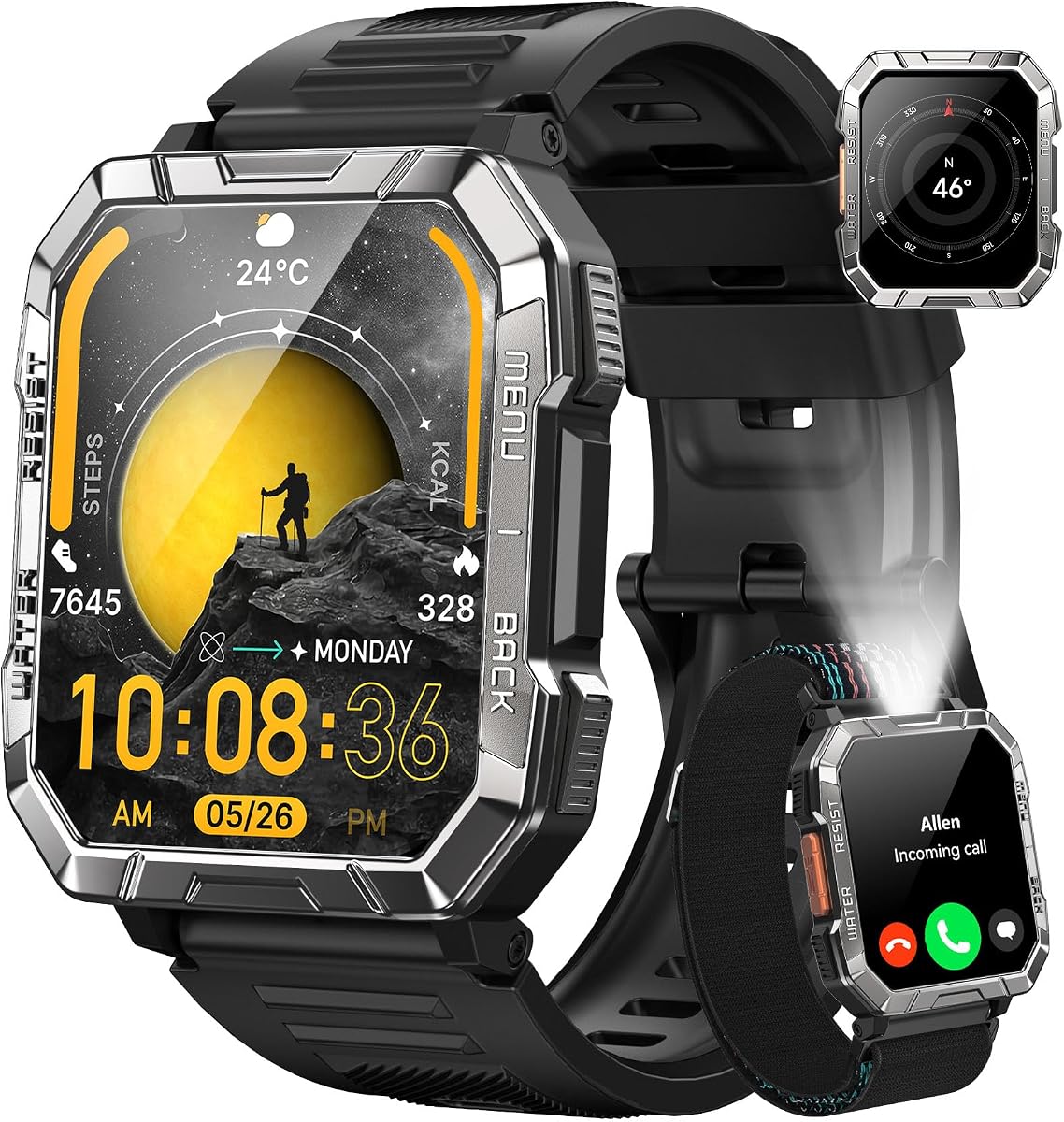
This Blackview Military Smart Watch shares the approachable design and extensive feature set of the first selection but emphasizes a 960mAh battery and a more compact 1.45-inch display. With a supplied rating of 5.0, it appeals to users who prioritize endurance, a rugged appearance, flashlight access, and smartphone connectivity more than standalone navigation.
We may earn a commission when you buy through this link, at no additional cost to you.
Its battery is listed at up to 100 days of standby and more than 30 days of daily use. The plastic case, zinc-alloy housing, scratch resistance, and dust protection are designed for outdoor wear. A one-button high-brightness LED flashlight handles nighttime hiking, camping, and emergency lighting, while the compass supports quick orientation when signals or conventional navigation tools are unavailable.
The watch tracks more than 100 sports modes and connects to the Da Fit app, which can use the phone’s GPS to record routes. It also supports Bluetooth calls, stored contacts, and notifications from familiar messaging services. Health tools include continuous heart-rate readings, blood-oxygen estimates, stress tracking, and sleep-stage analysis, but the manufacturer explicitly says the product is not a medical device and that its readings are for reference only.
Compared with the larger Blackview, this model offers a more compact screen and a slightly larger stated battery capacity. It may be more comfortable for officers who prefer a less conspicuous profile or wear the watch with a tight uniform sleeve. However, the lack of listed built-in GPS makes it less appropriate for users who need independent route recording away from a phone.
For extended deployments, training periods, and users who want minimal charging, the 960mAh configuration is highly compelling. It is a practical smartwatch for routine duty, workouts, and outdoor activity, provided that phone-dependent navigation is acceptable and all health data is treated as informational rather than diagnostic.
A 960mAh battery and the listed 30-plus-day daily runtime make this one of the most convenient options for prolonged assignments. Actual results depend on the selected features and connection habits.
Activating the flashlight directly from the watch avoids reaching for a separate light. It is useful for checking equipment, moving through dark areas, and signaling, subject to local policy.
We may earn a commission when you buy through this link, at no additional cost to you.
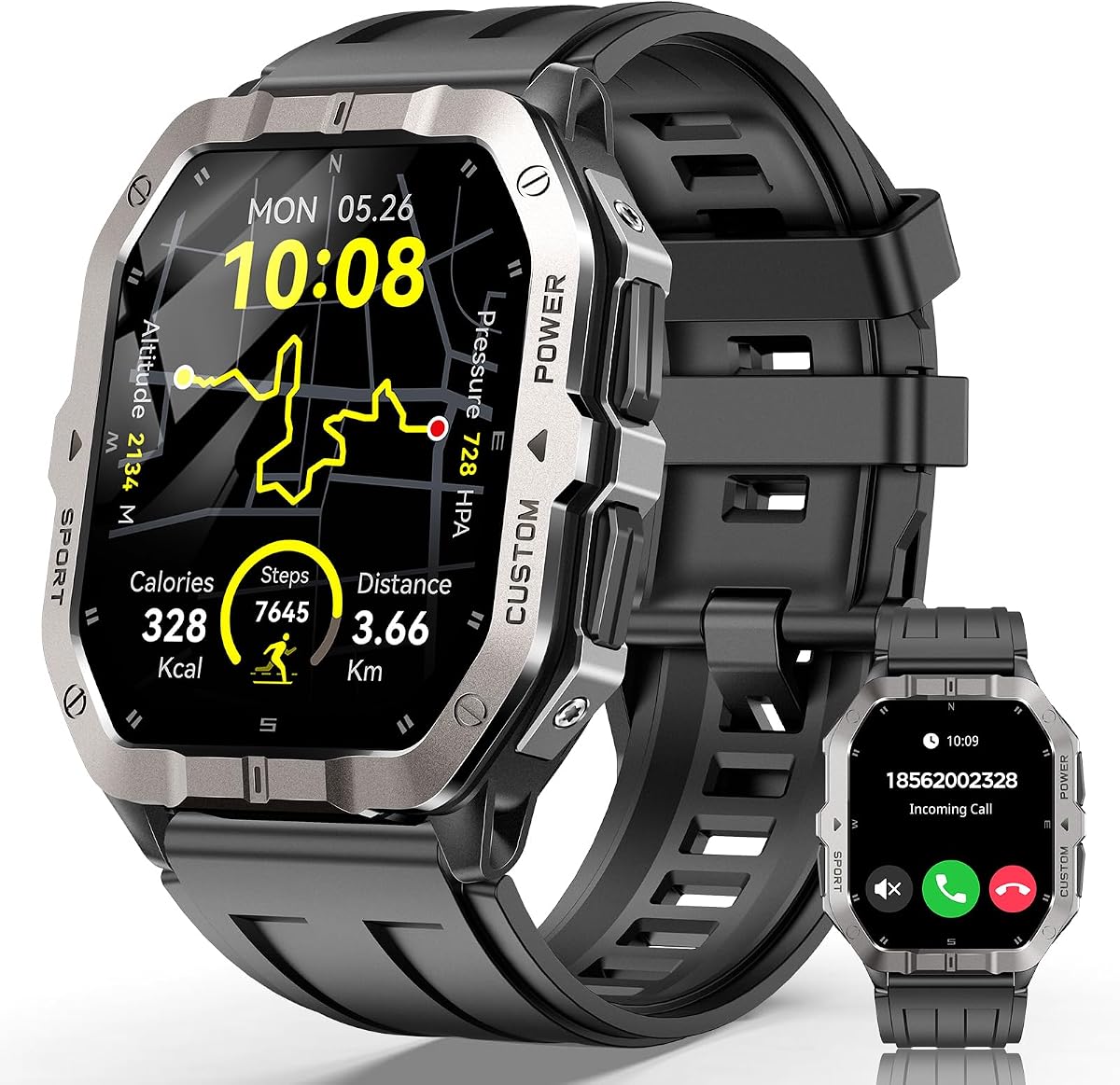
The Military Smart Watch Built-in GPS is the most balanced choice in this guide for officers who want independent location tracking without moving to a premium multisport watch. It carries a supplied rating of 5.0 and combines a 2.02-inch HD touch display, standalone GPS, environmental sensors, extensive sports modes, and Bluetooth calling in a rugged package.
We may earn a commission when you buy through this link, at no additional cost to you.
Its built-in GPS records pace, distance, and routes without requiring a connected smartphone. A compass, altimeter, and barometer add location, altitude, and air-pressure information. The composite body and aluminum-alloy bezel are described as passing military-grade testing, with stated resistance to high and low temperatures, water, low pressure, and dust. Those characteristics make the watch more compelling for field exercises and remote work than many general-purpose fitness trackers.
The watch supports 170-plus sport modes, including walking, running, cycling, hiking, and basketball. It also offers music control, camera remote, weather updates, reminders, Bluetooth calls, and message notifications. The large display is designed for legible fonts and strong color contrast, while tempered glass provides scratch resistance. Battery life is stated at more than 12 days with calling enabled, a practical figure for users who do not need the much longer runtime of the Blackview models.
Health monitoring includes heart rate, blood oxygen, blood pressure, and sleep trends. The manufacturer cautions that these readings are references for exercise and cannot be compared with professional medical equipment. The watch also has only a 12-month guarantee, which is shorter than the two-year coverage listed for the first two Blackview options.
This is the strongest fit for personnel who routinely train away from their phone or need basic standalone route data. It is less suitable for operators requiring satellite SOS, specialized ballistic calculations, cellular independence, or institutional-grade mapping. Even so, the combination of GPS, environmental sensors, a large display, and broad sports support makes it an excellent all-around field smartwatch.
Standalone GPS is the defining feature for officers who want recorded routes without carrying or using a phone. The compass, altimeter, and barometer add context that is useful in changing terrain.
The watch handles navigation, fitness, calls, notifications, and environmental readings in one enclosure. That versatility reduces the number of separate personal devices needed during training or outdoor duty.
We may earn a commission when you buy through this link, at no additional cost to you.
The Garmin fēnix 9 Pro is built for demanding athletes and adventurers who need more connectivity than a conventional sports watch can provide. Its supplied rating is 4.1, but that figure does not diminish its advanced feature set. The watch combines a titanium case, sapphire lens, LED flashlight, LTE, and optional inReach satellite communications in a premium 51mm design.
We may earn a commission when you buy through this link, at no additional cost to you.
LTE allows the wearer to leave a phone behind while exchanging messages and making voice calls. LiveTrack shares location with friends at 30-second intervals, while check-ins are handled through the Garmin Messenger app. inReach adds satellite messaging, location check-ins, and interactive emergency SOS through Garmin Response, though an active subscription is required and coverage or availability can vary. Some jurisdictions also regulate satellite communication equipment.
For law-enforcement users, the value lies in independent communication and location options during travel, search activities, and remote training. The watch also delivers 100-plus activity profiles, enhanced rowing and rucking tools, stamina curves and zones, indoor rowing VO2 max support, and advanced nutrition and performance features. These functions go well beyond basic step counting and are more useful for endurance-focused personnel.
The 1.5-inch AMOLED display and titanium construction create a distinctive premium device, but the 51mm case is large. A larger wrist profile may be uncomfortable during extended wear or less compatible with formal uniform sleeves. Connectivity also depends on carrier coverage, plan status, and regulatory conditions. The included inReach offer includes a waived activation fee and a free trial, with stated SOS messaging access under the supplied terms.
The fēnix 9 Pro is best for agencies or individuals willing to pay for advanced construction and connected services. It is less convincing as an everyday concealed watch or as a budget training tool. For remote operations where phone-independent calling and satellite rescue capabilities justify the complexity, however, it is among the most capable choices listed.
LTE permits calls, messages, and updates without a nearby phone, while inReach extends communication over satellite. These functions can improve resilience during remote assignments, although service plans and coverage rules apply.
The titanium case, sapphire lens, and 1.5-inch AMOLED display prioritize strength and legibility. The integrated flashlight offers white, red, and green settings for different lighting needs.
We may earn a commission when you buy through this link, at no additional cost to you.
The Garmin vívoactive 5 is less overtly tactical than the military-style models and rugged Garmin alternatives, but it offers one of the strongest general-purpose health and fitness packages. It has a supplied rating of 4.3, a bright AMOLED display, GPS-based sports apps, and up to 11 days of stated smartwatch battery life in a relatively compact 42mm case.
We may earn a commission when you buy through this link, at no additional cost to you.
Body Battery monitoring evaluates available energy using sleep, naps, stress, and workouts. The watch provides a sleep score, personalized sleep coaching, HRV status, automatic nap detection, wrist-based heart rate, stress tracking, fitness age, and menstrual and pregnancy tracking. Garmin notes that these metrics are close estimates. This makes the watch useful for officers interested in recovery and shift-load awareness, though it is not a medical device.
More than 30 built-in indoor and GPS sports apps cover walking, running, cycling, HIIT, swimming, golf, and other activities. Wheelchair mode tracks pushes rather than steps and includes handcycle activity, strength, cardio, HIIT, Pilates, and yoga options. Preloaded workouts, custom workouts, Garmin Coach plans, and training benefit and recovery estimates make it especially useful for personnel managing demanding fitness routines.
Offline music can be downloaded from Spotify, Amazon Music, or Deezer, and the watch connects to wireless headphones for phone-free listening. Its main limitation for law-enforcement use is the absence of listed rugged or tactical features such as a built-in flashlight, highly specialized military controls, or satellite emergency communication. The supplied information also does not establish an extreme water-resistance rating for this model.
The vívoactive 5 is a good choice for departments prioritizing officer wellness, rehabilitation, training, and sleep awareness over rugged field equipment. Its smaller dimensions make it easier to wear discreetly under a uniform. It can complement professional medical and fitness resources, but users should not treat its readings as diagnostic or substitute it for agency-approved protective gear.
Body Battery, HRV status, nap detection, and sleep coaching can help users examine how sleep and stress affect daily readiness. The readings remain estimates and should support, not replace, proper rest and medical guidance.
Wheelchair mode and handcycle profiles distinguish this watch from many basic fitness trackers. They provide a more useful activity record for users who push rather than take conventional steps.
We may earn a commission when you buy through this link, at no additional cost to you.
The Garmin Instinct 3 AMOLED delivers a strong balance of rugged construction, navigation, and battery endurance. Its supplied rating is 4.6 reflects a favorable overall result, while its key attractions are the reinforced 45mm case, vibrant 1.2-inch AMOLED screen, 18-day stated battery life, and built-in flashlight.
We may earn a commission when you buy through this link, at no additional cost to you.
Navigation is handled through a three-axis compass, barometric altimeter, and multi-band GPS with SatIQ technology. SatIQ is designed to improve positioning while managing power use, making the watch useful in remote terrain where users need dependable orientation. The built-in LED flashlight includes variable intensities and strobe modes for quick illumination without adding a separate light to the wrist.
Health features include wrist-based heart rate, advanced sleep monitoring, and Pulse Ox. Garmin cautions that the watch is not a medical device and that its readings are intended as close estimates. Pulse Ox availability also varies by country. These functions are most useful for general wellness and training awareness rather than clinical assessment.
Compared with the fēnix 9 Pro, this watch is smaller and less explicitly connected. The supplied information does not list LTE calling, satellite messaging, or interactive inReach SOS. Those omissions matter for remote operations where communication independence is essential. The 18-day stated battery nevertheless provides a useful compromise between a more capable smartwatch and a basic tracker.
This Instinct model suits personnel who want Garmin’s navigation and rugged design in a practical everyday format. It works well for outdoor patrol support, training, hiking, and fitness tracking, while the flashlight and long battery simplify field use. For agencies requiring standalone emergency communications, it should be paired with an approved radio or satellite communicator rather than treated as a replacement.
Multi-band GPS with SatIQ is designed to balance reliable positioning and runtime. The compass and altimeter add useful information when a route passes through areas with limited cellular service.
Variable flashlight output and strobe modes provide quick field illumination, while the stated 18-day battery reduces charging frequency. Actual runtime depends on GPS use, sensor activity, and notification settings.
We may earn a commission when you buy through this link, at no additional cost to you.
The SOUYIE Military GPS Watch is a feature-rich option for users who want independent positioning, Bluetooth calls, and a highly capable fitness ecosystem. Its supplied rating of 4.8 is among the strongest results in the guide. The zinc-alloy frame, tempered glass, always-on AMOLED display, and six-system satellite support make it visually and functionally oriented toward outdoor use.
We may earn a commission when you buy through this link, at no additional cost to you.
Built-in GPS records exercise routes and displays them on a connected phone’s map. It supports GPS, GLONASS, BeiDou, Galileo, NAVIC, and QZSS, while a compass, altimeter, and barometer provide orientation, altitude, and air-pressure information. This broad multi-satellite approach is useful for users who work across different regions and want more position sources than a basic phone-connected watch.
The watch includes 178 sports modes, automatic detection for five workouts, goal setting, and real-time tracking of heart rate, distance, pace, and calories. Bluetooth calling uses built-in speakers and a microphone, and up to 100 contacts can be synchronized. An AI assistant handles music, weather, alarms, and timers, while the app supports messages from platforms including WhatsApp, Facebook, and Twitter.
Health monitoring covers heart rate, blood pressure, blood oxygen, stress, nighttime sleep, and naps, including light, deep, and REM sleep categories. The watch can also issue alerts when readings cross user-defined maximum or minimum heart-rate values. These are wellness references, not medical determinations, and users with clinical needs should use approved medical equipment.
The 530mAh battery is stated to last seven to 10 days with normal use, up to 30 days on standby, and about three days with continuous GPS. A full charge takes around two hours. Its 3ATM rating and resistance to rain, sweat, and swimming broaden the operating envelope, although buyers should verify specific manufacturer instructions before exposing the watch to water.
Supporting six satellite constellations improves the range of available positioning signals. Standalone route recording is valuable during remote training, while the environmental sensors help contextualize direction and elevation.
Five automatically detected workout modes make it easier to begin exercises without manually selecting a profile. The extensive sports list also supports varied routines, from running and cycling to hiking and basketball.
We may earn a commission when you buy through this link, at no additional cost to you.
The Samsung Galaxy Watch Ultra2 is an ambitious outdoor smartwatch with cellular independence, exceptional screen brightness, and a complete set of rugged and health tools. Its supplied rating is 4.6, and the 47mm titanium design positions it as a substantial wearable for users who need more capability than a conventional fitness watch.
We may earn a commission when you buy through this link, at no additional cost to you.
Built-in LTE allows the watch to make calls, send texts, and receive updates while the phone remains behind. It works with Samsung phones and other Android devices, although the supplied information emphasizes seamless operation with Samsung hardware. A personalized heart score, sleep-based Vitals, and guidance features add wellness support, while voice interaction provides instant AI assistance without requiring a wake phrase.
The 5000-nit display is designed to remain legible in direct sun, a major advantage during outdoor assignments. The case is IP69K dust-tight and rated for 10 ATM water resistance. The Mares dive-computer app is EN13319-certified and provides ascent and descent information, depth-limit notifications, and safety-stop guidance, expanding the watch’s usefulness for water-related training and operations.
Path, elevation, and pace guidance support trail running, and personalized hydration alerts help users plan around long exertion. These features complement a normal watch but should not replace approved navigation, hydration protocols, or rescue planning. The large case may be conspicuous under a uniform, and cellular service must be configured and maintained separately from the phone.
The Galaxy Watch Ultra2 is most suitable for personnel who want a connected outdoor watch that remains useful when a phone is unavailable. Its combination of LTE, extreme display visibility, serious water resistance, and health monitoring makes it a strong all-round choice for field-oriented users who favor the Samsung ecosystem.
LTE calls, texts, and notifications can continue without the paired phone. This supports coordination and personal communication, but users should confirm carrier coverage and agency security requirements.
A display rated at up to 5000 nits improves readability in direct sunlight. The titanium case and IP69K and 10ATM ratings add meaningful outdoor durability for demanding environments.
We may earn a commission when you buy through this link, at no additional cost to you.
The CARBINOX Edge Smart Watch stands out through its unusually complete accessory bundle and a mix of rugged construction, navigation, and long stated battery life. It has a supplied rating of 4.1 and includes the watch, magnetic charging cable, screen protector, metal band, and six quick-release bands, giving users multiple ways to configure the wrist device.
We may earn a commission when you buy through this link, at no additional cost to you.
The stainless-steel bezel and Corning Gorilla Glass are described as MIL-STD-810H tested for drops, dust, and mud. A 5ATM rating and IP69K sealing add substantial water and high-pressure-jet resistance. The supplied information describes it as swim-ready, though users should follow the manufacturer’s specific care and operating instructions.
Dual-frequency L1+L5 GPS supports phone-free route tracking across six satellite systems. A compass, altimeter, and barometer help maintain orientation in remote terrain. The 1.96-inch AMOLED display produces 1000 nits of brightness for direct-sun visibility, and the watch supports Bluetooth calls, texts, and app notifications with both Android and iPhone devices.
The stated battery life reaches 25 days in basic watch mode, with a full recharge taking about two hours on the magnetic charger. It tracks 160 sports modes along with heart rate, blood oxygen, and sleep. This broad feature set makes it a flexible field and fitness watch, although the supplied data does not mention a built-in flashlight, cellular calling, satellite SOS, or specialized tactical profiles.
The six-band selection is a genuine advantage for personnel who alternate between uniform, training, exercise, and casual wear. Officers who want one watch to cover several roles may find that versatility more useful than a compact accessory set. Buyers who prefer minimal equipment may find the metal band and extra straps unnecessary, but the overall package is generous.
Six quick-release bands allow rapid changes between professional, training, and off-duty configurations. A metal band adds a more formal option, while the screen protector helps preserve the display.
MIL-STD-810H testing, 5ATM, IP69K, and dual-frequency GPS create a convincing field feature set. The watch also provides a compass, altimeter, and barometer for environmental context.
We may earn a commission when you buy through this link, at no additional cost to you.
The Garmin Instinct 3 Tactical Solar is the clearest tactical-focused option in this guide. It has a supplied rating of 4.6 and combines a reinforced 45mm case, solar charging, a built-in flashlight, multi-band GPS, and dedicated tactical features in a watch designed for demanding outdoor environments.
We may earn a commission when you buy through this link, at no additional cost to you.
Solar charging can deliver unlimited battery life under the manufacturer’s stated condition of all-day smartwatch wear with three hours per day outdoors at 50,000 lux. This makes it attractive for officers who spend substantial time outdoors and want to reduce dependence on wall outlets or vehicle charging. Solar performance is much lower indoors, so the watch should still be monitored and recharged normally as needed.
Dedicated tactical functions include jumpmaster, waypoint projection, dual-position GPS format, a preloaded tactical activity, stealth mode, kill switch, night-vision-goggle compatibility, and a rucking activity. A preloaded Applied Ballistics solver requires a separate one-time purchase through the AB Quantum app. These features add value for users who need more specialized controls without reaching for a phone.
Navigation uses a three-axis compass, barometric altimeter, and multi-band GPS with SatIQ. The built-in flashlight offers variable intensities and strobe modes. The case is fiber-reinforced polymer with a metal-reinforced bezel, measuring 45 by 45 by 14.9 millimeters and fitting wrists from 137 to 204 millimeters. It is water-rated to 10 ATM and designed to MIL-STD-810 for thermal and shock resistance.
Health monitoring includes heart rate, advanced sleep tracking, and Pulse Ox, with the usual reminder that these are estimates rather than medical readings. Smart notifications work when paired with a compatible phone, and Connect IQ support allows new apps and watch faces. Garmin Pay adds contactless payment with supported banks and select transit systems.
This watch is the strongest recommendation for users seeking explicit tactical features in a proven rugged platform. Its main drawbacks are the added complexity, premium positioning, and dependency on sunlight for the strongest battery benefit. The optional ballistics purchase also means users should verify exactly which tools their duties require. Even with those considerations, it offers the most purpose-built tactical feature set among the ten selections.
Solar charging can extend runtime substantially for users who regularly wear the watch in bright conditions. The claim depends on regular outdoor light, so indoor users should maintain a normal charging routine.
Stealth mode, kill switch, waypoint projection, dual-position GPS, and rucking support demonstrate a clear tactical orientation. Night-vision compatibility and the built-in flashlight further improve field usefulness.
We may earn a commission when you buy through this link, at no additional cost to you.
Selecting a watch for law-enforcement use requires balancing physical protection, reliable data, communications, battery endurance, and practical wearability. The most important starting point is the duties and environments in which the watch will be used.
Officers may encounter rain, dust, mud, impacts, extreme temperatures, and demanding training environments. Look for reinforced cases, scratch-resistant displays, clearly stated environmental testing, and a water-resistance rating that exceeds what normal daily wear requires. IP68, 3ATM, 5ATM, 10ATM, and IP69K are not interchangeable, so buyers should understand the differences and follow manufacturer guidance.
Choose a watch with durability claims suited to the actual work environment. A high rating is useful, but it does not authorize exposure beyond the manufacturer’s instructions.
Built-in GPS allows route recording without a phone and is valuable during remote patrols, searches, and field exercises. Multi-band GPS, multiple satellite systems, a compass, altimeter, and barometer can provide more context than basic route lines. Screen size, map readability, satellite acquisition behavior, and update frequency also influence practical use. Law-enforcement users should assess navigation alongside approved devices rather than expecting a watch to replace them.
Prioritize independent GPS if phones cannot be carried. For urban duties, Bluetooth-connected tracking may be sufficient, while remote assignments benefit from multi-system positioning.
Long battery life reduces the chance of a dead watch during a shift, training deployment, or travel. Compare stated battery figures carefully because standby time, basic watch time, GPS use, calling, and sensor-heavy use are very different workloads. Solar charging is valuable for all-day outdoor users but depends on access to strong sunlight. Magnetic charging, rapid charging, and included cables also affect convenience.
For extended or remote work, prioritize a watch that can last through several duty periods between charges. Indoor users should not rely on solar runtime alone.
Bluetooth calls, text notifications, app alerts, and voice assistants can reduce phone checks, but security requirements may limit their use. Cellular connectivity allows a watch to communicate without a nearby phone, while satellite messaging and SOS offer greater remote resilience. These premium functions commonly require compatible services, subscriptions, coverage, and regulatory compliance. Always separate an approved work radio from a consumer smartwatch.
Match communications features to policy and coverage needs. Bluetooth is convenient; cellular and satellite capabilities matter when phone-free communication is essential.
Built-in flashlights, waypoint projection, stealth controls, kill switches, dual-position GPS, rucking profiles, and ballistics tools can improve usability in field settings. The number of tactical labels matters less than whether the functions are accessible, reliable, and relevant to the wearer’s role. A simpler watch may be easier to operate under stress, especially when users wear gloves or need rapid access to controls.
Choose specialized tactical features deliberately. For routine duty, navigation, notifications, battery life, and durability may deliver more value than advanced controls that are rarely used.
Heart rate, sleep, stress, blood oxygen, recovery, and activity estimates can help personnel manage training and recovery. Fitness profiles, automatic workout detection, rucking metrics, and wheelchair support may be particularly relevant. Wearables are not medical devices, and agency policy should govern how readings are interpreted or shared. Users with specific medical needs need approved clinical equipment.
Choose health tools for general awareness and training support. Never use a consumer watch as the sole basis for diagnosis, duty fitness, or operational clearance.
Large screens can show more information, but they may be less discreet and require more battery. AMOLED displays generally provide strong color and contrast, while brightness ratings help indicate sunlight legibility. Touch controls should be responsive enough for use with gloves, though physical buttons or alternate control methods may be valuable. Always-on displays, customizable faces, and automatic brightness can improve daily convenience.
Balance screen size with discretion and battery impact. A highly visible display is useful outdoors, but readability should be tested under the actual conditions and lighting expected on duty.
Most watches rely on a companion app for setup, notifications, health data, music, route synchronization, and detailed settings. Confirm the required phone operating system, Bluetooth version, app permissions, and account requirements. Some models are optimized for one ecosystem, while others support both Android and iPhone. Mixed-device users should check compatibility before purchase and consider how managed phones handle notifications and secure communication.
Verify compatibility early because app and phone support can shape which features work. A capable watch cannot deliver its full feature set when setup software or hardware is unsupported.
Start by fully charging the watch, installing the manufacturer’s companion app, and reviewing permissions before connecting it to a phone or work device. Configure emergency contacts, notification priorities, units, display brightness, and fitness goals according to agency policy. Take time to learn the flashlight, navigation, and fitness controls in a safe setting rather than discovering them during an urgent assignment.
Treat health readings as general estimates, not medical or duty-clearance conclusions. If the watch supports calls, LTE, satellite messaging, or SOS, test those functions only where permitted and understand the required service plans, coverage limits, and emergency procedures. Keep an approved radio and navigation method available whenever a consumer smartwatch is presented as a backup rather than a replacement for professional equipment.
Clean the watch with a soft damp cloth, keep charging contacts free of dirt, and dry the watch after rain, sweat, or swimming. Replace straps when they become loose or damaged, inspect seals and screen protection regularly, and avoid exposing the device to hot water, saunas, solvents, or pressures beyond its rating. Update the firmware and app when needed, and store the watch in a moderate environment during long periods of non-use.
Consumer smartwatches can support fitness tracking, notifications, navigation, quick lighting, and personal communication. They should not replace approved radios, body cameras, navigation equipment, or medical monitoring tools. Agencies should evaluate security, durability, data handling, and feature reliability under their own policies before authorizing deployment.
The two Blackview military-style watches lead the supplied data with up to 100 days of standby and more than 30 days of daily use. Their actual runtime will vary with calls, GPS, notifications, and sensor activity. The Garmin Instinct 3 Tactical Solar is an alternative for outdoor users who want solar charging.
Built-in GPS is most useful when a phone is unavailable, prohibited, or impractical to operate. It supports standalone route recording and can improve awareness during remote training or outdoor assignments. For many urban roles, phone-assisted tracking may be sufficient, but users should verify actual behavior in their operating area.
No. Bluetooth calling, LTE, and satellite messaging can supplement communications, but they do not automatically provide the reliability, group coordination, dispatch integration, or security required of an approved radio. Keep agency-issued communications equipment primary and follow all rules governing personal devices and cellular services.
The listed manufacturers describe smartwatch health data as estimates or reference information, and several explicitly state that the devices are not medical instruments. Such readings may help users observe trends in sleep, stress, heart rate, and activity, but diagnosis or medical decisions require appropriate clinical tools and qualified personnel.
Solar charging is most useful when the watch receives several hours of strong outdoor sunlight, as described for the Garmin Instinct 3 Tactical Solar. Indoor or night shifts receive little benefit, so users should continue normal charging. Solar models are best viewed as a way to extend runtime between charges rather than eliminate them.
A built-in LED flashlight is the clearest advantage, and several selections provide adjustable brightness or strobe modes. Always-on AMOLED displays, customizable faces, and audible vibration can also help. Users should test controls in darkness and avoid bright displays where they could compromise night vision or reveal position.
Confirm the supported phone operating systems, Bluetooth requirements, app permissions, and MDM restrictions before purchasing. Some features may work differently across Android and iPhone ecosystems or disappear behind managed-device controls. Information technology, security, and procurement personnel should approve the watch, apps, accessories, and data workflow before use.
The best overall balance in this guide is the Military Smart Watch Built-in GPS, thanks to standalone positioning, environmental sensors, a large display, and broad fitness support. The Blackview Military Smart Watch 960mAh stands out for exceptional stated battery endurance and low-cost utility, while the Garmin Instinct 3 Tactical Solar leads users who want purpose-built tactical controls, solar charging, and proven outdoor durability.
The right choice depends on the mission. Maximum battery life favors the Blackview models, remote route tracking favors the GPS-equipped military watches and rugged Garmin alternatives, cellular independence favors the Galaxy Watch Ultra2, and dedicated tactical behavior favors the Garmin Instinct 3 Tactical. Wellness-focused users may find the vívoactive 5 more useful than a rugged watch with a larger case and fewer tactical functions.
Before buying, verify current specifications, smartphone compatibility, required services, water limits, and agency policies. Features, ratings, and availability can change, and no consumer smartwatch should be treated as a substitute for an approved radio, clinical monitor, or professional navigation system. Checking the latest information helps ensure the selected watch complements the wider duty kit rather than creating false confidence.
