
7-in-1 Digital Soil Tester Kit
4.3Editor score
Seven integrated soil measurements
Large backlit LCD display
Ten-second reading process
Our Soil Salinity Testers guide compares ten digital and multifunction meters for salinity, EC, moisture, pH, temperature, and field-ready soil testing
Soil salinity testers help gardeners, greenhouse operators, farmers, and landscapers identify excessive soluble salts before they interfere with nutrient uptake, root development, or irrigation management. A useful instrument should provide a dependable reading, clearly display its results, and fit the conditions where measurements will be taken. Probe design, measurement range, environmental protection, and ease of use all influence which model is most appropriate.
This guide compares ten soil salinity meters and closely related multifunction testers using the supplied specifications, capabilities, application notes, customer ratings, and construction details. It covers dedicated EC and salinity instruments, all-in-one soil analyzers, and water-focused alternatives for pools and aquariums. Each review explains the strongest reasons to consider the product as well as the limitations revealed by its stated features and intended use.
The first three recommendations represent the most balanced options for general buyers, budget-conscious users, and those seeking advanced soil analysis. Every entry highlights what makes the product distinctive, while the buying guide explains how to match probe type, readings, and durability to your own garden or agricultural needs. Retail terms and product availability can change, so confirm the current listing before purchasing.
4.3Editor score

4.6Editor score

The comparison below highlights each meter's core functions, probe design, measurement focus, and best-fit setting. Because some products specialize in soil while others target pool, aquarium, or marine water, readers should compare the application alongside the number of features.




The Long Probe Deep Soil Salinity EC Moisture Meter is a compact digital instrument designed for measuring salinity in soil and hydroponic nutrient solutions. Its most distinguishing feature is the elongated stainless steel probe, which can reach below the surface when checking larger garden beds, greenhouse containers, or outdoor growing areas. The supplied information does not include a numerical customer rating, so its appeal should be judged primarily from its stated construction and intended applications.
We may earn a commission when you buy through this link, at no additional cost to you.
The backlit digital screen is easier to interpret than an analog needle, particularly in greenhouses, low-light indoor areas, or at the edge of a planting bed. A digital display also makes it practical to compare readings taken at several locations. The stainless steel probe is described as practical and long-lasting, while the compact, lightweight body simplifies storage and transport between indoor and outdoor projects.
Its main trade-off is the limited technical detail in the listing. No explicit EC range, accuracy rating, calibration procedure, or measurement resolution is provided. A prospective buyer should therefore verify the current specifications and accessories before purchase. Users who need only a direct field estimate of soil salinity may find that sufficient, although demanding growers may prefer a model with clearly published accuracy and automatic temperature compensation.
This meter is best for gardeners, farmers, and hydroponic growers who value reach and portability over a large collection of secondary measurements. The long probe makes it a sensible option when surface-level readings are unlikely to represent the root zone. It is also a straightforward choice for users who want an easy-to-read EC meter for occasional checks across soil and nutrient solution.
The extended probe is the central advantage for users checking established beds, raised containers, or greenhouse rows. It reduces the need to disturb the upper layer of soil simply to position a short probe near the root zone, although careful insertion is still necessary around roots and stones.
Because the meter can measure soil and hydroponic nutrient solution, it can help connect two parts of a growing system. Checking both media may reveal whether an irrigation or nutrient-management issue is developing across the cultivation setup.
We may earn a commission when you buy through this link, at no additional cost to you.
The 2 in 1 Digital Plants EC Meter combines electrical conductivity and temperature measurement in a focused soil-testing instrument. With a 4.6 customer rating and a clearly stated EC range of 0–4.00 mS/cm, it offers the most balanced combination of relevant specifications for readers who specifically need a salinity meter rather than a broad household soil analyzer. The focused feature set also keeps the operating process relatively simple.
We may earn a commission when you buy through this link, at no additional cost to you.
Its probe detection technology is designed for rapid, precise readings, with a stated accuracy of plus or minus 2% of full scale. Temperature measurement adds useful context because electrical conductivity can change as environmental and soil conditions vary. The green backlit LCD presents the numerical results clearly, while a ten- to fifteen-second wait gives the probe time to stabilize after insertion.
The IP67 electrode provides substantial protection against water and dust, making the instrument suitable for outdoor beds, farms, and gardens where occasional rain or splashing is likely. The trade-off is that the meter concentrates on EC and temperature rather than adding pH, moisture, light, NPK, or other functions. The wired design also means the probe remains attached to the display during use.
This is the strongest general recommendation for home growers, greenhouse managers, and farmers who need a clear EC and salinity reading with a published range and accuracy. It is especially attractive for users who will operate it outdoors and want a waterproof probe without paying for a large multiparameter analyzer. Choose it for focused salinity monitoring and temperature context; choose a broader kit when moisture and pH are equally important.
The stated 0–4.00 mS/cm range makes this meter easier to evaluate than a model that does not publish its limits. That transparency helps buyers determine whether the device suits the salinity conditions expected in their soil or growing medium.
The IP67-rated electrode is intended to withstand moisture and dust exposure encountered during field use. That protection makes the meter more practical for garden rows and agricultural checks than an instrument without a clearly weather-resistant probe.
We may earn a commission when you buy through this link, at no additional cost to you.
The Moisture Meter for Plants 7-in-1 Digital Soil Tester Kit covers a broad set of plant-care measurements in one instrument. It can report soil moisture, pH, temperature, light intensity, fertility information, EC, and TDS-related water-quality data. The 4.3 rating reflects a generally favorable reception, and the seven-function format is especially attractive for home gardeners who want more information from a single probe.
We may earn a commission when you buy through this link, at no additional cost to you.
A large LCD with white backlighting keeps the numerical results visible in daylight and darkness. Low-battery warnings help users avoid making decisions with unreliable readings, while an intuitive arrangement of symbols and numbers makes the device approachable for beginners. The operating process is straightforward: insert the probe approximately 10 centimeters into the soil, wait around ten seconds, and review the display.
There are important operating restrictions. The tester must not be used directly to measure liquids, and the instructions advise against forcing the probe into dry or hard ground. Instead, the test area should be moistened lightly and allowed to sit for ten minutes. Four AAA batteries are required but not included, adding a small setup step that buyers should consider.
This kit is a good budget-oriented choice for indoor plant owners, balcony gardeners, and hobbyists who want salinity alongside moisture, pH, temperature, and light data. It is less suited to a commercial grower who needs laboratory-grade traceable measurements, and its direct-liquid limitation is important for hydroponic users. Even so, it delivers excellent functional breadth for routine plant monitoring.
Combining EC with moisture and pH helps create a more useful picture of root-zone conditions. If a reading changes, the additional parameters may help a grower decide whether irrigation, nutrient balance, or another factor deserves closer attention.
The extra-large backlit display reduces guesswork and makes routine checks easier in bright rooms or at night. Icons and numerical values are intended to be understandable even for users with little experience interpreting meter readings.
We may earn a commission when you buy through this link, at no additional cost to you.
The Pool Salt Tester 5-in-1 is a digital water-analysis instrument designed for pools, aquariums, hot tubs, and related saltwater environments. It measures salt level while also providing pH, TDS, EC, and temperature readings. Its 4.4 rating and broad range of display units make it a useful option for maintaining aquatic systems, although it is not a soil-insertion meter.
We may earn a commission when you buy through this link, at no additional cost to you.
One notable feature is the ability to display salinity as PPM, PPT, or percent. The listed pool range is 0–9999 PPM, while seawater is described as 10–200 PPT, with automatic switching to PPT when a PPM value exceeds 9999. Food testing is also described as operating from 0.01% to 25%. These alternatives can make the instrument relevant to growers who prepare nutrient solutions or evaluate brine concentration.
The primary limitation is its scope. The probe is designed to be dipped into water rather than inserted into soil, and the product information does not provide a detailed accuracy specification. Users who need a true soil tester should choose an instrument with a soil probe. Those focused on water salinity, however, may appreciate the simple interface, clear LCD, and absence of complicated setup.
This is a strong fit for pool owners, aquarium keepers, and anyone testing liquid nutrient solutions where salinity is the main concern. It is less appropriate as the primary diagnostic instrument for a raised bed, field, or greenhouse soil. Its unit flexibility and five-function design, however, make it a capable companion tool for hydroponic and water-based growing systems.
Offering PPM, PPT, and percent formats helps users interpret the same salinity information according to their application. This is particularly useful when comparing a pool reading with an aquarium target or checking a concentrated nutrient solution.
The device is used by dipping its probe into water and reading the LCD. That straightforward process makes routine monitoring practical for beginners and avoids the interpretation and timing steps required by many color-strip methods.
We may earn a commission when you buy through this link, at no additional cost to you.
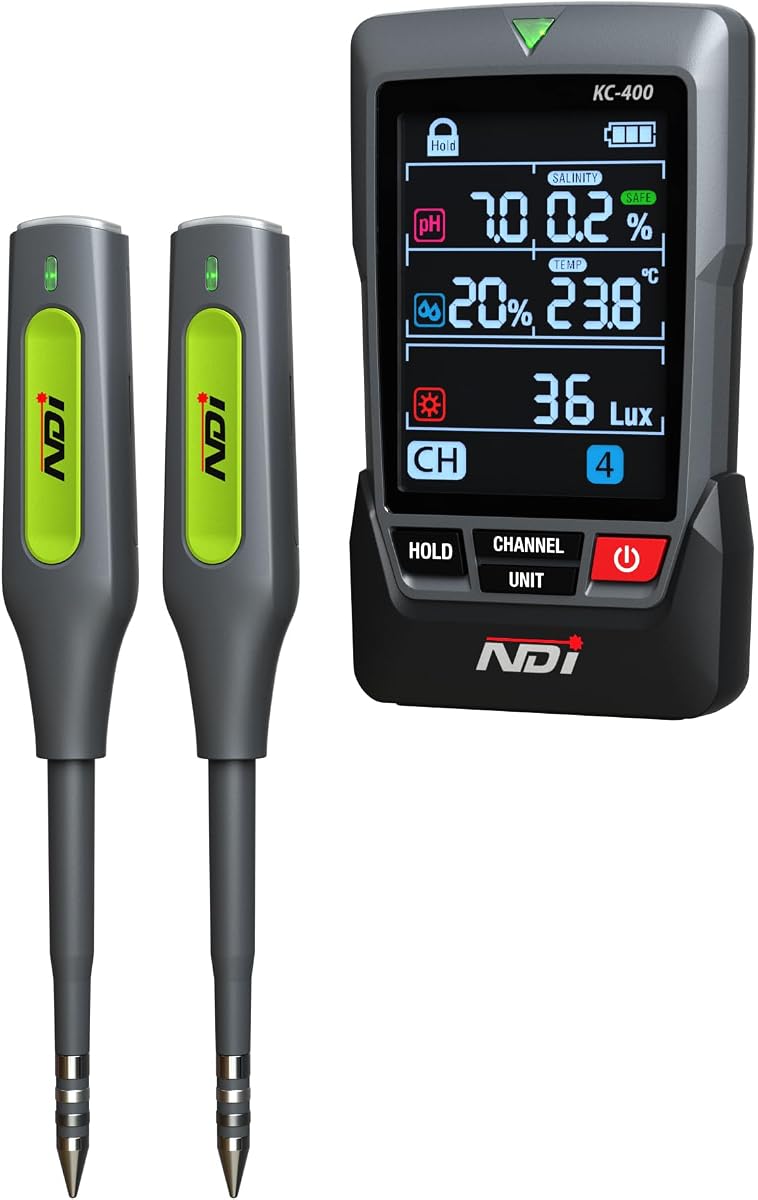
The NDI Multifunctional Soil Meter is designed for distributed monitoring, with support for as many as five probes and wireless transmission. It combines pH, salinity, temperature, and light-intensity functions, while the title also references acoustic wave growth assistance. Its 3.9 rating places it in the middle of this list, but the multi-probe concept is distinctive for users who want to compare several locations.
We may earn a commission when you buy through this link, at no additional cost to you.
Wireless data transmission can reduce the inconvenience of moving a single wired display between pots, beds, or planting zones. With multiple probes, a grower may keep measurements active across separate containers or monitor contrasting parts of a landscape. The combination of salinity with pH, temperature, and light gives broader context than a dedicated EC meter alone.
The supplied listing provides limited detail beyond the core feature claims, so the exact monitoring workflow, probe spacing, data range, and accuracy are not clear. The 3.9 rating also suggests that prospective buyers should review current customer feedback carefully. If a simple single-probe meter is all that is required, the multi-probe and wireless design may add unnecessary complexity.
This product makes the most sense for greenhouse operators, landscapers, and serious growers interested in monitoring multiple sites or maintaining a record outside a handheld display. It may be less attractive to casual houseplant owners who only need an occasional salinity check. Buyers should confirm the complete package contents and operating instructions before deciding that the expanded system is worth the added complexity.
The ability to support up to five probes distinguishes the meter from most single-probe soil tools. Multiple sampling points can be especially valuable where irrigation, soil composition, or plant uptake varies across a property.
Wireless transmission can simplify the display process by separating it from the sensing locations. This may be helpful in larger greenhouses or gardens where repeatedly moving one wired probe between sites is inconvenient.
We may earn a commission when you buy through this link, at no additional cost to you.
The Hanna HI98319 Marine Salinity Tester Checker is a compact handheld colorimeter intended for direct salinity measurement. Its 3.9 rating reflects a middling reception, but the product's clear marine focus gives it a distinct use case for aquariums, marine biology, and other saltwater environments. It prioritizes a single salinity task rather than attempting to provide a complete soil analysis.
We may earn a commission when you buy through this link, at no additional cost to you.
The compact design makes the meter easy to carry, which is valuable for field sampling away from a fixed workstation. A straightforward button interface simplifies operation, and the direct-reading format removes the need to interpret color-chart cards. These qualities make it a practical instrument for users who already know which salinity reading they need to obtain.
It should not be confused with a general soil salinity meter. The supplied information does not mention soil insertion, pH, moisture, temperature compensation, measurement range, or accuracy, and those omissions limit its relevance to garden and farm use. The 3.9 rating is another reason to examine recent customer feedback for details not included in the listing.
Choose this checker for marine and aquarium work where direct, portable salinity measurement is the primary objective. It is less appropriate for growers comparing nutrient solutions unless the device is specifically approved for that liquid, or for anyone needing multiple soil parameters. Its appeal lies in specialization and portability rather than broad functionality.
The handheld form is easy to transport between tanks, sample sites, and other marine-testing tasks. Compact equipment can be particularly useful when a salinity check must be made away from a permanent work area.
A direct digital salinity reading can be easier to work with than a visual color comparison. For experienced users who need a specific value, the focused interface reduces the number of choices involved in each measurement.
We may earn a commission when you buy through this link, at no additional cost to you.
The 4-in-1 Digital Soil Meter combines soil moisture, pH, temperature, and sunlight intensity in an easy-to-read format. Its 4.2 rating indicates generally positive reception, while the adjustable head and large backlit screen make it especially convenient for routine checks around pots, garden beds, and outdoor plants.
We may earn a commission when you buy through this link, at no additional cost to you.
The rotating head can tilt from zero to 45 degrees, reducing the need to bend awkwardly over a container or crouch beside a bed. An intuitive screen layout presents readings with easy-to-understand graphics, helping beginners connect numerical results with plant-care decisions. The product instructions call for insertion to about 10 centimeters, a ten-second wait, and readings from at least five locations when assessing pH and moisture.
Although the title and description position it as a soil meter for plant care, the listed functions do not include a dedicated salinity or EC reading. That distinction is important for anyone shopping specifically for salt detection. Batteries are also required but not included, and the probe must not be used directly to test liquids. Forcing it into very dry, hard soil should be avoided because the instructions warn that damage may result.
This is a useful everyday companion for houseplant owners, balcony gardeners, and outdoor hobbyists who want moisture, pH, temperature, and light data. It is less suitable as a dedicated salinity tester or professional field-analysis instrument. Its strongest advantages are straightforward operation and a display designed to be read easily in many positions.
The 45-degree rotating head is a practical improvement over a fixed display. Users can keep their posture more comfortable while checking pots on a shelf, raised beds, or ground-level plants.
The recommendation to take readings from at least five locations improves the usefulness of a pot or bed assessment. Averaging those results reduces the chance that one unusually wet or dry patch will represent the entire growing area.
We may earn a commission when you buy through this link, at no additional cost to you.
The 8-in-1 Saltwater Pool Tester provides an unusually broad set of water-analysis functions in one handheld device. It measures pH, TDS, EC, salinity, ORP, specific gravity, free chlorine, and temperature. Its 5.0 customer rating is the highest among the products with available ratings, making it a strong candidate for buyers who want one instrument to cover several pool, spa, aquarium, and drinking-water checks.
We may earn a commission when you buy through this link, at no additional cost to you.
Automatic temperature compensation adjusts readings as water temperature changes, an important detail for consistent aquatic monitoring. The product also advertises automatic calibration, a high-precision sensor, a 0.05-second response time, and 0.01 pH accuracy. Results appear numerically on a backlit LCD, which avoids the color-matching ambiguity associated with disposable test strips and supports quick repeat checks.
This is nevertheless a water tester rather than a conventional soil meter, so it does not replace a probe designed for root-zone analysis. The broad claims should also be interpreted in the context of the product's actual instructions and operating conditions. Users measuring free chlorine need to follow appropriate sample-handling procedures, and automatic features do not remove the importance of correct preparation and maintenance.
Choose it for comprehensive aquatic and liquid-water monitoring, particularly if maintaining a saltwater pool, hot tub, or aquarium. It may also help growers check prepared irrigation or nutrient water, provided the solution is appropriate for the instrument. It is the leading pick in this group for water-focused salinity monitoring, but readers seeking direct soil insertion should choose a dedicated soil model.
Combining pH, EC, salinity, ORP, specific gravity, free chlorine, TDS, and temperature reduces the need to juggle separate instruments. That efficiency is particularly useful for routine pool and aquarium maintenance.
Automatic temperature compensation helps keep readings more consistent as pool, spa, or aquarium water changes temperature. The feature is particularly relevant when salinity and other electrical readings are compared across differently conditioned water.
We may earn a commission when you buy through this link, at no additional cost to you.
The 8 in 1 High Accuracy Digital Soil Tester is the most technically expansive soil-focused model in this list. It combines temperature, humidity, EC, salinity, pH, and NPK measurements, with specified ranges covering temperatures from -40°C to 80°C, EC from 0 to 20,000 μS/cm, salinity from 0 to 20,000 mg/L, pH from 3 to 10, and NPK from 0 to 1999 mg/kg. No numerical customer rating is supplied.
We may earn a commission when you buy through this link, at no additional cost to you.
Its IP68 sealing is designed for rain, mud, and demanding outdoor conditions, while the 7.6-inch stainless steel probes provide meaningful depth for field insertion. USB-C power removes the need for replaceable batteries and supports repeated use. Type-C connectivity and digital results also make the device more suitable for organized farm and greenhouse records than a basic analog meter.
The trade-offs are real. It requires a USB-C power source, which may reduce convenience compared with a battery-operated display. The instructions recommend waiting three to five minutes for stabilized NPK readings in sufficiently moist soil, so this is less suitable for rapid spot checks. A single claimed NPK result should not be treated as a complete laboratory analysis without understanding the product's sampling method and limitations.
This is the premium recommendation for growers, farmers, and agronomists who want detailed salinity information alongside pH, NPK, moisture, and temperature. Its extensive measurement ranges, sealed construction, and deep stainless steel probes make it suitable for professional-style field monitoring. Users seeking only a quick EC value will find simpler and faster alternatives in the list.
The combination of EC, salinity, and NPK readings gives a more complete view of soil conditions than a dedicated conductivity meter. It can help users investigate suspected overfertilization, low nutrient availability, and broader root-zone changes within one workflow.
IP68 protection, sealed internal components, and a broad stated temperature range are meaningful advantages for outdoor farm and greenhouse use. Deep stainless steel probes also help users sample below the surface where root activity and salt accumulation may be more relevant.
We may earn a commission when you buy through this link, at no additional cost to you.
The Apera Instruments Value Series Salt20 Salinity Tester Kit is a dedicated salinity instrument with a clearly defined 0–10.0 ppt measurement range. Its 4.0 rating indicates moderate positive reception, while the included calibration solution, batteries, lanyard, and carrying case make it a more complete package than a bare probe-and-display device.
We may earn a commission when you buy through this link, at no additional cost to you.
Apera's platinum black sensor is central to the design and is intended to support accurate measurement across the stated salinity range. Automatic calibration simplifies setup, and automatic temperature compensation adjusts readings across a 0–50°C operating environment. The large LCD shows temperature and PPT together and includes reminders for completed calibration and stable readings.
As a dedicated salt meter, it does not offer the broader pH, moisture, light, or NPK functions found in the multifunction soil models. Its low-battery power source is also less convenient for continuous monitoring than a USB-powered instrument, though the stated battery life of up to 1,000 hours is substantial for normal field use. The kit should be kept dry and stored securely between measurements.
Choose the Salt20 for users who specifically need reliable liquid salinity readings and value a complete accessory set. It is well suited to aquaculture, water testing, and other applications where a focused range around 0–10.0 ppt is appropriate. For broad root-zone analysis or multimeter ownership, a soil-focused model in this guide offers a more suitable combination of functions.
The carrying case, calibration solution, batteries, and lanyard create a ready-to-use package. That completeness is helpful for buyers who want fewer separate accessories to source before making their first salinity measurement.
Automatic calibration and display reminders help reduce uncertainty about instrument readiness. Showing temperature alongside PPT and indicating when a reading is stable makes the instrument more methodical for users comparing repeated samples.
We may earn a commission when you buy through this link, at no additional cost to you.
The right soil salinity tester depends on what you need to measure, where it will operate, and how much diagnostic information you want. Review the measurement range, probe construction, salinity functions, environmental protection, calibration requirements, and display before choosing a model.
A product marketed as a soil tester may not actually measure salinity. Some of the strongest plant-care tools in this list measure moisture, pH, temperature, and light but do not include EC or a direct salt reading. If diagnosing saline conditions is your main objective, look specifically for EC or salinity in the specifications rather than assuming every multifunction meter performs that measurement. Also check whether the stated range covers the conditions you expect in your soil or growing medium.
Soil probes and liquid probes are not interchangeable in every situation. A device designed to be inserted into soil should have an appropriate probe length, moisture tolerance, and insertion guidance. A liquid tester is better for pools, aquariums, nutrient reservoirs, and prepared solutions but may not safely contact soil. The 7-in-1 and 4-in-1 models explicitly warn against direct liquid use, while the pool-focused products are designed around dipping a probe into water.
A useful meter publishes enough technical information to show whether it can cover the intended environment. The 2 in 1 EC meter states a 0–4.00 mS/cm range and plus or minus 2% full-scale accuracy, while the advanced 8-in-1 soil model lists EC from 0 to 20,000 μS/cm. The Apera Salt20 focuses on 0–10.0 ppt. These specifications are more useful for comparison than a generic claim that a tool is accurate.
EC and salinity are valuable, but moisture, pH, temperature, light, and nutrients can help explain what a salinity reading means. A meter that combines several measurements may be more practical for everyday plant care because one insertion can answer several questions. For professional crop monitoring, NPK and other nutrient readings may be useful, although a digital field meter should not be confused with a fully accredited laboratory analysis.
Field instruments must tolerate moisture, dust, mud, temperature changes, and repeated handling. The 2 in 1 EC meter has an IP67 electrode, and the premium 8-in-1 soil tester claims IP68 protection with a rugged stainless steel probe. If a device will remain outdoors or near irrigation equipment, environmental protection deserves as much attention as the screen and measurement features.
Consistent readings depend on correct preparation, a clean probe, and a stable measurement. Some products offer automatic calibration, while others provide calibration reminders or include calibration solution. The advanced NPK model requires several minutes for stabilized nutrient readings, and simpler meters often stabilize in about ten seconds. Choose a process that fits the frequency of your monitoring rather than one that is unnecessarily slow or lacks guidance.
A multifunction meter can simplify a grower's toolkit, but every added function increases complexity and may require more careful handling. The five-probe wireless model is useful for distributed monitoring, while dedicated meters may be easier to carry and quicker to deploy. Consider where readings will be taken, how often they will be recorded, and whether you genuinely need every measurement shown on the display.
Large backlit screens, simple button layouts, and rotating heads make readings easier to interpret in different positions. Power source is also important: some models use readily available AAA batteries, while the advanced soil analyzer requires USB-C power. Battery operation offers flexibility away from an outlet, whereas USB-C may be preferable for repeated professional work or integrated data management.
Begin by reading the manufacturer's instructions and identifying which functions your chosen model supports. Clean and dry the probe according to the manual, install the required batteries or connect the specified power source, and complete any calibration process before collecting field data. For models with multiple locations, prepare a consistent insertion depth and sample pattern so the readings can be compared fairly.
For soil testing, choose a representative spot away from an obvious dry edge, standing water, or recently disturbed area unless those conditions are what you need to investigate. Insert the probe as directed without forcing it through hard ground. Wait for the display to stabilize, record the result, and repeat at several locations when the instructions recommend averaging. For liquid devices, rinse the probe as required, immerse it to the stated depth, and wait for a stable numerical reading.
After use, remove the probe gently, wipe away loose soil or residue, and rinse liquid-contact sensors with appropriate clean water. Do not immerse portions of the instrument that the manual identifies as non-waterproof. Store the device in its case or a dry location, remove batteries if long-term storage is recommended, and inspect the probe for damage. Periodic comparison with a known solution or another meter can help identify a need for calibration or replacement.
Electrical conductivity measures how readily soil or water conducts electricity, which increases as dissolved salts become more concentrated. Salinity is commonly presented through an EC reading, a parts-per-thousand value, or another conversion. The units and conversion method should match the crop and growing medium, so a number should not be compared across products without checking their specifications.
Not always. Some multifunction soil meters include EC or salinity, while others measure only moisture, pH, temperature, light, or fertility. Check the full function list and measurement range before purchasing. If saline conditions are the concern, an EC reading or explicit salinity function is necessary.
Soil salinity and moisture can vary considerably over a short distance because of irrigation patterns, drainage, soil composition, fertilizer placement, and plant uptake. A single probe position may not represent the bed. Taking readings from several comparable locations and reviewing the results gives a more dependable overview of the growing area.
Do not force a probe into hard, dry soil. Several product instructions recommend lightly moistening the test area and waiting about ten minutes before insertion. This can soften the ground and reduce the risk of bending or damaging the sensor. After the area has settled, insert the probe gently and allow the reading to stabilize.
Only if the manufacturer explicitly approves liquid measurement for that model. Some dedicated soil meters can be inserted into nutrient solution, while other multifunction testers state that they must not be used directly to measure liquids. Pool and aquarium meters are designed for immersion, but their ranges may not match greenhouse nutrient concentrations.
These are ingress-protection ratings indicating resistance to dust and water under defined test conditions. A higher rating generally indicates stronger protection, but it does not mean the instrument can be left submerged indefinitely or exposed to every chemical. Users should still follow the manual, rinse the probe after use, and store the meter in a dry location.
Calibration needs depend on the model. Some meters use automatic calibration, some require calibration solution, and others provide guidance for checking stability without stating a full calibration procedure. Follow the included instructions, use the specified solution, and take readings only after the display indicates that calibration and stabilization are complete.
A digital meter is best viewed as a field diagnostic and monitoring tool. It can provide fast information about relative conditions, identify areas that need further investigation, and support routine irrigation or nutrient decisions. Regulated or high-stakes testing may still require laboratory analysis, especially when precise nutrient recommendations or crop compliance decisions are involved.
The 2 in 1 Digital Plants EC Meter is the strongest all-around recommendation because it combines a clearly stated EC range, published accuracy, temperature context, and an IP67-rated probe. The 7-in-1 Digital Soil Tester Kit is the best budget-oriented option for home growers who want salinity alongside moisture, pH, temperature, light, and other functions. The 8 in 1 High Accuracy Soil Tester leads the premium group with NPK analysis, deep stainless steel probes, and rugged IP68 construction.
The remaining products serve narrower or different needs. The long-probe meter is attractive when deeper soil insertion and portability matter, while the NDI system appeals to growers who want multiple wireless probes. The 4-in-1 soil meter is useful for everyday plant care, and the pool, marine, and aquarium instruments are better suited to liquid environments. Prioritize the actual salinity function, measurement range, probe design, and environmental protection before considering extra features.
A good soil salinity tester should make routine checks easier while encouraging more representative sampling and thoughtful follow-up. Confirm the current specifications, included accessories, operating restrictions, and retail terms before purchasing. Product details and availability can change, so the current listing is the best final source for the information you need.