
Fosmon Three-Outlet Heavy-Duty Protector
4.7Editor score
1200-joule surge protection
Three grounded outlet positions
UL498A and UL1449 conformity
Our best surge protector for washer and dryer guide compares voltage cutoffs, delay timing, outlet design, surge capacity, safety listings, and appliance
A washer and dryer can be exposed to voltage spikes, brownouts, load-shedding interruptions, and unstable power without warning. A suitable surge protector for washer and dryer adds monitoring and controlled delay cycles, helping reduce the chance that an appliance receives unstable voltage during a power disturbance.
The products in this guide were compared using the information supplied for each listing, including voltage behavior, delay functions, outlet configuration, electrical capacity, safety standards, appliance compatibility, and customer rating. The list covers 120-volt washer protectors, 220-volt dryer devices, and multi-outlet options for laundry rooms.
Each review explains the most useful design details and the trade-offs associated with that particular protector. The top selections are especially useful for shoppers who want clear status indicators, appliance-specific protection, or a multi-pack for more than one machine. Prices and availability can change, so check the current listing before purchasing.
4.7Editor score

4.8Editor score

4.7Editor score
The table below compares all ten options by their voltage class, outlet layout, delay behavior, and most relevant laundry-room feature. It also makes it easier to distinguish 120-volt washer devices from the dedicated 220-volt electric-dryer protector and to identify products designed for multiple appliances.



This two-unit voltage and surge protector combo has a 4.8 customer rating, the highest among the ten products listed, and it pairs a dedicated Lavamatic protector for a washing machine with a Refrigmatic protector for a refrigerator. Its strongest feature is appliance-specific guidance: the washing-machine protector is intended for front- and top-load models, while the refrigerator unit is described for domestic refrigerators, ice makers, and air conditioners up to 5,000 BTU.
We may earn a commission when you buy through this link, at no additional cost to you.
The protector is designed to address high and low voltage, brownouts, spikes, instant surges, power failures, fluctuations, and load shedding. Indicators show normal, high, low, and time-delay conditions, giving the user a clear indication of what the device is doing. The initial delay is 30 seconds, although the instructions advise waiting three minutes before connecting the appliance for the first time. That distinction is worth noting because the listing refers to both stabilization periods.
The appliance-specific pairing is both a strength and a limitation. It is more thoughtfully presented than a generic multi-outlet adapter, but laundry rooms with one washer, one dryer, and several other appliances may need additional protection. The combo also does not include a dedicated 220-volt electric-dryer protector, so a gas dryer or a standard 120-volt laundry setup is the more natural use case.
This is the strongest all-around recommendation in the guide for shoppers who want a washer protector and another appliance protector from one listing. It combines a high customer rating, clearly defined appliance roles, and useful voltage indicators without relying on a large multi-outlet design. It is especially suitable for a washing machine that should not restart immediately after a brief power interruption.
Rather than presenting one generic adapter, the listing separates the refrigerator and washing-machine functions. That makes the package easier to understand and helps ensure that the washer receives the protection described for high- and low-load laundry equipment.
The normal, high, low, and time-delay indicators provide useful feedback without requiring users to infer operating state from the appliance itself. A visible delay warning is particularly helpful when a washer should remain disconnected while conditions stabilize.
We may earn a commission when you buy through this link, at no additional cost to you.
This electronic surge protector is built for front- and top-load washers and gas dryers, making it one of the few products in the guide whose title directly addresses both halves of a typical laundry pair. It carries a 4.6 customer rating and uses light indicators to show normal voltage, high voltage, low voltage, and a time-delay state. The result is a straightforward protector for users who want a single compact unit rather than a multi-appliance adapter.
We may earn a commission when you buy through this link, at no additional cost to you.
Its listed protection covers blackouts, high voltage, and low voltage. A 30-second delay occurs when the protector is connected, allowing the electrical system to stabilize before the linked appliance starts. The delayed startup may be useful where repeated, rapid power cycling could be more disruptive than a single controlled interruption, although the product information does not describe a three-minute waiting interval.
The main limitation is that the listing provides no specific high- and low-voltage cutoff thresholds. Shoppers who want to compare exact cutoffs or plan for multiple machines may find the more detailed appliance-specific products easier to evaluate. It is also not a 220-volt electric-dryer solution, so its gas-dryer relevance should not be generalized to dedicated electric dryers.
The product is a practical choice for a standard 120-volt washer-and-gas-dryer arrangement when a compact, single protector is preferred. Its appeal lies in direct appliance compatibility, simple status lights, and the 30-second delay. Buyers should verify the outlet and appliance requirements before installation, particularly if their dryer uses a 240-volt connection.
The product information explicitly identifies front- and top-load washers and gas dryers. That appliance focus makes it more relevant to a conventional laundry room than a general-purpose travel adapter or a basic power strip.
A 30-second connection delay gives the electrical system time to settle before the appliance receives power. Users should follow the indicator state and manufacturer guidance rather than assuming the appliance can start immediately.
We may earn a commission when you buy through this link, at no additional cost to you.
This two-pack of Lavamatic voltage and surge protectors is specifically recommended for front- and top-load washing machines. It has a 4.6 customer rating and is one of the most informative products in the guide because it states that high-voltage shutoff occurs at 140 VAC and low-voltage shutoff occurs at 90 VAC. That transparency makes it easier for shoppers to understand when the device should interrupt power.
We may earn a commission when you buy through this link, at no additional cost to you.
The protectors respond to high and low voltage, brownouts, spikes, instant surges, power failures, voltage fluctuations, and load shedding. A delay-period indicator illuminates when the protector is first connected or after a power outage. The listing also describes a 30-second cutoff after a high-voltage event, while also advising a three-minute wait before the first appliance connection. Users should follow the product's own sequence and allow the delay cycle to finish.
A useful physical feature is the angled outlet, which is designed to position the washing machine closer to the wall. This can make installation easier in a tight laundry alcove. Electrically, the design is narrowly focused: it protects washing machines but does not extend to the 220- or 240-volt circuit used by a conventional electric dryer, nor does it offer additional outlets for other equipment.
The two-pack is an excellent choice for households with two washers, a washer and dryer that both use compatible 120-volt arrangements, or owners who want a replacement ready in reserve. The stated cutoffs, dedicated washer orientation, and space-saving outlet are more compelling than a generic multi-tap design for this specific use.
The stated 140-VAC high cutoff and 90-VAC low cutoff provide a concrete sense of the protector's operating limits. These figures are particularly useful when comparing appliance-specific devices with listings that describe protection but omit exact thresholds.
The angled connection is intended to reduce the gap between the washing machine and the wall. In a narrow laundry room, that modest design change can make placement and hose or cord management more practical.
We may earn a commission when you buy through this link, at no additional cost to you.
This Fosmon three-outlet protector combines 1200 joules of surge protection with a 1875-watt capacity and a 4.7 customer rating. Its title lists washing machines among the compatible appliances, and the three-outlet format gives it broad utility in a laundry room where the washer shares a receptacle with smaller appliances. It also includes protected LED indicators and a grounded three-prong plug.
We may earn a commission when you buy through this link, at no additional cost to you.
The product conforms to UL498A and UL1449 safety standards according to the supplied listing. Those standards cover the areas associated with general-use and surge-protective plug products, while the stated 15-amp, 125-volt capacity provides a clear electrical limit. The two-pack configuration provides an option for protecting equipment in more than one location, although only one pack is needed to use the three-outlet body.
This is primarily a surge protector rather than a detailed voltage-monitoring protector. The information does not list high- and low-voltage cutoffs, brownout timing, or a delayed restart cycle. That distinction matters if the main concern is a home area with unstable or frequently interrupted voltage rather than a sudden surge. It also cannot accommodate a standard high-voltage electric dryer without the appropriate circuit and connection.
The Fosmon is a compelling budget-oriented choice for a 120-volt laundry setup where multiple low-power appliances need one protected outlet. It is especially appealing for its stated surge energy, compact form, recognizable safety conformity, and grounded construction. Shoppers wanting automatic brownout cutoff and delay indicators should look instead at one of the dedicated voltage protectors in this guide.
Three grounded positions can reduce the need for multiple wall taps in a utility area. The shared 15-amp rating must still be respected, and high-draw appliances should not be connected beyond the listed capacity.
The stated UL498A and UL1449 conformity provides useful reassurance that the product was designed around recognized safety requirements. Buyers should still check that the unit matches their outlet type and the electrical needs of the connected appliances.
We may earn a commission when you buy through this link, at no additional cost to you.
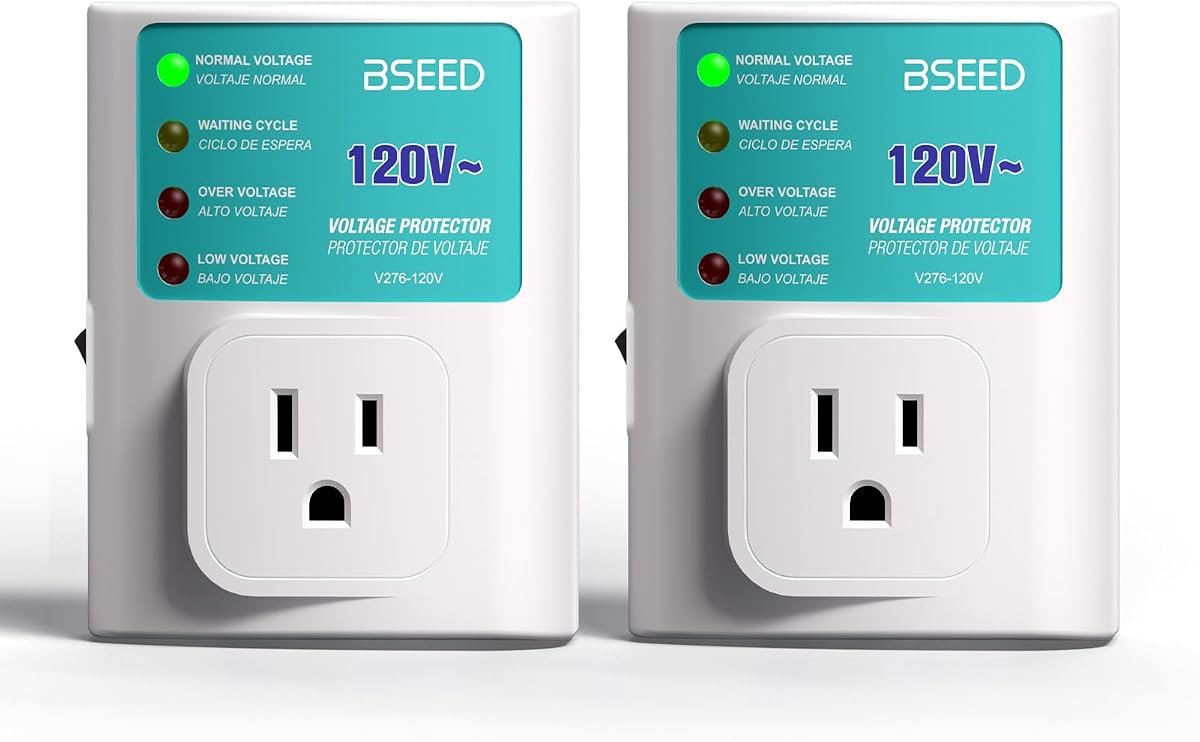
This BSEED single-outlet voltage protector is a well-rounded option for washing machines, refrigerators, freezers, ice makers, air conditioners, and other large appliances. It has a 4.7 customer rating, a stated capacity of 1875 watts, 125 volts, and 15 amps, and a three-minute delay intended to confirm that voltage has stabilized before output resumes.
We may earn a commission when you buy through this link, at no additional cost to you.
Automatic induction protection interrupts current flow when it detects voltage spikes, instant surges, fluctuations, brownouts, and voltage that is too high or too low. The DELAY indicator explains why output is interrupted, while separate indicators identify normal output, overvoltage, undervoltage, and delay status. This combination is more informative than a basic surge strip because the user can distinguish a temporary delay from normal operation.
The single-outlet format is a deliberate trade-off. It keeps the setup focused and avoids creating a high-demand multi-appliance hub, but it does not offer the convenience of powering several smaller devices from one wall receptacle. The product information also does not state exact high- and low-voltage cutoffs, so buyers who need precise threshold values should examine the controls or documentation before installation.
This protector is a strong choice for someone who wants one large appliance to receive monitored power with an extended stabilization period. It combines a high rating, clear indicators, and a stated three-year warranty. It is less suitable for a shared laundry outlet or a dedicated electric dryer, but it provides a focused solution for a single 120-volt machine.
The three-minute delay is intended to keep the appliance disconnected until conditions appear stable. That extended wait can be useful in locations where multiple power anomalies occur close together and rapid cycling would be undesirable.
The product is explicitly listed for washing machines and other major household equipment. Its single protected outlet keeps the installation simple and makes it easier to identify which appliance receives the monitored power.
We may earn a commission when you buy through this link, at no additional cost to you.
This BSEED four-pack is the most comprehensive option for covering several large appliances, with each single-outlet unit rated for 1875 watts, 120 volts, and 15 amps. It has a 4.7 customer rating and repeats the useful features of the one-pack version, including automatic voltage interruption, a three-minute stabilization delay, and indicators for normal, high, low, and delay states.
We may earn a commission when you buy through this link, at no additional cost to you.
The product applies to washing machines, refrigerators, freezers, ice makers, air conditioners, and other large appliances. Having four units can be valuable in a home with multiple appliances that need individual brownout protection, in separate rooms, or as a backup for replacements. Because each protector occupies a wall outlet, the pack does not eliminate the need for suitable outlets close to each appliance.
There are two important limitations. First, the listing does not provide exact undervoltage or overvoltage thresholds, which makes it less transparent for precise electrical matching. Second, the stated 120-volt capacity is not suitable for a conventional 220- or 240-volt electric dryer. The product is best suited to 120-volt washers and other compatible household equipment.
As the premium pick in this list, the four-pack stands out for breadth and convenience rather than a unique electrical specification. It is a good match for a household that wants several protected appliances or wants spare units in different areas. The three-year warranty and 24/7 customer support stated in the listing add further value, although the exact current terms should be confirmed on the product page.
Four individual units can be placed where each appliance is located instead of forcing several machines onto one shared adapter. This is particularly helpful for refrigerators, freezers, washers, and other equipment distributed through a home.
Each unit is described as delaying output for three minutes while checking for stable voltage. The visible delay indicator gives users a clear cue to wait rather than repeatedly trying to start an appliance.
We may earn a commission when you buy through this link, at no additional cost to you.
This 220-volt, four-prong protector is the only product in the guide explicitly designed for a conventional electric dryer. It has a heavy-duty 30-amp plug and is also described for washers, compressors, and other 220-volt motor appliances. Unlike the standard 120-volt devices, it targets the higher-voltage circuit and inductive loads commonly associated with large motor-driven equipment.
We may earn a commission when you buy through this link, at no additional cost to you.
The listing says the device protects the dryer motor from voltage spikes and electrical stress. It also offers power-factor optimization intended to reduce reactive power in inductive loads. A built-in safety discharge switch allows residual electrical energy to be discharged when the unit is unplugged, reducing accidental contact with stored charge. Importantly, the switch is not designed to turn the dryer on or off.
The absence of a customer rating makes this the least supported choice by user feedback in the set. The supplied details also do not state exact surge-energy capacity, voltage cutoffs, delay timing, or recognized safety certification. Those omissions make careful comparison with the product documentation and the dryer's electrical requirements especially important before installation.
For a household with a 220-volt electric dryer, this is the most relevant product in the guide. It should not be substituted for a 120-volt washer protector, and it is not intended to serve as the dryer's operating switch. Shoppers should confirm that the appliance uses the same four-prong connection and that the protector's 30-amp specification matches the dryer circuit.
A four-prong, 30-amp configuration is meaningfully different from the 120-volt plugs used by most protectors in this guide. It is intended for high-draw electric dryers and other compatible 220-volt inductive motor loads.
The safety discharge switch is designed to release residual energy after unplugging. It supports safer servicing, but the listing explicitly states that it is not intended to operate the dryer.
We may earn a commission when you buy through this link, at no additional cost to you.
This BSEED multi-function protector combines three outlet positions with a 125-volt, 1875-watt capacity and a 4.7 customer rating. Washing machines are among the appliances named in the product information, while the listing also supports refrigerators, air conditioners, computers, televisions, freezers, and ice makers. Its three-outlet body makes it more versatile than the single-outlet alternatives.
We may earn a commission when you buy through this link, at no additional cost to you.
The device is described as protecting against high and low voltage, brownouts, spikes, instant surges, power failures, voltage fluctuations, and load shedding. Four indicators identify normal voltage, overvoltage, undervoltage, and the waiting cycle. The three-minute delay is intended to prevent rapid power cycling when multiple surges occur within a short period, an especially relevant concern for compressor-based equipment but also useful for a washer with electronic controls.
The housing is described as flame-retardant PC material, and the direct plug-in format makes installation uncomplicated. The trade-off is that all connected devices share the listed 1875-watt capacity. A washing machine and dryer should not be treated as automatically compatible simply because the adapter has three outlets; the combined load, circuit type, and appliance-specific requirements still need to be checked.
This protector is well suited to a 120-volt utility area where one washing machine shares a wall receptacle with lower-draw appliances. It offers a stronger combination of outlet count and voltage-delay features than the Fosmon three-outlet surge protector, although the Fosmon states a higher 1200-joule surge rating and recognized UL conformity. The better choice depends on whether expanded monitoring or a specific surge-energy figure matters more.
The three protected positions can accommodate a washer and smaller appliances in one utility outlet. Users must remain within the shared capacity and should not treat the adapter as a substitute for a properly rated dryer circuit.
The three-minute waiting cycle is designed to avoid repeated short interruptions that can be hard on appliance electronics. Waiting for the normal indicator restores a more stable operating condition.
We may earn a commission when you buy through this link, at no additional cost to you.
This BSEED two-pack stands apart through its adjustable voltage protection range, which can be tuned from 90 to 105 volts using a dial on the back. It has a 4.4 customer rating and is compatible with washing machines, refrigerators, freezers, ovens, microwaves, dishwashers, coffee makers, bread makers, water heaters, fans, and other household appliances. The broad listing makes it a flexible choice for a mixed appliance setup.
We may earn a commission when you buy through this link, at no additional cost to you.
The protector addresses over- and undervoltage, brownouts, spikes, instantaneous surges, outages, fluctuations, and load shedding. When abnormal conditions occur, the delay indicator turns on and the unit uses a three-minute cycle to determine whether voltage has become steady. Ground-protected indicators provide visual feedback about the electrical state, helping users wait before restarting a connected machine.
The adjustable range adds control, but it also introduces a setup step. Users need to understand the desired lower threshold and avoid setting a range that could interrupt legitimate appliance operation. The product information does not state the surge-energy amount or exact high-voltage cutoff, and its 4.4 customer rating is the lowest among the products with numerical feedback. Those factors should be weighed when comparing it with more explicitly specified alternatives.
This two-pack is best for a shopper who wants separate protection for two appliances and values the ability to tune the undervoltage range. It is less ideal when a known joule rating or exact cutoffs are the priority. The included welcome guide and 24-hour customer support may help with initial configuration, but the device should be set up according to the manufacturer's instructions and local electrical conditions.
The rear adjustment dial allows the lower protection threshold to be set between 90 and 105 volts. This flexibility can be useful where ordinary low-voltage behavior differs, but it should be configured carefully and verified after installation.
The pack supplies two compact single-outlet units for separate locations. That arrangement is useful for a washer and refrigerator in different rooms without adding extra multi-outlet adapters.
We may earn a commission when you buy through this link, at no additional cost to you.
This three-outlet appliance protector has a 4.5 customer rating, a stated capacity of 125 volts, 15 amps, 60 Hz, and 1850 watts, and an ETL-listed design. It can serve up to three appliances, with washing machines explicitly included among the compatible equipment. A two-foot, 14-AWG extension cord also gives users more freedom in positioning the protector within a laundry alcove.
We may earn a commission when you buy through this link, at no additional cost to you.
The protector responds to high and low voltage, brownouts, spikes, instant surges, power failures, fluctuations, and load shedding. Four indicators distinguish normal, high, low, and waiting-cycle conditions. Its three-minute delay is intended to prevent rapid appliance power cycling, and the listing states a 0.5-second voltage-change detection time. The product should initially be left for three minutes before an appliance is connected.
Compared with the BSEED three-outlet model, this option offers a slightly higher listed maximum wattage and the added benefit of an ETL listing in the supplied information. It does not state a joule rating, however, so comparing it with the Fosmon's clearly stated 1200-joule specification is not straightforward. The extension cord is useful for positioning but adds another physical connection that laundry users need to route safely.
The product is a sensible choice for shoppers who want three protected positions, a long delay, and an ETL-listed design with a short positioning cord. It works well for a 120-volt washer and appropriate smaller appliances, provided the shared electrical load remains within the stated limit. It should not be used with a standard high-voltage electric dryer unless the appliance and connection requirements are explicitly supported.
The two-foot extension cord can bring the protected outlet closer to the washing machine or another appliance. It also needs to be routed so it is not pinched, exposed to moisture, or placed where it creates a trip hazard.
The listed ETL certification provides a useful safety reference, while three protected positions offer more flexibility than a single-outlet model. The combined load of connected appliances must remain within the stated 15-amp and 1850-watt capacity.
We may earn a commission when you buy through this link, at no additional cost to you.
The right protector depends on your washer and dryer configuration, the electrical conditions in your area, and the amount of control you want over restart timing. Start with voltage and plug compatibility, then consider cutoff behavior, surge capacity, indicators, and physical placement.
Begin by identifying whether your washer and dryer use standard 120-volt connections or a 220- or 240-volt electric-dryer circuit. Most dedicated voltage protectors in this guide are single-outlet 120-volt devices intended for washing machines, refrigerators, and similar household equipment. The COLL7AWS model is the exception: it uses a four-prong 220-volt, 30-amp connection intended for an electric dryer and other compatible inductive motor loads.
A plug shape that appears similar does not guarantee compatibility. Check the voltage, amperage, wattage, and connection style listed for the appliance and protector. A standard 125-volt plug-in unit must never be treated as suitable for a conventional high-voltage electric dryer merely because it has multiple outlets.
A surge protector primarily addresses sudden spikes and absorbs surge energy. A voltage protector is more comprehensive for unstable supply conditions because it can monitor high and low voltage, interrupt power during abnormal readings, and delay restoration. Several products in this guide combine both functions, while others emphasize surge joules and outlet expansion.
If your concern is a single sudden power event, a protector with a clearly stated joule rating may be a sensible starting point. If outages, load shedding, brownouts, or widely fluctuating voltage are more common, prioritize automatic over- and undervoltage cutoff, a visible delay indicator, and a defined recovery cycle.
Delay features prevent an appliance from restarting immediately after a disruption. The products here use either a stated 30-second delay or a three-minute stabilization period, and some listings describe both an initial connection delay and a post-event interruption. These intervals are not interchangeable, so read the instructions carefully and allow the full indicated period to elapse.
A longer delay is generally useful where repeated surges can occur close together or where rapid cycling may stress appliance controls. It also means the washer will not start immediately after an outage. Shoppers should choose a cycle they are willing to wait through, and they should rely on the normal-status indicator rather than repeatedly pressing start.
Exact cutoff points are important when the protector offers a broad or adjustable protection range. The Lavamatic two-pack identifies a 140-VAC high-voltage shutoff and a 90-VAC low-voltage shutoff, while the BSEED adjustable model allows the lower range to be set from 90 to 105 volts. Other products describe high- and low-voltage protection without publishing those thresholds in the supplied information.
Prefer a protector with understandable, documented limits. If the product uses a physical adjustment dial, select the range according to the manufacturer's instructions and local conditions. An incorrect setting can cause unnecessary interruptions or fail to provide the protection you expect.
Capacity matters because a washer can draw substantial current and a multi-outlet protector may appear to offer several independent connections. Most products in the guide are rated for 15 amps and approximately 1875 watts, with the three-outlet time-delay model stating 1850 watts and the BSEED four-pack products stating 1875 watts. These figures describe total capacity rather than separate capacity for every outlet.
A single-outlet design is focused and can prevent accidental overloading, but it requires a nearby wall receptacle for each appliance. A three-outlet adapter is convenient for lower-draw devices in a utility area, yet all connected loads share the stated limit. Electric dryers should remain on their proper dedicated circuits rather than being added to a standard 120-volt multi-tap.
LED indicators for normal, high, low, and delay conditions make it easier to understand why an appliance is not operating. These lights are especially valuable after a power interruption, when the user needs to know whether to wait, investigate an electrical problem, or contact an electrician. Some models also use protected indicator lights, while the 220-volt dryer protector relies more heavily on its discharge switch.
Clear status feedback does not replace safe installation. If the high or low indicator remains on, the outlet has a persistent problem, or the protector behaves unpredictably, stop using the connected appliance and have the electrical supply checked.
Recognized safety standards help establish that a protector was evaluated for relevant electrical risks. The Fosmon three-outlet product states conformity with UL498A and UL1449, while the three-outlet time-delay model is described as ETL listed. The BSEED products also state warranty and customer-support terms, although those service details are separate from electrical certification.
Check the current product page, manufacturer instructions, and certification markings before use. Certification cannot compensate for an incompatible plug, an overloaded adapter, a damaged cord, or installation in a wet location.
Laundry rooms often have limited space behind the washer and dryer. The Lavamatic protector uses an angled outlet intended to place the machine closer to the wall, while the three-outlet time-delay product includes a two-foot extension cord for placement flexibility. Compact single-outlet units are also useful when wall space is tight or when appliances are located in different areas.
Position extension cords where they will not be pinched, crushed, stepped on, or exposed to moisture. Do not place a power strip behind an appliance where heat or vibration can degrade the connection. Good placement makes the protector easier to inspect and allows status lights to remain visible.
Before installation, confirm that the protector's voltage, amperage, plug type, and outlet configuration match the appliance and wall receptacle. Read the included instructions, identify the high-voltage, low-voltage, normal, and delay indicators, and inspect the device and cord for visible damage. For a 220-volt electric dryer, use only a protector specifically designed for that circuit and connection.
Plug the protector into a properly grounded outlet first, then observe its status lights. Many products require a waiting period before the appliance is connected, with the supplied listings describing either 30 seconds or three minutes depending on the model and event. Leave the appliance unplugged until the protector indicates that power is normal and the required delay has completed.
After use or an outage, do not repeatedly restart the washer or dryer. Watch for the normal indicator, allow every stated delay to finish, and reconnect the appliance only when the unit is ready. If the high or low light stays illuminated, the protector continues to cycle, there is a burning smell, or the plug becomes hot, unplug it safely if possible and have a qualified electrician inspect the outlet and circuit.
It depends on the dryer type and the protector's electrical ratings. A standard 120-volt washer protector is suitable only for a dryer that uses a compatible 120-volt connection, such as many gas dryers. A conventional electric dryer generally requires a 220- or 240-volt circuit and a protector designed for that voltage and amperage.
A surge protector is designed primarily to absorb sudden voltage spikes and divert surge energy. A voltage protector also monitors the supply for high or low voltage, can interrupt power, and may delay restoration until conditions stabilize. Products described as voltage and surge protector combos offer both forms of protection.
The protector may be in its delay cycle or may have detected abnormal voltage. Wait for the full delay period specified by the manufacturer and watch the normal, high, and low indicators. If the abnormal indicator remains on, the electrical supply may be unstable and should be checked before restarting the machine.
The delay is intended to prevent rapid power cycling when several voltage disturbances occur close together. It can reduce stress on appliance electronics, but it also means the washer will not operate immediately after an outage. The product instructions and indicator lights should determine when it is safe to restart.
You can connect compatible appliances only if their combined load stays within the protector's total amperage and wattage rating. A high-draw washer should not automatically be combined with an electric dryer on a standard 120-volt adapter. Check the appliance labels and avoid using the adapter for a high-voltage electric-dryer circuit.
No. A protector can reduce exposure to specified surge or voltage events, but it cannot prevent damage caused by water, overheating, faulty wiring, mechanical problems, or electrical loads beyond its rating. It also cannot guarantee protection from every extreme power disturbance.
Place it in a dry, accessible location where the plug fits securely and the indicator lights remain visible. Route extension cords away from moving parts, hot surfaces, standing water, and foot traffic. Do not position the protector behind a machine where vibration or heat could stress the connection.
Leave the appliance disconnected and allow the protector to complete its stated delay cycle. If the light remains on or the unit continues cycling, the outlet may be receiving unstable voltage. Unplug the protector if it is safe to do so and have a qualified electrician evaluate the circuit before continuing to use the appliance.
The Two Electronic Voltage & Surge Protector Combo is the leading choice for a standard laundry setup because it includes a dedicated washing-machine protector, a separate refrigerator protector, clear operating indicators, and the highest customer rating in the group. The Fosmon three-outlet protector is the best budget option for a 120-volt utility area that needs several protected outlet positions, while the BSEED four-pack offers the broadest premium coverage for multiple large appliances.
Prioritize electrical compatibility before any other feature. A standard 120-volt washer protector cannot be assumed to fit a high-voltage electric dryer, and a multi-outlet adapter still has one shared capacity limit. Within the correct voltage class, look for well-documented cutoff behavior, a delay long enough to prevent rapid cycling, clear indicators, and a physical design that works in your laundry alcove.
Product listings, ratings, and availability can change over time, so review the current details before making a purchase. Check the product instructions, outlet type, appliance requirements, warranty language, and certification markings. Most importantly, confirm that the protector is designed for the specific washer or dryer you intend to connect rather than relying only on a broad appliance list.