
4K Mirror Dash Cam, Rear View Mirror Camera 10''
4.5Editor score
4K front camera
1080P rear camera
Wi-Fi app control
10-inch touch display
A mirror dash cam with front and rear cameras combines video recording with an enlarged replacement-style rearview display. The best models improve visibility, document both traffic directions, provide parking assistance, and reduce the need to adjust a conventional mirror. Important differences include display size, resolution, night performance, field of view, and wireless control.
We compared ten popular dual-camera systems using their stated specifications, camera resolutions, viewing angles, display features, connectivity, parking functions, storage support, and included accessories. The list covers premium models with advanced driver assistance, practical Wi-Fi systems, large-screen designs, and more affordable dual-1080P options for everyday use.
Each review explains who benefits most from that particular mirror dash cam, along with its strongest features and meaningful limitations. Ratings reflect the supplied customer feedback, while feature descriptions are based on manufacturer information rather than personal testing. Product availability and prices can change, so verify the current listing and accessories before buying.
4.5Editor score

5.0Editor score

4.4Editor score
As an Amazon Associate we earn from qualifying purchases.
This side-by-side overview compares each mirror dash cam by recording resolution, screen size, connectivity, parking assistance, and notable hardware features. It provides a quick way to identify the model that best fits your vehicle, display preferences, and recording priorities.



The WOLFBOX G840S combines a 12-inch curved mirror display with 4K UHD front recording and a 1080p rear camera. Its 4.3 rating reflects a strong balance of screen size, image quality, GPS, and wireless functions. The large display is especially useful for drivers who want more visible road area than a conventional rearview mirror can provide.
We may earn a commission when you buy through this link, at no additional cost to you.
The front camera uses a 170-degree lens, while the rear camera has a 140-degree lens, giving both ends a broad field of view. A smart split-screen mode can show both feeds at once, and the low-reflectivity display is intended to reduce daytime glare. WDR, HDR, a professional-grade sensor, and a six-glass lens support image quality in tunnels, direct sunlight, and nighttime conditions.
Connectivity is one of the G840S's strongest attributes. Its 5.8GHz Wi-Fi works with the WOLFBOX app for live viewing, playback, and quick sharing, while the included external GPS antenna can display real-time location information. Loop recording provides continuous coverage, and parking mode can use time-lapse recording when properly hardwired. The main compromise is that the rear feed remains 1080p rather than 2.5K or 4K.
This is an excellent choice for drivers who want a large screen, reliable dual-camera coverage, GPS information, and app-based management without moving to a much more elaborate driver-assistance system. It is particularly well suited to commuters and road-trippers who regularly review footage. Buyers should confirm their mirror can accommodate the unit and purchase a compatible hardwire kit if they want parking surveillance.
The G840S pairs a wide front lens with a broad rear lens and a 12-inch screen, making it useful for reducing visual blind spots. Its 4K front feed captures more detail than the 1080p rear channel, but both cameras are designed to support clear documentation.
The external GPS antenna and 5.8GHz app connection make footage easier to organize and share. Continuous loop recording is standard, while 24-hour parking monitoring requires a separately available hardwire kit.
We may earn a commission when you buy through this link, at no additional cost to you.
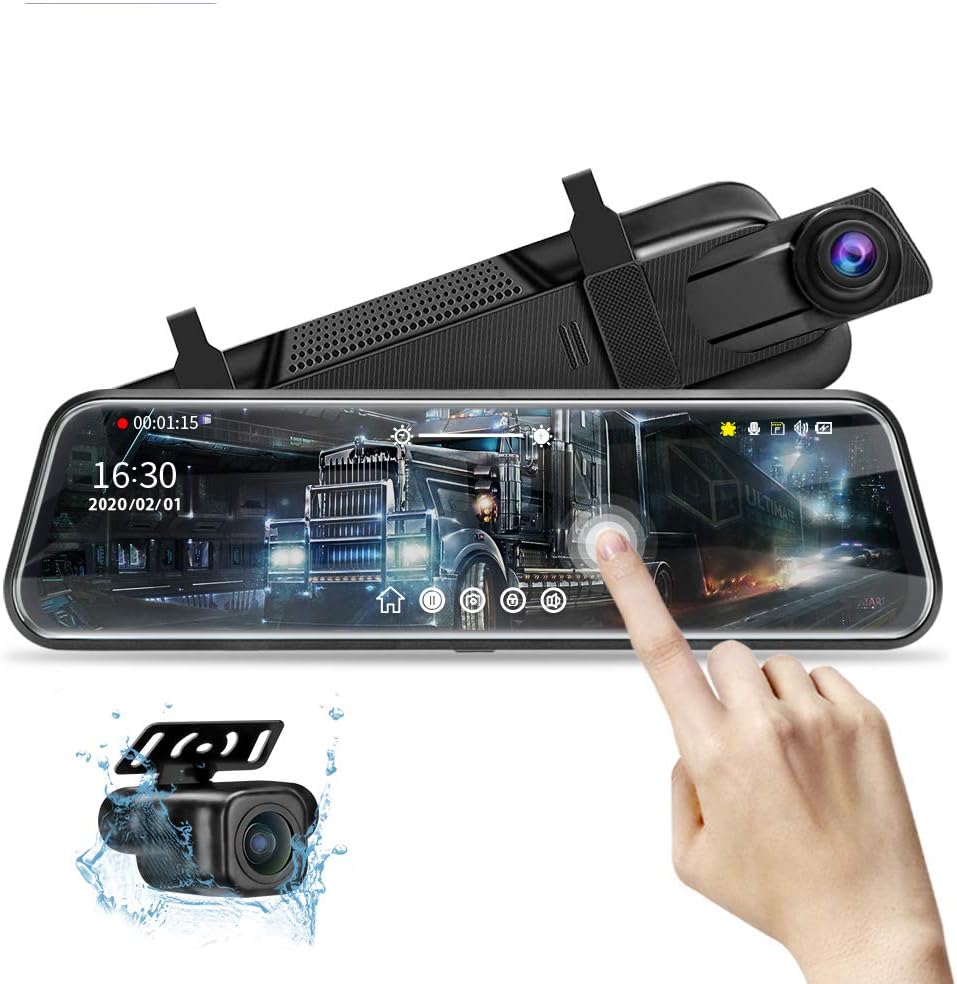
This 10-inch mirror dash cam offers a straightforward combination of dual 1080P recording, a full touchscreen, and detailed parking assistance. It receives a 4.1 rating and is aimed at drivers who prioritize the reversing function more than wireless footage transfer. The display is large enough to make rear-camera guidance easier to interpret.
We may earn a commission when you buy through this link, at no additional cost to you.
Front and rear cameras both record in 1080P, and the rear camera is described as IP68 waterproof. A six-layer rear lens, improved night exposure processing, and intelligent noise reduction support low-light footage. The touchscreen supports swiping between cameras, adjusting the viewing angle, changing exposure and brightness, reviewing recordings, and editing basic settings.
When reverse gear is selected, the rear image fills the screen and parking guidelines appear. The driver can adjust the vertical range, while a separate control allows adjustment of the backup camera's physical viewing angle. Loop recording overwrites older files, and the G-sensor locks collision-related clips. Storage can reach 128GB, although the memory card is not included.
This model makes sense for shoppers who want a large, affordable rear display and detailed parking support without paying for a complicated mobile ecosystem. It is less suitable for people who expect built-in Wi-Fi, GPS, or advanced collision warnings. A hardwire kit is also needed for the stated time-lapse and 24-hour parking functions. Buyers should verify that the original mirror can support the unit's dimensions and weight.
The rear camera automatically takes over the display when the vehicle reverses, and its guide lines can be adjusted for different vehicle heights. A physical one-key adjustment also changes the camera angle, making it easier to frame the area behind larger vehicles.
Both cameras record in 1080P and feed into a responsive 10-inch touchscreen. Loop recording and G-sensor protection help maintain coverage, while support for cards up to 128GB provides flexibility for longer recording sessions.
We may earn a commission when you buy through this link, at no additional cost to you.
The WOLFBOX G930 is a 10-inch streaming media mirror dash cam with 4K front recording, a 1080p rear camera, 5.8GHz Wi-Fi, and a 64GB card. Its 4.3 rating and broad feature set make it a practical middle ground between basic dual-camera systems and advanced 12-inch models. It is designed for drivers who want good video quality and convenient wireless transfers.
We may earn a commission when you buy through this link, at no additional cost to you.
The rearview display can show a split-screen combination of the front and rear feeds or provide a full rear view. Sliding gestures adjust the viewing angle and change camera sources. Its low-reflectivity LCD is intended to control glare, while WDR helps balance bright skies and darker areas. The supplied six-glass lens and night-vision features are useful for nighttime streets and tunnels.
The WOLFBOX app connects over 5.8GHz Wi-Fi for downloading and sharing video. Once the GPS receiver is inserted, the screen can show real-time speed and direction, and recorded files can be reviewed with GPS information in a player. Recording is available in selectable one-, two-, or three-minute loop intervals, and the G-sensor locks footage when it detects a collision.
The G930 is a good recommendation for everyday drivers who want 4K detail, wireless access, GPS, and a moderately sized mirror display. It is less compelling for buyers seeking a 12-inch screen, 2.5K rear footage, voice commands, or advanced driver-assistance alerts. Check the vehicle's mirror dimensions before installation and allow for separate wiring if continuous parking monitoring is required.
The upgraded 5.8GHz connection is designed to provide stable access to recordings through the WOLFBOX app. Drivers can download and share clips without repeatedly removing the included 64GB card or connecting the camera to a computer.
With the GPS receiver inserted, the display can present current speed and direction. That data can also be reviewed alongside saved video, adding useful context to journeys and incidents.
We may earn a commission when you buy through this link, at no additional cost to you.
The WOLFBOX G850 PRO is the most safety-feature-focused model in this group, combining a 12-inch touchscreen with 4K front video, a 1080p rear camera, ADAS, blind spot detection, and voice control. Its 4.3 rating reflects a well-rounded package for drivers who want more than ordinary loop recording. The alert system gives the unit a clear purpose beyond enlarging the rearview image.
We may earn a commission when you buy through this link, at no additional cost to you.
Advanced Driver Assistance System warnings include forward collision, pedestrian collision, lane departure, lead-vehicle start, and distance monitoring. The enhanced blind spot algorithm is designed to identify dangers during lane changes, while rear collision alerts provide additional awareness. These functions are most useful on busy roads, highways, and in changing traffic conditions.
Both recording channels use wide-angle lenses and WDR or HDR processing to handle direct sunlight, shadows, and nighttime environments. The 5.8GHz Wi-Fi connection works with the WOLFBOX app for downloads and sharing, and 12 voice commands offer hands-free control of functions such as taking a photo, enabling Wi-Fi, and locking a video. A 64GB card is included for storage.
The G850 PRO is worth considering for drivers who value active safety prompts and a large screen. It is also a more complex system than a basic mirror cam, and buyers should understand that advanced alerts are software-driven rather than substitutes for attentive driving. The rear channel does not match the 4K front feed, but it remains suitable for general traffic and parking documentation.
ADAS, blind spot detection, rear collision alerts, and distance monitoring distinguish this model from conventional dual-camera recorders. These prompts can encourage earlier reactions, although they remain supplementary to careful observation and proper following distance.
Twelve voice commands let the driver manage common functions without touching the touchscreen. The command set includes actions for Wi-Fi, photography, and locking important clips during a trip.
We may earn a commission when you buy through this link, at no additional cost to you.
The Upgraded 10-Inch Rear View Mirror Camera is a dual-1080P system distinguished by its 19.6-foot rear camera cable. It carries a 4.1 rating and is especially practical for larger vehicles, SUVs, trucks, or installations where the standard cable would be too short. The 10-inch touchscreen adds useful display area without moving to a larger 12-inch format.
We may earn a commission when you buy through this link, at no additional cost to you.
Both front and rear cameras record in 1080P, and the front lens covers 170 degrees while the rear lens covers 140 degrees. The system supports real-time display, full-screen viewing, and automatic switching to the rear perspective when reverse gear is selected. Parking guidelines assist the driver during backing, while the flexible installation hardware and extended cable make placement more flexible.
Night recording benefits from WDR or HDR, a STARVIS sensor, and a six-glass lens. The IP68 rear camera is designed for exterior mounting and resistance to rain. Loop recording overwrites the oldest unlocked files, and the G-sensor protects collision footage. In parking mode, the system can record a short locked clip when it detects an impact, though an ACC hardwire kit is required.
This is a good pick for drivers who need a long rear cable and robust basic recording more than app-based downloads. The absence of built-in Wi-Fi means footage must be managed through the touchscreen or a card reader. It is also important to note that the memory card is not included. Confirm mounting space and parking-mode wiring before purchasing.
The unusually long cable provides extra reach for larger vehicles and unconventional mounting positions. The waterproof rear camera can be installed outside the vehicle, while the supplied straps and brackets simplify the mirror-mounted front unit.
Night-oriented exposure processing, a STARVIS sensor, and WDR or HDR help preserve usable detail in difficult lighting. The display switches automatically to the rear camera when reversing, and guide lines help interpret the space behind the vehicle.
We may earn a commission when you buy through this link, at no additional cost to you.
The 10-Inch 4K Mirror Dash Cam stands out as a budget-oriented package that includes a 4K front camera, 1080p rear camera, Wi-Fi, a 32GB card, and parking monitoring. Its 4.5 rating is the second highest among the listed products, making it a compelling option for buyers who want modern features without choosing a large premium system.
We may earn a commission when you buy through this link, at no additional cost to you.
The 10-inch HD IPS touchscreen provides responsive control and makes it easy to switch between the front and rear views. A 130-degree front lens and 145-degree rear lens create a wider field of view, while the rear camera takes over automatically when reverse gear is engaged. An F1.8 aperture and night-vision capability support the front camera in low-light conditions.
Wireless connectivity allows the dash cam to connect to an app for fast footage downloads and sharing. The G-sensor locks the current video when it detects a collision. Its parking monitor is accessed through an OBD connection and provides 24-hour monitoring, which is a meaningful advantage for drivers who want coverage while the vehicle is unattended.
This model is our best budget recommendation because it combines higher-rated customer feedback with a broad set of standard features. Its limitations are the 1080p rear channel and the need for an OBD connection to activate parking mode. It is an excellent general-purpose choice for commuters seeking 4K front detail, convenient app access, and a sizable screen.
A 4K front feed, included storage, Wi-Fi transfers, and parking monitoring are features many basic dual-1080P alternatives lack. The result is a well-rounded package for daily traffic, commuting, and overnight surveillance.
The full-touch IPS display makes camera switching and basic adjustments straightforward. The rear camera automatically takes over during reversing, allowing the driver to concentrate on the parking area rather than manually changing views.
We may earn a commission when you buy through this link, at no additional cost to you.
The WOLFBOX G900 Core-N is a premium 12-inch mirror dash cam built around true 4K front recording, a 1080p rear channel, independent HDR, and the Sony STARVIS 2 IMX678 sensor. Its 4.4 rating reflects strong customer satisfaction, while the specification set targets drivers who care about low-light detail, fast transfers, and dependable parking hardware.
We may earn a commission when you buy through this link, at no additional cost to you.
Both cameras support independent HDR, helping preserve detail in bright skies, shadowed curbs, tunnels, and scenes illuminated by oncoming headlights. The STARVIS 2 IMX678 sensor is designed for improved sensitivity and reduced noise in dim conditions. This is particularly relevant for night driving, unlit roads, rural journeys, and garages where conventional sensors may produce grainy footage.
Its 5.8GHz Wi-Fi 6 connection supports downloads of up to 20MB/s through the WOLFBOX AUTO app, making it easier to retrieve large 4K clips. Twelve voice commands cover common actions, while loop recording and G-sensor locking manage storage and protect incident footage. Unlike battery-powered designs, the G900 Core-N uses a super capacitor rated for temperatures from -4°F to 158°F.
This is the best premium option for drivers who want advanced image quality, durable temperature handling, and fast wireless access. Parking mode provides time-lapse recording and impact detection, but a hardwire kit is required. Compatible WOLFBOX memory cards are also sold separately, so budget for storage before installation. The rear channel remains 1080p, which is the main specification trade-off.
The Sony STARVIS 2 IMX678 sensor and independent HDR on both channels are designed to retain useful detail under difficult lighting. This makes the G900 Core-N particularly suitable for night commutes, tunnels, and unlit rural roads.
Wi-Fi 6 transfers at up to 20MB/s reduce the wait involved in moving high-resolution clips to a phone. A super capacitor is also more resilient to temperature extremes than a conventional rechargeable battery, supporting parking-mode reliability.
We may earn a commission when you buy through this link, at no additional cost to you.
The Hufdic Mirror Dash Cam pairs a large 12-inch touchscreen with 4K front recording and an unusually high-resolution 2.5K rear camera. It has a 5.0 listed rating, the highest in this comparison. The balance of front and rear resolution, fast Wi-Fi, and parking-mode support makes it one of the most complete general-purpose options here.
We may earn a commission when you buy through this link, at no additional cost to you.
The rear camera's 2.5K resolution exceeds the 1080p channels used by many competitors, while the front camera records in 4K. The product information references STARVIS 2 low-light technology, a seven-glass lens, and a 12-inch display intended to provide a broad live view. These features are particularly useful when license plates, signs, or nearby vehicles need to be reviewed after an incident.
The built-in 5.8GHz Wi-Fi supports download speeds of up to 20MB/s through a phone connection. Drivers can review, download, and share clips without removing the memory card. The parking monitor includes time-lapse recording, and the G-sensor locks footage when a collision is detected. Voice control is also listed among the model's functions.
This camera is our editor's choice because it avoids the common compromise of pairing a 4K front camera with a much lower-resolution rear channel. It suits drivers who want high-resolution evidence from both directions, a generous display, and fast wireless management. Check the supplied sensor wording carefully and confirm the supported card format. A hardwire kit is needed for parking surveillance.
The combination of 4K front and 2.5K rear footage gives the Hufdic an advantage over most dual-camera alternatives. It is a strong choice for drivers who regularly review vehicles, signs, or license plates in saved recordings.
The 12-inch touchscreen provides a generous live-view area and straightforward camera controls. Wi-Fi transfer speeds of up to 20MB/s help make phone-based review of high-resolution clips more practical.
We may earn a commission when you buy through this link, at no additional cost to you.
The AZDOME 12-Inch 4K+2.5K Rearview Mirror Dash Cam combines high-resolution dual recording with a broad set of safety and parking tools. Its 4.2 rating reflects a capable but more complex system, with ADAS, blind spot detection, lane change assist, voice commands, and app-based analysis designed for modern connected driving.
We may earn a commission when you buy through this link, at no additional cost to you.
The front camera records at 3840 by 2160, while the rear camera records at 2560 by 1440. The 12-inch touchscreen provides a bright live view and touch control over both cameras. When reverse gear is engaged, the rear perspective appears with parking guide lines to help during parking, backing, and exiting a driveway.
ADAS, BSD, and lane change assist monitor traffic around the vehicle. In the AZDOME app, AI-powered augmented-reality overlays can present recognized license plates, vehicle distance, speed, and lane guidance. The app also supports preview, download, sharing, timeline playback, settings, and customer support. Ten English voice commands offer additional hands-free control.
For parking, AZDOME offers time-lapse and collision-detection recording modes. A three-lead Type-C hardwire kit with 3A output is required and sold separately. The included 64GB card removes one potential additional purchase. This model is a strong choice for drivers who want advanced alerts and rich post-incident review, provided they are comfortable using the companion app.
The app can add recognized plates, distance, speed, and lane information to downloaded footage. These overlays can make a recording easier to review, although they are presentation aids rather than substitutes for examining the original video.
ADAS, blind spot detection, lane change assistance, and voice commands broaden the functions beyond basic recording. Time-lapse and impact-response parking modes support unattended coverage when the correct hardwire kit is installed.
We may earn a commission when you buy through this link, at no additional cost to you.
The 4K CarPlay and Android Auto Mirror Dash Cam combines dual-camera recording with connected-car features in a 12-inch touchscreen unit. Its 4.6 rating is the second highest in the list, and its Bluetooth connectivity makes it appealing to drivers who want navigation, music, calls, and applications integrated into the mirror.
We may earn a commission when you buy through this link, at no additional cost to you.
The upgraded front camera records in 4K, while the rear camera records in 1080P. Viewing angles are stated at 170 degrees for the front and 140 degrees for the rear, helping cover a broad area around the vehicle. The built-in 1920 by 480 display and 2.5D curved glass provide a sleek presentation and responsive touch operation.
Bluetooth can establish a wireless connection with CarPlay or Android Auto, allowing supported apps, maps, music, and calls to be managed from the display. Voice commands provide an additional hands-free control method. The dash cam also supports loop recording, G-sensor locking, reverse assistance, and 24-hour parking monitoring when a hardwire kit is installed.
This is the most complete connected-driving choice for a compatible vehicle, combining a dash cam with smart display functions. It is not a direct replacement for the factory mirror and requires a mounting area at least 6.3 inches long. Confirm that your vehicle, phone, and preferred application platform are compatible before installation. The included 64GB card supports continuous recording.
CarPlay and Android Auto support turns the mirror into a connected interface for compatible phones. Maps, music, calls, and selected applications can be accessed alongside the front and rear camera views.
A 170-degree front lens and 140-degree rear lens reduce the amount of scene hidden from view. The 4K front feed supplies detailed daytime documentation, while the 1080p rear camera handles traffic monitoring and reversing.
We may earn a commission when you buy through this link, at no additional cost to you.
A mirror dash cam should balance recording quality, display usefulness, vehicle compatibility, and reliable installation. Comparing resolution, lens coverage, connectivity, parking functions, storage, and physical dimensions helps prevent an expensive mismatch with your car.
Resolution determines how much fine detail each camera can preserve. A 4K front camera offers more pixels for license plates, road signs, and distant traffic, while a 2.5K rear camera provides a meaningful improvement over 1080p. Many drivers prioritize the front channel because it records the road ahead, but rear resolution matters just as much when the camera covers lane changes, rear impacts, parking, and vehicles approaching from behind.
Choose 4K front and 2.5K rear when both directions are important and the vehicle is regularly driven at night or on busy roads. Dual-1080P systems remain practical for general coverage and often cost less. Do not judge the entire system by the highest advertised resolution; examine the rear channel and confirm that both cameras record simultaneously.
Night driving exposes the difference between a merely bright image and one that remains useful. WDR, HDR, night-vision processing, a low-reflectivity display, and a sensitive sensor can improve visibility in tunnels, parking garages, dim streets, and scenes with headlights. Dual-channel HDR is especially helpful when the front view is bright while the rear scene remains shadowed.
Prioritize a recognized low-light sensor or strong HDR implementation when most driving occurs after dark. The STARVIS 2 sensors used by some premium models are designed to improve sensitivity and reduce noise. Also consider the screen's reflectivity, because excessive glare can make an otherwise sharp recording difficult to monitor in real time.
Wide-angle lenses expand what the screen can show, but field of view should be assessed together with image distortion and the placement of the rear camera. Front lenses around 130 to 170 degrees and rear lenses around 140 degrees are common in this category. A broad view is helpful for lane changes and reversing, but excessive cropping or stretching may make objects appear farther away than they are.
Look for a system that shows both cameras clearly and allows the rear image to be adjusted vertically. This is particularly important for trucks, SUVs, vehicles carrying cargo, or setups where the camera is mounted higher than the factory mirror. The goal is useful spatial awareness rather than simply the largest number printed on the box.
Ten-inch displays offer a balance between visibility and physical size, while 12-inch models cover more of the original mirror and provide a larger live-view area. Touch controls make it easier to switch channels, review video, adjust brightness, change exposure, and configure parking guides. Some premium models also include voice commands that reduce the need to interact with the screen while driving.
Choose 10 inches if the original mirror is compact or dashboard space is limited. Choose 12 inches if broader visibility, easier reading, and a more integrated appearance matter more. Check the unit's width, height, and weight against your factory mirror, and confirm whether the screen can be turned off or used as a conventional reflective surface.
Wi-Fi makes it convenient to review and download recordings through a phone instead of repeatedly removing the memory card. A 5.8GHz connection is generally less congested than a 2.4GHz network, while Wi-Fi 6 models are designed for faster transfer of large 4K files. Some systems add GPS, timeline playback, AI overlays, or remote settings, but these features vary considerably between brands.
Choose Wi-Fi if you expect to review footage immediately after an incident or share clips frequently. Check whether the required app is available for your phone's operating system and whether it supports the advertised transfer speed. If seamless wireless management is not important, a non-Wi-Fi system can still provide reliable recording, loop storage, and parking protection with simpler operation.
Parking monitor functions can record time-lapse footage or lock a clip when the vehicle detects an impact. Most models require a hardwire kit, and one listed product uses an OBD connection. The correct kit must match the vehicle's electrical system and the dash cam's power requirements. Improper wiring can cause battery drain, electrical faults, or a parking function that does not operate as expected.
If overnight parking coverage is important, confirm the required accessory before purchase. A three-lead Type-C hardwire kit, ACC hardwire kit, and OBD-based solution are not interchangeable without checking compatibility. Also consider sound recording, privacy expectations, and local rules. For basic use, a hardwired system with time-lapse and impact locking is usually the most useful combination.
Mirror dash cams rely on microSD cards, and their supported capacity varies. Some products include a card, while others require the buyer to supply one. Higher-resolution recordings consume storage more quickly, so a larger card is useful for extended trips and parking surveillance. Loop recording overwrites older unlocked files, while G-sensor locking preserves clips associated with sudden impacts.
Check whether a card is included, what capacity is supported, and what card type is recommended. Format the card in the dash cam before relying on it, and periodically confirm that recordings remain accessible. Drivers who need long parking coverage should choose a high-capacity, suitably rated card and understand that continuous recording requires regular overwriting as standard.
ADAS, blind spot detection, lane change assistance, forward collision warnings, and rear collision alerts can make a mirror cam more useful on busy roads. These tools use camera analysis and algorithms, so performance can vary with lighting, road layout, traffic, and sensor calibration. Connected-car features such as CarPlay and Android Auto serve a different purpose, combining navigation, communication, and entertainment with recording.
Choose ADAS or blind spot tools if early warnings are a major priority, but continue to drive attentively and verify alerts against the actual traffic scene. Choose CarPlay or Android Auto only if the vehicle and phone are compatible and the connected functions are more important than a larger storage card or front-and-rear resolution upgrade. Treat every driver-assistance feature as supplemental.
Begin by comparing the mirror unit's dimensions and weight with the factory rearview mirror, then inspect the mount, straps, rear camera cable, and power connections. Mount the front unit securely, position the rear camera for a useful view, and route the cable away from sharp edges, hinges, and moving parts. Before relying on parking mode, install the specified compatible hardwire or OBD kit and confirm the vehicle's electrical routing.
Format a compatible memory card in the camera, set the correct date and time, and choose sensible recording intervals, display brightness, exposure, and viewing preferences. Connect the app if the model supports wireless control, and confirm that live preview, playback, downloads, and sharing work correctly. Test both camera angles in daylight and darkness, then verify automatic rear-view switching when the vehicle enters reverse.
Review storage capacity periodically, clear unwanted files, and back up important recordings to a phone or computer. Clean the front and rear lenses with a soft microfiber cloth, avoiding harsh chemicals and moisture around the display. Inspect the power lead and mount for looseness, and check recorded footage after a long drive or a temperature change. Unplug the unit before removing the memory card or changing settings when the manual advises it.
A mirror dash cam combines recording hardware with a large display that can show the front or rear camera feed. It is useful for drivers who want a larger rearview image, parking guidance, and fewer separate devices. A conventional dual-camera system may be easier to position discreetly, but it usually provides a smaller screen and less integrated reversing control.
It depends on the model. Some displays can be switched off and may retain a reflective function, while others are explicitly designed only as a digital streaming display. Several products in this guide state that they cannot be used as a standard mirror, so check the specifications before purchasing if reflective rearview visibility is essential.
Most mirror dash cams require a microSD card for normal recording, although the card may or may not be included. The WOLFBOX G840S, G930, and G850 PRO, the 10-inch 4K model, and the AZDOME model list included storage. The 10-inch Dual 1080P and Upgraded 10-Inch models do not include a card, so add compatible storage to the purchase.
Properly installed hardwire or OBD parking systems are designed to manage vehicle power, but configuration matters. A wrong connection, incompatible kit, or poor grounding can cause drain or electrical problems. Follow the manufacturer's wiring instructions, use the specified accessory, and consider having installation handled by a qualified automotive professional if you are uncertain.
4K provides more detail in the front recording, which can help when reading distant signs, plates, or vehicle details. The rear channel matters equally during lane changes and parking, so a 2.5K rear camera can be more useful than two 1080p cameras. For ordinary commuting, dual 1080P is still practical, provided the lens, sensor, and exposure perform well.
The 5.8GHz band is commonly used by these dash cams because it can offer faster transfers and experience less household congestion than 2.4GHz. Actual speed depends on the camera, phone, app, network environment, and file size. Premium models may advertise Wi-Fi 6 or speeds up to 20MB/s, while some budget-oriented products provide Wi-Fi without the same transfer rate.
Fit depends on the unit's width, height, weight, mounting space, and the shape of the factory mirror. Some products provide exact dimensions and minimum mirror length, while others offer a general compatibility warning. Measure the available area before buying, confirm that the straps can hold the unit securely, and check whether the added weight or protrusion interferes with visibility.
Most models support continuous loop recording while the vehicle is powered, with older unlocked files overwritten as storage fills. G-sensor locking preserves important clips, and many models also offer parking mode through a hardwire or OBD connection. The exact recording interval, overwrite behavior, and parking capabilities vary by model.
The 10-inch 4K Mirror Cam is the strongest budget-oriented option because it combines a 4K front feed, 1080p rear camera, Wi-Fi, an included 32GB card, and parking monitoring. The Hufdic 4K Plus 2.5K is the most balanced all-around choice, with high resolution from both directions, a large touchscreen, fast transfers, and a 5.0 listed rating. The WOLFBOX G900 Core-N is the premium selection, emphasizing true 4K, dual HDR, low-light performance, and a temperature-resilient super capacitor.
Prioritize the features that directly affect your use. Commuters may value a sensitive sensor, glare control, and quick app access; drivers in large vehicles may need a long rear cable and adjustable reverse view; connected-car users may prefer CarPlay or Android Auto. Safety-focused shoppers can examine ADAS and blind spot tools, while anyone recording at night should examine HDR, night processing, and low-reflectivity screens alongside raw resolution.
Before purchasing, verify the current product listing, card inclusion, supported storage capacity, hardwire requirements, and physical fit. Prices, bundle contents, software availability, and manufacturer specifications can change over time. Reviewing those details at checkout will help ensure that the selected mirror dash cam works with your vehicle and recording habits.