
RVMATE 12 Pack RV Leveling Blocks
4.6Editor score
Ten blocks with two top covers
Interlocking multi-height stack design
Includes convenient carrying bag
Supports wheels and multiple jack types
Compare the 10 best overlanding leveling blocks for RVs and trailers, including stackable, interlocking, curved, heavy-duty, portable, and premium designs.
Overlanding leveling blocks help create a stable, level parking foundation for RVs, travel trailers, campers, and motorhomes on uneven ground. The best ones combine load support, secure stacking, reliable ground grip, manageable storage, and compatibility with the wheels or jacks used by your rig.
This guide compares ten leveling block systems using the supplied product details, including configuration, dimensions, materials, storage features, supported leveling tasks, and trailer compatibility. The list covers conventional interlocking stacks, curved wheel levelers, jack-support blocks, compact kits, and larger multipacks.
Each recommendation identifies the setup best suited to a particular need, from budget-friendly stacking blocks to premium curved systems. Product ratings provide one point of comparison, but compatibility, adjustability, and setup method matter just as much. Prices and availability can change, so confirm current details before purchasing.
4.6Editor score

4.8Editor score

4.7Editor score
The comparison below covers ten block-based leveling systems, highlighting their core configurations, height options, accessory details, and likely uses. Traditional stacks offer flexible support for wheels and jacks, while curved levelers use a different drive-on method that can simplify setup.




The Lynx Levelers 11 Pack is a conventional interlocking system designed to support RVs, trailers, motorhomes, and vanlife setups on uneven campsites. Its 4.8 rating, modular construction, and stated capacity of up to 40,000 pounds make it the strongest all-around recommendation in this guide. The set combines 10 main blocks, a dedicated cap-level top, and a nylon carrying bag.
We may earn a commission when you buy through this link, at no additional cost to you.
The blocks measure 8.5 by 8.5 inches and stand 1.5 inches tall individually, while their interlocking profile reduces the effective contribution of each additional layer to one inch. That makes the system easy to configure beneath individual wheels, dual-wheel assemblies, or supported jacks. The cap adds only 0.25 inches when interlocked, preserving stability without creating excessive height.
Its versatility extends beyond basic wheel leveling. The manufacturer identifies stability, appliance leveling, water drainage, and general sleeping comfort as practical benefits of a properly level setup. The main limitation is that the package includes only one Lynx Cap, so campers needing broad top-contact coverage may have to arrange separate support pieces or select another configuration.
This is the recommendation for an overlander who wants a proven, flexible system for a substantial rig. It combines a high stated load rating, recognizable U.S. manufacturing, a straightforward interlocking design, and a useful storage solution. It is particularly well suited to campers who need blocks for several stabilization points but do not want a complex curved-leveling procedure.
The interlocking format lets campers build different heights beneath wheels and jacks without relying on improvised boards. Adding the cap provides a broader contact surface while keeping the stack compact, which can help improve appliance operation, drainage, and interior comfort.
A stated 40,000-pound capacity provides ample headroom for heavy trailers and motorhomes, although the complete rig must still be positioned and supported correctly. Confirm that the blocks sit on stable, level ground and that the vehicle is not supported at unsupported points.
We may earn a commission when you buy through this link, at no additional cost to you.
The RVMATE 12 Pack is an economical traditional leveling system with a 4.6 rating and a practical 10-block, two-top configuration. It is designed to help RVs and trailers remain stable on uneven ground while also supporting hydraulic jacks, tongue jacks, stabilizer jacks, and fifth-wheel jacks. A carrying bag keeps the components organized between campsites.
We may earn a commission when you buy through this link, at no additional cost to you.
Every main block measures 8.5 by 8.5 by 1.5 inches, while the two top blocks measure 8.5 by 8.5 by 0.75 inches. The interlocking construction allows the camper to combine layers into different shapes and heights, with each main block contributing one inch of additional lift. This is especially useful when different sides of a trailer need different amounts of correction.
The top covers serve a practical purpose beyond adding height. They are intended to reduce direct contact between the tire and the body of a leveling block, which can limit compression wear on the tread. The reinforced high-density material and interlocking profile also make the blocks suitable for both single and dual wheels, depending on the available space.
This set is best for budget-conscious overlanders who need a complete, portable leveling kit with several top pieces. It does not publish a maximum load capacity, and the overall stack height is not specified, so buyers should prioritize ground quality and follow the intended configurations. Even so, the useful accessory mix and broad jack compatibility make it an excellent general-purpose choice.
Many campers use leveling blocks at more than one wheel or jack, and the two included tops offer greater coverage than a single-cap system. They can also reduce direct tire-to-block contact when the top pieces are positioned correctly.
Compatibility with single wheels, dual wheels, and multiple jack types makes this kit adaptable to common trailer layouts. Users can build a pyramid-style stack or arrange the pieces beneath whichever support points need correction.
We may earn a commission when you buy through this link, at no additional cost to you.
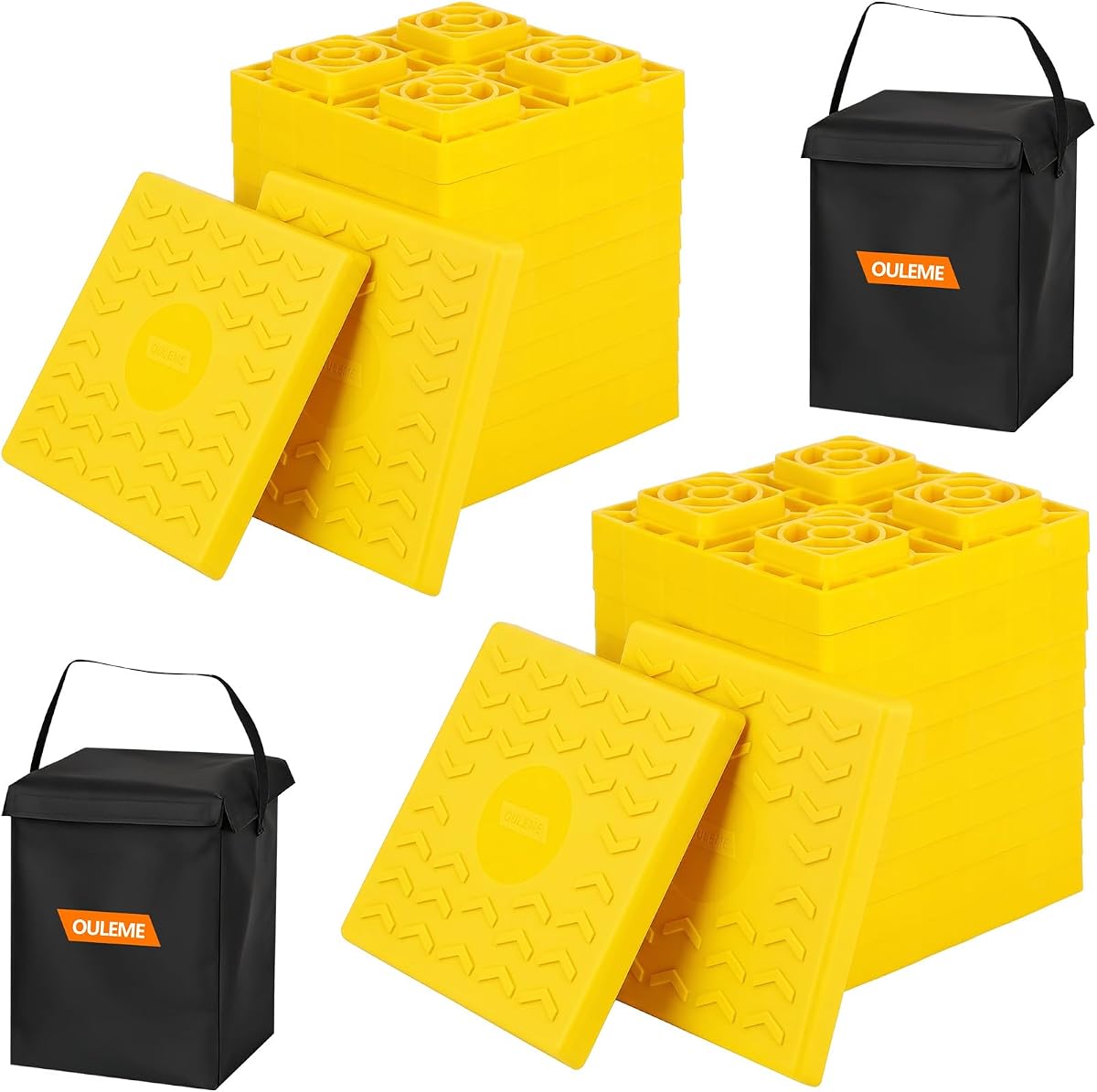
The OULEME 12 Pack is a 4.7-rated set of interlocking blocks designed for campers and travel trailers. It includes 10 standard blocks, two top blocks, and a carrying bag. The configuration closely resembles other square stacking systems, but its explicit use of anti-UV aging additives makes it relevant for campers who store equipment outdoors or use it repeatedly through changing seasons.
We may earn a commission when you buy through this link, at no additional cost to you.
The main blocks measure 8.5 by 8.5 by 1.5 inches, and the top pieces measure 8.5 by 8.5 by 0.7 inches. Although the product description refers to each block as one inch tall in practice, the dimensional list shows 1.5 inches before interlocking. Campers should account for the assembled footprint rather than relying on either number in isolation.
The increased density and thickness of the polypropylene construction are intended to provide structural strength. Beyond wheel leveling, the blocks can support trailer jacks, stabilizers, and other equipment. Their square footprint also allows multiple blocks to be joined, creating a wider base when a single layer is not sufficient.
This OULEME set is a strong choice for travelers who want a simple stack with material attention to outdoor exposure. It offers fewer pieces than the 24-pack version but includes more than the bare minimum for leveling several support points. The lack of a published load figure means buyers should assess their rig and campsite conditions before committing to a tall stack.
Anti-UV aging additives help the polypropylene resist deterioration from prolonged sunlight. That consideration is especially useful for rigs that remain parked at campgrounds or storage areas for extended periods between trips.
Ten main blocks and two tops offer enough material for common leveling arrangements without creating the bulk of a larger multipack. The included bag also helps prevent pieces from becoming scattered in exterior storage compartments.
We may earn a commission when you buy through this link, at no additional cost to you.
This 12-Pack RV Leveling Blocks set is a straightforward interlocking system with a 4.4 rating. Every block measures 8.5 by 8.5 by 1.3 inches, and the set includes a carry bag for transport. It is marketed for travel trailers, campers, fifth wheels, and RVs, with support applications that include wheels, trailer jacks, and stabilizer jacks.
We may earn a commission when you buy through this link, at no additional cost to you.
A notable feature is the combination of a non-slip texture and solid block bottom. These details are intended to reduce movement and sinking on gravel, dirt, grass, and other uneven campsite surfaces. The 12-piece count gives campers several ways to build wider or taller arrangements, including the configurations described as six-plus-six or three-layer arrangements.
The set does not include dedicated top blocks. That means tire contact remains with the regular block surface unless a camper adds compatible caps or another form of protection. It also lacks a published load limit and maximum height, which should be considered before placing a heavy vehicle on a multi-level stack.
Despite those limitations, it is a useful option for campers who prefer one uniform component rather than a mixed set. Its compact storage profile, textured surface, and solid base are useful for campsites that are not perfectly level. It is best suited to owners who understand stacking geometry and can verify that their rig, ground, and block arrangement are compatible.
A textured surface and solid base can improve stability on gravel, dirt, grass, and uneven campsites. These features cannot compensate for severely sinking soil, so a separate ground pad may still be necessary in soft conditions.
Having 12 identical components makes it easy to form paired or layered supports without mixing top and base pieces. It also gives owners extra material for several stabilization points around a larger trailer.
We may earn a commission when you buy through this link, at no additional cost to you.
The CARMTEK Camper Leveler Premium Kit uses curved blocks and matching wheel chocks rather than a conventional pile of square leveling blocks. Its 4.7 rating and stated ability to adjust a trailer in increments from one-half inch to four inches make it a strong choice for campers who prioritize fast, straightforward setup.
We may earn a commission when you buy through this link, at no additional cost to you.
The patented jointing system uses the leveler's grip channels and the chock's notches to help prevent movement. As the trailer moves upward, more channels align with the notches, creating a stable relationship between the curved leveler and the chock. The kit also includes rubber mats, wheel chocks, and a carrying bag.
The manufacturer specifies compatibility with trailers weighing up to 35,000 pounds and tires up to 32 inches in diameter. Tight dual-axle spacing can require shortening one leveler by as much as four inches. Instructions are included, and the product description states that trimming does not adversely affect the leveler when done as directed.
This is the premium recommendation for owners who want fewer loose stacking components and a more guided leveling process. The trade-off is that it departs from the familiar block-stack format and may need adjustment for narrow dual-axle layouts. For compatible trailers, its quick setup, anti-slip joint design, and strong load specification distinguish it from conventional kits.
Instead of repeatedly building a tall stack, the camper drives onto the curved leveler until the desired height is reached and then secures the chock. This approach can reduce setup time and the number of separate pieces that must be carried.
The notched chocks lock into the leveler's grip channels while rubber mats add separation from the campsite surface. The system is designed to limit both horizontal movement and sinking where ground conditions allow.
We may earn a commission when you buy through this link, at no additional cost to you.
The RVMATE Red 12 Pack is a square-block system designed to level and stabilize RVs and trailers on uneven ground. It holds a 4.6 rating and includes 10 main blocks, two top blocks, and a carrying bag. Its most immediately noticeable feature is the red finish, which can help campers see the pieces before driving or leaving camp.
We may earn a commission when you buy through this link, at no additional cost to you.
The blocks use high-density reinforced material and an interlocking design. Main pieces measure 8.5 by 8.5 by 1.5 inches, and the two top pieces measure 8.5 by 8.5 by 0.75 inches. Each added main layer contributes approximately one inch of additional height, allowing the camper to build a stack that matches the terrain.
The set is compatible with single wheels, dual wheels, hydraulic jacks, tongue jacks, stabilizer jacks, and fifth-wheel jacks. This broad support range makes it useful for travel trailers and RVs with different leveling arrangements. As with other block systems, campsite stability and correct placement remain essential.
The red color is a practical benefit at dark campsites or when a block might otherwise be left behind. Beyond visibility, this kit offers the same basic stackability and carrying-bag convenience as conventional 12-piece sets. It is a solid choice for owners who value recognizable support functions and easy piece identification over a premium curved design.
A bright finish is especially useful when leveling in fading daylight or around busy campsites. It does not replace careful wheel checks, but it can make stray equipment easier to notice.
The square blocks can support tongue, stabilizer, hydraulic, and fifth-wheel jacks according to the intended configuration. This makes the kit useful for campers who need leveling at several points rather than only beneath the wheels.
We may earn a commission when you buy through this link, at no additional cost to you.
The OULEME 24 Pack is the largest conventional block set in this guide, containing 20 main blocks and four top blocks. Its 4.7 rating and expanded inventory make it appropriate for overlanders who need to level multiple support points, build wider bases, or keep spare pieces available for different trailer configurations.
We may earn a commission when you buy through this link, at no additional cost to you.
The main blocks measure 8.5 by 8.5 by 1.5 inches, and the top blocks measure 8.5 by 8.5 by 0.7 inches. High-density polypropylene with anti-UV aging additives forms the construction. The pieces can be stacked at customized heights for wheels, trailer jacks, stabilizers, and other leveling tasks.
The four top pieces are particularly useful for campers with several wheel or jack supports. They can also help limit direct tire contact with the body of a main block. The large number of standard pieces provides more freedom than smaller sets, although each added layer also increases the importance of correct interlocking and stable ground.
This is the best expanded inventory for a camper who wants one material solution for many campground conditions. The obvious trade-off is bulk: 24 pieces take more room than a compact eight- or twelve-piece kit. No maximum load rating is provided, so users should follow the interlocking design and avoid exceeding suitable ground limits.
Twenty standard blocks allow paired stacks, broader bases, and multiple support locations. The extra inventory is useful when leveling a large trailer, supporting several jacks, or creating replacement configurations at different campsites.
Four top pieces can serve several wheels without forcing the user to rely only on the main block surface. They also make it easier to maintain consistent contact points around a dual-wheel or tandem-axle setup.
We may earn a commission when you buy through this link, at no additional cost to you.
The Camco FasTen system is a 4.8-rated set of ten interlocking RV leveling blocks with a distinctive integrated T-handle. Manufactured in the United States, it combines the familiar square block format with a premium handle intended to make carrying, joining, and storing the pieces more convenient.
We may earn a commission when you buy through this link, at no additional cost to you.
The product description uses a nominal one-inch size in the title, while the detailed specifications list each block as 8.5 by 8.5 by 1.5 inches. Most importantly for buyers, Camco states that the blocks should not be stacked higher than 4.5 inches. That defined limit makes it easier to keep assembled heights within the manufacturer's intended range.
The handle can be lifted for carrying and twisted into the base block to lock the camper blocks together. It also collapses for storage. This feature is a meaningful convenience when blocks must be moved from a vehicle compartment to the support points or gathered quickly before departure.
Camco identifies compatibility with single wheels, double wheels, tandem axles, and hydraulic, tongue, stabilizer, and fifth-wheel jacks. The set does not include dedicated top blocks, so owners should consider separate compatible top pieces when tire protection is important. For campers who value a secure transport system and an explicit maximum height, FasTen stands out.
The integrated T-handle lets users carry the set as a connected group instead of gathering loose blocks individually. After leveling, twisting the handle into a base block secures the pieces and helps the system stay organized during storage.
Camco's recommendation not to exceed 4.5 inches gives campers a concrete assembly limit. This guidance is useful when comparing the system with taller stacks, especially on sites where substantial correction is needed.
We may earn a commission when you buy through this link, at no additional cost to you.
The WELLUCK 12 Pack combines 10 interlocking blocks, two top caps, and two Velcro storage straps. Its 4.4 rating is slightly below several conventional alternatives, but the kit offers a clearly defined height range, directional alignment guidance, and a practical way to secure the pieces for storage.
We may earn a commission when you buy through this link, at no additional cost to you.
The base blocks measure 8.5 by 8.5 by 1.25 inches, and the tops measure 8.5 by 8.5 by 0.7 inches. The description explains that the first layer provides 1.25 inches of lift, while each additional layer increases the assembled height by about 0.8 inches because of the interlocking profile. A maximum of five blocks and 4.45 inches of total height is recommended.
The non-slip surface and solid base are intended to improve stability and reduce sinking on soft ground. The kit supports single and dual wheels as well as tongue, trailer, hydraulic, stabilizer, and fifth-wheel jacks. Alignment arrows help users orient the pieces consistently, which is valuable when forming a pyramid-style stack.
WELLUCK is best for campers who want organized storage and explicit setup guidance. The lack of a published load rating is the main drawback, while the straps should be checked periodically because Velcro can loosen with repeated handling. Even so, the hardware and height direction create a more controlled setup than many basic block kits.
The two included straps keep the block set together in storage compartments and make it easier to check that every piece is present before departure. They are simple, reusable accessories that add organization without requiring a separate bag.
Directional arrows help campers match the interlocking profiles correctly, while the stated 4.45-inch maximum supports safer assembly planning. This is especially useful for taller stacks where a poorly aligned joint could compromise the base.
We may earn a commission when you buy through this link, at no additional cost to you.
The RVMATE Camper Levelers 8-Piece Kit is a compact curved-leveling system for RVs, motorhomes, dual-axle trailers, and other trailers. It receives a 4.5 rating and includes two black curved levelers, two green chocks, two black rubber grip mats, and a carrying bag.
We may earn a commission when you buy through this link, at no additional cost to you.
The system adjusts in increments from one-half inch to four inches. To use it, the camper places a rubber mat on the ground, drives the wheel onto the curved leveler until the desired height is reached, and then inserts the chock beneath the leveler. A precision gear-mesh design is intended to limit slippage between the leveler and chock.
The manufacturer states that the kit works with vehicles weighing up to 35,000 pounds and tires up to 32 inches in diameter. Unlike curved systems designed for very narrow dual-axle spacing, the RVMATE kit is described as sized to fit dual axles without trimming. The rubber mats add another layer between the leveler and campsite surface.
This compact kit is a practical option for owners who want curved-leveling convenience without carrying a larger set. Its principal trade-off is that it provides only two curved levelers and two chocks, so it is not a general-purpose stack of blocks for supporting arbitrary jack points. For trailer wheels on reasonably spaced axles, however, it offers a simple and focused system.
The eight-piece package focuses on wheel leveling without the bulk of a large conventional set. Curved blocks provide incremental lift as the wheel is driven upward, and the chocks hold the selected position.
Thickened rubber mats help limit contact and movement between the leveler and ground. The stated dual-axle compatibility without trimming simplifies setup for trailers with a conventional amount of space between tires.
We may earn a commission when you buy through this link, at no additional cost to you.
Choosing leveling blocks starts with the trailer, axle layout, jack arrangement, and campsite conditions. The right system must support the intended load points, fit beneath the available clearance, remain stable on the ground, and still be manageable when packed and deployed.
Traditional interlocking blocks are the most flexible option because they can be arranged beneath single wheels, dual wheels, tongue jacks, stabilizer jacks, hydraulic jacks, or fifth-wheel jacks. Their square footprint also allows multiple blocks to form a wider base. Curved wheel levelers serve a narrower purpose: the camper drives onto a curved block to gain height, then secures it with a chock. Decide whether you need broad support-point flexibility or a focused wheel-leveling process before comparing kits.
Measure the clearance under the tire and between dual wheels before choosing a system. Most square blocks are approximately 8.5 by 8.5 inches, which can be useful in tight spaces but may not suit every rim. Curved systems also have length and width considerations, especially on narrow dual-axle trailers. Some premium curved levelers can be trimmed, while others are specifically designed to fit without cutting. Check the product dimensions against the actual space available rather than relying on broad RV compatibility claims.
Block height depends on both the individual dimensions and the way the pieces interlock. A nominal one-inch contribution may differ from the printed 1.5-inch height of an individual block. Camco provides a maximum stack height of 4.5 inches, while WELLUCK lists a 4.45-inch maximum for its recommended five-block arrangement. Curved kits adjust in increments from one-half inch to four inches. For conventional stacks, measure the assembled configuration and stay within the manufacturer's guidance.
Leveling blocks cannot overcome deeply saturated or unstable soil. On gravel, the broad bottom of a block can distribute load and reduce sinking. On grass or soft dirt, a solid base helps, but a separate ground pad may be needed. Curved systems benefit from rubber mats that add separation and grip. Always park on a site that is relatively level before adding support, and consider how water will drain away from the vehicle after rain or campground irrigation.
Load ratings are useful when they are clearly stated. The Lynx Levelers claim support for weights up to 40,000 pounds, while CARMTEK and the RVMATE curved kit are described as compatible with vehicles up to 35,000 pounds. Other products emphasize reinforced or high-density polymer without publishing a maximum figure. Compare material, wall structure, interlocking geometry, and published capacity, and avoid treating the word heavy-duty as a precise load specification.
Blocks are awkward to carry when loose, so the storage method can matter as much as the leveling performance. Options include a carrying bag, an integrated locking handle, or Velcro straps. The Lynx set includes a nylon bag, several competing kits include carry bags, and the Camco FasTen integrates a collapsible T-handle. Estimate the space needed in an exterior compartment and make sure the kit can be bundled before you leave a campsite rather than leaving individual pieces behind.
A complete leveling setup may need to support more than the trailer wheels. Most square-block products are listed for hydraulic, tongue, stabilizer, and fifth-wheel jacks, with some also mentioning trailer jacks. Compatibility does not mean every jack should be raised to the same height; it means the blocks are suitable for the intended support arrangement. Map each jack, wheel, or stabilizer before purchase and confirm the required height and footprint.
Interlocking systems are straightforward after the first use, but orientation and alignment still matter. Directional arrows, top caps, and clearly stated height limits can reduce setup errors. Bright colors, such as the yellow or red options in this guide, also make leftover blocks easier to notice. Before driving onto any leveler, inspect the campsite, confirm all blocks are fully engaged, and ensure the wheel will not contact a neighboring part of the rig.
Begin by choosing the most level section of the campsite and inspecting the ground for rocks, roots, holes, soft patches, and drainage channels. For conventional square blocks, arrange the pieces beneath the appropriate wheel or jack and interlock them fully. Read the assembly arrows, add layers gradually, and use dedicated top pieces where included. For curved systems, place the rubber mat first, position the curved leveler, and drive slowly onto it until the desired height is reached.
Once the trailer is at the intended height, add and secure the chock or locking piece before releasing the vehicle's support systems. Turn the steering and wheels as directed, then check the level of doors, appliances, sleeping areas, and the trailer frame. Recheck the arrangement after the suspension settles and whenever the campsite ground shifts. Never reposition a loaded trailer with support equipment that is not rated for the task.
Before departure, remove every block, top, chock, and mat from beneath the vehicle. Inspect the pieces for cracking, deformation, worn teeth, or damaged locking features, and clean off mud, sand, and stones before placing them in storage. Use straps or a bag to keep the kit together, check that all pieces are present, and store the set away from prolonged direct sunlight when practical. Replace damaged components rather than relying on a weakened block beneath a heavy vehicle.
Interlocking blocks are more versatile because they can support different wheels and jacks in many arrangements. Curved levelers provide a faster, more focused wheel-leveling procedure and often include matched chocks and mats. The best choice depends on whether flexibility or compact setup speed matters more to the camper.
The stack should be only as tall as necessary and should remain within the manufacturer's stated limit. Some systems specify a maximum around 4.5 inches, while curved kits offer adjustment up to four inches. Taller stacks require more attention to alignment, ground stability, and the load carried by each joint.
Many square leveling block kits are designed for tongue, stabilizer, hydraulic, and fifth-wheel jacks as well as wheels. Use a broad, stable arrangement and follow the vehicle and block instructions. Do not substitute a small stack for a purpose-built jack pad when the ground is soft or uneven.
They can, especially when the ground is saturated or lacks firm material beneath the surface. A solid base distributes some of the load, and rubber mats can improve separation and grip, but no block completely solves unstable soil. Choose a firmer parking spot or add suitable ground protection when conditions are poor.
Dedicated top pieces can prevent direct contact between the tire and the leveling block body, reducing compression wear and making the contact area more consistent. Not every kit includes them, so check the package contents. If a vehicle must roll directly onto a standard block, inspect the tread and block surface before positioning the rig.
The required count depends on the trailer's axle layout, jack positions, and the amount of correction at each site. A conventional set with multiple base blocks and top pieces offers more flexibility than a small curved kit. Map the support points and build a sufficiently wide stack at each location before the vehicle is moved onto it.
Only do so when the manufacturer permits it and follow the included instructions carefully. Some premium curved levelers can be trimmed by a stated amount, while other systems are specifically designed to fit dual axles without modification. Check the product guidance because an unauthorized cut may affect fit or performance.
They are intended for uneven campsites, but the ground must still be capable of supporting the vehicle. Park on the flattest firm area available, inspect beneath the blocks, and use mats or a separate ground pad when soil is soft. If the surface continues to move, relocate rather than creating an increasingly tall stack.
The Lynx Levelers 11 Pack is the strongest all-around choice because it combines a high rating, substantial stated load support, flexible interlocking construction, and a dedicated cap. The RVMATE 12 Pack stands out as the best value option with two top pieces and broad jack compatibility, while the CARMTEK Camper Leveler earns the premium position for fast curved leveling and a sophisticated anti-slip joint system.
Prioritize the factors that reflect your actual setup: clearance beneath the wheels, the number of support points, assembled height, campsite surface, and storage space. A larger kit is not automatically better if it cannot fit between dual wheels, and a curved system may be less useful if you need flexible jack support. Confirm dimensions and manufacturer instructions before taking the trailer onto any system.
Ratings, product configurations, prices, and availability can change, so review the current listing before purchasing. Compare the latest specifications with your trailer, tires, jacks, and typical campsites, and select the set that offers the safest fit and most useful configuration for your travel style.