
Griddy Complete Kit
4.0Editor score
600-6500 MHz frequency coverage
N-Type, TS9, SMA adapters
Supports 4G LTE and 5G
Parabolic WiFi antennas compared for gain, frequency range, connectors, MIMO support, outdoor durability, and ideal point-to-point installations.
A parabolic WiFi antenna can solve stubborn coverage problems by concentrating radio energy toward a specific access point, tower, or second antenna. The right model depends on frequency support, gain, connector type, deployment environment, and whether your system needs a single link or multiple MIMO connections.
This guide compares ten antennas and closely related directional models for their stated gain, operating bands, included hardware, installation requirements, and practical use cases. It highlights genuine parabolic grid antennas while also examining Yagi, panel, and satellite alternatives so readers can distinguish specialized options from conventional WiFi choices.
Each review explains who the product is best suited for, along with its important limitations. Ratings reflect the supplied customer feedback, while specifications and included components are based only on listed product information. Availability and pricing can change, so confirm current listing details before purchasing.
4.0Editor score

4.2Editor score

5.0Editor score
The comparison highlights the most important differences among true grid parabolic antennas, wide-band cellular models, satellite receivers, and related directional WiFi options, including supported frequencies, gain, mounting hardware, and connection methods.


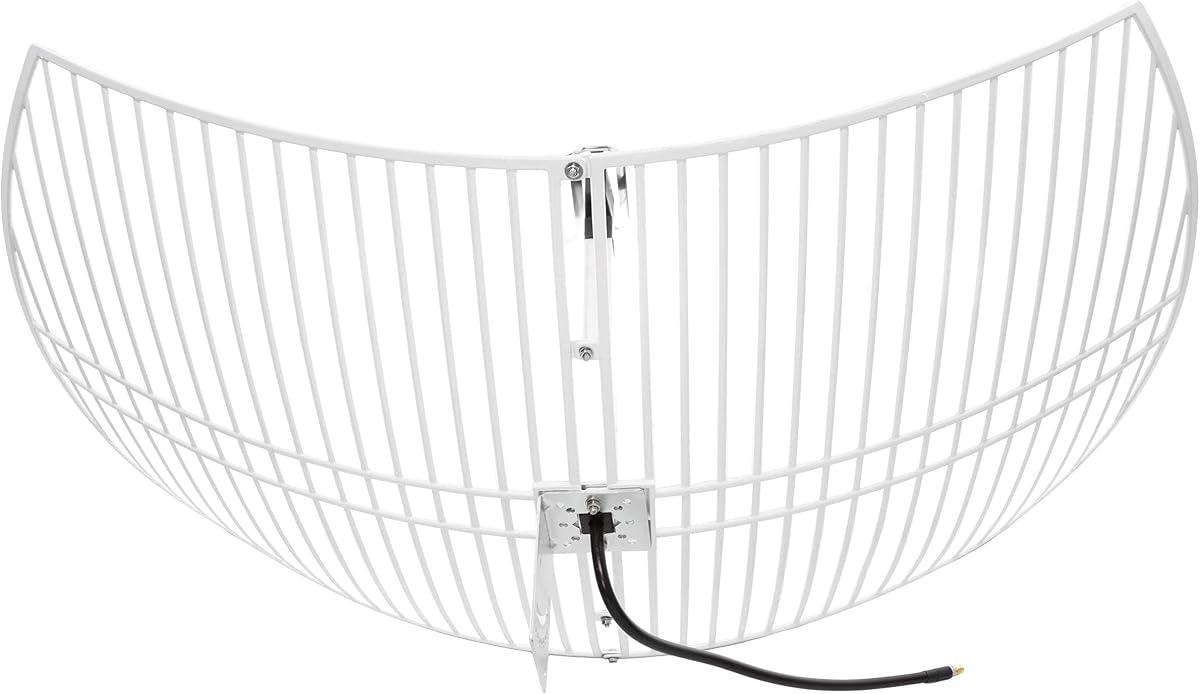


The Griddy antenna-only model is the most versatile true parabolic option in this guide, earning a 4.2 rating from its listed customer feedback. Its unusual breadth distinguishes it from ordinary 2.4GHz dishes: the antenna covers 600-6500 MHz and can work with WiFi, 4G LTE, and 5G NR equipment when the host device has compatible external antenna ports.
We may earn a commission when you buy through this link, at no additional cost to you.
The stated gain varies by band. Griddy provides 12-17 dBi from 600-960 MHz, 20-23 dBi from 1700-2700 MHz, and 23-26 dBi from 3000-6500 MHz. That makes the model useful for long directional links, cellular reception, fixed wireless access, and point-to-point WiFi installations. Its 50-ohm N-Type connection also suits professional radio hardware better than a convenience-oriented WiFi connector.
The central compromise is the need for line of sight. Because a high-gain antenna narrows its useful pattern, trees, buildings, terrain, and other obstructions can substantially reduce performance. This antenna-only package also does not include the TS9 and SMA adapters supplied with the complete kit. Buyers therefore need compatible equipment or additional adapters, and successful use depends heavily on careful positioning.
This is the leading recommendation for technically confident users who want one antenna platform across WiFi and cellular bands. It suits installers, rural operators, and advanced enthusiasts able to mount the unit outdoors and aim it precisely. For buyers wanting a more conventional 2.4GHz WiFi package with mounting and cable hardware already included, the fourth product is easier to deploy.
The 600-6500 MHz range separates Griddy from narrowly focused WiFi dishes. That flexibility lets an installer reuse the antenna for supported WiFi, LTE, and 5G systems rather than committing to a single network generation.
High gain is valuable only when the target transmitter or receiver is clearly visible. Mount the antenna high enough and aim it carefully, because reflected signals may not provide the consistent link users expect from the headline gain figure.
We may earn a commission when you buy through this link, at no additional cost to you.
The Griddy Complete Kit is the premium version of the antenna featured in first place, and it carries a 4.0 rating. Its primary advantage is practical completeness: the package includes 50-ohm N-Type connectors plus TS9 and SMA adapters, reducing the need to find interface hardware before connecting the antenna to a booster, LTE router, WiFi access point, hotspot, or modem.
We may earn a commission when you buy through this link, at no additional cost to you.
The antenna retains the same 600-6500 MHz operating range and three-band gain profile as the antenna-only model. It offers 12-17 dBi at 600-960 MHz, 20-23 dBi at 1700-2700 MHz, and 23-26 dBi at 3000-6500 MHz. For a technically equipped buyer, that makes it a capable choice for fixed cellular service, rural networking, and directional WiFi backhaul.
The included adapters do not solve every installation variable. Users still need appropriate cabling, a secure outdoor mounting solution, and compatible host equipment. They must also provide a clear view of the cell tower or access point. The kit's rating of 4.0 suggests generally favorable customer sentiment, but it does not indicate flawless performance in obstructed or poorly aimed setups.
Choose this version when convenience and interface flexibility matter, especially if the equipment uses N-Type, TS9, or SMA connections. It is less attractive for a simple router upgrade where a ready-to-install 2.4GHz dish and standard mounting hardware would be easier to manage. The complete kit earns its premium position by offering a broader and more adaptable installation package.
N-Type, TS9, and SMA connections cover several common external antenna interfaces. Including all three reduces compatibility guesswork, although installers must still confirm the exact connector and impedance requirements of the connected device.
Hosts with multiple external antenna connectors can use more than one Griddy to support MIMO operation. This is particularly relevant where cellular or WiFi equipment benefits from independent transmit and receive paths.
We may earn a commission when you buy through this link, at no additional cost to you.
The Nooelec GOES Weather Satellite Mesh Antenna is a 21 dBi parabolic antenna optimized for a very specific mission: receiving detailed, near-real-time images from orbiting weather satellites. Its 4.0 rating reflects its appeal to radio and satellite reception enthusiasts, but it should not be confused with a conventional 2.4GHz or 5GHz WiFi dish.
We may earn a commission when you buy through this link, at no additional cost to you.
Centered at 1.7 GHz with more than 200 MHz of bandwidth, it supports applications including GOES HRIT and LRIT, NOAA HRPT, Meteor M2 HRPT, Metop, and FengYun. It can receive both linear and circularly polarized signals, including right-hand and left-hand circular polarization, making it adaptable to different weather-satellite transmission formats.
The LMR400 feed cable with male SMA termination, mounting hardware, and two-year warranty make it a more complete satellite package than a bare dish. Even so, the antenna is only one part of a functioning receive chain. Users need an appropriate RF system, potentially filters and low-noise amplifiers, while software such as SatDump is required to decode the resulting imagery. XRIT Decoder for Windows is an optional paid program whose license is not included.
This is an excellent choice for satellite receiving, remote sensing, and weather tracking, but it is the wrong antenna for improving a home WiFi router. It earns its place in the guide as a specialized parabolic model and demonstrates why buyers must confirm frequency and application before choosing an antenna based only on shape or gain.
A 1.7 GHz center frequency and more than 200 MHz of bandwidth align the antenna with the listed weather-satellite applications. It is intended to work with a complete RF receiving chain rather than plug directly into an ordinary computer.
Support for linearly and circularly polarized signals broadens the antenna's usefulness across different satellite systems. Correct feed arrangement and matching equipment remain important when receiving weaker satellite transmissions.
We may earn a commission when you buy through this link, at no additional cost to you.
This 2.4GHz grid parabolic set is the most straightforward WiFi-focused choice in the top three, and it has a 5.0 rating in the supplied data. It provides 20 dBi of directional gain across 2400-2500 MHz, making it aimed at long-range backhaul, point-to-point links, and weak 2.4GHz access-point reception rather than omnidirectional room coverage.
We may earn a commission when you buy through this link, at no additional cost to you.
The package includes one grid parabolic antenna, a right-angle mounting bracket, a 9.8-foot RF400 cable, an SMA male adapter, and two U-bolt clamps. Specifications list 50-ohm impedance, vertical polarization, maximum input power of 100 watts, and a voltage standing wave ratio of 1.5 or less. These details give buyers most of the physical components needed for a straightforward outdoor installation.
Its limitation is frequency concentration. Although 2.4GHz is widely used by WiFi equipment, this antenna does not cover the 5GHz band, so it cannot serve a dual-band access point or modern WiFi 6 system operating across both ranges. It also uses a female N-Type connector, with the included SMA adapter allowing connection to compatible host equipment.
For a user extending a 2.4GHz network between buildings, connecting a camera to a distant hotspot, or receiving a signal from a fixed access point, this is a compelling package. It combines useful gain with a complete set of installation accessories and currently carries the strongest listed rating among the picks. It is the best budget-oriented parabolic entry for ordinary WiFi duties.
The bracket, clamps, RF400 cable, and SMA adapter cover the major physical connection tasks. The result is easier to deploy than a bare dish, particularly for users who are familiar with outdoor router and access-point installations.
The listing describes a weather-resistant grid dish, corrosion-resistant materials, and resistance to wind speeds up to 60 meters per second. Those claims make it more appropriate for a protected exterior mount than for an indoor antenna position.
We may earn a commission when you buy through this link, at no additional cost to you.
The HzFitInc 2×2 MIMO parabolic antenna combines 34 dBi of stated gain with a 600-6000 MHz range, making it the highest-gain cellular-focused model in the guide. It carries a 3.0 rating, the lowest numerical score among the products, so prospective buyers should evaluate compatibility and installation conditions particularly carefully.
We may earn a commission when you buy through this link, at no additional cost to you.
Its defining feature is the 2×2 MIMO arrangement. The package includes one directional parabolic antenna, two 49-foot SMA cables, two TS9 cables, two N male adapters, and pole-mount brackets. This hardware is intended to support modern 5G, 4G LTE, and WiFi devices that expose multiple antenna connectors and can benefit from independent signal paths.
Broad compatibility is convenient, but it should not be mistaken for guaranteed performance with every carrier, band, or device. The 34 dBi figure represents a highly directional configuration, which increases the importance of accurate alignment and an unobstructed view. Long cable runs can also introduce losses not reflected in the antenna's headline gain, and the exact connector arrangement must match the host system.
This antenna is best for users with compatible 5G home internet hardware, cellular routers, or MIMO access points who can mount and align the unit outside. Its impressive specifications justify consideration, particularly for fixed installations, but the 3.0 rating makes it a less confident all-around recommendation than the Griddy products. Confirm device support and the intended target location before buying.
Two cable paths and multiple adapter types support the stated 2×2 MIMO design. The host device must provide compatible antenna ports, and correct port mapping is important for taking full advantage of the configuration.
A 34 dBi directional pattern can deliver strong results when aimed directly at a transmitter, but it also concentrates sensitivity. Trees, terrain, and buildings can have a greater effect than they would on a less focused antenna.
We may earn a commission when you buy through this link, at no additional cost to you.
The Eifagur dual-band panel antenna is included as a practical directional alternative rather than a true parabolic dish. It earns a 4.3 rating and offers 15 dBi of gain across 2.4GHz and 5GHz/5.8GHz, making it relevant to modern WiFi users who need more than the 2.4GHz-only range offered by many dish antennas.
We may earn a commission when you buy through this link, at no additional cost to you.
Its 2400-2485 MHz and 5150-5850 MHz coverage supports 802.11 b, g, n, and ac networks. The listed applications include routers, repeaters, access points, security cameras, DVR recorders, and PCI WiFi adapters. Directional focus concentrates coverage in the direction of the antenna, which is useful for a targeted link but less appropriate for supplying signals throughout a building.
The included 10-foot RG58 cable and RP-SMA male connection make the package approachable. However, RG58 is more commonly associated with radio and amateur equipment than with low-loss WiFi distribution, and the host device may require a suitable RP-SMA female pigtail. Compared with a high-gain parabolic grid, the panel also generally has a broader beam, which can be helpful when the target is not perfectly aligned.
This product makes sense for a camera, outdoor router, or fixed access point on the 2.4GHz and 5GHz bands when a compact directional antenna is preferred to a large dish. It is not the most technically specialized option here, but its dual-band support and simple format broaden the guide's practical options. Choose it when convenience and compatibility matter more than maximum concentration.
Support for both 2.4GHz and 5GHz/5.8GHz lets the antenna work with more current dual-band WiFi equipment. It remains a directional product, so the target access point should be within the panel's main coverage area.
The attached cable and RP-SMA connection suit users adding external gain to compatible security cameras, routers, or access points. Check connector gender carefully because the antenna end and device end must match.
We may earn a commission when you buy through this link, at no additional cost to you.
The Nooelec L-Band Satellite Mesh Antenna is a 20 dBi parabolic product designed to receive Inmarsat, Iridium, Hydrogen Line, and other L-band signals. Its 4.4 rating is strong among the specialized products, although its intended use is satellite reception rather than ordinary home networking.
We may earn a commission when you buy through this link, at no additional cost to you.
The antenna has a 1.4 GHz center frequency and more than 300 MHz of bandwidth, allowing it to encompass numerous popular satellite applications. A sub-reflector is included for enhanced performance, while the LMR400 feed cable is already attached to the arm. The package also provides a versatile mounting kit, reducing assembly and installation work compared with a bare reflector and loose feed assembly.
Its lightweight, durable design and stated low-noise characteristics suit outdoor satellite communication, remote sensing, and weather-tracking stations. The listing specifically describes the antenna as ideal for applications where it remains stationary, which is reasonable because precise aiming is important for receiving a relatively narrow signal from an orbiting or geostationary source.
This antenna should be purchased for satellite work rather than a WiFi dead zone. It is a good fit for radio enthusiasts who understand feed lines, receivers, and L-band applications and want a mesh dish with mounting hardware included. Anyone searching for a router upgrade should instead consider the conventional 2.4GHz grids or dual-band panel options.
The 1.4 GHz center frequency and broad bandwidth target the L-band services named in the product information. A compatible receiver and appropriate feed arrangement remain necessary to turn the antenna into a working communication system.
The preattached arm, coax, sub-reflector, and mounting kit simplify setup. This is particularly valuable for fixed installations where repeat disassembly would be inconvenient.
We may earn a commission when you buy through this link, at no additional cost to you.
The 2.4GHz 25dBi Yagi antenna provides a compact, high-gain alternative to a parabolic grid. It has a 4.5 rating and covers 2400-2483 MHz with 50-ohm impedance, making it a potential fit for routers, hotspots, USB adapters, desktop wireless cards, network cards, security cameras, DVR systems, and other 2.4GHz equipment.
We may earn a commission when you buy through this link, at no additional cost to you.
Its directional design concentrates the 25 dBi gain toward the signal source. The antenna measures 50 centimeters and comes with a 1.5-meter extension cable, a gold-plated RP-SMA connector, and a wall-mount bracket. Aluminum alloy construction and listed waterproof characteristics make it suitable for protected outdoor use, while the extended lead provides more placement freedom than a short fixed pigtail.
The key trade-off is that it is limited to 2.4GHz. It cannot receive or transmit on 5GHz or 5.8GHz, and users should not expect dual-band compatibility. The RP-SMA connector also differs from the N-Type connectors used by several true parabolic options, so it is better suited to WiFi adapters and equipment designed for that interface.
This Yagi is a compelling choice when a 2.4GHz link needs strong directional gain but a dish would be too large or visually unsuitable. Its 4.5 rating and stated 25 dBi gain make it one of the strongest conventional WiFi alternatives in the guide. Buy it for 2.4GHz only, and save the broad-frequency dishes for more demanding multi-band installations.
A 25 dBi directional pattern can strengthen a point-to-point or access-point link over distance. Its effect will be greatest when the antenna is aimed directly at the intended source and mounted away from avoidable obstructions.
The 1.5-meter cable allows the antenna to sit near a window, wall, or outdoor mounting point while the radio remains indoors. Longer placement options can improve the available line of sight, but cable quality remains relevant to the final result.
We may earn a commission when you buy through this link, at no additional cost to you.
The 16dBi 2.4GHz Yagi is a versatile directional antenna for USB adapters, routers, cameras, drones, industrial routers, remote monitoring systems, and other 2.4GHz wireless equipment. Its 3.9 rating places it behind the stronger-rated alternatives, but its broad deployment examples and supplied mounting equipment remain useful for specialized projects.
We may earn a commission when you buy through this link, at no additional cost to you.
The antenna operates from 2400-2500 MHz and concentrates its signal in a chosen direction. The listing identifies SMA and RP-SMA male antenna connectors and includes a two-meter extension cable, allowing users to position the radio and antenna separately. Mounting accessories support rapid deployment in locations such as vehicles, workspaces, industrial facilities, or exterior structures.
Compared with the 25dBi Yagi, it offers less headline gain but presents a potentially more approachable installation. It remains restricted to 2.4GHz, however, and cannot cover 5GHz or 5.8GHz networks. Users should also verify whether their equipment requires SMA or RP-SMA, because visually similar connectors are not always electrically interchangeable.
Choose this model for a 2.4GHz point-to-point link, drone-related reception, a camera with a weak connection, or a directional deployment that needs both connector formats. It is not the right selection for dual-band WiFi or cellular networks. Within the 2.4GHz Yagi category, it is the more flexible and broadly packaged option, while the 25dBi model is the stronger-gain choice.
By focusing energy toward a specific target, the Yagi can reduce the influence of signals arriving from other directions. This can improve stability in congested settings where unwanted WiFi sources are present.
The stated use cases span consumer WiFi, surveillance, drones, industrial gateways, and remote control systems. The common factor is 2.4GHz operation, so compatibility with the target device's connector and supported band must be checked first.
We may earn a commission when you buy through this link, at no additional cost to you.
The 2.4GHz Outdoor Grid Parabolic is a focused dish option for point-to-point WiFi and backhaul links. It has no numerical customer rating in the supplied data, so it is not possible to compare its customer feedback with the rated products. Its specifications instead present a clear technical case: 2400-2500 MHz coverage, 17 dBi gain, and 50-ohm impedance.
We may earn a commission when you buy through this link, at no additional cost to you.
The package contains one grid parabolic antenna, a right-angle mounting bracket, and two U-bolt clamps. Vertical polarization, maximum input power of 100 watts, and a voltage standing wave ratio of 1.5 or less define the stated electrical performance. The N-Type female connector suits many professional access points and radio installations, although a host-side cable or adapter may be required.
The outdoor construction is described as weather resistant, with corrosion-resistant materials and wind resistance up to 60 meters per second. Like other directional dishes, it depends on careful placement and a clear path toward the source. Its 17 dBi figure makes it most meaningful for linking two fixed locations rather than distributing coverage in every direction.
This model is a sensible straightforward choice for a 2.4GHz backhaul link, outdoor access-point bridge, or long-range camera connection when the required N-Type interface suits the system. It is less versatile than the wider-band Griddy models and lacks a cable in the stated package, but it provides a genuine grid parabolic design with the essential mounting hardware.
The dish concentrates its 17 dBi gain toward a selected source, which is useful for a stable bridge between buildings or outdoor equipment. It should not be expected to provide the same room-filling coverage as an omnidirectional access point.
The N-Type female interface is common in fixed radio equipment and provides a straightforward way to integrate the dish with compatible access points. Check the complete cable and connector path before installation.
We may earn a commission when you buy through this link, at no additional cost to you.
The most important selection criteria are operating frequency, gain, connector compatibility, mounting requirements, and the intended radio link. A technically impressive antenna cannot improve a network if it operates on the wrong band or lacks a clear path to the target.
Start by confirming the exact frequency range used by the access point, tower, camera, or other transmitter. The 2.4GHz grid models support 2400-2500 MHz, the dual-band panel covers 2.4GHz plus 5GHz and 5.8GHz, and the two Griddy versions span 600-6500 MHz. The Nooelec satellite dishes occupy L-band and near-1.7GHz applications, making them entirely different products despite their parabolic shape.
Gain describes how strongly an antenna concentrates energy compared with a reference antenna, but it also indicates how narrow and directional the pattern may be. The listed products range from 15 dBi for the dual-band panel to 34 dBi for the MIMO cellular model. Higher gain can improve a long, clear point-to-point link, but it places a greater burden on accurate aiming and may make the installation less forgiving of nearby obstructions.
A high-gain parabolic antenna performs best when the target is directly visible. Trees, leaves, walls, roofs, glass, terrain, and other structures can scatter or reflect the signal, reducing the benefit of the nominal gain. This limitation is explicitly important for both Griddy versions and applies in principle to any tightly focused directional antenna. Users should consider mounting height, nearby structures, seasonal foliage, and the direction in which the signal must travel.
The antenna connector must physically and electrically match the device or the cable leading to it. N-Type, TS9, SMA, and RP-SMA appear across these products, and gender matters. RF400 and LMR400 are used in some parabolic packages, while the dual-band panel includes RG58. Cable type, length, and losses should be considered alongside the antenna, particularly for outdoor runs or long MIMO connections.
A single directional antenna is often sufficient for a basic bridge or one-antenna router connection. MIMO systems can benefit from multiple independent antenna paths, and both Griddy products explicitly mention using two or four units where the host supports them. The dedicated 2×2 cellular antenna provides a preconfigured alternative. For the strongest results, match the number of antenna ports and supported MIMO configuration on the host equipment.
An outdoor directional antenna needs a stable mount, weather-resistant hardware, and a cable route that protects connections. The two 2.4GHz grid sets include right-angle brackets and U-bolt clamps, while the satellite bundle includes a versatile mounting kit. The cellular MIMO package includes pole-mount brackets. Check the size and weight of the dish, the strength of the mounting point, wind exposure, grounding requirements, and whether a clear line of sight can be maintained.
Conventional WiFi antennas connect to routers, access points, cameras, adapters, or repeaters, but the satellite dishes require compatible radio equipment and potentially filters, low-noise amplifiers, and decoding software. The GOES antenna is intended for weather imagery, while the L-Band model targets satellite communication and remote sensing. Identifying the complete signal chain prevents an expensive mismatch in which the reflector performs well but cannot pass the desired signal to the receiver.
Directional antennas work best close to a window, wall, roof, or exterior mounting point, but their position must be chosen with the target in mind. A long extension cable can allow a WiFi radio to remain indoors while the antenna sits nearer the required line of sight. Avoid unnecessary slack and sharp cable bends, and do not place a directional antenna behind several layers of glazing or wall material. For apartment-style coverage, an omnidirectional access point may be a better base signal source.
Begin by identifying the device's supported frequency range, antenna-port type, and connector gender. Connect the appropriate adapter and cable before mounting, then place the antenna where it has the clearest possible view of the intended access point, tower, or second antenna. For directional models, make small aim adjustments and test the link after each change rather than relying on the physical appearance of the dish alone.
Install the bracket securely and route the coax away from sharp bends, moving metal, power cables, and places where water can collect. Outdoor connectors should be protected according to the manufacturer's instructions, while any penetrations through walls or roofs should be sealed. Do not route long cable runs closer to unnecessary electronics than necessary, because external noise and interference can affect weak signals.
For normal care, inspect the reflector, mounting hardware, cable, and connectors periodically, especially after severe weather. Clean debris from the grid with a soft brush and avoid abrasive cleaners that could damage coatings. Check alignment if performance declines, then compare current signal readings and throughput with earlier measurements. A sudden drop may indicate a loose connector, damaged cable, movement of the mount, or seasonal obstruction rather than a change in the network itself.
A parabolic antenna is usually better when you want a strong link between two fixed locations or reception from a distant, clearly visible transmitter. Its narrow pattern concentrates energy in one direction. An omnidirectional antenna remains more convenient when several devices need coverage around a room or building, or when the source may be in different directions.
Only if the antenna supports the correct band, matches the device connection, and has a useful signal path to the access point. A strong signal on a nearby access point can be made worse if a directional antenna is aimed incorrectly. Fixed wireless and rural installations often benefit more because the transmitter is at a known location and direction.
Gain indicates how effectively an antenna concentrates radio energy in a particular direction. It does not create additional power, and the stated figure is not the same as internet speed. Real results also depend on frequency, distance, interference, cable losses, antenna alignment, and the radio equipment connected to the antenna.
No, not for 5GHz reception or transmission. The dedicated 2.4GHz grid and Yagi products are limited to their stated 2.4GHz range. A dual-band model such as the 15 dBi Eifagur panel, or a sufficiently wide-band Griddy antenna, is more appropriate when both 2.4GHz and 5GHz must be supported.
SMA and RP-SMA use similar external threads but differ in the center contact arrangement. RP-SMA is the reverse-polarity version commonly used on WiFi routers and adapters. Because the difference is easy to miss visually, check the manufacturer's connector specification before purchasing an adapter or antenna.
They work best with a clear line of sight. Walls, foliage, roofs, and terrain can reflect or absorb the signal, reducing the practical benefit of a high-gain dish. If the target cannot be seen, moving the antenna or using an omnidirectional antenna may work better than increasing the dish's advertised gain.
Yes, if the host device supports the required MIMO configuration and has the appropriate separate antenna connectors. The Griddy products specifically mention using two or four antennas for MIMO, while the wide-band cellular model offers a 2×2 arrangement. Each antenna must also be positioned and oriented correctly to support the intended system.
No. The GOES and L-Band Nooelec models are specialized satellite-reception antennas rather than general WiFi accessories. They target 1.7 GHz and 1.4 GHz L-band applications and require compatible radio systems. Ordinary home and outdoor WiFi users should select a model explicitly covering 2.4GHz, 5GHz, or the cellular bands used by their equipment.
The Griddy antenna-only model is the strongest all-around choice because it combines a true parabolic grid design, broad 600-6500 MHz coverage, and compatibility with WiFi and cellular systems. The Griddy Complete Kit is the premium option for users who value included N-Type, TS9, and SMA adapters, while the 2.4GHz WiFi Parabolic Set is the most accessible choice for a conventional outdoor WiFi link.
Prioritize the target frequency, connector path, and physical line of sight before considering gain. Specialized satellite dishes and conventional Yagi or panel antennas can be excellent within their intended applications, but they are not interchangeable with a multi-band WiFi grid. For MIMO, verify the number of supported ports and plan antenna placement before installing multiple units.
Finally, confirm the current product listing, included accessories, and specifications before ordering. Customer ratings and product configurations can change, and the price of a particular antenna may also change over time. Choosing a compatible model and installing it correctly will contribute more to a successful link than the largest gain number alone.
