
Amazon Basics 50-inch Travel Tripod
4.5Editor score
1.23-pound tripod weight
16.1-inch minimum height
Three-section lever locks
Built-in bubble level
A lightweight tripod makes cameras and phones easier to carry without giving up stable, repeatable shots. The right model balances folded size, actual weight, usable height, load capacity, head control, and mounting flexibility. These ten options range from compact phone stands to full-height aluminum tripods for travel and everyday photography.
We compared the supplied specifications to evaluate portability, adjustment range, supported equipment, head movement, included accessories, and practical compatibility. The list covers dedicated camera tripods, phone-focused rigs, selfie sticks with tripod bases, and hybrid models that can handle cameras, phones, lights, and other standard-mount accessories.
Each review identifies the circumstances in which its tripod stands out, along with weight, height, or load-related limitations worth considering. Product listings and configurations can change, so verify current specifications and accessories before purchasing. Availability and pricing also vary over time.
4.5Editor score

4.6Editor score

4.5Editor score
As an Amazon Associate we earn from qualifying purchases.
This side-by-side comparison highlights the major differences among the ten tripods, particularly weight, folded dimensions, maximum height, load capacity, mounting options, and the type of creator each model is designed to support.



The K&F Concept 64-inch Lightweight Aluminum Travel Camera Tripod is the most well-rounded conventional travel tripod in this group. Its 4.6 rating reflects a strong balance of manageable weight, useful height adjustment, and a ball head that can be rotated for varied compositions. The included ball head and stated net weight of 2.53 pounds, or 1.15 kilograms, make it practical for photographers who want more capability than a simple phone stand.
We may earn a commission when you buy through this link, at no additional cost to you.
Four-section legs extend the tripod from a 20.4-inch minimum to 64.1 inches, giving it enough range for ground-level compositions, normal eye-level photography, and elevated group shots. The quick flip locks can be operated with one hand, which matters when changing position on a trail, in a crowded venue, or during a fast-paced assignment. The 36mm ball head supports up to 17.6 pounds, or 8 kilograms, and its panning dial adds a useful degree of control for landscapes and panoramic work.
The principal advantage is flexibility without excessive mass. The center column can be inverted for low-angle, archery, or specialized photography, while a shorter center-column configuration provides another way to manage framing. A standard 1/4-inch thread and Arca-Swiss quick-release compatibility broaden the range of supported cameras, projectors, and telescopes. These features make the tripod more versatile than models sold only for phones.
The tradeoff is that it is not the smallest option here. Its 15.5-inch folded length and center column make it bulkier than a pocket-sized magnetic phone stand, and a long aluminum body can occupy more luggage than a very compact rig. Even so, the stated weight remains reasonable for a full-size tripod. It is the strongest recommendation for travel photographers and mobile creators who need dependable camera support, low-angle capability, and a ball head without carrying an overly elaborate system.
At a stated 1.15 kilograms including the ball head, this model is light enough for regular travel while retaining features associated with larger tripods. The quick leg locks, adjustable center column, and rotating head make it more versatile than a basic fixed-leg stand.
The invertible center column helps when the camera needs to sit below normal tripod height, while the 360-degree ball head supports portrait, landscape, and panoramic framing. These features are valuable for street, landscape, tabletop, and low-angle work.
We may earn a commission when you buy through this link, at no additional cost to you.
The EUCOS 62-inch Phone Tripod is a strong choice for creators who want one very light tool for selfies, group photos, live video, and remote-controlled phone footage. It has a 4.6 rating and a listed tripod weight of 13 ounces. That low figure is particularly compelling when the product can also extend into a 62-inch selfie stick, making it a flexible travel companion for solo content creation.
We may earn a commission when you buy through this link, at no additional cost to you.
The modified nylon construction is designed to provide a balance of rigidity, toughness, and crush or shear resistance. Its phone clamp accommodates devices from 2.2 to 3.6 inches wide, and the included cold shoe creates a connection point for compatible lights and microphones. Those features extend the rig beyond basic phone support and allow creators to assemble a more useful mobile production setup.
The wireless remote provides hands-free still capture and video start or stop control from up to 33 feet, or 10 meters. A fluid sliding extension mechanism changes the product from its compact tripod form into a full-height stick. The bundle also includes a 2.3-ounce phone holder and states compatibility with phones, action cameras, and 360-degree cameras, although particular adapters may be needed for some of those devices.
Its main limitation is that it is not positioned as a conventional camera tripod and no load rating is supplied. A large DSLR, long lens, or heavy production rig would not be its natural use case. For phone-first travelers, however, the combination of low weight, quick conversion, remote operation, and accessory support makes it one of the most useful and economical options in the roundup.
The 13-ounce tripod portion folds into a compact support and extends smoothly into a 62-inch selfie stick. That combination reduces the number of separate accessories a solo creator needs to carry for angled, full-body, or elevated phone footage.
A 10-meter wireless remote lets creators frame a shot, step away, and still take a photograph or start recording. The ability to begin and stop video is especially useful for demonstrations, fitness content, and unattended group footage.
We may earn a commission when you buy through this link, at no additional cost to you.
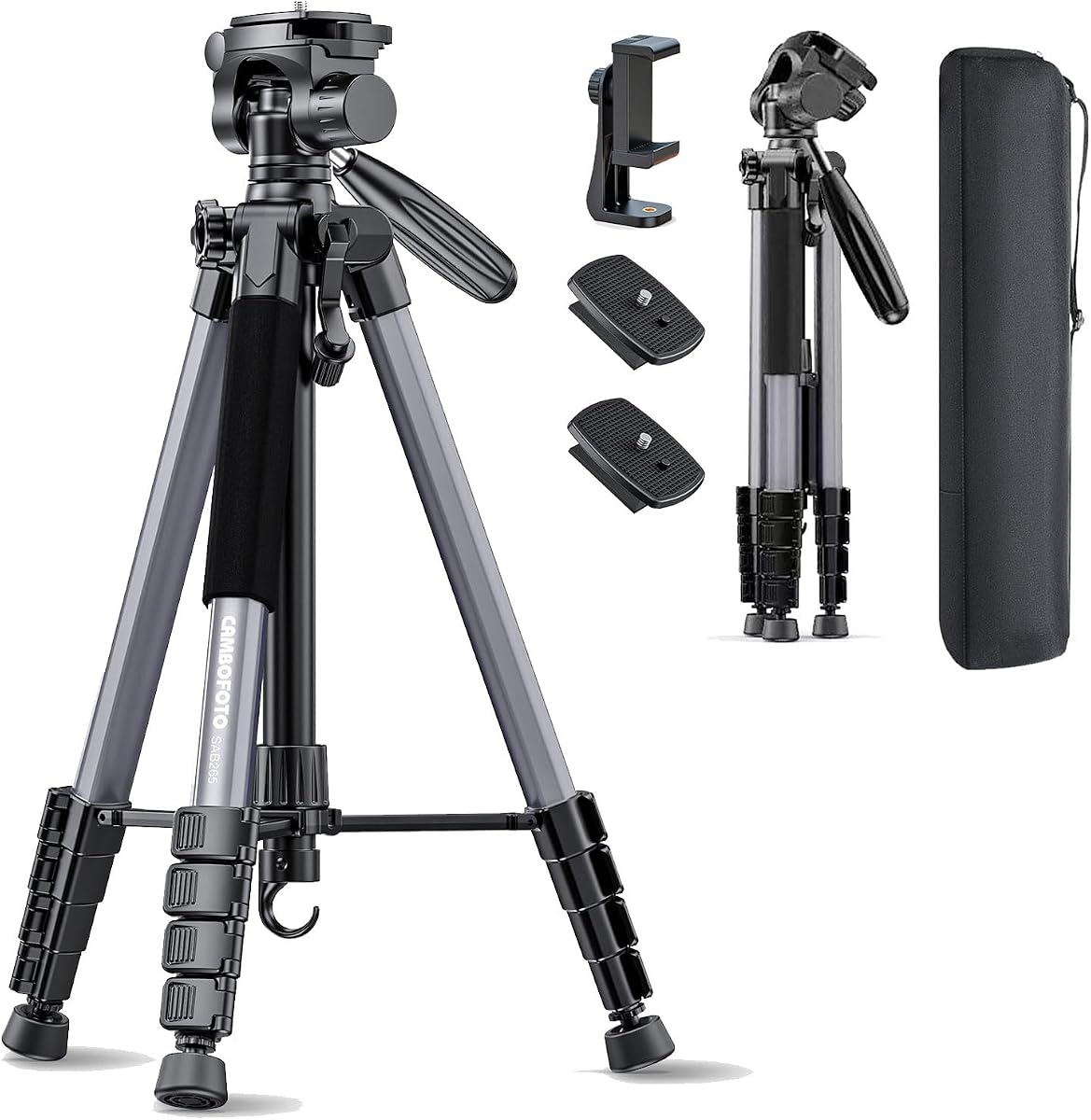
The CAMBOFOTO 74-inch Camera Tripod stands out as a capable hybrid for photographers and content creators who alternate between cameras and phones. Its 4.6 rating reflects a versatile package that includes aluminum legs, a pan-and-tilt head, a quick-release plate, a phone mount, and a carry bag. The stated weight is 2.8 pounds, which remains manageable for day hikes and road trips.
We may earn a commission when you buy through this link, at no additional cost to you.
Height adjustment extends from 20 inches to 74 inches, allowing the tripod to serve as a tabletop-height support, conventional standing camera tripod, or elevated shooting platform. Aluminum legs are listed as supporting up to 8.8 pounds, enough for a typical DSLR, mirrorless camera, ring light, GoPro, or smartphone according to the supplied information. The quick-release plate and separate phone mount make transitions between equipment types more convenient.
The 360-degree pan-and-tilt head should appeal to videographers because it allows smoother directional changes than a simple fixed mount. Smooth panning also benefits landscape panoramas and video compositions that require controlled movement. Meanwhile, the included carry bag and compact folding design make storage more convenient for travelers who do not want to carry an exposed tripod between locations.
The main compromise is weight and bulk relative to models engineered primarily for phones. A 2.8-pound tripod with a large height range is less convenient for long walks than a 13-ounce selfie stick or the 3.6-ounce Lamicall stand. It is still a practical choice for someone who already carries a camera and wants one support system for both devices. For hybrid workflows, its accessory package is a notable advantage.
The included quick-release plate and phone mount reduce the need to carry separate supports for camera and mobile work. This makes the tripod practical for creators who produce short-form video with a phone but still want a stable platform for photographs.
The 20-to-74-inch adjustment range covers low tabletop compositions, normal standing angles, and elevated perspectives. That range gives the tripod broader creative usefulness than a short desktop stand or a pocket selfie stick.
We may earn a commission when you buy through this link, at no additional cost to you.
The Amazon Basics 50-inch Lightweight Portable Camera Tripod is a straightforward, travel-conscious camera stand with a 4.5 rating. At 1.23 pounds, it is one of the lighter full-size options here, yet it provides a 16.1-to-50-inch adjustment range, a three-way head, a built-in bubble level, and a quick-release plate. Those fundamentals make it approachable for travel, hiking, camping, and casual photography.
We may earn a commission when you buy through this link, at no additional cost to you.
Three-section legs use lever locks that allow the height to be changed without handling tiny, recessed controls. The 3-way head supports tilt and swivel movement, allowing the camera to be oriented in portrait or landscape positions. A quick-release plate speeds up transitions between shots, while the included zippered bag protects the folded tripod and makes it easier to organize inside luggage.
The most important limitation is stated clearly in the product information: the tripod is not recommended for heavy, high-end DSLR bodies, long lenses, or large telescopes. Total equipment weight should remain under 4.4 pounds. That guidance makes the model more appropriate for compact cameras, mirrorless bodies, and modest camera-and-lens combinations than professional setups built around heavy optics.
For a traveler who wants a conventional tripod without a complicated head, this Amazon Basics model provides a useful balance of size, simplicity, and function. It lacks some of the low-angle flexibility and larger stated load capacity found in more advanced models, but those omissions make sense within its lighter travel focus. It is a sensible recommendation for beginners, vacation photographers, and anyone carrying equipment closer to the stated weight limit.
The three-section legs and lever locks make adjustment straightforward, which is useful in changing light or when repositioning a composition. The controls are easier to operate quickly than small twist locks, particularly while wearing gloves.
The integrated bubble level helps keep the camera level, while the three-way head supports common portrait and landscape angles. These details can reduce setup time and make compositions more consistent.
We may earn a commission when you buy through this link, at no additional cost to you.
The TONEOF 68-inch Magnetic Aluminum Phone Tripod is built for creators who prioritize minimal packed weight and quick phone attachment. It carries a 4.3 rating, the lowest among the selected tripods, but its listed weight of 11.3 ounces and 11-inch folded length make it one of the easiest to carry. It combines an aluminum extension system, magnetic holder, selfie stick, tripod base, and detachable remote.
We may earn a commission when you buy through this link, at no additional cost to you.
The magnetic aluminum mount is designed to work with MagSafe-enabled devices, allowing the phone to be attached and removed with one hand. For phones without magnetic support, the included metal ring provides an alternative attachment point. Once connected, the holder offers 360-degree horizontal rotation and 200-degree vertical tilt, giving the user a broad range of shooting orientations without changing mounts.
Eight telescoping sections expand the tool from 11 inches to 68 inches, covering close-up content, normal-height recording, and elevated group shots. The built-in rechargeable wireless remote supports hands-free still capture and video control. This combination makes the tripod especially relevant for solo travelers who need to film themselves, record demonstrations, or position a phone for unattended video.
The magnetic system is the central tradeoff. A device or case without magnetic support requires the supplied ring, and users should ensure the phone, case, and mount are securely coupled before movement. It is also not presented as a conventional camera tripod for heavier equipment. For its intended phone-first purpose, however, it offers an unusually useful combination of compactness, height, and flexible positioning.
The magnetic holder can be especially convenient when a creator is changing phones or switching between a supported device and another setup. The included ring expands compatibility for phones that do not have built-in magnetic attachment.
The eight-section aluminum structure packs to 11 inches but extends to 68 inches. That range makes the unit useful for low-angle clips, standard selfies, overhead framing, and full-body group footage.
We may earn a commission when you buy through this link, at no additional cost to you.
The VIMOSE 66-inch Phone Tripod is a flexible mobile-production stand with a 4.6 rating. Its three functions—a steady base, telescoping arm, and multi-angle phone holder—allow it to handle overhead product shots, full-body portraits, and everyday phone recording. This makes it more versatile than a simple compact selfie stick that can only offer limited placement options.
We may earn a commission when you buy through this link, at no additional cost to you.
Locking flanges allow quick changes among portrait, landscape, and 45-degree positions. The phone holder accepts widths from 2.2 to 3.6 inches and includes padding intended to help prevent slipping. A built-in cold shoe provides a connection for compatible LED panels or microphones, allowing creators to assemble a more complete mobile recording arrangement without hunting for separate adapters.
A Bluetooth remote with a 10-meter range handles still images and video start or stop functions without touching the screen. The 1/4-inch screw mount also allows the stand to connect with fill lights, ring lights, and other compatible equipment. This is a useful expansion for creators who already use lightweight accessories and want one support system to serve multiple parts of a mobile setup.
The product information does not provide a specific overall weight, which makes it harder to compare directly with models that list an exact packed weight. It is also primarily a phone and light-accessory system rather than a conventional camera tripod with a stated load rating. Even so, its 66-inch reach, multiple angles, cold shoe, and remote control make it a compelling choice for mobile creators who regularly work alone.
The cold shoe and 1/4-inch connection make it possible to add a light or microphone to the support. That turns a simple phone holder into the central point of a more functional recording setup.
Portrait, landscape, and 45-degree positions cover common content formats. The 66-inch extension also provides enough height for full-body framing, while the base can support lower product-oriented compositions.
We may earn a commission when you buy through this link, at no additional cost to you.
The Amazon Basics 60-inch Lightweight DSLR Tripod is a conventional camera support for photographers who want recognizable DSLR compatibility, adjustable legs, and a three-way head. It has a 4.5 rating and a stated weight of 2.7 pounds. At 23.2 inches in its lowest configuration and 60 inches when the center post is fully extended, it covers common standing and elevated shooting positions.
We may earn a commission when you buy through this link, at no additional cost to you.
The listed maximum load of 6.6 pounds provides more support than the smaller 50-inch Amazon Basics travel model. Compatibility includes digital and still cameras, GoPro devices, scopes, and smartphones when a suitable adapter is available, though the smartphone adapter is not included. Two built-in bubble levels and the three-way head assist with tilt, swivel, portrait, and landscape positioning.
Its quick-release mounting plate is helpful when the camera needs to be removed quickly or when switching between a still camera and another mounted device. Rubber feet provide a basic grip on the ground, and the included carrying case makes it easier to keep the tripod organized during transport. These are practical details for users who want a recognizable, camera-first package.
The model weighs more and folds longer than several compact travel and phone options in the roundup. It also does not include a phone adapter despite supporting phones with the correct accessory. Those limitations matter for minimalist packers, but they are reasonable for a tripod intended primarily for cameras. It is best suited to travel and family photographers who value head adjustment, load capacity, and a conventional included case.
The three-way head, quick-release plate, and standard camera setup provide a familiar workflow for photographers. It is easier to transition to this tripod than to adapt to a phone-first or modular magnetic system.
The 23.2-to-60-inch range covers low and standard positions, while two bubble levels support accurate positioning from different angles. These details are useful for landscapes, events, portraits, and general travel photography.
We may earn a commission when you buy through this link, at no additional cost to you.
The Lamicall for MagSafe Tripod Stand is the most pocket-oriented model in the roundup, with a listed weight of 3.6 ounces and a 4.6 rating. Its dual-side magnetic system allows it to function as a desktop stand, extend into a selfie stick, operate in handheld mode, or attach to a flat metal surface. For creators who want a phone support that can live in a pocket, its design is notably adaptable.
We may earn a commission when you buy through this link, at no additional cost to you.
Triple-axis adjustment and a 360-degree rotating pivot create numerous framing positions, including portrait, landscape, overhead flat-lay, low-angle, and oblique views. The mantis-style hook can grip railings, chair backs, or tray tables, while the base magnet can attach to gym equipment, refrigerators, golf carts, and metal racks. These situations often appear in travel, fitness, and everyday creator content.
Unlike a phone-only selfie stick, the Lamicall can integrate into larger equipment setups. Its support for the Arca-Swiss standard and 1/4-inch screw mounts allows it to work with compatible cameras and accessories. An additional thread on the arm can support a microphone or light. An included Allen wrench is provided for tightening the screws when needed.
Its limitations are inherent to the mini format. It does not offer the tall working height of a full-size tripod, and stable magnetic attachment depends on the phone, case, and surface. It also requires attention in windy or high-movement situations. For desk use, travel vlogs, fitness recording, and spontaneous phone content, however, the combination of weight, attachment methods, and angle control is exceptionally practical.
At 3.6 ounces, the stand adds very little to everyday carry. Its slim form can remain in a pocket or small bag, making it practical when an opportunity for a stable phone shot appears unexpectedly.
The hook, base magnet, selfie-stick mode, and standard mounts create several ways to position the phone. That versatility is useful around the home, in a gym, at a desk, or while traveling.
We may earn a commission when you buy through this link, at no additional cost to you.
The VICTIV 74-inch Camera Tripod is a full-height, camera-first support rated 4.6 by users. It weighs 3.14 pounds, making it the heaviest conventional tripod in this list, but its 19-to-74-inch adjustment range provides substantial working height. That makes it suitable for creators who need tall framing for group photos, full-body video, landscapes, events, or overhead compositions.
We may earn a commission when you buy through this link, at no additional cost to you.
The standard 1/4-inch mount works with Canon, Nikon, Fujifilm, Olympus, Panasonic, DSLR, SLR, digital cinema cameras, spotting scopes, projectors, compact camcorders, and binoculars, according to the supplied compatibility information. A 360-degree phone holder expands the system for mobile shooting. The complete package includes the tripod, phone holder, extra quick-release plate, handle, and three non-slip pads, plus a carrying bag.
The three-way pan head supports 360-degree horizontal panoramas, 180-degree tilting, and 90-degree vertical portrait positioning. A weight hook can hold a backpack for added stability, and the non-slip pads improve footing. These features make the tripod more adaptable for different working environments than a basic ball-head travel model.
The central compromise is weight. At 3.14 pounds, this tripod is less attractive for long walks than the 1.23-pound Amazon Basics model or the very small phone stands. It is better viewed as a portable full-height tool than an ultralight hiking accessory. Users who value a tall camera head, broad equipment compatibility, and included accessories over minimum packed weight will find the VICTIV particularly well equipped.
The 74-inch maximum allows the camera to rise above many seated or waist-level shooting positions. That makes it useful for full-body recordings, larger groups, and compositions that need a higher vantage point.
The three-way head handles horizontal pans, vertical tilting, and portrait orientation. That range supports landscapes, interviews, video, and everyday photography without changing the entire support system.
We may earn a commission when you buy through this link, at no additional cost to you.
The K&F CONCEPT 75-inch Aluminum Camera Tripod is a feature-rich travel support with a 4.5 rating. Its stated weight is 2.6 pounds, and it adjusts from 18.9 inches to 75 inches. The combination of a long working range, collapsible construction, and a 19.6-inch folded size makes it suitable for creators who need more height than a compact travel tripod but still intend to carry one support for multiple devices.
We may earn a commission when you buy through this link, at no additional cost to you.
Its pentagonal tube design is intended to improve stability, durability, and folding convenience. A 360-degree rotatable three-way pan head handles panning, tilting, portrait, and landscape work, while the built-in bubble level assists with alignment. The adjustable 2-in-1 holder supports both smartphones and tablets using thick rubber padding, which is useful for livestreams, online meetings, video recording, and photography.
A Bluetooth remote is included for hands-free still capture and video control from up to 472 inches. That generous stated range allows the phone or camera to be placed at a distance for group photographs, selfies, or recording. The holder and remote together make the tripod particularly relevant to solo creators who cannot remain beside the device during a take.
The trade-offs are size and weight compared with slim phone tripods. Its 19.6-inch folded length and 2.6-pound weight require more luggage space than the Lamicall, EUCOS, or TONEOF models. In return, it provides a conventional camera tripod, tablet support, greater height, and a more complete accessory set. It is best recommended to mobile creators and travelers who want one adaptable system for cameras, phones, and tablets.
The pentagonal tube construction is designed to provide rigidity while remaining portable. Its folded form remains relatively long, but the shape and foldability are intended to make storage and setup more manageable.
The included holder accommodates both phones and tablets, while the standard tripod head remains useful for cameras. This broadens the model beyond a dedicated selfie stick and reduces the need for separate mobile stands.
We may earn a commission when you buy through this link, at no additional cost to you.
Choosing a lightweight tripod involves balancing packed size, actual weight, stability, working height, supported equipment, and control features. The best choice for a phone creator is not necessarily the best option for a DSLR user, so the intended device and shooting environment should guide the decision.
Weight matters when a tripod must be carried through airports, over trails, or for long city days, but folded length is equally important because a very light model can still occupy too much luggage. Models such as the Lamicall at 3.6 ounces, TONEOF at 11.3 ounces, and EUCOS at 13 ounces are designed for minimal carry. Conventional aluminum tripods in the 2.6-to-3.14-pound range provide more substantial camera support while remaining travel-capable.
Compare the actual packed dimensions, not only the listed weight. A tripod that folds short can fit in a day bag, while a longer folded unit may need to share space with a larger camera body. Choose the smallest system that still meets your height and stability needs.
Maximum height is useful for group shots, full-body video, elevated landscapes, and shooting over crowds, while minimum height determines whether the tripod can handle tabletop, product, and low-angle compositions. The K&F Concept options reach 64.1 and 75 inches, while the CAMBOFOTO and VICTIV models reach 74 inches. Smaller stands provide less height but concentrate on portability and phone-specific positioning.
Consider both ends of the adjustment range. A wide range is more versatile, but a model that starts low may be more useful for everyday creative work. Do not choose based on maximum height alone if your main requirement is a pocket-sized travel accessory.
Camera tripods need a standard 1/4-inch mount and an appropriate head, while phone-focused products should have a secure clamp or magnetic holder. Some models include both a quick-release plate and phone mount, making them more useful for mixed workflows. The Lamicall also supports Arca-Swiss and additional 1/4-inch accessory connections, while several phone tripods provide cold-shoe mounting points for lights and microphones.
Check the supplied mounting hardware before buying. A product that claims broad compatibility may still require a separate phone adapter, and magnetic systems need either magnetic phone hardware or the included metal ring. Choose the attachment style that matches the devices you actually use.
Load capacity tells you how much equipment the tripod is designed to support, but it should not be treated as a guarantee for every camera configuration. The K&F Concept 64-inch model lists an 8-kilogram ball-head capacity, CAMBOFOTO lists 8.8 pounds, and Amazon Basics lists 6.6 pounds for its 60-inch model. The smaller 50-inch Amazon Basics tripod has a stated total-equipment limit of 4.4 pounds.
Include the camera body, lens, battery, and mounted accessories when checking suitability. Long lenses can place more stress on a head than a compact camera with a short lens. For mobile-only tools, evaluate the intended phone weight separately because some listings focus on compatibility rather than a published load rating.
A ball head offers broad angular freedom, a three-way head provides pan, tilt, and portrait controls, and a phone mount may offer 360-degree rotation with additional vertical tilt. These distinctions affect how quickly a creator can compose landscapes, portraits, overhead videos, group photographs, and live broadcasts. Built-in bubble levels are also helpful when the head does not remain perfectly level.
Choose movement that matches your compositions. Ball and multi-axis heads are convenient for quick changes, while a conventional three-way head may feel more intuitive for portrait, landscape, and event work. For phone creators, pay particular attention to portrait locking and angle stiffness.
Wireless remotes make solo recording more practical by allowing the creator to start, stop, or capture without touching the device. The EUCOS, TONEOF, VIMOSE, and K&F CONCEPT 75-inch models include remotes with different stated ranges. Cold shoes and standard accessory threads can also support microphones, LED panels, ring lights, and other mobile-production equipment.
Remote range should match the intended recording situation. A short range is sufficient for a desk or nearby floor setup, while a longer range helps with group photographs and wider scenes. Confirm that the remote works with the device and that any attached light or microphone does not create unwanted balance issues.
A lightweight tripod should still have a stable base when used on uneven ground. Rubber feet are common on conventional camera models, while the VICTIV includes non-slip pads. Phone tripods need a sufficiently wide stance or rigid base to resist tipping, and magnetic desktop models must also be checked for attachment strength. Stability depends on both the tripod and the surface beneath it.
For smooth indoor surfaces, a low-profile phone stand or desktop mount may be more appropriate than spreading long legs. Outdoors, inspect the feet, leg locks, and center column for movement before mounting expensive equipment. Tighten controls and keep the center column properly extended for a stable working configuration.
Before setting up, choose firm, level ground and orient the tripod so its legs are spread evenly. Attach the camera or phone to the appropriate plate, clamp, or magnetic mount, then tighten the connection until there is no visible play. For conventional tripods, extend each leg section gradually and confirm that every lever or twist lock is fully engaged.
Set the center column and head only after the legs are stable. Raise the camera to the intended framing height, use the bubble level where available, and adjust the head with small movements rather than forcing a locked joint. When using a remote, place the tripod where the device will remain in focus and make a test recording to check exposure, stabilization, and framing.
For transport, collapse the tripod in reverse order of setup, tighten or close every leg lock, and return telescoping sections to their nested positions. Carry conventional tripods in the supplied bag when available. Keep magnetic phone attachments covered or separated from keys, coins, and other metal objects, and do not leave a phone attached to an exposed magnetic base.
The Lamicall for MagSafe Tripod Stand is the lightest model listed, with a stated weight of 3.6 ounces. Among the conventional camera tripods, the Amazon Basics 50-inch model is listed at 1.23 pounds, while the K&F Concept 64-inch model weighs 2.53 pounds including its ball head. Actual packed weight can vary if accessories are added.
No. A lighter tripod is easier to carry, but height, stability, head control, and load capacity still determine how useful it is for a particular camera. A pocket phone stand may be perfect for selfies, while a photographer carrying a mirrorless body will need a conventional support that can handle the equipment and remain stable.
Several models can support a DSLR within their stated limits. The Amazon Basics 60-inch tripod lists a 6.6-pound maximum load, and the K&F Concept 64-inch model has an 8-kilogram ball-head capacity. Always include the camera body, lens, and accessories when checking the total weight, and follow the manufacturer’s guidance.
A ball head allows movement in multiple directions and makes angle changes fast, which is useful for landscapes and varied video compositions. A three-way head separates pan and tilt controls and commonly provides a vertical portrait position. Both can be effective, and the better choice depends on the user’s preferred controls and shooting style.
It depends on the case and phone. The TONEOF and Lamicall products support magnetic phones and include a metal ring for devices that do not support magnetic attachment. The ring should be placed securely on the phone or case, and users should check that the combined connection will not slip before moving the setup.
The most convenient length is one that fits comfortably in the bag you will actually carry. A short folding length is useful for daily excursions and air travel, while a longer folded tripod may be acceptable in a vehicle or dedicated camera bag. Compare packed dimensions together with weight because both contribute to portability.
A case is not essential, but it helps keep legs, locks, and adapters together and protects the product from scratches and dirt. The Amazon Basics 50-inch and 60-inch models, CAMBOFOTO, and VICTIV include carrying cases. Smaller phone stands can fit in a pocket or small organizer, so a separate bag may add little practical value for those users.
A phone tripod is usually more convenient when all footage is recorded on a phone, especially if it includes a remote, flexible angles, and a compact selfie-stick function. A camera tripod is preferable when using a camera, long lens, larger light, microphone, or other equipment that requires a stronger standard mount and higher working height.
The K&F Concept 64-inch Travel Tripod is the most balanced overall recommendation because it combines a 1.15-kilogram stated weight with a useful ball head, 64.1-inch height range, quick locks, and inverted center-column capability. For a phone-only creator, the EUCOS 62-inch model provides an especially light and versatile package, while the Amazon Basics 50-inch model remains a simple option for travel photographers using lighter cameras.
Prioritize the device you need to support, the distance you will carry the support, and the range of positions you need. Ultra-compact magnetic models are ideal for spontaneous phone content and desk use, while conventional aluminum tripods are better for cameras, taller framing, panoramic work, and added accessories. The stated load and folded dimensions matter more than the tallest possible extension.
Before purchasing, verify the current specification, included components, mounting compatibility, and manufacturer instructions. Listings, included accessories, and availability can change, and prices fluctuate over time. Comparing those details with the way you shoot will help identify the most practical lightweight tripod for your own travel and creative routine.