
Official Creality Ender 3 V2 Heated Bed
4.5Editor score
Official Creality replacement
235 × 235 × 3 mm
24V 220W heating system
Compare the best heated bed for 3D printer options for Ender, Voron, and large-format builds, focusing on size, voltage, power, and printer fit.
A heated bed gives a 3D printer the stable, elevated surface needed for strong first-layer adhesion and reliable prints with demanding materials. A good replacement should match the printer’s dimensions, mounting pattern, electrical system, thermistor arrangement, and thermal-control expectations while providing even heat across the usable area.
We compared the ten options by examining their stated bed dimensions, voltage and wattage, heating-element construction, sensor or fuse details, installation needs, printer compatibility, and customer ratings. The list covers common Ender and Creality replacements, oversized aluminum beds, Voron silicone mats, and other specialized heated-bed solutions.
Each review explains the product’s strongest contribution and any meaningful limitations, helping you distinguish a direct replacement from a custom-build component. Ratings, specifications, availability, and prices can change over time, so confirm the current listing and exact fit before ordering.
4.5Editor score

5.0Editor score

5.0Editor score
This comparison highlights the key differences among ten heated beds, including their physical sizes, electrical ratings, construction styles, intended printer families, and available ratings. It provides a quick way to identify the most appropriate option before reading the detailed reviews.

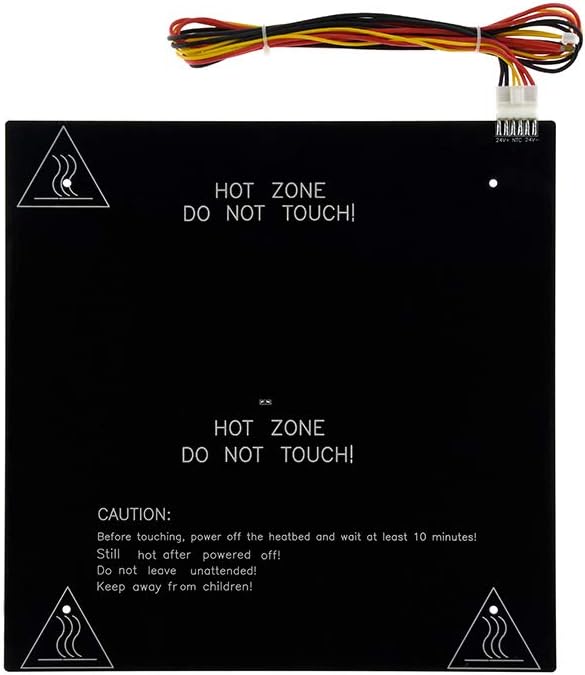


The Official Creality Ender 3 V2 Heated Bed is a direct replacement option for owners of several popular Ender 3 variants. It carries a 4.5 customer rating and stands out for its official branding, familiar 235 × 235 × 3 mm footprint, and an included cable. For many users replacing a cracked or poorly heating original bed, those details make it a straightforward first choice.
We may earn a commission when you buy through this link, at no additional cost to you.
The bed uses a 220W, 24V heating system and an aluminum platform. Its stated compatibility includes the Ender 3, Ender 3 Pro, Ender 3 V2, Ender 3 Neo, and Ender 3 V2 Neo. The assembled cable is especially useful because it reduces the amount of reconnection work required, although the cable connector still needs to match the printer’s original bed socket.
The principal limitation is that this is not a universal heated-bed platform. It is intended for the named Creality models and their 24V electrical arrangement. The supplied information does not state a maximum temperature, so buyers needing a published temperature limit should verify that detail in the current listing. Surface-sheet compatibility and mounting hardware should also be checked before ordering.
This is our leading recommendation for an Ender owner seeking the most familiar replacement format. It combines official branding, standard dimensions, broad model compatibility, and a supplied cable without introducing unfamiliar custom-build specifications. Confirm your exact printer revision and connector, then treat it as a direct-service replacement rather than a general-purpose large-format bed.
The assembled cable and standard Ender 3 dimensions simplify replacement for compatible machines. It is particularly attractive when the original bed has stopped heating uniformly or its surface has become damaged.
Compatibility spans several common Ender 3 variants, giving owners a broader selection of matching 24V systems. Exact revision matching remains essential before installation.
We may earn a commission when you buy through this link, at no additional cost to you.
The HICTOP Ender 3 Heated Bed is a budget-minded replacement with the same basic 235 × 235 × 3 mm dimensions used by many Ender-style machines. Its 4.5 rating, 24V 220W rating, included cable, and stated maximum temperature of 110°C provide a useful specification package for common ABS and PLA printing setups.
We may earn a commission when you buy through this link, at no additional cost to you.
Compatibility is the main selling point. The listing names the Creality Ender 3, Ender 3 Neo, Ender 3 Pro, Ender 3 V2, Ender 3 V2 Neo, and Voxelab Aquila X2. Its aluminum construction also closely follows the familiar original-bed format, making it easier to compare with an existing assembly than a radically different silicone mat.
The stated 110°C limit is worth considering if you routinely print high-temperature polymers or use special settings demanding a wider thermal margin. As with any replacement, verify the electrical connector, thermistor arrangement, lead-wire routing, and sheet support. The compatibility list provides a starting point but does not eliminate the need to compare the exact revision of your printer.
This bed is a sensible value option for owners of a listed model who need a conventional aluminum replacement and do not need extreme temperature capacity. It is less suitable as a universal solution or for high-temperature industrial work. With exact fit verified, it delivers the essential dimensions, power rating, and cable in an accessible package.
Using a familiar aluminum platform makes this option suitable for standard Ender-style assemblies. It should integrate more directly than a full custom silicone-mat installation.
The published 110°C maximum helps buyers match the bed to their filament choices. It is an important constraint for high-temperature specialty materials.
We may earn a commission when you buy through this link, at no additional cost to you.
The Tosuny 200W Silicone Heated Bed combines a 5.0 customer rating with a flexible 235 × 235 mm format. Designed for Ender 3, Ender 3 Pro, and related 24V systems, it appeals to builders who prefer the installation approach of a silicone heating pad rather than a conventional rigid aluminum hot bed.
We may earn a commission when you buy through this link, at no additional cost to you.
Its stated 200W, 24V design is intended to promote rapid heating and uniform heat transfer. The three-point backing rubber makes the pad easier to position on a compatible bed, while the thin silicone construction can be useful when clearance is limited. These characteristics distinguish it from the full replacement beds that include an aluminum platform and installed wiring.
This product requires more care than a drop-in assembly. The description warns that the silicone material is limited to about 200°C and may be damaged by excessive temperatures. It also stresses preventing hot-end contact and taking precautions during installation. Those warnings make temperature control and correct mounting essential rather than optional.
The Tosuny is a compelling choice for an informed maker comfortable adapting an Ender-style bed around a silicone heater. Its perfect customer rating supports its appeal, but the installation method and material limitations distinguish it from the official direct replacement. Buyers who prioritize simple plug-and-play restoration should consider the first option instead.
A thin silicone pad can conform to the bed surface and simplify custom installations. Its 200W rating targets responsive heating within a common 24V printer system.
The heating pad should be positioned carefully and protected from the hot end. Correct temperature control and clearance are especially important because of the silicone construction.
We may earn a commission when you buy through this link, at no additional cost to you.
The CR-10 Aluminum Heated Bed is designed specifically for the Creality CR-10 and its 310 × 310 mm platform. Its 3.8 customer rating is lower than those of the leading Ender replacements, but the detailed dimensions and included power wire kit make this a focused option for someone restoring the correct larger bed for that printer family.
We may earn a commission when you buy through this link, at no additional cost to you.
The heating system is rated at 24V and 220W. The bed itself is made from 3 mm aluminum and has a center hole distance of 240 mm, with holes measuring approximately 4.2 mm in diameter. Those mounting details let a buyer compare the replacement against the original assembly before ordering.
The product is not as broadly compatible as the smaller Ender beds, and its rating suggests some customer experiences may not have met expectations. The installation instructions emphasize removing the protective film from the back of the aluminum bed before use. Omitting that step could interfere with heat transfer or installation.
This is the most targeted choice for a CR-10 owner who knows the required 310 mm footprint and mounting geometry. It offers more documented fit information than many large generic beds, but it should not be considered an interchangeable Ender or CR-10 Pro component without confirmation.
The 310 × 310 mm platform targets the Creality CR-10 format. This focused sizing is preferable to forcing a smaller or unverified universal bed into the machine.
Published hole spacing and diameter make installation easier to plan. Buyers should also check the entire cable, connector, and sheet-support arrangement.
We may earn a commission when you buy through this link, at no additional cost to you.
The YWBL-WH 500 × 500 mm Heated Bed is built for large-format work, combining a 24V 350W rating with an aluminum alloy platform. Its integrated heating and substrate design, flat countersunk holes, and claimed suitability for mainstream large printers distinguish it as a custom-upgrade component rather than a small desktop-printer replacement.
We may earn a commission when you buy through this link, at no additional cost to you.
The description emphasizes rapid heating, uniform temperature distribution, and support for first-layer adhesion and flatness. Countersunk mounting holes are designed to keep the surface free of protruding screw heads, which can help prevent nozzle collisions. The integrated construction is also intended to maintain consistent heat conduction and power output.
Its 2.8 rating is the clearest caution. The listing provides fewer exact fit details than the CR-10 and Ender options and does not identify a precise list of compatible printer models. Its 350W draw also demands a capable 24V power supply and appropriate wiring, while the actual mounting dimensions, sensor arrangement, and connector details should be confirmed before purchasing.
For a large custom printer, this bed’s scale and integrated construction may be attractive, but it carries more integration risk than a model-specific replacement. Prospective buyers should treat the product dimensions and power system as a design project rather than a simple swap.
The 500 × 500 mm surface creates a substantial printable area for large-format projects. Mechanical dimensions and bed weighting become important considerations in a large chassis.
Combining the heating plate with an aluminum substrate supports consistent thermal transfer. Mounting details and electrical requirements still need to be matched carefully.
We may earn a commission when you buy through this link, at no additional cost to you.
The FYSETC Silicone Heating Plate is a specialized 300 × 300 mm upgrade for Voron 2.4 R2 and Trident builds, plus other projects using a similar heat-mat arrangement. Its 5.0 customer rating, 750W heater, included 3950 100K thermistor, and bimetal thermal fuse form the most complete safety-oriented package among the listed silicone products.
We may earn a commission when you buy through this link, at no additional cost to you.
A key benefit is expanded heating coverage. The manufacturer states that the mat covers more than 95% of the hot-bed plate, potentially improving usable heated space and uniformity. It is approximately 1.8 mm thick and uses an XH2.54 two-pin connector. The included sensor and thermal fuse reduce the number of separate components a builder must source.
This is mains-voltage equipment rated at 110V and 750W. It requires a suitable solid-state relay and careful enclosure of electrical connections. The instructions explicitly warn against trimming or drilling the mat because doing so may damage its heating performance. Operating above 100°C is discouraged to protect service life, even though the stated resistance threshold is around 120°C.
This premium plate is best suited to a capable Voron or custom high-voltage build where broad coverage and integrated protection matter. It is not a direct Ender replacement. In return for its specialized design, it offers a carefully specified heater, sensor, fuse, and connector arrangement that can simplify a planned maintenance upgrade.
The claimed coverage of more than 95% reduces unheated regions near the plate edges. That makes the mat useful for builds where consistent first-layer temperature is a priority.
The included 3950 100K thermistor supports temperature measurement, while the bimetal fuse provides overload protection. Both still require correct wiring and placement.
We may earn a commission when you buy through this link, at no additional cost to you.
The Anet MK2 MK3 Heated Bed is a compact aluminum replacement aimed at 12V Anet A8, A6, A2, and compatible systems. Its 4.5 rating, 220 × 220 mm size, 120W power rating, and included hot-bed wire make it an accessible service option for owners of that printer class.
We may earn a commission when you buy through this link, at no additional cost to you.
The heater uses a 1.2-ohm resistance wire, creating a compact heating assembly with a rigid aluminum substrate. The product description emphasizes straightforward installation and provides both the plate and wire. That combination can help a user replace a failed bed without searching separately for a matching cable.
Its 12V rating is the essential compatibility detail. It must not be treated as a drop-in option for the 24V Ender beds listed elsewhere in this guide. Although several Anet models are named, the thermistor configuration, mounting-hole pattern, sheet type, and exact electrical connector are not described in the supplied specifications and should be checked before purchase.
This heated bed is a good match for an Anet owner who needs a straightforward 12V replacement with the correct general form factor. It offers less customization than a full silicone-mat system but avoids the complexity of assembling a custom heater. Exact fit verification remains the deciding factor.
A 12V heater and 1.2-ohm resistance distinguish this model from common 24V replacements. Matching the original electrical system protects the control hardware and heater.
The included hot-bed wire reduces one extra purchasing step. It does not eliminate the need to confirm sensor, connector, and mounting compatibility.
We may earn a commission when you buy through this link, at no additional cost to you.
The 400 × 400 mm Aluminum Heated Bed Kit is aimed at builders enlarging an entry-level 3D printer. Its 24V 280W system follows the electrical pattern of common Ender and Creality machines, while the 400 mm surface offers considerably more room than a standard desktop bed.
We may earn a commission when you buy through this link, at no additional cost to you.
The product description focuses on flatness, stable heating, and countersunk mounting holes. An integrated heating plate and aluminum substrate are intended to maintain consistent power output and reduce edge curling, while flush holes help avoid nozzle interference. These are useful design features for a large bed, where small mounting inconsistencies can affect repeatability.
The product is advertised as compatible with the Ender 3 Pro and CR-10, but those are different-sized printer platforms, so buyers should not interpret the statement as a promise of direct installation in either machine. The supplied details do not list hole spacing, exact thickness, connector type, sensor specifications, or whether a power cable is included. The listing also has no customer rating, providing less feedback than established options.
This kit is best considered a large-format project requiring dimensional confirmation. Its 280W rating is substantial enough to demand attention to the power supply and wiring. If the mechanical and electrical specifications align with the planned printer, it may offer a capable foundation for a larger build.
The 400 mm platform can accommodate larger footprints than a conventional compact bed. Frame rigidity, bed weight, and Z-axis travel should be evaluated alongside the purchase.
Countersunk holes help preserve an uninterrupted printing surface. Exact hole coordinates and supported sheet systems remain important installation details.
We may earn a commission when you buy through this link, at no additional cost to you.
The 500mm Hot Bed Heating Assembly is an oversized aluminum-and-silicone system designed for large-format or handcraft applications. Its 24V 350W bed rating, separate 3800W silicone heating pad, and stated ability to reach 100°C in 90 seconds make it one of the most powerful configurations in the list.
We may earn a commission when you buy through this link, at no additional cost to you.
Integrating a silicone pad with an aluminum alloy substrate is intended to improve heat conduction and thermal stability. Countersunk holes support a flat printing surface, and the product description emphasizes strong first-layer performance and support for high-temperature materials. The size also gives builders enough surface for oversized models or multiple smaller pieces.
The two power ratings need clarification before installation. A 3800W pad and a 350W bed are not interchangeable ratings, and the relationship between them is not fully explained in the supplied information. Because the listing has no customer rating and does not state the mounting pattern, sensor details, connector, or appropriate power-supply configuration, this is not a drop-in purchase.
This assembly makes sense for a custom industrial-scale project where sufficient electrical capacity is already available and the builder will verify the full wiring design. For most desktop users, the engineering effort required makes a smaller, model-specific bed the safer purchase.
The combined bed and silicone-pad arrangement targets fast heating and high-temperature use. Electrical sizing must be based on the actual heater configuration rather than a single headline wattage.
A 500 mm platform supports demanding work but also affects machine balance, bed weight, and frame rigidity. These mechanical factors should be resolved before installation.
We may earn a commission when you buy through this link, at no additional cost to you.
The 300/350mm Silicone Heated Bed Heating Pad is intended for Voron 2.4 R2 and Trident-style builds. Its pre-drilled center opening, flexible silicone construction, and choices of 300 or 350 mm make it a practical option for replacing or extending a large heated-bed system.
We may earn a commission when you buy through this link, at no additional cost to you.
The product is offered with 220V and 750W or 1000W configurations. Its stable power-supply design is intended to reduce temperature fluctuations, while quick and even heating can shorten preheating time. The perforated format balances installation convenience with the stated need for heat dissipation and allows the pad to fit around the bed’s central structure.
Choosing the correct configuration is essential because the size and wattage appear to vary across options. High-voltage equipment also requires proper control components, insulation, strain relief, and electrical protection. The listing lacks a customer rating and provides limited detail about sensor placement, wiring connectors, and exact dimensions beyond the nominal 300 or 350 mm sizing.
This pad is best for a builder comfortable working with a custom high-voltage bed. It offers flexibility and a convenient pre-cut opening, but it should be selected only after checking the printer’s bed geometry, temperature sensor arrangement, and power system. It is not a general desktop-printer replacement.
The center opening can simplify positioning around existing bed hardware. It may also affect heated coverage, so the layout should be checked against the desired printable area.
The 300 and 350mm versions serve different geometries, while the 750W and 1000W options require different electrical capacity. Matching the original system is essential.
We may earn a commission when you buy through this link, at no additional cost to you.
The right heated bed depends on printer model, electrical system, bed geometry, sensor arrangement, and material requirements. Compare dimensions and connectors before focusing on wattage, because a powerful heater is only useful when it safely fits the machine.
Start with the exact printer model and revision, not merely the brand family. The official Creality bed and HICTOP option both list several Ender 3 variants, while the CR-10 bed is intended for a different platform and size. A product can share an electrical rating and still have different mounting holes, cable routing, sensor positions, or sheet-support geometry. Review every compatibility statement, but treat it as a starting point rather than proof of direct fit.
Measure the full bed assembly, not only the visible printing surface. Compact Ender replacements commonly use a 235 × 235 × 3 mm format, while large CR-10, Voron, and custom products range from 300 to 500 mm. Check center-hole spacing, hole diameter, bed thickness, spring or spacer positions, and available clearance around the nozzle. Countersunk holes can improve flatness, but they only work if their positions match the carriage.
The listed products span 12V, 24V, 110V, and 220V systems. A 12V replacement is intended for compatible Anet models, while most compact Ender and Creality beds use 24V. Larger Voron silicone mats may use mains voltage. These categories are not interchangeable. A heater also draws meaningful current, so the printer or build must have a suitable power supply, wiring, control output, grounding where applicable, and protection against overload.
Aluminum platforms are rigid and straightforward to mount around a carriage, while silicone pads can provide broad, flexible contact with the build surface. Each has trade-offs. The HICTOP bed states a 110°C maximum, the FYSETC silicone plate recommends staying below 100°C, and the Tosuny silicone material is described as limited to roughly 200°C. Select according to the highest temperature required by your filaments while leaving a safe operating margin.
A functional heated bed must also report temperature accurately and stop heating if a fault occurs. The FYSETC 300 mm silicone plate includes a 3950 100K thermistor and bimetal thermal fuse, giving it a clear advantage for planned custom installations. Other beds may rely on the printer’s existing sensor and wiring. A replacement bed must match the expected resistance, sensor type, connector pinout, and control logic, while high-voltage systems require suitable enclosure and overcurrent protection.
The heater is only one part of the printing surface. A level, rigid bed with the correct textured sheet improves adhesion and repeatability. Check whether the replacement includes a compatible sheet, spring assemblies, clips, or mounting hardware. Flat countersunk holes can reduce nozzle collisions, while a flexible silicone mat must lie evenly without wrinkles or trapped air. Consider the surface material used by your slicer and the amount of printable area lost around the edges.
A model-specific replacement is usually the simplest path, but custom beds can correct weak heating or expand a printer. For custom work, review the heating element, bed thickness, insulation, structural reinforcement, and thermal expansion. Larger aluminum beds are heavy, while silicone mats can warp if mounted incorrectly. Custom installations also demand careful wire management, strain relief, calibration, and thermal-runaway protection. The highest wattage does not automatically mean the best or most consistent performance.
Customer ratings can provide a useful signal, particularly for direct replacements with a long history of use. The official Creality, HICTOP, and Anet options each have a 4.5 rating, while the Tosuny and FYSETC silicone products display 5.0 ratings. Some newer large-format products have no displayed rating, so there is less evidence to evaluate. Read reviews for details about fit, connector quality, heating consistency, and durability rather than treating the number as a complete performance test.
Before installation, power the printer down, disconnect the mains or printer power supply, and allow the bed to cool completely. Compare the replacement with the original assembly, including dimensions, mounting holes, sensor connectors, heater lead, and surface sheet. Do not force a connector or alter the heater wiring. For silicone pads, follow the manufacturer’s instructions exactly and avoid cutting, drilling, folding, or sharply creasing the heating element.
Install the bed according to its construction and the printer’s design. Tighten screws evenly on a rigid aluminum bed without over-compressing spacers or springs. Position silicone mats flat, secure their edges, and keep them clear of sharp edges that could abrade the surface. Route wires away from moving axes, hot ends, fans, and sharp fasteners. Restore the printer’s appropriate bed-leveling procedure and verify that the nozzle can reach every intended printing area without contacting a protruding screw.
During operation, use the printer’s temperature controls and confirm the displayed reading with an independent measurement when setting up a new system. Avoid leaving the heater energized when it is not needed, and allow the bed to cool before removing a printed part or touching the surface. Inspect periodically for cable damage, loose connectors, wrinkles, discoloration, damaged coating, or uneven gaps. Replace worn surface sheets and address calibration shifts before they produce recurring first-layer defects.
No. A matching size only confirms the basic footprint, not electrical or mechanical compatibility. Check the 24V rating, heater connector, thermistor type, mounting-hole layout, sheet attachment, and printer revision. The official Creality and HICTOP options list several Ender variants, but the exact machine and connector should still be verified before purchase.
Neither construction is universally better. Silicone mats can offer broad surface contact and rapid heating, while rigid aluminum plates are straightforward to mount and mechanically stable. Your choice depends on the printer design, mounting method, temperature needs, and electrical system. Low-voltage aluminum replacements are generally easier for standard Ender and Creality repairs, whereas silicone mats are common in specialized builds.
The common Ender 3 replacement beds in this guide use a 24V heating system, commonly rated at 220W. The Anet option shown here is 12V, while several large silicone products use 110V or 220V mains power. Always verify the label on the original heater and the printer’s power system before connecting a replacement.
It depends on the product and what counts as the bed assembly. The FYSETC 300 mm silicone plate explicitly includes a 3950 100K thermistor and a bimetal thermal fuse. Other listings emphasize the heater, cable, or wire kit but do not explicitly list a sensor. Confirm whether the sensor is included, whether it is reusable, and whether its resistance matches the printer’s control board.
Only if the printer’s power supply, control board, wiring, relay, and enclosure are specifically designed for that mains-voltage heater. A 24V desktop printer cannot simply be connected to a 220V pad. High-voltage systems need suitable control hardware, insulation, grounding where applicable, strain relief, and appropriate overcurrent protection.
Compare the replacement against the original assembly rather than relying on the product category alone. Verify width, length, thickness, hole spacing, hole diameter, sensor position, connector type, lead-wire orientation, sheet system, and available nozzle clearance. For custom silicone installations, also check the flat mounting area and whether the product specifically prohibits trimming or drilling.
Choose a bed whose usable temperature range comfortably covers the highest temperature required by your filament and slicer profile. The HICTOP option states a 110°C maximum, while the FYSETC silicone plate recommends not exceeding 100°C for service life. A higher listed material limit does not mean the complete printer system, sensor, sheet, and enclosure can safely operate at that level.
The supplied product information does not consistently confirm a sheet for every model, so do not assume one is included. Some replacement beds are sold as heater assemblies with a cable or wire kit, while others may be bare platforms or pads. Check the current package contents and plan to use the sheet material recommended for your printer and filament.
The best heated bed for 3D printer repair is usually the option that matches the machine most closely. The official Creality 235 mm assembly leads the practical recommendations for listed Ender models, while the HICTOP bed provides a similar budget-oriented alternative with a published temperature limit. The Tosuny and FYSETC silicone options are more appropriate for builders comfortable with heater adaptation and careful installation.
Prioritize exact dimensions, mounting-hole locations, connector pinout, sensor compatibility, voltage, and safe power capacity before considering wattage or customer rating. Large beds demand additional attention to frame rigidity, bed weight, leveling, and electrical protection. A higher rating cannot compensate for a mismatch in the dimensions or control system that makes installation unsafe.
Product listings, ratings, package contents, and prices change over time, so verify the current specifications and seller information immediately before purchasing. With the correct model confirmed, a properly matched heated bed can restore first-layer reliability and provide a stable foundation for a wide range of 3D-printing materials.